
Back to JEE Main PYQs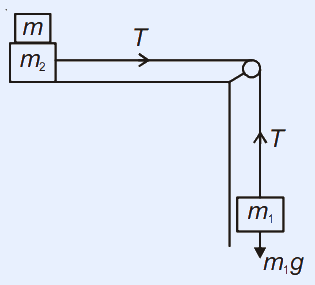
JEE Main 2018 April 08 Question Paper with Solutions
All 90 questions from the JEE Main 2018 (April 08) shift — Physics (30), Chemistry (30) and Mathematics (30) — each with the correct answer (answer key) and a step-by-step solution. Read it free online, or attempt the full paper as a timed mock test.
Physics30 questions
Q1Single correctUnits and Measurements
The density of a material in the shape of a cube is determined by measuring three sides of the cube and its mass. If the relative errors in measuring the mass and length are respectively 1.5% and 1%, the maximum error in determining the density is
(1)
(2)
(3)
(4)
SolutionAnswer: Option 34.5%
Approach:
Propagate fractional errors for .
Step 1:Density is mass over volume of a cube.
Step 2:Take logarithmic differentials to combine fractional errors.
Step 3:Substitute the given relative errors.
Final answer: 4.5%
Q2Single correctKinematics
All the graphs below are intended to represent the same motion. One of them does it incorrectly. Pick it up.
(1)
(2)
(3)
(4)
SolutionAnswer: Option 2
Approach:
Identify which graph is inconsistent with uniformly accelerated motion having an initial velocity.
Step 1:Graphs (1), (3) and (4) describe straight-line motion with positive initial velocity and constant negative acceleration.
Step 2:Graph (2) shows distance that does not correspond to that motion.
Q3Single correctLaws of Motion
Two masses kg and kg, connected by an inextensible string over a frictionless pulley, are moving as shown in the figure. The coefficient of friction of horizontal surface is 0.15. The minimum weight m that should be put on top of to stop the motion is
(1)
(2)
(3)
(4)
SolutionAnswer: Option 227.3 kg
Approach:
For the block to remain at rest, limiting friction on it must balance the hanging weight .
Step 1:To stop motion the friction force must at least equal the driving tension from .
Step 2:Substitute the values with kg.
Step 3:Solve for the minimum added mass.
kg
Final answer: 27.3 kg
Q4Single correctWork, Energy and Power
A particle is moving in a circular path of radius a under the action of an attractive potential . Its total energy is
(1)
(2)
(3)
(4)
SolutionAnswer: Option 3Zero
Approach:
Equate the central force from the potential to the centripetal requirement, then add kinetic and potential energies.
Step 1:Obtain the force from the potential.
Step 2:Set this equal to the centripetal force at radius .
Step 3:Compute kinetic energy.
Step 4:Add potential energy at .
Final answer: Zero
Q5Single correctWork, Energy and Power
In a collinear collision, a particle with an initial speed strikes a stationary particle of the same mass. If the final total kinetic energy is 50% greater than the original kinetic energy, the magnitude of the relative velocity between the two particles, after collision, is
(1)
(2)
(3)
(4)
SolutionAnswer: Option 2
Approach:
Apply momentum conservation and the energy condition, then evaluate the relative speed.
Step 1:Conserve momentum.
Step 2:Impose the 50% increased kinetic energy.
Step 3:Use to find the product.
Step 4:Form the relative velocity squared.
Final answer:
Q6Single correctRotational Motion
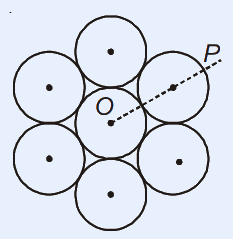
Seven identical circular planar disks, each of mass and radius are welded symmetrically as shown. The moment of inertia of the arrangement about the axis normal to the plane and passing through the point is
(1)
(2)
(3)
(4)
SolutionAnswer: Option 4
Approach:
Find the moment of inertia about the centre using the parallel-axis theorem for the six outer disks, then shift the axis to point .
Step 1:Moment of inertia about the central axis: central disk plus six disks each shifted by .
Step 2:Shift the axis from the centre to point at distance using total mass .
Final answer:
Q7Single correctRotational Motion
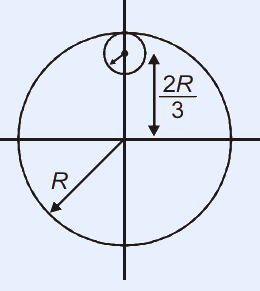
From a uniform circular disc of radius R and mass , a small disc of radius is removed as shown in the figure. The moment of inertia of the remaining disc about an axis perpendicular to the plane of the disc and passing through centre of disc is
(1)
(2)
(3)
(4)
SolutionAnswer: Option 1
Approach:
Subtract the moment of inertia of the removed disc (with parallel-axis shift) from that of the full disc about the central axis.
Step 1:Full disc moment of inertia about its centre.
Step 2:Mass of removed small disc scales with area.
Step 3:Inertia of removed disc about the centre, with its centre at distance .
Step 4:Subtract to get the remaining inertia.
Final answer:
Q8Single correctGravitation
A particle is moving with a uniform speed in a circular orbit of radius R in a central force inversely proportional to the power of R. If the period of rotation of the particle is T, then
(1)
(2)
(3)
(4)
SolutionAnswer: Option 3
Approach:
Set the central force equal to the centripetal force and relate the period to the radius.
Step 1:Balance forces for the circular orbit.
Step 2:Express the period using the speed.
Final answer:
Q9Single correctMechanical Properties of Solids
A solid sphere of radius r made of a soft material of bulk modulus K is surrounded by a liquid in a cylindrical container. A massless piston of area a floats on the surface of the liquid, covering entire cross-section of cylindrical container. When a mass m is placed on the surface of the piston to compress the liquid, the fractional decrement in the radius of the sphere, , is
(1)
(2)
(3)
(4)
SolutionAnswer: Option 3
Approach:
Relate the applied pressure to volumetric strain via bulk modulus, then convert to fractional radius change.
Step 1:Pressure increase from the placed mass.
Step 2:Volumetric strain from bulk modulus.
Step 3:Convert to fractional radius change.
Final answer:
Q10Single correctThermodynamics
Two moles of an ideal monoatomic gas occupies a volume V at C. The gas expands adiabatically to a volume . Calculate (a) the final temperature of the gas and (b) change in its internal energy.
(1)
(2)
(3)
(4)
SolutionAnswer: Option 3(a) 189 K (b) –2.7 kJ
Approach:
Use the adiabatic temperature-volume relation for a monoatomic gas, then compute internal energy change.
Step 1:For a monoatomic gas ; apply the adiabatic relation from K.
Step 2:Compute internal energy change with .
Final answer: (a) 189 K (b) –2.7 kJ
Q11Single correctKinetic Theory of Gases
The mass of a hydrogen molecule is kg. If hydrogen molecules strike, per second, a fixed wall of area 2 c at an angle of to the normal, and rebound elastically with a speed of m/s, then the pressure on the wall is nearly
(1)
(2)
(3)
(4)
SolutionAnswer: Option 1 N/
Approach:
Compute the rate of momentum transfer normal to the wall and divide by area.
Step 1:Each elastic collision transfers normal momentum; per second.
Step 2:Substitute the values over area .
Final answer: N/
Q12Single correctOscillations
A silver atom in a solid oscillates in simple harmonic motion in some direction with a frequency of /second. What is the force constant of the bonds connecting one atom with the other? (Mole wt. of silver and Avagadro number gm mol)
(1)
(2)
(3)
(4)
SolutionAnswer: Option 27.1 N/m
Approach:
Use the SHM frequency-mass-stiffness relation with the mass of one silver atom.
Step 1:Mass of one silver atom.
kg
Step 2:Invert the frequency relation for the force constant.
Step 3:Evaluate numerically.
Final answer: 7.1 N/m
Q13Single correctOscillations and Waves
A granite rod of 60 cm length is clamped at its middle point and is set into longitudinal vibrations. The density of granite is kg/ and its Young's modulus is Pa. What will be the fundamental frequency of the longitudinal vibrations?
(1)
(2)
(3)
(4)
SolutionAnswer: Option 15 kHz
Approach:
A rod clamped at the middle vibrates with the fundamental wavelength equal to twice its length; use the speed of longitudinal waves.
Step 1:Speed of longitudinal waves in the rod.
Step 2:Fundamental frequency with m.
Final answer: 5 kHz
Q14Single correctElectrostatics
Three concentric metal shells A, B and C of respective radii a, b and c have surface charge densities , and respectively. The potential of shell B is
(1)
(2)
(3)
(4)
SolutionAnswer: Option 2
Approach:
Sum the potential at radius contributed by each charged shell.
Step 1:At radius , shell (inside) contributes via , shell via its own radius , shell (outside) via .
Step 2:Simplify each term.
Final answer:
Q15Single correctElectrostatics
A parallel plate capacitor of capacitance 90 pF is connected to a battery of emf 20 V. If a dielectric material of dielectric constant is inserted between the plates, the magnitude of the induced charge will be
(1)
(2)
(3)
(4)
SolutionAnswer: Option 11.2 nC
Approach:
Find the charge on the dielectric-filled capacitor and the bound (induced) charge from the dielectric constant.
Step 1:Charge with the dielectric inserted while connected to the battery.
Step 2:Bound charge induced on the dielectric surfaces.
Final answer: 1.2 nC
Q16Single correctElectromagnetic Induction and Alternating Currents
In an a.c. circuit, the instantaneous e.m.f. and current are given by
In one cycle of a.c., the average power consumed by the circuit and the wattless current are, respectively
In one cycle of a.c., the average power consumed by the circuit and the wattless current are, respectively
(1)
(2)
(3)
(4)
SolutionAnswer: Option 2,
Approach:
Compute the average AC power from peak emf, peak current and the phase difference, then compute the wattless (reactive) component of current.
Step 1:Identify peak values and phase difference.
Step 2:Compute average power.
Step 3:Compute wattless current.
Final answer: ,
Q17Single correctCurrent Electricity
Two batteries with e.m.f. 12 V and 13 V are connected in parallel across a load resistor of . The internal resistances of the two batteries are and respectively. The voltage across the load lies between
(1)
(2)
(3)
(4)
SolutionAnswer: Option 211.5 V and 11.6 V
Approach:
Find the equivalent EMF and internal resistance of the parallel combination of cells, then compute the voltage across the load resistor.
Step 1:Compute equivalent internal resistance.
Step 2:Compute equivalent EMF.
Step 3:Compute load voltage.
Final answer: 11.5 V and 11.6 V
Q18Single correctMoving Charges and Magnetism
An electron, a proton and an alpha particle having the same kinetic energy are moving in circular orbits of radii , , respectively in a uniform magnetic field B. The relation between , , is
(1)
(2)
(3)
(4)
SolutionAnswer: Option 2
Approach:
Express the radius of the circular path in terms of kinetic energy, mass and charge, then compare for the three particles at equal kinetic energy.
Step 1:Write radius from r = p/(qB) with momentum p = sqrt(2mK).
Step 2:Use masses and charges: electron (m, e), proton ( = 1836 m approx, e), alpha (m = , q = 2e).
Step 3:Compare electron radius with proton: electron has much smaller mass with same charge magnitude.
Final answer:
Q19Single correctMoving Charges and Magnetism
The dipole moment of a circular loop carrying a current I, is m and the magnetic field at the centre of the loop is . When the dipole moment is doubled by keeping the current constant, the magnetic field at the centre of the loop is . The ratio is
(1)
(2)
(3)
(4)
SolutionAnswer: Option 3
Approach:
Relate dipole moment and radius for fixed current, find the new radius when the moment doubles, then compare the central magnetic field for the two radii.
Step 1:Doubling moment at constant current doubles the area, so the new radius is sqrt(2) times the old.
Step 2:Write the two central fields.
Step 3:Take the ratio.
Final answer:
Q20Single correctElectromagnetic Induction and Alternating Currents
For an RLC circuit driven with voltage of amplitude and frequency the current exhibits resonance. The quality factor, Q is given by
(1)
(2)
(3)
(4)
SolutionAnswer: Option 1
Approach:
Use the standard definition of the quality factor of a series RLC circuit at resonance.
Step 1:At resonance the quality factor is the ratio of resonant frequency times inductive reactance per unit, equivalently bandwidth based definition.
Step 2:Confirm dimensional and standard form for series RLC.
Final answer:
Q21Single correctElectromagnetic Waves
An EM wave from air enters a medium. The electric fields are in air and in medium, where the wave number k and frequency v refer to their values in air. The medium is non-magnetic. If and refer to relative permittivities of air and medium respectively, which of the following options is correct?
(1)
(2)
(3)
(4)
SolutionAnswer: Option 3
Approach:
Compare the wave numbers in the two media from the given expressions, relate wave speed to refractive index, and use n = sqrt() for a non-magnetic medium.
Step 1:Rewrite the medium field phase to read off its wave number. Air phase is 2*pi*v*(z/c - t) with wave number k. Medium phase k(2z - ct) = 2k*z - kc*t.
Step 2:Same frequency in both, so phase velocity scales inversely with k, giving the refractive index of the medium relative to air.
(relative to air)
Step 3:Use n = sqrt() with air n = 1.
Final answer:
Q22Single correctWave Optics
Unpolarized light of intensity I passes through an ideal polarizer A. Another identical polarizer B is placed behind A. The intensity of light beyond B is found to be . Now another identical polarizer C is placed between A and B. The intensity beyond B is now found to be . The angle between polarizer A and C is
(1)
(2)
(3)
(4)
SolutionAnswer: Option 3
Approach:
From the first measurement, A and B are parallel (transmit I/2). Insert C at angle theta to A and apply Malus's law twice, then solve for theta.
Step 1:Light through A is I/2. With B parallel to A and C between them at angle theta to A, B is at angle theta to C.
Step 2:Solve for (theta).
Step 3:Solve for theta.
Final answer:
Q23Single correctWave Optics
The angular width of the central maximum in a single slit diffraction pattern is . The width of the slit is m. The slit is illuminated by monochromatic light of wavelength 500 nm. If another slit of same width is made near it, Young's fringes can be observed on a screen placed at a distance 50 cm from the slits. If the observed fringe width is 1 cm, what is slit separation distance?
(i.e. distance between the centres of each slit.)
(i.e. distance between the centres of each slit.)
(1)
(2)
(3)
(4)
SolutionAnswer: Option 1m
Approach:
Use the single-slit central-maximum half angle to confirm the wavelength, then apply the Young's double-slit fringe-width formula to find the slit separation.
Step 1:Half angular width is 30 degrees for slit width d = 1 micrometre. The first minimum condition gives wavelength.
Step 2:Apply double-slit fringe-width formula with beta = 1 cm, D = 50 cm, lambda = 500 nm, solve for separation d'.
Step 3:Express in micrometres.
Final answer: m
Q24Single correctDual Nature of Radiation and Matter / Atoms
An electron from various excited states of hydrogen atom emit radiation to come to the ground state. Let , be the de Broglie wavelength of the electron in the state and the ground state respectively. Let be the wavelength of the emitted photon in the transition from the state to the ground state. For large n, (A, B are constants)
(1)
(2)
(3)
(4)
SolutionAnswer: Option 1
Approach:
Relate the de Broglie wavelength of the electron to its energy in each state, express the emitted photon wavelength via energy difference, then expand for large n.
Step 1:Express electron energy in state n via its de Broglie wavelength.
Step 2:Set photon energy equal to the energy difference.
Step 3:Invert and expand for large n ( large), keeping leading terms.
Final answer:
Q25Single correctAtoms
If the series limit frequency of the Lyman series is , then the series limit frequency of the Pfund series is
(1)
(2)
(3)
(4)
SolutionAnswer: Option 4
Approach:
Use the series-limit () photon energy for each series, which is proportional to , and take the ratio of Pfund to Lyman.
Step 1:Lyman series limit has lower level n = 1.
Step 2:Pfund series limit has lower level n = 5.
Step 3:Take the ratio.
Final answer:
Q26Single correctAtoms and Nuclei
It is found that if a neutron suffers an elastic collinear collision with deuterium at rest, fractional loss of its energy is ; while for its similar collision with carbon nucleus at rest, fractional loss of energy is . The values of and are respectively
(1)
(2)
(3)
(4)
SolutionAnswer: Option 1
Approach:
For a head-on elastic collision of a neutron (mass m) with a stationary nucleus of mass M, compute the fractional kinetic energy transferred, equal to 4mM/, for deuterium (M = 2m) and carbon (M = 12m).
Step 1:For deuterium, M = 2m.
Step 2:For carbon, M = 12m.
Step 3:Compare with options. Computed (0.89, 0.28) corresponds to option (1).
Final answer:
Q27Single correctSemiconductor Electronics
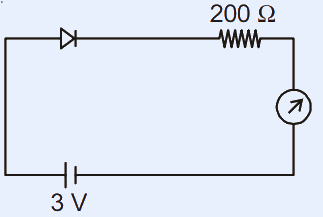
The reading of the ammeter for a silicon diode in the given circuit is
(1)
(2)
(3)
(4)
SolutionAnswer: Option 311.5 mA
Approach:
Treat the forward-biased silicon diode as a 0.7 V drop in series with the resistor, then apply Ohm's law to find the ammeter current.
Step 1:Silicon diode forward drop is 0.7 V; source is 3 V across a 200 ohm resistor.
Step 2:Compute the current.
Final answer: 11.5 mA
Q28Single correctCommunication Systems
A telephonic communication service is working at carrier frequency of 10 GHz. Only 10% of it is utilized for transmission. How many telephonic channels can be transmitted simultaneously if each channel requires a bandwidth of 5 kHz?
(1)
(2)
(3)
(4)
SolutionAnswer: Option 3
Approach:
Find the available bandwidth as 10% of the carrier frequency, then divide by the per-channel bandwidth.
Step 1:Available bandwidth is 10% of 10 GHz.
Step 2:Divide by 5 kHz per channel.
Step 3:The number of channels equals 2 x .
Final answer:
Q29Single correctCurrent Electricity
In a potentiometer experiment, it is found that no current passes through the galvanometer when the terminals of the cell are connected across 52 cm of the potentiometer wire. If the cell is shunted by a resistance of , a balance is found when the cell is connected across 40 cm of the wire. Find the internal resistance of the cell.
(1)
(2)
(3)
(4)
SolutionAnswer: Option 2
Approach:
Use the potentiometer internal-resistance relation r = R(l1 - l2)/l2, with l1 the open-circuit balance length and l2 the balance length when shunted by R.
Step 1:EMF balances at l1 = 52 cm; terminal voltage with shunt R = 5 ohm balances at l2 = 40 cm.
Step 2:Substitute into the internal-resistance relation.
Step 3:Compute.
Final answer:
Q30Single correctCurrent Electricity
On interchanging the resistances, the balance point of a meter bridge shifts to the left by 10 cm. The resistance of their series combination is . How much was the resistance on the left slot before interchanging the resistances?
(1)
(2)
(3)
(4)
SolutionAnswer: Option 3
Approach:
Use the metre-bridge balance condition before and after interchanging, with the balance length shifting left by 10 cm, and R1 + R2 = 1000 ohm.
Step 1:Write both balance conditions and cross-multiply.
Step 2:Expand and solve for the balance length.
Step 3:Use R1/R2 = 55/45 with R1 + R2 = 1000.
Final answer:
Chemistry30 questions
Q31Single correctSome Basic Concepts in Chemistry
The ratio of mass percent of C and H of an organic compound is 6 : 1. If one molecule of the above compound contains half as much oxygen as required to burn one molecule of compound completely into and . The empirical formula of compound is
(1)
(2)
(3)
(4)
SolutionAnswer: Option 4
Approach:
Determine the C:H mole ratio from the given mass-percent ratio, then use the oxygen-balance condition to find the oxygen subscript and write the empirical formula.
Step 1:Mass ratio C : H = 6 : 1 gives mole ratio.
Step 2:Oxygen atoms needed to burn completely.
Step 3:The compound contains half as much oxygen, i.e. Z oxygen atoms equal half the O atoms required to burn .
Step 4:Substitute X = 1, Y = 2 to obtain Z.
Final answer:
Q32Single correctSolid State
Which type of 'defect' has the presence of cations in the interstitial sites?
(1)
(2)
(3)
(4)
SolutionAnswer: Option 3Frenkel defect
Approach:
Identify the point defect in which a smaller ion (usually the cation) leaves its lattice site and occupies an interstitial position.
Step 1:In a Frenkel defect a cation is displaced from its normal lattice site to an interstitial site, leaving a vacancy behind.
Step 2:Schottky defect involves equal numbers of cation and anion vacancies (no interstitials); vacancy and metal-deficiency defects do not place cations in interstitial sites.
Final answer: Frenkel defect
Q33Single correctChemical Bonding and Molecular Structure
According to molecular orbital theory, which of the following will not be a viable molecule?
(1)
(2)
(3)
(4)
SolutionAnswer: Option 4
Approach:
Compute the bond order of each species from its molecular-orbital electron configuration; a species with zero bond order is not viable.
Step 1: has configuration .
Step 2: has configuration .
Step 3: has configuration .
Step 4: has configuration .
Final answer:
Q34Single correctChemical and Ionic Equilibrium
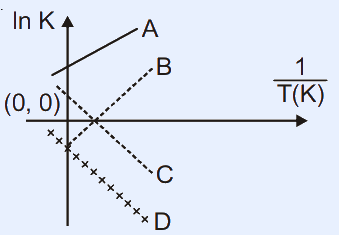
Which of the following lines correctly show the temperature dependence of equilibrium constant K, for an exothermic reaction?
(1)
(2)
(3)
(4)
SolutionAnswer: Option 1A and B
Approach:
Use the van't Hoff form of the equilibrium constant to find the slope of a ln K versus 1/T plot for an exothermic reaction.
Step 1:Express K as the ratio of forward and backward Arrhenius factors.
Step 2:Take the logarithm to obtain a straight line in ln K versus 1/T with slope .
Step 3:For an exothermic reaction , so the slope is positive.
Step 4:Lines A and B have positive slopes in the ln K versus 1/T plot.
Final answer: A and B
Q35Single correctThermodynamics
The combustion of benzene (l) gives (g) and (l). Given that heat of combustion of benzene at constant volume is kJ mo at C; heat of combustion (in kJ mo) of benzene at constant pressure will be
J mol
J mol
(1)
(2)
(3)
(4)
SolutionAnswer: Option 4
Approach:
Relate enthalpy of combustion to internal energy of combustion using the change in moles of gas, then evaluate.
Step 1:Write the balanced combustion of benzene.
Step 2:Compute change in moles of gaseous species.
Step 3:Substitute into with kJ, T = 298 K.
Step 4:Evaluate the correction term and add.
Final answer:
Q36Single correctSolutions
For 1 molal aqueous solution of the following compounds, which one will show the highest freezing point?
(1)
(2)
(3)
(4)
SolutionAnswer: Option 4
Approach:
Freezing point is highest when depression is least, i.e. for the solute giving the fewest dissociated particles (smallest van't Hoff factor i).
Step 1:Determine i from the number of ions produced on dissociation.
Step 2: gives 4 ions (i = 4); the pentaaqua gives 3 (i = 3); the tetraaqua gives 2 (i = 2).
Step 3: is a non-electrolyte that does not dissociate, so i = 1.
Step 4:Least i gives least depression, hence highest freezing point.
Final answer:
Q37Single correctIonic Equilibrium
An aqueous solution contains 0.10 M and 0.20 M HCl. If the equilibrium constants for the formation of HS from is and that of from HS ions is then the concentration of ions in aqueous solution is
(1)
(2)
(3)
(4)
SolutionAnswer: Option 2
Approach:
Combine the two stepwise dissociation equilibria and solve for the sulfide-ion concentration using the H+ supplied by the strong acid HCl.
Step 1:In the presence of strong acid, M from HCl.
Step 2:Multiply the two dissociation constants.
Step 3:Substitute into the combined equilibrium expression with M.
Step 4:Solve for the sulfide-ion concentration.
Final answer:
Q38Single correctIonic Equilibrium
An aqueous solution contains an unknown concentration of . When 50 mL of a 1 M solution of is added, just begins to precipitate. The final volume is 500 mL. The solubility product of is . What is original concentration of ?
(1)
(2)
(3)
(4)
SolutionAnswer: Option 3 M
Approach:
Find the sulfate concentration at the final volume, use Ksp to get the barium concentration at precipitation onset, then back-calculate the original concentration by dilution.
Step 1:Sulfate concentration after dilution to 500 mL.
M
Step 2:Barium concentration at onset of precipitation from Ksp.
M
Step 3:This M is the diluted barium concentration; the original was in 450 mL before adding 50 mL.
Step 4:Solve for the original barium concentration.
M
Final answer: M
Q39Single correctChemical Kinetics
At C, the rate of decomposition of a sample of gaseous acetaldehyde, initially at a pressure of 363 torr, was 1.00 torr when 5% had reacted and 0.5 torr when 33% had reacted. The order of the reaction is
(1)
(2)
(3)
(4)
SolutionAnswer: Option 1
Approach:
Express the rate as proportional to the remaining pressure raised to the order x, form the ratio of the two conditions, and solve for x.
Step 1:When 5% reacted, remaining pressure = 363 x 0.95 = 344.85 torr.
Step 2:When 33% reacted, remaining pressure = 363 x 0.67 = 243.21 torr.
Step 3:Divide condition 1 by condition 2.
Step 4:Since , solve for x.
Final answer:
Q40Single correctElectrochemistry
How long (approximate) should water be electrolysed by passing through 100 amperes current so that the oxygen released can completely burn 27.66 g of diborane? (Atomic weight of B = 10.8 u)
(1)
(2)
(3)
(4)
SolutionAnswer: Option 33.2 hours
Approach:
Find moles of diborane, the oxygen required to burn it, the charge needed to liberate that oxygen by electrolysis, and finally the time.
Step 1:Molar mass of = 2(10.8) + 6 = 27.6 g; so 27.66 g is 1 mole.
mol
Step 2:Burning 1 mole of requires 3 moles of .
Step 3:Producing 3 mol by electrolysis needs 12 Faradays of charge.
Step 4:Solve for time and convert to hours.
hours
Final answer: 3.2 hours
Q41Single correctp-Block Elements
The recommended concentration of fluoride ion in drinking water is up to 1 ppm as fluoride ion is required to make teeth enamel harder by converting to
(1)
(2)
(3)
(4)
SolutionAnswer: Option 3
Approach:
Identify the chemical change brought about by fluoride ions on tooth enamel.
Step 1:Tooth enamel is hydroxyapatite .
Step 2:Fluoride ions replace the hydroxide to form the harder fluorapatite.
Step 3:The product is .
Final answer:
Q42Single correctChemical Bonding and Molecular Structure
Which of the following compounds contain(s) no covalent bond(s)?
, , , ,
, , , ,
(1)
(2)
(3)
(4)
SolutionAnswer: Option 3
Approach:
Classify each species by bond type; only the purely ionic compound has no covalent bond.
Step 1: is an ionic bond between and .
Step 2: has covalent P-H bonds and has a covalent O=O bond.
Step 3: has covalent B-H bonds and has covalent S-O and O-H bonds.
Step 4:Only has no covalent bond.
Final answer:
Q43Single correctChemical Bonding and Molecular Structure
Which of the following are Lewis acids?
(1)
(2)
(3)
(4)
SolutionAnswer: Option 4 and
Approach:
Identify electron-deficient species (incomplete octet) able to accept an electron pair as Lewis acids.
Step 1: is electron deficient with an incomplete octet on boron, hence a Lewis acid.
Step 2: is electron deficient with an incomplete octet on aluminium, hence a Lewis acid.
Step 3: can accept a lone pair into vacant d-orbitals and so can also behave as a Lewis acid, but the paper keys and .
Final answer: and
Q44Single correctChemical Bonding and Molecular Structure
Total number of lone pair of electrons in ion is
(1)
(2)
(3)
(4)
SolutionAnswer: Option 3
Approach:
Draw the structure of the triiodide ion and count all lone pairs on the three iodine atoms.
Step 1:In the central iodine bears three lone pairs (it is bonded to two terminal iodine atoms and carries the negative charge).
Step 2:Each of the two terminal iodine atoms carries three lone pairs.
Step 3:Sum the lone pairs over all three iodine atoms.
Final answer:
Q45Single correctIonic Equilibrium
Which of the following salts is the most basic in aqueous solution?
(1)
(2)
(3)
(4)
SolutionAnswer: Option 2
Approach:
Classify each salt by the strength of its parent acid and base; the salt of a weak acid and a strong base is the most basic on hydrolysis.
Step 1: is a salt of a strong acid and weak base, giving an acidic solution.
Step 2: and are salts of weak acid and weak base.
Step 3: is a salt of weak acid (acetic) and strong base (KOH); its hydrolysis releases .
Step 4:Hence the solution of is the most basic.
Final answer:
Q46Single correctCoordination Compounds
Hydrogen peroxide oxidises to in acidic medium but reduces to in alkaline medium. The other products formed are, respectively,
(1)
(2)
(3)
(4)
SolutionAnswer: Option 3 and
Approach:
Balance the two half-reactions of hydrogen peroxide acting first as an oxidant (acidic) and then as a reductant (alkaline) to identify the byproduct in each case.
Step 1:In acidic medium, ferrocyanide is oxidised to ferricyanide; H2O2 takes the electron and yields water.
Step 2:In alkaline medium, ferricyanide is reduced to ferrocyanide; H2O2 supplies the electron and is itself oxidised to O2 (with water from OH-).
Step 3:Match the byproduct pair to the options.
Final answer: and
Q47Single correctCoordination Compounds
The oxidation states of Cr in , , and respectively are
(1)
(2)
(3)
(4)
SolutionAnswer: Option 3 and
Approach:
Assign ligand charges and apply overall charge neutrality to solve for the oxidation state of chromium in each complex.
Step 1:In the hexaaqua chloride, water is neutral and three chlorides are -1 each.
Step 2:In bis(benzene)chromium both arene ligands are neutral.
Step 3:In the potassium salt, CN is -1 (x2), oxide O is -2 (x2), peroxide O2 is -2, NH3 is 0, and two K are +1 each.
Final answer: and
Q48Single correctThe s-Block and p-Block Elements / Nitrogen compounds
The compound that does not produce nitrogen gas by the thermal decomposition is
(1)
(2)
(3)
(4)
SolutionAnswer: Option 4
Approach:
Write the thermal decomposition of each salt and check whether dinitrogen is among the products.
Step 1:Ammonium dichromate decomposes to N2.
Step 2:Ammonium nitrite decomposes to N2.
Step 3:Barium azide decomposes to N2.
Step 4:Ammonium sulphate on heating releases ammonia, not dinitrogen.
Final answer:
Q49Single correctThe p-Block Elements / Metallurgy
When metal 'M' is treated with NaOH, a white gelatinous precipitate 'X' is obtained, which is soluble in excess of NaOH. Compound 'X' when heated strongly gives an oxide which is used in chromatography as an adsorbent. The metal 'M' is
(1)
(2)
(3)
(4)
SolutionAnswer: Option 3Al
Approach:
Identify the metal whose hydroxide is white, amphoteric, and whose oxide is the common chromatographic adsorbent.
Step 1:Aluminium with NaOH gives white gelatinous Al(OH)3 that dissolves in excess base as sodium meta-aluminate.
Step 2:Strong heating of Al(OH)3 yields alumina.
Step 3:Al2O3 is the standard adsorbent in column chromatography.
Final answer: Al
Q50Single correctCoordination Compounds
Consider the following reaction and statements
(I) Two isomers are produced if the reactant complex ion is a cis-isomer
(II) Two isomers are produced if the reactant complex ion is a trans-isomer
(III) Only one isomer is produced if the reactant complex ion is a trans-isomer
(IV) Only one isomer is produced if the reactant complex ion is a cis-isomer
The correct statements are
(I) Two isomers are produced if the reactant complex ion is a cis-isomer
(II) Two isomers are produced if the reactant complex ion is a trans-isomer
(III) Only one isomer is produced if the reactant complex ion is a trans-isomer
(IV) Only one isomer is produced if the reactant complex ion is a cis-isomer
The correct statements are
(1)
(2)
(3)
(4)
SolutionAnswer: Option 2(I) and (III)
Approach:
Analyse the substitution of one NH3 by Br- in the octahedral complex separately for the cis and trans starting isomers and count the geometrical products (fac/mer).
Step 1:Starting from the cis-dibromo isomer, replacement of an ammonia by bromide can give both the facial and meridional trisubstituted products.
Step 2:Starting from the trans-dibromo isomer, the two bromides are already axial, so substitution gives only the meridional product.
Step 3:Therefore statements (I) and (III) are correct.
Final answer: (I) and (III)
Q51Single correctBiomolecules
Glucose on prolonged heating with HI gives
(1)
(2)
(3)
(4)
SolutionAnswer: Option 1-Hexane
Approach:
Use the strong reducing action of HI on glucose, which exhaustively removes all oxygen functionalities and reduces the carbon chain.
Step 1:Prolonged heating with HI reduces every C-OH and the aldehyde group of the straight-chain glucose, replacing oxygen and removing it as water.
Step 2:The six-carbon straight chain confirms n-hexane.
Final answer: -Hexane
Q52Single correctHydrocarbons
The trans-alkenes are formed by the reduction of alkynes with
(1)
(2)
(3)
(4)
SolutionAnswer: Option 3Na/liq.
Approach:
Recall the stereochemical outcome of dissolving-metal reduction of alkynes versus catalytic hydrogenation.
Step 1:Sodium in liquid ammonia reduces an internal alkyne through a trans-vinyl radical/anion intermediate, placing the substituents on opposite sides.
Step 2:Catalytic H2 with poisoned Pd would instead give the cis-alkene, so option 1 is excluded.
Final answer: Na/liq.
Q53Single correctPurification and Characterisation of Organic Compounds
Which of the following compounds will be suitable for Kjeldahl's method for nitrogen estimation?
(1)
(2)
(3)
(4)
SolutionAnswer: Option 2
Approach:
Identify the compound whose nitrogen is convertible to ammonium sulphate during acid digestion; ring nitrogen, nitro, and azo/diazonium nitrogen fail Kjeldahl.
Step 1:Pyridine has nitrogen in the aromatic ring, which does not convert to ammonium sulphate, so option 1 is unsuitable.
Step 2:Aniline carries nitrogen as a primary amine on the ring, which is quantitatively converted to ammonium sulphate on digestion.
Step 3:Nitrobenzene (nitro nitrogen) and benzenediazonium chloride (diazonium nitrogen) are not converted, excluding options 3 and 4.
Final answer: Aniline (option 2)
Q54Single correctOrganic Compounds Containing Oxygen
Phenol on treatment with in the presence of NaOH followed by acidification produces compound X as the major product. X on treatment with in the presence of catalytic amount of produces
(1)
(2)
(3)
(4)
SolutionAnswer: Option 1
Approach:
Apply the Kolbe-Schmitt carboxylation to phenol, then acetylate the phenolic OH of the resulting salicylic acid to obtain aspirin.
Step 1:Phenol with CO2/NaOH followed by acidification gives salicylic acid (ortho-hydroxybenzoic acid) as the major product X.
Step 2:Salicylic acid with acetic anhydride and catalytic H2SO4 acetylates the phenolic OH to give acetylsalicylic acid (aspirin), which carries an ortho COOH and an O-COCH3 group.
Final answer: Acetylsalicylic acid / Aspirin (option 1)
Q55Single correctEquilibrium / Ionic Equilibrium
An alkali is titrated against an acid with methyl orange as indicator, which of the following is a correct combination?
Base Acid End point
(1) Weak Strong Colourless to pink
(2) Strong Strong Pinkish red to yellow
(3) Weak Strong Yellow to pinkish red
(4) Strong Strong Pink to colourless
Base Acid End point
(1) Weak Strong Colourless to pink
(2) Strong Strong Pinkish red to yellow
(3) Weak Strong Yellow to pinkish red
(4) Strong Strong Pink to colourless
(1)
(2)
(3)
(4)
SolutionAnswer: Option 3Weak Strong Yellow to pinkish red
Approach:
Use the colour range of methyl orange and the requirement that it suits a weak base versus strong acid titration, then determine the end-point colour change.
Step 1:Methyl orange changes from pinkish red (below pH 3.1) to yellow (above pH 4.5); it is suited to titrating a weak base with a strong acid.
Step 2:When alkali (weak base) is titrated with strong acid, the basic solution is initially yellow and turns pinkish red at the acidic end point.
Final answer: Weak Strong Yellow to pinkish red
Q56Single correctBiomolecules / Acid-base behaviour
The predominant form of histamine present in human blood is (p, Histidine = 6.0)
(1)
(2)
(3)
(4)
SolutionAnswer: Option 4
Approach:
Compare the pKa values of histamine's basic sites with blood pH (about 7.4) to decide which nitrogen is protonated.
Step 1:The aliphatic primary amine of histamine is the most basic site, with the highest pKa, so at blood pH (7.4) it is protonated.
Step 2:The imidazole ring (pKa near 6.0) remains largely neutral at pH 7.4, giving a structure with a neutral ring and a protonated primary amine.
Final answer: Histamine protonated at primary amine (option 4)
Q57Single correctOrganic Compounds Containing Oxygen / Phenols
Phenol reacts with methyl chloroformate in the presence of NaOH to form product A. A reacts with to form product B. A and B are respectively
(1)
(2)
(3)
(4)
SolutionAnswer: Option 3
Approach:
Acylate the phenolic oxygen with methyl chloroformate to give the aryl carbonate (A), then brominate the activated ring para to the oxygen substituent (B).
Step 1:Phenoxide attacks methyl chloroformate, displacing chloride to give the O-carbomethoxy phenyl carbonate, product A (PhO-CO-OCH3).
Step 2:The O-CO-OCH3 group is ring-activating and ortho/para-directing; Br2 substitutes at the para position to give the para-bromo carbonate, product B.
Final answer: A = phenyl methyl carbonate, B = para-bromo derivative (option 3)
Q58Single correctOrganic Compounds Containing Nitrogen / Amines
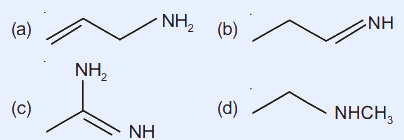
The increasing order of basicity of the following compound is
(1)
(2)
(3)
(4)
SolutionAnswer: Option 3(b) < (a) < (d) < (c)
Approach:
Rank basicity by the hybridisation and resonance environment of each nitrogen lone pair across the four structures (a) allyl primary amine, (b) an sp2 imine, (c) an amidine-type with resonance-stabilised cation, and (d) a secondary allyl amine.
Step 1:The imine (b) has its lone pair on sp2 nitrogen, making it the least basic.
Step 2:The primary allyl amine (a) is sp3 and 1 degree, more basic than the imine.
Step 3:The secondary allyl amine (d) is sp3 and 2 degree, more basic than the primary amine.
Step 4:The amidine-type compound (c) forms a conjugate acid stabilised by equivalent resonance, making it the most basic.
Final answer: (b) < (a) < (d) < (c)
Q59Single correctHaloalkanes and Haloarenes / Ethers
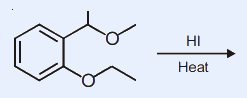
The major product formed in the following reaction is
(1)
(2)
(3)
(4)
SolutionAnswer: Option 4
Approach:
Apply HI cleavage rules to the two ether linkages: the aryl alkyl ether and the secondary alkyl ether, recognising that aryl-O bonds are not cleaved while the alkyl group leaves as alkyl iodide.
Step 1:HI cleaves the aryl-O-ethyl ether so the phenolic oxygen retains and the ethyl group departs as ethyl iodide, regenerating an aromatic OH.
Step 2:The benzylic/secondary alkyl ether is cleaved so the alkyl carbon takes iodide, giving a secondary alkyl iodide on the side chain.
Step 3:The major aromatic product carries an ortho OH group and a side-chain CH-I, matching option 4.
Final answer: Aromatic OH with side-chain alkyl iodide (option 4)
Q60Single correctHaloalkanes and Haloarenes
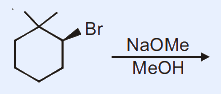
The major product of the following reaction is
(1)
(2)
(3)
(4)
SolutionAnswer: Option 2
Approach:
Evaluate the competition between SN2 and E2 for a hindered secondary cyclohexyl bromide treated with sodium methoxide, a strong base and nucleophile, in methanol.
Step 1:Methoxide is a strong base and strong nucleophile, so the favourable pathways are SN2 and E2.
Step 2:The substrate is a secondary halide whose beta carbons are quaternary and secondary, so the bulky environment hinders SN2 and E2 dominates.
Step 3:Methanol is less polar than water, so E1 is also suppressed in favour of E2, giving the alkene as the major product (option 2).
Final answer: Elimination alkene (option 2)
Mathematics30 questions
Q61Single correctSets, Relations and Functions
Two sets A and B are as under:
, then
, then
(1)
(2)
(3)
(4)
SolutionAnswer: Option 2
Approach:
Interpret A as an open square and B as a closed elliptical region in the plane, then test whether the square lies inside the ellipse.
Step 1:Rewrite A from the modulus inequalities.
Step 2:Divide B by 36 to obtain the ellipse centred at .
Step 3:Check the extreme corner of the square farthest from the ellipse centre, and .
Step 4:All square points satisfy the ellipse inequality.
Final answer:
Q62Single correctSets, Relations and Functions
Let . Then S :
(1)
(2)
(3)
(4)
SolutionAnswer: Option 3Contains exactly two element
Approach:
Substitute to convert the equation into a quadratic in modulus form, solve for , then count valid non-negative x.
Step 1:Expand the second term and group.
Step 2:Let , so .
Step 3:Solve the modulus equation.
or
Step 4:Both roots are non-negative and valid.
Final answer: Contains exactly two element
Q63Single correctComplex Numbers and Quadratic Equations
If are the distinct roots, of the equation , then is equal to
(1)
(2)
(3)
(4)
SolutionAnswer: Option 3
Approach:
Recognise the roots as primitive sixth roots of unity, expressed via the cube-root-of-unity , then reduce the exponents modulo 6.
Step 1:Identify the roots of .
Step 2:Evaluate .
Step 3:Evaluate .
Step 4:Add the two results.
Final answer:
Q64Single correctMatrices and Determinants
If , then the ordered pair (A, B) is equal to
(1)
(2)
(3)
(4)
SolutionAnswer: Option 3
Approach:
Use row operations to factor the determinant, identify the repeated root and the linear factor, then match coefficients with .
Step 1:Apply ; each first-column entry becomes .
Step 2:Substituting makes all three rows identical, so divides the determinant.
Step 3:Compare with : the squared factor forces so , and the linear factor gives .
Step 4:State the ordered pair.
Final answer:
Q65Single correctMatrices and Determinants
If the system of linear equations
has a non-zero solution (x, y, z), then is equal to
has a non-zero solution (x, y, z), then is equal to
(1)
(2)
(3)
(4)
SolutionAnswer: Option 2
Approach:
Set the coefficient determinant to zero to find k, then solve the homogeneous system in terms of a parameter and evaluate .
Step 1:Require the determinant of coefficients to vanish.
Step 2:Solve for .
Step 3:Let . From the first and second equations, and ; subtracting gives , .
Step 4:Compute the ratio.
Final answer:
Q66Single correctPermutations and Combinations
From 6 different novels and 3 different dictionaries, 4 novels and 1 dictionary are to be selected and arranged in a row on a shelf so that the dictionary is always in the middle. The number of such arrangements is
(1)
(2)
(3)
(4)
SolutionAnswer: Option 1At least 1000
Approach:
Choose the novels and dictionary, fix the dictionary at the centre, and arrange the four novels in the remaining positions.
Step 1:Select 4 novels from 6.
Step 2:Select 1 dictionary from 3.
Step 3:The dictionary occupies the fixed middle position; arrange the 4 novels in the remaining 4 places.
Step 4:Multiply the counts.
Final answer: At least 1000
Q67Single correctBinomial Theorem
The sum of the co-efficients of all odd degree terms in the expansion of , is
(1)
(2)
(3)
(4)
SolutionAnswer: Option 4
Approach:
Add the two binomial expansions so only even powers of survive, obtain a polynomial in x, then sum the coefficients of its odd-degree terms.
Step 1:Retain only even powers of .
Step 2:Expand each term.
Step 3:Collect the odd-degree terms ().
Step 4:Sum the odd-degree coefficients.
Final answer:
Q68Single correctSequences and Series
Let be in A.P. such that and . If , then m is equal to
(1)
(2)
(3)
(4)
SolutionAnswer: Option 3
Approach:
Write the two given conditions in terms of first term and common difference , solve for and , then compute the sum of squares of the first 17 terms.
Step 1:The 13 terms form an AP with middle term ; their sum is .
Step 2:Use .
Step 3:Subtract (i) from (ii).
Step 4:Sum the squares .
Final answer:
Q69Single correctSequences and Series
Let A be the sum of the first 20 terms and B be the sum of the first 40 terms of the series
If , then is equal to
If , then is equal to
(1)
(2)
(3)
(4)
SolutionAnswer: Option 2
Approach:
Recognise that even-indexed terms carry an extra factor 2; express each partial sum as a sum of squares plus the extra contribution from even squares, then form .
Step 1:Write A (first 20 terms) as all squares plus an extra set of even squares.
Step 2:Write B (first 40 terms) similarly.
Step 3:Form .
Step 4:Divide by 100.
Final answer:
Q70Single correctLimits, Continuity and Differentiability
For each , let [t] be the greatest integer less than or equal to t. Then
(1)
(2)
(3)
(4)
SolutionAnswer: Option 3Is equal to 120
Approach:
Bound each greatest-integer term between and , multiply the whole sum by x, and apply the squeeze theorem as .
Step 1:Sum the bounds over to .
Step 2:Multiply by and use .
Step 3:Take the limit .
Step 4:Conclude by the squeeze theorem.
Final answer: Is equal to 120
Q71Single correctLimits, Continuity and Differentiability
Let . Then the set S is equal to
(1)
(2)
(3)
(4)
SolutionAnswer: Option 1 (an empty set)
Approach:
Examine the candidate non-smooth points and where modulus terms occur, and check whether the accompanying factors make the product differentiable there.
Step 1:At , only has a corner, but there, providing a repeated zero that smooths the product.
Step 2:At , the factors in and in each vanish, so the product has zeros that cancel the corners.
as
Step 3:Both candidate points yield repeated zero factors making differentiable.
are repeated roots and also continuous
Step 4:Conclude the set is empty.
Final answer: (an empty set)
Q72Single correctCoordinate Geometry
If the curves , intersect each other at right angles, then the value of b is
(1)
(2)
(3)
(4)
SolutionAnswer: Option 4
Approach:
Find the slope of the tangent to each curve at a common point , impose the orthogonality condition , and use .
Step 1:Differentiate to get the tangent slope.
Step 2:Differentiate .
Step 3:Impose .
Step 4:Substitute .
Final answer:
Q73Single correctApplications of Derivatives
Let and , . If , then the local minimum value of h(x) is:
(1)
(2)
(3)
(4)
SolutionAnswer: Option 4
Approach:
Express f in terms of g via , substitute to write h as , then minimise over the relevant range using AM-GM.
Step 1:Rewrite h in terms of .
Step 2:For (i.e. ), apply AM-GM.
Step 3:For , the corresponding extremum is , a local maximum of the branch.
Step 4:The local minimum value of is on the positive branch.
Final answer:
Q74Single correctIntegral Calculus
The integral is equal to
(1)
(2)
(3)
(4)
SolutionAnswer: Option 2
Approach:
Factor the denominator and divide numerator and denominator by to convert to a function of , then substitute .
Step 1:Group the denominator: .
Step 2:Divide numerator and denominator by .
Step 3:Substitute , so .
Step 4:Integrate.
Final answer:
Q75Single correctIntegral Calculus
Then value of is :
(1)
(2)
(3)
(4)
SolutionAnswer: Option 4
Approach:
Apply the king property to combine the integrand with its reflection and eliminate the factor.
Step 1:Write I and its reflected form using .
Step 2:Add the two forms.
Step 3:Use evenness and .
Step 4:Solve for .
Final answer:
Q76Single correctIntegral Calculus
Let , , and , () be the roots of the quadratic equation . Then the area (in sq. units) bounded by the curve and the lines , and , is
(1)
(2)
(3)
(4)
SolutionAnswer: Option 1
Approach:
Find the roots of the quadratic to get the integration limits, compose the functions to obtain the integrand, then integrate.
Step 1:Factor the quadratic to find the roots.
Step 2:Order the roots.
Step 3:Form the integrand by composition.
Step 4:Integrate between the limits.
Final answer:
Q77Single correctDifferential Equations
let be the solution of the differential equation , . If , then is equal to :
(1)
(2)
(3)
(4)
SolutionAnswer: Option 3
Approach:
Recognize the left side as the derivative of a product, integrate, apply the initial condition, then evaluate.
Step 1:Rewrite the left side as an exact derivative.
Step 2:Integrate both sides.
Step 3:Apply .
Step 4:Evaluate at where .
Final answer:
Q78Single correctCo-ordinate Geometry
A straight line through a fixed point intersects the coordinate axes at distinct points and . If is the origin and the rectangle is completed, then the locus of is
(1)
(2)
(3)
(4)
SolutionAnswer: Option 3
Approach:
Write the intercept-form line through the fixed point, locate the rectangle vertex R, then eliminate the intercepts.
Step 1:Let the line cut the axes at and .
Step 2:Apply the fixed-point condition.
Step 3:Identify as the fourth rectangle vertex with , , .
Step 4:Substitute and clear denominators.
Final answer:
Q79Single correctCo-ordinate Geometry
Let the orthocentre and centroid of a triangle be and respectively. If is the circumcentre of this triangle, then the radius of the circle having line segment as diameter, is
(1)
(2)
(3)
(4)
SolutionAnswer: Option 3
Approach:
Use the collinearity of orthocentre, centroid and circumcentre on the Euler line with ratio 2:1, find AC, then halve it.
Step 1:Compute between orthocentre and centroid.
Step 2:Centroid divides A-to-circumcentre in , so .
Step 3:Radius of circle with diameter is half of .
Step 4:Rewrite the radius.
Final answer:
Q80Single correctCo-ordinate Geometry
If the tangent at to the curve touches the circle then the value of c is
(1)
(2)
(3)
(4)
SolutionAnswer: Option 4
Approach:
Find the tangent line to the parabola at the given point, then enforce tangency to the circle by equating the perpendicular distance from the centre to the radius.
Step 1:Write the tangent at .
Step 2:Identify the circle centre and radius.
Step 3:Set distance from centre to the line equal to radius.
Step 4:Solve for .
Final answer:
Q81Single correctCo-ordinate Geometry
Tangent and normal are drawn at on the parabola , which intersect the axis of the parabola at A and B, respectively. If C is the centre of the circle through the points P, A and B and , then a value of is
(1)
(2)
(3)
(4)
SolutionAnswer: Option 2
Approach:
Find the tangent and normal at P, locate their x-axis intercepts A and B, determine the circle centre C as the midpoint of AB (since the angle in a semicircle subtends PB), and compute the angle.
Step 1:Tangent at .
, giving
Step 2:Normal at .
, giving
Step 3:Since tangent and normal are perpendicular, , so AB is a diameter and C is its midpoint.
Step 4:Compute slopes and and the angle between them.
Step 5:Apply the angle formula.
Final answer:
Q82Single correctCo-ordinate Geometry
Tangents are drawn to the hyperbola at the points P and Q. If these tangents intersect at the point then the area (in sq. units) of is
(1)
(2)
(3)
(4)
SolutionAnswer: Option 1
Approach:
Write the chord of contact PQ from T, intersect it with the hyperbola to find P and Q, then compute the triangle area.
Step 1:Chord of contact from .
Step 2:Intersect with the hyperbola.
Step 3:Base PQ lies on with length ; height is the vertical distance from .
Step 4:Compute the area.
Final answer:
Q83Single correct3D Geometry
If is the line of intersection of the planes , and is the line of intersection of the planes , , then the distance of the origin from the plane containing the lines and , is
(1)
(2)
(3)
(4)
SolutionAnswer: Option 2
Approach:
Find direction vectors of both lines as cross products of plane normals, find a point on L2, build the plane through it parallel to both directions, then compute the origin distance.
Step 1:Direction of from the first pair of normals.
Step 2:Direction of from the second pair of normals.
Step 3:A point on is ; form the plane through it parallel to and .
Step 4:Expand to obtain the plane and compute the origin distance.
Final answer:
Q84Single correct3D Geometry
The length of the projection of the line segment joining the points and on the plane, is:
(1)
(2)
(3)
(4)
SolutionAnswer: Option 4
Approach:
Compute the segment vector and its length, find the component along the plane normal, then subtract in quadrature to get the in-plane projection length.
Step 1:Segment vector and its length.
Step 2:Component of along the unit normal .
Step 3:Apply Pythagoras for the in-plane projection.
Step 4:Take the square root.
Final answer:
Q85Single correctVector Algebra
Let be a vector coplanar with the vectors and . If is perpendicular to and , then is equal to
(1)
(2)
(3)
(4)
SolutionAnswer: Option 1
Approach:
Express the coplanar vector perpendicular to a as a scalar multiple of a×(a×b), apply the dot-product condition to fix the scalar, then take the magnitude squared.
Step 1:Since is coplanar with and perpendicular to , write .
Step 2:Substitute the scalars.
Step 3:Apply .
Step 4:Form and compute its magnitude squared.
Final answer:
Q86Single correctStatistics and Probability
A bag contains 4 red and 6 black balls. A ball is drawn at random from the bag, its colour is observed and this ball along with two additional balls of the same colour are returned to the bag. If now a ball is drawn at random from the bag, then the probability that this drawn ball is red, is:
(1)
(2)
(3)
(4)
SolutionAnswer: Option 2
Approach:
Condition on the colour of the first ball drawn, then apply the total probability theorem for the second draw being red.
Step 1:First ball red has probability ; the bag then holds 6 red of 12.
Step 2:First ball black has probability ; the bag then holds 4 red of 12.
Step 3:Combine via total probability.
Step 4:Simplify.
Final answer:
Q87Single correctStatistics and Probability
If and , then the standard deviation of the 9 items is
(1)
(2)
(3)
(4)
SolutionAnswer: Option 3
Approach:
Shifting all observations by a constant does not change the standard deviation, so compute it for the shifted variable using the standard formula.
Step 1:Let ; standard deviation is invariant under the shift.
Step 2:Substitute into the formula.
Step 3:Simplify under the radical.
Final answer:
Q88Single correctTrigonometry
If sum of all the solutions of the equation in is , then k is equal to :
(1)
(2)
(3)
(4)
SolutionAnswer: Option 2
Approach:
Use the product-to-identity for cos(A+x)cos(A-x), reduce the bracket to a triple-angle form, solve cos3x = 1/2 in the interval, and sum the roots.
Step 1:Apply the product identity with .
Step 2:Rewrite using .
Step 3:Solve for so .
Step 4:Sum the solutions.
Final answer:
Q89Single correctTrigonometry
PQR is a triangular park with m. A T.V. tower stands at the mid-point of QR. If the angles of elevation of the top of the tower at P, Q and R are respectively , and , then the height of the tower (in m) is
(1)
(2)
(3)
(4)
SolutionAnswer: Option 1
Approach:
Let the tower height be h. Express the horizontal distances from the base M to P and to Q in terms of h using the elevation angles, then use the right triangle PMQ (PM perpendicular to QR since PQ=PR and M is the midpoint).
Step 1:Let tower at midpoint M. From P at , .
Step 2:From Q at .
Step 3:In right triangle PMQ (median since ).
Step 4:Solve for .
m
Final answer:
Q90Single correctMathematical Reasoning
The Boolean expression is equivalent to
(1)
(2)
(3)
(4)
SolutionAnswer: Option 1
Approach:
Apply De Morgan's law to the first term, then factor the common literal to simplify the disjunction.
Step 1:Expand the negated disjunction.
Step 2:Rewrite the full expression and factor .
Step 3:Simplify using .
Final answer:
Frequently Asked Questions
How many questions are in the JEE Main 2018 April 08 paper?
The JEE Main 2018 April 08 paper has 90 questions — Physics (30), Chemistry (30) and Mathematics (30). Every question is on this page with its correct answer and a step-by-step solution.
What is the marking scheme for JEE Main?
JEE Main awards +4 marks for each correct answer and −1 for a wrong answer, with 0 for questions left unattempted. The paper covers Physics, Chemistry and Mathematics.
Are the answer key and step-by-step solutions provided for the 2018 April 08 paper?
Yes — every question shows the correct answer (answer key) and a detailed step-by-step solution, free to read online.
Can I take the JEE Main 2018 April 08 paper as a timed mock test?
Yes. With a free JEEnify account you can attempt this exact paper as a timed test in the real exam interface, then see your score and weak-area analysis.
Solved this paper? Calculate your JEE Main scoremost important chaptersformula sheetsall free tools.