
Back to JEE Main PYQs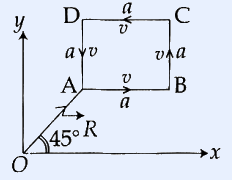
JEE Main 2016 April 03 Question Paper with Solutions
All 90 questions from the JEE Main 2016 (April 03) shift — Physics (30), Chemistry (30) and Mathematics (30) — each with the correct answer (answer key) and a step-by-step solution. Read it free online, or attempt the full paper as a timed mock test.
Physics30 questions
Q1Single correctUnits and Measurements
A student measures the time period of 100 oscillations of a simple pendulum four times. The data set is 90 s, 91 s, 95 s and 92 s. If the minimum division in the measuring clock is 1 s, then the reported mean time should be :
(1)
(2)
(3)
(4)
SolutionAnswer: Option 1 s
Approach:
Compute the arithmetic mean of the four readings, then the mean absolute deviation, and round the uncertainty to the least count of the clock.
Step 1:Mean of the four readings.
s
Step 2:Mean absolute deviation of the readings.
s
Step 3:Since the least count of the clock is 1 s, the uncertainty cannot be quoted finer than 1 s, so it is rounded up to 2 s.
s
Final answer: s
Q2Single correctMotion in a Plane
A particle of mass m is moving along the side of a square of side 'a', with a uniform speed v in the x-y plane as shown in the figure : (see figure) Which of the following statements is false for the angular momentum about the origin?
(1)
(2)
(3)
(4)
SolutionAnswer: Option 3 when the particle is moving from B to C.
Approach:
Angular momentum about the origin equals the linear momentum times the perpendicular distance from the origin to the line of motion. Evaluate this distance for each side of the square and compare with the given expressions.
Step 1:With the square's centre on a line of symmetry, the perpendicular distance from the origin to side CD is , giving the magnitude of angular momentum for motion along CD.
Step 2:The statement assigning this expression to motion from B to C is therefore incorrect, since for BC the magnitude is the same value but the geometric assignment in option (3) does not match the side it claims.
Final answer: when the particle is moving from B to C.
Q3Single correctLaws of Motion
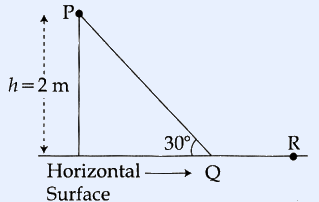
A point particle of mass m, moves along the uniformly rough track PQR as shown in the figure. The coefficient of friction, between the particle and the rough track equals . The particle is released, from rest, from the point P and it comes to rest at a point R. The energies, lost by the particle, when it passes through portions PQ and QR, of the track, are equal to each other, and no energy is lost when particle changes direction from PQ to QR. The values of the coefficient of friction and the distance x (= QR), are, respectively close to :
(1)
(2)
(3)
(4)
SolutionAnswer: Option 3 and m
Approach:
Use the geometry of the track (incline PQ at angle to the horizontal and horizontal stretch QR with h = 2 m) together with the work-energy theorem. Equate the friction energy lost on PQ to that on QR, and impose that the particle starts and ends at rest.
Step 1:On the inclined portion PQ, equating gravitational drop energy to total friction loss gives the friction coefficient from the incline geometry.
Step 2:Equal energy loss on QR with this gives the horizontal distance.
m
Final answer: and m
Q4Single correctThermal Properties of Matter
A person trying to lose weight by burning fat lifts a mass of 10 kg upto a height of 1 m 1000 times. Assume that the potential energy lost each time he lowers the mass is dissipated. How much fat will he use up considering the work done only when the weight is lifted up? Fat supplies J of energy per kg which is converted to mechanical energy with a 20% efficiency rate. Take m :
(1)
(2)
(3)
(4)
SolutionAnswer: Option 4 kg
Approach:
Find the total mechanical work done in 1000 lifts, then divide by the usable energy per kilogram of fat (the supplied energy scaled by the 20% efficiency).
Step 1:Total mechanical work in 1000 lifts.
J
Step 2:Usable energy per kg of fat is J. Dividing the work by this gives the fat consumed.
kg
Final answer: kg
Q5Single correctSystem of Particles and Rotational Motion
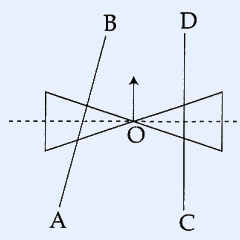
A roller is made by joining together two cones at their vertices O. It is kept on two rails AB and CD which are placed asymmetrically (see figure), with its axis perpendicular to CD and its centre O at the centre of line joining AB and CD (see figure). It is given a light push so that it starts rolling with its centre O moving parallel to CD in the direction shown. As it moves, the roller will tend to :
(1)
(2)
(3)
(4)
SolutionAnswer: Option 1turn left
Approach:
For a double cone rolling on two non-parallel rails, the contact radii at the two rails differ. Rolling without slipping forces the side with the larger contact radius to advance faster, steering the roller toward the side with the smaller radius.
Step 1:As the cones taper from O outward, the contact radius on one rail exceeds that on the other for the asymmetric placement shown.
Step 2:Equal angular velocity with unequal radii makes the larger-radius contact travel faster, turning the roller's path toward the rail of smaller radius, i.e. to the left.
Final answer: turn left
Q6Single correctGravitation
A satellite is revolving in a circular orbit at a height h from the earth surface, such that h << R where R is the radius of the earth. Assuming that the effect of earth's atmosphere can be neglected the minimum increase in the speed required so that the satellite could escape from the gravitational field of earth is :
(1)
(2)
(3)
(4)
SolutionAnswer: Option 4
Approach:
Find the orbital speed at height h (with h << R) and the escape speed at the surface, and take the difference, since the minimum increase in speed needed to escape is the gap between them.
Step 1:With h << R, the orbital speed at the orbit radius is approximately the surface value.
Step 2:The escape speed exceeds the orbital speed; the required increase is their difference.
Final answer:
Q7Single correctThermal Properties of Matter
A pendulum clock loses 12 s a day if the temperature is 40°C and gains 4s a day if the temperature is 20°C. The temperature at which the clock will show correct time, and the co-efficient of linear expansion () of the metal of the pendulum shaft are respectively :
(1)
(2)
(3)
(4)
SolutionAnswer: Option 1C; C
Approach:
The fractional change in a pendulum clock's time period over a day equals one half the linear-expansion strain. Set up two equations for the loss and gain relative to the correct-time temperature, then solve for that temperature and for alpha.
Step 1:Let the correct-time temperature be theta0. At 40 C the clock loses 12 s; at 20 C it gains 4 s. A loss means the period lengthened (temperature above theta0); a gain means the period shortened (temperature below theta0).
Step 2:Write the gain equation at 20 C.
Step 3:Divide the two equations to eliminate alpha.
Step 4:Solve for theta0.
C
Step 5:Substitute theta0 = 25 C into the gain equation to find alpha.
Final answer: C; C
Q8Single correctThermodynamics
An ideal gas undergoes a quasi static, reversible process in which its molar heat capacity Cremains constant. If during this process the relation of pressure P and volume V is given by = constant, then n is given by (Here and are molar specific heat at constant pressure and constant volume, respectively) :
(1)
(2)
(3)
(4)
SolutionAnswer: Option 2
Approach:
For a polytropic process = constant, the molar heat capacity is C = + R/(1-n). Solve this for n in terms of C, , and using the Mayer relation - = R.
Step 1:Start from the polytropic molar heat capacity and isolate the R/(1-n) term.
Step 2:Solve for n and substitute R = - .
Step 3:Simplify the numerator.
Final answer:
Q9Single correctThermodynamics
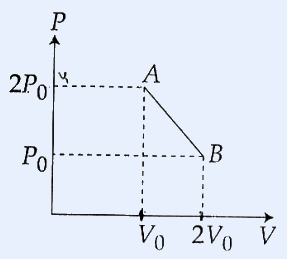
n moles of an ideal gas undergoes a process as shown in the figure. The maximum temperature of the gas during the process will be :
(1)
(2)
(3)
(4)
SolutionAnswer: Option 1
Approach:
The process A to B is a straight line in the P-V plane from A(V0, 2P0) to B(2V0, P0). Express P as a linear function of V, write T = PV/(nR), and maximize over V.
Step 1:From the figure, A = (V0, 2P0) and B = (2V0, P0). The equation of the straight line joining them is P = 3P0 - (P0/V0)V.
Step 2:Temperature along the path.
Step 3:Maximize T: set dT/dV = 0.
Step 4:Find P at this V, then PV.
Step 5:Maximum temperature.
Final answer:
Q10Single correctOscillations
A particle performs simple harmonic motion with amplitude A. Its speed is trebled at the instant that it is at a distance from equilibrium position. The new amplitude of the motion is :
(1)
(2)
(3)
(4)
SolutionAnswer: Option 4
Approach:
Use the SHM speed-position relation v = omega*sqrt( - ). At x = 2A/3 the speed is trebled while x and omega are unchanged; equate the new energy expression with a new amplitude A'.
Step 1:Original speed at x = 2A/3.
Step 2:After trebling the speed at the same position, the new amplitude A' satisfies the speed relation with v' = 3v.
Step 3:Substitute and simplify.
Step 4:Take the square root.
Final answer:
Q11Single correctWaves
A uniform string of length 20 m is suspended from a rigid support. A short wave pulse in introduced at its lowest end. It starts moving up the string. The time taken to reach the support is : (take m)
(1)
(2)
(3)
(4)
SolutionAnswer: Option 3 s
Approach:
In a vertically hanging string the tension at height y above the lowest end equals the weight of string below, giving a position-dependent wave speed v = sqrt(g*y). Integrate dt = dy/v from 0 to L.
Step 1:At height y, the tension supports the weight of the string below it: tau = (mu)(y)(g). The local wave speed is therefore sqrt(g*y).
Step 2:Express the travel time as an integral over the length L.
Step 3:Evaluate the integral.
Step 4:Substitute L = 20 m, g = 10 m/.
s
Final answer: s
Q12Single correctElectrostatics
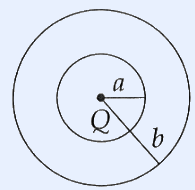
The region between two concentric spheres of radii 'a' and 'b', respectively (see figure), has volume charge density , where A is a constant and r is the distance from the centre. At the centre of the spheres is a point charge Q. The value of A such that the electric field in the region between the spheres will be constant, is :
(1)
(2)
(3)
(4)
SolutionAnswer: Option 1
Approach:
Apply Gauss's law on a sphere of radius r in (a, b). The enclosed charge is the central point charge plus the integrated shell charge. Require the field to be independent of r by canceling the r-dependent terms.
Step 1:Charge in a thin shell at radius r' has dq = (A/r')(4*pi*r'^2)dr' = 4*pi*A*r' dr'. Integrate from a to r.
Step 2:Total enclosed charge includes the central point charge Q.
Step 3:Field from Gauss's law.
Step 4:Rewrite to separate constant and r-dependent parts.
Step 5:For E independent of r the 1/ term must vanish.
Final answer:
Q13Single correctElectrostatic Potential and Capacitance
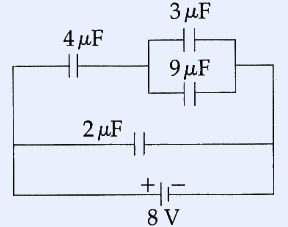
A combination of capacitors is set up as shown in the figure. The magnitude of the electric field, due to a point charge Q (having a charge equal to the sum of the charges on the 4 F and 9 F capacitors), at a point distant 30 m from it, would equal :
(1)
(2)
(3)
(4)
SolutionAnswer: Option 3 N/C
Approach:
Determine the charges stored on the 4 F and 9 F capacitors from the circuit and supply voltage, sum them to get Q, then compute the field of this point charge at 30 m.
Step 1:Charges on the two capacitors with their respective voltages give (across the 4 F branch) and , summing to Q.
Step 2:Field of point charge Q at r = 30 m.
N/C
Final answer: N/C
Q14Single correctCurrent Electricity
The temperature dependence of resistances of Cu and undoped Si in the temperature range 300-400 K, is best described by :
(1)
(2)
(3)
(4)
SolutionAnswer: Option 3Linear increase for Cu, exponential decrease for Si.
Approach:
Compare how resistance varies with temperature for a metal (Cu) and an intrinsic semiconductor (undoped Si).
Step 1:For a metal such as Cu, resistivity rises approximately linearly with temperature over a modest range because lattice scattering of conduction electrons grows with T.
Step 2:For undoped (intrinsic) Si the free-carrier density grows exponentially with temperature, so resistance falls exponentially as T increases.
Step 3:Combining: Cu shows a linear increase and Si an exponential decrease over 300-400 K.
Final answer: Linear increase for Cu, exponential decrease for Si.
Q15Single correctMoving Charges and Magnetism
Two identical wires A and B, each of length , carry the same current I. Wire A is bent into a circle of radius R and wire B is bent to form a square of side a. If and are the values of magnetic field at the centres of the circle and square respectively, then the ratio is :
(1)
(2)
(3)
(4)
SolutionAnswer: Option 4
Approach:
Use the same wire length for both shapes to fix radius/side, then compute the central field of a full circular loop and of a square loop.
Step 1:Circle of circumference equal to wire length gives the radius.
Step 2:Central field of the circular loop.
Step 3:Square of perimeter equal to wire length gives the side.
Step 4:Field at the centre of a square loop of side a (sum of four finite straight segments).
Step 5:Take the ratio.
Final answer:
Q16Single correctMagnetism and Matter
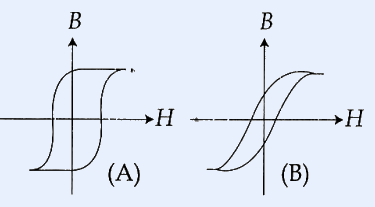
Hysteresis loops for two magnetic materials A and B are given below :
These materials are used to make magnets for electric generators, transformer core and electromagnet core. Then it is proper to use :
These materials are used to make magnets for electric generators, transformer core and electromagnet core. Then it is proper to use :
(1)
(2)
(3)
(4)
SolutionAnswer: Option 4B for electromagnets and transformers.
Approach:
Identify which loop represents soft magnetic material (narrow loop, small hysteresis loss) suited to cyclically magnetised cores, versus hard material (wide loop).
Step 1:Electromagnets and transformer cores are repeatedly magnetised and demagnetised, so a small loop area (low hysteresis loss) and low retentivity/coercivity are required - a soft magnetic material.
Step 2:Loop B is the narrow loop (soft material: low coercivity, low energy loss), so it suits both electromagnets and transformers.
Step 3:The wide loop A (hard material, high retentivity) suits permanent magnets, not cyclic-core applications.
Final answer: B for electromagnets and transformers.
Q17Single correctAlternating Current
An arc lamp requires a direct current of 10 A at 80 V to function. It is connected to a 220 V (rms), 50 Hz AC supply, the series inductor needed for it to work is close to :
(1)
(2)
(3)
(4)
SolutionAnswer: Option 40.065 H
Approach:
Find the lamp resistance from its DC ratings, then treat it as a series LR circuit on the AC supply where the rms current must remain 10 A; solve for the inductive reactance and hence L.
Step 1:Lamp resistance from DC operating values.
Step 2:On AC the rms current stays 10 A at 220 V, so the total impedance is the supply voltage divided by current.
Step 3:Extract the inductive reactance.
Step 4:Solve for L using the supply angular frequency.
Final answer: 0.065 H
Q18Single correctElectromagnetic Waves
Arrange the following electromagnetic radiations per quantum in the order of increasing energy : A : Blue light B : Yellow light C : X-ray D : Radiowave
(1)
(2)
(3)
(4)
SolutionAnswer: Option 1D, B, A, C
Approach:
Photon energy increases with frequency (decreasing wavelength). Order the radiations from longest wavelength (lowest energy) to shortest wavelength (highest energy).
Step 1:Rank by wavelength: radiowave has the longest wavelength, then yellow light, then blue light, and X-rays have the shortest wavelength.
Step 2:Since energy varies inversely with wavelength, increasing energy follows the reverse wavelength order.
Final answer: D, B, A, C
Q19Single correctRay Optics and Optical Instruments
As an observer looks at a distant tree of height of 10 m with a telescope of magnifying power of 20. To the observer the tree appears :
(1)
(2)
(3)
(4)
SolutionAnswer: Option 420 times nearer
Approach:
Interpret the angular magnification of a telescope: it increases the angle subtended by a distant object so that the object appears closer, while the actual linear size of the object is unchanged.
Step 1:A telescope magnifies the angle subtended by a distant object rather than its physical height, so the object is not made physically taller.
Step 2:Increasing the subtended angle by a factor of 20 makes the object appear as if it were 20 times nearer.
Final answer: 20 times nearer
Q20Single correctWave Optics
The box of a pin hole camera, of length L, has a hole of radius a. It is assumed that when the hole is illuminated by a parallel beam of light of wavelength the spread of the spot (obtained on the opposite wall of the camera) is the sum of its geometrical spread and the spread due to diffraction. The spot would then have its minimum size (say ) when :
(1)
(2)
(3)
(4)
SolutionAnswer: Option 3 and
Approach:
Write the total spot size as the sum of the geometrical spread (twice the hole radius) and the diffraction spread (proportional to lambda L over the radius), then minimise with respect to the radius.
Step 1:Express the spot size as the sum of geometrical and diffraction contributions.
Step 2:Minimise by setting the derivative with respect to a to zero.
Step 3:Substitute the optimal radius back into the spread expression.
Final answer: and
Q21Single correctDual Nature of Matter and Radiation
Radiation of wavelength , is incident on a photocell. The fastest emitted electron has speed v. If the wavelength is changed to , the speed of the fastest emitted electron will be :
(1)
(2)
(3)
(4)
SolutionAnswer: Option 1
Approach:
Apply the Einstein photoelectric equation for both wavelengths, express the new maximum kinetic energy in terms of the original, and compare the resulting speed against the work-function-free scaling v sqrt(4/3).
Step 1:For wavelength lambda the fastest electron has speed v.
Step 2:For wavelength 3 lambda over 4 the photon energy rises by the factor 4/3.
Step 3:Eliminating the photon energy term shows the new speed squared exceeds (4/3) times the original speed squared by a positive multiple of the work function, so the speed is greater than v sqrt(4/3).
Final answer:
Q22Single correctAtoms and Nuclei
Half-lives of two radioactive elements A and B are 20 minutes and 40 minutes, respectively. Initially, the samples have equal number of nuclei. After 80 minutes, the ratio of decayed numbers of A and B nuclei will be :
(1)
(2)
(3)
(4)
SolutionAnswer: Option 45 : 4
Approach:
Determine the number of half-lives elapsed for each element in 80 minutes, find the surviving fraction, then the decayed fraction, and take the ratio.
Step 1:Element A undergoes four half-lives; the decayed fraction is one minus the surviving fraction.
Step 2:Element B undergoes two half-lives.
Step 3:Form the ratio of decayed numbers.
Final answer: 5 : 4
Q23Single correctElectronic Devices
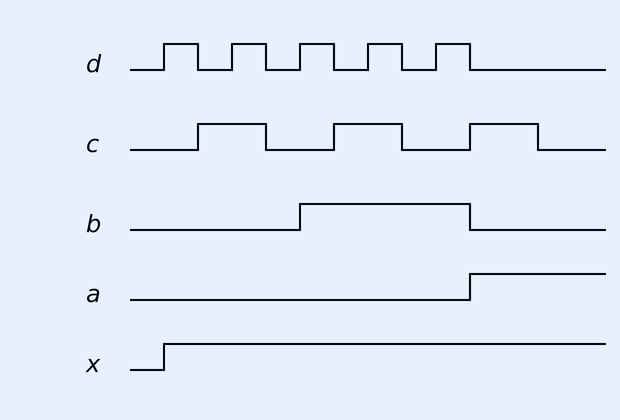
If a, b, c, d are inputs to a gate and x is its output, then, as per the following time graph, the gate is :
(1)
(2)
(3)
(4)
SolutionAnswer: Option 3OR
Approach:
Read the input and output waveforms from the timing diagram, determine the output level for each combination of inputs, and match the behaviour to a standard logic gate.
Step 1:The output x is high whenever at least one of the inputs is high, and is low only when all inputs are simultaneously low.
Step 2:This behaviour defines the OR gate.
Final answer: OR
Q24Single correctCommunication Systems
Choose the correct statement :
(1)
(2)
(3)
(4)
SolutionAnswer: Option 1In amplitude modulation the amplitude of the high frequency carrier wave is made to vary in proportion to the amplitude of the audio signal.
Approach:
Apply the definitions of amplitude modulation and frequency modulation to identify which property of the carrier varies with the message signal.
Step 1:In amplitude modulation the instantaneous amplitude of the carrier varies in proportion to the amplitude of the modulating (audio) signal, while the carrier frequency stays constant.
Step 2:Statements 2, 3 and 4 incorrectly interchange the roles of amplitude and frequency, so only the first statement is correct.
Final answer: In amplitude modulation the amplitude of the high frequency carrier wave is made to vary in proportion to the amplitude of the audio signal.
Q25Single correctExperimental Skills
A screw gauge with a pitch of 0.5 mm and a circular scale with 50 divisions is used to measure the thickness of a thin sheet of Aluminium. Before starting the measurement, it is found that when the two jaws of the screw gauge and brought into contact, the division coincides with the main scale line and that the zero of the main scale is barely visible. What is the thickness of the sheet if the main scale reading is 0.5 mm and the division coincides with the main scale line?
(1)
(2)
(3)
(4)
SolutionAnswer: Option 20.80 mm
Approach:
Find the least count from the pitch and number of circular divisions, determine the zero error from the contact reading, then compute the corrected thickness as main-scale plus circular-scale reading minus zero error.
Step 1:Compute the least count from the pitch and circular-scale divisions.
Step 2:With the jaws in contact the 45th division coincides while the main-scale zero is barely visible, giving a negative zero error of minus five divisions.
Step 3:Compute the corrected thickness.
Final answer: 0.80 mm
Q26Single correctOscillations and Waves
A pipe open at both ends has a fundamental frequency f in air. The pipe is dipped vertically in water so that half of it is in water. The fundamental frequency of the air column is now :
(1)
(2)
(3)
(4)
SolutionAnswer: Option 4
Approach:
Compare the fundamental frequency of an open pipe of length L with that of a pipe closed at one end whose air-column length is L/2 after being half submerged.
Step 1:Initially the pipe is open at both ends with length L.
Step 2:After half the pipe is submerged the lower end is effectively closed by water and the remaining air column has length L/2, forming a closed pipe.
Step 3:Compute the new fundamental for the closed air column.
Final answer:
Q27Single correctCurrent Electricity
A galvanometer having a coil resistance of gives a full scale deflection, when a current of is passed through it. The value of the resistance, which can convert this galvanometer into ammeter giving a full scale deflection for a current of , is :
(1)
(2)
(3)
(4)
SolutionAnswer: Option 1
Approach:
A galvanometer is converted to an ammeter by connecting a low-resistance shunt in parallel; equate the voltage across the galvanometer and the shunt to find the shunt resistance.
Step 1:The shunt carries the remaining current and shares the same potential difference as the coil.
Step 2:Insert the values: full-scale current 1 mA, coil resistance 100 ohm, total current 10 A.
Step 3:Simplify.
Final answer:
Q28Single correctRay Optics
In an experiment for determination of refractive index of glass of a prism by i-, plot, it was found that a ray incident at angle , suffers a deviation of and that it emerges at angle . In that case which of the following is closest to the maximum possible value of the refractive index ?
(1)
(2)
(3)
(4)
SolutionAnswer: Option 11.5
Approach:
Use the prism deviation relation to obtain the apex angle, then bound the refractive index by evaluating the prism formula treating the given deviation as the minimum deviation, which yields the maximum possible value.
Step 1:Find the apex angle.
Step 2:Maximum refractive index uses the deviation as the minimum deviation.
Final answer: 1.5
Q29Single correctSemiconductor Electronics
Identify the semiconductor devices whose characteristics are given below, in the order (a), (b), (c), (d) :
(1)
(2)
(3)
(4)
SolutionAnswer: Option 1Simple diode, Zener diode, Solar cell, Light dependent resistance.
Approach:
Match each given current-voltage or schematic characteristic to the corresponding semiconductor device based on its distinctive behaviour, then order the identifications as (a), (b), (c), (d).
Step 1:Characteristic (a) shows ordinary forward conduction and reverse blocking, identifying a simple p-n junction diode.
Step 2:Characteristic (b) shows a sharp reverse breakdown at a fixed voltage, identifying a Zener diode; (c) operates in the photovoltaic region under illumination, identifying a solar cell; (d) shows resistance changing with illumination, identifying a light dependent resistance.
Final answer: Simple diode, Zener diode, Solar cell, Light dependent resistance.
Q30Single correctSemiconductor Electronics
For a common emitter configuration, if and have their usual meanings, the incorrect relationship between and is :
(1)
(2)
(3)
(4)
SolutionAnswer: Option 2
Approach:
Recall the exact relation between the common-base current gain alpha and the common-emitter current gain beta, then test each option to find the one that does not hold.
Step 1:The standard relation gives alpha in terms of beta with a plus sign in the denominator, validating option (3).
Step 2:Taking reciprocals of this relation reproduces option (1), which is therefore also correct, and option (4) is a valid identity; only option (2) uses a minus sign in the denominator and is incorrect.
Final answer:
Chemistry30 questions
Q31Single correctSome Basic Concepts in Chemistry
At 300 K and 1 atm, 15 mL of a gaseous hydrocarbon requires 375 mL air containing 20% by volume for complete combustion. After combustion the gases occupy 330 mL. Assuming that the water formed is in liquid form and the volumes were measured at the same temperature and pressure, the formula of the hydrocarbon is :
(1)
(2)
(3)
(4)
SolutionAnswer: Option 2
Approach:
Apply eudiometry to the combustion of a hydrocarbon , using the supplied oxygen volume and the contraction observed to solve for x and y.
Step 1:Oxygen supplied equals 20% of 375 mL.
Step 2:For 15 mL hydrocarbon, the oxygen required equals 15(x + y/4); equate to 75 mL.
Step 3:The integer solution consistent with a hydrocarbon is x = 3, y = 8.
Final answer:
Q32Single correctStates of Matter
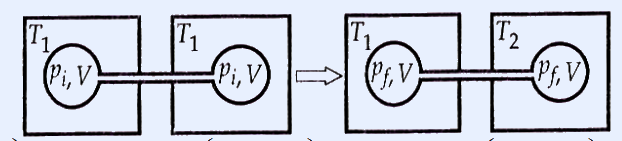
Two closed bulbs of equal volume (V) containing an ideal gas initially at pressure and temperature are connected through a narrow tube of negligible volume as shown in the figure below. The temperature of one of the bulbs is then raised to . The final pressure is :
(1)
(2)
(3)
(4)
SolutionAnswer: Option 3
Approach:
Conserve total moles of gas before and after the temperature change, with one bulb at and the other at , both at the common final pressure .
Step 1:Initial total moles in the two bulbs at , .
Step 2:Final total moles with one bulb at and the other at , both at .
Step 3:Equate and solve for .
Final answer:
Q33Single correctStructure of Atom
A stream of electrons from a heated filament was passed between two charged plates kept at a potential difference V esu. If e and m are charge and mass of an electron, respectively, then the value of h/ (where is wavelength associated with electron wave) is given by :
(1)
(2)
(3)
(4)
SolutionAnswer: Option 4
Approach:
Equate the kinetic energy gained by an electron accelerated through potential difference V to its kinetic energy, and substitute the resulting momentum into the de Broglie relation.
Step 1:Momentum from kinetic energy eV.
Step 2:Reciprocal of de Broglie wavelength.
Final answer:
Q34Single correctChemical Bonding and Molecular Structure
The species in which the N atom is in a state of sp hybridization is :
(1)
(2)
(3)
(4)
SolutionAnswer: Option 1
Approach:
Determine the steric number (sigma bonds plus lone pairs) on the nitrogen atom in each species; sp hybridization corresponds to a steric number of 2.
Step 1:In the nitronium ion NO2+, nitrogen has two sigma bonds and no lone pair (linear, O=N=O), giving steric number 2.
Step 2:NO2-, NO3- and NO2 each carry a lone pair or single electron on N, giving steric number 3 (sp2).
Final answer:
Q35Single correctChemical Thermodynamics
The heats of combustion of carbon and carbon monoxide are and kJ mo, respectively. The heat of formation (in kJ) of carbon monoxide per mole is :
(1)
(2)
(3)
(4)
SolutionAnswer: Option 4
Approach:
Use Hess's law: subtract the combustion of CO from the combustion of C to obtain the formation reaction of CO.
Step 1:Combustion of carbon.
Step 2:Combustion of carbon monoxide.
Step 3:Subtract to obtain formation of CO.
Final answer:
Q36Single correctSolutions
18 g of glucose () is added to 178.2 g water. The vapor pressure of water (in torr) for this aqueous solution is :
(1)
(2)
(3)
(4)
SolutionAnswer: Option 3
Approach:
Apply Raoult's law: the vapour pressure of the solution equals the mole fraction of water times the vapour pressure of pure water (taken as 760 torr).
Step 1:Moles of water and glucose.
Step 2:Mole fraction of water.
Step 3:Vapour pressure of solution.
Final answer:
Q37Single correctEquilibrium
The equilibrium constant at 298 K for a reaction A + B C + D is 100. If the initial concentration of all the four species were 1M each, then equilibrium concentration of D (in mol ) will be :
(1)
(2)
(3)
(4)
SolutionAnswer: Option 3
Approach:
Set up an ICE table with extent of reaction x, write the equilibrium constant expression, and solve for x.
Step 1:Equilibrium concentrations: [A]=[B]=1-x, [C]=[D]=1+x.
Step 2:Take square root.
Step 3:Equilibrium concentration of D.
Final answer:
Q38Single correctGeneral Principles and Processes of Isolation of Metals
Galvanization is applying a coating of :
(1)
(2)
(3)
(4)
SolutionAnswer: Option 4Zn
Approach:
Identify the metal used in galvanization, a process that protects iron from corrosion by sacrificial coating.
Step 1:Galvanization is the deposition of zinc on iron.
Step 2:Zinc has a more negative standard reduction potential than iron, so it corrodes preferentially and protects the iron.
Final answer: Zn
Q39Single correctChemical Kinetics
Decomposition of follows a first order reaction. In fifty minutes the concentration of decreases from 0.5 to 0.125 M in one such decomposition. When the concentration of reaches 0.05 M, the rate of formation of will be :
(1)
(2)
(3)
(4)
SolutionAnswer: Option 2 mol mi
Approach:
Find the rate constant from the number of half-lives elapsed, then evaluate the rate of H2O2 decomposition at the stated concentration and convert to the rate of O2 formation using stoichiometry.
Step 1:Going from 0.5 to 0.125 M is two half-lives in 50 min, so t(1/2) = 25 min.
Step 2:Rate of H2O2 decomposition at 0.05 M.
Step 3:Rate of O2 formation is half the decomposition rate of H2O2.
Final answer: mol mi
Q40Single correctSurface Chemistry
For a linear plot of log (x/m) versus log p in a Freundlich adsorption isotherm, which of the following statements is correct ? (k and n are constants)
(1)
(2)
(3)
(4)
SolutionAnswer: Option 3Only 1/n appears as the slope.
Approach:
Take the logarithm of the Freundlich isotherm and compare with the straight line equation y = mx + c to identify slope and intercept.
Step 1:Logarithmic form of the isotherm.
Step 2:Compare with y = mx + c: the slope is 1/n and the intercept is log k.
Final answer: Only 1/n appears as the slope.
Q41Single correctClassification of Elements and Periodicity in Properties
Which of the following atoms has the highest first ionization energy ?
(1)
(2)
(3)
(4)
SolutionAnswer: Option 4Sc
Approach:
Compare the first ionization energies of the given atoms; the three alkali metals have low values, while scandium, a transition metal with higher effective nuclear charge, has the largest.
Step 1:Ionization energies (kJ/mol): Na = 496, K = 419, Rb = 403, Sc = 631.
Step 2:Scandium has the highest first ionization energy among the listed atoms.
Final answer: Sc
Q42Single correctGeneral Principles and Processes of Isolation of Metals
Which one of the following ores is best concentrated by froth floatation method ?
(1)
(2)
(3)
(4)
SolutionAnswer: Option 3Galena
Approach:
Froth flotation is used for sulphide ores; identify which listed ore is a sulphide.
Step 1:Galena (PbS) is a sulphide ore; magnetite (Fe3O4), siderite (FeCO3) and malachite (basic copper carbonate) are not sulphides.
Step 2:Sulphide ores are concentrated by froth flotation because their surfaces are preferentially wetted by oil.
Final answer: Galena
Q43Single correctHydrogen
Which one of the following statements about water is ?
(1)
(2)
(3)
(4)
SolutionAnswer: Option 3There is extensive intramolecular hydrogen bonding in the condensed phase.
Approach:
Evaluate each statement and identify the incorrect one.
Step 1:Water in liquid and solid phases shows extensive intermolecular, not intramolecular, hydrogen bonding, so statement (3) is false.
(intermolecular)
Step 2:Statements 1, 2 and 4 are correct: water is oxidized in photosynthesis, is amphoteric, and heavy ice (D2O ice) sinks in ordinary water due to higher density.
Final answer: There is extensive intramolecular hydrogen bonding in the condensed phase.
Q44Single corrects-Block Elements
The main oxides formed on combustion of Li, Na and K in excess of air are, respectively :
(1)
(2)
(3)
(4)
SolutionAnswer: Option 4 and
Approach:
Recall the characteristic oxides of alkali metals formed on burning in excess air, which vary down the group from normal oxide to peroxide to superoxide.
Step 1:Lithium forms the normal oxide.
Step 2:Sodium forms the peroxide.
Step 3:Potassium forms the superoxide.
Final answer: and
Q45Single correctp-Block Elements
The reaction of zinc with dilute and concentrated nitric acid, respectively produces :
(1)
(2)
(3)
(4)
SolutionAnswer: Option 1 and
Approach:
Recall the reduction products of nitric acid with zinc: dilute acid is reduced further (to nitrous oxide) than concentrated acid (to nitrogen dioxide).
Step 1:Dilute nitric acid (about 20%) reacts with zinc to give nitrous oxide.
Step 2:Concentrated nitric acid (about 70%) reacts with zinc to give nitrogen dioxide.
Final answer: and
Q46Single correctp-Block Elements
The pair in which phosphorous atoms have a formal oxidation state of is :
(1)
(2)
(3)
(4)
SolutionAnswer: Option 1Orthophosphorous and pyrophosphorous acids
Approach:
Assign the oxidation state of phosphorus in each named oxoacid using known formulae and the standard rule that H is and O is .
Step 1:Orthophosphorous acid has one P; balance gives P oxidation state.
Step 2:Pyrophosphorous acid has two equivalent P.
Step 3:Hypophosphoric acid gives P at ; pyrophosphoric acid gives P at .
Final answer: Orthophosphorous and pyrophosphorous acids
Q47Single correctd- and f-Block Elements
Which of the following compounds is metallic and ferromagnetic ?
(1)
(2)
(3)
(4)
SolutionAnswer: Option 2
Approach:
Recall the electrical and magnetic behaviour of the listed transition-metal dioxides.
Step 1:, (at room temperature) and are not metallic ferromagnets; is an insulator/semiconductor and is antiferromagnetic.
Step 2: conducts like a metal and is ferromagnetic, used in magnetic recording tapes.
Final answer:
Q48Single correctCoordination Compounds
The pair having the same magnetic moment is : [At. No.: Cr , Mn , Fe , Co ]
(1)
(2)
(3)
(4)
SolutionAnswer: Option 2 and
Approach:
Determine the number of unpaired electrons for each complex with weak-field/water or chloride ligands and compute the spin-only moment.
Step 1: is with weak-field , giving unpaired electrons.
Step 2: is high-spin with , giving unpaired electrons.
Step 3: (, ) and in (, ) give different moments.
Final answer: and
Q49Single correctCoordination Compounds
Which one of the following complexes shows optical isomerism ? (en ethylenediamine)
(1)
(2)
(3)
(4)
SolutionAnswer: Option 2
Approach:
Optical isomerism requires a non-superimposable mirror image, typical of cis-bis(bidentate) octahedral complexes lacking a plane of symmetry.
Step 1:The trans isomer of has a plane of symmetry and is optically inactive.
Step 2:The cis isomer of has no plane or centre of symmetry and exists as a pair of enantiomers.
Step 3:The remaining complexes possess symmetry elements making them optically inactive.
Final answer:
Q50Single correctEnvironmental Chemistry
The concentration of fluoride, lead, nitrate and iron in a water sample from an underground lake was found to be 1000 ppb, 40 ppb, 100 ppm and 0.2 ppm, respectively. This water is unsuitable for drinking due to high concentration of :
(1)
(2)
(3)
(4)
SolutionAnswer: Option 3Nitrate
Approach:
Convert all values to common units and compare each against its maximum permissible limit in drinking water.
Step 1:Express each in ppm: fluoride ppm, lead ppm, nitrate ppm, iron ppm.
Step 2:Nitrate permissible limit is about ppm; the sample value of ppm greatly exceeds it (high nitrate causes blue-baby syndrome).
Step 3:Fluoride, lead and iron values lie within or close to their permissible limits.
Final answer: Nitrate
Q51Single correctOrganic Chemistry - Some Basic Principles and Techniques
The distillation technique most suited for separating glycerol from spentlye in the soap industry is :
(1)
(2)
(3)
(4)
SolutionAnswer: Option 4Distillation under reduced pressure
Approach:
Select the distillation method based on the thermal sensitivity and high boiling point of glycerol.
Step 1:Glycerol has a very high boiling point and decomposes near it, so it cannot be distilled at atmospheric pressure.
Step 2:Reducing the pressure lowers the boiling point, allowing glycerol to distil from spent-lye without decomposition.
Final answer: Distillation under reduced pressure
Q52Single correctHaloalkanes and Haloarenes
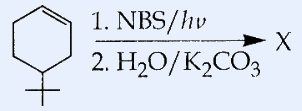
The product X of the following reaction is :
(1)
(2)
(3)
(4)
SolutionAnswer: Option 2
Approach:
NBS under photochemical conditions performs allylic bromination; subsequent hydrolysis with water and base substitutes the allylic bromide for an allylic alcohol.
Step 1:NBS brominates the allylic CH position of the cyclohexene, giving an allylic bromide.
Step 2:Hydrolysis with replaces Br by OH, retaining the ring double bond and forming an allylic alcohol.
Final answer: allylic alcohol product (option 2)
Q53Single correctOrganic Chemistry - Some Basic Principles and Techniques
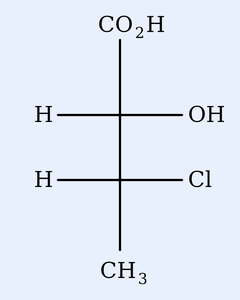
The absolute configuration of [Fischer projection: C2 bearing at top with H on left and OH on right; C3 below bearing H on left and Cl on right; at bottom] is :
(1)
(2)
(3)
(4)
SolutionAnswer: Option 2(2S, 3R)
Approach:
Assign Cahn-Ingold-Prelog priorities at each stereocentre and determine R/S from the Fischer projection, accounting for the lowest-priority group orientation.
Step 1:At C2 the priority order is OH > CH > C3-chain > H; reading the rotation in the Fischer projection and inverting because H (lowest priority) is horizontal gives the S assignment.
Step 2:At C3 the priority order is Cl > C2-chain > C > H; the corresponding analysis with horizontal H gives the R assignment.
Final answer: (2S, 3R)
Q54Single correctHaloalkanes and Haloarenes
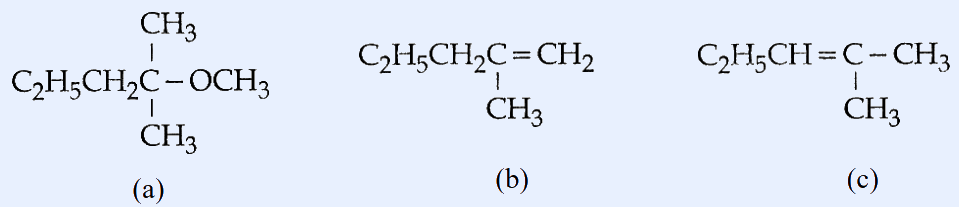
2-chloro-2-methylpentane on reaction with sodium methoxide in methanol yields :
(1)
(2)
(3)
(4)
SolutionAnswer: Option 1All of these
Approach:
A tertiary halide with the moderately basic/nucleophilic methoxide can undergo both substitution and elimination, giving an ether plus the two regiochemical alkenes.
Step 1:Substitution of Cl by methoxide gives the tertiary methyl ether (product a).
Step 2:Elimination (E1/E2) removes HCl to give the more substituted alkene (product c, Zaitsev) and the less substituted alkene (product b, Hofmann).
Step 3:All three products a, b and c are obtained.
Final answer: All of these
Q55Single correctHydrocarbons
The reaction of propene with HOCl () proceeds through the intermediate :
(1)
(2)
(3)
(4)
SolutionAnswer: Option 2
Approach:
HOCl supplies as the electrophile; its addition forms a chloronium/carbocation intermediate before water attacks.
Step 1: adds to the terminal carbon of propene, placing the positive charge on the more stable secondary carbon.
Step 2:This secondary carbocation bearing the group is the reaction intermediate.
Final answer:
Q56Single correctAmines
In the Hofmann bromamide degradation reaction, the number of moles of NaOH and used per mole of amine produced are :
(1)
(2)
(3)
(4)
SolutionAnswer: Option 4Four moles of NaOH and one mole of .
Approach:
Write the balanced Hofmann bromamide degradation equation and read the stoichiometric coefficients.
Step 1:Balancing the conversion of an amide to a primary amine consumes one mole of bromine and four moles of sodium hydroxide.
Final answer: Four moles of NaOH and one mole of B.
Q57Single correctPolymers
Which of the following statements about low density polythene is FALSE ?
(1)
(2)
(3)
(4)
SolutionAnswer: Option 4It is used in the manufacture of buckets, dustbins etc.
Approach:
Compare each statement with the known preparation and uses of low density polythene (LDPE).
Step 1:LDPE is made by free-radical polymerisation of ethene at high pressure and temperature using a peroxide or dioxygen initiator, and it is an electrical insulator; statements 1, 2 and 3 are true.
Step 2:Rigid articles such as buckets and dust-bins are made from high density polythene (HDPE), not LDPE, so statement 4 is false.
Final answer: It is used in the manufacture of buckets, dustbins etc.
Q58Single correctBiomolecules
Thiol group is present in :
(1)
(2)
(3)
(4)
SolutionAnswer: Option 3Cysteine
Approach:
Recall the side-chain functional groups of the listed species and identify which contains a free SH (thiol).
Step 1:Cysteine, , has a free thiol (SH) side chain.
Step 2:Cystine is the disulfide dimer (no free SH), methionine contains a thioether (S), and cytosine is a nitrogen base with no sulfur.
Final answer: Cysteine
Q59Single correctChemistry in Everyday Life
Which of the following is an anionic detergent ?
(1)
(2)
(3)
(4)
SolutionAnswer: Option 2Sodium lauryl sulphate
Approach:
Classify each species; an anionic detergent carries a negatively charged hydrophilic head and is a sulfate/sulfonate salt rather than a soap or a cationic surfactant.
Step 1:Sodium lauryl sulphate, , ionises to give a long-chain sulfate anion and is an anionic detergent.
Step 2:Sodium stearate is a soap, cetyltrimethyl ammonium bromide is a cationic detergent, and glyceryl oleate is a non-ionic ester.
Final answer: Sodium lauryl sulphate
Q60Single correctOrganic Chemistry - Some Basic Principles and Techniques
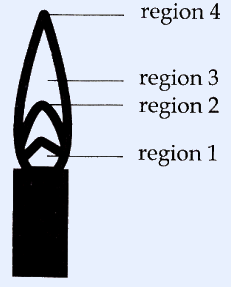
The hottest region of Bunsen flame shown in the figure below is : [figure: Bunsen flame with four labelled zones, region 1 near the base, region 2 just above it, region 3 higher, region 4 at the top]
(1)
(2)
(3)
(4)
SolutionAnswer: Option 2region 2
Approach:
Identify the zone of complete combustion in a non-luminous Bunsen flame, which is the hottest region.
Step 1:The faint blue zone of complete combustion, located just above the base of the inner cone, reaches the highest temperature.
Step 2:In the labelling of the figure this corresponds to region 2.
Final answer: region 2
Mathematics30 questions
Q61Single correctSets, Relations and Functions
If , , and ; then S:
(1)
(2)
(3)
(4)
SolutionAnswer: Option 3contains exactly two elements.
Approach:
Solve the functional equation for f(x) by substituting x with 1/x, then impose evenness to count solutions.
Step 1:Replace x by 1/x in the given relation.
Step 2:Eliminate f(1/x) from the two equations.
Step 3:Apply the condition f(x) = f(-x).
Step 4:Solve for x.
Final answer: contains exactly two elements.
Q62Single correctComplex Numbers and Quadratic Equations
A value of for which is purely imaginary, is:
(1)
(2)
(3)
(4)
SolutionAnswer: Option 4
Approach:
Rationalize the expression and set the real part of the numerator to zero.
Step 1:Multiply numerator and denominator by the conjugate of the denominator.
Step 2:For a purely imaginary value, set the real part to zero.
Step 3:Solve for theta.
Final answer:
Q63Single correctComplex Numbers and Quadratic Equations
The sum of all real values of x satisfying the equation is:
(1)
(2)
(3)
(4)
SolutionAnswer: Option 13
Approach:
A power equals 1 when the exponent is zero (base nonzero), when the base is 1, or when the base is -1 with an even exponent.
Step 1:Case exponent zero with base not equal to 0, 1, -1.
Step 2:Case base equal to 1.
Step 3:Case base equal to -1 with even exponent.
Step 4:Collect valid solutions and sum them.
Final answer: 3
Q64Single correctMatrices and Determinants
If and , then is equal to:
(1)
(2)
(3)
(4)
SolutionAnswer: Option 25
Approach:
Use A adj(A) = det(A) I and compare with A entrywise to solve for a and b.
Step 1:Compute det(A).
Step 2:Compute A and equate corresponding entries.
Step 3:Solve 15a - 2b = 0 together with 10a + 3b = 13.
Step 4:Evaluate 5a + b.
Final answer: 5
Q65Single correctMatrices and Determinants
The system of linear equations
has a non-trivial solution for:
has a non-trivial solution for:
(1)
(2)
(3)
(4)
SolutionAnswer: Option 4exactly three values of
Approach:
A homogeneous system has a non-trivial solution when the coefficient determinant is zero; count the roots in lambda.
Step 1:Set up the coefficient determinant.
Step 2:Expand the determinant.
Step 3:Solve for lambda.
Final answer: exactly three values of
Q66Single correctPermutations and Combinations
If all the words (with or without meaning) having five letters, formed using the letters of the word SMALL and arranged as in a dictionary; then the position of the word SMALL is:
(1)
(2)
(3)
(4)
SolutionAnswer: Option 4
Approach:
Order letters alphabetically and count words preceding SMALL, accounting for the repeated letter L.
Step 1:Alphabetical order of letters is A, L, L, M, S. Count words starting with A.
Step 2:Count words starting with L (remaining A, L, M, S all distinct).
Step 3:Count words starting with M (remaining A, L, L, S).
Step 4:For words starting with S, next letter alphabetically before M: SA gives 3!/1 with remaining L,L,M and SL gives 3 words.
Step 5:Total words before reaching SM, then SMALL is the first word of the SM block.
Final answer:
Q67Single correctBinomial Theorem
If the number of terms in the expansion of , , is 28, then the sum of the coefficients of all the terms in this expansion, is:
(1)
(2)
(3)
(4)
SolutionAnswer: Option 4729
Approach:
Use the number-of-terms formula for a trinomial expansion to find n, then substitute x = 1 for the sum of coefficients.
Step 1:Equate the number of distinct terms to 28.
Step 2:Solve for n.
Step 3:Sum of coefficients is obtained by setting x = 1.
Final answer: 729
Q68Single correctSequences and Series
If the , and terms of a non-constant A.P. are in G.P., then the common ratio of this G.P. is:
(1)
(2)
(3)
(4)
SolutionAnswer: Option 2
Approach:
Express the A.P. terms in a and d, apply the G.P. middle-term condition, then compute the ratio.
Step 1:Write the three terms.
Step 2:Apply the geometric mean condition.
Step 3:Since the A.P. is non-constant, d is nonzero, giving a = 8d.
Step 4:Compute the common ratio.
Final answer:
Q69Single correctSequences and Series
If the sum of the first ten terms of the series , is , then m is equal to:
(1)
(2)
(3)
(4)
SolutionAnswer: Option 2101
Approach:
Convert mixed numbers to a common-denominator form, find the general term, then sum the first ten squared terms.
Step 1:Rewrite each term over 5: 8/5, 12/5, 16/5, 20/5, 24/5, ...
Step 2:Express the sum of squares.
Step 3:Evaluate the component sums for n = 1 to 10.
Step 4:Assemble and equate to (16/5)m.
Final answer: 101
Q70Single correctLimits, Continuity and Differentiability
Let then is equal to:
(1)
(2)
(3)
(4)
SolutionAnswer: Option 3
Approach:
Use the standard nfinity limit form, taking logarithm and the small-angle equivalence tan(t) ~ t.
Step 1:Write the limit in exponential form.
Step 2:Apply tan(sqrt(x)) ~ sqrt(x) as x approaches 0 from the right.
Step 3:Take logarithm of p.
Final answer:
Q71Single correctLimits, Continuity and Differentiability
For , and , then:
(1)
(2)
(3)
(4)
SolutionAnswer: Option 2
Approach:
Near x = 0 the inner absolute value can be removed because log 2 - sin x stays positive, allowing direct differentiation of the composite.
Step 1:Since 2 is approximately 0.693 and sin x is small near 0, log 2 - sin x > 0, so f(x) = log 2 - sin x locally.
Step 2:Form g(x) = f(f(x)) near x = 0.
Step 3:Differentiate using the chain rule.
Step 4:Evaluate at x = 0.
Final answer:
Q72Single correctDifferential Calculus
Consider , . A normal to at also passes through the point:
(1)
(2)
(3)
(4)
SolutionAnswer: Option 2
Approach:
Simplify f(x) using half-angle identities, differentiate to get the slope, then form the normal line and test which point lies on it.
Step 1:Simplify the function on the given interval.
Step 2:Differentiate to find the slope of the tangent.
Step 3:Find the point at x = pi/6.
Step 4:Write the normal and test (0, 2pi/3).
Final answer:
Q73Single correctDifferential Calculus
A wire of length 2 units is cut into two parts which are bent respectively to form a square of side units and a circle of radius units. If the sum of the areas of the square and the circle so formed is minimum, then:
(1)
(2)
(3)
(4)
SolutionAnswer: Option 3
Approach:
Express the total area in one variable using the perimeter constraint, minimize, and compare x with r.
Step 1:Let the parts have lengths a and 2 - a, with .
Step 2:Write the total area as a function of a.
Step 3:Differentiate, set to zero, and solve for a.
Step 4:Compute x and r and compare.
Final answer:
Q74Single correctIntegral Calculus
The integral is equal to:
(1)
(2)
(3)
(4)
SolutionAnswer: Option 2
Approach:
Factor from the denominator, divide numerator and denominator by , then substitute the bracket as a single variable.
Step 1:Factor out of the cube in the denominator.
Step 2:Divide numerator and denominator by .
Step 3:Substitute t for the bracket; its derivative matches the numerator (up to sign).
Step 4:Integrate and back-substitute.
Final answer:
Q75Single correctLimits, Continuity and Differentiability
is equal to:
(1)
(2)
(3)
(4)
SolutionAnswer: Option 2
Approach:
Take the logarithm and convert the resulting average of logarithms into a definite integral.
Step 1:Write the product over as a product of (n + r)/n for r from 1 to 2n.
Step 2:Take logarithm to form a Riemann sum.
Step 3:Evaluate the integral by parts.
Step 4:Exponentiate to recover P.
Final answer:
Q76Single correctIntegral Calculus
The area (in sq. units) of the region is:
(1)
(2)
(3)
(4)
SolutionAnswer: Option 2
Approach:
Identify the bounded region between the circle (centre , radius 2) and the parabola in the first quadrant, then integrate.
Step 1:Find intersection of the curves.
Step 2:The quarter circle (radius 2) area for equals one quarter of the full disc.
Step 3:Subtract the area under the parabola from to .
Step 4:Combine.
Final answer:
Q77Single correctDifferential Equations
If a curve passes through the point and satisfies the differential equation, , then is equal to:
(1)
(2)
(3)
(4)
SolutionAnswer: Option 4
Approach:
Rewrite the equation and use the substitution to reduce it to separable form, apply the initial condition, then evaluate at .
Step 1:Rearrange into derivative form.
Step 2:Substitute .
Step 3:Integrate and back-substitute .
Step 4:Apply .
Step 5:Put and solve for y.
Final answer:
Q78Single correctCo-ordinate Geometry
Two sides of a rhombus are along the lines, and . If its diagonals intersect at , then which one of the following is a vertex of this rhombus?
(1)
(2)
(3)
(4)
SolutionAnswer: Option 3
Approach:
The intersection of the two given sides is one vertex. The opposite vertex is its reflection through the diagonal intersection. Other vertices satisfy lines through these parallel to the given sides.
Step 1:Solve the two given side-lines for their common vertex.
Step 2:Reflect through centre to get opposite vertex .
Step 3:The remaining two vertices lie on lines through and parallel to the sides; solving the side-parallels through the centre gives a vertex.
lies on a side and is equidistant from the centre.
Final answer:
Q79Single correctCo-ordinate Geometry
The centres of those circles which touch the circle, , externally and also touch the x-axis, lie on:
(1)
(2)
(3)
(4)
SolutionAnswer: Option 4a parabola
Approach:
Let the moving circle have centre with radius (touching the x-axis). External tangency to the given circle sets the distance between centres equal to the sum of radii.
Step 1:Given circle: centre , radius .
Step 2:Moving circle touches x-axis so its radius is ; centre .
Step 3:Square and simplify.
Step 4:This relation in has degree two in but degree one in , the equation of a parabola.
Final answer: a parabola
Q80Single correctCo-ordinate Geometry
If one of the diameters of the circle, given by the equation, , is a chord of a circle S, whose centre is at , then the radius of S is:
(1)
(2)
(3)
(4)
SolutionAnswer: Option 2
Approach:
The diameter of the given circle is a chord of S whose midpoint is the given circle's centre. The radius of S equals the hypotenuse formed by half the chord and the distance between the two centres.
Step 1:Given circle centre and radius.
Step 2:Distance between centres of S and the given circle.
Step 3:Radius of S using the right triangle (half-chord and perpendicular distance ).
Final answer:
Q81Single correctCo-ordinate Geometry
Let P be the point on the parabola, which is at a minimum distance from the centre C of the circle, . Then the equation of the circle, passing through C and having its centre at P is:
(1)
(2)
(3)
(4)
SolutionAnswer: Option 1
Approach:
The minimum-distance point on the parabola from C lies along the normal passing through C. Find P, then form the circle centred at P passing through C.
Step 1:Parametrize with ; the normal passes through .
Step 2:Coordinates of P.
Step 3:Radius is distance PC.
Step 4:Equation of circle centred at P.
Final answer:
Q82Single correctCo-ordinate Geometry
The eccentricity of the hyperbola whose length of the latus rectum is equal to 8 and the length of its conjugate axis is equal to half the distance between its foci, is:
(1)
(2)
(3)
(4)
SolutionAnswer: Option 3
Approach:
Use the latus rectum and the conjugate-axis condition to relate a, b, and the eccentricity e through .
Step 1:Latus rectum condition.
Step 2:Conjugate axis equals half the distance between foci.
Step 3:Square and use .
Step 4:Solve for .
Final answer:
Q83Single correctThree Dimensional Geometry
The distance of the point from the plane measured along the line is:
(1)
(2)
(3)
(4)
SolutionAnswer: Option 2
Approach:
Write the line through the given point with direction , find where it meets the plane, then compute the distance between the point and that intersection.
Step 1:General point on the line.
Step 2:Substitute into the plane.
Step 3:Foot point on plane.
Step 4:Distance from to .
Final answer:
Q84Single correctThree Dimensional Geometry
If the line, lies in the plane, , then is equal to:
(1)
(2)
(3)
(4)
SolutionAnswer: Option 4
Approach:
A line lies in a plane when a point of the line satisfies the plane and the line's direction is perpendicular to the plane's normal. Solve the two resulting equations.
Step 1:Point on the line lies on the plane.
Step 2:Direction is perpendicular to normal .
Step 3:Solve the two equations.
Step 4:Compute the required sum.
Final answer:
Q85Single correctVector Algebra
Let , and be three unit vectors such that . If is not parallel to , then the angle between and is:
(1)
(2)
(3)
(4)
SolutionAnswer: Option 4
Approach:
Expand the vector triple product using the BAC-CAB identity and match coefficients of and , which are independent since is not parallel to .
Step 1:Expand the left side.
Step 2:Match coefficients.
Step 3:Use unit vectors so .
Final answer:
Q86Single correctStatistics and Probability
If the standard deviation of the numbers 2, 3, a and 11 is 3.5, then which of the following is true?
(1)
(2)
(3)
(4)
SolutionAnswer: Option 2
Approach:
Apply the variance formula with and , then simplify.
Step 1:Set up the variance equation.
Step 2:Multiply through by .
Step 3:Simplify.
Final answer:
Q87Single correctStatistics and Probability
Let two fair six-faced dice A and B be thrown simultaneously. If is the event that die A shows up four, is the event that die B shows up two and is the event that the sum of numbers on both dice is odd, then which of the following statements is NOT true?
(1)
(2)
(3)
(4)
SolutionAnswer: Option 4, and are independent
Approach:
Compute the individual probabilities and the pairwise and triple intersection probabilities, then test the independence conditions.
Step 1:Single-event probabilities.
Step 2:Pairwise intersections each equal the product, so pairs are independent.
Step 3:Triple intersection.
Step 4:Therefore the three together are not independent.
Final answer: , and are independent
Q88Single correctTrigonometry
If , then the number of real values of x, which satisfy the equation , is :
(1)
(2)
(3)
(4)
SolutionAnswer: Option 3
Approach:
Pair the cosine terms, apply sum-to-product, and factor to obtain two simpler trigonometric equations; count distinct solutions in .
Step 1:Group as .
Step 2:Factor.
Step 3:Solve in .
Step 4:Solve giving .
Step 5:Solve giving in range.
Step 6:Count distinct solutions.
Final answer:
Q89Single correctTrigonometry
A man is walking towards a vertical pillar in a straight path, at a uniform speed. At a certain point A on the path, he observes that the angle of elevation of the top of the pillar is . After walking for 10 minutes from A in the same direction, at a point B, he observes that the angle of elevation of the top of the pillar is . Then the time taken (in minutes) by him, from B to reach the pillar, is :
(1)
(2)
(3)
(4)
SolutionAnswer: Option 4
Approach:
Let the pillar foot be Q, height , with travelled in 10 minutes and remaining. Use the two elevation angles to relate and , then convert distance to time at the uniform speed.
Step 1:From A: angle over distance .
Step 2:From B: angle over distance y.
Step 3:Equate and solve.
Step 4:Distance x takes 10 minutes at uniform speed, so takes half the time.
Final answer:
Q90Single correctMathematical Reasoning
The Boolean Expression is equivalent to :
(1)
(2)
(3)
(4)
SolutionAnswer: Option 3
Approach:
Simplify the expression using distribution and absorption laws of Boolean algebra.
Step 1:Combine the last two terms.
Step 2:Reduce to two terms.
Step 3:Apply .
Final answer:
More JEE Main 2016 papers
Frequently Asked Questions
How many questions are in the JEE Main 2016 April 03 paper?
The JEE Main 2016 April 03 paper has 90 questions — Physics (30), Chemistry (30) and Mathematics (30). Every question is on this page with its correct answer and a step-by-step solution.
What is the marking scheme for JEE Main?
JEE Main awards +4 marks for each correct answer and −1 for a wrong answer, with 0 for questions left unattempted. The paper covers Physics, Chemistry and Mathematics.
Are the answer key and step-by-step solutions provided for the 2016 April 03 paper?
Yes — every question shows the correct answer (answer key) and a detailed step-by-step solution, free to read online.
Can I take the JEE Main 2016 April 03 paper as a timed mock test?
Yes. With a free JEEnify account you can attempt this exact paper as a timed test in the real exam interface, then see your score and weak-area analysis.
Solved this paper? Calculate your JEE Main scoremost important chaptersformula sheetsall free tools.