
Back to JEE Main PYQs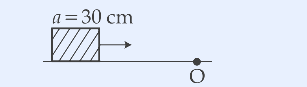
JEE Main 2016 April 09 Question Paper with Solutions
All 90 questions from the JEE Main 2016 (April 09) shift — Physics (30), Chemistry (30) and Mathematics (30) — each with the correct answer (answer key) and a step-by-step solution. Read it free online, or attempt the full paper as a timed mock test.
Physics30 questions
Q1Single correctPhysics and Measurement
In the following 'I' refers to current and 'a' to acceleration of a point mass falling vertically in a viscous medium. Choose the option that corresponds to the dimensions of electrical conductivity :
(1)
(2)
(3)
(4)
SolutionAnswer: Option 3
Approach:
Express electrical conductivity through current density and electric field, then reduce to base dimensions.
Step 1:Resistance has dimensions from R = V/I, with V = work per charge.
Step 2:Resistivity equals resistance times area over length.
Step 3:Conductivity is the reciprocal of resistivity.
Final answer:
Q2Single correctLaws of Motion
Which of the following option correctly describes the variation of the speed and acceleration 'a' of a point mass falling vertically in a viscous medium that applies a force , where 'k' is a constant, on the body ? (Graphs are schematic and not drawn to scale)
(1)
(2)
(3)
(4)
SolutionAnswer: Option 2Graph in which starts from zero and increases with time, saturating to a constant value, while starts at a high value and decreases to zero.
Approach:
Write Newton's equation for fall with linear drag and analyse the time behaviour of speed and acceleration.
Step 1:At the instant of release the speed is zero, so the drag vanishes and the acceleration is maximum.
Step 2:As speed grows the drag rises, reducing the net force and hence the acceleration.
Step 3:Speed rises from zero and asymptotically approaches the terminal value where acceleration becomes zero.
Final answer: Graph in which starts from zero and increases with time, saturating to a constant value, while starts at a high value and decreases to zero.
Q3Single correctLaws of Motion
A rocket is fired vertically from the earth with an acceleration of , where g is the gravitational acceleration. On an inclined plane inside the rocket, making an angle with the horizontal, a point object of mass m is kept. The minimum coefficient of friction between the mass and the inclined surface such that the mass does not move is :
(1)
(2)
(3)
(4)
SolutionAnswer: Option 1
Approach:
Work in the accelerating rocket frame, where an effective gravity acts, and balance forces along and perpendicular to the incline.
Step 1:In the rocket frame a pseudo-force adds to gravity, giving an effective downward field.
Step 2:Component of effective weight along the incline.
Step 3:Maximum static friction from the normal reaction.
Step 4:For no motion the friction must balance the driving component; the common factor cancels.
Final answer:
Q4Single correctWork, Energy and Power
A car of weight W is on an inclined road that rises by 100 m over a distance of 1 km and applies a constant frictional force on the car. While moving uphill on the road at a speed of , the car needs power P. If it needs power while moving downhill at speed v then value of v is :
(1)
(2)
(3)
(4)
SolutionAnswer: Option 2
Approach:
Find the driving force and power going uphill, then the driving force going downhill, and use the given power ratio to get the speed.
Step 1:Uphill the engine overcomes both the gravity component and friction.
Step 2:Power required uphill at 10 m/s.
Step 3:Downhill gravity assists, so the magnitude of the engine force needed is the difference of gravity component and friction.
Step 4:Apply the given power downhill equal to half of P.
Final answer:
Q5Single correctRotational Motion
A cubical block of side 30 cm is moving with velocity on a smooth horizontal surface. The surface has a bump at a point O as shown in figure. The angular velocity (in rad/s) of the block immediately after it hits the bump, is :
(1)
(2)
(3)
(4)
SolutionAnswer: Option 1
Approach:
Conserve angular momentum about the bump O at the instant of impact, then use the cube's moment of inertia about an edge.
Step 1:Before impact the centre of mass moves horizontally at height a/2 above the bump.
Step 2:After impact the block rotates about the edge through O.
Step 3:Equate the two and solve for the angular velocity.
Step 4:Evaluate numerically.
Final answer:
Q6Single correctGravitation
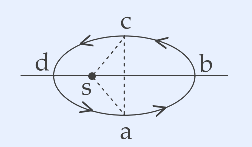
Figure shows elliptical path abcd of a planet around the sun S such that the area of triangle csa is the area of the ellipse. (See figure) With db as the semimajor axis, and ca as the semiminor axis. If is the time taken for planet to go over path abc and for path taken over cda then :
(1)
(2)
(3)
(4)
SolutionAnswer: Option 3
Approach:
Apply Kepler's second law, which makes the time spent proportional to the area swept by the radius from the sun.
Step 1:The major axis divides the ellipse into two equal halves, each of area A/2.
Step 2:The triangle csa with the sun contributes one quarter of the ellipse area to the swept region.
Step 3:Area swept along abc is half the ellipse plus the triangle; along cda it is half the ellipse minus the triangle.
Step 4:Times are in the same ratio as the swept areas.
Final answer:
Q7Single correctProperties of Solids and Liquids
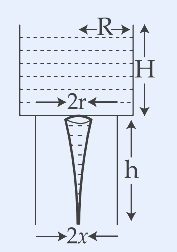
Consider a water jar of radius R that has water filled up to height H and is kept on a stand of height h (see figure). Through a hole of radius r (r << R) at its bottom, the water leaks out and the stream of water coming down towards the ground has a shape like a funnel as shown in the figure. If the radius of the cross-section of water stream when it hits the ground is x. Then :
(1)
(2)
(3)
(4)
SolutionAnswer: Option 3
Approach:
Use Torricelli's theorem for the exit speed and the equation of continuity between the hole and the ground.
Step 1:Speed at the hole is set by the water column height H.
Step 2:Falling a further height h to the ground, the speed increases.
Step 3:Apply continuity of volume flow between hole and ground.
Step 4:Take the square root.
Final answer:
Q8Single correctThermodynamics
200 g water is heated from to . Ignoring the slight expansion of water, the change in its internal energy is (Given specific heat of water ) :
(1)
(2)
(3)
(4)
SolutionAnswer: Option 3
Approach:
With negligible expansion the work done is zero, so the change in internal energy equals the heat supplied.
Step 1:Convert the mass and find the temperature rise.
Step 2:Compute the heat supplied.
Step 3:Ignoring expansion, the internal energy change equals this heat.
Final answer:
Q9Single correctThermodynamics
The ratio of work done by an ideal monoatomic gas to the heat supplied to it in an isobaric process is :
(1)
(2)
(3)
(4)
SolutionAnswer: Option 4
Approach:
Express the work and the heat for an isobaric process using the molar gas constant and the molar heat capacity at constant pressure.
Step 1:Form the ratio of work to heat.
Step 2:Substitute the monoatomic value of Cp.
Final answer:
Q10Single correctOscillations and Waves
Two particles are performing simple harmonic motion in a straight line about the same equilibrium point. The amplitude and time period for both particles are same and equal to A and T, respectively. At time one particle has displacement A while the other one has displacement and they are moving towards each other. If they cross each other at time t, then t is :
(1)
(2)
(3)
(4)
SolutionAnswer: Option 1
Approach:
Write each displacement as a cosine with the correct phase, impose the meeting condition, and solve for the time.
Step 1:Particle 1 starts at the positive extreme.
Step 2:Particle 2 starts at -A/2 moving towards particle 1, fixing its phase at -2 pi/3.
Step 3:Set the displacements equal so the cosines are equal at symmetric phases.
Step 4:Solve for the time.
Final answer:
Q11Single correctOscillations and Waves
Two engines pass each other moving in opposite directions with uniform speed of 30 m/s. One of them is blowing a whistle of frequency 540 Hz. Calculate the frequency heard by driver of second engine before they pass each other. Speed of sound is 330 m/sec is :
(1)
(2)
(3)
(4)
SolutionAnswer: Option 3
Approach:
Apply the Doppler formula with both source and observer approaching each other before they meet.
Step 1:Both engines move towards each other, so observer speed adds and source speed subtracts.
Step 2:Substitute into the Doppler formula.
Step 3:Evaluate.
Final answer:
Q12Single correctElectrostatics
The potential (in volts) of a charge distribution is given by
for
for
V(z) does not depend on x and y. If this potential is generated by a constant charge per unit volume (in units of ) which is spread over a certain region, then choose the correct statement.
for
for
V(z) does not depend on x and y. If this potential is generated by a constant charge per unit volume (in units of ) which is spread over a certain region, then choose the correct statement.
(1)
(2)
(3)
(4)
SolutionAnswer: Option 1 for and elsewhere
Approach:
Apply Poisson's equation, which relates the second derivative of the potential to the charge density.
Step 1:Differentiate the inner potential twice.
Step 2:Relate to the charge density inside.
Step 3:Differentiate the outer potential twice.
Step 4:The charge density vanishes outside.
Final answer: for and elsewhere
Q13Single correctElectrostatics
Three capacitors each of are to be connected in such a way that the effective capacitance is . This can be done by connecting them :
(1)
(2)
(3)
(4)
SolutionAnswer: Option 2two in series and one in parallel
Approach:
Test each configuration by computing its equivalent capacitance until 6 microfarad is reached.
Step 1:Combine two capacitors in series.
Step 2:Add the third capacitor in parallel with this series pair.
Final answer: two in series and one in parallel
Q14Single correctCurrent Electricity
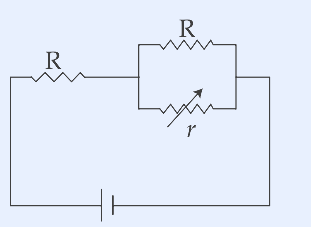
In the circuit shown, the resistance is a variable resistance. If for , the heat generation in is maximum then the value of is :
(1)
(2)
(3)
(4)
SolutionAnswer: Option 2
Approach:
Write the power in r in terms of f using series R with the parallel combination of R and r, then maximize.
Step 1:Set R = 1 and r = f; find the parallel block and total resistance.
Step 2:Voltage across the parallel block from the current through it.
Step 3:Power dissipated in r.
Step 4:Differentiate and set to zero.
Final answer:
Q15Single correctMagnetic Effects of Current and Magnetism
A magnetic dipole is acted upon by two magnetic fields which are inclined to each other at an angle of . One of the fields has a magnitude of 15 mT. The dipole attains stable equilibrium at an angle of with this field. The magnitude of the other field (in mT) is close to :
(1)
(2)
(3)
(4)
SolutionAnswer: Option 1
Approach:
At equilibrium the torques from the two fields balance; equate the two torque magnitudes and solve for the unknown field.
Step 1:The dipole makes 30 degrees with the first field, hence 45 degrees with the second.
Step 2:Balance the torques from the two fields.
Step 3:Solve for the second field magnitude.
Step 4:Evaluate.
Final answer:
Q16Single correctCurrent Electricity
A resistance is connected to a battery of 5 V. A galvanometer of resistance is to be used as an ammeter to measure current through the resistance, for this a resistance is connected to the galvanometer. Which of the following connections should be employed if the measured current is within of the current without the ammeter in the circuit ?
(1)
(2)
(3)
(4)
SolutionAnswer: Option 1 in parallel with the galvanometer
Approach:
An ammeter must present a very small resistance so it does not alter the circuit current; a galvanometer is converted to an ammeter by placing a low-value shunt in parallel. The shunt is chosen so the extra series resistance kept in the loop changes the current by at most one percent.
Step 1:Compute the undisturbed current.
Step 2:For an ammeter the meter resistance must be added in series with the load, so it has to be made as small as possible by a parallel shunt across the galvanometer.
Step 3:With a parallel shunt of the inserted resistance is about , changing the current to , a deviation under one percent; a series resistance only raises the total resistance and a parallel shunt adds roughly twice as much, so the parallel choice satisfies the requirement.
Final answer: in parallel with the galvanometer
Q17Single correctAlternating Current
A series LR circuit is connected to a voltage source with . After very large time, current I(t) behaves as :
(1)
(2)
(3)
(4)
SolutionAnswer: Option 2I(t) is a sustained sinusoid of constant amplitude oscillating symmetrically about zero for
Approach:
The current in a driven series LR circuit is the sum of a transient term that decays with time constant L/R and a steady-state sinusoidal term at the driving frequency. After a time large compared with L/R the transient vanishes and only the constant-amplitude sinusoid survives.
Step 1:The full solution contains an exponential transient with time constant L/R plus a forced sinusoidal response.
Step 2:For the exponential factor is negligibly small.
Step 3:Only the steady-state sinusoid of fixed amplitude remains, oscillating about zero, matching the constant-amplitude wave.
Final answer: I(t) is a sustained sinusoid of constant amplitude oscillating symmetrically about zero for
Q18Single correctElectromagnetic Waves
Microwave oven acts on the principle of :
(1)
(2)
(3)
(4)
SolutionAnswer: Option 2giving rotational energy to water molecules
Approach:
Microwave frequencies match the rotational resonance of polar water molecules; the oscillating field exerts a torque on the molecular dipole, exciting rotational motion that is then shared as heat.
Step 1:Water is a polar molecule with a permanent electric dipole moment.
Step 2:The microwave field oscillates at a frequency close to the rotational resonance of water, exerting an oscillating torque.
Step 3:The rotational energy spreads through molecular collisions, heating the food.
Final answer: giving rotational energy to water molecules
Q19Single correctRay Optics and Optical Instruments
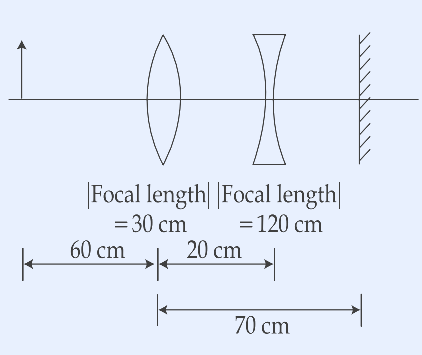
A convex lens, of focal length 30 cm, a concave lens of focal length 120 cm, and a plane mirror are arranged as shown. For an object kept at a distance of 60 cm from the convex lens, the final image, formed by the combination, is a real image, at a distance of :
(1)
(2)
(3)
(4)
SolutionAnswer: Option 160 cm from the convex lens
Approach:
Trace the object through the convex lens, then the concave lens, reflect off the plane mirror and retrace back through both lenses. The intended retracing geometry makes the final real image coincide with the object plane at 60 cm from the convex lens.
Step 1:The convex lens images the object placed 60 cm away.
Step 2:This image lies at the concave-lens plane (the lens separation is 60 cm), so the rays converge to a point on the concave lens and pass essentially undeviated towards the plane mirror.
Step 3:The plane mirror reflects the rays back through the concave and convex lenses; the symmetric return path reconstructs a real image at the object plane, 60 cm from the convex lens.
Final answer: 60 cm from the convex lens
Q20Single correctWave Optics
In Young's double slit experiment, the distance between slits and the screen is 1.0 m and monochromatic light of 600 nm is being used. A person standing near the slits is looking at the fringe pattern. When the separation between the slits is varied, the interference pattern disappears for a particular distance between the slits. If the angular resolution of the eye is , the value of is close to :
(1)
(2)
(3)
(4)
SolutionAnswer: Option 22 mm
Approach:
The fringe pattern stops being resolvable when the angular fringe spacing equals the angular resolution of the eye. Equate the angular fringe width to the given resolution to obtain the slit separation.
Step 1:Convert the eye's angular resolution to radians.
Step 2:Set the angular fringe spacing equal to this resolution.
Step 3:Solve for the slit separation.
Final answer: 2 mm
Q21Single correctDual Nature of Radiation and Matter
When photons of wavelength are incident on an isolated sphere, the corresponding stopping potential is found to be V. When photons of wavelength are used, the corresponding stopping potential was thrice that of the above value. If light of wavelength is used then find the stopping potential for this case :
(1)
(2)
(3)
(4)
SolutionAnswer: Option 3
Approach:
Apply Einstein's photoelectric equation for each wavelength to express the stopping potential in terms of the work function, eliminate the work function using the two known cases, then substitute for the third wavelength.
Step 1:Write the stopping potential for the first two wavelengths.
Step 2:Eliminate V by combining the relations (3 times the first minus the second) to find the work function.
Step 3:Substitute into the stopping-potential expression for the third wavelength.
Final answer:
Q22Single correctAtoms and Nuclei
A hydrogen atom makes a transition from to and emits a photon. This photon strikes a doubly ionized lithium atom in excited state and completely removes the orbiting electron. The least quantum number for the excited state of the ion for the process is :
(1)
(2)
(3)
(4)
SolutionAnswer: Option 34
Approach:
Find the energy of the emitted hydrogen photon, then require it to be at least the binding energy of the lithium ion in level n so the electron is removed; solve for the smallest integer n.
Step 1:Compute the energy of the photon emitted in the n=2 to n=1 hydrogen transition.
Step 2:Write the binding energy of the Li (Z=3) ion in level n.
Step 3:Require the photon energy to exceed the binding energy and solve for the least integer n.
Final answer: 4
Q23Single correctSemiconductor Electronics
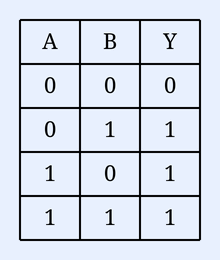
The truth table given in fig. represents :
(1)
(2)
(3)
(4)
SolutionAnswer: Option 2OR - Gate
Approach:
Read the output column of the truth table for each input combination and match it to the standard logic-gate outputs.
Step 1:Tabulate the given outputs: inputs (0,0) give 0; (0,1) give 1; (1,0) give 1; (1,1) give 1.
Step 2:The output is 0 only when both inputs are 0 and 1 otherwise.
Step 3:This is the truth table of an OR gate.
Final answer: OR - Gate
Q24Single correctCommunication Systems
An audio signal consists of two distinct sounds : one a human speech signal in the frequency band of 200 Hz to 2700 Hz, while the other is a high frequency music signal in the frequency band of 10200 Hz to 15200 Hz. The ratio of the AM signal bandwidth required to send both the signals together to the AM signal bandwidth required to send just the human speech is :
(1)
(2)
(3)
(4)
SolutionAnswer: Option 36
Approach:
The AM bandwidth equals twice the highest modulating frequency present. Compute the bandwidth needed for the combined signal and for speech alone, then take the ratio.
Step 1:For both signals together the highest frequency is 15200 Hz.
Step 2:For speech alone the highest frequency is 2700 Hz.
Step 3:Take the ratio of the two bandwidths.
Final answer: 6
Q25Single correctOscillations
A simple pendulum made of a bob of mass m and a metallic wire of negligible mass has time period 2 s at . If the temperature of the wire is increased and the corresponding change in its time period is plotted against its temperature, the resulting graph is a line of slope S. If the coefficient of linear expansion of metal is then the value of S is :
(1)
(2)
(3)
(4)
SolutionAnswer: Option 1
Approach:
Express the pendulum period as a function of temperature using linear expansion of the wire, expand to first order, and identify the slope of period versus temperature.
Step 1:Write the period with the temperature-dependent length.
Step 2:Expand to first order in the small expansion term.
Step 3:The slope of period versus temperature is the derivative, with .
Final answer:
Q26Single correctMechanical Properties of Solids
A uniformly tapering conical wire is made from a material of Young's modulus and has a normal, unextended length . The radii, at the upper and lower ends of this conical wire, have values and , respectively. The upper end of the wire is fixed to a rigid support and a mass is suspended from its lower end. The equilibrium extended length, of this wire, would equal :
(1)
(2)
(3)
(4)
SolutionAnswer: Option 2
Approach:
Integrate the elemental extension along the cone, where the radius varies linearly from R to 3R, to obtain the total elongation, then add it to the natural length.
Step 1:Write the cross-sectional area as a function of position with radius varying from R to 3R.
Step 2:Integrate the elemental extension over the full length with force Mg.
Step 3:Add the elongation to the natural length to get the extended length.
Final answer:
Q27Single correctCurrent Electricity
To know the resistance G of a galvanometer by half deflection method, a battery of emf and resistance R is used to deflect the galvanometer by angle . If a shunt of resistance S is needed to get half deflection then G, R and S are related by the equation :
(1)
(2)
(3)
(4)
SolutionAnswer: Option 2
Approach:
Compute the galvanometer current before the shunt and again after the shunt is connected in parallel, then impose that the second current is half of the first to find the relation between R, G and S.
Step 1:Before the shunt, the galvanometer carries the full current giving full deflection.
Step 2:With the shunt S across the galvanometer, the current through G for half deflection is half the initial value.
Step 3:Solving the condition yields the relation between the resistances.
Final answer:
Q28Single correctRay Optics and Optical Instruments
To find the focal length of a convex mirror, a student records the following data :
Object Pin : 22.2 cm; Convex Lens : 32.2 cm; Convex Mirror : 45.8 cm; Image Pin : 71.2 cm.
The focal length of the convex lens is and that of mirror is . Then taking index correction to be negligibly small, and are close to :
Object Pin : 22.2 cm; Convex Lens : 32.2 cm; Convex Mirror : 45.8 cm; Image Pin : 71.2 cm.
The focal length of the convex lens is and that of mirror is . Then taking index correction to be negligibly small, and are close to :
(1)
(2)
(3)
(4)
SolutionAnswer: Option 2
Approach:
Use the object pin and image pin positions with the lens to find the lens focal length, then use the fact that the rays retrace through the convex mirror only when they meet its centre of curvature to find the mirror radius and hence its focal length.
Step 1:Object distance for the lens is the separation of object pin and lens; the image distance is the separation of image pin and lens.
Step 2:Apply the lens equation to obtain the lens focal length.
Step 3:For the image pin to coincide without parallax, the rays strike the convex mirror normally and meet at its centre of curvature; the radius equals the distance from mirror to the lens image position.
Final answer:
Q29Single correctSemiconductor Electronics
An experiment is performed to determine the I - V characteristics of a Zener diode, which has a protective resistance of , and a maximum power of dissipation rating of 1 W. The minimum voltage range of the DC source in the circuit is :
(1)
(2)
(3)
(4)
SolutionAnswer: Option 3
Approach:
The maximum permissible current is fixed by the 1 W power rating dissipated in the 100 ohm protective resistance. The DC source must supply the voltage drop across this resistance plus the Zener voltage, so its minimum range just exceeds the resistor drop.
Step 1:The maximum current follows from the 1 W rating across the 100 ohm resistance.
Step 2:The voltage drop across the protective resistance at this current is computed.
Step 3:The source must cover the resistor drop plus the Zener voltage to trace the full characteristic, so the minimum range exceeding 10 V is 0 to 12 V.
Final answer:
Q30Single correctSemiconductor Electronics
An unknown transistor needs to be identified as a or type. A multimeter, with ve and ve terminals, is used to measure resistance between different terminals of transistor. If terminal 2 is the base of the transistor then which of the following is correct for a transistor ?
(1)
(2)
(3)
(4)
SolutionAnswer: Option 2ve terminal 2, ve terminal 1, resistance high
Approach:
In a pnp transistor the base is the n-type region and the emitter and collector are p-type. A junction shows low resistance when forward biased and high resistance when reverse biased; determine the bias for each option.
Step 1:For a pnp transistor the base (terminal 2) is n-type while terminals 1 and 3 are p-type.
Step 2:A high resistance reading corresponds to a reverse-biased junction, obtained by connecting the positive lead to the n-side (base) and the negative lead to a p-side.
Step 3:Connecting positive to terminal 2 (base, n) and negative to terminal 1 (p) reverse biases the junction and gives high resistance, matching the stated reading.
Final answer: ve terminal 2, ve terminal 1, resistance high
Chemistry30 questions
Q31Single correctSome Basic Concepts in Chemistry
The amount of arsenic pentasulphide that can be obtained when 35.5 g arsenic acid is treated with excess ( assuming 100% conversion) is :
(1)
(2)
(3)
(4)
SolutionAnswer: Option 3
Approach:
Find moles of arsenic acid, then apply the reaction stoichiometry for formation of arsenic pentasulphide.
Step 1:Molar mass of arsenic acid, H3AsO4.
Step 2:Moles of arsenic acid taken.
Step 3:Reaction with hydrogen sulphide forms arsenic pentasulphide.
Step 4:Moles of arsenic pentasulphide formed equal half the moles of arsenic acid.
Final answer:
Q32Single correctStates of Matter
At very high pressures, the compressibility factor of one mole of a gas is given by :
(1)
(2)
(3)
(4)
SolutionAnswer: Option 2
Approach:
Apply the van der Waals equation in the high-pressure limit where the volume-correction term dominates.
Step 1:At very high pressure the pressure-correction term a/ is negligible.
Step 2:Solve for V.
Step 3:Substitute into the compressibility factor.
Final answer:
Q33Single correctStructure of Atom
The total number of orbitals associated with the principal quantum number 5 is :
(1)
(2)
(3)
(4)
SolutionAnswer: Option 4
Approach:
Use the relation that the number of orbitals in a shell equals the square of the principal quantum number.
Step 1:For principal quantum number n = 5, count orbitals across subshells s, p, d, f, g.
Step 2:Equivalently apply .
Final answer:
Q34Single correctStates of Matter
Which intermolecular force is most responsible in allowing xenon gas to liquefy ?
(1)
(2)
(3)
(4)
SolutionAnswer: Option 3Instantaneous dipole - induced dipole
Approach:
Identify the dominant intermolecular interaction for a monatomic, nonpolar noble gas.
Step 1:Xenon is a nonpolar, monatomic noble gas with no permanent dipole and no ions.
Step 2:Attraction arises from momentary fluctuations of the electron cloud creating instantaneous dipoles that induce dipoles in neighbours (London dispersion forces).
Final answer: Instantaneous dipole - induced dipole
Q35Single correctChemical Thermodynamics
A reaction at 1 bar is non-spontaneous at low temperature but becomes spontaneous at high temperature. Identify the correct statement about the reaction among the following :
(1)
(2)
(3)
(4)
SolutionAnswer: Option 1Both and are positive.
Approach:
Use the Gibbs free energy criterion and the temperature dependence of spontaneity.
Step 1:Spontaneity at high temperature but not at low temperature requires the term -T* to become dominant and negative as T rises.
Step 2:Non-spontaneity at low temperature requires positive so that at small T the positive enthalpy dominates.
Final answer: Both and are positive.
Q36Single correctSolutions
The solubility of in water at 300 K and 500 torr partial pressure is 0.01 g . The solubility (in g ) at 750 mm partial pressure is :
(1)
(2)
(3)
(4)
SolutionAnswer: Option 2
Approach:
Apply Henry's law: at constant temperature solubility is directly proportional to the partial pressure of the gas.
Step 1:Both pressures are in mm Hg (torr); 500 torr corresponds to solubility 0.01 g/L.
Step 2:Scale the solubility by the pressure ratio.
Final answer:
Q37Single correctChemical Thermodynamics
For the reaction,
and are, respectively, kJ mo and kJ mo at 298 K. The equilibrium constant for the reaction at 298 K is :
and are, respectively, kJ mo and kJ mo at 298 K. The equilibrium constant for the reaction at 298 K is :
(1)
(2)
(3)
(4)
SolutionAnswer: Option 4
Approach:
Compute the standard Gibbs free energy change, then relate it to the equilibrium constant.
Step 1:Evaluate the standard free energy change at 298 K.
Step 2:Relate zero free energy change to the equilibrium constant.
Final answer:
Q38Single correctRedox Reactions and Electrochemistry
What will occur if a block of copper metal is dropped into a beaker containing a solution of ?
(1)
(2)
(3)
(4)
SolutionAnswer: Option 4No reaction will occur.
Approach:
Compare the relative reactivity (standard reduction potentials) of copper and zinc to decide whether displacement occurs.
Step 1:Zinc is more reactive than copper; the standard reduction potential of Zn2+/Zn (-0.76 V) is lower than that of Cu2+/Cu (+0.34 V).
Step 2:A less reactive metal cannot displace a more reactive metal from its salt, so copper cannot reduce Zn2+ ions.
Final answer: No reaction will occur.
Q39Single correctChemical Kinetics
The reaction of ozone with oxygen atoms in the presence of chlorine atoms can occur by a two step process shown below :
----- (i)
L mo
----- (ii)
L mo
The closest rate constant for the overall reaction is :
----- (i)
L mo
----- (ii)
L mo
The closest rate constant for the overall reaction is :
(1)
(2)
(3)
(4)
SolutionAnswer: Option 1 L mo
Approach:
In a multistep mechanism the overall rate is governed by the slowest (rate-determining) step.
Step 1:Chlorine atoms act as a catalyst; ClO is an intermediate. The overall rate is limited by the slower elementary step.
Step 2:Compare the two rate constants.
Step 3:The closest overall rate constant equals that of the slower step.
Final answer: L mo
Q40Single correctSurface Chemistry
A particular adsorption process has the following characteristics : (i) It arises due to van der Waals forces and (ii) it is reversible. Identify the correct statement that describes the above adsorption process :
(1)
(2)
(3)
(4)
SolutionAnswer: Option 2Energy of activation is low.
Approach:
Identify the type of adsorption from the clues, then select the property consistent with it.
Step 1:Adsorption arising from van der Waals forces and being reversible is physisorption.
Step 2:Physisorption has low enthalpy (20-40 kJ/mol), low activation energy, multilayer character, and decreases with temperature.
Step 3:Among the options only low activation energy matches physisorption.
Final answer: Energy of activation is low.
Q41Single correctp-Block Elements
The non-metal that does not exhibit positive oxidation state is :
(1)
(2)
(3)
(4)
SolutionAnswer: Option 4Fluorine
Approach:
Use electronegativity to decide which element can never carry a positive oxidation state.
Step 1:Fluorine is the most electronegative element; it always attracts shared electrons and cannot be assigned a positive oxidation state.
Step 2:Oxygen shows +2 in OF2, while iodine and chlorine show positive states in interhalogens and oxoacids.
Final answer: Fluorine
Q42Single correctGeneral Principles and Processes of Isolation of Metals
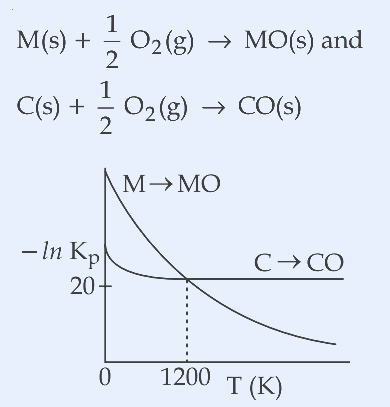
The plot shows the variation of versus temperature for the two reactions.
and
Identify the correct statement :
and
Identify the correct statement :
(1)
(2)
(3)
(4)
SolutionAnswer: Option 2At T1200 K, the reaction MO(s) C(s) M(s) CO(g) is spontaneous.
Approach:
Ellingham reading: on the plot the MMO line lies above the CCO line for T1200 K, so formation of CO is more favourable than formation of MO; therefore MO(s)+C(s)M(s)+CO(g) is spontaneous below 1200 K.
Step 1:Ellingham reading: on the plot the MMO line lies above the CCO line for T1200 K, so formation of CO is more favourable than formation of MO; therefore MO(s)+C(s)M(s)+CO(g) is spontaneous below 1200 K.
At T1200 K, the reaction MO(s) C(s) M(s) CO(g) is spontaneous.
Final answer: At T1200 K, the reaction MO(s) C(s) M(s) CO(g) is spontaneous.
Q43Single correctHydrogen
Identify the incorrect statement regarding heavy water :
(1)
(2)
(3)
(4)
SolutionAnswer: Option 2It is used as a coolant in nuclear reactors.
Approach:
Evaluate each statement; the reactions of heavy water are well established, so the odd statement concerns its role in nuclear reactors.
Step 1:Heavy water hydrolyses Al4C3 to CD4 and Al(OD)3, CaC2 to C2D2 and Ca(OD)2, and reacts with SO3 to give D2SO4; these are correct.
Step 2:Heavy water functions chiefly as a moderator (to slow neutrons), not as a coolant; describing it as a coolant is the incorrect statement.
Final answer: It is used as a coolant in nuclear reactors.
Q44Single corrects-Block Elements
The correct order of the solubility of alkaline-earth metal sulphates in water is :
(1)
(2)
(3)
(4)
SolutionAnswer: Option 4
Approach:
Use the trend that solubility of alkaline earth sulphates decreases down the group due to the dominance of falling hydration energy over lattice energy.
Step 1:Cation size increases down the group, so hydration enthalpy decreases sharply while lattice enthalpy changes little.
Step 2:Solubility therefore decreases from Mg to Ba.
Final answer:
Q45Single correctp-Block Elements
Match the items in Column I with their use mentioned in Column II :
| Column I | Column II |
|---|---|
| (A). Silica gel | (i). Transistor |
| (B). Silicon | (ii). Ion-exchanger |
| (C). Silicone | (iii). Drying agent |
| (D). Silicate | (iv). Sealant |
(1)
(2)
(3)
(4)
SolutionAnswer: Option 1(A)-(iii), (B)-(i), (C)-(iv), (D)-(ii)
Approach:
Match each silicon-based material with its characteristic application.
Step 1:Silica gel is highly porous and adsorbs moisture, so it is a drying agent.
Step 2:Silicon is a semiconductor used in transistors.
Step 3:Silicones are water-repellent polymers used as sealants.
Step 4:Silicates such as zeolites act as ion-exchangers.
Final answer: (A)-(iii), (B)-(i), (C)-(iv), (D)-(ii)
Q46Single correctChemical Bonding and Molecular Structure
The group of molecules having identical shape is :
(1)
(2)
(3)
(4)
SolutionAnswer: Option 2
Approach:
Apply VSEPR theory to count bond pairs and lone pairs on the central atom in each molecule and compare resulting shapes.
Step 1:Examine option 2 species.
Step 2:Examine remaining option 2 species.
Step 3:Compare with other options where the species differ (tetrahedral/square planar in option 1, trigonal pyramidal/trigonal planar in option 3, mixed in option 4).
Final answer:
Q47Single correctThe d- and f-Block Elements
Which one of the following species is stable in aqueous solution ?
(1)
(2)
(3)
(4)
SolutionAnswer: Option 4
Approach:
C is a strong reductant (reduces water), C disproportionates (Cu+C), and MnO (Mn(V)) disproportionates; manganate MnO (Mn(VI)) is the only species isolable/stable in aqueous (alkaline) solution.
Step 1:C is a strong reductant (reduces water), C disproportionates (Cu+C), and MnO (Mn(V)) disproportionates; manganate MnO (Mn(VI)) is the only species isolable/stable in aqueous (alkaline) solution.
Final answer:
Q48Single correctCoordination Compounds
Which one of the following complexes will consume more equivalents of aqueous solution of ?
(1)
(2)
(3)
(4)
SolutionAnswer: Option 3
Approach:
Only chloride ions outside the coordination sphere are ionizable and precipitate with silver nitrate; count ionizable chlorides in each complex.
Step 1:Coordinated chlorides do not react with silver nitrate.
Step 2:Count ionizable chlorides in the partially aquated complexes.
Step 3:The fully aquated complex has all three chlorides outside the sphere.
Final answer:
Q49Single correctCoordination Compounds
Identify the correct trend given below :
(Atomic No. = Ti : 22, Cr : 24 and Mo : 42)
(Atomic No. = Ti : 22, Cr : 24 and Mo : 42)
(1)
(2)
(3)
(4)
SolutionAnswer: Option 3 of and of
Approach:
Apply the dependence of crystal field splitting on the principal quantum number of the d orbitals and on the oxidation state of the metal.
Step 1:Splitting increases on moving down a group from 3d to 4d.
Step 2:Splitting increases with higher metal oxidation state.
Step 3:Combine both correct inequalities.
Final answer: of and of
Q50Single correctEnvironmental Chemistry
BOD stands for :
(1)
(2)
(3)
(4)
SolutionAnswer: Option 3Biochemical Oxygen Demand
Approach:
Recall the standard expansion of the water-quality parameter BOD.
Step 1:BOD measures the oxygen required by microorganisms to biochemically degrade organic matter in water.
Final answer: Biochemical Oxygen Demand
Q51Single correctSome Basic Concepts in Chemistry
An organic compound contains C, H and S. The minimum molecular weight of the compound containing 8% sulphur is :
(atomic weight of S = 32 amu)
(atomic weight of S = 32 amu)
(1)
(2)
(3)
(4)
SolutionAnswer: Option 2
Approach:
Minimum molecular weight corresponds to exactly one sulphur atom per molecule; relate the sulphur mass percentage to the molecular weight.
Step 1:Set the number of sulphur atoms to its minimum value of one.
Step 2:Substitute the sulphur percentage into the mass-percent relation.
Step 3:Solve for the molecular weight.
Final answer:
Q52Single correctHydrocarbons
The hydrocarbon with seven carbon atoms containing a neopentyl and a vinyl group is :
(1)
(2)
(3)
(4)
SolutionAnswer: Option 34, 4-dimethyl-1-pentene
Approach:
Construct the molecule from a neopentyl fragment joined to a vinyl group, then assign the IUPAC name with lowest locants.
Step 1:Combine neopentyl (5 carbons) with vinyl (2 carbons).
Step 2:Choose the longest chain containing the double bond and number from the end giving the double bond the lowest locant.
Step 3:Assign substituent positions.
Final answer: 4, 4-dimethyl-1-pentene
Q53Single correctHydrocarbons
5 L of an alkane requires 25 L of oxygen for its complete combustion. If all volumes are measured at constant temperature and pressure, the alkane is :
(1)
(2)
(3)
(4)
SolutionAnswer: Option 2Propane
Approach:
Use Gay-Lussac's law of combining volumes for the general alkane combustion equation, equating volume ratios with mole ratios.
Step 1:At constant T and P, volume ratio equals mole ratio.
Step 2:Equate this ratio with the stoichiometric oxygen coefficient.
Step 3:Solve for the number of carbon atoms.
Final answer: Propane
Q54Single correctOrganic Compounds Containing Halogens
The gas evolved on heating in methanol is :
(1)
(2)
(3)
(4)
SolutionAnswer: Option 2Methane
Approach:
A Grignard reagent reacts with the acidic hydroxyl hydrogen of an alcohol to liberate the corresponding alkane.
Step 1:Methanol provides an active O-H proton to the carbanion-like methyl of the Grignard reagent.
Step 2:The magnesium ends up as the methoxide salt.
Final answer: Methane
Q55Single correctAldehydes, Ketones and Carboxylic Acids
Bouveault-Blanc reduction reaction involves :
(1)
(2)
(3)
(4)
SolutionAnswer: Option 2Reduction of an ester with .
Approach:
Recall the substrate and reagent associated with the Bouveault-Blanc reduction.
Step 1:The Bouveault-Blanc method reduces esters using sodium metal in ethanol.
Final answer: Reduction of an ester with .
Q56Single correctOrganic Compounds Containing Nitrogen
The test to distinguish primary, secondary and tertiary amines is :
(1)
(2)
(3)
(4)
SolutionAnswer: Option 2
Approach:
Identify the reagent whose differing reactivity with the three classes of amines provides a distinguishing test.
Step 1:Benzenesulphonyl chloride is the Hinsberg reagent used to separate and distinguish amine classes.
Step 2:Primary amines give an alkali-soluble sulphonamide, secondary amines give an alkali-insoluble sulphonamide, and tertiary amines do not react.
Final answer:
Q57Single correctPolymers
Assertion : Rayon is a semisynthetic polymer whose properties are better than natural cotton.
Reason : Mechanical and aesthetic properties of cellulose can be improved by acetylation.
Reason : Mechanical and aesthetic properties of cellulose can be improved by acetylation.
(1)
(2)
(3)
(4)
SolutionAnswer: Option 1Both assertion and reason are correct, and the reason is the correct explanation for the assertion.
Approach:
Assess the truth of the assertion and the reason separately, then decide whether the reason explains the assertion.
Step 1:Rayon is regenerated/modified cellulose, a semisynthetic fibre with improved mechanical and aesthetic properties over natural cotton.
Step 2:Acetylation of cellulose enhances its mechanical and aesthetic properties, accounting for rayon's superiority.
Final answer: Both assertion and reason are correct, and the reason is the correct explanation for the assertion.
Q58Single correctBiomolecules
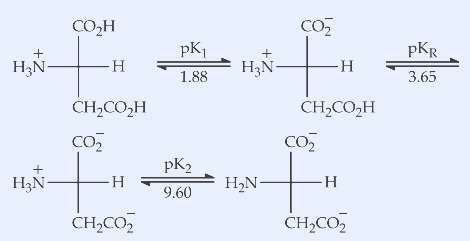
Consider the following sequence for aspartic acid :
The (isoelectric point) of aspartic acid is :
The (isoelectric point) of aspartic acid is :
(1)
(2)
(3)
(4)
SolutionAnswer: Option 4
Approach:
For an acidic amino acid, the isoelectric point is the average of the two pKa values that bracket the neutral (zwitterionic) species, which are the two lowest pKa values.
Step 1:Identify the two acidic dissociations flanking the neutral form.
Step 2:Average the two values.
Step 3:Round to the option value.
Final answer:
Q59Single correctChemistry in Everyday Life
The artificial sweetener that has the highest sweetness value in comparison to cane sugar is :
(1)
(2)
(3)
(4)
SolutionAnswer: Option 4Alitame
Approach:
Compare the relative sweetness of the listed artificial sweeteners against sucrose.
Step 1:List the approximate sweetness of each agent relative to cane sugar.
Final answer: Alitame
Q60Single correctSurface Chemistry
The most appropriate method of making egg-albumin sol is :
(1)
(2)
(3)
(4)
SolutionAnswer: Option 1Break an egg carefully and transfer the transparent part of the content to 100 mL of 5% w/V saline solution and stir well.
Approach:
Egg-albumin sol is a lyophilic colloid of the soluble egg-white protein; the protein must remain native, so boiling (which coagulates it) is avoided and the transparent white is used.
Step 1:Egg albumin resides in the transparent (white) part, not the yellow yolk.
Step 2:Boiling denatures and coagulates albumin, destroying the sol-forming protein.
Step 3:Stirring the native egg white into dilute saline disperses the protein as a lyophilic sol.
Final answer: Break an egg carefully and transfer the transparent part of the content to 100 mL of 5% w/V saline solution and stir well.
Mathematics30 questions
Q61Single correctRelations and Functions
For , let and Then the value of is equal to :
(1)
(2)
(3)
(4)
SolutionAnswer: Option 2
Approach:
Compute the first few iterates of to detect periodicity, then reduce indices modulo the period and evaluate.
Step 1:Compute .
Step 2:Compute .
Step 3:Reduce the index 100 modulo 3.
Step 4:Evaluate the remaining terms.
Step 5:Add the three values.
Final answer:
Q62Single correctComplex Numbers
The point represented by in the Argand plane moves 1 unit eastwards, then 2 units northwards and finally from there units in the south-westwards direction. Then its new position in the Argand plane is at the point represented by :
(1)
(2)
(3)
(4)
SolutionAnswer: Option 2
Approach:
Translate the directional moves into complex displacements and add them to the starting point.
Step 1:Move 1 unit east.
Step 2:Move 2 units north.
Step 3:Move units south-west.
Step 4:Add the final displacement.
Final answer:
Q63Single correctComplex Numbers and Quadratic Equations
If the equations and have a common root different from , then is equal to :
(1)
(2)
(3)
(4)
SolutionAnswer: Option 4
Approach:
Subtract the equations to get the common root, substitute back, and solve the resulting cubic in b.
Step 1:Subtract the second equation from the first.
Step 2:Substitute this root into and clear denominators.
Step 3:Expand and simplify.
Step 4:Reject since it forces the common root to be , which is excluded.
Final answer:
Q64Single correctMatrices and Determinants
If , and , then is :
(1)
(2)
(3)
(4)
SolutionAnswer: Option 4
Approach:
Use that P is orthogonal so the conjugation telescopes, reducing the expression to a power of A.
Step 1:P is a rotation matrix, hence orthogonal.
Step 2:Raise to the power 2015.
Step 3:Conjugate back by P.
Step 4:Compute the matrix power.
Final answer:
Q65Single correctMatrices and Determinants
The number of distinct real roots of the equation, in the interval is :
(1)
(2)
(3)
(4)
SolutionAnswer: Option 3
Approach:
Factor the determinant using its symmetric structure, then count the roots of each factor inside the interval.
Step 1:The matrix has diagonal cos x and equal off-diagonal sin x, giving a factored determinant.
Step 2:Solve .
Step 3:Solve .
Step 4:Count distinct roots.
Final answer:
Q66Single correctPermutations and Combinations
If the four letter words (need not be meaningful) are to be formed using the letters from the word "MEDITERRANEAN" such that the first letter is R and the fourth letter is E, then the total number of all such words is :
(1)
(2)
(3)
(4)
SolutionAnswer: Option 4
Approach:
Word pattern R _ _ E using letters of MEDITERRANEAN. After fixing one R and one E, the two middle places are filled from 8 distinct letter types (E,A,N each still available in pairs): ordered distinct pairs plus identical pairs (EE, AA, NN) .
Step 1:Word pattern R _ _ E using letters of MEDITERRANEAN. After fixing one R and one E, the two middle places are filled from 8 distinct letter types (E,A,N each still available in pairs): ordered distinct pairs plus identical pairs (EE, AA, NN) .
Final answer:
Q67Single correctBinomial Theorem
For , if , then is equal to :
(1)
(2)
(3)
(4)
SolutionAnswer: Option 1
Approach:
Sum the geometric series in closed form, then read off the coefficient of .
Step 1:The left side is a geometric series with ratio x/(1+x) and first term .
Step 2:Sum the series.
Step 3:Extract the coefficient of (only the first term contributes).
Final answer:
Q68Single correctAlgebra
Let x, y, z be positive real numbers such that and . Then is equal to :
(1)
(2)
(3)
(4)
SolutionAnswer: Option 4
Approach:
Apply weighted AM-GM with weights 3, 4, 5; equality forces a unique (x, y, z), then evaluate the required sum.
Step 1:Equality in weighted AM-GM holds when x/3 = y/4 = z/5; with x+y+z=12 the common ratio is 1.
Step 2:Check the product constraint.
Step 3:Compute the required sum of cubes.
Final answer:
Q69Single correctBinomial Theorem
The value of is equal to :
(1)
(2)
(3)
(4)
SolutionAnswer: Option 2
Approach:
Simplify the ratio of consecutive binomial coefficients, reduce the summand to a polynomial in r, and use standard summation formulas.
Step 1:Simplify the ratio for n = 15.
Step 2:Reduce the summand.
Step 3:Sum from r = 1 to 15.
Final answer:
Q70Single correctLimits, Continuity and Differentiability
If , then 'a' is equal to :
(1)
(2)
(3)
(4)
SolutionAnswer: Option 2
Approach:
Use the nfinity standard form, where the limit equals e raised to the limit of (base minus 1) times the exponent.
Step 1:Apply the standard form with f = a/x - 4/ and g = 2x.
Step 2:Equate to the given value.
Final answer:
Q71Single correctLimits, Continuity and Differentiability
If the function is differentiable at , then is equal to :
(1)
(2)
(3)
(4)
SolutionAnswer: Option 3
Approach:
Impose equality of left and right derivatives at x=1 to find b, then continuity to find a, and form the ratio.
Step 1:Match the right derivative at x=1 with the left derivative -1.
Step 2:Impose continuity at x=1 using b=-1.
Step 3:Form the ratio a/b.
Final answer:
Q72Single correctApplication of Derivatives
If the tangent at a point P, with parameter t, on the curve , , , meets the curve again at a point Q, then the coordinates of Q are :
(1)
(2)
(3)
(4)
SolutionAnswer: Option 1
Approach:
Equate the slope of the tangent at parameter t with the slope of the chord joining parameters t and s, solve for the second parameter, and substitute.
Step 1:Compute the tangent slope at parameter t.
Step 2:Set chord slope between parameters t and s equal to 3t.
Step 3:Factor and take the root other than s = t.
Step 4:Substitute s = -t/2 into the parametrisation.
Final answer:
Q73Single correctApplication of Derivatives
The minimum distance of a point on the curve from the origin is :
(1)
(2)
(3)
(4)
SolutionAnswer: Option 3
Approach:
Minimise the squared distance from the origin as a function of .
Step 1:Write the squared distance for a point on the curve.
Step 2:Let u = and minimise.
Step 3:Evaluate the minimum squared distance.
Step 4:Take the square root.
Final answer:
Q74Single correctIntegral Calculus
If , where k is a constant of integration, then equals :
(1)
(2)
(3)
(4)
SolutionAnswer: Option 2
Approach:
Rewrite the integrand in terms of tan x, substitute t = tan x, integrate the resulting power function, and identify A, B, C.
Step 1:Simplify the radical.
Step 2:Rewrite the integrand.
Step 3:Substitute t = tan x and integrate.
Step 4:Identify A, B, C and add.
Final answer:
Q75Single correctIntegral Calculus
If , then is equal to :
(1)
(2)
(3)
(4)
SolutionAnswer: Option 3
Approach:
Use tan inverse plus cot inverse equals pi/2 to relate the required integral to the given one, then evaluate the elementary integral of tan inverse x.
Step 1:Apply the complementary identity to the required integral.
Step 2:Evaluate the arctan integral.
Step 3:Substitute back.
Final answer:
Q76Single correctIntegral Calculus
The area (in sq. units) of the region described by is :
(1)
(2)
(3)
(4)
SolutionAnswer: Option 2
Approach:
Identify the boundaries of the region, locate intersection points, and integrate the vertical distance between the upper bound y=0 and the relevant lower bound over each sub-interval.
Step 1:The parabola y = - 5x + 4 has roots at x = 1 and x = 4; the line x + y = 1 gives y = 1 - x. The region requires y below 0, above the line, and above the parabola.
Step 2:Find where parabola meets the line.
Step 3:On [1,3] the line is the higher (less negative) lower bound; on [3,4] the parabola is. Integrate against the upper bound y = 0.
Step 4:Evaluate each integral.
Step 5:Add the contributions.
Final answer:
Q77Single correctDifferential Equations
If f is a differentiable function in the interval such that and , for each , then is equal to :
(1)
(2)
(3)
(4)
SolutionAnswer: Option 4
Approach:
Evaluate the 0/0 limit by L'Hospital's rule with respect to t to obtain a first-order linear ODE, then solve it using the integrating-factor form and apply the initial condition.
Step 1:The limit is of 0/0 form; differentiate numerator with respect to t and take t to x.
Step 2:Divide by to recognise the derivative of f(x)/.
Step 3:Integrate both sides.
Step 4:Apply f(1) = 1.
Step 5:Evaluate at x = 3/2.
Final answer:
Q78Single correctCoordinate Geometry
If a line drawn through the intersection of the lines and , meets the coordinate axes at A and B, , then the locus of the mid-point of AB is :
(1)
(2)
(3)
(4)
SolutionAnswer: Option 3
Approach:
Find the common point of the two given lines, write the intercept form of a variable line through it, express the mid-point of the axis-intercepts, and eliminate the parameters.
Step 1:Subtract the two equations to find the intersection.
Step 2:Substitute back to get the point.
Step 3:Let A = (a,0), B = (0,b); mid-point (h,k) gives a = 2h, b = 2k. The line x/a + y/b = 1 passes through P.
Step 4:Substitute a = 2h, b = 2k and simplify.
Step 5:Replace (h,k) by (x,y) to state the locus.
Final answer:
Q79Single correctCoordinate Geometry
The point is translated parallel to the line by units. If the new point Q lies in the third quadrant, then the equation of the line passing through Q and perpendicular to L is :
(1)
(2)
(3)
(4)
SolutionAnswer: Option 3
Approach:
Move the given point along the unit direction of L by the stated distance in the sense that lands in the third quadrant, then form the line of perpendicular slope through that point.
Step 1:Line L has slope 1, so its unit direction is (1/sqrt2, 1/sqrt2). Translating toward the third quadrant uses the negative direction.
Step 2:Simplify the shift magnitude.
Step 3:Both coordinates are negative, confirming Q is in the third quadrant.
Step 4:A line perpendicular to L has slope -1, so it has the form x + y = c. Substitute Q.
Final answer:
Q80Single correctCoordinate Geometry
A circle passes through and touches the -axis at . Which one of the following equations can represent a diameter of this circle ?
(1)
(2)
(3)
(4)
SolutionAnswer: Option 2
Approach:
Use the tangency at (0,2) to fix the centre's ordinate and radius, apply the point (-2,4) to find the abscissa, then test which line passes through the centre.
Step 1:Touching the y-axis at (0,2) places the centre at (h, 2) with radius |h|.
Step 2:The circle passes through (-2, 4).
Step 3:Solve for h.
Step 4:A diameter must pass through the centre. Test the options at (-2, 2).
Final answer:
Q81Single correctCoordinate Geometry
Let a and b be respectively the semi-transverse and semi-conjugate axes of a hyperbola whose eccentricity satisfies the equation . If is a focus and is the corresponding directrix of this hyperbola, then is equal to :
(1)
(2)
(3)
(4)
SolutionAnswer: Option 2
Approach:
Solve the quadratic for the eccentricity choosing the root greater than 1, use the focus to find a, then obtain from the relation = ( - 1).
Step 1:Solve the eccentricity equation.
Step 2:For a hyperbola e > 1, so take e = 5/3.
Step 3:Use the focus ae = 5.
Step 4:Compute .
Step 5:Form - .
Final answer:
Q82Single correctCoordinate Geometry
If the tangent at a point on the ellipse meets the coordinate axes at A and B, and O is the origin, then the minimum area (in sq. units) of the triangle OAB is :
(1)
(2)
(3)
(4)
SolutionAnswer: Option 4
Approach:
Write the tangent at a parametric point, find its axis intercepts, express the triangle area as a function of the parameter, and minimise.
Step 1:Here = 27, = 3, so a = 3 sqrt3, b = sqrt3. The intercepts of the tangent are A = (a/cos theta, 0), B = (0, b/sin theta).
Step 2:Area of triangle OAB.
Step 3:The area is minimum when sin 2theta = 1.
Step 4:State the minimum.
Final answer:
Q83Single correctThree Dimensional Geometry
The shortest distance between the lines and lies in the interval :
(1)
(2)
(3)
(4)
SolutionAnswer: Option 3
Approach:
Use the standard shortest-distance formula for skew lines with the cross product of the two direction vectors and the vector joining points on the lines.
Step 1:Directions and points: b1 = (2,2,1), a1 = (0,0,0); b2 = (-1,8,4), a2 = (-2,4,5).
Step 2:Compute the cross product.
Step 3:Form the joining vector and the dot product.
Step 4:Magnitude of the cross product.
Step 5:Divide to get the distance.
Final answer:
Q84Single correctThree Dimensional Geometry
The distance of the point from the plane passing through the point and perpendicular to the planes and , is :
(1)
(2)
(3)
(4)
SolutionAnswer: Option 1
Approach:
The required plane's normal is the cross product of the two given planes' normals; write its equation through the given point, then apply the point-to-plane distance formula.
Step 1:Normals of given planes: n1 = (1,-1,2), n2 = (2,-2,1). The required normal is their cross product.
Step 2:Plane through (1,2,2).
Step 3:Distance of (1,-2,4).
Step 4:Simplify.
Final answer:
Q85Single correctVector Algebra
In a triangle ABC, right angled at the vertex A, if the position vectors of A, B and C are respectively , and , then the point (p, q) lies on a line :
(1)
(2)
(3)
(4)
SolutionAnswer: Option 3making an acute angle with the positive direction of -axis.
Approach:
Impose the right angle at A by setting the dot product of vectors AB and AC to zero, producing a linear relation between p and q whose slope determines the orientation of the line.
Step 1:Form the two edge vectors from A.
Step 2:Set the dot product to zero.
Step 3:Simplify the relation between p and q.
Step 4:A positive slope means the line makes an acute angle with the positive x-axis.
Final answer: making an acute angle with the positive direction of -axis.
Q86Single correctStatistics
If the mean deviation of the numbers from their mean is , then a value of d is :
(1)
(2)
(3)
(4)
SolutionAnswer: Option 1
Approach:
The data form an arithmetic progression of 101 terms; compute the mean, then sum the absolute deviations symmetrically and equate to 255.
Step 1:There are 101 terms with general term 1 + kd, k = 0 to 100. The mean is the middle term.
Step 2:The absolute deviation of the kth term is |k - 50| d.
Step 3:The symmetric sum equals 2 times the sum 1 to 50.
Step 4:Set the mean deviation to 255 and solve.
Final answer:
Q87Single correctProbability
If A and B are any two events such that and , then the conditional probability, , where A' denotes the complement of A, is equal to :
(1)
(2)
(3)
(4)
SolutionAnswer: Option 2
Approach:
Recognise A' union B' as the complement of A intersect B, then apply the definition of conditional probability and simplify the intersection in the numerator.
Step 1:Rewrite the conditioning event.
Step 2:Simplify the numerator intersection.
Step 3:Compute P(A intersect B').
Step 4:Form the conditional probability.
Final answer:
Q88Single correctTrigonometry
The number of for which is :
(1)
(2)
(3)
(4)
SolutionAnswer: Option 4
Approach:
Express each radicand in terms of a single squared trigonometric quantity, factor the difference of the radical expressions, and count the solutions of the resulting trigonometric equation over the interval.
Step 1:Rewrite the radicands by completing squares with t = cos2x.
Step 2:Set u = the first radical and v = the second; difference of radicals factors using sum and difference.
Step 3:The difference of the radicands depends linearly on cos 2x, leading to a single condition on cos 2x in (0, 2pi).
Step 4:Solving the resulting equation over [0, 2pi] yields eight values, confirmed by a sign-change count of the function f(x) = |u - v| - 1.
Final answer:
Q89Single correctTrigonometry
If m and M are the minimum and the maximum values of , then is equal to :
(1)
(2)
(3)
(4)
SolutionAnswer: Option 2
Approach:
Reduce the expression to a quadratic in x, then find its maximum and minimum over the range of x in [0,1].
Step 1:Let c = x; then 2x = 4c(1 - c) and x = .
Step 2:Differentiate with respect to c and find the critical point.
Step 3:Maximum value at c = 1/4.
Step 4:Check endpoints c = 0 and c = 1 for the minimum.
Step 5:Compute M - m.
Final answer:
Q90Single correctMathematical Reasoning
Consider the following two statements :
P : If 7 is an odd number, then 7 is divisible by 2.
Q : If 7 is a prime number, then 7 is odd.
If is the truth value of the contrapositive of P and is the truth value of contrapositive of Q, then the ordered pair equals :
P : If 7 is an odd number, then 7 is divisible by 2.
Q : If 7 is a prime number, then 7 is odd.
If is the truth value of the contrapositive of P and is the truth value of contrapositive of Q, then the ordered pair equals :
(1)
(2)
(3)
(4)
SolutionAnswer: Option 3
Approach:
A conditional and its contrapositive share the same truth value, so evaluate each original implication directly from the truth of its hypothesis and conclusion.
Step 1:Statement P: hypothesis '7 is odd' is true, conclusion '7 is divisible by 2' is false, so P is false.
Step 2:Statement Q: hypothesis '7 is prime' is true, conclusion '7 is odd' is true, so Q is true.
Step 3:The contrapositive has the same truth value as the original statement.
Final answer:
More JEE Main 2016 papers
Frequently Asked Questions
How many questions are in the JEE Main 2016 April 09 paper?
The JEE Main 2016 April 09 paper has 90 questions — Physics (30), Chemistry (30) and Mathematics (30). Every question is on this page with its correct answer and a step-by-step solution.
What is the marking scheme for JEE Main?
JEE Main awards +4 marks for each correct answer and −1 for a wrong answer, with 0 for questions left unattempted. The paper covers Physics, Chemistry and Mathematics.
Are the answer key and step-by-step solutions provided for the 2016 April 09 paper?
Yes — every question shows the correct answer (answer key) and a detailed step-by-step solution, free to read online.
Can I take the JEE Main 2016 April 09 paper as a timed mock test?
Yes. With a free JEEnify account you can attempt this exact paper as a timed test in the real exam interface, then see your score and weak-area analysis.
Solved this paper? Calculate your JEE Main scoremost important chaptersformula sheetsall free tools.