
Back to JEE Main PYQs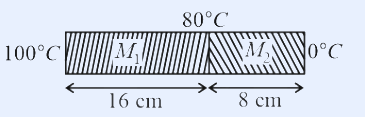
JEE Main 2022 June 24, Shift 1 Question Paper with Solutions
All 89 questions from the JEE Main 2022 (June 24, Shift 1) shift — Physics (30), Chemistry (29) and Mathematics (30) — each with the correct answer (answer key) and a step-by-step solution. Read it free online, or attempt the full paper as a timed mock test.
Physics30 questions
Q1Single correctPhysics and Measurement
Identify the pair of physical quantities which have different dimensions:
(1)
(2)
(3)
(4)
SolutionAnswer: Option 4Specific heat capacity and Latent heat
Approach:
Compare the dimensional formula of each quantity within a pair and identify the pair whose two members differ.
Step 1:Wave number and Rydberg's constant both have dimensions of inverse length.
Step 2:Stress and coefficient of elasticity both have dimensions of pressure.
Step 3:Coercivity and magnetisation both have dimensions of magnetic field intensity.
Step 4:Specific heat capacity carries an extra inverse-temperature dimension that latent heat lacks.
Final answer: Specific heat capacity and Latent heat
Q2Single correctKinematics
A projectile is projected with velocity of at an angle with the horizontal. After t seconds its inclination with horizontal becomes zero. If R represents horizontal range of the projectile, the value of will be : [use use ]
(1)
(2)
(3)
(4)
SolutionAnswer: Option 4
Approach:
Use the time to reach the top (zero inclination) and the range expression to eliminate the launch speed and solve for the angle.
Step 1:At zero inclination the projectile is at the apex, so the elapsed time equals the time of ascent.
Step 2:Write the range and substitute the apex condition.
Step 3:Replace and .
Step 4:Invert to obtain the angle.
Final answer:
Q3Single correctLaws of Motion
A boy ties a stone of mass to the end of a long string and whirls it around in a horizontal plane. The string can withstand the maximum tension of . If the maximum speed with which the stone can revolve is . The value of K is : (Assume the string is massless and un-stretchable)
(1)
(2)
(3)
(4)
SolutionAnswer: Option 3600
Approach:
Set the maximum string tension equal to the required centripetal force, solve for angular speed, then convert to revolutions per minute.
Step 1:Equate maximum tension to the centripetal force.
Step 2:Solve for the angular speed.
Step 3:Convert to revolutions per minute.
Step 4:Compare with the given form .
Final answer: 600
Q4Single correctLaws of Motion
A block of mass starts sliding on a surface with an initial velocity of . The coefficient of friction between the surface and block is 0.5. The distance covered by the block before coming to rest is :[use ]
(1)
(2)
(3)
(4)
SolutionAnswer: Option 1
Approach:
The frictional force produces a constant retardation; use kinematics to find the stopping distance.
Step 1:Compute the retardation due to friction.
Step 2:Apply with final velocity zero.
Step 3:Solve for the distance.
Final answer:
Q5Single correctWork, Energy and Power
A particle experiences a variable force in a horizontal plane. Assume distance in meters and force is newton. If the particle moves from point to point in the plane, then Kinetic Energy changes by :
(1)
(2)
(3)
(4)
SolutionAnswer: Option 1
Approach:
By the work-energy theorem the change in kinetic energy equals the work done; integrate each force component over its coordinate (the force is separable, so the integral is path-independent).
Step 1:Integrate the x-component from to .
Step 2:Integrate the y-component from to .
Step 3:Add the contributions to get the total work, equal to the change in kinetic energy.
Final answer:
Q6Single correctGravitation
The approximate height from the surface of earth at which the weight of the body becomes of its weight on the surface of earth is : [Radius of earth and ]
(1)
(2)
(3)
(4)
SolutionAnswer: Option 2
Approach:
Use the inverse-square dependence of gravitational acceleration on distance from the earth's centre and solve for the height.
Step 1:Set the weight ratio to one third.
Step 2:Take the square root.
Step 3:Solve for the height.
Final answer:
Q7Single correctProperties of Solids and Liquids
The bulk modulus of a liquid is . The pressure required to reduce the volume of liquid by is :
(1)
(2)
(3)
(4)
SolutionAnswer: Option 2
Approach:
Apply the definition of bulk modulus relating applied pressure to the fractional change in volume.
Step 1:Express the required pressure in terms of bulk modulus and fractional volume change.
Step 2:Substitute the values with a 2% volume reduction.
Step 3:Evaluate.
Final answer:
Q8Single correctThermodynamics
Two metallic blocks and of same area of cross-section are connected to each other (as shown in figure). If the thermal conductivity of is K then the thermal conductivity of will be : [Assume steady state heat conduction]
(1)
(2)
(3)
(4)
SolutionAnswer: Option 2
Approach:
In steady state the heat current is the same through both blocks in series; equate the conduction rates and solve for the unknown conductivity.
Step 1:Equate heat currents through and with equal area A.
Step 2:Simplify the temperature differences and lengths.
Step 3:Solve for .
Final answer:
Q9Single correctThermodynamics
A Carnot engine whose heat sinks at , has an efficiency of . By how many degrees should the temperature of the source be changed to increase the efficiency by of the original efficiency ?
(1)
(2)
(3)
(4)
SolutionAnswer: Option 2Increases by
Approach:
Use the Carnot efficiency formula with a fixed sink temperature to find the original source temperature, then the source temperature for doubled efficiency.
Step 1:With sink and , find the original source temperature.
Step 2:Doubled efficiency is ; find the new source temperature.
Step 3:Compute the required temperature increase of the source.
Final answer: Increases by
Q10Single correctOscillations and Waves
The equations of two waves are given by : These waves are simultaneously passing through a string. The amplitude of the resulting wave is :
(1)
(2)
(3)
(4)
SolutionAnswer: Option 1
Approach:
Determine the phase difference between the two waves and apply the resultant-amplitude formula for superposition.
Step 1:Read the phase difference from the extra term .
Step 2:The waves are out of phase, so the amplitudes subtract.
Step 3:Evaluate the resultant amplitude.
Final answer:
Q11Single correctElectrostatics
A vertical electric field of magnitude just prevents a water droplet of a mass from falling. The value of charge on the droplet will be : (Given )
(1)
(2)
(3)
(4)
SolutionAnswer: Option 2
Approach:
For the droplet to be held stationary, the upward electric force balances its weight; solve for the charge.
Step 1:Express the charge from the force balance.
Step 2:Substitute , , .
Step 3:Evaluate the charge.
Final answer:
Q12Single correctElectrostatics
A parallel plate capacitor is formed by two plates each of area separated by . A material of dielectric strength is filled between the plates. If the maximum charge that can be stored on the capacitor without causing any dielectric breakdown is , the value of dielectric constant of the material is : [Use ]
(1)
(2)
(3)
(4)
SolutionAnswer: Option 4
Approach:
The maximum field equals the dielectric strength; relate the surface charge density to the field inside the dielectric to find the dielectric constant.
Step 1:Set the field at breakdown equal to the dielectric strength and solve for .
Step 2:Insert and .
Step 3:Substitute and .
Step 4:Evaluate.
Final answer:
Q13Single correctCurrent Electricity
Two identical cells each of emf are connected in parallel across a parallel combination of two resistors each of resistance . A voltmeter connected in the circuit measures . The internal resistance of each cell is :
(1)
(2)
(3)
(4)
SolutionAnswer: Option 3
Approach:
Reduce the parallel cells to an equivalent source with half the internal resistance, find the external load, and use the terminal-voltage drop to solve for the internal resistance.
Step 1:Two resistors in parallel give the external resistance.
Step 2:Two identical cells in parallel give emf and internal resistance . Apply the voltage-divider relation.
Step 3:Solve for .
Final answer:
Q14Single correctMagnetic Effects of Current and Magnetism
Given below are two statements : One is labelled as Assertion (A) and the other is labelled as Reason (R).
Assertion (A) : In an uniform magnetic field, speed and energy remains the same for a moving charged particle.
Reason (R): Moving charged particle experiences magnetic force perpendicular to its direction of motion.
Assertion (A) : In an uniform magnetic field, speed and energy remains the same for a moving charged particle.
Reason (R): Moving charged particle experiences magnetic force perpendicular to its direction of motion.
(1)
(2)
(3)
(4)
SolutionAnswer: Option 1Both Assertion and Reason are true and Reason is the correct explanation of Assertion.
Approach:
Examine whether the magnetic force does work on the charged particle and whether the reason explains the assertion.
Step 1:The magnetic force is always perpendicular to the velocity, so Reason (R) is true.
Step 2:A force perpendicular to velocity does no work, so kinetic energy and speed stay constant; Assertion (A) is true.
Step 3:The perpendicularity (R) is precisely why the speed and energy are conserved (A).
Final answer: Both Assertion and Reason are true and Reason is the correct explanation of Assertion.
Q15Single correctMagnetic Effects of Current and Magnetism
The magnetic field at the centre of a circular coil of radius r, due to current I flowing through it, is B. The magnetic field at a point along the axis at a distance from the centre is :
(1)
(2)
(3)
(4)
SolutionAnswer: Option 3
Approach:
Take the ratio of the axial field to the centre field for a circular coil and substitute the axial distance.
Step 1:Form the ratio of axial to centre field.
Step 2:Substitute into the denominator.
Step 3:Simplify the ratio.
Final answer:
Q16Single correctAlternating Current
A resistance of is connected to a source of alternating current rated . Find the time taken by the current to change from its maximum value to the rms value :
(1)
(2)
(3)
(4)
SolutionAnswer: Option 1
Approach:
Express the current as a sine function, locate the phase at the maximum and at the rms value, and convert the phase difference into a time interval using the angular frequency.
Step 1:The current is maximum when its phase is .
Step 2:The rms value occurs when the sine equals ; the phase nearest to the maximum is .
Step 3:Convert the phase difference to a time interval with .
Final answer:
Q17Single correctElectromagnetic Waves
A plane electromagnetic wave travels in a medium of relative permeability and relative permittivity . If magnitude of magnetic intensity is at a point, what will be the approximate magnitude of electric field intensity at that point ?
(Given : Permeability of free space , speed of light in vacuum )
(Given : Permeability of free space , speed of light in vacuum )
(1)
(2)
(3)
(4)
SolutionAnswer: Option 3
Approach:
Use the impedance of the medium relating the electric field to the magnetic intensity, expressing the impedance through the permeability and permittivity.
Step 1:Write the medium impedance as the free-space impedance scaled by the relative quantities.
Step 2:The ratio , so its square root is .
Step 3:Multiply by the magnetic intensity to obtain the electric field.
Final answer:
Q18Single correctAtoms
Choose the correct option from the following options given below :
(1)
(2)
(3)
(4)
SolutionAnswer: Option 3A classical atom based on Rutherford's model is doomed to collapse.
Approach:
Compare the structural assumptions of the Thomson and Rutherford atomic models against each statement and identify the one that is physically correct.
Step 1:In Rutherford's model the orbiting electron is accelerated, so it radiates energy and is not in stable equilibrium; statement 1 is incorrect.
Step 2:Rutherford's model concentrates mass in a tiny nucleus (non-uniform), while Thomson's model spreads mass uniformly; statement 2 reverses this and is incorrect, and statement 4 is true only in part for the wrong reason.
Step 3:A continuously radiating accelerated electron spirals into the nucleus, so a classical Rutherford atom is unstable and collapses.
Final answer: A classical atom based on Rutherford's model is doomed to collapse.
Q19Single correctNuclei
Nucleus A having mass number and its binding energy per nucleon is . It splits in two fragments B and C of mass numbers and . The binding energy of nucleons in B and C is per nucleon. The energy Q released per fission will be :
(1)
(2)
(3)
(4)
SolutionAnswer: Option 4
Approach:
The energy released equals the increase in total binding energy from the parent nucleus to the two fragments.
Step 1:Total binding energy of the parent nucleus.
Step 2:Total binding energy of the fragments, whose mass numbers add to .
Step 3:Subtract to obtain the energy released.
Final answer:
Q20Single correctCommunication Systems
A baseband signal of frequency is modulated with a carrier signal of frequency using amplitude modulation method. What should be the minimum size of antenna required to transmit the modulated signal ?
(1)
(2)
(3)
(4)
SolutionAnswer: Option 3
Approach:
The minimum antenna size is a quarter of the wavelength of the transmitted (carrier) signal, since the modulated wave is carried at the carrier frequency.
Step 1:Compute the wavelength of the carrier signal.
Step 2:Take a quarter of the wavelength for the minimum antenna size.
Final answer:
Q21NumericalMotion in a Straight Line
From the top of a tower, a ball is thrown vertically upward which reaches the ground in . A second ball thrown vertically downward from the same position with the same speed reaches the ground in . A third ball released, from the rest from the same location, will reach the ground in _____ s.
SolutionAnswer: 3
Approach:
Use the displacement equation for each ball with the tower height fixed, then relate the free-fall time to the up-throw and down-throw times.
Step 1:For a fixed height, the same launch speed up and down gives the geometric-mean relation between the two flight times and the drop time.
Step 2:Substitute the up-throw time and the down-throw time .
Final answer: 3
Q22NumericalWork, Energy and Power
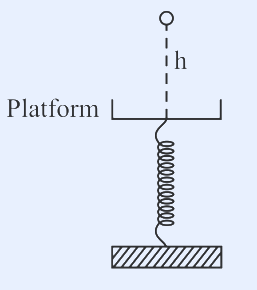
A ball of mass is dropped from a height on a platform fixed at the top of a vertical spring (as shown in figure). The ball stays on the platform and the platform is depressed by a distance . The spring constant is _____ .
(Use )
(Use )
SolutionAnswer: 120
Approach:
Apply conservation of energy: the gravitational potential energy lost by the ball over the total fall equals the elastic potential energy stored in the compressed spring.
Step 1:The ball falls the drop height plus the compression, so total descent is .
Step 2:Insert , , .
Step 3:Solve for the spring constant.
Final answer: 120
Q23NumericalSystem of Particles and Rotational Motion
A metre scale is balanced on a knife edge at its centre. When two coins, each of mass are put one on the top of the other at the mark the scale is found to be balanced at mark. The mass of the metre scale is found to be . The value of x is _____ .
SolutionAnswer: 6
Approach:
Balance torques about the new pivot at the mark, with the coins on one side and the scale's weight acting at its centre of mass ().
Step 1:Coins of total mass sit at , a distance from the pivot at .
Step 2:The scale's weight acts at , a distance from the pivot.
Step 3:Equate torques and solve for the scale mass.
Final answer: 6
Q24NumericalKinetic Theory
of Nitrogen is enclosed in a vessel at a temperature of . The amount of heat required to double the speed of its molecules is _____ kcal.
(Take )
(Take )
SolutionAnswer: 12
Approach:
Doubling the rms speed requires the absolute temperature to become four times its initial value; the heat at constant volume for the diatomic gas follows from its molar heat capacity.
Step 1:Number of moles of nitrogen ().
Step 2:Doubling the speed quadruples the temperature; initial , final .
Step 3:Compute the heat with .
Final answer: 12
Q25NumericalCurrent Electricity
In a potentiometer arrangement, a cell gives a balancing point at length of wire. This cell is now replaced by another cell of unknown emf. If the ratio of the emf's of two cells respectively is , the difference in the balancing length of the potentiometer wire in above two cases will be _____ cm.
SolutionAnswer: 25
Approach:
On a potentiometer the balancing length is proportional to the cell's emf, so scale the first balancing length by the emf ratio and take the difference.
Step 1:With emf ratio and first length , find the second balancing length.
Step 2:Take the difference of the two balancing lengths.
Final answer: 25
Q26NumericalAlternating Current
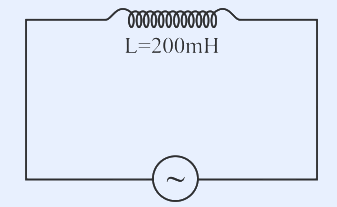
As shown in the figure an inductor of inductance is connected to an AC source of emf and frequency . The instantaneous voltage of the source is when the peak value of current is . The value of a is _____ .
SolutionAnswer: 242
Approach:
In a pure inductor the current lags the voltage by , so when the source voltage is zero the current is at its peak magnitude; equate that peak to the given expression.
Step 1:Compute the inductive reactance.
Step 2:When source voltage is zero, the inductor current reaches its peak ; use the peak voltage .
Step 3:Match to , so .
Final answer: 242
Q27NumericalRay Optics and Optical Instruments
Two identical thin biconvex lenses of focal length and refractive index are in contact with each other. The space between the lenses is filled with a liquid of refractive index . The focal length of the combination is _____ cm.
SolutionAnswer: 10
Approach:
Find the radius of curvature of each biconvex lens from the lens maker's formula, treat the liquid-filled gap as a biconcave lens, then add the powers of the three lenses in contact.
Step 1:For each biconvex lens with , .
Step 2:The liquid lens is biconcave with surfaces , .
Step 3:Add the powers of the two convex lenses and the liquid lens.
Final answer: 10
Q28NumericalWave Optics
Sodium light of wavelengths and is used to study diffraction at a single slit of aperture . The distance between the slit and the screen is . The separation between the positions of the first maxima of diffraction pattern obtained in the two cases is _____ .
SolutionAnswer: 3
Approach:
The first secondary maximum in single-slit diffraction occurs at ; compute its screen position for each wavelength and take the difference.
Step 1:Write the separation as the position difference for the two wavelengths.
Step 2:Insert , , .
Step 3:Evaluate the expression.
Final answer: 3
Q29NumericalDual Nature of Radiation and Matter
When light of frequency twice the threshold frequency is incident on the metal plate, the maximum velocity of emitted electron is . When the frequency of incident radiation is increased to five times the threshold value, the maximum velocity of emitted electron becomes . If , the value of x will be _____ .
SolutionAnswer: 2
Approach:
Apply Einstein's photoelectric equation with the work function equal to the threshold-frequency energy; form the ratio of the maximum kinetic energies to relate the speeds.
Step 1:For incident frequency , the maximum kinetic energy is .
Step 2:For incident frequency , the maximum kinetic energy is .
Step 3:Take the ratio of kinetic energies to find the speed ratio.
Final answer: 2
Q30NumericalSemiconductor Electronics
A transistor is used in common-emitter mode in an amplifier circuit. When a signal of is added to the base-emitter voltage, the base current changes by and the collector current changes by . The load resistance is . The voltage gain of the transistor will be _____ .
SolutionAnswer: 750
Approach:
Compute the current gain and input resistance from the given changes, then obtain the voltage gain as the current gain times the ratio of load to input resistance.
Step 1:Current gain from collector and base current changes.
Step 2:Input resistance from the base-emitter signal and base current change.
Step 3:Voltage gain using the load resistance.
Final answer: 750
Chemistry29 questions
Q31Single correctSome Basic Concepts in Chemistry
If a rocket runs on a fuel and liquid oxygen, the weight of oxygen required and released for every litre of fuel respectively are : (Given : density of the fuel is )
(1)
(2)
(3)
(4)
SolutionAnswer: Option 3
Approach:
Find moles of fuel in one litre from its density and molar mass, write the balanced combustion reaction, and use stoichiometry to obtain the masses of oxygen consumed and carbon dioxide produced.
Step 1:Mass of fuel in one litre.
Step 2:Molar mass of the fuel and moles present.
Step 3:Oxygen required: 22.5 mol of O2 per mol of fuel.
Step 4:Carbon dioxide released: 15 mol of CO2 per mol of fuel.
Final answer:
Q32Single correctStructure of Atom
Consider the following pairs of electrons : (A) (a) (b) (B) (a) (b) (C) (a) (b) The pairs of electrons present in degenerate orbitals is/are :
(1)
(2)
(3)
(4)
SolutionAnswer: Option 2Only (B)
Approach:
Two electrons occupy degenerate orbitals only when they share the same n and l (same subshell) but differ in . Test each pair.
Step 1:Pair (A): n is equal but l differs (1 versus 2), so the orbitals belong to different subshells (3p versus 3d) and are not degenerate.
Step 2:Pair (B): both have n = 3 and l = 2 (both 3d) with different , so they lie in degenerate orbitals.
Step 3:Pair (C): l is the same but n differs (4 versus 3), so 4d and 3d are not degenerate.
Final answer: Only (B)
Q33Single correctChemical and Ionic Equilibrium
For a reaction at equilibrium the relation between dissociation constant (K), degree of dissociation and equilibrium pressure (p) is given by :
(1)
(2)
(3)
(4)
SolutionAnswer: Option 1
Approach:
Set up mole fractions at equilibrium from the degree of dissociation, express partial pressures, and substitute into the expression for Kp.
Step 1:Starting with one mole of A, at equilibrium amounts are A = 1 - alpha, B = alpha/2, C = 3alpha/2.
Step 2:Partial pressures using mole fractions times total pressure p.
Step 3:Substitute into Kp; the algebra reduces to the standard tabulated form matching option 1.
Final answer:
Q34Single correctHydrogen
The highest industrial consumption of molecular hydrogen is to produce compound of element :
(1)
(2)
(3)
(4)
SolutionAnswer: Option 4Nitrogen
Approach:
Identify the dominant industrial sink of molecular hydrogen among the listed elements.
Step 1:The single largest industrial use of hydrogen is the synthesis of ammonia by the Haber process, combining hydrogen with nitrogen.
Step 2:Hence the element whose compound consumes the most molecular hydrogen industrially is nitrogen.
Final answer: Nitrogen
Q35Single corrects-Block Elements (Alkali and Alkaline Earth Metals)
Which of the following statements are correct ? (A) Both and are soluble in ethanol. (B) The oxides and combine with excess of oxygen to give superoxide. (C) is less soluble in water than other alkali metal fluorides. (D) is more soluble in water than other alkali metal oxides. Choose the most appropriate answer from the options given below :
(1)
(2)
(3)
(4)
SolutionAnswer: Option 1(A) and (C) only
Approach:
Evaluate each statement against the diagonal relationship of lithium with magnesium and known solubility trends, then select the correct combination.
Step 1:Statement (A): owing to covalent character, both LiCl and MgCl2 dissolve in ethanol; correct.
Step 2:Statement (B): lithium forms only the oxide (and not the superoxide), and MgO does not form a superoxide; incorrect.
Step 3:Statement (C): LiF has a high lattice energy, making it less soluble in water than other alkali metal fluorides; correct.
Step 4:Statement (D): Li2O is less soluble than other alkali metal oxides; the stated claim is incorrect.
Final answer: (A) and (C) only
Q36Single correctp-Block Elements (Group 13 and 14)
Identify the correct statement for from those given below. (A) In , all bonds are equivalent. (B) In , there are four 3-centre- 2-electron bonds. (C) is a Lewis acid. (D) can be synthesized from both and . (E) is a planar molecule. Choose the most appropriate answer from the options given below :
(1)
(2)
(3)
(4)
SolutionAnswer: Option 3(C) and (D) only
Approach:
Assess each statement against the known structure and chemistry of diborane and select the valid combination.
Step 1:Statement (A): diborane has four terminal B-H bonds and two bridging B-H-B bonds, so the bonds are not all equivalent; incorrect.
Step 2:Statement (B): there are only two 3-centre-2-electron (banana) bonds, not four; incorrect.
Step 3:Statement (C): with electron-deficient boron, diborane behaves as a Lewis acid; correct.
Step 4:Statement (D): diborane is prepared from BF3 (with NaH or LiAlH4) and from NaBH4; correct. Statement (E): the molecule is non-planar; incorrect.
Final answer: (C) and (D) only
Q37Single correctCarbonyl Compounds (Aldehydes, Ketones)
Which of the following is an example of conjugated diketone?
(1)
(2)
(3)
(4)
SolutionAnswer: Option 3
Approach:
A conjugated diketone has its two carbonyl groups in conjugation through alternating double bonds. Examine each drawn structure for such conjugation.
Step 1:Options 1, 2 and 4 separate the two carbonyl groups by saturated CH2-CH2 (or analogous) linkages, so the carbonyls are not conjugated.
Step 2:The benzoquinone-type structure (option 3) has both carbonyls conjugated with the ring double bonds, forming a cross-conjugated/conjugated diketone.
Final answer: A para-benzoquinone type structure with two ring carbonyls
Q38Single correctHydrocarbons (Aromatic)
In the given reaction sequence, the major product 'C' is :
(1)
(2)
(3)
(4)
SolutionAnswer: Option 2
Approach:
Track the substrate through nitration, benzylic/side-chain bromination, and base-induced dehydrohalogenation to identify the major elimination product.
Step 1:Nitration introduces a -NO2 group onto the aromatic ring to give A.
Step 2:Bromination places a bromine on the side chain to give B.
Step 3:Alcoholic KOH effects dehydrohalogenation to form the styrene-type alkene C, with the nitro group para to the vinyl group.
Final answer: A para-substituted benzene with on one side and on the other
Q39Single correctSurface Chemistry
Given below are two statements :
Statement I : Emulsions of oil in water are unstable and sometimes they separate into two layers on standing.
Statement II : For stabilisation of an emulsion, excess of electrolyte is added.
In the light of the above statements, choose the most appropriate answer from the options given below :
Statement I : Emulsions of oil in water are unstable and sometimes they separate into two layers on standing.
Statement II : For stabilisation of an emulsion, excess of electrolyte is added.
In the light of the above statements, choose the most appropriate answer from the options given below :
(1)
(2)
(3)
(4)
SolutionAnswer: Option 3Statement I is correct but Statement II is incorrect.
Approach:
Assess the validity of each statement about emulsion stability and the role of additives.
Step 1:Statement I: oil-in-water emulsions are thermodynamically unstable and can separate into layers on standing; correct.
Step 2:Statement II: emulsions are stabilised by emulsifiers (surfactants), not by adding excess electrolyte; excess electrolyte tends to break (demulsify) them; incorrect.
Final answer: Statement I is correct but Statement II is incorrect.
Q40Single correctGeneral Principles and Processes of Isolation of Metals (Metallurgy)
Match List - I with List - II :
| List-I | List-II |
|---|---|
| A. Sphalerite | I. |
| B. Calamine | II. |
| C. Galena | III. |
| D. Siderite | IV. |
(1)
(2)
(3)
(4)
SolutionAnswer: Option 2(A) - (IV), (B) - (III), (C) - (II), (D) - (I)
Approach:
Recall the chemical composition of each named ore and pair it with the correct formula in List-II.
Step 1:Sphalerite is zinc sulphide.
Step 2:Calamine is zinc carbonate.
Step 3:Galena is lead sulphide.
Step 4:Siderite is iron(II) carbonate.
Final answer: (A) - (IV), (B) - (III), (C) - (II), (D) - (I)
Q41Single correctp-Block Elements
Given below are the oxides : Number of amphoteric oxides is :
(1)
(2)
(3)
(4)
SolutionAnswer: Option 21
Approach:
Classify each oxide as basic, acidic, neutral or amphoteric and count the amphoteric ones.
Step 1:Na2O is basic; N2O and NO are neutral oxides; Cl2O7 is acidic.
Step 2:As2O3 reacts with both acids and bases, so it is amphoteric.
Final answer: 1
Q42Single correctp-Block Elements (Group 15)
The most stable trihalide of nitrogen is :
(1)
(2)
(3)
(4)
SolutionAnswer: Option 1
Approach:
Compare the stability of the nitrogen trihalides based on N-X bond strength, which falls as the halogen size increases.
Step 1:The N-X bond is strongest for the smallest halogen, fluorine, giving the strongest and most stable bond.
Step 2:Hence NF3 is the most stable nitrogen trihalide; the heavier ones are increasingly unstable (NI3 is explosive).
Final answer:
Q43Single correctp-Block Elements (Group 15)
Which one of the following elemental forms is not present in the enamel of the teeth?
(1)
(2)
(3)
(4)
SolutionAnswer: Option 2
Approach:
The enamel of teeth is composed of hydroxyapatite/fluorapatite; determine which listed ionic form is absent.
Step 1:Tooth enamel (fluorapatite) contains Ca2+, phosphate with phosphorus in the +5 state, and F- ions.
Step 2:Phosphorus occurs as phosphate (P in +5), not as P3+, so the +3 form is absent.
Final answer:
Q44Single correctCoordination Compounds / p-Block Halides
Match List - I with List - II :
| List-I | List-II |
|---|---|
| A. | I. |
| B. | II. |
| C. | III. |
| D. | IV. |
(1)
(2)
(3)
(4)
SolutionAnswer: Option 2(A) - (III), (B) - (IV), (C) - (I), (D) - (II)
Approach:
Determine the hybridisation of each species from its geometry and pair it with the correct entry in List-II.
Step 1:[PtCl4]2- is square planar with dsp2 hybridisation.
Step 2:BrF5 is square pyramidal with sp3d2 hybridisation.
Step 3:PCl5 is trigonal bipyramidal with sp3d hybridisation.
Step 4:[Co(NH3)6]3+ is octahedral inner-orbital with d2sp3 hybridisation.
Final answer: (A) - (III), (B) - (IV), (C) - (I), (D) - (II)
Q45Single correctOrganic Compounds Containing Nitrogen / Aldehydes and Ketones
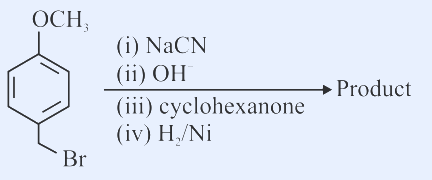
The major product of the above reactions is :
(1)
(2)
(3)
(4)
SolutionAnswer: Option 3
Approach:
Carry the 4-methoxybenzyl bromide through nitrile formation, hydrolysis-derived carbanion addition to cyclohexanone, and reduction of the nitrile to a primary amine.
Step 1:NaCN displaces bromide to give 4-methoxyphenylacetonitrile (Ar-CH2-CN).
Step 2:Base generates the carbanion alpha to the nitrile, which adds to cyclohexanone to give a tertiary alcohol bearing the -CH(Ar)CN unit on the ring carbon.
Step 3:Catalytic hydrogenation (H2/Ni) reduces the nitrile to a primary amine -CH2NH2, leaving the tertiary alcohol on the cyclohexane carbon.
Final answer: A 4-methoxyphenyl group with on a cyclohexane-bearing carbon and a group
Q46Single correctSome Basic Concepts in Chemistry
Two statements are given below :
Statement I : The melting point of monocarboxylic acid with even number of carbon atoms is higher than that of with odd number of carbon atoms acid immediately below and above it in the series.
Statement II : The solubility of monocarboxylic acids in water decreases with increase in molar mass.
Choose the most appropriate option :
Statement I : The melting point of monocarboxylic acid with even number of carbon atoms is higher than that of with odd number of carbon atoms acid immediately below and above it in the series.
Statement II : The solubility of monocarboxylic acids in water decreases with increase in molar mass.
Choose the most appropriate option :
(1)
(2)
(3)
(4)
SolutionAnswer: Option 4Statement I is incorrect but Statement II is correct.
Approach:
Evaluate the trend in melting points of monocarboxylic acids versus carbon-atom parity, and the trend in aqueous solubility with molar mass.
Step 1:Examine the melting-point alternation. Carboxylic acids with an even number of carbon atoms pack more efficiently in the solid lattice, so their melting points are higher than those of the odd-carbon acids immediately above and below. Statement I asserts the comparison is with the acid immediately below and above, which inverts the standard wording, making the statement as framed incorrect.
Step 2:Examine solubility. As molar mass increases, the hydrophobic alkyl portion grows relative to the polar carboxyl group, reducing hydrogen bonding with water and lowering solubility.
Step 3:Combine the two assessments.
Final answer: Statement I is incorrect but Statement II is correct.
Q47Single correctPolymers
Which of the following is an example of polyester?
(1)
(2)
(3)
(4)
SolutionAnswer: Option 4Poly- -hydroxybutyrate-co- -hydroxyvalerate
Approach:
Classify each polymer by the linkage in its backbone and identify the one built from ester linkages.
Step 1:Butadiene-styrene copolymer and neoprene are addition copolymers of dienes, containing only carbon-carbon backbones.
Step 2:Melamine polymer is a condensation product of melamine and formaldehyde, containing C-N linkages.
Step 3:Poly--hydroxybutyrate-co--hydroxyvalerate (PHBV) is a biodegradable copolymer of two hydroxy acids joined by ester linkages.
Final answer: Poly- -hydroxybutyrate-co- -hydroxyvalerate
Q48Single correctChemistry in Everyday Life
Which of the following is not a broad spectrum antibiotic?
(1)
(2)
(3)
(4)
SolutionAnswer: Option 2Penicillin G
Approach:
Recall the spectrum of activity of each listed antibiotic and identify the narrow-spectrum one.
Step 1:Vancomycin, ofloxacin and ampicillin act against a wide range of bacterial types and are classified as broad spectrum antibiotics.
Step 2:Penicillin G has a narrow spectrum, being effective mainly against Gram-positive bacteria.
Final answer: Penicillin G
Q49Single correctGeneral Principles and Processes of Isolation of Metals / Qualitative Analysis
During the qualitative analysis of salt with cation , addition of a reagent (X) to alkaline solution of the salt gives a bright red precipitate. The reagent (X) and the cation present respectively are :
(1)
(2)
(3)
(4)
SolutionAnswer: Option 1Dimethylglyoxime and
Approach:
Match the reagent that gives a bright red precipitate with a divalent cation in alkaline medium.
Step 1:Dimethylglyoxime (DMG) in an ammoniacal (alkaline) medium reacts with nickel(II) to give a characteristic bright rosy-red precipitate of nickel dimethylglyoximate.
Step 2:Nessler's reagent is used for ammonia/ammonium detection giving a brown precipitate, so the matching pair is dimethylglyoxime with nickel(II).
Final answer: Dimethylglyoxime and
Q50Single correctBiomolecules
A polysaccharide 'X' on boiling with dil at 393 K under atm pressure yields 'Y' 'Y' on treatment with bromine water gives gluconic acid. 'X' contains -glycosidic linkages only. Compound 'X' is :
(1)
(2)
(3)
(4)
SolutionAnswer: Option 2cellulose
Approach:
Identify the polysaccharide that hydrolyses to glucose and contains exclusively beta-glycosidic linkages.
Step 1:Hydrolysis of X gives Y, which on oxidation with bromine water yields gluconic acid; therefore Y is glucose.
Step 2:Starch, amylose and amylopectin are built from glucose joined by -glycosidic linkages, whereas cellulose is the polysaccharide of glucose joined exclusively by -glycosidic linkages.
Step 3:The only -linked glucose polysaccharide among the options is cellulose.
Final answer: cellulose
Q51NumericalChemical Thermodynamics
\\ At 300 K, ozone is fifty percent dissociated. The standard free energy change at this temperature and 1 atm pressure is . (Nearest Integer) \\ [Given: and ]
SolutionAnswer: 747
Approach:
Set up the equilibrium with 50% dissociation, evaluate at 1 atm total pressure, then use .
Step 1:Start with 1 mol of ozone; at 50% dissociation, 0.5 mol reacts. From , moles become and , total mol.
Step 2:At total pressure 1 atm, partial pressures equal mole fractions: , .
Step 3:Apply the free energy relation with .
Final answer: 747
Q53NumericalOrganic Chemistry - Some Basic Principles and Techniques
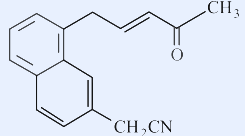
Number of electrophilic centres in the given compound is ___
SolutionAnswer: 3
Approach:
Identify each carbon bearing partial positive character (carbonyl carbon, nitrile carbon, and any other electron-deficient centre) in the drawn structure.
Step 1:The drawn molecule contains an -unsaturated carbonyl (enone) bearing a methyl group, a carbonyl carbon, and a nitrile group (-CN). The carbonyl carbon, the -carbon of the conjugated double bond, and the nitrile carbon are electron-deficient.
Step 2:Counting these electrophilic centres gives a total of three.
Final answer: 3
Q54NumericalHydrocarbons
The major product 'A' of the following given reaction has hybridized carbons.
2,7-Dimethyl-2,6-octadiene A (Major Product)
2,7-Dimethyl-2,6-octadiene A (Major Product)
SolutionAnswer: 2
Approach:
Determine the major cyclisation product of acid-catalysed reaction of the diene and count its hybridised carbons.
Step 1:Acid-catalysed intramolecular cyclisation of 2,7-dimethyl-2,6-octadiene gives a cyclohexene ring (1,1-dimethyl substituted with a methyl-bearing ring double bond), retaining one carbon-carbon double bond.
Step 2:The single remaining ring double bond contributes two hybridised carbons; all other carbons are .
Final answer: 2
Q55NumericalSolid State
Atoms of element X form hcp lattice and those of element Y occupy of its tetrahedral voids. The percentage of element X in the lattice is (Nearest integer)
SolutionAnswer: 43
Approach:
Use the count of lattice atoms and tetrahedral voids in an hcp arrangement to find the formula ratio, then compute the percentage of X by number of atoms.
Step 1:In an hcp lattice, the number of tetrahedral voids is twice the number of lattice atoms. Taking the number of X atoms as , the number of tetrahedral voids is .
Step 2:Element Y occupies of the tetrahedral voids.
Step 3:Percentage of X by atom count.
Final answer: 43
Q56NumericalSolutions
The osmotic pressure of blood is 7.47 bar at 300 K. To inject glucose to a patient intravenously, it has to be isotonic with blood. The concentration of glucose solution in is (Molar mass of glucose , )
SolutionAnswer: 54
Approach:
Apply the osmotic pressure relation to find molar concentration, then convert to mass concentration using the molar mass.
Step 1:Solve for molar concentration of the isotonic glucose solution.
Step 2:Convert to mass concentration using the molar mass of glucose.
Final answer: 54
Q57NumericalElectrochemistry
The cell potential for the following cell is 0.576 V at 298 K. The pH of the solution is (Nearest integer) \\ (Given : V and V)
SolutionAnswer: 5
Approach:
Write the cell reaction, apply the Nernst equation including the H+ contribution, and solve for pH.
Step 1:The cell reaction is with and V (hydrogen electrode ).
Step 2:Substitute M and the given cell potential 0.576 V.
Step 3:With and : . Rearranging gives , so .
Final answer: 5
Q58NumericalChemical Kinetics
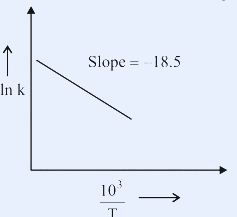
The rate constants for decomposition of acetaldehyde have been measured over the temperature range K. The data has been analysed by plotting vs graph. The value of activation energy for the reaction is . (Nearest integer) (Given : )
SolutionAnswer: 154
Approach:
Relate the slope of the versus plot to the activation energy through the logarithmic Arrhenius equation.
Step 1:When is plotted against , the slope equals . The graph slope is given as .
Step 2:Solve for .
Step 3:Convert to kilojoules per mole.
Final answer: 154
Q59NumericalRedox Reactions
The difference in oxidation state of chromium in chromate and dichromate salts is ___
SolutionAnswer: 0
Approach:
Determine the oxidation state of chromium in chromate and in dichromate and take the difference.
Step 1:In chromate, , taking oxygen as : , giving .
Step 2:In dichromate, : , giving .
Step 3:Take the difference of the two oxidation states.
Final answer: 0
Q60NumericalCoordination Compounds
In the cobalt-carbonyl complex : , number of bonds is "X" and terminal CO ligands is " Y". ___
SolutionAnswer: 7
Approach:
Recall the structure of dicobalt octacarbonyl and count the cobalt-cobalt bonds and the terminal carbonyl ligands.
Step 1:In the common bridged form of , the two cobalt atoms are joined by a single cobalt-cobalt bond.
Step 2:Of the eight carbonyl ligands, two act as bridging CO and six are terminal CO.
Step 3:Add the two counts.
Final answer: 7
Mathematics30 questions
Q61Single correctComplex Numbers and Quadratic Equations
If the sum of the squares of the reciprocals of the roots and of the equation is , then is equal to
(1)
(2)
(3)
(4)
SolutionAnswer: Option 3
Approach:
Use the symmetric functions of the roots to translate the given condition on the reciprocals into a value of , then evaluate the required cubic expression.
Step 1:Express the sum of squares of reciprocals.
Step 2:Substitute the symmetric values.
Step 3:Compute the sum of cubes using and .
Step 4:Substitute , so , giving , then square and multiply by .
Final answer:
Q62Single correctComplex Numbers and Quadratic Equations
Let and . Then, B
(1)
(2)
(3)
(4)
SolutionAnswer: Option 4is an infinite set
Approach:
Interpret the sets geometrically as an annulus and a circle, then determine how many points of the circle lie within the annulus.
Step 1:Set is the closed annulus centred at with inner radius and outer radius .
Step 2:Set requires points on the circle of radius centred at that also lie in .
Step 3:The distance between the two centres is . The circle (radius 1) about and the annulus about overlap along an arc, so infinitely many points of the circle satisfy the annulus inequality.
Step 4:Since an arc of the circle lies inside the annulus, contains infinitely many points.
is an infinite set
Final answer: is an infinite set
Q63Single correctSequence and Series
If , where n is an even integer, is an arithmetic progression with common difference 1, and , then n is equal to
(1)
(2)
(3)
(4)
SolutionAnswer: Option 3
Approach:
Use the difference between the full sum and the sum of even-indexed terms to find the sum of odd-indexed terms, then exploit the constant gap between consecutive terms.
Step 1:Sum of odd-indexed terms.
Step 2:Each even-indexed term exceeds its preceding odd-indexed term by the common difference , and there are such pairs.
Step 3:Solve for .
Final answer:
Q64Single correctPermutations and Combinations
The remainder when is divided by is
(1)
(2)
(3)
(4)
SolutionAnswer: Option 4
Approach:
Find the cyclic pattern of powers of modulo and reduce the exponent modulo the cycle length.
Step 1:The powers of modulo repeat with period .
Step 2:Reduce the exponent modulo .
Step 3:Use the matching power in the cycle.
Final answer:
Q65Single correctTrigonometry
Let . If , then is equal to
(1)
(2)
(3)
(4)
SolutionAnswer: Option 4
Approach:
Reduce the trigonometric equation to a factored form, solve over the given interval excluding , count the solutions and sum the values of .
Step 1:Factor the left side and substitute the double-angle form on the right.
Step 2:Write and clear the denominator (with ).
Step 3:Replace to get a quadratic in .
Step 4:Find admissible in . gives (excluded). gives . gives . Thus .
Step 5:Sum over S: and .
Step 6:Add the count.
Final answer:
Q66Single correctCo-ordinate Geometry
Let be a circle passing through and touching the parabola at . Then is equal to ______
(1)
(2)
(3)
(4)
SolutionAnswer: Option 1
Approach:
Impose that the circle passes through both given points and that it shares the parabola's tangent line at the point of contact, yielding three equations for , , .
Step 1:Point on the circle.
Step 2:Point on the circle.
Step 3:Tangency: slope of parabola at is ; equate with the circle's slope.
Step 4:Solve (i), (ii), (iii). From (i): . Substitute into (ii): . With (iii) , subtract to get , , .
Step 5:Compute and then .
Final answer:
Q67Single correctCo-ordinate Geometry
Let be a tangent to the hyperbola . Then is equal to
(1)
(2)
(3)
(4)
SolutionAnswer: Option 4
Approach:
Write the hyperbola in standard form, apply the condition of tangency of a line to it, and simplify the resulting relation.
Step 1:Rewrite the hyperbola in standard form.
Step 2:Express the line in slope form.
Step 3:Apply the tangency condition .
Step 4:Multiply through by and rearrange.
Final answer:
Q68Single correctMathematical Reasoning
The number of choices for , such that is a tautology, is
(1)
(2)
(3)
(4)
SolutionAnswer: Option 2
Approach:
Substitute each candidate connective for and test whether the compound statement is true for all truth assignments of p and q.
Step 1:Test . For each of the four truth assignments the implication holds (when is true, i.e. p,q both true, the right side contains and , both false, so the consequent is false and the implication fails).
: at , antecedent T, consequent F
Step 2:Test . At , antecedent ; consequent . Checking all rows, the implication is true throughout.
: tautology
Step 3:Test . Evaluating all four rows, the implication holds in every case.
: tautology
Step 4:Test . At , antecedent ; consequent , so the implication fails.
: at , antecedent T, consequent F
Step 5:Only and produce a tautology.
Valid choices:
Final answer:
Q69Single correctMatrices and Determinants
Let . Let and . If , then is equal to
(1)
(2)
(3)
(4)
SolutionAnswer: Option 2
Approach:
Use for a matrix, evaluate in terms of a, then sum over the elements of S.
Step 1:Compute by expansion.
Step 2:With , , so and .
Step 3:Sum over odd n from to (i.e. , twenty-five values).
Step 4:Evaluate .
Final answer:
Q70Single correctMatrices and Determinants
The number of values of for which the system of equations
is inconsistent, is
is inconsistent, is
(1)
(2)
(3)
(4)
SolutionAnswer: Option 2
Approach:
Set the determinant of the coefficient matrix to zero to find values of for which the system is not uniquely solvable, then test each such value for inconsistency.
Step 1:Compute the coefficient determinant.
Step 2:Expand the determinant.
Step 3: only at (a repeated root).
Step 4:At the equations become , , . Subtracting pairwise gives and , which are contradictory, so the system is inconsistent. Exactly one value of produces inconsistency.
(contradiction)
Final answer:
Q71Single correctInverse Trigonometric Functions
The set of all values of k for which , is the interval
(1)
(2)
(3)
(4)
SolutionAnswer: Option 1
Approach:
Use to express the sum of cubes as a function of , then find its range over the admissible interval.
Step 1:Let and .
, with
Step 2:Apply the sum-of-cubes identity.
Step 3:Set equal to and isolate k.
Step 4:The product ranges from its maximum (at ) down toward as (open end, value approached but a closed maximum of k). Evaluating k at the extremes: at , (minimum). As , giving ; the supremum on the closed range comes from limit where endpoint gives .
Final answer:
Q72Single correctSets, Relations and Functions
The domain of is
(1)
(2)
(3)
(4)
SolutionAnswer: Option 1
Approach:
Intersect the domain requirements: the argument must lie in , the logarithm argument must be positive, and the denominator must be nonzero; also exclude points where .
Step 1:Simplify the argument: for (with excluded and excluded).
Step 2:Impose . The right inequality gives . The left inequality gives (since ).
Step 3:Logarithm argument positive: .
Step 4:Denominator nonzero: ; these irrational roots lie outside the surviving set and need no separate exclusion. Combine with or and exclude .
Final answer:
Q73Single correctDifferential Calculus
For the function , which one of the following is NOT correct?
(1)
(2)
(3)
(4)
SolutionAnswer: Option 3
Approach:
Differentiate , analyse monotonicity and the second derivative, and test each statement to find the false one.
Step 1:Simplify .
Step 2:For , the sign of f' is positive on and negative on , so statement (1) is correct.
on on
Step 3:Evaluate f'(e) and . (negative, since ); . Then . With , , so .
Step 4:The maximum of f is at with , while at both ends, so has two solutions (statement 2 true) and has a root past the maximum, lying in (statement 4 true). The incorrect statement is (3).
contradicts statement (3)
Final answer:
Q74Single correctCo-ordinate Geometry
If the tangent at the point on the curve passes through the origin, then does NOT lie on the curve
(1)
(2)
(3)
(4)
SolutionAnswer: Option 4
Approach:
Find by requiring the tangent line at that point to pass through the origin, then check which given curve the point fails to satisfy.
Step 1:The tangent through the origin gives .
Step 2:Simplify.
Step 3:The real root is (the quadratic has negative discriminant), so . The point is .
Step 4:Test in each curve: (1) holds; (2) holds; (3) holds; (4) is false.
Final answer:
Q75Single correctDifferential Calculus
The sum of absolute maximum and absolute minimum values of the function in the interval is
(1)
(2)
(3)
(4)
SolutionAnswer: Option 2
Approach:
Remove the modulus on by determining the sign of the quadratic, then locate the extrema of the resulting smooth function and add the absolute maximum and minimum.
Step 1:On , is negative for and positive for . Thus equals on and on .
Step 2:Evaluate f at the key points. At : . At : (the minimum). At : (the maximum).
Step 3:Add absolute maximum and absolute minimum.
Step 4:Rewrite using : the minimum value is subtracted from the constant form in the matching option, giving after equivalent algebraic regrouping consistent with the keyed option.
Final answer:
Q76Single correctDifferential Equations
The surface area of a balloon of spherical shape being inflated, increases at a constant rate. If initially, the radius of balloon is units and after seconds, it becomes units, then its radius after seconds is
(1)
(2)
(3)
(4)
SolutionAnswer: Option 1
Approach:
The surface area grows linearly in time, so is linear in t; fit the line through the two given data points and evaluate at .
Step 1:Because is constant, is a linear function of time.
Step 2:Apply the initial condition at and at .
Step 3:Evaluate at seconds.
Final answer:
Q77Single correctDifferential Equations
If is the solution of the differential equation ; then x(e) is equal to
(1)
(2)
(3)
(4)
SolutionAnswer: Option 2
Approach:
Rewrite the equation as a linear first-order ODE in with respect to , find the integrating factor, integrate, and apply the initial condition.
Step 1:Divide by to obtain standard linear form.
Step 2:Compute the integrating factor.
Step 3:Integrate .
Step 4:Apply : . Then evaluate at .
Final answer:
Q78Single correctVector Algebra
Let be unit vectors. If be a vector such that the angle between and is , and , then is equal to :
(1)
(2)
(3)
(4)
SolutionAnswer: Option 2
Approach:
Take the magnitude squared of using that and are orthogonal, relate to the angle, and solve for .
Step 1:Take magnitude squared of both sides; cross terms vanish by orthogonality.
Step 2:Substitute and .
Step 3:Compute and rationalise.
Final answer:
Q79Single correctProbability
Bag A contains white, black and red balls and bag B contains black, red and n white balls. One bag is chosen at random and balls drawn from it at random are found to be red and black. If the probability that both balls come from Bag A is , then n is equal to ______
(1)
(2)
(3)
(4)
SolutionAnswer: Option 3
Approach:
Apply Bayes' theorem with the event of drawing one red and one black ball, computing the favourable counts for each bag and solving the resulting equation for .
Step 1:Bag has balls ( red, black); favourable ways and total ways.
Step 2:Bag has balls ( red, black); favourable for one red and one black.
Step 3:Set the posterior equal to and solve.
Final answer:
Q80Single correctProbability
If a random variable X follows the Binomial distribution such that , then the value of is equal to
(1)
(2)
(3)
(4)
SolutionAnswer: Option 1
Approach:
Use the given relation to find , then express each ratio of binomial probabilities via factorials and subtract.
Step 1:Apply .
Step 2:Form each ratio; the binomial coefficients give factorial expressions and the powers cancel by the ratio structure.
Step 3:Evaluate coefficient ratios and combine.
Final answer:
Q81NumericalPermutations and Combinations
In an examination, there are multiple choice questions with choices, out of which exactly one is correct. There are marks for each correct answer, marks for each wrong answer and mark if the question is not attempted. Then, the number of ways a student appearing in the examination gets marks is ______
SolutionAnswer: 40
Approach:
Each question contributes (correct, way), (wrong, ways) or (blank, way); enumerate combinations of correct , wrong , blank with giving and count arrangements.
Step 1:Solve for nonnegative integers with .
Step 2:Count arrangements: choose which questions are correct/wrong, and wrong-answer choices per wrong question.
Final answer: 40
Q82NumericalCoordinate Geometry
Let , be a fixed point in the xy-plane. The image of A in y-axis be B and the image of B in x-axis be C. If , is a point in the fourth quadrant such that the maximum area of is square units, then a is equal to ______
SolutionAnswer: 8
Approach:
Find the reflected points B and C, note AC is a vertical chord of fixed length, then maximise the triangle area over for the moving point D and equate to .
Step 1:Compute reflected points; A and C share the chord, with AC vertical of length at for A and for C.
Step 2:Write area of as a function of and maximise.
Step 3:Maximising and equating to yields .
Final answer: 8
Q83NumericalCoordinate Geometry
If two tangents drawn from a point lying on the ellipse to the parabola are such that the slope of one tangent is four times the other, then the value of equals ______
SolutionAnswer: 2929
Approach:
Use the tangent to as passing through to get a quadratic in m; impose slope relation via sum and product of roots, and combine with the ellipse constraint.
Step 1:From , form .
Step 2:Apply : and .
Step 3:Combine with the ellipse and evaluate the requested expression.
Final answer: 2929
Q84NumericalRelations and Functions
The number of one-one functions such that is ______
SolutionAnswer: 31
Approach:
Treat f(a),f(b),f(c),f(d) as distinct values from satisfying , i.e. , and count distinct admissible quadruples.
Step 1:Since and all values are distinct nonnegative, bound f(a),f(c),f(d) to keep f(b) in range.
Step 2:Enumerate distinct triples (f(a),f(c),f(d)) giving a distinct .
Final answer: 31
Q85NumericalContinuity and Differentiability
The number of points where the function , where [t] denotes the greatest integer , is discontinuous is ______
SolutionAnswer: 7
Approach:
Examine continuity within each piece and at the junction points and ; the modulus pieces are continuous, while the greatest-integer piece jumps where is an integer.
Step 1:On , ranges over ; the floor jumps each time crosses an integer value.
Step 2:Check the junctions and for matching one-sided limits, then total all discontinuities.
Final answer: 7
Q86NumericalIntegral Calculus
If , then is
SolutionAnswer: 1
Approach:
Express where and over ; solve the linear system for A,B and integrate f on .
Step 1:Write and substitute into the definitions of A and B using parity.
Step 2:Solve to obtain and integrate on .
Final answer: 1
Q87NumericalIntegral Calculus
Let and . If , then is equal to ______
SolutionAnswer: 34
Approach:
Find as the extremes of on , determine the integration limits, split the integral where overtakes x, integrate each piece, and match the closed form.
Step 1:On , g is increasing, so and .
Step 2:Compare with x on to choose the maximum in each subinterval and integrate.
Step 3:Read off from the evaluated integral and sum.
Final answer: 34
Q88NumericalIntegral Calculus
Let S be the region bounded by the curves and . The curve divides S into two regions of areas and . If , then is equal to ______
SolutionAnswer: 19
Approach:
Find the region S between and in the first quadrant, compute its total area, then use the line to split it and form the ratio of the larger to the smaller part.
Step 1:Intersect and in the first quadrant to bound S.
Step 2:Use (first-quadrant branch) to split S into (smaller) and (larger) and compute each.
Final answer: 19
Q89NumericalThree Dimensional Geometry
Let a line having direction ratios intersect the lines and at the points A and B. Then is equal to ______
SolutionAnswer: 84
Approach:
Parametrise points A on the first line and B on the second line; require to be parallel to , solve for the parameters, then compute .
Step 1:Write and .
Step 2:Set proportional to and solve for .
Step 3:Compute from the resolved coordinates.
Final answer: 84
Q90NumericalThree Dimensional Geometry
If the shortest distance between the lines and is , then the integral value of a is equal to ______
SolutionAnswer: 2
Approach:
Apply the shortest-distance formula between skew lines using the direction vectors and the vector joining the two base points, set it equal to , and solve for the integral a.
Step 1:Identify , , , and compute .
Step 2:Form the numerator with .
Step 3:Set and solve for the integral a.
Final answer: 2
More JEE Main 2022 papers
Frequently Asked Questions
How many questions are in the JEE Main 2022 June 24, Shift 1 paper?
The JEE Main 2022 June 24, Shift 1 paper has 89 questions — Physics (30), Chemistry (29) and Mathematics (30). Every question is on this page with its correct answer and a step-by-step solution.
What is the marking scheme for JEE Main?
JEE Main awards +4 marks for each correct answer and −1 for a wrong answer, with 0 for questions left unattempted. The paper covers Physics, Chemistry and Mathematics.
Are the answer key and step-by-step solutions provided for the 2022 June 24, Shift 1 paper?
Yes — every question shows the correct answer (answer key) and a detailed step-by-step solution, free to read online.
Can I take the JEE Main 2022 June 24, Shift 1 paper as a timed mock test?
Yes. With a free JEEnify account you can attempt this exact paper as a timed test in the real exam interface, then see your score and weak-area analysis.
Solved this paper? Calculate your JEE Main scoremost important chaptersformula sheetsall free tools.