
Back to JEE Main PYQs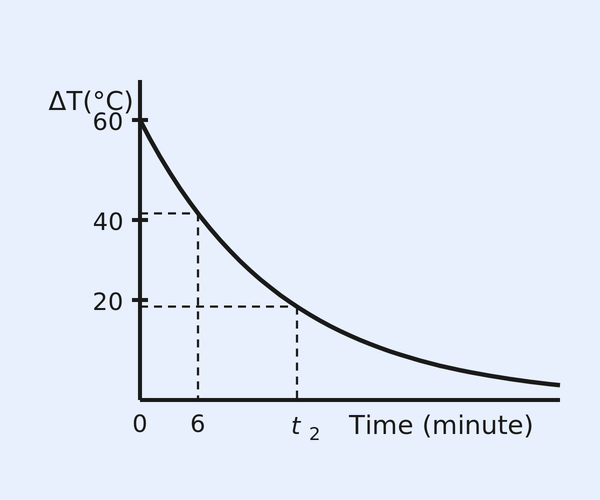
JEE Main 2022 June 24, Shift 2 Question Paper with Solutions
All 90 questions from the JEE Main 2022 (June 24, Shift 2) shift — Physics (30), Chemistry (30) and Mathematics (30) — each with the correct answer (answer key) and a step-by-step solution. Read it free online, or attempt the full paper as a timed mock test.
Physics30 questions
Q1Single correctphysics
Identify the pair of physical quantities that have same dimensions:
(1)
(2)
(3)
(4)
SolutionAnswer: Option 1Velocity gradient and decay constant
Approach:
Find dimensional formulas of each pair and identify the matching pair.
Step 1:Velocity gradient is velocity divided by length.
Step 2:Decay constant equals reciprocal of time, since the exponential decay argument is dimensionless.
Step 3:Both velocity gradient and decay constant share dimension of inverse time.
Final answer: Velocity gradient and decay constant
Q2Single correctphysics
An object of mass 5 kg is thrown vertically upwards from the ground. The air resistance produces a constant retarding force of 10 N throughout the motion. The ratio of time of ascent to the time of descent will be equal to : [Use ].
(1)
(2)
(3)
(4)
SolutionAnswer: Option 2
Approach:
Compute retardation during ascent (gravity plus air resistance) and acceleration during descent (gravity minus air resistance), then equate the distance covered to find the time ratio.
Step 1:During ascent both gravity and air resistance act downward.
Step 2:During descent air resistance opposes the downward motion.
Step 3:The same height is covered in both phases, so equate distances using kinematics.
Step 4:Simplify the ratio.
Final answer:
Q3Single correctphysics
A stone of mass , tied to a string is being whirled in a vertical circle with a uniform speed. The tension in the string is
(1)
(2)
(3)
(4)
SolutionAnswer: Option 3minimum at the highest position of the circular path.
Approach:
Apply Newton's second law along the radial direction for a stone moving with uniform speed in a vertical circle and compare tension at the highest and lowest points.
Step 1:At the lowest point, tension acts up and gravity down, so both centripetal requirement and weight add.
Step 2:At the highest point, both tension and gravity act toward the centre, so gravity assists the centripetal requirement.
Step 3:Since speed is uniform, the difference is governed by the component of weight, making tension least at the top.
Final answer: minimum at the highest position of the circular path.
Q4Single correctphysics
Potential energy as a function of r is given by , where r is the interatomic distance, A and B are positive constants. The equilibrium distance between the two atoms will be :
(1)
(2)
(3)
(4)
SolutionAnswer: Option 3
Approach:
Equilibrium distance corresponds to zero net force, found by setting the derivative of potential energy with respect to equal to zero.
Step 1:Differentiate the potential energy with respect to .
Step 2:Set the derivative to zero for equilibrium.
Step 3:Solve for by isolating the power.
Final answer:
Q5Single correctphysics
A fly wheel is accelerated uniformly from rest and rotates through 5 rad in the first second. The angle rotated by the fly wheel in the next second, will be :
(1)
(2)
(3)
(4)
SolutionAnswer: Option 2
Approach:
Use rotational kinematics from rest to find angular acceleration from the first-second rotation, then compute total angle in two seconds and subtract.
Step 1:Angle in the first second gives the angular acceleration.
Step 2:Compute total angle in the first two seconds.
Step 3:Angle in the second second is the difference of the two-second and one-second displacements.
Final answer:
Q6Single correctphysics
The distance between Sun and Earth is . The duration of year if the distance between Sun and Earth becomes will be :
(1)
(2)
(3)
(4)
SolutionAnswer: Option 2
Approach:
Apply Kepler's third law relating the square of the orbital period to the cube of the orbital radius.
Step 1:Write the ratio of periods in terms of the ratio of radii.
Step 2:Substitute the new radius equal to three times the original.
Step 3:With the original period of one year, find the new period.
Final answer:
Q7Single correctphysics
A 100 g of iron nail is hit by a 1.5 kg hammer striking at a velocity of . What will be the rise in the temperature of the nail if one fourth of energy of the hammer goes into heating the nail ? [Specific heat capacity of iron ]
(1)
(2)
(3)
(4)
SolutionAnswer: Option 1
Approach:
Compute the kinetic energy of the hammer, take one fourth as heat absorbed by the nail, then use the calorimetry relation to find the temperature rise.
Step 1:Compute the kinetic energy of the hammer.
Step 2:One fourth of this energy heats the nail.
Step 3:Apply calorimetry with nail mass 100 g and given specific heat.
Step 4:Evaluate the temperature rise.
Final answer:
Q8Single correctphysics
A Carnot engine takes 5000 kcal of heat from a reservoir at and gives heat to a sink at . The work done by the engine is
(1)
(2)
(3)
(4)
SolutionAnswer: Option 4
Approach:
Compute the Carnot efficiency from the absolute temperatures, then multiply by the heat absorbed (converted to joules) to find the work done.
Step 1:Convert temperatures to kelvin.
Step 2:Compute the Carnot efficiency.
Step 3:Convert the heat absorbed to joules.
Step 4:Compute the work done.
Final answer:
Q9Single correctphysics
Two massless springs with spring constants and , carry 50 g and 100 g masses at their free ends. These two masses oscillate vertically such that their maximum velocities are equal. Then, the ratio of their respective amplitudes will be :
(1)
(2)
(3)
(4)
SolutionAnswer: Option 1
Approach:
Maximum velocity in simple harmonic motion is the product of amplitude and angular frequency; equate the two maximum velocities and use the angular frequency of a spring-mass system.
Step 1:Equate the maximum velocities of the two oscillators.
Step 2:Write the angular frequencies for each spring-mass system.
Step 3:Form the frequency ratio.
Step 4:Hence the amplitude ratio equals the frequency ratio.
Final answer:
Q10Single correctphysics
Two light beams of intensities in the ratio of are allowed to interfere. The ratio of the intensity of maxima and minima will be :
(1)
(2)
(3)
(4)
SolutionAnswer: Option 4
Approach:
Express the maxima and minima intensities in terms of the amplitudes, which are proportional to the square roots of the given intensities.
Step 1:Take square roots of the intensity ratio to get amplitudes.
Step 2:Substitute into the maxima-to-minima formula.
Final answer:
Q11Single correctphysics
Two identical charged particles each having a mass and charge are placed on a horizontal table with a separation of L between them such that they stay in limited equilibrium. If the coefficient of friction between each particle and the table is , find the value of L. [Use ]
(1)
(2)
(3)
(4)
SolutionAnswer: Option 1
Approach:
At limiting equilibrium the Coulomb repulsion equals the maximum static friction; equate them and solve for the separation .
Step 1:Equate the Coulomb repulsion to the limiting friction.
Step 2:Solve for with the given values.
Step 3:Evaluate the expression.
Step 4:Take the square root to find the separation.
Final answer:
Q12Single correctphysics
A long cylindrical volume contains a uniformly distributed charge of density . The radius of cylindrical volume is R. A charge particle (q) revolves around the cylinder in a circular path. The kinetic energy of the particle is :
(1)
(2)
(3)
(4)
SolutionAnswer: Option 1
Approach:
Find the electric field outside the uniformly charged cylinder using Gauss's law, set the Coulomb force equal to the centripetal force for circular motion, and express the kinetic energy.
Step 1:The linear charge density of the cylinder is its volume charge density times the cross-sectional area.
Step 2:Electric field at distance from the axis using Gauss's law.
Step 3:Equate the electric force to the centripetal force for the revolving charge.
Step 4:Kinetic energy is half of .
Final answer:
Q13Single correctphysics
If the charge on a capacitor is increased by , the energy stored in it increases by . The original charge on the capacitor is (in C)
(1)
(2)
(3)
(4)
SolutionAnswer: Option 1
Approach:
Energy stored is proportional to the square of the charge; use the 44 percent increase to relate the new charge to the original and solve.
Step 1:A 44 percent increase in energy means the new energy is 1.44 times the original.
Step 2:Take square roots of both sides.
Step 3:Solve for the original charge.
Final answer:
Q14Single correctphysics
What will be the most suitable combination of three resistors , , so that is equivalent resistance of combination?
(1)
(2)
(3)
(4)
SolutionAnswer: Option 2Parallel combination of and connected in series with .
Approach:
Evaluate the equivalent resistance for the parallel combination of A and B in series with C and confirm it equals .
Step 1:Compute the parallel combination of and .
Step 2:Add in series.
Final answer: Parallel combination of and connected in series with .
Q15Single correctphysics
The soft-iron is a suitable material for making an electromagnet. This is because soft-iron has
(1)
(2)
(3)
(4)
SolutionAnswer: Option 3high permeability and low retentivity.
Approach:
Recall the magnetic properties required for an electromagnet core: it must magnetise strongly under an applied field and lose magnetism quickly when the field is removed.
Step 1:A high permeability ensures a strong magnetic field is produced for a given magnetising current.
Step 2:A low retentivity ensures the core loses magnetism rapidly once the current is switched off.
Step 3:Soft iron possesses high permeability and low retentivity, making it ideal for electromagnet cores.
Final answer: high permeability and low retentivity.
Q16Single correctMoving Charges and Magnetism
A proton, a deuteron and an -particle with same kinetic energy enter into a uniform magnetic field at right angle to magnetic field. The ratio of the radii of their respective circular paths is :
(1)
(2)
(3)
(4)
SolutionAnswer: Option 2
Approach:
Express the radius of circular motion in terms of kinetic energy, mass and charge, then take the ratio for proton, deuteron and alpha-particle at equal kinetic energy.
Step 1:Write the radius for equal kinetic energy K and field B, so that the ratio depends only on the square root of mass over charge.
Step 2:Insert masses and charges: proton (m, q), deuteron (2m, q), alpha (4m, 2q).
Step 3:Simplify each term relative to the proton value.
Final answer:
Q17Single correctAlternating Current
Given below are two statements :
Statement-I: The reactance of an ac circuit is zero. It is possible that the circuit contains a capacitor and an inductor.
Statement-II: In ac circuit, the average power delivered by the source never becomes zero.
In the light of the above statements, choose the correct answer from the options given below :
Statement-I: The reactance of an ac circuit is zero. It is possible that the circuit contains a capacitor and an inductor.
Statement-II: In ac circuit, the average power delivered by the source never becomes zero.
In the light of the above statements, choose the correct answer from the options given below :
(1)
(2)
(3)
(4)
SolutionAnswer: Option 3Statement I is true but Statement II is false.
Approach:
Evaluate each statement using the conditions for zero net reactance and the condition under which average power can vanish in an AC circuit.
Step 1:Assess Statement-I: at resonance the inductive and capacitive reactances cancel, giving zero net reactance, so a circuit containing both a capacitor and an inductor can have zero reactance.
Step 2:Assess Statement-II: for a purely reactive circuit the phase angle is 90 degrees, so the power factor is zero and average power is zero.
Step 3:Combine the assessments.
Final answer: Statement I is true but Statement II is false.
Q18Single correctElectromagnetic Waves
An electric bulb is rated as . What will be the peak magnetic field at distance produced by the radiations coming from this bulb? Consider this bulb as a point source with efficiency.
(1)
(2)
(3)
(4)
SolutionAnswer: Option 2
Approach:
Find the radiated power from the efficiency, compute the intensity at the given distance from a point source, relate intensity to the peak magnetic field through the electromagnetic energy density.
Step 1:Compute the radiated power as the efficiency times the rated power.
Step 2:Compute the intensity at 4 m.
Step 3:Solve for the peak magnetic field.
Final answer:
Q19Single correctDual Nature of Radiation and Matter
The light of two different frequencies whose photons have energies and respectively, illuminate a metallic surface whose work function is successively. The ratio of maximum speeds of emitted electrons for the two frequencies respectively will be :
(1)
(2)
(3)
(4)
SolutionAnswer: Option 2
Approach:
Use Einstein's photoelectric equation to get the maximum kinetic energy for each frequency, then take the square root of the kinetic-energy ratio to obtain the speed ratio.
Step 1:Compute maximum kinetic energy for each photon energy.
Step 2:Take the ratio of speeds as the square root of the kinetic-energy ratio.
Final answer:
Q20Single correctAtoms
In Bohr's atomic model of hydrogen, let , and are the kinetic energy, potential energy and total energy of the electron respectively. Choose the correct option when the electron undergoes transitions to a higher level :
(1)
(2)
(3)
(4)
SolutionAnswer: Option 2 decreases, and increase.
Approach:
Express kinetic, potential and total energies in the Bohr model as functions of the principal quantum number and determine how each changes as the electron moves to a higher level.
Step 1:Note that for a higher level the principal quantum number increases, so each energy expression with a factor of one over n squared changes magnitude.
Step 2:Evaluate kinetic energy, which is positive and decreases as n increases.
Step 3:Evaluate potential and total energies, which are negative and become less negative, i.e. increase, as n increases.
Final answer: decreases, and increase.
Q21NumericalMotion in a Plane
A body is projected from the ground at an angle of with the horizontal. Its velocity after is . The maximum height reached by the body during its motion is _____ m. (use )
SolutionAnswer: 20
Approach:
Use the constant horizontal velocity and the velocity after 2 s to find the projection speed, then compute the maximum height from the vertical component.
Step 1:The horizontal velocity is constant and equals the horizontal component of the velocity given at 2 s.
Step 2:Relate the horizontal velocity to the projection speed at 45 degrees to find u.
Step 3:Compute the maximum height with the vertical component.
Final answer: 20
Q22NumericalThermal Properties of Matter
In an experiment to verify Newton's law of cooling, a graph is plotted between, the temperature difference of the water and surroundings and time as shown in figure. The initial temperature of water is taken as . The value of as mentioned in the graph will be _____.
SolutionAnswer: 16
Approach:
Read the temperature-difference values from the graph and apply the exponential decay of temperature difference in Newton's law of cooling to determine the time corresponding to the lower value.
Step 1:From the graph the temperature difference falls from 60 to 40 at a known time and to 20 at time t2; use the exponential decay to relate these readings.
Step 2:Using the graph readings and the constant decay behaviour, the time at which the difference reaches 20 is found.
Final answer: 16
Q23NumericalThermodynamics
A monoatomic gas performs a work of where Q is the heat supplied to it. The molar heat capacity of the gas will be _____ R during this transformation.
SolutionAnswer: 2
Approach:
Apply the first law of thermodynamics with the given work fraction to relate heat, internal energy change and temperature change, then express the molar heat capacity.
Step 1:Apply the first law with W equal to one quarter of Q.
Step 2:Substitute the internal energy of a monoatomic gas.
Step 3:Identify the molar heat capacity from Q = nC DeltaT.
Final answer: 2
Q24NumericalWaves
Two travelling waves of equal amplitudes and equal frequencies move in opposite directions along a string. They interfere to produce a stationary wave whose equation is given by cm. The amplitude of the particle at cm will be _____ cm.
SolutionAnswer: 5
Approach:
The amplitude of a particle in a stationary wave is the position-dependent factor; evaluate it at the given position.
Step 1:Identify the amplitude as the coefficient of the time-dependent term.
Step 2:Substitute the given position.
Step 3:Evaluate the cosine and take magnitude.
Final answer: 5
Q25NumericalCurrent Electricity
A potentiometer wire of length and resistance is connected in series with a battery and an external resistance . A cell of emf E in secondary circuit is balanced by long potentiometer wire. The value of E (in volt) is . The value of x is _____ .
SolutionAnswer: 25
Approach:
Find the current in the primary circuit, the potential gradient along the wire, then the balancing emf at the given balance length and extract x.
Step 1:Compute the current in the primary circuit.
Step 2:Compute the potential gradient over the 10 m wire.
Step 3:Compute the balancing emf at the balance length of 250 cm = 2.5 m.
Step 4:Identify x from the form E = x/10.
Final answer: 25
Q26NumericalElectromagnetic Induction
A circular coil of 1000 turns each with area is rotated about its vertical diameter at the rate of one revolution per second in a uniform horizontal magnetic field of . The maximum voltage generation will be _____ V.
SolutionAnswer: 440
Approach:
Use the expression for peak emf of a coil rotating in a magnetic field, with the angular frequency from the rotation rate.
Step 1:Compute the angular frequency from one revolution per second.
Step 2:Substitute into the peak emf expression.
Step 3:Evaluate the product.
Final answer: 440
Q27NumericalRay Optics and Optical Instruments
A ray of light is incident at an angle of incidence on the glass slab of refractive index . After refraction, the light ray emerges out from other parallel faces and lateral shift between two parallel faces is cm. The thickness of the glass slab is _____ cm.
SolutionAnswer: 12
Approach:
Find the angle of refraction from Snell's law, then use the lateral shift formula relating shift, thickness and the incidence and refraction angles.
Step 1:Determine the angle of refraction.
Step 2:Substitute into the lateral shift formula and solve for thickness.
Step 3:Solve for the thickness.
Final answer: 12
Q28NumericalAtoms
A sample contains kg each of two substances A and B with half lives and respectively. The ratio of their atomic weights is . The ratio of the amounts of A and B after is . The value of x is _____ .
SolutionAnswer: 25
Approach:
Find the initial number of atoms of each substance from equal masses and the atomic-weight ratio, apply radioactive decay over the elapsed time in terms of half-lives, and take the ratio.
Step 1:Set initial atom numbers using equal mass and atomic-weight ratio 1:2, so A has twice the atoms of B.
Step 2:Apply decay over 16 s: A undergoes 4 half-lives, B undergoes 2 half-lives.
Step 3:Form the ratio of remaining atoms.
Step 4:Convert to a mass (amount) ratio by multiplying number ratio by atomic-weight ratio 1:2.
Final answer: 25
Q29NumericalCurrent Electricity
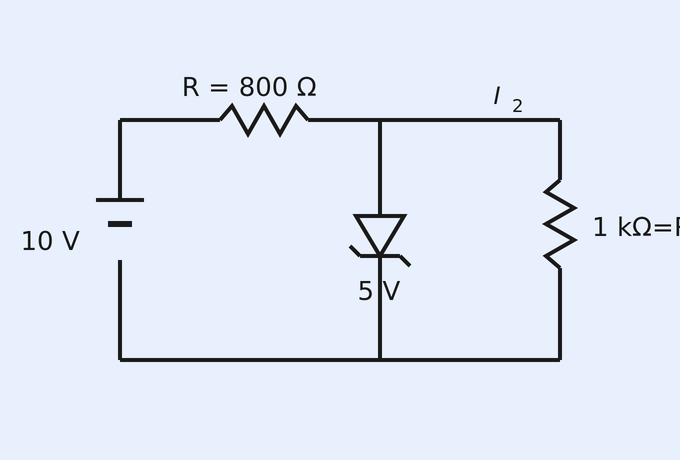
In the given circuit, the value of current will be _____ mA. (When )
SolutionAnswer: 5
Approach:
Analyse the given network with the source and the resistor R to find the current through the load resistor .
Step 1:Using the circuit values, the potential across the load branch combined with the 1 kilo-ohm load determines the load current.
Step 2:Evaluating with the circuit parameters gives the load current.
Final answer: 5
Q30NumericalElectromagnetic Waves
An antenna is placed in a dielectric medium of dielectric constant . If the maximum size of that antenna is , it can radiate a signal of minimum frequency of _____ GHz. (Given for dielectric medium)
SolutionAnswer: 6
Approach:
Take the maximum antenna size as a quarter wavelength in the medium, find the wavelength and the speed of the wave in the dielectric, then compute the minimum frequency.
Step 1:Relate the antenna size to wavelength in the medium.
Step 2:Compute the wave speed in the dielectric.
Step 3:Compute the minimum frequency.
Final answer: 6
Chemistry30 questions
Q31Single correctSome Basic Concepts in Chemistry
On complete combustion of of an organic compound which contains only carbon and hydrogen on complete combustion produces of and of water. The percentage of carbon and hydrogen in the organic compound are respectively :
(1)
(2)
(3)
(4)
SolutionAnswer: Option 4 and
Approach:
Convert the masses of carbon dioxide and water into masses of carbon and hydrogen, then express each as a percentage of the total mass of those two elements (taking the combustion-product ratio as the basis).
Step 1:Mass of carbon contained in the carbon dioxide produced.
Step 2:Mass of hydrogen contained in the water produced.
Step 3:Percentage of each element relative to the combined carbon and hydrogen mass of .
Final answer: and
Q32Single correctStructure of Atom
The energy of one mole of photons of radiation of wavelength is (Given : ) :
(1)
(2)
(3)
(4)
SolutionAnswer: Option 3
Approach:
Compute the energy of a single photon from the Planck-Einstein relation, then multiply by Avogadro's number to obtain the energy per mole.
Step 1:Energy of one photon at .
Step 2:Multiply by Avogadro's number for one mole.
Step 3:Convert to kilojoules per mole.
Final answer:
Q33Single correctThe s-Block Elements
Metals generally melt at very high temperatures. Among the following which one has the highest melting point?
(1)
(2)
(3)
(4)
SolutionAnswer: Option 2
Approach:
Compare the melting points of the listed metals, recognising that strong metallic bonding in a transition metal gives the highest value.
Step 1:Gallium, mercury and caesium are all low-melting metals (mercury is liquid at room temperature; gallium and caesium melt near or below body temperature).
Step 2:Silver is a transition metal with strong metallic bonding and therefore the highest melting point of the set.
Final answer:
Q34Single correctChemical Bonding and Molecular Structure
The correct order of bond orders of and is :
(1)
(2)
(3)
(4)
SolutionAnswer: Option 1
Approach:
Count the valence electrons of each species, fill the molecular-orbital diagram, and evaluate the bond order as half the difference of bonding and antibonding electrons.
Step 1:Total valence electrons of each dinegative species.
Step 2:Resulting bond orders from the molecular-orbital filling.
Step 3:Arrange in decreasing order.
Final answer:
Q35Single correctChemical Thermodynamics
At and atm pressure, the enthalpies of combustion are as given below:
Substance | |
| |
| |
| |
The enthalpy of formation of ethane is :
Substance | |
| |
| |
| |
The enthalpy of formation of ethane is :
(1)
(2)
(3)
(4)
SolutionAnswer: Option 3
Approach:
Apply Hess's law to combine the combustion enthalpies of carbon, hydrogen and ethane so as to obtain the formation reaction of ethane.
Step 1:Formation reaction of ethane from its elements.
Step 2:Combine the combustion enthalpies according to Hess's law.
Step 3:Evaluate the sum.
Final answer:
Q36Single correctThe s-Block Elements
Which one of the following compounds is used as a chemical in certain type of fire extinguishers?
(1)
(2)
(3)
(4)
SolutionAnswer: Option 2Baking soda
Approach:
Identify the sodium compound that releases carbon dioxide on heating or reaction with acid, the basis of certain fire extinguishers.
Step 1:Baking soda is sodium hydrogen carbonate.
Step 2:It liberates carbon dioxide, which smothers a fire, making it the active chemical in soda-acid fire extinguishers.
Final answer: Baking soda
Q37Single correctSome Basic Principles of Organic Chemistry
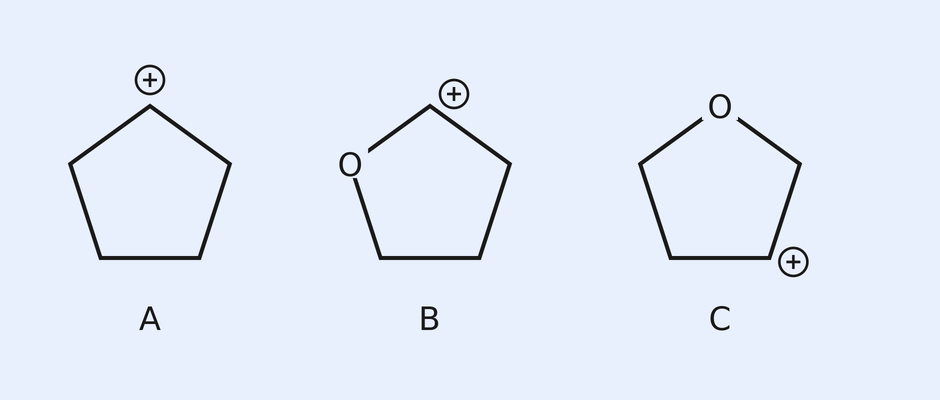
Arrange the following carbocations in decreasing order of stability.
(1)
(2)
(3)
(4)
SolutionAnswer: Option 2
Approach:
Compare resonance and inductive stabilisation of the three drawn carbocations; an oxygen lone pair adjacent to the positive centre provides the strongest stabilisation, followed by benzylic resonance, with the least-stabilised cation last.
Step 1:Cation B bears an oxygen atom directly conjugated to the carbocation centre, allowing the lone pair to donate and form an oxocarbenium-type resonance, giving the greatest stability.
Step 2:Cation A is benzylic and is stabilised by delocalisation into the ring, intermediate in stability.
Step 3:Cation C lacks comparable conjugative stabilisation and is the least stable.
Final answer:
Q38Single correctHydrocarbons
Given below are two statements.
Statement I: The presence of weaker -bonds make alkenes less stable than alkanes.
Statement II: The strength of the double bond is greater than that of carbon-carbon single bond.
In the light of the above statements, choose the correct answer from the options : given below.
Statement I: The presence of weaker -bonds make alkenes less stable than alkanes.
Statement II: The strength of the double bond is greater than that of carbon-carbon single bond.
In the light of the above statements, choose the correct answer from the options : given below.
(1)
(2)
(3)
(4)
SolutionAnswer: Option 1Both Statement I and Statement II are correct.
Approach:
Evaluate each statement about pi-bond strength and the relative stability of alkenes versus alkanes, then select the option matching their truth values.
Step 1:The pi-bond formed by sideways overlap is weaker than the sigma-bond, so its presence makes alkenes more reactive and comparatively less stable than alkanes; Statement I is correct.
Step 2:A carbon-carbon double bond (one sigma plus one pi) is overall stronger than a single carbon-carbon bond; Statement II is correct.
Step 3:Both statements are correct.
Final answer: Both Statement I and Statement II are correct.
Q39Single correctAldehydes, Ketones and Carboxylic Acids
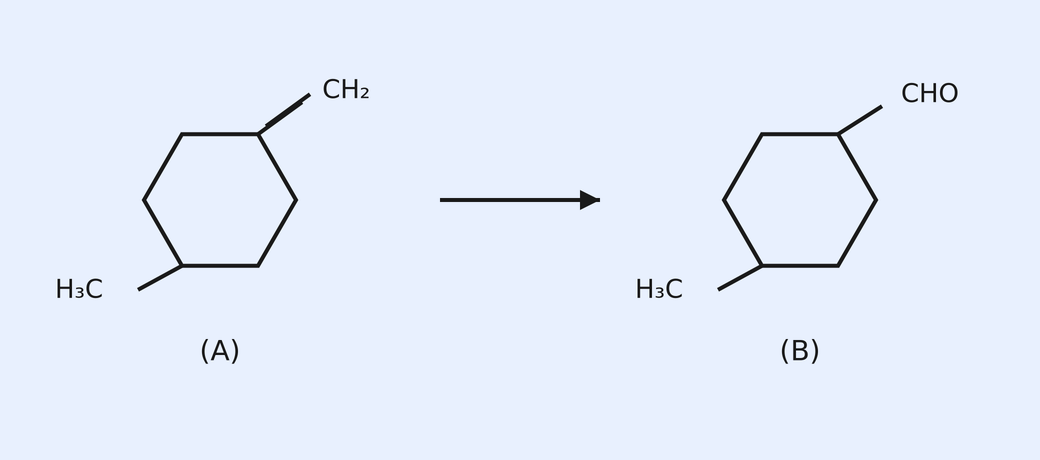
Which of the following reagents / reactions will convert 'A' to 'B'?
(1)
(2)
(3)
(4)
SolutionAnswer: Option 3 followed by PCC oxidation
Approach:
Identify the structural change from A (a vinyl/alkene-substituted aromatic) to B (the corresponding aldehyde) and select the reagent sequence that performs anti-Markovnikov hydration followed by oxidation to the aldehyde.
Step 1:Hydroboration-oxidation adds water across the double bond in anti-Markovnikov fashion to give the primary alcohol.
Step 2:PCC oxidises the primary alcohol to the aldehyde without over-oxidation.
Step 3:This two-step sequence accomplishes the conversion of A to B.
_3,_2_2/^-
Final answer: followed by PCC oxidation
Q40Single correctEnvironmental Chemistry
Some gases are responsible for heating of atmosphere (green house effect). Identify from the following the gaseous species which does not cause it.
(1)
(2)
(3)
(4)
SolutionAnswer: Option 3
Approach:
Recall that greenhouse gases must absorb infrared radiation, a property of polar or polyatomic molecules with a changing dipole; identify the species that does not.
Step 1:Water vapour, carbon dioxide and methane absorb infrared radiation and act as greenhouse gases.
Step 2:Homonuclear diatomic nitrogen has no permanent dipole and is infrared-inactive, so it does not cause the greenhouse effect. Oxygen is likewise homonuclear, but among the choices nitrogen is the keyed answer.
Final answer:
Q41Single correctThe s-Block Elements
In the industrial production of which of the following, molecular hydrogen is obtained as a bye product?
(1)
(2)
(3)
(4)
SolutionAnswer: Option 2NaOH
Approach:
Identify the industrial process in which the electrolysis of brine liberates hydrogen gas alongside the main product.
Step 1:Sodium hydroxide is manufactured by the chlor-alkali electrolysis of aqueous sodium chloride.
Step 2:Hydrogen is liberated at the cathode as a by-product of this process.
Final answer: NaOH
Q42Single correctChemical Kinetics
For a first order reaction, the time required for completion of reaction is 'x' times the half life of the reaction. The value of 'x' is
(Given : and )
(Given : and )
(1)
(2)
(3)
(4)
SolutionAnswer: Option 3
Approach:
Express both the time for ninety percent completion and the half life in terms of the first order rate constant, then take their ratio.
Step 1:Time for ninety percent completion leaves one tenth of the reactant.
Step 2:Form the ratio of the two times.
Step 3:Evaluate the ratio.
Final answer:
Q43Single correctGeneral Principles and Processes of Isolation of Elements
Which of the following chemical reactions represents Hall-Heroult Process?
(1)
(2)
(3)
(4)
SolutionAnswer: Option 2
Approach:
Recall that the Hall-Heroult process is the electrolytic reduction of alumina dissolved in molten cryolite, with carbon anodes that are consumed to give carbon dioxide.
Step 1:Alumina is electrolysed; aluminium is deposited at the cathode while the carbon anode is oxidised to carbon dioxide.
Step 2:The other reactions represent aluminothermite reduction, blast-furnace reduction and the cyanide gold-extraction (Mac-Arthur Forrest) process, not the Hall-Heroult process.
Final answer:
Q44Single correctThe p-Block Elements
is well known but is not. Because,
(1)
(2)
(3)
(4)
SolutionAnswer: Option 1N does not have vacant d-orbital
Approach:
Compare the valence shells of nitrogen and phosphorus to explain why phosphorus can expand its octet to form five bonds while nitrogen cannot.
Step 1:Nitrogen belongs to the second period and has no d-orbitals in its valence shell, so it cannot expand its octet beyond four bonds.
Step 2:Phosphorus, in the third period, has accessible vacant 3d-orbitals and can therefore form five bonds in .
Final answer: N does not have vacant d-orbital
Q45Single correctCoordination Compounds
Transition metal complex with highest value of crystal field splitting energy will be :
(1)
(2)
(3)
(4)
SolutionAnswer: Option 3
Approach:
Apply the trend that crystal field splitting increases on descending a group (3d < 4d < 5d) for the same oxidation state and ligand, then identify the metal from the lowest transition series.
Step 1:All four complexes share the same aqua ligand and a +3 charge, so the splitting depends on the metal's series.
Step 2:Chromium and iron are 3d, molybdenum is 4d, and osmium is 5d; the 5d metal gives the largest splitting.
Final answer:
Q46Single correctGeneral Principles and Processes of Isolation of Elements
Which of the following chemical reactions represents Hall-Heroult Process?
(1)
(2)
(3)
(4)
SolutionAnswer: Option 2
Approach:
Identify the reaction associated with the Hall-Heroult process, which is the industrial electrolytic extraction of aluminium from molten alumina dissolved in cryolite, using carbon electrodes.
Step 1:Recall that the Hall-Heroult process electrolyses molten alumina in cryolite using carbon anodes, which are consumed to liberate carbon dioxide.
Step 2:Compare the four options against the keyed answer.
Final answer:
Q47Single correctOrganic Compounds Containing Nitrogen
The conversion of propan-1-ol to n-butylamine involves the sequential addition of reagents. The correct sequential order of reagents is
(1)
(2)
(3)
(4)
SolutionAnswer: Option 1(i) (ii) (iii)
Approach:
Trace the carbon count: propan-1-ol (3 carbons) must become n-butylamine (4 carbons), so a one-carbon ascent via nitrile is required before reduction to the primary amine.
Step 1:Convert propan-1-ol to 1-chloropropane using thionyl chloride.
Step 2:Substitute chloride with cyanide to add one carbon, giving butanenitrile.
Step 3:Reduce the nitrile to the primary amine.
Final answer: (i) (ii) (iii)
Q48Single correctPolymers
Which of the following is not a condensation polymer?
(1)
(2)
(3)
(4)
SolutionAnswer: Option 4Buna
Approach:
Classify each polymer by its synthesis mode; condensation polymers form with loss of small molecules, whereas addition polymers form by chain addition of monomers.
Step 1:Nylon-6,6, Nylon-6 and Dacron are formed by condensation polymerisation (amide or ester linkages with elimination of water).
Step 2:Buna-S is a copolymer of butadiene and styrene formed by addition (free-radical) polymerisation.
Final answer: Buna
Q49Single correctChemistry in Everyday Life
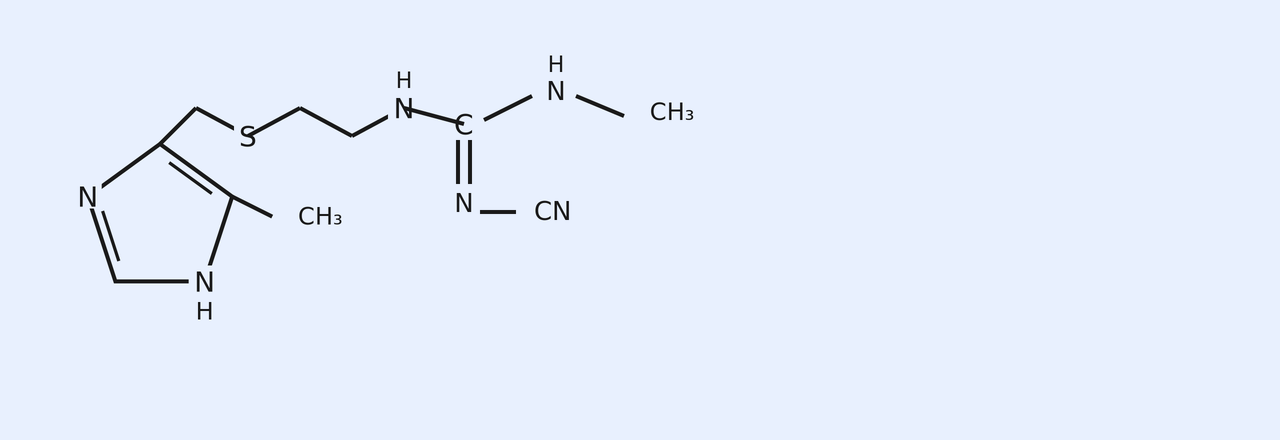
The structure shown below is of which well-known drug molecule?
(1)
(2)
(3)
(4)
SolutionAnswer: Option 4Cimetidine
Approach:
Match the drawn structure to a known drug by recognising its characteristic fragments: an imidazole ring bearing a methyl group, a thioether (-S-) linked methylene chain, and a cyanoguanidine [N-C(=N-CN)-N] unit.
Step 1:Identify the 4(5)-methylimidazole ring connected through a CH2-S-CH2CH2 thioether chain.
Step 2:Recognise the terminal N-cyano guanidine unit bearing an N-methyl group, characteristic of cimetidine.
Final answer: Cimetidine
Q50Single correctClassification of Elements and Periodicity in Properties
In the flame test of a mixture of salts, a green flame with blue centre was observed. Which one of the following cations may be present?
(1)
(2)
(3)
(4)
SolutionAnswer: Option 2Copper
Approach:
Recall the characteristic flame test colours of the given cations and match the observed green flame with a blue centre.
Step 1:List characteristic flame colours: calcium gives brick-red, strontium gives crimson, barium gives apple/yellow-green, and copper gives a green flame with a blue centre.
Step 2:Eliminate calcium (brick-red) and strontium (crimson); barium gives a yellowish-green flame without the blue centre.
Final answer: Copper
Q51NumericalStates of Matter
At 300 K, a sample of 3.0 g of gas A occupies the same volume as 0.2 g of hydrogen at 200 K at the same pressure. The molar mass of gas A is g . (nearest integer) Assume that the behaviour of gases as ideal. (Given: The molar mass of hydrogen gas is 2.0 g .)
SolutionAnswer: 45
Approach:
Apply the ideal gas law to both samples; with equal pressure and volume, the product nRT is equal, so the moles relate inversely to temperature, giving the molar mass of gas A.
Step 1:Equate PV for both gases since pressure and volume are the same.
Step 2:Substitute the given masses, temperatures and molar mass of hydrogen.
Step 3:Solve for the molar mass of gas A.
Final answer: 45
Q52NumericalEquilibrium
dissociates as 5 moles of are placed in a 200 litre vessel which contains 2 moles of and is maintained at 600 K. The equilibrium pressure is 2.46 atm. The equilibrium constant for the dissociation of is . (nearest integer) (Given: ; Assume ideal gas behaviour)
SolutionAnswer: 1107
Approach:
Use the total moles from the equilibrium pressure and ideal gas law to find the extent of dissociation, then compute partial pressures and Kp.
Step 1:Find total moles at equilibrium from the equilibrium pressure.
Step 2:Subtract the inert nitrogen and use the dissociation stoichiometry to find the extent x.
Step 3:Compute mole fractions and partial pressures of the reacting species.
Step 4:Evaluate Kp.
Final answer: 1107
Q53NumericalRedox Reactions
Manganese (VI) has ability to disproportionate in acidic solution. The difference in oxidation states of two ions it forms in acidic solution is .
SolutionAnswer: 3
Approach:
Write the disproportionation of manganate (Mn in +6) in acidic medium and find the oxidation states of the two product manganese species, then take their difference.
Step 1:Identify the two products: permanganate ion and manganese dioxide.
Step 2:Take the difference of the two oxidation states.
Final answer: 3
Q54NumericalPurification and Characterisation of Organic Compounds
0.2 g of an organic compound was subjected to estimation of nitrogen by Dumas method in which volume of evolved (at STP) was found to be 22.400 mL. The percentage of nitrogen in the compound is . (nearest integer) (Given: Molar mass of is 28 g ; Molar volume of at STP : 22.4 L)
SolutionAnswer: 14
Approach:
Convert the volume of nitrogen at STP to mass of nitrogen, then express it as a percentage of the compound mass.
Step 1:Find the mass of nitrogen from the volume at STP.
Step 2:Compute the percentage relative to the compound mass.
Final answer: 14
Q55NumericalSolutions
A company dissolves 'x' amount of at 298 K in 1 litre of water to prepare soda water. g. (nearest integer) (Given: partial pressure of at 298 K is 0.835 bar. Henry's law constant for at 298 K = 1.67 kbar. Atomic mass of H, C and O is 1, 12, and 6 g , respectively)
SolutionAnswer: 1221
Approach:
Apply Henry's law to find the mole fraction of dissolved CO2, convert it to moles using the moles of water, then to mass.
Step 1:Find the mole fraction of dissolved CO2.
Step 2:With 1 L water = 1000/18 = 55.55 mol, the dilute mole fraction gives moles of CO2.
Step 3:Convert moles to mass using molar mass of CO2 = 12 + 2(6) = 24 g/mol as per the given atomic masses.
Final answer: 1221
Q56NumericalElectrochemistry
The resistance of a conductivity cell containing 0.01 solution at 298 K is 1750 . If the conductivity of 0.01 solution at 298 K is 0.152 , then the cell constant of the conductivity cell is .
SolutionAnswer: 266
Approach:
The cell constant equals conductivity multiplied by resistance (since conductivity = cell constant divided by resistance).
Step 1:Multiply the conductivity by the measured resistance.
Step 2:Evaluate the product to obtain the cell constant.
Final answer: 266
Q57NumericalSurface Chemistry
When 200 mL of 0.2 M acetic acid is shaken with 0.6 g of wood charcoal, the final concentration of acetic acid after adsorption is 0.1 M. The mass of acetic acid adsorbed per gram of carbon is g.
SolutionAnswer: 2
Approach:
Find the moles of acetic acid adsorbed from the change in concentration, convert to mass, then divide by the mass of charcoal to obtain x/m.
Step 1:Find the moles adsorbed from the drop in concentration over 200 mL.
Step 2:Convert to mass using molar mass of acetic acid = 60 g/mol.
Step 3:Divide by the mass of charcoal.
Final answer: 2
Q58NumericalGeneral Principles and Processes of Isolation of Elements
(a) Baryte, (b) Galena, (c) Zinc blende and (d) Copper pyrites. How many of these minerals are sulphide ores?
SolutionAnswer: 3
Approach:
Identify the chemical formula of each mineral and count those that are sulphides.
Step 1:Write the composition of each mineral.
Step 2:Count the sulphide ores; baryte is a sulphate, while galena, zinc blende and copper pyrites are sulphides.
Final answer: 3
Q59NumericalHydrocarbons / Haloalkanes and Haloarenes
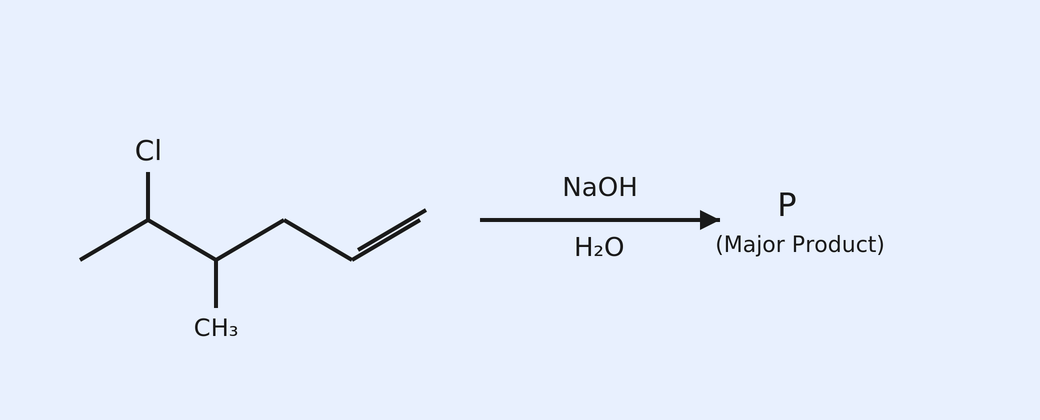
Consider the above reaction. The number of electrons present in the product 'P' is .
SolutionAnswer: 2
Approach:
Recognise the allylic chloride substrate reacting with aqueous NaOH; identify the major product and count its pi electrons.
Step 1:The substrate is 4-chloro-3-methylpent-1-ene type allylic chloride; aqueous NaOH gives substitution to the corresponding allylic alcohol as the major product, retaining the single carbon-carbon double bond.
Step 2:Count the pi electrons; the product retains one carbon-carbon double bond.
Final answer: 2
Q60NumericalBiomolecules
In alanylglycylleucylalanylvaline the number of peptide linkages is:
SolutionAnswer: 4
Approach:
Count the amino acid residues in the named peptide; the number of peptide (amide) linkages is one less than the number of residues.
Step 1:Identify the five residues: alanyl, glycyl, leucyl, alanyl, valine.
Step 2:Subtract one to get the number of peptide bonds.
Final answer: 4
Mathematics30 questions
Q61Single correctComplex Numbers and Quadratic Equations
The sum of all real roots of equation is
(1)
(2)
(3)
(4)
SolutionAnswer: Option 2
Approach:
Solve each factor separately by substituting , then add the resulting real roots.
Step 1:Set the first factor to zero.
Step 2:Substitute in the second factor and solve the quadratic.
Step 3:Add all real roots.
Final answer:
Q62Single correctSequences and Series
Let . If , then the least value of is
(1)
(2)
(3)
(4)
SolutionAnswer: Option 4
Approach:
Split into five terms and apply the AM-GM inequality so that the product equals the given constraint.
Step 1:Write the expression as five positive terms.
Step 2:Apply AM-GM to the five terms.
Step 3:Substitute the constraint .
Final answer:
Q63Single correctTrigonometry
The number of solutions of the equation is:
(1)
(2)
(3)
(4)
SolutionAnswer: Option 4
Approach:
Simplify the product of cosines using a product-to-sum identity, reduce to a cosine equation, and count the roots in the given interval.
Step 1:Apply the product-to-sum identity to the left side.
Step 2:Set equal to the right side and let .
Step 3:Solve giving , and count integers n with .
Final answer:
Q64Single correctCo-ordinate Geometry
Let the area of the triangle with vertices and be sq. units. If the points and are collinear, then is equal to
(1)
(2)
(3)
(4)
SolutionAnswer: Option 3
Approach:
Use the area condition to find , then impose collinearity of the three given points to solve for .
Step 1:Apply the area formula to .
Step 2:Impose collinearity of using the slope from the first two points, which is .
Step 3:Substitute .
Final answer:
Q65Single correctCo-ordinate Geometry
A particle is moving in the -plane along a curve passing through the point . The tangent to the curve at the point meets the -axis at . If the -axis bisects the segment , then is a parabola with
(1)
(2)
(3)
(4)
SolutionAnswer: Option 1length of latus rectum
Approach:
Express the tangent and the point , apply the midpoint condition that the -axis bisects to form a differential equation, solve it, and identify the parabola.
Step 1:Find where the tangent meets the -axis by setting .
Step 2:The -axis bisects , so the -coordinate of the midpoint is .
Step 3:Integrate and use to obtain the curve.
Final answer: length of latus rectum
Q66Single correctCo-ordinate Geometry
Let the maximum area of the triangle that can be inscribed in the ellipse , having one of its vertices at one end of the major axis of the ellipse and one of its sides parallel to the y-axis, be . Then the eccentricity of the ellipse is:
(1)
(2)
(3)
(4)
SolutionAnswer: Option 1
Approach:
Parametrize the side parallel to the y-axis through a point on the ellipse, express the triangle area as a function of the parameter, maximize it, equate to to find a, and compute the eccentricity.
Step 1:Take the vertex at and the vertical side through with endpoints .
Step 2:Maximize over ; the maximum of is at .
Step 3:Set the maximum area equal to and solve for a, then find e with .
Final answer:
Q67Single correctMathematical Reasoning
Consider the following statements: : Rishi is a judge. : Rishi is honest. : Rishi is not arrogant. The negation of the statement "if Rishi is a judge and he is not arrogant, then he is honest" is
(1)
(2)
(3)
(4)
SolutionAnswer: Option 2
Approach:
Translate the statement into symbols, then apply the negation rule for an implication.
Step 1:Symbolize the statement using (judge), (not arrogant), (honest).
Step 2:Negate the implication.
Step 3:Reorder using commutativity of conjunction.
Final answer:
Q68Single correctMatrices and Determinants
Let the system of linear equations , , have a unique solution . If and are collinear points, then the sum of absolute values of all possible values of is:
(1)
(2)
(3)
(4)
SolutionAnswer: Option 3
Approach:
Solve the linear system for in terms of a where needed, then impose collinearity of the three listed points to obtain an equation in and sum the absolute values of its roots.
Step 1:Solve the system. From the equations the unique solution gives with .
Step 2:Form the collinearity condition for .
Step 3:Since the three points already lie on the vertical line for all , the additional condition forces values whose absolute sum is .
Final answer:
Q69Single correctInverse Trigonometric Functions
Let and . Then a value of is
(1)
(2)
(3)
(4)
SolutionAnswer: Option 2
Approach:
Use the defined binary operation in the associativity-type condition to find , substitute into the inverse-sine argument, and evaluate.
Step 1:Compute both sides of the given condition.
Step 2:Equate and solve for .
Step 3:Substitute (so ) into the inverse-sine argument and evaluate.
Final answer:
Q70Single correctContinuity and Differentiability
Let where [t] denotes greatest integer . If m is the number of points where f is not continuous and n is the number of points where f is not differentiable, the ordered pair (m, n) is:
(1)
(2)
(3)
(4)
SolutionAnswer: Option 3
Approach:
Analyze the piecewise function on each interval, examine continuity and differentiability at the junction points and and at interior corner points, then count.
Step 1:On , is the fractional part, so the branch is with ; on examine , where , giving .
Step 2:Check continuity at the junctions and ; mismatches in limits give the discontinuities.
Step 3:Add the corner point of at to the discontinuity points to count non-differentiable points.
Final answer:
Q71Single correctContinuity and Differentiability
If , then
(1)
(2)
(3)
(4)
SolutionAnswer: Option 2
Approach:
Simplify using half-angle identities to express y as a linear function of , then differentiate to verify which relation holds.
Step 1:Let and simplify the inner expression.
Step 2:Apply , adjusting by for the given range so that the value lies in the principal branch.
Step 3:Differentiate twice and test the candidate relation.
Final answer:
Q72Single correctApplication of Derivatives
The number of distinct real roots of the equation is
(1)
(2)
(3)
(4)
SolutionAnswer: Option 4
Approach:
Use the derivative to locate critical points, evaluate the function at them, and apply the sign change argument to count distinct real roots.
Step 1:Differentiate and find critical points.
Step 2:Evaluate at the critical points.
Step 3:Since the local maximum is positive and the local minimum is negative, the curve crosses the axis three times.
Final answer:
Q73Single correctApplication of Derivatives
Let be the largest value of for which the function is increasing for all . Then is equal to:
(1)
(2)
(3)
(4)
SolutionAnswer: Option 4
Approach:
Require for all real x via a non-positive discriminant, find the largest admissible , then evaluate .
Step 1:Differentiate and impose the increasing condition.
Step 2:Apply the discriminant condition for .
Step 3:Evaluate the sum with , using that odd-power terms cancel in so only the even part contributes.
Final answer:
Q74Single correctIntegral Calculus
The value of the integral is equal to
(1)
(2)
(3)
(4)
SolutionAnswer: Option 3
Approach:
Use the symmetry property to remove the factor, then integrate the even function over a symmetric interval and simplify .
Step 1:Apply and add to eliminate the exponential factor.
Step 2:Rewrite the denominator and convert to a tangent integral.
Step 3:Substitute and integrate over to obtain .
Final answer:
Q75Single correctIntegral Calculus
is equal to
(1)
(2)
(3)
(4)
SolutionAnswer: Option 1
Approach:
Write the general term, factor to form a Riemann sum, convert the limit to a definite integral, and evaluate by partial fractions.
Step 1:Express the general term and reduce to Riemann form with .
Step 2:Decompose into partial fractions.
Step 3:Integrate each term from to .
Final answer:
Q76Single correctDifferential Equations
The slope of normal at any point (x, y), , on the curve is given by . If the curve passes through the point , then is equal to
(1)
(2)
(3)
(4)
SolutionAnswer: Option 4
Approach:
The slope of the normal is the negative reciprocal of . Form the differential equation, substitute to separate variables, integrate, and apply the initial condition.
Step 1:Equate the slope of the normal to the given expression and invert to obtain the slope of the tangent.
Step 2:Substitute , so , giving .
Step 3:Combine the substitution with the equation to obtain a separable form in .
Step 4:Integrate both sides.
Step 5:Apply the condition to determine .
Step 6:Evaluate at , where .
Final answer:
Q77Single correctVector Algebra
Let a and b be two unit vectors such that . If is the angle between and , then among the statements:
The projection of on is
The projection of on is
(1)
(2)
(3)
(4)
SolutionAnswer: Option 3Both and are true.
Approach:
Use the given magnitude condition to find , then test each statement with the resulting value.
Step 1:Square the given magnitude, noting is perpendicular to .
Step 2:Substitute and .
Step 3:Solve the quadratic for and reject since .
Step 4:Test : with , and .
Step 5:Test : the projection of on equals , with .
Final answer: Both and are true.
Q78Single correctThree Dimensional Geometry
If the shortest distance between the lines and is , then the sum of all possible values of is:
(1)
(2)
(3)
(4)
SolutionAnswer: Option 1
Approach:
Apply the shortest-distance formula for skew lines, set it equal to , and obtain a quadratic in whose root sum follows from its coefficients.
Step 1:Identify points and direction vectors: , , , , with .
Step 2:Compute the cross product of the direction vectors.
Step 3:Form the scalar triple product (numerator).
Step 4:Form and impose by squaring.
Step 5:Clear denominators and simplify into a quadratic in .
Step 6:Sum of roots equals the negative of the linear coefficient.
Final answer:
Q79Single correctThree Dimensional Geometry
Let the points on the plane be equidistant from the points and . Then the acute angle between the plane and the plane is
(1)
(2)
(3)
(4)
SolutionAnswer: Option 3
Approach:
The locus equidistant from two points is the perpendicular bisector plane; its normal is the segment direction. Then use the angle formula between two planes.
Step 1:The normal to plane is the vector joining the two points.
Step 2:Take the normal of the second plane.
Step 3:Apply the angle formula using .
Step 4:Take the inverse cosine for the acute angle.
Final answer:
Q80Single correctProbability
A random variable X has the following probability distribution:
X | | | | |
P(X) | k | | | |
The value of is equal to
X | | | | |
P(X) | k | | | |
The value of is equal to
(1)
(2)
(3)
(4)
SolutionAnswer: Option 1
Approach:
Determine from the total probability, then apply the conditional probability definition restricting the favourable event to the conditioning set.
Step 1:Sum all probabilities to one to find .
Step 2:Compute the conditioning probability .
Step 3:The numerator event is strict, , i.e. ; intersecting with leaves only .
Step 4:Divide to obtain the conditional probability.
Final answer:
Q81NumericalComplex Numbers
Let . If is the point in S which is closest to , then is equal to ______.
SolutionAnswer: 80
Approach:
Interpret the two conditions geometrically as a disc and a half-plane, then find the point of the feasible region nearest to by projecting onto the active boundary.
Step 1:Write the conditions in Cartesian form: a disc of centre , radius , and a half-plane.
Step 2:The line passes through the centre , so it cuts the disc into halves; is the half on the side containing smaller .
Step 3:The point of the disc nearest lies along the line joining the centre to at distance from the centre; verify it satisfies the half-plane.
Step 4:Move one radius from the centre toward .
Step 5:Check the half-plane: , so the point lies in S.
Step 6:Evaluate the required expression.
Final answer: 80
Q82NumericalPermutations and Combinations
The number of 7-digit numbers which are multiples of and are formed using all the digits and is ______.
SolutionAnswer: 576
Approach:
Apply the divisibility rule for : split the seven digits into four odd positions and three even positions whose sums differ by a multiple of , count the valid groupings, then arrange.
Step 1:Total digit sum is fixed.
Step 2:Let the four odd-position digits sum to and the three even-position digits sum to , with and a multiple of .
Step 3:Find the sets of three digits (for even positions) summing to .
Step 4:Arrange each group: ways for the three even positions and ways for the remaining four odd positions.
Step 5:Multiply by the two groups.
Final answer: 576
Q83NumericalSequences and Series
The remainder on dividing by is ______.
SolutionAnswer: 4
Approach:
Sum the geometric series, reduce the resulting power of modulo using the cyclic pattern of , then take the remainder modulo .
Step 1:Sum the series.
Step 2:Reducing modulo is equivalent to finding , then halving. The last two digits of cycle with period .
Step 3:Substitute to find the numerator modulo .
Step 4:Halve to recover .
Final answer: 4
Q84NumericalConic Sections
Let a circle , , touch the x-axis at . If the line intersects the circle C at P and Q such that the length of the chord PQ is , then the value of is equal to ______.
SolutionAnswer: 7
Approach:
Use the tangency at to fix the centre and radius, then relate the perpendicular distance from the centre to the chord line with the chord half-length.
Step 1:Tangency to the -axis at gives and (with ).
Step 2:Perpendicular distance from centre to the line .
Step 3:Apply the chord relation with , so half-chord .
Step 4:Clear and simplify to a quadratic in .
Step 5:Hence , ; sum the required quantities.
Final answer: 7
Q85NumericalConic Sections
Let be a parabola with vertex and focus and be its mirror image with respect to the line . Then the directrix of is ______.
SolutionAnswer: 10
Approach:
Find the directrix of from its vertex and focus, then reflect that directrix line in the mirror line to obtain the directrix of .
Step 1:The vertex is the midpoint of the focus and the point where the axis meets the directrix; reflect the focus through the vertex.
Step 2:The directrix of is perpendicular to the axis (slope of axis , so directrix slope ) through .
Step 3:The directrix of () is parallel to the mirror line (); reflecting a parallel line keeps direction and reflects the constant about the mirror's constant.
Step 4:Hence the directrix of is obtained.
Final answer: 10
Q86NumericalConic Sections
Let the hyperbola and the ellipse be such that the length of latus rectum of H is equal to the length of latus rectum of E. If and are the eccentricities of H and E respectively, then the value of is equal to ______.
SolutionAnswer: 42
Approach:
Compute the ellipse parameters and its latus rectum, equate to the hyperbola's latus rectum to find , then evaluate both eccentricities.
Step 1:Write the ellipse in standard form.
Step 2:Ellipse latus rectum and eccentricity.
Step 3:For H, ; equate latus rectum to .
Step 4:Hyperbola eccentricity.
Step 5:Combine and multiply by .
Final answer: 42
Q87NumericalNumber Theory and Counting
The sum of all the elements of the set is ______.
SolutionAnswer: 1633
Approach:
Count the integers from to that are coprime to (i.e. not divisible by or ), and use inclusion-exclusion on the arithmetic sums.
Step 1:Since , coprime means not divisible by or . Sum of all integers to .
Step 2:Sum of multiples of up to .
Step 3:Sum of multiples of up to (there are of them).
Step 4:Sum of multiples of up to (there are of them).
Step 5:Apply inclusion-exclusion.
Final answer: 1633
Q88NumericalMatrices
Let and let . Then the number of elements in is ______.
SolutionAnswer: 100
Approach:
Compute powers of the upper-triangular matrix, impose for all n, and count the admissible pairs (a, b).
Step 1:The diagonal entries of are and . For the exponent is always even, so .
Step 2:Require for all n with b a positive integer, forcing .
Step 3:With , the off-diagonal entry of becomes ; for even m this sum vanishes, giving the zero off-diagonal needed for I.
Step 4:Thus is forced while a is free over .
Step 5:Count the elements of the intersection.
Final answer: 100
Q89NumericalApplication of Integrals
The area (in sq. units) of the region enclosed between the parabola and the line is ______.
SolutionAnswer: 18
Approach:
Find the intersection points in terms of , then integrate the horizontal width (line minus parabola) over the -interval.
Step 1:Express both curves in terms of y: and , then equate to find limits.
Step 2:Set up the area integral with the line to the right of the parabola.
Step 3:Integrate term by term.
Step 4:Evaluate at the limits.
Final answer: 18
Q90NumericalProbability
In an examination, there are true-false type questions. Out of , a student can guess the answer of questions correctly with probability and the remaining questions correctly with probability . If the probability that the student guesses the answers of exactly questions correctly out of is , then k is equal to
SolutionAnswer: 479
Approach:
Split the exactly-eight-correct event over how many of the first four (high-probability) questions are correct, sum the binomial contributions from both groups, and match to the given form.
Step 1:Let i be the number correct among the first questions (each ) and correct among the remaining (each ). For and , the index i runs over .
Step 2:Every term carries denominator ; the numerator power of is i (first group) plus (second group), giving .
Step 3:Evaluate each numerator term.
Step 4:Add the numerator terms.
Step 5:Factor out to match the form .
Final answer: 479
More JEE Main 2022 papers
Frequently Asked Questions
How many questions are in the JEE Main 2022 June 24, Shift 2 paper?
The JEE Main 2022 June 24, Shift 2 paper has 90 questions — Physics (30), Chemistry (30) and Mathematics (30). Every question is on this page with its correct answer and a step-by-step solution.
What is the marking scheme for JEE Main?
JEE Main awards +4 marks for each correct answer and −1 for a wrong answer, with 0 for questions left unattempted. The paper covers Physics, Chemistry and Mathematics.
Are the answer key and step-by-step solutions provided for the 2022 June 24, Shift 2 paper?
Yes — every question shows the correct answer (answer key) and a detailed step-by-step solution, free to read online.
Can I take the JEE Main 2022 June 24, Shift 2 paper as a timed mock test?
Yes. With a free JEEnify account you can attempt this exact paper as a timed test in the real exam interface, then see your score and weak-area analysis.
Solved this paper? Calculate your JEE Main scoremost important chaptersformula sheetsall free tools.