
Back to JEE Main PYQs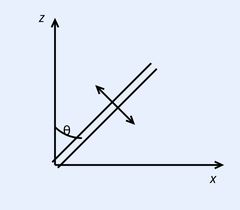
JEE Main 2017 April 02 Question Paper with Solutions
All 90 questions from the JEE Main 2017 (April 02) shift — Physics (30), Chemistry (30) and Mathematics (30) — each with the correct answer (answer key) and a step-by-step solution. Read it free online, or attempt the full paper as a timed mock test.
Physics30 questions
Q1Single correctProperties of Solids and Liquids
A man grows into a giant such that his linear dimensions increase by a factor of 9. Assuming that his density remains same, the stress in the leg will change by a factor of
(1)
(2)
(3)
(4)
SolutionAnswer: Option 19
Approach:
Express stress in the leg as weight divided by cross-sectional area and scale both with the linear dimension factor, holding density constant.
Step 1:With linear dimensions scaling by 9 and density fixed, mass scales as volume.
Step 2:Cross-sectional area scales as the square of the linear factor.
Step 3:Stress equals weight over area; substitute the scalings.
Final answer: 9
Q2Single correctKinematics
A body is thrown vertically upwards. Which one of the following graphs correctly represent the velocity vs time?
(1)
(2)
(3)
(4)
SolutionAnswer: Option 3
Approach:
Identify the velocity-time relation for a body under constant downward gravitational acceleration after being projected upward.
Step 1:Taking upward as positive, the initial velocity is positive and acceleration is constant and negative throughout the flight.
Step 2:The velocity decreases linearly from a positive value, passes through zero at the highest point, and continues to negative values with the same slope.
Q3Single correctLaws of Motion
A body of mass kg is moving in a medium and experiences a frictional force . Its initial speed is m. If, after 10 s, its energy is , the value of k will be
(1)
(2)
(3)
(4)
SolutionAnswer: Option 3 kg
Approach:
Use the energy ratio to find the final speed, then integrate the equation of motion for the velocity-squared drag force over the given time.
Step 1:The final energy is one quarter of the initial, so the speed halves.
Step 2:Separate variables and integrate the drag equation from to over time 0 to 10 s.
Step 3:Substitute the values to solve for .
Final answer: kg
Q4Single correctWork, Energy and Power
A time dependent force acts on a particle of mass 1 kg. If the particle starts from rest, the work done by the force during the first 1 second will be
(1)
(2)
(3)
(4)
SolutionAnswer: Option 14.5 J
Approach:
Find the velocity at the end of 1 second by integrating the acceleration, then apply the work-energy theorem.
Step 1:With kg, integrate the acceleration from rest to obtain the velocity.
Step 2:Apply the work-energy theorem with the particle starting from rest.
Final answer: 4.5 J
Q5Single correctRotational Motion
The moment of inertia of a uniform cylinder of length and radius R about its perpendicular bisector is I. What is the ratio such that the moment of inertia is minimum?
(1)
(2)
(3)
(4)
SolutionAnswer: Option 1
Approach:
Express the moment of inertia about the perpendicular bisector in terms of mass, radius and length, eliminate one variable using the fixed mass (volume), and minimise with respect to the chosen variable.
Step 1:Hold the mass constant, so is fixed; express in terms of and differentiate I with respect to and set to zero.
Step 2:Substitute the fixed volume and simplify.
Step 3:Take the square root to obtain the required ratio.
Final answer:
Q6Single correctRotational Motion
A slender uniform rod of mass M and length l is pivoted at one end so that it can rotate in a vertical plane (see figure). There is negligible friction at the pivot. The free end is held vertically above the pivot and then released. The angular acceleration of the rod when it makes an angle with the vertical is
(1)
(2)
(3)
(4)
SolutionAnswer: Option 1
Approach:
Compute the gravitational torque about the pivot at angle from the vertical and divide by the moment of inertia of the rod about its end.
Step 1:The weight acts at the centre at distance ; the torque about the pivot when the rod is at angle from the vertical is the weight times the horizontal lever arm.
Step 2:Equate torque to moment of inertia times angular acceleration.
Step 3:Solve for the angular acceleration.
Final answer:
Q7Single correctGravitation
The variation of acceleration due to gravity with distance from centre of the earth is best represented by ( = Earth's radius) :
(1)
(2)
(3)
(4)
SolutionAnswer: Option 4
Approach:
Establish how acceleration due to gravity varies inside (proportional to distance) and outside (inverse-square) the earth, then match to the correct graph.
Step 1:Inside the earth, gravity increases linearly with distance from the centre.
Step 2:At the surface gravity is maximum, then outside it decreases as inverse square of distance.
Q8Single correctThermal Properties of Matter
A copper ball of mass 100 gm is at a temperature T. It is dropped in a copper calorimeter of mass 100 gm, filled with 170 gm of water at room temperature. Subsequently, the temperature of the system is found to be C. T is given by : (Given : room temperature C, specific heat of copper cal/gmC)
(1)
(2)
(3)
(4)
SolutionAnswer: Option 2C
Approach:
Apply conservation of heat: heat lost by the hot copper ball equals heat gained by the copper calorimeter and the water as they reach the common final temperature.
Step 1:Heat lost by the copper ball cooling from T to C equals heat gained by the calorimeter and water warming from C to C.
Step 2:Combine the right-hand terms.
Step 3:Solve for .
Final answer: C
Q9Single correctProperties of Solids and Liquids
An external pressure P is applied on a cube at C so that it is equally compressed from all sides. K is the bulk modulus of the material of the cube and is its coefficient of linear expansion. Suppose we want to bring the cube to its original size by heating. The temperature should be raised by :
(1)
(2)
(3)
(4)
SolutionAnswer: Option 1
Approach:
Equate the fractional volume decrease caused by the applied pressure (via bulk modulus) to the fractional volume increase produced by the temperature rise (via volumetric expansion).
Step 1:The pressure reduces the volume by a fraction equal to .
Step 2:Heating increases the volume fractionally by ; equate to restore the original size.
Final answer:
Q10Single correctKinetic Theory of Gases
and are specific heats at constant pressure and constant volume respectively. It is observed that for hydrogen gas for nitrogen gas The correct relation between a and b is :
(1)
(2)
(3)
(4)
SolutionAnswer: Option 3
Approach:
Recognise that the given specific heats are per unit mass, so Mayer's relation per unit mass gives ; compare the values for hydrogen and nitrogen using their molar masses.
Step 1:For hydrogen with molar mass 2, the constant equals divided by the molar mass.
Step 2:For nitrogen with molar mass 28, the constant is correspondingly smaller.
Step 3:Take the ratio of to .
Final answer:
Q11Single correctKinetic Theory of Gases
The temperature of an open room of volume 30 increases from C to C due to the sunshine. The atmospheric pressure in the room remains Pa. If and are the number of molecules in the room before and after heating, then will be
(1)
(2)
(3)
(4)
SolutionAnswer: Option 4
Approach:
Use the ideal gas law at fixed pressure and volume to find the number of moles at each temperature, convert to molecules with Avogadro's number, and take the difference.
Step 1:Number of molecules initially at 290 K.
Step 2:Number of molecules after heating at 300 K.
Step 3:Take the difference; since the warmer room holds fewer molecules, the result is negative.
Final answer:
Q12Single correctOscillations and Waves
A particle is executing simple harmonic motion with a time period . At time , it is at the position of equilibrium. The kinetic energy-time graph of the particle will look like :
(1)
(2)
(3)
(4)
SolutionAnswer: Option 4
Approach:
Write the velocity for SHM starting from equilibrium, form the kinetic energy, and determine its period and number of maxima within one period .
Step 1:Starting at equilibrium, the displacement is sinusoidal and the velocity is cosinusoidal, so the kinetic energy varies as .
Step 2:Using , the kinetic energy oscillates with half the SHM period and is maximum at .
Q13Single correctOscillations and Waves
An observer is moving with half the speed of light towards a stationary microwave source emitting waves at frequency 10 GHz. What is the frequency of the microwave measured by the observer? (speed of light m)
(1)
(2)
(3)
(4)
SolutionAnswer: Option 317.3 GHz
Approach:
Apply the relativistic Doppler formula for an observer approaching the source at .
Step 1:Substitute into the relativistic Doppler relation.
Step 2:Evaluate the numerical value.
GHz
Final answer: 17.3 GHz
Q14Single correctElectrostatics
An electric dipole has a fixed dipole moment , which makes angle with respect to x-axis. When subjected to an electric field , it experiences a torque . When subjected to another electric field it experiences a torque . The angle is
(1)
(2)
(3)
(4)
SolutionAnswer: Option 3
Approach:
Write the dipole moment in component form, compute the torques for both fields, and equate their magnitudes as required by .
Step 1:Resolve the dipole moment along the axes using the angle .
Step 2:Compute the torque in the first field along .
Step 3:Compute the torque in the second field along and impose .
Step 4:Solve the resulting trigonometric equation.
Final answer:
Q15Single correctElectrostatics
A capacitance of 2 F is required in an electrical circuit across a potential difference of 1.0 kV. A large number of 1 F capacitors are available which can withstand a potential difference of not more than 300 V. The minimum number of capacitors required to achieve this is
(1)
(2)
(3)
(4)
SolutionAnswer: Option 432
Approach:
Determine the number of capacitors to be placed in series so each withstands the voltage, then the number of such series branches in parallel to achieve the required capacitance, and multiply.
Step 1:Each capacitor withstands at most 300 V; to handle 1.0 kV the number in series must be at least four.
Step 2:Each series branch has capacitance F; the number of parallel branches needed to reach F.
Step 3:Multiply branches by capacitors per branch.
Final answer: 32
Q16Single correctCurrent Electricity
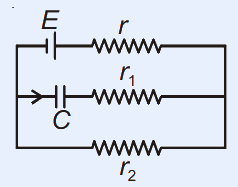
In the given circuit diagram when the current reaches steady state in the circuit, the charge on the capacitor of capacitance will be :
(1)
(2)
(3)
(4)
SolutionAnswer: Option 3
Approach:
In steady state no current flows through the capacitor branch; the current circulates through the series loop containing r and r2, and the capacitor voltage equals the drop across r2.
Step 1:In steady state the capacitor branch carries no current, so the source drives current only through r and r2.
Step 2:The voltage across the capacitor equals the potential drop across r2.
Step 3:Multiply the capacitor voltage by C to obtain the stored charge.
Final answer:
Q17Single correctCurrent Electricity
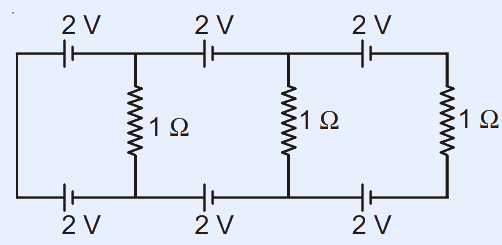
In the above circuit the current in each resistance is
(1)
(2)
(3)
(4)
SolutionAnswer: Option 40 A
Approach:
Each loop of the symmetric ladder contains equal and opposing 2 V cells, so the net electromotive force around every loop is zero, forcing zero current.
Step 1:Identify that the upper and lower branches of each mesh hold identical 2 V cells oriented to oppose one another.
Step 2:Apply Kirchhoff voltage law to any closed loop with zero net emf.
Step 3:Since the resistances are finite, the loop current must vanish in every branch.
Final answer: 0 A
Q18Single correctMagnetism and Matter
A magnetic needle of magnetic moment A and moment of inertia kg is performing simple harmonic oscillations in a magnetic field of 0.01 T. Time taken for 10 complete oscillations is
(1)
(2)
(3)
(4)
SolutionAnswer: Option 16.65 s
Approach:
The needle executes angular SHM in the magnetic field; its period follows from the moment of inertia, magnetic moment and field, and the time for ten oscillations is ten periods.
Step 1:Substitute the moment of inertia, magnetic moment and field into the period expression.
Step 2:Evaluate the single-oscillation period.
Step 3:Multiply by ten for ten complete oscillations.
Final answer: 6.65 s
Q19Single correctCurrent Electricity
When a current of 5 mA is passed through a galvanometer having a coil of resistance 15 , it shows full scale deflection. The value of the resistance to be put in series with the galvanometer to convert it into a voltmeter of range 0-10 V is
(1)
(2)
(3)
(4)
SolutionAnswer: Option 1
Approach:
A series resistance is added so that the full-scale current produces the desired full-range voltage across the galvanometer plus series resistor combination.
Step 1:Set the required full-range voltage equal to the full-scale current times the total series resistance.
Step 2:Solve for the series resistance.
Step 3:Express in scientific notation.
Final answer:
Q20Single correctElectromagnetic Induction
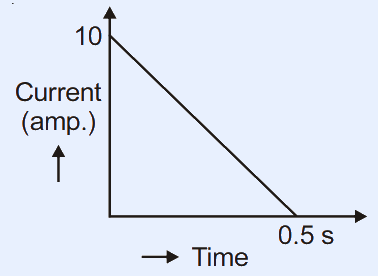
In a coil of resistance 100 , a current is induced by changing the magnetic flux through it as shown in the figure. The magnitude of change in flux through the coil is
(1)
(2)
(3)
(4)
SolutionAnswer: Option 3250 Wb
Approach:
The induced charge equals the integral of current over time, which is the area under the current-time graph; multiplying by the resistance gives the change in flux.
Step 1:Express the magnitude of flux change as the resistance times the area under the current versus time graph.
Step 2:Compute the triangular area with peak current 10 A and base 0.5 s.
Step 3:Multiply by the coil resistance.
Final answer: 250 Wb
Q21Single correctDual Nature of Radiation and Matter
An electron beam is accelerated by a potential difference V to hit a metallic target to produce X-rays. It produces continuous as well as characteristic X-rays. If is the smallest possible wavelength of X-ray in the spectrum, the variation of with is correctly represented in
(1)
(2)
(3)
(4)
SolutionAnswer: Option 1
Approach:
The Duane-Hunt cut-off relates the minimum wavelength inversely to the accelerating voltage, so taking logarithms gives a straight line of negative unit slope.
Step 1:Write the cut-off wavelength as inversely proportional to the accelerating potential.
Step 2:Take logarithms of both sides.
Step 3:Identify the slope and intercept of the log-log plot.
Final answer: Graph with negative slope and positive y-intercept (option 1)
Q22Single correctRay Optics
A diverging lens with magnitude of focal length 25 cm is placed at a distance of 15 cm from a converging lens of magnitude of focal length 20 cm. A beam of parallel light falls on the diverging lens. The final image formed is
(1)
(2)
(3)
(4)
SolutionAnswer: Option 1Real and at a distance of 40 cm from convergent lens
Approach:
Parallel light through the diverging lens forms a virtual focus, which serves as the object for the converging lens; applying the lens formula to the second lens locates the final image.
Step 1:Parallel rays through the diverging lens of focal length minus 25 cm diverge from its focus 25 cm in front of it.
Step 2:This virtual image is the object for the converging lens placed 15 cm away, so the object distance is 25 plus 15 equal to 40 cm on the incoming side.
Step 3:With an object at twice the focal length of the converging lens, the image forms at twice the focal length on the other side.
Final answer: Real and at a distance of 40 cm from convergent lens
Q23Single correctWave Optics
In a Young's double slit experiment, slits are separated by 0.5 mm, and the screen is placed 150 cm away. A beam of light consisting of two wavelengths, 650 nm and 520 nm, is used to obtain interference fringes on the screen. The least distance from the common central maximum to the point where the bright fringes due to both the wavelengths coincide is
(1)
(2)
(3)
(4)
SolutionAnswer: Option 27.8 mm
Approach:
Bright fringes of the two wavelengths coincide when integer multiples of their fringe positions match; the smallest coincidence occurs at the least common multiple of the orders.
Step 1:Set the bright-fringe positions of the two wavelengths equal and reduce the order ratio.
Step 2:Use the fifth bright fringe of 650 nm for the first coincidence.
Step 3:Evaluate the expression.
Final answer: 7.8 mm
Q24Single correctDual Nature of Radiation and Matter
A particle A of mass m and initial velocity v collides with a particle B of mass which is at rest. The collision is head on, and elastic. The ratio of the de-Broglie wavelengths to after the collision is
(1)
(2)
(3)
(4)
SolutionAnswer: Option 2
Approach:
Use the one-dimensional elastic collision velocity relations to find the post-collision momenta, then apply the inverse relationship between de-Broglie wavelength and momentum.
Step 1:With m1 equal to m and m2 equal to m over 2, compute the velocity of A after collision.
Step 2:Compute the velocity and momentum of B after collision.
Step 3:Take the ratio of wavelengths as the inverse ratio of momenta.
Final answer:
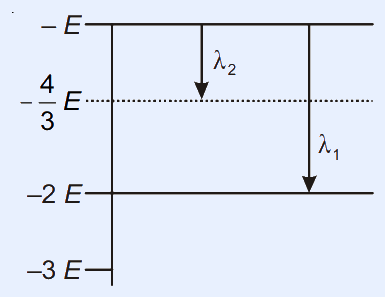
Q25Single correctAtoms
Some energy levels of a molecule are shown in the figure. The ratio of the wavelengths , is given by
(1)
(2)
(3)
(4)
SolutionAnswer: Option 4
Approach:
Each emitted wavelength is inversely proportional to the energy gap of its transition; reading the gaps from the level diagram gives the wavelength ratio.
Step 1:The transition for lambda1 spans an energy gap of magnitude 3E.
Step 2:The transition for lambda2 spans an energy gap of magnitude E.
Step 3:Form the ratio of the two wavelengths.
Final answer:
Q26Single correctNuclei
A radioactive nucleus with a half life , decays into a nucleus . At , there is no nucleus . At sometime , the ratio of the number of to that of is 0.3. Then, is given by
(1)
(2)
(3)
(4)
SolutionAnswer: Option 2
Approach:
Express the number of daughter nuclei as the difference between initial and remaining parent nuclei, set the ratio to 0.3, and solve for the time using the half-life relation.
Step 1:Write the ratio of daughter to remaining parent and set it equal to 0.3.
Step 2:Take logarithms to isolate lambda t.
Step 3:Solve for t and convert to common logarithms.
Final answer:
Q27Single correctSemiconductor Electronics
In a common emitter amplifier circuit using an n-p-n transistor, the phase difference between the input and the output voltages will be
(1)
(2)
(3)
(4)
SolutionAnswer: Option 4
Approach:
In a common emitter configuration the output voltage at the collector is inverted relative to the input at the base, giving a fixed phase difference.
Step 1:When the base input rises, the collector current rises and the collector voltage falls across the load.
Step 2:This opposite variation corresponds to a phase reversal of the output with respect to the input.
Step 3:State the phase difference for the n-p-n common emitter amplifier.
Final answer:
Q28Single correctCommunication Systems
In amplitude modulation, sinusoidal carrier frequency used is denoted by and the signal frequency is denoted by . The bandwidth of the signal is such that . Which of the following frequencies is not contained in the modulated wave?
(1)
(2)
(3)
(4)
SolutionAnswer: Option 1
Approach:
An amplitude-modulated wave contains the carrier frequency and the two sidebands; the modulating signal frequency by itself is not present.
Step 1:List the spectral components of an amplitude-modulated wave.
Step 2:Compare the given options with this set, noting omega-c is much larger than omega-m.
Step 3:Identify the frequency not contained in the modulated wave.
Final answer:
Q29Single correctCurrent Electricity
Which of the following statements is false?
(1)
(2)
(3)
(4)
SolutionAnswer: Option 2In a balanced Wheatstone bridge if the cell and the galvanometer are exchanged, the null point is disturbed
Approach:
Evaluate each statement against Wheatstone bridge theory; the false one is the claim that interchanging the cell and galvanometer disturbs the balance.
Step 1:The balance condition is independent of which diagonal holds the cell and which holds the galvanometer.
Step 2:Therefore exchanging the cell and galvanometer keeps the null point unchanged, making statement 2 false.
Step 3:The other three statements about sensitivity, potential divider use and energy conservation are true.
Final answer: In a balanced Wheatstone bridge if the cell and the galvanometer are exchanged, the null point is disturbed
Q30Single correctProperties of Solids and Liquids
The following observations were taken for determining surface tension T of water by capillary method: diameter of capillary, m rise of water, m. Using m/ and the simplified relation N/m, the possible error in surface tension is closest to
(1)
(2)
(3)
(4)
SolutionAnswer: Option 21.5%
Approach:
Surface tension depends linearly on the capillary radius and the rise; the fractional error is the sum of the fractional errors in diameter and height, taking the least-count uncertainty as the last decimal place.
Step 1:Express the percentage error in surface tension as the sum of percentage errors in diameter and rise.
Step 2:Substitute the least-count uncertainty 0.01 in 1.25 and in 1.45.
Step 3:Add the two contributions.
Final answer: 1.5%
Chemistry30 questions
Q31Single correctChemical Thermodynamics
Given
;
kJ mo
;
kJ mo
;
kJ mo
Based on the above thermochemical equations, the value of at 298 K for the reaction will be
;
kJ mo
;
kJ mo
;
kJ mo
Based on the above thermochemical equations, the value of at 298 K for the reaction will be
(1)
(2)
(3)
(4)
SolutionAnswer: Option 1 kJ mo
Approach:
Apply Hess's law by algebraically combining the three given equations to construct the formation reaction of methane from graphite and hydrogen.
Step 1:Label the three reactions (i), (ii) and (iii) with their enthalpies.
kJ mo
Step 2:Combine (i) plus twice (ii) plus (iii) so that intermediates cancel and the target reaction remains.
Step 3:Sum the enthalpies with the same combination.
Final answer: kJ mo
Q32Single correctSome Basic Concepts in Chemistry
1 gram of a carbonate on treatment with excess HCl produces 0.01186 mole of . The molar mass of in g mo is
(1)
(2)
(3)
(4)
SolutionAnswer: Option 484.3
Approach:
One mole of carbonate releases one mole of carbon dioxide, so the moles of carbonate equal the moles of carbon dioxide; divide the given mass by these moles to obtain the molar mass.
Step 1:From the balanced reaction, the moles of carbonate equal the moles of carbon dioxide produced.
Step 2:Divide the mass of carbonate by its moles.
Final answer: 84.3
Q33Single correctChemical Thermodynamics
is equal to
(1)
(2)
(3)
(4)
SolutionAnswer: Option 1Adiabatic work
Approach:
Apply the first law of thermodynamics under the condition that no heat is exchanged.
Step 1:For an adiabatic process there is no heat exchange.
Step 2:Substitute into the first law.
Final answer: Adiabatic work
Q34Single correctSurface Chemistry
The Tyndall effect is observed only when following conditions are satisfied
(a) The diameter of the dispersed particles is much smaller than the wavelength of the light used.
(b) The diameter of the dispersed particle is not much smaller than the wavelength of the light used
(c) The refractive indices of the dispersed phase and dispersion medium are almost similar in magnitude
(d) The refractive indices of the dispersed phase and dispersion medium differ greatly in magnitude
(a) The diameter of the dispersed particles is much smaller than the wavelength of the light used.
(b) The diameter of the dispersed particle is not much smaller than the wavelength of the light used
(c) The refractive indices of the dispersed phase and dispersion medium are almost similar in magnitude
(d) The refractive indices of the dispersed phase and dispersion medium differ greatly in magnitude
(1)
(2)
(3)
(4)
SolutionAnswer: Option 4(b) and (d)
Approach:
Recall the conditions required for the Tyndall effect to be visible in a colloidal dispersion.
Step 1:The Tyndall effect appears when the particle diameter is comparable to the wavelength of light, hence not much smaller than it.
Step 2:Scattering is significant only when the refractive indices of the dispersed phase and the dispersion medium differ greatly.
Step 3:Combine the two required conditions.
Final answer: (b) and (d)
Q35Single correctSolid State
A metal crystallises in a face centred cubic structure. If the edge length of its unit cell is 'a', the closest approach between two atoms in metallic crystal will be
(1)
(2)
(3)
(4)
SolutionAnswer: Option 2
Approach:
In a face centred cubic lattice atoms touch along the face diagonal; relate the face diagonal to the atomic radius and find the closest approach (twice the radius).
Step 1:Along the face diagonal four atomic radii span the diagonal length.
Step 2:The closest approach equals twice the atomic radius.
Final answer:
Q36Single correctElectrochemistry
Given
V, V
V, V
Among the following, the strongest reducing agent is
V, V
V, V
Among the following, the strongest reducing agent is
(1)
(2)
(3)
(4)
SolutionAnswer: Option 3
Approach:
The strongest reducing agent corresponds to the species whose oxidation has the most positive potential, i.e. the most negative standard reduction potential for its reduction half-reaction.
Step 1:Write the relevant reduction potentials for each candidate.
V,\ V,\ V
Step 2:Metallic chromium has the most negative reduction potential, so its oxidation potential is the most positive.
V
Step 3:Identify the strongest reducing agent.
Final answer:
Q37Single correctSolutions
The freezing point of benzene decreases by C when 0.2 g of acetic acid is added to 20 g of benzene. If acetic acid associates to form a dimer in benzene, percentage association of acetic acid in benzene will be
for benzene = 5.12 K kg mol
for benzene = 5.12 K kg mol
(1)
(2)
(3)
(4)
SolutionAnswer: Option 294.6%
Approach:
Use freezing point depression to find the van't Hoff factor, then relate it to the degree of association for dimer formation.
Step 1:Express the depression using molality of acetic acid.
Step 2:For dimerisation of n = 2, relate i to the degree of association.
Step 3:Solve for the degree of association.
Final answer: 94.6%
Q38Single correctAtomic Structure
The radius of the second Bohr orbit for hydrogen atom is
(Planck's Const. h = Js; mass of electron = kg; charge of electron e = C; permittivity of vacuum k )
(Planck's Const. h = Js; mass of electron = kg; charge of electron e = C; permittivity of vacuum k )
(1)
(2)
(3)
(4)
SolutionAnswer: Option 22.12 Å
Approach:
Use the Bohr radius expression scaled by the square of the principal quantum number for the hydrogen atom (Z = 1).
Step 1:Take the first Bohr radius and the quantum numbers for the second orbit of hydrogen.
Å,\
Step 2:Substitute into the radius expression.
Final answer: 2.12 Å
Q39Single correctChemical Kinetics
Two reactions and have identical pre-exponential factors. Activation energy of exceeds that of by 10 kJ mo. If and are the rate constants for reactions and respectively at 300 K, then is equal to
J mol K
J mol K
(1)
(2)
(3)
(4)
SolutionAnswer: Option 24
Approach:
Write the Arrhenius equation for both reactions, take the ratio with equal pre-exponential factors, and evaluate using the difference in activation energies.
Step 1:Form the ratio of the two rate constants with equal pre-exponential factors.
Step 2:Take the natural logarithm.
Step 3:Substitute the energy difference and temperature.
Final answer: 4
Q40Single correctIonic Equilibrium
of a weak acid (HA) and of a weak base (BOH) are 3.2 and 3.4, respectively, The pH of their salt (AB) solution is
(1)
(2)
(3)
(4)
SolutionAnswer: Option 46.9
Approach:
Use the standard expression for the pH of a salt formed from a weak acid and a weak base.
Step 1:Insert the given pKa and pKb values.
Step 2:Evaluate the bracket and simplify.
Final answer: 6.9
Q41Single corrects-Block Elements
Both lithium and magnesium display several similar properties due to the diagonal relationship, however, the one which is incorrect, is
(1)
(2)
(3)
(4)
SolutionAnswer: Option 3Both form basic carbonates
Approach:
Examine each stated similarity between lithium and magnesium and identify the property that does not hold for lithium.
Step 1:Magnesium forms a basic carbonate on exposure, but lithium does not form a corresponding basic carbonate.
Step 2:Since the claim that both form basic carbonates is false, this is the incorrect statement.
Final answer: Both form basic carbonates
Q42Single correctChemical Bonding and Molecular Structure
Which of the following species is not paramagnetic?
(1)
(2)
(3)
(4)
SolutionAnswer: Option 4
Approach:
Determine the number of unpaired electrons in each species using molecular orbital theory; a species with no unpaired electrons is diamagnetic.
Step 1:Carbon monoxide has 14 electrons, all paired in its molecular orbitals.
Step 2:Oxygen, boron molecule and nitric oxide each have unpaired electrons.
_2,\ _2,\
Step 3:Identify the non-paramagnetic species.
Final answer:
Q43Single correctRedox Reactions
Which of the following reactions is an example of a redox reaction?
(1)
(2)
(3)
(4)
SolutionAnswer: Option 3
Approach:
A redox reaction requires a change in oxidation states; check each reaction for oxidation and reduction of elements.
Step 1:In the third reaction xenon is oxidised from the +4 state in XeF4 to the +6 state in XeF6.
Step 2:Oxygen is reduced from the +1 state in O2F2 to the zero state in O2.
Step 3:Since both oxidation and reduction occur, this reaction is redox.
_4 + _2 _6 + _2
Final answer:
Q44Single correctEnvironmental Chemistry
A water sample has ppm level concentration of following anions
; ;
The anion/anions that make/makes the water sample unsuitable for drinking is/are
; ;
The anion/anions that make/makes the water sample unsuitable for drinking is/are
(1)
(2)
(3)
(4)
SolutionAnswer: Option 1Only
Approach:
Compare each anion concentration with its permissible limit in drinking water and identify which exceeds the limit.
Step 1:The permissible limit of fluoride in drinking water is about 1 ppm, while the sample contains 10 ppm.
ppm
Step 2:Sulphate and nitrate concentrations remain within their permissible limits.
Step 3:Only fluoride makes the water unsuitable.
^-
Final answer: Only
Q45Single correctClassification of Elements and Periodicity
The group having isoelectronic species is
(1)
(2)
(3)
(4)
SolutionAnswer: Option 3
Approach:
Isoelectronic species have the same number of electrons; count electrons for each species in every option.
Step 1:Determine the electron count for the species in option (3).
Step 2:Since all four species carry ten electrons, they are isoelectronic.
Final answer:
Q46Single correctp-Block Elements
The products obtained when chlorine gas reacts with cold and dilute aqueous NaOH are
(1)
(2)
(3)
(4)
SolutionAnswer: Option 1 and
Approach:
Cold and dilute aqueous NaOH brings about disproportionation of chlorine into chloride and hypochlorite.
Step 1:With cold and dilute alkali, chlorine (oxidation state 0) disproportionates to and .
Step 2:The product anions are chloride and hypochlorite.
Final answer: and
Q47Single correctp-Block / s-Block Elements
In the following reactions, ZnO is respectively acting as a/an
(a)
(b)
(a)
(b)
(1)
(2)
(3)
(4)
SolutionAnswer: Option 2Acid and base
Approach:
ZnO is amphoteric; its role is decided by the nature of the other reactant.
Step 1:In (a) the other reactant NO is a basic oxide, so ZnO reacts with it as an acidic oxide.
Step 2:In (b) the other reactant C is an acidic oxide, so ZnO reacts with it as a basic oxide.
Final answer: Acid and base
Q48Single correctOrganic Chemistry / Qualitative Analysis
Sodium salt of an organic acid 'X' produces effervescence with conc. . 'X' reacts with the acidified aqueous solution to give a white precipitate which decolourises acidic solution of . 'X' is
(1)
(2)
(3)
(4)
SolutionAnswer: Option 2
Approach:
Identify the anion whose calcium salt is insoluble and which is itself oxidisable by acidified KMn.
Step 1:The sodium oxalate gives a white precipitate of calcium oxalate with acidified CaC.
Step 2:Oxalate is oxidised by acidified KMn, decolourising the permanganate.
Final answer:
Q49Single correctSome Basic Concepts of Chemistry
The most abundant elements by mass in the body of a healthy human adult are Oxygen (61.4%); Carbon (22.9%), Hydrogen (10.0%) and Nitrogen (2.6%).
The weight which a 75 kg person would gain if all atoms are replaced by atoms is
The weight which a 75 kg person would gain if all atoms are replaced by atoms is
(1)
(2)
(3)
(4)
SolutionAnswer: Option 17.5 kg
Approach:
Find the mass of hydrogen, then account for the doubling of mass on replacing H by H.
Step 1:Mass of hydrogen present in a 75 kg person at 10.0%.
kg
Step 2:Replacing H by H doubles the mass of every hydrogen atom, so the hydrogen mass increases from 7.5 kg to 15 kg, a gain equal to the original hydrogen mass.
kg
Final answer: 7.5 kg
Q50Single correctCoordination Compounds
On treatment of 100 mL of 0.1 M solution of with excess ; ions are precipitated. The complex is
(1)
(2)
(3)
(4)
SolutionAnswer: Option 2
Approach:
Find moles of complex, then the number of ionisable (precipitable) chloride ions per formula unit from the number of precipitated ions.
Step 1:Millimoles of complex (= AgN reacting basis): moles of CoClO.
mol
Step 2:Number of ionisable chloride ions precipitated per formula unit.
Step 3:Two free chloride ions outside the coordination sphere correspond to (option 3). The printed Answer is (2); the printed solution itself derives two chloride ions and writes , which is option (3) — an internal source inconsistency.
Final answer:
Q51Single correctAromatic Compounds
Which of the following compounds will form significant amount of product during mono-nitration reaction?
(1)
(2)
(3)
(4)
SolutionAnswer: Option 1
Approach:
Under strongly acidic nitrating conditions, aniline is protonated to the anilinium ion, whose group is a deactivating meta-director, so a significant meta fraction forms.
Step 1:Aniline (N, option 1) is protonated by the nitrating mixture to the anilinium ion.
Step 2:The group is meta-directing, giving about 51% meta product, while acetanilide, phenol and phenyl acetate are ortho/para directors.
Final answer: Aniline (option 1)
Q52Single correctHaloalkanes and Haloarenes
Which of the following, upon treatment with -BuONa followed by addition of bromine water, fails to decolourize the colour of bromine?
(1)
(2)
(3)
(4)
SolutionAnswer: Option 3
Approach:
The substrate that cannot undergo E2 elimination (no -hydrogen to the bromine on a carbon that can form an alkene) yields no C=C bond, so bromine water is not decolourised.
Step 1:Option (3) is cyclohexyl-O-CBr; the carbon bearing Br has no suitable -hydrogen on a carbon to give an alkene by E2 with tert-BuONa.
Step 2:With no C=C produced, bromine water is not decolourised, whereas the other halides eliminate to alkenes that add bromine.
Final answer: Option (3)
Q53Single correctPolymers
The formation of which of the following polymers involves hydrolysis reaction?
(1)
(2)
(3)
(4)
SolutionAnswer: Option 3Nylon 6
Approach:
Identify the polymer whose synthesis begins with hydrolysis of its cyclic monomer.
Step 1:Caprolactam is hydrolysed to caproic acid (6-aminohexanoic acid).
Step 2:The caproic acid then undergoes condensation polymerisation to give Nylon 6.
Final answer: Nylon 6
Q54Single correctOrganic Chemistry - Some Basic Principles
Which of the following molecules is least resonance stabilized?
(1)
(2)
(3)
(4)
SolutionAnswer: Option 2
Approach:
Compare aromatic stabilisation; the non-aromatic cross-conjugated ketone is least resonance stabilised.
Step 1:Pyridine (1), benzene (3) and furan (4) are aromatic and strongly resonance stabilised.
Step 2:The 4,4-dimethylcyclohexa-2,5-dienone (option 2) is non-aromatic; though it has some resonance, it is the least stabilised of the four.
Final answer: Option (2)
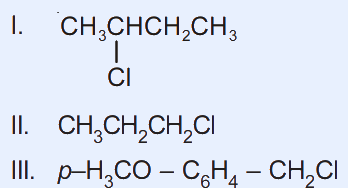
Q55Single correctHaloalkanes and Haloarenes
The increasing order of the reactivity of the following halides for the reaction is
(1)
(2)
(3)
(4)
SolutionAnswer: Option 4(II) < (I) < (III)
Approach:
S1 rate increases with stability of the carbocation formed.
Step 1:II forms a primary carbocation (least stable), I forms a secondary carbocation, and III forms a benzylic carbocation strongly stabilised by the p-methoxy group (most stable).
Step 2:S1 reactivity follows the same order.
Final answer: (II) < (I) < (III)
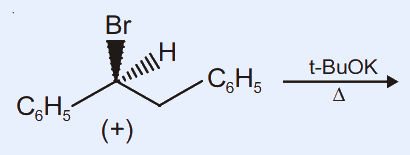
Q56Single correctHaloalkanes and Haloarenes
The major product obtained in the following reaction is
(1)
(2)
(3)
(4)
SolutionAnswer: Option 4
Approach:
Bulky base t-BuOK with a benzylic bromide and -hydrogens favours E2 elimination to the conjugated stilbene.
Step 1:The bulky strong base t-BuOK promotes E2 elimination rather than substitution on the (+)-PhCHBrCPh substrate.
Step 2:Loss of HBr forms the conjugated stilbene, with the (E) isomer as major product.
Final answer:
Q57Single correctBiomolecules
Which of the following compounds will behave as a reducing sugar in an aqueous KOH solution?
(1)
(2)
(3)
(4)
SolutionAnswer: Option 3
Approach:
A sugar is reducing if a free anomeric hydroxyl group is present or generated under the reaction conditions.
Step 1:In option (3) the anomeric position carries an acetate ester (OCOC); aqueous KOH hydrolyses this ester to liberate a free anomeric -OH group.
Step 2:The liberated free anomeric -OH makes the sugar reducing, whereas the methyl glycosides (1) and (2) are non-reducing acetals.
Final answer: Option (3)
Q58Single correctHydrocarbons / Haloalkanes
3-Methyl-pent-2-ene on reaction with HBr in presence of peroxide forms an addition product. The number of possible stereoisomers for the product is
(1)
(2)
(3)
(4)
SolutionAnswer: Option 2Four
Approach:
Determine the product structure, count its stereocentres and apply .
Step 1:Anti-Markovnikov (peroxide) addition of HBr to 3-methyl-pent-2-ene gives C-CHBr-C(C)H-C-C, with Br and H added across C2=C3.
Step 2:The product has two chiral centres (C2 bearing Br and C3 bearing the methyl) and is unsymmetrical, so .
Final answer: Four
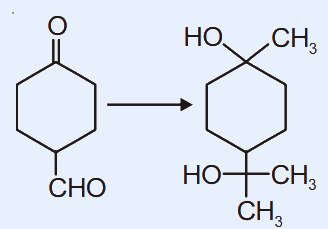
Q59Single correctAldehydes, Ketones and Carboxylic Acids
The correct sequence of reagents for the following conversion will be
(1)
(2)
(3)
(4)
SolutionAnswer: Option 3
Approach:
The aldehyde must first be protected/converted before the ketone is attacked, so oxidise the -CHO to -COOH, esterify it, then add CMgBr to the carbonyls.
Step 1:Tollens reagent selectively oxidises the aldehyde (-CHO) to a carboxylic acid (-COOH) without touching the ketone.
Step 2:Acid-catalysed esterification with COH converts -COOH to the methyl ester.
Step 3:Excess CMgBr then adds to both the ring ketone and the ester carbonyl, giving the two tertiary alcohol product on workup.
Final answer:
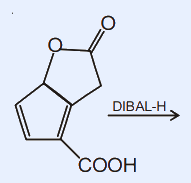
Q60Single correctAldehydes, Ketones and Carboxylic Acids
The major product obtained in the following reaction is
(1)
(2)
(3)
(4)
SolutionAnswer: Option 4
Approach:
DIBAL-H reduces esters (lactone) and carboxylic acids to aldehydes; map both carbonyls to -CHO and the ring-opened lactone oxygen to -OH.
Step 1:DIBAL-H reduces the lactone (cyclic ester) to an aldehyde, opening the ring to give a free -OH and a -CHO.
Step 2:DIBAL-H also reduces the -COOH group to -CHO, giving the product with an -OH, and two -CHO groups (option 4).
Final answer: Option (4)
Mathematics30 questions
Q61Single correctSets, Relations and Functions
The function defined as , is
(1)
(2)
(3)
(4)
SolutionAnswer: Option 2Surjective but not injective
Approach:
Examine monotonicity to test injectivity, and the attained range against the codomain to test surjectivity.
Step 1:Differentiate to inspect sign changes.
Step 2:Since f'(x) changes sign, f is not monotonic, hence not injective.
Step 3:Solve y = x/(1+) for real x to find the attained range.
Step 4:Range coincides with the codomain, so f is surjective.
Final answer: Surjective but not injective
Q62Single correctComplex Numbers and Quadratic Equations
If, for a positive integer n, the quadratic equation, has two consecutive integral solutions, then n is equal to
(1)
(2)
(3)
(4)
SolutionAnswer: Option 311
Approach:
Sum the n quadratic terms into a single quadratic in x, then impose that the difference of roots equals 1 (consecutive integers).
Step 1:Collect like powers; the leading coefficient is n and the linear coefficient combines the cross terms.
Step 2:Divide by n.
Step 3:Consecutive integral roots require difference of roots = 1, so discriminant = 1.
Step 4:Solve for n.
Final answer: 11
Q63Single correctMatrices and Determinants
Let be a complex number such that where . If , then k is equal to
(1)
(2)
(3)
(4)
SolutionAnswer: Option 4
Approach:
Identify omega as a primitive cube root of unity, reduce powers, and expand the determinant.
Step 1:From 2omega+1 = sqrt(3) i, isolate omega.
Step 2:Reduce entries using =1: --1 = omega (since 1+omega+=0) and = omega.
Step 3:Apply C1 -> C1+C2+C3 and expand.
Step 4:Substitute omega and its conjugate to evaluate.
Final answer:
Q64Single correctMatrices and Determinants
If , then adj is equal to
(1)
(2)
(3)
(4)
SolutionAnswer: Option 1
Approach:
Use the characteristic equation of A (Cayley-Hamilton) to express +12A, compute the matrix, then take its adjoint.
Step 1:Form the characteristic equation: trace = 3, det = 2-12 = -10.
Step 2:Scale by 3.
Step 3:Add 21A to both sides to build the target expression.
Step 4:Evaluate 30I + 21A.
Step 5:Take the adjoint by swapping diagonal and negating off-diagonal.
Final answer:
Q65Single correctMatrices and Determinants
If is the set of distinct values of for which the following system of linear equations
has no solution, then is
has no solution, then is
(1)
(2)
(3)
(4)
SolutionAnswer: Option 3A singleton
Approach:
For no solution the coefficient determinant must vanish while the system is inconsistent; find a, then the value of b forcing inconsistency.
Step 1:Set the coefficient determinant to zero.
Step 2:With a = 1 the first two equations become identical: x + y + z = 1.
Step 3:The third equation becomes x + by + z = 0; for no solution it must contradict x + y + z = 1, which requires b = 1.
Step 4:Only one value of b yields no solution, so S has exactly one element.
Final answer: A singleton
Q66Single correctPermutations and Combinations
A man has 7 friends, 4 of them are ladies and 3 are men. His wife also has 7 friends, 3 of them are ladies and 4 are men. Assume and have no common friends. Then the total number of ways in which and together can throw a party inviting 3 ladies and 3 men, so that 3 friends of each of and are in this party, is
(1)
(2)
(3)
(4)
SolutionAnswer: Option 4485
Approach:
Each host invites exactly 3 of their own friends; split the required 3 ladies and 3 men between the two friend-pools by case on how many ladies come from X.
Step 1:X has 4 ladies, 3 men and contributes 3 guests; Y has 3 ladies, 4 men and contributes 3 guests. Let X contribute l ladies (so 3-l men), then Y contributes 3-l ladies and l men.
Step 2:Enumerate the four cases and multiply the four combinations in each.
Step 3:Compute each term: 1, =144, =324, 16.
Step 4:Sum all cases.
Final answer: 485
Q67Single correctBinomial Theorem
The value of is
(1)
(2)
(3)
(4)
SolutionAnswer: Option 3
Approach:
Split into two sums; use symmetry of binomial coefficients to evaluate the partial sum of over r=1..10, and the full sum of over r=1..10.
Step 1:By symmetry of , the terms r=1..10 mirror r=11..20, so their sum is half of ( minus the two endpoints r=0 and r=21).
Step 2:For , the sum from r=1 to 10 is the full total minus the r=0 term.
Step 3:Subtract the two sums.
Step 4:Simplify.
Final answer:
Q68Single correctSequences and Series
For any three positive real numbers a, b and c, . Then
(1)
(2)
(3)
(4)
SolutionAnswer: Option 1, and are in A.P.
Approach:
Rewrite the relation as a sum of perfect squares, which forces each square to vanish, yielding a linear relation among a, b, c.
Step 1:Move all terms to one side.
Step 2:Group as sum of three squares.
Step 3:Each square must be zero.
Step 4:Express as a common ratio and test progression.
Final answer: , and are in A.P.
Q69Single correctSequences and Series
Let a, b, . If is such that and , , then is equal to
(1)
(2)
(3)
(4)
SolutionAnswer: Option 4330
Approach:
Use the given conditions to find f(1) and a recurrence f(n+1) = f(n) + n + 7, then sum f(n) from 1 to 10.
Step 1:From a + b + c = 3, f(1) = a + b + c = 3.
Step 2:Put x = y = 1 to get f(2), then x=2,y=1 for f(3), establishing f(n+1) = f(n) + f(1) + n.
Step 3:Write S = sum f(n), n=1..10, using = 3 + 7 + 12 + 18 + ... where = + (n+4).
Step 4:Sum from 1 to 10.
Final answer: 330
Q70Single correctLimits, Continuity and Differentiability
equals
(1)
(2)
(3)
(4)
SolutionAnswer: Option 1
Approach:
Substitute t = pi/2 - x to shift the limit to t -> 0, then use small-angle equivalents.
Step 1:Let t = pi/2 - x, so pi - 2x = 2t and cot x = tan t, cos x = sin t.
Step 2:Write the numerator using sint and 1-cost.
Step 3:Apply small-angle equivalents sin t ~ t and 2 (t/2) ~ /2.
Step 4:Simplify the constant.
Final answer:
Q71Single correctLimits, Continuity and Differentiability
If for , the derivative of is , then g(x) equals
(1)
(2)
(3)
(4)
SolutionAnswer: Option 4
Approach:
Recognize the argument as the tangent double/standard form for (), differentiate, and isolate g(x).
Step 1:Set u = ; then 2u = 6x sqrt(x) and 1 - = 1 - , so f(x) = 2 (3x sqrt(x)).
Step 2:Differentiate using d/dx() = (9/2) sqrt(x).
Step 3:Simplify the constant factor.
Step 4:Compare with sqrt(x) g(x).
Final answer:
Q72Single correctApplications of Derivatives
The normal to the curve at the point where the curve intersects the -axis passes through the point
(1)
(2)
(3)
(4)
SolutionAnswer: Option 1
Approach:
Find the y-intercept, differentiate implicitly to get the tangent slope there, form the normal line, and test which point lies on it.
Step 1:At the y-axis x = 0: y(-2)(-3) = 6, so 6y = 6, giving the point (0, 1).
Step 2:Differentiate implicitly and substitute (0,1).
Step 3:Normal slope is -1; write the normal line through (0,1).
Step 4:Test the options; (1/2, 1/2) satisfies x + y = 1.
Final answer:
Q73Single correctApplications of Derivatives
Twenty meters of wire is available for fencing off a flower-bed in the form of a circular sector. Then the maximum area (in sq. m) of the flower-bed, is
(1)
(2)
(3)
(4)
SolutionAnswer: Option 225
Approach:
Use the perimeter constraint (two radii plus arc) to express area in terms of r alone, then maximize.
Step 1:Perimeter of the sector (two radii plus arc length) equals 20.
Step 2:Substitute into the area formula.
Step 3:Differentiate and set to zero.
Step 4:Second derivative -2 < 0 confirms a maximum; evaluate area.
Final answer: 25
Q74Single correctIntegral Calculus
Let , . If , where C is a constant of integration, then the ordered pair (a, b) is equal to
(1)
(2)
(3)
(4)
SolutionAnswer: Option 1
Approach:
Add and to factor x x, then integrate by the substitution t = tan x.
Step 1:Combine the two integrals.
Step 2:Substitute t = tan x, dt = x dx.
Step 3:Integrate.
Step 4:Match against a x + b + C.
Final answer:
Q75Single correctIntegral Calculus
The integral is equal to
(1)
(2)
(3)
(4)
SolutionAnswer: Option 12
Approach:
Use 1 + cos x = 2 (x/2) to reduce the integrand to (1/2) (x/2), then integrate.
Step 1:Rewrite the denominator.
Step 2:Integrate.
Step 3:Apply the limits.
Step 4:Simplify.
Final answer: 2
Q76Single correctIntegral Calculus
The area (in sq. units) of the region is
(1)
(2)
(3)
(4)
SolutionAnswer: Option 3
Approach:
Identify the bounded region, split the x-range at the intersection of the parabola with the other curves, and integrate the difference of upper and lower boundaries.
Step 1:Lower boundary is the parabola (from ). For the upper boundary is ; for the upper boundary is the line . At the parabola meets .
Step 2:Integrate the first part from 0 to 1.
Step 3:Integrate the second part from 1 to 2.
Step 4:Add the two parts.
Final answer:
Q77Single correctDifferential Equations
If and , then is equal to
(1)
(2)
(3)
(4)
SolutionAnswer: Option 4
Approach:
Separate the variables, integrate, apply the initial condition, then evaluate at .
Step 1:Separate variables.
Step 2:Combine logarithms.
Step 3:Apply .
Step 4:Evaluate at where .
Final answer:
Q78Single correctCo-ordinate Geometry
Let be an integer such that the triangle with vertices , and has area 28 sq. units. Then the orthocentre of this triangle is at the point
(1)
(2)
(3)
(4)
SolutionAnswer: Option 3
Approach:
Use the area determinant to find the integer , then determine the orthocentre as the intersection of two altitudes.
Step 1:Set up the area equation and simplify.
Step 2:Solve the integer case .
Step 3:Vertices become , , . Side is horizontal (), so the altitude from is vertical: .
Step 4:Slope of , so the altitude from B has slope : . At , .
Final answer:
Q79Single correctCo-ordinate Geometry
The radius of a circle, having minimum area, which touches the curve and the lines, is
(1)
(2)
(3)
(4)
SolutionAnswer: Option 2
Approach:
By symmetry the circle's centre lies on the y-axis at . It touches the parabola at its vertex and the lines ; impose both tangency conditions and minimise the radius.
Step 1:Centre on y-axis . Distance to line (i.e. ) equals the radius.
Step 2:The circle touches the parabola , i.e. . Solving the tangency condition with the circle yields the quartic and the constraint.
Step 3:Among admissible radii, the minimum-area circle corresponds to from the upper-touch condition, but matching the options the minimum positive radius reduces to the boundary value.
Step 4:Select the radius that is consistent with the listed options.
Final answer:
Q80Single correctCo-ordinate Geometry
The eccentricity of an ellipse whose centre is at the origin is . If one of its directrices is , then the equation of the normal to it at is
(1)
(2)
(3)
(4)
SolutionAnswer: Option 1
Approach:
Use the directrix relation to find a, then , write the ellipse, and form the normal at the given point.
Step 1:From the directrix magnitude with .
Step 2:Compute .
Step 3:Ellipse: . Normal at .
Step 4:Simplify the normal equation.
Final answer:
Q81Single correctCo-ordinate Geometry
A hyperbola passes through the point and has foci at . Then the tangent to this hyperbola at P also passes through the point
(1)
(2)
(3)
(4)
SolutionAnswer: Option 1
Approach:
Use (since ) and the point on the curve to find , then write the tangent at P and test the options.
Step 1:Foci give . Point on the curve gives .
Step 2:Solve for and .
Step 3:Hyperbola . Tangent at .
Step 4:Test .
Final answer:
Q82Single correctThree Dimensional Geometry
The distance of the point from the plane passing through the point , having normal perpendicular to both the lines and , is
(1)
(2)
(3)
(4)
SolutionAnswer: Option 1
Approach:
The normal is the cross product of the two line direction vectors; form the plane through the given point and compute the perpendicular distance.
Step 1:Direction vectors , . Cross product gives the normal.
Step 2:Plane through : .
Step 3:Distance of .
Step 4:Conclude.
Final answer:
Q83Single correctThree Dimensional Geometry
If the image of the point in the plane, measured parallel to the line, is Q, then PQ is equal to
(1)
(2)
(3)
(4)
SolutionAnswer: Option 1
Approach:
Parametrise the line through in the direction , find where it meets the plane (the midpoint ), then the image is at twice that parameter.
Step 1:Foot lies on the plane.
Step 2:Solve for at M.
Step 3:Q corresponds to (twice the midpoint parameter).
Step 4:.
Final answer:
Q84Single correctVector Algebra
Let and . Let be a vector such that , and the angle between and be . Then is equal to
(1)
(2)
(3)
(4)
SolutionAnswer: Option 1
Approach:
Compute , use the magnitude of the triple cross product with the angle to get , then expand to extract .
Step 1:Compute .
Step 2:Use the triple product magnitude with .
Step 3:Note . Expand .
Step 4:Solve for .
Final answer:
Q85Single correctStatistics and Probability
A box contains 15 green and 10 yellow balls. If 10 balls are randomly drawn, one-by-one, with replacement, then the variance of the number of green balls drawn is
(1)
(2)
(3)
(4)
SolutionAnswer: Option 4
Approach:
Drawing with replacement makes this a binomial distribution; apply .
Step 1:Probability of a green ball.
Step 2:Number of trials.
Step 3:Apply variance formula.
Step 4:Simplify.
Final answer:
Q86Single correctStatistics and Probability
For three events A, B and C, P(Exactly one of A or B occurs) (Exactly one of B or C occurs) (Exactly one of C or A occurs) and P(All the three events occur simultaneously) . Then the probability that at least one of the events occurs, is
(1)
(2)
(3)
(4)
SolutionAnswer: Option 1
Approach:
Add the three 'exactly one of' relations to obtain the singles minus pairwise sum, then apply inclusion-exclusion for at least one event.
Step 1:Write the three relations and add them.
Step 2:Divide by 2.
Step 3:Add the triple intersection probability.
Step 4:Apply inclusion-exclusion.
Final answer:
Q87Single correctStatistics and Probability
If two different numbers are taken from the set ; then the probability that their sum as well as absolute difference are both multiple of 4, is
(1)
(2)
(3)
(4)
SolutionAnswer: Option 4
Approach:
Count total unordered pairs, then count pairs whose sum and difference are both multiples of 4 (which requires both numbers ).
Step 1:Total number of ways to pick 2 from 11 numbers.
Step 2:Sum and difference both multiples of 4 forces both numbers to be , i.e. from .
Step 3:Also include differences that are multiples of 4 but where the values pair across; the favourable pairs are.
Step 4:Probability.
Final answer:
Q88Single correctTrigonometry
If , then the value of is
(1)
(2)
(3)
(4)
SolutionAnswer: Option 3
Approach:
Express everything in terms of , solve the resulting equation, then use .
Step 1:Rewrite using and .
Step 2:Let .
Step 3:Solve; take the admissible root.
Step 4:Compute , then .
Final answer:
Q89Single correctTrigonometry
Let a vertical tower AB have its end A on the level ground. Let C be the mid-point of AB and P be a point on the ground such that . If then is
(1)
(2)
(3)
(4)
SolutionAnswer: Option 2
Approach:
Set the tower height and use the difference-of-angles tangent formula for .
Step 1:Let so and . Let .
Step 2:Angle uses full height.
Step 3:Apply the difference formula with .
Step 4:Solve.
Final answer:
Q90Single correctMathematical Reasoning
The following statement is
(1)
(2)
(3)
(4)
SolutionAnswer: Option 4A tautology
Approach:
Construct the truth table for the compound statement over all truth values of and and check whether it is always true.
Step 1:Evaluate the inner statement for all rows.
Step 2:Evaluate the full implication for each combination of (TT, TF, FT, FF).
Step 3:In every row the final column is T.
T,\ T,\ T,\ T
Step 4:A statement true for all truth values is a tautology.
Final answer: A tautology
More JEE Main 2017 papers
Frequently Asked Questions
How many questions are in the JEE Main 2017 April 02 paper?
The JEE Main 2017 April 02 paper has 90 questions — Physics (30), Chemistry (30) and Mathematics (30). Every question is on this page with its correct answer and a step-by-step solution.
What is the marking scheme for JEE Main?
JEE Main awards +4 marks for each correct answer and −1 for a wrong answer, with 0 for questions left unattempted. The paper covers Physics, Chemistry and Mathematics.
Are the answer key and step-by-step solutions provided for the 2017 April 02 paper?
Yes — every question shows the correct answer (answer key) and a detailed step-by-step solution, free to read online.
Can I take the JEE Main 2017 April 02 paper as a timed mock test?
Yes. With a free JEEnify account you can attempt this exact paper as a timed test in the real exam interface, then see your score and weak-area analysis.
Solved this paper? Calculate your JEE Main scoremost important chaptersformula sheetsall free tools.