
Back to JEE Main PYQs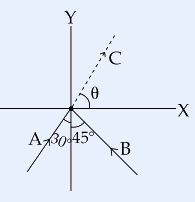
JEE Main 2017 April 09 Question Paper with Solutions
All 89 questions from the JEE Main 2017 (April 09) shift — Physics (29), Chemistry (30) and Mathematics (30) — each with the correct answer (answer key) and a step-by-step solution. Read it free online, or attempt the full paper as a timed mock test.
Physics29 questions
Q1Single correctUnits and Measurements
A physical quantity P is described by the relation
If the relative errors in the measurement of a, b, c and d respectively, are 2%, 1%, 3% and 5%, then the relative error in P will be :
If the relative errors in the measurement of a, b, c and d respectively, are 2%, 1%, 3% and 5%, then the relative error in P will be :
(1)
(2)
(3)
(4)
SolutionAnswer: Option 332%
Approach:
For a product of powers, the maximum relative error is the sum of the magnitudes of each power times the corresponding relative error.
Step 1:Identify the powers of each quantity in P.
Step 2:Sum the products of power magnitude and relative error.
Final answer: 32%
Q2Single correctKinematics
A car is standing 200 m behind a bus, which is also at rest. The two start moving at the same instant but with different forward accelerations. The bus has acceleration 2 m/ and the car has acceleration 4 m/. The car will catch up with the bus after a time of :
(1)
(2)
(3)
(4)
SolutionAnswer: Option 3 s
Approach:
The car catches the bus when the extra distance covered by the car equals the initial 200 m gap.
Step 1:Write displacements of car and bus from rest.
Step 2:Set the difference equal to the 200 m gap.
Step 3:Solve for t.
Final answer: s
Q3Single correctWork, Energy and Power
Two particles A and B of equal mass M are moving with the same speed v as shown in the figure. They collide completely inelastically and move as a single particle C. The angle that the path of C makes with the X-axis is given by :
(1)
(2)
(3)
(4)
SolutionAnswer: Option 1
Approach:
Conserve linear momentum in the X and Y directions. A approaches at 30 degrees from the downward vertical and B at 45 degrees from the downward vertical; the resultant momentum direction gives the angle of C.
Step 1:Resolve A's velocity (incoming, 60 degrees above +X axis).
Step 2:Resolve B's velocity (incoming, 135 degrees from +X axis).
Step 3:Add momentum components.
Step 4:Form the tangent of the resultant angle.
Final answer:
Q4Single correctKinematics
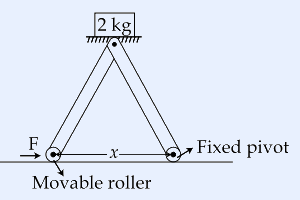
The machine as shown has 2 rods of length 1 m connected by a pivot at the top. The end of one rod is connected to the floor by a stationary pivot and the end of the other rod has a roller that rolls along the floor in a slot. As the roller goes back and forth, a 2 kg weight moves up and down. If the roller is moving towards right at a constant speed, the weight moves up with a :
(1)
(2)
(3)
(4)
SolutionAnswer: Option 2decreasing speed
Approach:
Relate the apex height to the half-base using the constant rod length, then differentiate to compare the weight's speed with the roller's speed.
Step 1:Let x be half the base and y the apex height; with rod length 1 m, x squared plus y squared equals 1.
Step 2:Differentiate with respect to time.
Step 3:As the weight rises, the base shrinks so x decreases and y increases; hence the ratio x/y decreases.
Final answer: decreasing speed
Q5Single correctLaws of Motion
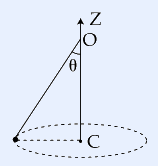
A conical pendulum of length 1 m makes an angle w.r.t. Z-axis and moves in a circle in the XY plane. The radius of the circle is 0.4 m and its center is vertically below O. The speed of the pendulum, in its circular path, will be : (Take g m)
(1)
(2)
(3)
(4)
SolutionAnswer: Option 42 m/s
Approach:
For a conical pendulum, the horizontal component of tension provides the centripetal force and the vertical component balances gravity.
Step 1:Apply the conical pendulum relation with r = 0.4 m and theta = 45 degrees.
Step 2:Evaluate.
Final answer: 2 m/s
Q6Single correctRotational Motion
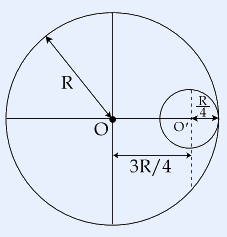
A circular hole of radius is made in a thin uniform disc having mass M and radius R, as shown in figure. The moment of inertia of the remaining portion of the disc about an axis passing through the point O and perpendicular to the plane of the disc is :
(1)
(2)
(3)
(4)
SolutionAnswer: Option 2
Approach:
Subtract the moment of inertia of the removed small disc (using the parallel axis theorem to shift it to O) from that of the full disc.
Step 1:Full disc MOI about O.
Step 2:Mass of removed disc of radius R/4.
Step 3:MOI of removed disc about O (center at 3R/4 from O).
Step 4:Subtract.
Final answer:
Q7Single correctGravitation
The mass density of a spherical body is given by for and for , where r is the distance from the centre.
The correct graph that describes qualitatively the acceleration, a, of a test particle as a function of r is :
The correct graph that describes qualitatively the acceleration, a, of a test particle as a function of r is :
(1)
(2)
(3)
(4)
SolutionAnswer: Option 2
Approach:
Find the mass enclosed within radius r, then use a = G M(r) / for the regions inside and outside the body.
Step 1:Compute enclosed mass for r <= R.
Step 2:Acceleration inside (r < R).
Step 3:Acceleration outside (r > R) with total mass 2 pi k .
Final answer: Graph constant up to R, then decreasing as 1/ (option 2)
Q8Single correctProperties of Solids
A steel rail of length 5 m and area of cross section 40 c is prevented from expanding along its length while the temperature rises by 10C. If coefficient of linear expansion and Young's modulus of steel are and N respectively, the force developed in the rail is approximately :
(1)
(2)
(3)
(4)
SolutionAnswer: Option 2 N
Approach:
A constrained rod develops a thermal stress; the force equals Young's modulus times area times the prevented thermal strain.
Step 1:Substitute the values (A = 40 = 4e-3 ).
Step 2:Evaluate.
Final answer: N
Q9Single correctMechanics of Fluids
Two tubes of radii and , and lengths and , respectively, are connected in series and a liquid flows through each of them in stream line conditions. and are pressure differences across the two tubes. If is and is , then the radius will be equal to :
(1)
(2)
(3)
(4)
SolutionAnswer: Option 4
Approach:
In series the volume flow rate Q is the same through both tubes; apply Poiseuille's law to each and take the ratio.
Step 1:Equal flow rate gives P proportional to l / .
Step 2:Form the pressure ratio.
Step 3:Solve for r2.
Final answer:
Q10Single correctThermodynamics
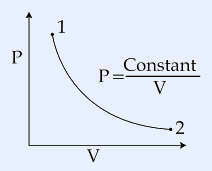
For the P-V diagram given for an ideal gas, out of the following which one correctly represents the T-P diagram ?
(1)
(2)
(3)
(4)
SolutionAnswer: Option 3
Approach:
The given P-V curve satisfies PV = constant, which for an ideal gas means temperature is constant; the T-P plot must therefore be a horizontal line, traversed from high P (state 1) to low P (state 2).
Step 1:PV = constant implies nRT = constant, so T is constant.
Step 2:On the T-P plane the locus is a horizontal line; the process goes from state 1 (high P) to state 2 (low P).
Final answer: Horizontal T-P line with state 1 at higher P and state 2 at lower P (option 3)
Q11Single correctKinetic Theory of Gases
N moles of a diatomic gas in a cylinder are at a temperature T. Heat is supplied to the cylinder such that the temperature remains constant but n moles of the diatomic gas get converted into monoatomic gas. What is the change in the total kinetic energy of the gas ?
(1)
(2)
(3)
(4)
SolutionAnswer: Option 1
Approach:
Each diatomic molecule that dissociates yields two monoatomic atoms; compute the internal kinetic energy before and after at the same temperature.
Step 1:Initial kinetic energy of N moles diatomic.
Step 2:After dissociation: (N - n) moles diatomic plus 2n moles monoatomic.
Step 3:Take the difference.
Final answer:
Q12Single correctOscillations
A block of mass 0.1 kg is connected to an elastic spring of spring constant 640 N and oscillates in a damping medium of damping constant kg . The system dissipates its energy gradually. The time taken for its mechanical energy of vibration to drop to half of its initial value, is closest to :
(1)
(2)
(3)
(4)
SolutionAnswer: Option 47 s
Approach:
In a damped oscillator the mechanical energy decays exponentially as E = E0 exp(-(b/m)t); set E = E0/2 and solve for t.
Step 1:Set the energy to half its initial value.
Step 2:Substitute m = 0.1 kg and b = 1e-2 kg/s.
Final answer: 7 s
Q13Single correctWaves
A standing wave is formed by the superposition of two waves travelling in opposite directions. The transverse displacement is given by
What is the speed of the travelling wave moving in the positive x direction ?
(x and t are in meter and second, respectively.)
What is the speed of the travelling wave moving in the positive x direction ?
(x and t are in meter and second, respectively.)
(1)
(2)
(3)
(4)
SolutionAnswer: Option 1160 m/s
Approach:
Read the wave number k and angular frequency omega from the standing wave expression; the component wave speed is omega divided by k.
Step 1:Identify k and omega.
Step 2:Compute the speed.
Final answer: 160 m/s
Q14Single correctElectrostatics
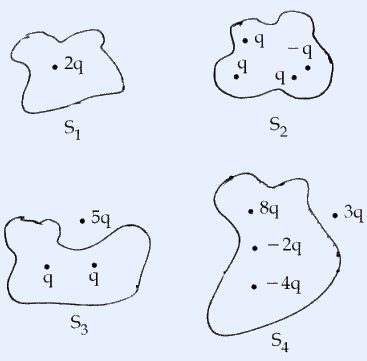
Four closed surfaces and corresponding charge distributions are shown below.
Let the respective electric fluxes through the surfaces be and . Then :
Let the respective electric fluxes through the surfaces be and . Then :
(1)
(2)
(3)
(4)
SolutionAnswer: Option 3
Approach:
By Gauss's law the flux through each closed surface equals the net enclosed charge divided by epsilon-naught; compute the net enclosed charge for each surface.
Step 1:Net charge inside each surface from the figure.
Step 2:Flux is proportional to enclosed charge; is the largest and the others are equal.
Final answer:
Q15Single correctElectrostatics
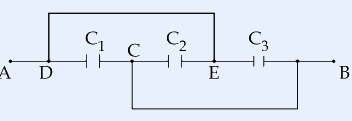
A combination of parallel plate capacitors is maintained at a certain potential difference.
When a 3 mm thick slab is introduced between all the plates, in order to maintain the same potential difference, the distance between the plates is increased by 2.4 mm. Find the dielectric constant of the slab.
When a 3 mm thick slab is introduced between all the plates, in order to maintain the same potential difference, the distance between the plates is increased by 2.4 mm. Find the dielectric constant of the slab.
(1)
(2)
(3)
(4)
SolutionAnswer: Option 35
Approach:
Inserting a dielectric slab of thickness t reduces the effective air gap by t(1 - 1/K); to keep the capacitance (hence the potential difference at fixed charge) unchanged, the plate separation must be increased by exactly that amount.
Step 1:Equate the required increase to the gap reduction.
Step 2:Solve for K.
Final answer: 5
Q16Single correctCurrent Electricity
A uniform wire of length l and radius r has a resistance of 100 . It is recast into a wire of radius . The resistance of new wire will be :
(1)
(2)
(3)
(4)
SolutionAnswer: Option 11600
Approach:
Resistance varies with length and cross-sectional area. On recasting, the volume of the wire is conserved, which fixes the new length once the new radius is given.
Step 1:New radius is half the original, so the new area is one quarter.
Step 2:Volume is conserved, giving the new length.
Step 3:Apply the resistance ratio.
Final answer: 1600
Q17Single correctCurrent Electricity
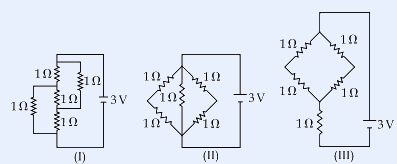
The figure shows three circuits I, II and III which are connected to a 3V battery. If the powers dissipated by the configurations I, II and III are , and respectively, then :
(1)
(2)
(3)
(4)
SolutionAnswer: Option 3
Approach:
Each network is reduced to an equivalent resistance across the 3V source. With a fixed source voltage, dissipated power varies inversely with equivalent resistance, so the lowest resistance dissipates the most power.
Step 1:Circuit I is a balanced bridge of unit resistors; the bridging resistor carries no current, giving two 2 ohm paths in parallel.
Step 2:Circuit II places two 2 ohm paths and a direct 1 ohm bridge resistor in parallel across the source.
Step 3:Circuit III is a 1 ohm bridge (two 2 ohm paths in parallel) in series with an extra 1 ohm resistor.
Step 4:Compute the powers from P = /R with V = 3V.
Final answer:
Q18Single correctMoving Charges and Magnetism
A negative test charge is moving near a long straight wire carrying a current. The force acting on the test charge is parallel to the direction of the current. The motion of the charge is :
(1)
(2)
(3)
(4)
SolutionAnswer: Option 2towards the wire
Approach:
The magnetic field of the straight wire is azimuthal (circular). The force on the charge is q(v x B). Working out the cross product for a velocity directed radially toward the wire shows the force lies along the current direction for a negative charge.
Step 1:Take the current along the x-axis. At a point on the +y side the field points along +z.
Step 2:Let the negative charge move toward the wire, i.e. along -y.
Step 3:Evaluate the force for q < 0.
Final answer: towards the wire
Q19Single correctMoving Charges and Magnetism
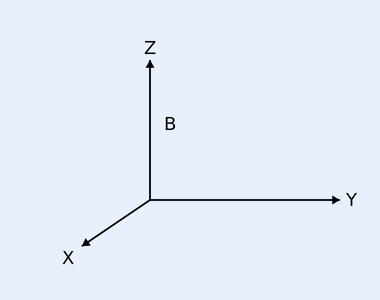
A uniform magnetic field B of 0.3 T is along the positive Z-direction. A rectangular loop (abcd) of sides 10 cm 5 cm carries a current I of 12 A. Out of the following different orientations which one corresponds to stable equilibrium ?
(1)
(2)
(3)
(4)
SolutionAnswer: Option 3
Approach:
A current loop is a magnetic dipole with moment m = I A n-hat, the normal fixed by the right-hand rule following the current sense. Stable equilibrium occurs when the magnetic moment is parallel to the external field (potential energy minimum).
Step 1:Stable equilibrium requires the magnetic moment to point along +Z, parallel to B.
Step 2:Evaluating the current sense for each option, only option 3 has the loop in the X-Y plane with a circulation giving a +Z moment.
Step 3:The other orientations give a moment along X or along -Z, which are unstable or perpendicular configurations.
Final answer: Option 3 (magnetic moment along +Z, parallel to B)
Q20Single correctAlternating Current
A sinusoidal voltage of peak value 283 V and angular frequency 320/s is applied to a series LCR circuit. Given that R , L mH and C F. The total impedance, and phase difference between the voltage across the source and the current will respectively be :
(1)
(2)
(3)
(4)
SolutionAnswer: Option 27 and 4
Approach:
Compute the inductive and capacitive reactances, find the net reactance, then the magnitude of impedance and the phase angle of a series LCR circuit.
Step 1:Reactances at omega = 320 rad/s.
Step 2:Net reactance and impedance.
Step 3:Phase angle.
Final answer: 7 and 4
Q21Single correctElectromagnetic Waves
The electric field component of a monochromatic radiation is given by
Its magnetic field is then given by :
Its magnetic field is then given by :
(1)
(2)
(3)
(4)
SolutionAnswer: Option 3
Approach:
This is a standing electromagnetic wave with E along x. Faraday's law gives the magnetic field from the spatial derivative of E, integrated in time.
Step 1:Only is nonzero and depends on z, so the curl has a y-component equal to the z-derivative of .
Step 2:Integrate -curl in time to get .
Step 3:Substitute k/omega = 1/c.
Final answer:
Q22Single correctRay Optics
In an experiment a convex lens of focal length 15 cm is placed coaxially on an optical bench in front of a convex mirror at a distance of 5 cm from it. It is found that an object and its image coincide, if the object is placed at a distance of 20 cm from the lens. The focal length of the convex mirror is :
(1)
(2)
(3)
(4)
SolutionAnswer: Option 127.5 cm
Approach:
For the object and image to coincide, rays after the lens must strike the convex mirror normally and retrace their path, which means the lens forms its image at the centre of curvature of the mirror. Locate the lens image, then equate its distance behind the mirror to the radius of curvature.
Step 1:Lens image with u = -20 cm and f = +15 cm.
Step 2:The mirror is 5 cm behind the lens, so the converging point lies 55 cm behind the mirror. This must be the centre of curvature.
Step 3:Mirror focal length.
Final answer: 27.5 cm
Q23Single correctWave Optics
A single slit of width 0.1 mm is illuminated by a parallel beam of light of wavelength 6000 and diffraction bands are observed on a screen 0.5 m from the slit. The distance of the third dark band from the central bright band is :
(1)
(2)
(3)
(4)
SolutionAnswer: Option 29 mm
Approach:
In single slit diffraction, dark bands (minima) occur where the path difference equals an integer multiple of the wavelength. The linear position on the screen follows from the small-angle approximation.
Step 1:List the data in SI units.
Step 2:Use n = 3 for the third dark band.
Step 3:Evaluate.
Final answer: 9 mm
Q24Single correctDual Nature of Radiation and Matter
A Laser light of wavelength 660 nm is used to weld Retina detachment. If a Laser pulse of width 60 ms and power 0.5 kW is used the number of photons in the pulse are :
[Take Planck's constant h Js]
[Take Planck's constant h Js]
(1)
(2)
(3)
(4)
SolutionAnswer: Option 1
Approach:
Find the total energy delivered by the pulse, divide by the energy of a single photon to get the photon count.
Step 1:Total energy in the pulse.
Step 2:Energy of one photon.
Step 3:Photon count.
Final answer:
Q25Single correctAtoms
The acceleration of an electron in the first orbit of the hydrogen atom (n ) is :
(1)
(2)
(3)
(4)
SolutionAnswer: Option 3
Approach:
Use Bohr's quantization to express the orbital speed of the electron, then compute the centripetal acceleration /r.
Step 1:Speed for n = 1.
Step 2:Centripetal acceleration.
Step 3:Simplify.
Final answer:
Q26Single correctNuclei
Imagine that a reactor converts all given mass into energy and that it operates at a power level of watt. The mass of the fuel consumed per hour in the reactor will be : (velocity of light, c is m/s)
(1)
(2)
(3)
(4)
SolutionAnswer: Option 3 gm
Approach:
The energy produced in one hour equals the power times time. Convert this energy to mass using Einstein's mass-energy relation.
Step 1:Energy in one hour (t = 3600 s).
Step 2:Mass from E = .
Step 3:Evaluate.
Final answer: gm
Q27Single correctSemiconductor Electronics
The current gain of a common emitter amplifier is 69. If the emitter current is 7.0 mA, collector current is :
(1)
(2)
(3)
(4)
SolutionAnswer: Option 26.9 mA
Approach:
The common emitter current gain beta relates collector and base currents. Combine with the emitter current relation to express collector current in terms of the emitter current.
Step 1:Express base current and substitute.
Step 2:Solve for collector current.
Step 3:Evaluate.
Final answer: 6.9 mA
Q29Single correctCurrent Electricity
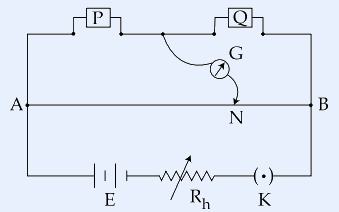
In a meter bridge experiment resistances are connected as shown in the figure. Initially resistance P and the neutral point N is at 60 cm from A. Now an unknown resistance R is connected in series to P and the new position of the neutral point is at 80 cm from A. The value of unknown resistance R is :
(1)
(2)
(3)
(4)
SolutionAnswer: Option 4
Approach:
The meter bridge balance condition relates the ratio of the two resistances to the ratio of the bridge lengths. First find Q from the initial balance, then use the second balance with P + R to solve for R.
Step 1:Initial balance at 60 cm gives Q.
Step 2:New balance at 80 cm with series resistance P + R.
Step 3:Solve for R.
Final answer:
Q30Single correctOscillations
In an experiment to determine the period of a simple pendulum of length 1 m, it is attached to different spherical bobs of radii and . The two spherical bobs have uniform mass distribution. If the relative difference in the periods, is found to be s, the difference in radii, is best given by :
(1)
(2)
(3)
(4)
SolutionAnswer: Option 20.1 cm
Approach:
The effective length of the pendulum is the string length plus the bob radius. The period depends on the square root of the effective length, so a small change in radius produces a relative change in period equal to half the relative change in effective length.
Step 1:Since r is much smaller than L, the effective length is approximately L = 1 m.
Step 2:Solve for the radius difference.
Step 3:Evaluate.
Final answer: 0.1 cm
Chemistry30 questions
Q31Single correctChemical Thermodynamics
An ideal gas undergoes isothermal expansion at constant pressure. During the process :
(1)
(2)
(3)
(4)
SolutionAnswer: Option 2enthalpy remains constant but entropy increases.
Approach:
For an ideal gas, enthalpy is a function of temperature only; an isothermal process keeps temperature constant, so enthalpy does not change. Expansion increases the accessible volume, raising entropy.
Step 1:Isothermal process means constant temperature; since H depends only on T for an ideal gas, enthalpy is constant.
Step 2:Expansion increases volume, so the entropy of the gas increases.
Final answer: enthalpy remains constant but entropy increases.
Q32Single correctEquilibrium
50 mL of 0.2 M ammonia solution is treated with 25 mL of 0.2 M HCl. If of ammonia solution is 4.75, the pH of the mixture will be :
(1)
(2)
(3)
(4)
SolutionAnswer: Option 49.25
Approach:
Find millimoles of NH3 and HCl, identify the basic buffer formed after partial neutralisation, then apply the Henderson equation for a base.
Step 1:Compute millimoles: ammonia and HCl.
Step 2:HCl converts 5 mmol NH3 to NH4Cl, leaving 5 mmol NH3 and 5 mmol NH4+ (equal amounts).
Step 3:Apply Henderson for base.
Step 4:Convert to pH.
Final answer: 9.25
Q33Single correctAtomic Structure
The electron in the hydrogen atom undergoes transition from higher orbitals to orbital of radius 211.6 pm. This transition is associated with :
(1)
(2)
(3)
(4)
SolutionAnswer: Option 2Balmer series
Approach:
Use the Bohr radius formula to find the principal quantum number of the target orbital, then identify the spectral series by the lower level.
Step 1:Solve for n using the given radius.
Step 2:Transitions ending at n = 2 belong to the Balmer series.
Final answer: Balmer series
Q34Single correctStates of Matter
At 300 K, the density of a certain gaseous molecule at 2 bar is double to that of dinitrogen at 4 bar. The molar mass of gaseous molecule is :
(1)
(2)
(3)
(4)
SolutionAnswer: Option 3
Approach:
Express gas density from the ideal gas equation, set up the doubling relation between the unknown gas and dinitrogen, and solve for the molar mass.
Step 1:Write density of the unknown gas and of N2.
Step 2:Apply the condition density of unknown is double that of N2.
Step 3:Solve for M.
Final answer:
Q35Single correctSome Basic Concepts in Chemistry
What quantity (in mL) of a 45% acid solution of a mono-protic strong acid must be mixed with a 20% solution of the same acid to produce 800 mL of a 29.875% acid solution ?
(1)
(2)
(3)
(4)
SolutionAnswer: Option 3316
Approach:
Set up a mass (volume-percent) balance: the acid contributed by both solutions equals the acid in the final mixture.
Step 1:Let x mL be the 45% solution, so (800 - x) mL is the 20% solution.
Step 2:Expand and simplify.
Step 3:Solve for x.
Final answer: 316
Q36Single correctElectrochemistry
To find the standard potential of electrode, the following cell is constituted : . The emf of the cell is found to be 0.421 volt at 298 K. The standard potential of half reaction at 298 K will be : (Given at 298 K Volt)
(1)
(2)
(3)
(4)
SolutionAnswer: Option 20.32 Volt
Approach:
Apply the Nernst equation to both half-cells to get their actual potentials, then use cell emf equals cathode minus anode to solve for the unknown standard potential.
Step 1:Silver is the cathode (reduction). Compute its potential.
Step 2:M is the anode. Its electrode potential (reduction form).
Step 3:Use cell emf relation and solve.
Final answer: 0.32 Volt
Q37Single correctChemical Thermodynamics
A gas undergoes change from state A to state B. In this process, the heat absorbed and work done by the gas is 5 J and 8 J, respectively. Now gas is brought back to A by another process during which 3 J of heat is evolved. In this reverse process of B to A :
(1)
(2)
(3)
(4)
SolutionAnswer: Option 46 J of the work will be done by the surrounding on gas.
Approach:
Use the first law to find the internal energy change for A to B; since internal energy is a state function, the reverse path has the opposite change, allowing the work in the reverse step to be found.
Step 1:For A to B with q = 5 J absorbed and w = 8 J done by gas.
Step 2:Reverse process B to A: state function reverses sign.
Step 3:For B to A, 3 J of heat evolved so q = -3 J. Solve for work done by gas.
Step 4:Negative work by gas means surroundings do 6 J of work on the gas.
Final answer: 6 J of the work will be done by the surrounding on gas.
Q38Single correctSurface Chemistry
Adsorption of a gas on a surface follows Freundlich adsorption isotherm. Plot of versus log p gives a straight line with slope equal to 0.5, then : ( is the mass of the gas adsorbed per gram of adsorbent)
(1)
(2)
(3)
(4)
SolutionAnswer: Option 3Adsorption is proportional to the square root of pressure.
Approach:
Take the logarithmic form of the Freundlich isotherm; the slope of the log-log plot equals 1/n, which sets the power of pressure.
Step 1:Identify the slope of the log-log plot with 1/n.
Step 2:Substitute into the isotherm.
Final answer: Adsorption is proportional to the square root of pressure.
Q39Single correctChemical Kinetics
The rate of a reaction quadruples when the temperature changes from 300 to 310 K. The activation energy of this reaction is : (Assume activation energy and pre-exponential factor are independent of temperature; ln 2 ; R J mo )
(1)
(2)
(3)
(4)
SolutionAnswer: Option 1
Approach:
Use the two-temperature form of the Arrhenius equation with the rate-constant ratio of 4 and solve for the activation energy.
Step 1:Rate quadruples, so the ratio is 4.
Step 2:Compute the temperature term.
Step 3:Solve for activation energy.
Final answer:
Q40Single correctSolutions
A solution is prepared by mixing 8.5 g of and 11.95 g of . If vapour pressure of and at 298 K are 415 and 200 mmHg respectively, the mole fraction of in vapour form is : (Molar mass of Cl g mo)
(1)
(2)
(3)
(4)
SolutionAnswer: Option 30.325
Approach:
Compute moles and liquid mole fractions, apply Raoult's law for partial pressures, then use Dalton's law to obtain the vapour-phase mole fraction of CHCl3.
Step 1:Molar masses and moles.
Step 2:Liquid mole fractions are equal.
Step 3:Partial pressures by Raoult's law.
Step 4:Vapour mole fraction of CHCl3.
Final answer: 0.325
Q41Single correctClassification of Elements and Periodicity
The electronic configuration with the highest ionization enthalpy is :
(1)
(2)
(3)
(4)
SolutionAnswer: Option 3
Approach:
Identify the elements behind each configuration and compare ionization enthalpies using periodic trends and half-filled stability.
Step 1:Identify elements: Al, Si, P, As respectively.
Step 2:Phosphorus has an exactly half-filled 3p subshell giving extra stability and a higher ionization enthalpy.
Step 3:Phosphorus is smaller and above arsenic, so its ionization enthalpy exceeds that of As, Si and Al.
Final answer:
Q42Single correctEquilibrium
The following reaction occurs in the Blast Furnace where iron ore is reduced to iron metal : . Using the Le Chatelier's principle, predict which one of the following will not disturb the equilibrium ?
(1)
(2)
(3)
(4)
SolutionAnswer: Option 4Addition of
Approach:
Recognise that pure solids and pure liquids do not appear in the equilibrium expression, so changing their amounts cannot shift the equilibrium, while changing gaseous species does.
Step 1:Fe2O3 is a pure solid; its activity is unity and absent from Kp.
Step 2:Adding a pure solid does not change concentrations of gases, so equilibrium is undisturbed.
Final answer: Addition of
Q43Single corrects-Block Elements
Which one of the following is an oxide ?
(1)
(2)
(3)
(4)
SolutionAnswer: Option 3
Approach:
Classify each compound by the oxidation state of oxygen: a normal oxide contains O in the -2 state, while peroxides and superoxides contain O-O linkages.
Step 1:KO2 and CsO2 contain the superoxide ion O2 minus (oxygen -1/2).
Step 2:BaO2 contains the peroxide ion O2 two-minus (oxygen -1).
Step 3:SiO2 contains oxide ions with oxygen in -2 state.
Final answer:
Q44Single correctEnvironmental Chemistry
Which of the following is a set of green house gases ?
(1)
(2)
(3)
(4)
SolutionAnswer: Option 4
Approach:
Recall the standard list of greenhouse gases and select the option in which every species qualifies.
Step 1:Recognised greenhouse gases include CO2, CH4, N2O, O3, water vapour and CFCs.
Step 2:N2, SO2 and Cl2 are not greenhouse gases, eliminating the other options.
Final answer:
Q45Single correctChemical Bonding and Molecular Structure
The group having triangular planar structures is :
(1)
(2)
(3)
(4)
SolutionAnswer: Option 2
Approach:
Apply VSEPR theory to each species; a trigonal (triangular) planar geometry requires three bonding regions and no lone pair on the central atom.
Step 1:CO3 2-, NO3 - and SO3 each have a central atom with three regions and no lone pair, giving trigonal planar geometry.
Step 2:NF3, NH3 and NCl3 have a lone pair on nitrogen and are pyramidal, so options 1, 3 and 4 are rejected.
Final answer:
Q46Single correctp-Block Elements
on partial hydrolysis with water produces a compound 'X'. The same compound 'X' is formed when reacts with silica. The compound 'X' is :
(1)
(2)
(3)
(4)
SolutionAnswer: Option 3
Approach:
Identify the product common to both partial hydrolysis of XeF6 and its reaction with silica.
Step 1:Partial (incomplete) hydrolysis of XeF6 replaces two fluorine atoms by one oxygen, giving XeOF4.
Step 2:Reaction of XeF6 with silica also yields XeOF4 (plus SiF4), confirming the same product.
Final answer:
Q47Single correctp-Block Elements
The number of bonds and the oxidation state of phosphorus atom in pyrophosphoric acid respectively are :
(1)
(2)
(3)
(4)
SolutionAnswer: Option 4four and five
Approach:
Draw the structure of pyrophosphoric acid and count P-OH bonds; compute the oxidation state of P.
Step 1:Pyrophosphoric acid H4P2O7 has two PO4 tetrahedra sharing one bridging oxygen. Each phosphorus carries two terminal OH groups, so total P-OH bonds = 4.
Step 2:Apply oxidation-state balance with H = +1, O = -2.
Final answer: four and five
Q48Single correctd- and f-Block Elements
Which of the following ions does liberate hydrogen gas on reaction with dilute acids ?
(1)
(2)
(3)
(4)
SolutionAnswer: Option 4
Approach:
An M2+ ion liberates H2 (is oxidised to M3+) only if its M3+/M2+ standard potential is negative. Compare across the listed ions.
Step 1:Ti2+, V2+ and Cr2+ have negative M3+/M2+ potentials, so they act as reducing agents and reduce H+ to H2 while being oxidised to M3+.
Step 2:Mn3+/Mn2+ potential is large and positive, so Mn2+ cannot be oxidised by H+; therefore Mn2+ does not liberate hydrogen.
Final answer:
Q49Single correctp-Block Elements
The correct sequence of decreasing number of -bonds in the structures of , and is :
(1)
(2)
(3)
(4)
SolutionAnswer: Option 3
Approach:
Count the number of S=O (pi) bonds in each oxoacid structure.
Step 1:H2SO3 has structure (HO)2S=O with one S=O double bond, giving 1 pi-bond.
Step 2:H2SO4 has structure (HO)2S(=O)2 with two S=O double bonds, giving 2 pi-bonds.
Step 3:H2S2O7 (pyrosulfuric acid) has two SO3H units joined by a bridging O; each S carries two S=O bonds, giving 4 pi-bonds total.
Final answer:
Q50Single correctCoordination Compounds
displays :
(1)
(2)
(3)
(4)
SolutionAnswer: Option 1one bond, six terminal CO and two bridging CO
Approach:
Recall the bridged structure of dicobalt octacarbonyl.
Step 1:The stable (solid) form of Co2(CO)8 contains a direct Co-Co bond.
Step 2:Of the eight CO ligands, six are terminal (three on each Co) and two bridge the two cobalt atoms.
Final answer: one bond, six terminal CO and two bridging CO
Q51Single correctAldehydes, Ketones and Carboxylic Acids
A compound of molecular formula reacts with acetophenone to form a single cross-aldol product in the presence of base. The same compound on reaction with conc. NaOH forms benzyl alcohol as one of the products. The structure of the compound is :
(1)
(2)
(3)
(4)
SolutionAnswer: Option 1para-methoxybenzaldehyde (CH3O-C6H4-CHO)
Approach:
The compound must be an aromatic aldehyde lacking alpha-hydrogen so it gives a clean cross-aldol with acetophenone and undergoes Cannizzaro reaction with conc. NaOH to yield benzyl alcohol.
Step 1:Conc. NaOH converts the compound into benzyl alcohol, characteristic of the Cannizzaro reaction, which requires an aldehyde with no alpha-hydrogen (an aromatic aldehyde).
Step 2:Molecular formula C8H8O2 with an ArCHO unit and a second oxygen corresponds to para-methoxybenzaldehyde (anisaldehyde), CH3O-C6H4-CHO.
Step 3:Having no alpha-hydrogen, it forms a single cross-aldol product with the alpha-hydrogens of acetophenone.
Final answer: para-methoxybenzaldehyde (CH3O-C6H4-CHO)
Q52Single correctHydrocarbons
Which of the following compounds is most reactive to an aqueous solution of sodium carbonate ?
(1)
(2)
(3)
(4)
SolutionAnswer: Option 31,3-cyclopentadiene (five-membered ring with two double bonds)
Approach:
Reactivity toward aqueous Na2CO3 reflects acidity; the most acidic C-H, on deprotonation, gives the most stabilised (aromatic) carbanion.
Step 1:Loss of a proton from the sp3 CH2 of 1,3-cyclopentadiene generates the cyclopentadienyl anion, which is aromatic (6 pi electrons, Huckel's rule).
Step 2:This aromatic stabilisation makes cyclopentadiene the most acidic (pKa around 16) among the given cyclic alkenes/dienes, so it is most reactive toward the weak base Na2CO3.
Final answer: 1,3-cyclopentadiene (five-membered ring with two double bonds)
Q53Single correctBasic Principles of Organic Chemistry
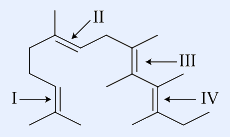
In the following structure, the double bonds are marked as I, II, III and IV. Geometrical isomerism is possible at site (s) :
(1)
(2)
(3)
(4)
SolutionAnswer: Option 2I
Approach:
Geometrical isomerism requires each doubly-bonded carbon to bear two different substituents; a carbon with two identical groups precludes it.
Step 1:At site I the terminal carbon of the double bond is a =C(CH3)2 carbon bearing two identical methyl groups.
Step 2:Since one alkene carbon at site I carries two equal groups, cis-trans (geometrical) isomerism is not possible there, whereas sites II, III and IV each have two different substituents on both carbons.
Final answer: I
Q54Single correctHydrocarbons
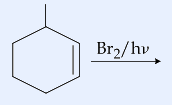
The major product of the following reaction is :
(1)
(2)
(3)
(4)
SolutionAnswer: Option 2tertiary allylic bromide: Br on the methyl-bearing allylic carbon with ring double bond retained
Approach:
Br2 with light (hv) and low Br2 concentration favours free-radical allylic substitution; the most stable allylic radical determines the major product.
Step 1:Under Br2/hv, allylic substitution proceeds via abstraction of an allylic hydrogen, not electrophilic addition.
Step 2:Abstraction at the methyl-substituted allylic carbon gives the most stable (tertiary, resonance-stabilised) allylic radical; recombination with Br places Br on that carbon while the double bond is retained.
Final answer: tertiary allylic bromide: Br on the methyl-bearing allylic carbon with ring double bond retained
Q55Single correctBiomolecules
The statement among the following is :
(1)
(2)
(3)
(4)
SolutionAnswer: Option 2-D-glucose and -D-glucose are enantiomers.
Approach:
Evaluate each statement about glucose chemistry to find the false one.
Step 1:Alpha- and beta-D-glucose differ only in configuration at the anomeric (C1) carbon, so they are anomers (statement 1 correct). They are diastereomers, not non-superimposable mirror images, so they are NOT enantiomers (statement 2 is incorrect).
Step 2:Cellulose is indeed a straight-chain polymer of beta-D-glucose (statement 3 correct), and glucose pentaacetate has no free -CHO/hemiacetal -OH, so it does not react with hydroxylamine (statement 4 correct).
Final answer: -D-glucose and -D-glucose are enantiomers.
Q56Single correctPolymers
Which of the following is a biodegradable polymer ?
(1)
(2)
(3)
(4)
SolutionAnswer: Option 1nylon-2-nylon-6 (copolymer of glycine and amino caproic acid)
Approach:
Identify the polymer composed of naturally occurring amino-acid-type monomers, which is biodegradable.
Step 1:Option 1 is nylon-2-nylon-6, an alternating polyamide of glycine (H2N-CH2-COOH) and amino caproic acid (H2N-(CH2)5-COOH); these biological-type monomers make it biodegradable.
Step 2:Nylon-6 (option 2) and nylon-6,6 (option 3) are non-biodegradable polyamides, and option 4 is a synthetic polyester that is not biodegradable here.
Final answer: nylon-2-nylon-6 (copolymer of glycine and amino caproic acid)
Q57Single correctOrganic Compounds Containing Oxygen / Haloalkanes
The increasing order of the boiling points for the following compounds is : (I), (II), (III), (IV)
(1)
(2)
(3)
(4)
SolutionAnswer: Option 1(III) < (IV) < (II) < (I)
Approach:
Order boiling points by intermolecular forces: hydrogen bonding > dipole-dipole > van der Waals.
Step 1:III is propane (C2H5CH3), a nonpolar alkane with only weak London forces, so it has the lowest boiling point (about -42 C).
Step 2:IV is methoxyethane (an ether) with weak dipole interactions (bp about 7 C); II is ethyl chloride, more polar/polarisable (bp about 12 C).
Step 3:I is ethanol, which forms intermolecular hydrogen bonds, giving the highest boiling point (78 C).
Final answer: (III) < (IV) < (II) < (I)
Q58Single correctBasic Principles of Organic Chemistry
Which of the following compounds will show highest dipole moment ?
(1)
(2)
(3)
(4)
SolutionAnswer: Option 1(I)
Approach:
Greatest charge separation gives the highest dipole moment; a carbonyl whose ring becomes aromatic on shifting electron density shows an exceptionally large dipole.
Step 1:In cyclopropenone (I), shifting the carbonyl pi electrons toward oxygen leaves an aromatic cyclopropenyl cation (2 pi electrons) in the ring, strongly stabilising the charge-separated form.
Step 2:This aromatic stabilisation makes the dipole moment of cyclopropenone (about 4.8 D) the largest among the listed carbonyl compounds.
Step 3:p-Benzoquinone (IV) has two opposed C=O dipoles that partly cancel, lowering its net dipole, while II and III lack the strong aromatic cation stabilisation of I.
Final answer: (I)
Q59Single correctHaloalkanes and Haloarenes
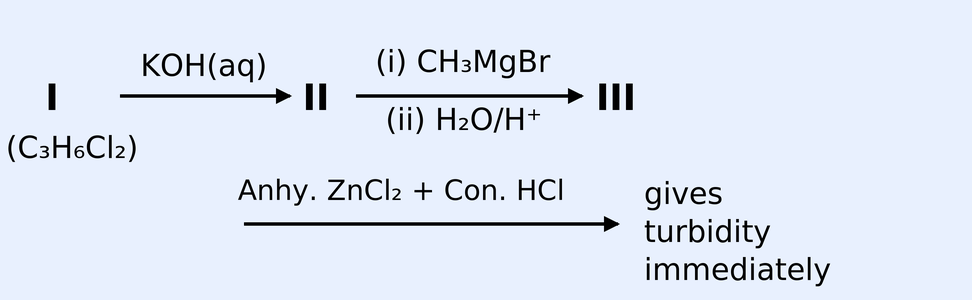
In the following reaction sequence :
The compound I is :
The compound I is :
(1)
(2)
(3)
(4)
SolutionAnswer: Option 4 (2,2-dichloropropane)
Approach:
Immediate turbidity in the Lucas test means III is a tertiary alcohol; work backward through the Grignard step and the hydrolysis of the dihalide.
Step 1:Immediate turbidity with anhydrous ZnCl2 + conc. HCl (Lucas reagent) identifies III as a tertiary alcohol.
Step 2:A tertiary alcohol from CH3MgBr addition requires II to be a ketone. The only C3 ketone here is acetone.
Step 3:Acetone forms by hydrolysis of a gem-dihalide; the gem-dichloride C3H6Cl2 is 2,2-dichloropropane, CH3-CCl2-CH3.
Final answer: (2,2-dichloropropane)
Q60Single correctAmines
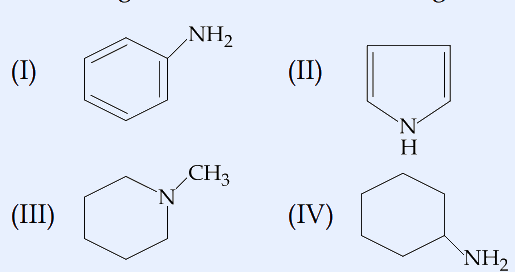
Among the following compounds, the increasing order of their basic strength is :
(1)
(2)
(3)
(4)
SolutionAnswer: Option 3(II) < (I) < (IV) < (III)
Approach:
Basicity depends on availability of the nitrogen lone pair; lone pairs locked in aromatic systems or delocalised into rings are least available.
Step 1:In pyrrole (II) the nitrogen lone pair is part of the aromatic sextet, so it is essentially unavailable; pyrrole is the weakest base.
Step 2:In aniline (I) the lone pair is delocalised into the benzene ring, so it is more basic than pyrrole but less basic than the aliphatic amines.
Step 3:Cyclohexylamine (IV) is a primary aliphatic amine with a fully available lone pair; N-methylpiperidine (III) is a tertiary aliphatic amine, the most basic of these due to alkyl electron donation.
Final answer: (II) < (I) < (IV) < (III)
Mathematics30 questions
Q61Single correctSets, Relations and Functions
The function defined by , where is the set of natural numbers and [x] denotes the greatest integer less than or equal to x, is :
(1)
(2)
(3)
(4)
SolutionAnswer: Option 4neither one-one nor onto.
Approach:
Interpret the rule and test injectivity and surjectivity on the domain and codomain of natural numbers.
Step 1:Identify the output set.
Step 2:Check onto.
map to but values such as are never attained as a remainder; range is not all of
Step 3:Check one-one.
Final answer: neither one-one nor onto.
Q62Single correctComplex Numbers and Quadratic Equations
The sum of all the real values of x satisfying the equation is :
(1)
(2)
(3)
(4)
SolutionAnswer: Option 3
Approach:
Since the base is 2, the equation holds when the exponent equals zero; sum the resulting roots.
Step 1:Set exponent to zero.
Step 2:Solve each factor.
Step 3:Add the roots.
Final answer:
Q63Single correctComplex Numbers and Quadratic Equations
The equation represents a part of a circle having radius equal to :
(1)
(2)
(3)
(4)
SolutionAnswer: Option 3
Approach:
Write , extract the imaginary part of the given expression, and reduce to a circle equation.
Step 1:Substitute and simplify the imaginary part.
Step 2:Set numerator to zero.
Step 3:Complete the square.
Final answer:
Q64Single correctMatrices and Determinants
For two matrices A and B, let and , where B' is the transpose of B and is identity matrix. Then :
(1)
(2)
(3)
(4)
SolutionAnswer: Option 2
Approach:
Use the transpose of the first relation together with the second to solve for A and B explicitly.
Step 1:Transpose the first equation.
Step 2:Solve the linear system entrywise with .
Step 3:Test the options.
Final answer:
Q65Single correctMatrices and Determinants
If , , is a solution of the system of linear equations
such that the point lies on the plane , then equals :
such that the point lies on the plane , then equals :
(1)
(2)
(3)
(4)
SolutionAnswer: Option 3
Approach:
Solve the homogeneous system for a parametric solution, then fix the parameter using the plane condition.
Step 1:Solve the homogeneous system.
Step 2:Apply the plane condition.
Step 3:Evaluate the required expression.
Final answer:
Q66Single correctPermutations and Combinations
The number of ways in which 5 boys and 3 girls can be seated on a round table if a particular boy and a particular girl never sit adjacent to each other, is :
(1)
(2)
(3)
(4)
SolutionAnswer: Option 1
Approach:
Use complementary counting: total circular arrangements minus those where the two specified people sit together.
Step 1:Total circular arrangements of 8 people.
Step 2:Arrangements with and together (treat as one block).
Step 3:Subtract.
Final answer:
Q67Single correctBinomial Theorem
The coefficient of in the binomial expansion of , where , is :
(1)
(2)
(3)
(4)
SolutionAnswer: Option 1
Approach:
Simplify each rational term using factorisation, then apply the binomial general term to locate .
Step 1:Simplify the first term with .
Step 2:Simplify the second term.
Step 3:Combine to get the base.
Step 4:Require exponent in the general term.
Step 5:Compute the coefficient.
Final answer:
Q68Single correctSequences and Series
If three positive numbers a, b and c are in A.P. such that , then the minimum possible value of b is :
(1)
(2)
(3)
(4)
SolutionAnswer: Option 1
Approach:
Use the AP condition and the AM-GM inequality to bound b in terms of the product.
Step 1:Apply AM-GM to a and c.
Step 2:Use the product condition .
Step 3:Identify minimum.
Final answer:
Q69Single correctSequences and Series
Let . If , then n is equal to :
(1)
(2)
(3)
(4)
SolutionAnswer: Option 1
Approach:
Simplify the general term using standard sum formulas, telescope, then solve the given relation for n.
Step 1:Simplify the general term.
Step 2:Sum by telescoping.
Step 3:Apply the condition.
Final answer:
Q70Single correctLimits, Continuity and Differentiability
The value of k for which the function is continuous at , is :
(1)
(2)
(3)
(4)
SolutionAnswer: Option 3
Approach:
Continuity requires the limit of the first piece as to equal the value at .
Step 1:Evaluate the exponent limit.
Step 2:Compute the limit of the first piece.
Step 3:Match with the value at .
Final answer:
Q71Single correctDifferential Equations
If and , then is equal to :
(1)
(2)
(3)
(4)
SolutionAnswer: Option 2
Approach:
Express y explicitly, differentiate twice, and identify the coefficients and k of the resulting differential equation.
Step 1:Solve for y.
Step 2:Form the differential equation by differentiating.
Step 3:Add the coefficients.
Final answer:
Q72Single correctApplications of Derivatives
The function f defined by , is :
(1)
(2)
(3)
(4)
SolutionAnswer: Option 1increasing in .
Approach:
Examine the sign of the first derivative over all real numbers.
Step 1:Differentiate.
Step 2:Check the discriminant.
Step 3:Determine the sign.
Final answer: increasing in .
Q73Single correctDifferentiation
Let f be a polynomial function such that , for all . Then :
(1)
(2)
(3)
(4)
SolutionAnswer: Option 2
Approach:
Compare degrees to fix the polynomial degree, determine coefficients, then test the options.
Step 1:Match degrees.
Step 2:Solve for coefficients.
Step 3:Evaluate derivatives at .
Final answer:
Q74Single correctIntegral Calculus
If , and , then the ordered pair (A, B) is equal to : (where C is a constant of integration)
(1)
(2)
(3)
(4)
SolutionAnswer: Option 2
Approach:
Invert the argument to find explicitly, integrate, and compare with the given form.
Step 1:Solve the argument for x.
Step 2:Write explicitly.
Step 3:Integrate.
Final answer:
Q75Single correctIntegral Calculus
If , then k is equal to :
(1)
(2)
(3)
(4)
SolutionAnswer: Option 1
Approach:
Complete the square, evaluate the definite integral, then equate to the given expression and solve for k.
Step 1:Complete the square.
Step 2:Evaluate the integral.
Step 3:Solve for k.
Final answer:
Q76Single correctLimit, Continuity and Differentiability
If for some positive real number a, then a is equal to :
(1)
(2)
(3)
(4)
SolutionAnswer: Option 1
Approach:
Replace the numerator power sum by its leading asymptotic term and the bracket sum by its leading term, then equate the resulting limit to 1/60.
Step 1:Numerator leading behaviour.
Step 2:Evaluate the bracket sum and its leading term.
Step 3:Denominator leading behaviour with ~ .
Step 4:Form the limit and set equal to 1/60.
Step 5:Solve the equation.
Final answer:
Q77Single correctDifferential Equations
A tangent to the curve, at P(x, y) meets x-axis at A and y-axis at B. If AP : BP = 1 : 3 and , then the curve also passes through the point :
(1)
(2)
(3)
(4)
SolutionAnswer: Option 3
Approach:
Express the x- and y-intercepts of the tangent, apply the section-formula ratio AP:BP = 1:3 to obtain a differential equation, solve it with the initial condition, then test the options.
Step 1:Intercepts of the tangent at P(x,y).
Step 2:AP:BP = 1:3 places P at t=1/4 from A; match x-coordinate.
Step 3:Separate variables and integrate.
Step 4:Apply f(1)=1.
Step 5:Test options.
Final answer:
Q78Single correctCoordinate Geometry
A square, of each side 2, lies above the x-axis and has one vertex at the origin. If one of the sides passing through the origin makes an angle 3 with the positive direction of the x-axis, then the sum of the x-coordinates of the vertices of the square is :
(1)
(2)
(3)
(4)
SolutionAnswer: Option 2
Approach:
Place one vertex at the origin, use the 30 degree direction for one side and the perpendicular 120 degree direction for the adjacent side to find all four vertices, then add their x-coordinates.
Step 1:Vertices adjacent to the origin.
Step 2:Fourth vertex.
Step 3:Sum of x-coordinates.
Final answer:
Q79Single correctCoordinate Geometry
A line drawn through the point P(4, 7) cuts the circle at the points A and B. Then PA . PB is equal to :
(1)
(2)
(3)
(4)
SolutionAnswer: Option 2
Approach:
Use the power of a point with respect to the circle, which equals PA.PB for any secant through the point.
Step 1:Apply the power formula for P(4,7) and the circle of radius 3.
Step 2:Compute.
Final answer:
Q80Single correctCoordinate Geometry
The eccentricity of an ellipse having centre at the origin, axes along the co-ordinate axes and passing through the points and is :
(1)
(2)
(3)
(4)
SolutionAnswer: Option 3
Approach:
Take the standard ellipse with unknown 1/ and 1/, substitute both points to form linear equations, solve, then compute eccentricity.
Step 1:Let u=1/, v=1/ and substitute the two points.
Step 2:Solve the system.
Step 3:Compute eccentricity (>).
Final answer:
Q81Single correctCoordinate Geometry
If is the normal at a point on the parabola whose focal distance is 8, then is equal to :
(1)
(2)
(3)
(4)
SolutionAnswer: Option 3
Approach:
Use the focal distance to locate the point on the parabola, find the parameter t, then write the normal in parametric form and read off c.
Step 1:Identify a and locate the point.
Step 2:Find parameter t from x=.
Step 3:Normal intercept c (with a=2).
Step 4:Evaluate at t=sqrt3.
Final answer:
Q82Single correctThree Dimensional Geometry
If a variable plane, at a distance of 3 units from the origin, intersects the coordinate axes at A, B and C, then the locus of the centroid of is :
(1)
(2)
(3)
(4)
SolutionAnswer: Option 1
Approach:
Write the intercept form of the plane, impose the distance-from-origin condition, express the centroid coordinates in terms of the intercepts, and eliminate the intercepts.
Step 1:Distance condition gives a relation among intercepts.
Step 2:Centroid (x,y,z) implies p=3x, q=3y, r=3z.
Step 3:Multiply by 9.
Final answer:
Q83Single correctThree Dimensional Geometry
If the line, lies in the plane, , then the shortest distance between this line and the line is :
(1)
(2)
(3)
(4)
SolutionAnswer: Option 3
Approach:
Determine lambda from the condition that the first line lies in the given plane, then compute the shortest distance between the two lines using the scalar triple product.
Step 1:The point (3,-2,-lambda) lies in the plane.
Step 2:Direction vectors and a connecting vector.
Step 3:Cross product of directions.
Step 4:Scalar triple product of the connecting vector with the cross product.
Step 5:Shortest distance.
Final answer:
Q84Single correctVector Algebra
If the vector is written as the sum of a vector , parallel to and a vector , perpendicular to , then is equal to :
(1)
(2)
(3)
(4)
SolutionAnswer: Option 2
Approach:
Project b onto a to get b1, subtract to get b2, then take the cross product.
Step 1:Component parallel to a.
Step 2:Perpendicular component.
Step 3:Cross product.
Final answer:
Q85Single correctProbability
From a group of 10 men and 5 women, four member committees are to be formed each of which must contain at least one woman. Then the probability for these committees to have more women than men, is :
(1)
(2)
(3)
(4)
SolutionAnswer: Option 3
Approach:
Count committees containing at least one woman as the sample space, count those with more women than men as the favourable event, and divide.
Step 1:Total committees with at least one woman.
Step 2:Favourable: more women than men means 3W1M or 4W.
Step 3:Probability.
Final answer:
Q86Single correctProbability
Let E and F be two independent events. The probability that both E and F happen is and the probability that neither E nor F happens is , then a value of is :
(1)
(2)
(3)
(4)
SolutionAnswer: Option 1
Approach:
Use independence to set up equations for the product and for the complement product, solve for P(E) and P(F) as roots of a quadratic, then form the ratio.
Step 1:Let p=P(E), q=P(F).
Step 2:Expand the second equation.
Step 3:p and q are roots of the quadratic.
Step 4:Take the ratio.
Final answer:
Q87Single correctStatistics
The sum of 100 observations and the sum of their squares are 400 and 2475, respectively. Later on, three observations, 3, 4 and 5, were found to be incorrect. If the incorrect observations are omitted, then the variance of the remaining observations is :
(1)
(2)
(3)
(4)
SolutionAnswer: Option 4
Approach:
Remove the three omitted observations from the sum and sum of squares, then apply the variance formula to the remaining 97 observations.
Step 1:Corrected sum after removing 3,4,5.
Step 2:Corrected sum of squares.
Step 3:Mean of remaining 97 observations.
Step 4:Variance.
Final answer:
Q88Single correctInverse Trigonometric Functions
A value of x satisfying the equation , is :
(1)
(2)
(3)
(4)
SolutionAnswer: Option 1
Approach:
Convert each inverse-trig expression to an algebraic form and equate.
Step 1:Rewrite both sides.
Step 2:Square and simplify.
Step 3:Solve.
Final answer:
Q89Single correctTrigonometry
The two adjacent sides of a cyclic quadrilateral are 2 and 5 and the angle between them is 6. If the area of the quadrilateral is , then the perimeter of the quadrilateral is :
(1)
(2)
(3)
(4)
SolutionAnswer: Option 3
Approach:
Use the cyclic property (opposite angles supplementary) to relate the two diagonal-triangles via the common diagonal and the total area, then solve for the remaining two sides.
Step 1:Diagonal from the 60-degree triangle (sides 2,5).
Step 2:Opposite angle is 120 degrees; let other sides be c, e.
Step 3:Total area equation.
Step 4:Find c+e.
Step 5:Perimeter.
Final answer:
Q90Single correctMathematical Reasoning
Contrapositive of the statement 'If two numbers are not equal, then their squares are not equal', is :
(1)
(2)
(3)
(4)
SolutionAnswer: Option 1If the squares of two numbers are equal, then the numbers are equal.
Approach:
Identify the hypothesis p and conclusion q, then form the contrapositive as (not q) implies (not p).
Step 1:Identify p and q.
two numbers not equal; their squares not equal
Step 2:Form the contrapositive (not q implies not p).
squares equal; numbers equal
Final answer: If the squares of two numbers are equal, then the numbers are equal.
More JEE Main 2017 papers
Frequently Asked Questions
How many questions are in the JEE Main 2017 April 09 paper?
The JEE Main 2017 April 09 paper has 89 questions — Physics (29), Chemistry (30) and Mathematics (30). Every question is on this page with its correct answer and a step-by-step solution.
What is the marking scheme for JEE Main?
JEE Main awards +4 marks for each correct answer and −1 for a wrong answer, with 0 for questions left unattempted. The paper covers Physics, Chemistry and Mathematics.
Are the answer key and step-by-step solutions provided for the 2017 April 09 paper?
Yes — every question shows the correct answer (answer key) and a detailed step-by-step solution, free to read online.
Can I take the JEE Main 2017 April 09 paper as a timed mock test?
Yes. With a free JEEnify account you can attempt this exact paper as a timed test in the real exam interface, then see your score and weak-area analysis.
Solved this paper? Calculate your JEE Main scoremost important chaptersformula sheetsall free tools.