
Back to JEE Main PYQs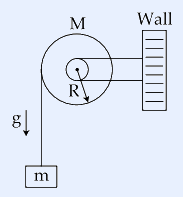
JEE Main 2017 April 08 Question Paper with Solutions
All 89 questions from the JEE Main 2017 (April 08) shift — Physics (29), Chemistry (30) and Mathematics (30) — each with the correct answer (answer key) and a step-by-step solution. Read it free online, or attempt the full paper as a timed mock test.
Physics29 questions
Q1Single correctUnits and Measurements
Time (T), velocity (C) and angular momentum (h) are chosen as fundamental quantities instead of mass, length and time. In terms of these, the dimensions of mass would be :
(1)
(2)
(3)
(4)
SolutionAnswer: Option 1
Approach:
Express mass as a product of powers of T, C and h, then equate dimensions in M, L, T.
Step 1:Assume the form for mass.
Step 2:Substitute the dimensions of each base quantity.
Step 3:Equate exponents of M, L and T with the target [M].
Step 4:Write the result.
Final answer:
Q2Single correctKinematics
Which graph corresponds to an object moving with a constant negative acceleration and a positive velocity ?
(1)
(2)
(3)
(4)
SolutionAnswer: Option 3
Approach:
Use the kinematic relation between velocity and distance for constant acceleration and identify the matching graph shape.
Step 1:A velocity-time graph for constant acceleration is a straight line; options (1) and (2) are curved, so they are excluded.
Step 2:For constant negative acceleration with positive velocity, use the velocity-distance relation.
Step 3:The slope is shallow at large v and becomes steep (vertical) as .
Step 4:This concave-down velocity-distance curve meeting the axis vertically is option (3).
Final answer: Option (3): velocity vs distance curve, concave, meeting the distance axis vertically.
Q3Single correctOscillations and Waves
A 1 kg block attached to a spring vibrates with a frequency of 1 Hz on a frictionless horizontal table. Two springs identical to the original spring are attached in parallel to an 8 kg block placed on the same table. So, the frequency of vibration of the 8 kg block is :
(1)
(2)
(3)
(4)
SolutionAnswer: Option 3 Hz
Approach:
Find the spring constant from the first system, then use the parallel combination and new mass to find the new frequency.
Step 1:Original system: m = 1 kg, f = 1 Hz.
Step 2:Two identical springs in parallel give effective constant 2k; new mass 8 kg.
kg
Step 3:Compute the new frequency.
Hz
Final answer: Hz
Q5Single correctRotational Motion
A uniform disc of radius R and mass M is free to rotate only about its axis. A string is wrapped over its rim and a body of mass m is tied to the free end of the string as shown in the figure. The body is released from rest. Then the acceleration of the body is :
(1)
(2)
(3)
(4)
SolutionAnswer: Option 1
Approach:
Write Newton's law for the hanging mass and the rotational equation for the disc, with the string constraint a = R alpha.
Step 1:Newton's law for the mass m.
Step 2:Torque on disc.
Step 3:Eliminate T.
Final answer:
Q6Single correctRotational Motion
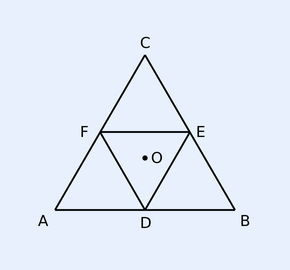
Moment of inertia of an equilateral triangular lamina ABC, about the axis passing through its centre O and perpendicular to its plane is as shown in the figure. A cavity DEF is cut out from the lamina, where D, E, F are the mid points of the sides. Moment of inertia of the remaining part of lamina about the same axis is :
(1)
(2)
(3)
(4)
SolutionAnswer: Option 2
Approach:
The medial triangle DEF is similar to ABC with half the side and shares the same centroid O; scale its moment of inertia and subtract.
Step 1:DEF has side a/2 and area one quarter of ABC, so its mass is M/4. Its centroid coincides with O.
Step 2:Moment of inertia of DEF about O.
Step 3:Subtract the cavity contribution.
Final answer:
Q7Single correctGravitation
If the Earth has no rotational motion, the weight of a person on the equator is W. Determine the speed with which the Earth would have to rotate so that the person at the equator will weigh W. Radius of the Earth is 6400 km and m/.
(1)
(2)
(3)
(4)
SolutionAnswer: Option 3 rad/s
Approach:
Apparent weight at the equator is reduced by the centripetal term; set it equal to 3/4 of the true weight and solve for the angular speed.
Step 1:Set apparent weight to three quarters of true weight.
Step 2:Solve for omega squared.
Step 3:Take the square root.
rad/s
Final answer: rad/s
Q8Single correctThermal Properties of Matter
In an experiment a sphere of aluminium of mass 0.20 kg is heated upto 15C. Immediately, it is put into water of volume 150 cc at 2C kept in a calorimeter of water equivalent to 0.025 kg. Final temperature of the system is 4C. The specific heat of aluminium is : (take 4.2 Joule = 1 calorie)
(1)
(2)
(3)
(4)
SolutionAnswer: Option 4 J/kg-C
Approach:
Apply conservation of heat: heat lost by the aluminium equals heat gained by the water plus the calorimeter (via its water equivalent).
Step 1:Water mass = 150 cc = 0.150 kg; total water-equivalent gaining heat = 0.150 + 0.025 = 0.175 kg; J/kg-C.
kg
Step 2:Aluminium temperature fall = 150 - 40 = 11C; write the heat balance.
Step 3:Solve for the specific heat.
J/kg-C
Final answer: J/kg-C
Q9Single correctProperties of Solids
A compressive force, F is applied at the two ends of a long thin steel rod. It is heated, simultaneously, such that its temperature rises by . The net change in its length is zero. Let l be the length of the rod, A its area of cross-section, Y its Young's modulus, and its coefficient of linear expansion. Then, F is equal to :
(1)
(2)
(3)
(4)
SolutionAnswer: Option 3
Approach:
Set the thermal expansion equal in magnitude to the compressive contraction so the net length change is zero, and solve for F.
Step 1:Net change zero means thermal expansion equals elastic compression.
Step 2:Solve for F.
Final answer:
Q10Single correctThermodynamics
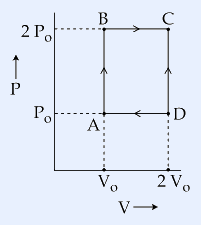
An engine operates by taking n moles of an ideal gas through the cycle ABCDA shown in figure. The thermal efficiency of the engine is : (Take , where R is gas constant)
(1)
(2)
(3)
(4)
SolutionAnswer: Option 2
Approach:
The rectangular cycle on the P-V diagram (A at , B at , C at , D at ) is run clockwise. Compute net work from the enclosed area and heat input from the two heat-absorbing legs.
Step 1:Net work equals the rectangle area.
Step 2:Heat absorbed on A->B (isochoric, P rises).
Step 3:Heat absorbed on B->C (isobaric, V rises).
Step 4:Efficiency = work / heat input.
Final answer:
Q11Single correctKinetic Theory of Gases
An ideal gas has molecules with 5 degrees of freedom. The ratio of specific heats at constant pressure () and at constant volume () is :
(1)
(2)
(3)
(4)
SolutionAnswer: Option 4
Approach:
Use the equipartition expressions for Cv and Cp in terms of degrees of freedom f.
Step 1:With f = 5.
Step 2:Take the ratio.
Final answer:
Q12Single correctOscillations and Waves
The ratio of maximum acceleration to maximum velocity in a simple harmonic motion is 10 . At, the displacement is 5 m. What is the maximum acceleration ? The initial phase is .
(1)
(2)
(3)
(4)
SolutionAnswer: Option 2 m/
Approach:
The ratio of maximum acceleration to maximum velocity gives omega; use the initial displacement with the given phase to find amplitude, then maximum acceleration.
Step 1:From the given ratio.
Step 2:Use x(0) = 5 m with phase pi/4.
Step 3:Compute maximum acceleration.
m/
Final answer: m/
Q13Single correctOscillations and Waves
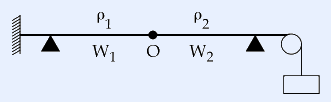
Two wires and have the same radius r and respective densities and such that . They are joined together at the point O, as shown in the figure. The combination is used as a sonometer wire and kept under tension T. The point O is midway between the two bridges. When a stationary wave is set up in the composite wire, the joint is found to be a node. The ratio of the number of antinodes formed in to is :
(1)
(2)
(3)
(4)
SolutionAnswer: Option 2
Approach:
Both segments have the same length, tension and frequency. Compare wave speeds (set by linear mass density), then wavelengths and the number of loops (antinodes) in each segment.
Step 1:Same radius, so speed varies with density only.
Step 2:Same frequency f throughout, so wavelengths scale with speed.
Step 3:Each segment has equal length L with nodes at both ends; number of loops (antinodes) is inversely proportional to wavelength.
Final answer:
Q14Single correctElectrostatics
There is a uniform electrostatic field in a region. The potential at various points on a small sphere centred at P, in the region, is found to vary between the limits 589.0 V to 589.8 V. What is the potential at the centre of the sphere where the radius vector makes an angle of 6 with the direction of the field ?
(1)
(2)
(3)
(4)
SolutionAnswer: Option 3 V
Approach:
In a uniform field the potential varies linearly across the sphere, so the centre potential is the arithmetic mean of the maximum and minimum surface potentials.
Step 1:Surface extremes occur at theta = 0 and theta = pi; their average eliminates the field term and gives the centre value.
Step 2:Substitute the limits.
V
Final answer: V
Q15Single correctElectrostatics
The energy stored in the electric field produced by a metal sphere is 4.5 J. If the sphere contains 4 C charge, its radius will be : [Take : N - / ]
(1)
(2)
(3)
(4)
SolutionAnswer: Option 4 mm
Approach:
Use the self-energy of a charged conducting sphere and solve for the radius.
Step 1:Substitute the known values.
Step 2:Simplify the numerator.
Step 3:Solve for R.
m mm
Final answer: mm
Q16Single correctElectronic Devices
What is the conductivity of a semiconductor sample having electron concentration of , hole concentration of , electron mobility of and hole mobility of ?
(Take charge of electron as C)
(Take charge of electron as C)
(1)
(2)
(3)
(4)
SolutionAnswer: Option 1
Approach:
Apply the conductivity expression for a semiconductor with both electron and hole contributions.
Step 1:Compute electron contribution.
Step 2:Compute hole contribution.
Step 3:Substitute into conductivity formula.
Final answer:
Q17Single correctCurrent Electricity
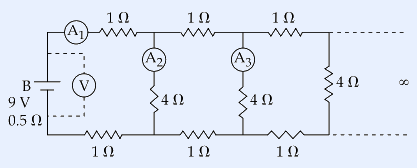
A V battery with internal resistance of is connected across an infinite network as shown in the figure. All ammeters , , and voltmeter V are ideal.
Choose correct statement.
Choose correct statement.
(1)
(2)
(3)
(4)
SolutionAnswer: Option 1Reading of is A
Approach:
Find the equivalent resistance of the self-similar infinite ladder using the recursive relation, then apply Ohm's law to the full loop.
Step 1:Each repeating cell adds two series resistors (top and bottom) and a shunt. Let R be the equivalent resistance of the infinite network.
Step 2:Clear the fraction and solve the quadratic.
Step 3:Total resistance includes the internal resistance; compute the main current through .
Final answer: Reading of is A
Q18Single correctMoving Charges and Magnetism
In a certain region static electric and magnetic fields exist. The magnetic field is given by . If a test charge moving with a velocity experiences no force in that region, then the electric field in the region, in SI units, is :
(1)
(2)
(3)
(4)
SolutionAnswer: Option 4
Approach:
Zero net Lorentz force requires the electric force to cancel the magnetic force, giving E = -(v x B).
Step 1:Evaluate the cross product of velocity and magnetic field.
Step 2:Apply the force balance to obtain the electric field.
Final answer:
Q19Single correctMoving Charges and Magnetism
A magnetic dipole in a constant magnetic field has :
(1)
(2)
(3)
(4)
SolutionAnswer: Option 3zero potential energy when the torque is maximum.
Approach:
Compare the angular dependence of the dipole potential energy and torque.
Step 1:Torque is maximum when sine is maximum, i.e. at theta = 90 degrees.
Step 2:Evaluate the potential energy at this orientation.
Final answer: zero potential energy when the torque is maximum.
Q20Single correctElectromagnetic Induction
A small circular loop of wire of radius a is located at the centre of a much larger circular wire loop of radius b. The two loops are in the same plane. The outer loop of radius b carries an alternating current . The emf induced in the smaller inner loop is nearly :
(1)
(2)
(3)
(4)
SolutionAnswer: Option 1
Approach:
Approximate the field of the large loop as uniform over the small loop, compute the flux linkage, and differentiate to get the induced emf.
Step 1:Flux through the small loop assuming nearly uniform field over its area.
Step 2:Substitute the alternating current and differentiate.
Final answer:
Q21Single correctElectromagnetic Waves
Magnetic field in a plane electromagnetic wave is given by
T
Expression for corresponding electric field will be :
Where c is speed of light.
T
Expression for corresponding electric field will be :
Where c is speed of light.
(1)
(2)
(3)
(4)
SolutionAnswer: Option 1 V/m
Approach:
Use E0 = cB0 for magnitude and require the Poynting vector E x B to point along the direction of propagation to fix the direction and sign.
Step 1:The phase (kx + omega t) indicates propagation along the negative x direction.
Step 2:E must be perpendicular to B (which is along j). Test E along +k.
Step 3:Apply the amplitude relation with the same phase.
Final answer: V/m
Q22Single correctRay Optics
Let the refractive index of a denser medium with respect to a rarer medium be and its critical angle be . At an angle of incidence A when light is travelling from denser medium to rarer medium, a part of the light is reflected and the rest is refracted and the angle between reflected and refracted rays is . Angle A is given by :
(1)
(2)
(3)
(4)
SolutionAnswer: Option 4
Approach:
Use the 90 degree condition between reflected and refracted rays to relate the refraction angle to A, then apply Snell's law and the critical angle definition.
Step 1:The reflected ray makes angle A and the refracted ray makes angle r; the 90 degree condition gives r = 90 - A.
Step 2:Apply Snell's law for travel from denser to rarer medium.
Step 3:Substitute the critical angle relation.
Final answer:
Q23Single correctWave Optics
A single slit of width b is illuminated by a coherent monochromatic light of wavelength . If the second and fourth minima in the diffraction pattern at a distance m from the slit are at cm and cm respectively from the central maximum, what is the width of the central maximum ? (i.e. distance between first minimum on either side of the central maximum)
(1)
(2)
(3)
(4)
SolutionAnswer: Option 2 cm
Approach:
Use the single-slit minima condition to find the spacing per order, then double it for the full central maximum width.
Step 1:Use the second minimum position to find the per-order spacing.
Step 2:Confirm with the fourth minimum.
Step 3:Width of central maximum equals distance between first minima on either side.
Final answer: cm
Q24Single correctDual Nature of Radiation and Matter
The maximum velocity of the photoelectrons emitted from the surface is v when light of frequency n falls on a metal surface. If the incident frequency is increased to , the maximum velocity of the ejected photoelectrons will be :
(1)
(2)
(3)
(4)
SolutionAnswer: Option 3more than
Approach:
Apply Einstein's photoelectric equation at both frequencies and compare the maximum kinetic energies.
Step 1:Write the kinetic energy at frequency n and at frequency 3n.
Step 2:Since hn = (1/2) + phi > (1/2), the added term exceeds twice the original KE.
Final answer: more than
Q25Single correctAtoms
According to Bohr's theory, the time averaged magnetic field at the centre (i.e. nucleus) of a hydrogen atom due to the motion of electrons in the orbit is proportional to : (n = principal quantum number)
(1)
(2)
(3)
(4)
SolutionAnswer: Option 2
Approach:
Express the orbital current and the field at the centre in terms of Bohr's velocity and radius dependence on n.
Step 1:Express current in terms of n.
Step 2:Combine with the field expression.
Final answer:
Q26Single correctNuclei
Two deuterons undergo nuclear fusion to form a Helium nucleus. Energy released in this process is : (given binding energy per nucleon for deuteron MeV and for helium MeV)
(1)
(2)
(3)
(4)
SolutionAnswer: Option 3 MeV
Approach:
Energy released equals the gain in total binding energy of the products over the reactants.
Step 1:Total binding energy of the helium nucleus (4 nucleons).
Step 2:Total binding energy of two deuterons (2 nucleons each).
Step 3:Subtract to find energy released.
Final answer: MeV
Q27Single correctElectronic Devices
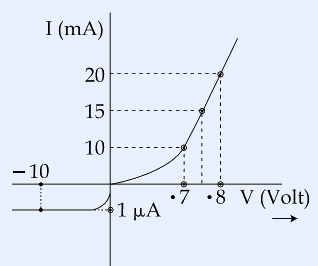
The V-I characteristic of a diode is shown in the figure. The ratio of forward to reverse bias resistance is :
(1)
(2)
(3)
(4)
SolutionAnswer: Option 2
Approach:
Estimate the forward resistance from the slope in the forward region and the reverse resistance from the reverse leakage point, then take their ratio.
Step 1:Reverse bias: at V = -10 V the reverse current is about 1 microampere.
Step 2:Forward bias: in the steep forward region the resistance is of the order of a few ohms to tens of ohms.
Step 3:Form the ratio of forward to reverse resistance.
Final answer:
Q28Single correctCommunication Systems
A signal of frequency kHz and peak voltage of Volt is used to modulate a carrier wave of frequency MHz and peak voltage Volts. Choose the correct statement.
(1)
(2)
(3)
(4)
SolutionAnswer: Option 4Modulation index , side frequency bands are at kHz and kHz
Approach:
Compute the modulation index as the ratio of message to carrier amplitude and locate the sidebands at carrier plus or minus message frequency.
Step 1:Modulation index from peak voltages.
Step 2:Sidebands at carrier 1200 kHz plus or minus message 20 kHz.
Final answer: Modulation index , side frequency bands are at kHz and kHz
Q29Single correctExperimental Skills
In a physical balance working on the principle of moments, when mg weight is placed on the left pan, the beam becomes horizontal. Both the empty pans of the balance are of equal mass. Which of the following statements is correct ?
(1)
(2)
(3)
(4)
SolutionAnswer: Option 3Left arm is shorter than the right arm
Approach:
Apply the principle of moments about the fulcrum with equal pan masses and an extra weight on the left pan that still leaves the beam horizontal.
Step 1:With equal pan masses but an additional 5 mg on the left, the left side carries more weight while the beam remains horizontal.
Step 2:For the moments to balance, the larger left load must act on a shorter arm.
Final answer: Left arm is shorter than the right arm
Q30Single correctCurrent Electricity
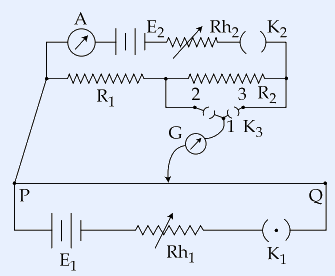
A potentiometer PQ is set up to compare two resistances as shown in the figure. The ammeter A in the circuit reads A when two way key is open. The balance point is at a length cm from P when two way key is plugged in between and , while the balance point is at a length cm from P when key is plugged in between and . The ratio of two resistances , is found to be :
(1)
(2)
(3)
(4)
SolutionAnswer: Option 4
Approach:
The balance length is proportional to the potential drop measured across the chosen part of the resistance combination; form the two relations and eliminate the current and potential gradient.
Step 1:With K3 between 2 and 1 the drop across R1 is balanced at length l1.
Step 2:With K3 between 3 and 1 the drop across R1 + R2 is balanced at length l2.
Step 3:Divide and solve for the ratio of resistances.
Final answer:
Chemistry30 questions
Q31Single correctSurface Chemistry
Among the following, correct statement is :
(1)
(2)
(3)
(4)
SolutionAnswer: Option 1Brownian movement is more pronounced for smaller particles than for bigger-particles.
Approach:
Evaluate each statement against established surface-chemistry facts on Brownian motion, lyophilic/lyophobic sols, the Hardy-Schulze rule and selective adsorption.
Step 1:Brownian motion arises from unbalanced molecular bombardment; smaller, lighter colloidal particles are jostled more, so the zig-zag motion is more pronounced for smaller particles.
Step 2:Metal sulphide sols are inorganic and have little affinity for the dispersion medium, hence lyophobic, not lyophilic.
Step 3:Hardy-Schulze rule: coagulating power depends on the magnitude of the charge of the active (oppositely charged) ion, not on its size.
Step 4:Adsorption increases with ease of liquefaction (higher critical temperature). H2S liquefies more readily than Cl2-equivalent comparison favours H2S, so charcoal adsorbs hydrogen sulphide more, not chlorine.
Final answer: Brownian movement is more pronounced for smaller particles than for bigger-particles.
Q32Single correctSome Basic Concepts in Chemistry
Excess of NaOH (aq) was added to 100 mL of (aq) resulting into 2.14 g of . The molarity of (aq) is : (Given molar mass of Fe = 56 g mo and molar mass of Cl = 35.5 g mo)
(1)
(2)
(3)
(4)
SolutionAnswer: Option 10.2 M
Approach:
Find moles of Fe(OH)3 precipitated, equate to moles of FeCl3 (1:1), then divide by volume in litres.
Step 1:Molar mass of Fe(OH)3 = 56 + 3(16+1) = 56 + 51 = 107 g .
Step 2:Moles of Fe(OH)3 = 2.14 / 107 = 0.02 mol.
Step 3:Reaction FeCl3 + 3NaOH -> Fe(OH)3 + 3NaCl gives 1 mol FeCl3 per mol Fe(OH)3, so moles FeCl3 = 0.02 mol in 0.1 L.
Final answer: 0.2 M
Q33Single correctStates of Matter
Among the following, the incorrect statement is :
(1)
(2)
(3)
(4)
SolutionAnswer: Option 2At very low temperature, real gases show ideal behaviour.
Approach:
Recall the conditions under which intermolecular forces and molecular volume become negligible, making real gases approach ideal behaviour.
Step 1:Low pressure and large volume make both correction terms (a / and nb) negligible, so statements (1) and (3) are correct.
Step 2:At Boyle temperature, deviations cancel over a range of pressures and PV = nRT holds, so (4) is correct.
Step 3:At very low temperature, attractive forces dominate (gases approach condensation), causing maximum deviation from ideality; high temperature, not low, favours ideal behaviour.
Final answer: At very low temperature, real gases show ideal behaviour.
Q34Single correctChemical Thermodynamics
For a reaction, A(g) A(l); H = 3RT. The correct statement for the reaction is :
(1)
(2)
(3)
(4)
SolutionAnswer: Option 4
Approach:
Use the relation between enthalpy and internal energy with change in moles of gas to compute Delta U and compare magnitudes.
Step 1:Gaseous moles change from 1 (A gas) to 0 (A liquid), so Delta = 0 - 1 = -1.
Step 2:Substitute: -3RT = Delta U + (-1)RT, hence Delta U = -3RT + RT = -2RT.
Step 3:Compare magnitudes: |Delta H| = 3RT and |Delta U| = 2RT, so |Delta H| > |Delta U|.
Final answer:
Q35Single correctElectrochemistry
What is the standard reduction potential () for Fe ? Given that : Fe; V; ; V
(1)
(2)
(3)
(4)
SolutionAnswer: Option 1 V
Approach:
Combine the two half-reactions through Gibbs energies (DeltaG = -nFE), since potentials are not additive but DeltaG values are.
Step 1:Target Fe3+ + 3e- -> Fe is the sum of Fe3+ + e- -> Fe2+ (n=1) and Fe2+ + 2e- -> Fe (n=2).
Step 2:Add Gibbs energies: -3F E = (-1)F(0.77) + (-2)F(-0.47).
Step 3:Solve: -3 E = -0.17, so E = 0.17/3 ... computed as -3E = 0.77 - 0.94 = -0.17 gives E = 0.0567; re-evaluate signs: -3F E = -0.77F + 0.94F = 0.17F, hence E = -0.0567 V.
then divided by sign
Final answer: V
Q36Single correctAtomic Structure
If the shortest wavelength in Lyman series of hydrogen atom is A, then the longest wavelength in Paschen series of H is :
(1)
(2)
(3)
(4)
SolutionAnswer: Option 4
Approach:
Use the Rydberg formula for hydrogen-like species to express A from the shortest Lyman line of H, then find the longest Paschen line of He+.
Step 1:Shortest Lyman wavelength of H (Z=1): n1=1, n2=infinity gives 1/A = R, so R = 1/A.
Step 2:Longest Paschen line of He+ (Z=2): n1=3, n2=4. 1/lambda = R(4)(1/9 - 1/16) = R(4)(7/144) = 7R/36.
Step 3:Substitute R = 1/A: lambda = 36/(7R) = 36A/7.
Final answer:
Q37Single correctSolutions
5 g of was dissolved in x g of . The change in freezing point was found to be 3.8C. If is 81.5% ionised, the value of x ( for water = 1.8C kg mo) is approximately : (molar mass of S = 32 g mo and that of Na = 23 g mo)
(1)
(2)
(3)
(4)
SolutionAnswer: Option 345 g
Approach:
Compute the van't Hoff factor from the degree of ionisation, then apply the depression of freezing point formula to find the mass of water.
Step 1:Molar mass Na2SO4 = 2(23) + 32 + 4(16) = 142 g ; moles = 5/142 = 0.0352 mol.
Step 2:Na2SO4 -> 2Na+ + - gives n=3 ions; i = 1 + 0.815(3-1) = 1 + 1.63 = 2.63.
Step 3:Molality m = /(i ) = 3.82/(2.63 x 1.86) = 0.781 mol .
Step 4:Mass of water = moles/m = 0.0352/0.781 = 0.0451 kg = 45.1 g.
Final answer: 45 g
Q38Single correctEquilibrium
Addition of sodium hydroxide solution to a weak acid (HA) results in a buffer of pH 6. If ionisation constant of HA is 1, the ratio of salt to acid concentration in the buffer solution will be :
(1)
(2)
(3)
(4)
SolutionAnswer: Option 310 : 1
Approach:
Apply the Henderson-Hasselbalch equation for an acidic buffer using the given pH and ionisation constant.
Step 1:pKa = -log() = 5.
Step 2:Substitute pH = 6: 6 = 5 + log([salt]/[acid]).
Step 3:log(ratio) = 1 gives [salt]/[acid] = 10, i.e. 10 : 1.
Final answer: 10 : 1
Q39Single correctChemical Kinetics
The rate of a reaction A doubles on increasing the temperature from 300 to 310 K. By how much, the temperature of reaction B should be increased from 300 K so that rate doubles if activation energy of the reaction B is twice to that of reaction A.
(1)
(2)
(3)
(4)
SolutionAnswer: Option 24.92 K
Approach:
Use the Arrhenius equation in two-temperature form; both reactions double their rate (same ln2), so equate the two expressions with = 2 .
Step 1:For A: ln2 = (/R)(1/300 - 1/310). For B: ln2 = (/R)(1/300 - 1/T).
Step 2:Equate right sides: (1/300 - 1/310) = 2(1/300 - 1/T), so (1/300 - 1/T) = (1/2)(1/300 - 1/310).
Step 3:1/T = 1/300 - 5.376e-5 = 3.2796e-3, so T = 304.92 K; increase = 304.92 - 300 = 4.92 K.
Final answer: 4.92 K
Q40Single correctChemical Thermodynamics
The enthalpy change on freezing of 1 mol of water at C to ice at C is : (Given H = 6 kJ mo at C, , l) = 75.3 J mo , , s) = 36.8 J mo )
(1)
(2)
(3)
(4)
SolutionAnswer: Option 36.56 kJ mo
Approach:
Construct a three-step path (cool water 5 to 0, freeze at 0, cool ice 0 to -5) and sum the enthalpy changes by Hess's law.
Step 1:Cool water from 5 to 0 C: 1 x 75.3 x (-5) = -376.5 J.
Step 2:Freezing at 0 C is the negative of fusion: -6000 J.
Step 3:Cool ice from 0 to -5 C: 1 x 36.8 x (-5) = -184 J.
Step 4:Sum: -376.5 - 6000 - 184 = -6560.5 J = -6.56 kJ ; magnitude 6.56 kJ .
Final answer: 6.56 kJ mo
Q41Single correctChemical Bonding and Molecular Structure
Which of the following is paramagnetic ?
(1)
(2)
(3)
(4)
SolutionAnswer: Option 4
Approach:
Use molecular orbital theory to count valence electrons and determine the presence of unpaired electrons for each species.
Step 1:NO+ has 14 electrons; configuration fills bonding/antibonding pairs completely, no unpaired electrons (diamagnetic).
Step 2:CO has 14 electrons, isoelectronic with N2, all paired (diamagnetic).
Step 3:- (peroxide) has 18 electrons; pi* orbitals are completely filled, all paired (diamagnetic).
Step 4:B2 has 10 electrons; configuration places one electron in each of pi(2px) and pi(2py), giving two unpaired electrons (paramagnetic).
Final answer:
Q42Single correctd- and f-Block Elements / Coordination Compounds
The pair of compounds having metals in their highest oxidation state is :
(1)
(2)
(3)
(4)
SolutionAnswer: Option 4 and
Approach:
Assign the oxidation state of the metal in each compound and identify the pair where both metals are at their highest commonly attained oxidation state.
Step 1:Option 1: MnO2 -> Mn(+4) (Mn max is +7, not highest); CrO2Cl2 -> Cr(+6) highest. Not both at highest.
Step 2:Option 2: [NiCl4]2- -> Ni(+2); [CoCl4]2- -> Co(+2). Neither at highest.
Step 3:Option 3: [Fe(CN)6]3- -> Fe(+3); [Cu(CN)4]2- -> Cu(+2). Cu(+2) is not its highest stable state in this context.
Step 4:Option 4: [FeCl4]- -> Fe(+3) (highest common state of iron) and Co2O3 -> Co(+3) (highest common state of cobalt). Both metals are in their highest stable oxidation states.
Final answer: and
Q43Single correctChemical Bonding and Molecular Structure
s hybridization is not displayed by :
(1)
(2)
(3)
(4)
SolutionAnswer: Option 4
Approach:
Determine the number of electron domains (steric number) around the central atom; sp3d2 corresponds to six domains (octahedral).
Step 1:BrF5: 5 bond pairs + 1 lone pair = 6 domains -> sp3d2 (square pyramidal).
Step 2:SF6: 6 bond pairs = 6 domains -> sp3d2 (octahedral).
Step 3:[CrF6]3-: octahedral complex, 6 ligands -> sp3d2 (outer orbital).
Step 4:PF5: 5 bond pairs = 5 domains -> sp3d (trigonal bipyramidal), not sp3d2.
Final answer:
Q44Single correctEnvironmental Chemistry
Identify the pollutant gases largely responsible for the discoloured and lustreless nature of marble of the Taj Mahal.
(1)
(2)
(3)
(4)
SolutionAnswer: Option 3 and
Approach:
Recall the environmental chemistry of acid rain and its action on marble (calcium carbonate).
Step 1:SO2 and NO2 from fuel combustion oxidise and dissolve in rain to form sulphuric and nitric acids (acid rain).
Step 2:These acids react with the calcium carbonate of marble, corroding and discolouring it, causing the lustreless surface.
Final answer: and
Q45Single correctHydrogen / Redox Reactions
In which of the following reactions, hydrogen peroxide acts as an oxidizing agent ?
(1)
(2)
(3)
(4)
SolutionAnswer: Option 4
Approach:
An oxidising agent is itself reduced; track the oxidation state of oxygen in H2O2 (which is -1). If it falls to -2 (water), H2O2 is the oxidiser; if it rises to 0 (O2), H2O2 is the reducer.
Step 1:In options 1, 2 and 3, H2O2 is converted to O2 (oxygen goes -1 to 0, oxidised), so H2O2 acts as a reducing agent there.
Step 2:In option 4, sulphur of PbS goes from -2 to +6 (oxidised), while oxygen of H2O2 goes -1 to -2 in water (reduced).
Step 3:Since H2O2 is reduced and oxidises PbS to PbSO4, it acts as an oxidising agent in reaction (4).
Final answer:
Q46Single correctClassification of Elements and Periodicity in Properties
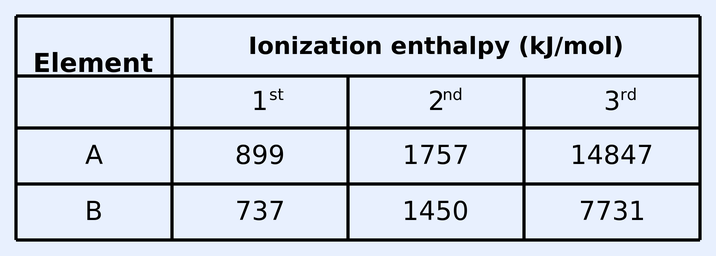
Consider the following ionization enthalpies of two elements 'A' and 'B'.
Which of the following statements is correct?
Which of the following statements is correct?
(1)
(2)
(3)
(4)
SolutionAnswer: Option 3Both 'A' and 'B' belong to group-2 where 'B' comes below 'A'.
Approach:
Identify the group from the position of the large jump in successive ionization enthalpies, then order the two elements within the group using the first ionization enthalpy.
Step 1:For both A and B the third ionization enthalpy is far larger than the second (A: 1757 to 14847; B: 1450 to 7731), so removal of the third electron breaks a noble-gas core. Each element therefore has two easily-removable valence electrons.
Step 2:Within a group ionization enthalpy decreases on moving down. A has the higher first IE (899 > 737), so A lies higher and B lies below A.
Final answer: Both 'A' and 'B' belong to group-2 where 'B' comes below 'A'.
Q47Single correctGeneral Principles and Processes of Isolation / p-Block Elements
Consider the following standard electrode potentials (V in aqueous solution):
Element Al: ,
Element Tl: ,
Based on these data, which of the following statements is correct?
Element Al: ,
Element Tl: ,
Based on these data, which of the following statements is correct?
(1)
(2)
(3)
(4)
SolutionAnswer: Option 3 is more stable than
Approach:
Interpret the sign and magnitude of the standard reduction potentials: a large positive potential means the ion is readily reduced (less stable in that oxidation state); compare the +1 states of Al and Tl.
Step 1:For thallium the inert pair effect makes the +1 state stable; its M+/M potential is negative (-0.34), so Tl+ is not easily reduced and is stable.
Step 2:For aluminium the +1 state is unstable; its M+/M potential is positive (+0.55), so Al+ is readily reduced to Al (and disproportionates), making Al+ unstable.
Step 3:Comparing the two monovalent ions, Tl+ is more stable than Al+.
Final answer: is more stable than
Q48Single corrects-Block Elements
A metal 'M' reacts with nitrogen gas to afford 'N'. 'N' on heating at high temperature gives back 'M' and on reaction with water produces a gas 'B'. Gas 'B' reacts with aqueous solution of to form a deep blue compound. 'M' and 'B' respectively are :
(1)
(2)
(3)
(4)
SolutionAnswer: Option 1Li and
Approach:
Use the M3N stoichiometry to fix the oxidation state of M, identify gas B from the deep-blue CuSO4 test, and select the metal that reacts directly with nitrogen.
Step 1:The nitride M3N requires M to be monovalent (M+), so M is an alkali metal (Li or Na).
Step 2:Gas B gives a deep blue compound with CuSO4, which is the test for ammonia forming the tetraamminecopper(II) complex. Hence B is NH3.
Step 3:Among the alkali metals only lithium reacts directly with nitrogen to give Li3N. Therefore M = Li.
Final answer: Li and
Q49Single correctp-Block Elements (Group 16)
The number of and bonds present in peroxodisulphuric acid and pyrosulphuric acid respectively are :
(1)
(2)
(3)
(4)
SolutionAnswer: Option 4(4 and 2) and (4 and 2)
Approach:
Draw the structures of the two oxoacids and count the S=O double bonds and S-OH single bonds in each.
Step 1:Peroxodisulphuric acid (Marshall's acid) is HO-SO2-O-O-SO2-OH. Each sulphur bears two S=O bonds and one S-OH; the two sulphurs are linked by a peroxide bridge.
Step 2:Pyrosulphuric acid (oleum, disulphuric acid) is HO-SO2-O-SO2-OH. Each sulphur again bears two S=O bonds and one S-OH, joined by a single oxygen bridge.
Final answer: (4 and 2) and (4 and 2)
Q50Single correctEnvironmental / Qualitative Inorganic Analysis
A solution containing a group-IV cation gives a precipitate on passing . A solution of this precipitate in dil.HCl produces a non-toxic gas/compound on reaction with potassium ferrocyanide. The cation is :
(1)
(2)
(3)
(4)
SolutionAnswer: Option 4
Approach:
Use the solubility of the group-IV sulphides in dilute HCl and the confirmatory potassium ferrocyanide test to identify the cation.
Step 1:Among the group-IV cations, the sulphide that dissolves in dilute HCl to give a clean solution is ZnS; CoS and NiS are insoluble in dilute HCl.
Step 2:The dil.HCl solution gives a bluish-white (non-toxic) precipitate of zinc ferrocyanide with potassium ferrocyanide, confirming Zn2+.
Final answer:
Q51Single correctPurification and Characterisation of Organic Compounds
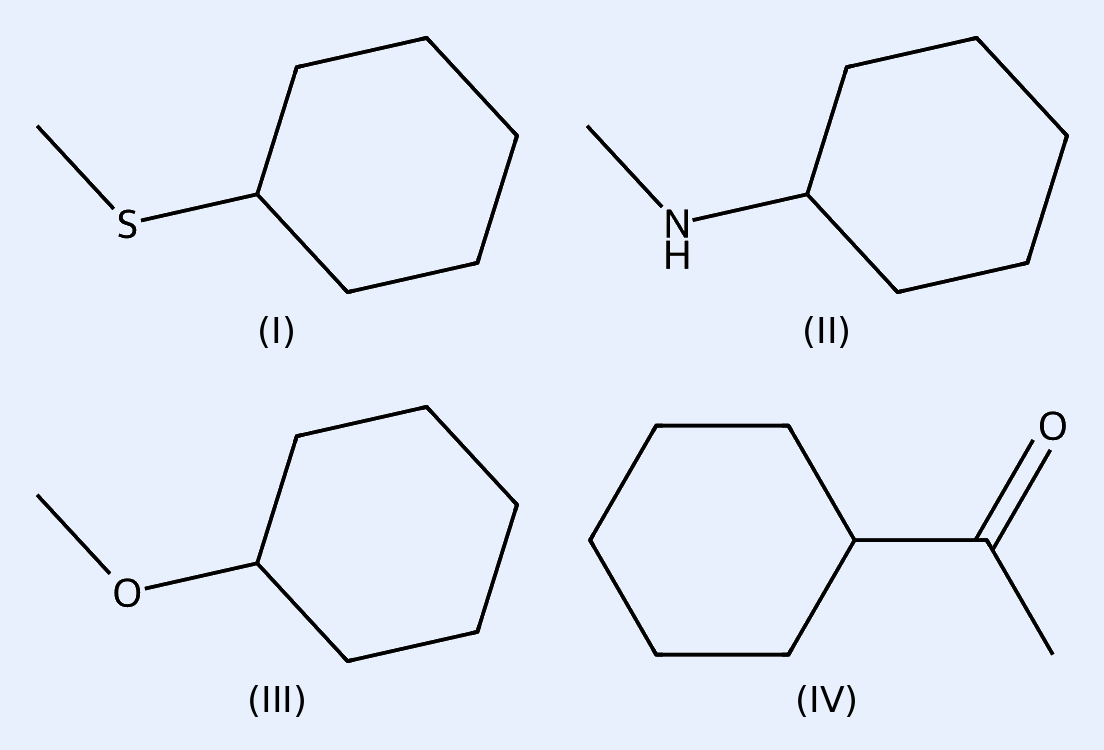
A mixture containing the following four compounds is extracted with 1M HCl. The compound that goes to aqueous layer is :
(1)
(2)
(3)
(4)
SolutionAnswer: Option 2(II)
Approach:
Determine which functional class among the four (thiol I, amine II, ether III, ketone IV) is basic enough to be protonated by dilute HCl and pass into the aqueous layer as a salt.
Step 1:Extraction with 1M HCl removes basic compounds by forming water-soluble ammonium salts.
Step 2:Of the four compounds, only the amine (II) is basic; the thiol (I), ether (III) and ketone (IV) are not protonated by dilute HCl and remain in the organic layer.
Final answer: (II)
Q52Single correctChemistry in Everyday Life
The reason for 'drug induced poisoning' is :
(1)
(2)
(3)
(4)
SolutionAnswer: Option 3Binding irreversibly to the active site of the enzyme
Approach:
Recall the mechanism by which poisons/drugs permanently inhibit enzyme action.
Step 1:Drug-induced poisoning results when the drug binds strongly (often covalently and irreversibly) to the active site, blocking the substrate permanently and inhibiting enzyme function.
Final answer: Binding irreversibly to the active site of the enzyme
Q53Single correctHydrocarbons / Haloalkanes and Haloarenes
Which of the following compounds will not undergo Friedel Craft's reaction with benzene ?
(1)
(2)
(3)
(4)
SolutionAnswer: Option 3 (but-3-enyl chloride)
Approach:
Friedel-Crafts proceeds through an acylium ion (from acid chlorides) or a stabilized carbocation (from suitable alkyl halides). Identify the compound that can give neither.
Step 1:Options (1) acryloyl chloride and (4) methacryloyl chloride are acid chlorides; they form acylium ions and undergo Friedel-Crafts acylation.
Step 2:Option (2) is allyl chloride; ionization gives a resonance-stabilized allyl cation, so it undergoes Friedel-Crafts alkylation.
Step 3:Option (3) is but-3-enyl chloride; the C-Cl is on a primary sp3 carbon not adjacent to the double bond, so ionization would give an unstabilized primary carbocation. It does not undergo Friedel-Crafts.
Final answer: (but-3-enyl chloride)
Q54Single correctBiomolecules
Among the following, the essential amino acid is :
(1)
(2)
(3)
(4)
SolutionAnswer: Option 2Valine
Approach:
Recall which listed amino acids the human body cannot synthesise and must obtain from diet.
Step 1:Essential amino acids cannot be synthesised by the body. Among the options, valine is essential, whereas alanine, aspartic acid and serine are non-essential.
Final answer: Valine
Q55Single correctAldehydes, Ketones and Carboxylic Acids / Alcohols
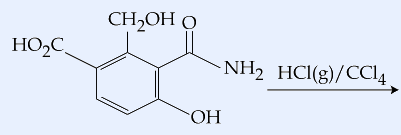
The major product expected from the following reaction is :
(1)
(2)
(3)
(4)
SolutionAnswer: Option 1Phthalide (5-membered lactone) bearing the -CO2H and -OH groups, formed by cyclization of -CH2OH with the ortho -CONH2
Approach:
Anhydrous HCl(g) in CCl4 promotes intramolecular cyclization of the benzylic -CH2OH with the ortho carbonyl to give a five-membered lactone (phthalide), expelling ammonia from the amide as ammonium chloride.
Step 1:The benzylic primary alcohol is ortho to the amide carbonyl. Under HCl(g)/CCl4 the -CH2OH attacks the protonated amide carbonyl, cyclizing to a five-membered lactone (phthalide ring) and releasing NH3 (as NH4Cl).
Step 2:The carboxylic acid (-CO2H) and phenolic -OH on the ring are retained. The product is the phthalide bearing -CO2H and -OH (option 1).
Final answer: Phthalide (5-membered lactone) bearing the -CO2H and -OH groups
Q56Single correctHaloalkanes and Haloarenes / Hydrocarbons
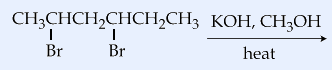
The major product of the following reaction is :
(1)
(2)
(3)
(4)
SolutionAnswer: Option 3
Approach:
Alcoholic KOH causes double dehydrohalogenation of 2,4-dibromohexane; each elimination follows Saytzeff and the diene that is internal and conjugated is the most stable major product.
Step 1:The substrate is 2,4-dibromohexane, CH3-CHBr-CH2-CHBr-CH2-CH3. Alcoholic KOH eliminates two molecules of HBr.
Step 2:Eliminating toward the internal carbon (C3) from each C-Br carbon gives the C2=C3 and C4=C5 double bonds, producing the conjugated, internal hexa-2,4-diene, the most stable product.
Final answer:
Q57Single correctPurification and Characterisation of Organic Compounds
Which of the following statements is not true about partition chromatography ?
(1)
(2)
(3)
(4)
SolutionAnswer: Option 2Stationary phase is a finely divided solid adsorbent
Approach:
Distinguish partition chromatography (stationary phase is a liquid held on a support) from adsorption chromatography (stationary phase is a solid adsorbent).
Step 1:In partition chromatography the stationary phase is a liquid held on an inert support (e.g. water on cellulose in paper chromatography), not a finely divided solid adsorbent. The description in statement (2) belongs to adsorption chromatography.
Final answer: Stationary phase is a finely divided solid adsorbent
Q58Single correctSome Basic Principles of Organic Chemistry
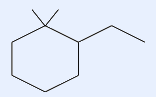
The IUPAC name of the following compound is :
(1)
(2)
(3)
(4)
SolutionAnswer: Option 22-Ethyl-1,1-dimethylcyclohexane
Approach:
Number the cyclohexane ring to give the lowest set of locants, then cite the substituents alphabetically.
Step 1:The ring bears a gem-dimethyl carbon and an adjacent ethyl carbon. Numbering to give lowest locants gives {1,1,2} (dimethyl at 1,1 and ethyl at 2) rather than {1,2,2}.
Step 2:Substituents are cited alphabetically: ethyl before methyl. The name is 2-ethyl-1,1-dimethylcyclohexane.
Final answer: 2-Ethyl-1,1-dimethylcyclohexane
Q59Single correctHaloalkanes and Haloarenes
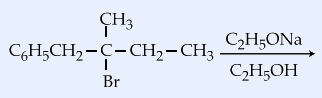
The major product of the following reaction is :
(1)
(2)
(3)
(4)
SolutionAnswer: Option 2
Approach:
Sodium ethoxide is a strong base; with a tertiary halide it favours E2 elimination, giving the most stable (conjugated) alkene.
Step 1:The substrate is a tertiary benzylic-type halide. The strong base C2H5ONa promotes E2 elimination over substitution.
Step 2:Removing a beta-hydrogen from the benzylic CH2 gives a double bond conjugated with the benzene ring, the most stable alkene.
Final answer:
Q60Single correctAlcohols, Phenols and Ethers
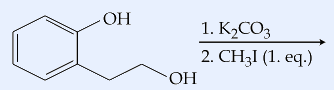
The major product of the following reaction is :
(1)
(2)
(3)
(4)
SolutionAnswer: Option 12-(2-methoxyphenyl)ethanol: benzene ring with ortho -OCH3 and -CH2CH2OH
Approach:
K2CO3 selectively deprotonates the more acidic phenolic -OH; the resulting phenoxide is methylated by one equivalent of CH3I, leaving the aliphatic alcohol untouched.
Step 1:Phenol (pKa ~10) is far more acidic than the primary aliphatic alcohol (pKa ~16); mild base K2CO3 deprotonates only the phenol to give the phenoxide.
Step 2:One equivalent of CH3I methylates the more nucleophilic phenoxide oxygen, giving the aryl methyl ether while the -CH2CH2OH group remains intact.
Final answer: 2-(2-methoxyphenyl)ethanol: benzene ring with ortho -OCH3 and -CH2CH2OH
Mathematics30 questions
Q61Single correctRelations and Functions
Let and . If , then x is equal to :
(1)
(2)
(3)
(4)
SolutionAnswer: Option 4
Approach:
Compute the composition f(g(x)), set it equal to x, solve the resulting linear equation, then divide numerator and denominator by to match the option form.
Step 1:Substitute g(x) into f.
Step 2:Set equal to x and collect terms.
Step 3:Divide numerator and denominator by .
Final answer:
Q62Single correctAlgebra
Let be a quadratic polynomial such that . If leaves remainder when divided by and it leaves remainder when divided by ; then :
(1)
(2)
(3)
(4)
SolutionAnswer: Option 3
Approach:
Write p(x)=+bx+c, use p(0)=1 and the remainder theorem values p(1)=4, p(-1)=6 to find the coefficients, then evaluate p(2) and p(-2).
Step 1:Use p(0)=1.
Step 2:p(1)=4 and p(-1)=6 give two equations.
Step 3:Solve for a and b.
Step 4:Evaluate at -2 (and 2).
Final answer:
Q63Single correctComplex Numbers
Let , the set of complex numbers. Then the equation, represents :
(1)
(2)
(3)
(4)
SolutionAnswer: Option 1a circle with radius .
Approach:
Write z=x+iy, square the modulus equation, simplify to the general circle form, and read off the radius.
Step 1:Set 2|z+3i|=|z-i| and substitute z=x+iy, then square.
Step 2:Collect terms.
Step 3:Complete the square to find radius.
Final answer: a circle with radius .
Q64Single correctMatrices and Determinants
The number of real values of for which the system of linear equations , , has infinitely many solutions, is :
(1)
(2)
(3)
(4)
SolutionAnswer: Option 2
Approach:
A homogeneous system has non-trivial (infinitely many) solutions iff the coefficient determinant is zero. Expand the determinant in lambda and count its real roots.
Step 1:Form and expand the coefficient determinant.
Step 2:Set determinant to zero.
Step 3:Analyse number of real roots via monotonicity.
Final answer:
Q65Single correctMatrices and Determinants
Let A be any invertible matrix. Then which one of the following is not always true ?
(1)
(2)
(3)
(4)
SolutionAnswer: Option 4
Approach:
Use the n=3 adjoint identities adj(A)=|A| and adj(adj(A))=A=|A|A, plus =A/|A|, to test each option.
Step 1:Option 1 is the defining identity.
Step 2:Option 2 uses the double-adjoint formula with n=3.
Step 3:Check option 3 using =A/|A|.
Step 4:Check option 4.
in general
Final answer:
Q66Single correctPermutations and Combinations
If all the words, with or without meaning, are written using the letters of the word QUEEN and are arranged as in English dictionary, then the position of the word QUEEN is :
(1)
(2)
(3)
(4)
SolutionAnswer: Option 3
Approach:
Order the letters E,E,N,Q,U alphabetically and count, by leading letters, how many words precede QUEEN, accounting for the repeated E with 4!/2! counts.
Step 1:Words starting with E (remaining E,N,Q,U distinct).
Step 2:Words starting with N (remaining E,E,Q,U).
Step 3:Words with Q: order second letter E,N,U. Q E _ : 3!=6 (37-42); Q N _ : 3!/2!=3 (43-45); Q U _ : remaining E,E,N.
Step 4:Within Q U _ _ arrange E,E,N: EEN, ENE, NEE; QUEEN is EEN, the first.
Final answer:
Q67Single correctNumber Theory
If is divided by , then the remainder is :
(1)
(2)
(3)
(4)
SolutionAnswer: Option 4
Approach:
Reduce 27 modulo 7 to -1, raise to the odd power, and convert the result to a non-negative remainder.
Step 1:Reduce the base mod 7.
Step 2:Raise to the odd exponent 999.
Step 3:Express as a positive remainder.
Final answer:
Q68Single correctSequences and Series
If the arithmetic mean of two numbers a and b, , is five times their geometric mean, then is equal to :
(1)
(2)
(3)
(4)
SolutionAnswer: Option 4
Approach:
From AM=5 GM get a+b=10 sqrt(ab); set r=sqrt(a/b), find r+1/r and r-1/r, then form (a+b)/(a-b).
Step 1:Translate the condition.
Step 2:Divide by sqrt(ab) with r=sqrt(a/b).
Step 3:Compute r-1/r (positive since a>b).
Step 4:Form the required ratio.
Final answer:
Q69Single correctSequences and Series
If the sum of the first n terms of the series is , then n equals :
(1)
(2)
(3)
(4)
SolutionAnswer: Option 2
Approach:
Factor sqrt 3 out of each term to expose an arithmetic progression in the coefficients, sum it, and solve for n.
Step 1:Simplify the surds.
Step 2:Sum n terms.
Step 3:Set equal to 435 sqrt 3 and solve.
Final answer:
Q70Single correctLimits and Continuity
is equal to :
(1)
(2)
(3)
(4)
SolutionAnswer: Option 2
Approach:
Rationalise numerator and denominator separately, cancel the common factor (x-3), and substitute x=3.
Step 1:Rationalise numerator.
Step 2:Rationalise denominator.
Step 3:Cancel (x-3) and substitute x=3.
Final answer:
Q71Single correctDifferential Calculus
The tangent at the point to the curve, does not pass through the point :
(1)
(2)
(3)
(4)
SolutionAnswer: Option 4
Approach:
Differentiate implicitly to get the slope at (2,-2), write the tangent line, then test each candidate point.
Step 1:Differentiate the curve.
Step 2:Substitute (2,-2).
Step 3:Write the tangent line.
Step 4:Test points; (-2,-7) gives LHS=-5, RHS=-14/3.
Final answer:
Q72Single correctDifferential Calculus
If , then is equal to :
(1)
(2)
(3)
(4)
SolutionAnswer: Option 4
Approach:
Let u=x+sqrt(-1), v=x-sqrt(-1); differentiate y=+, obtain sqrt(-1) y' = 15( - ), differentiate again and simplify.
Step 1:First derivative.
Step 2:Differentiate the bracketed relation.
Step 3:Multiply through by sqrt(-1).
Final answer:
Q73Single correctCoordinate Geometry
If a point P has co-ordinates and Q is any point on the circle, , then the maximum value of is :
(1)
(2)
(3)
(4)
SolutionAnswer: Option 2
Approach:
Find the circle's centre C and radius r, compute PC, then max PQ = PC + r and square it.
Step 1:Centre and radius squared.
Step 2:Distance PC.
Step 3:Maximum = .
Final answer:
Q74Single correctIntegral Calculus
The integral is equal to : (where C is a constant of integration)
(1)
(2)
(3)
(4)
SolutionAnswer: Option 2
Approach:
Recognise the radicand as a perfect square , take the positive square root on (0, pi/2), then integrate csc x + cot x and simplify using half-angle identities.
Step 1:Simplify the radicand.
Step 2:Integrate.
Step 3:Simplify with half-angle identities.
Final answer:
Q75Single correctIntegral Calculus
The integral equals :
(1)
(2)
(3)
(4)
SolutionAnswer: Option 1
Approach:
Use tan x + cot x = 2/sin 2x to reduce the integrand to cos 2x 2x, then substitute u = sin 2x.
Step 1:Simplify the integrand.
Step 2:Substitute u = sin 2x, du = 2 cos 2x dx.
Step 3:Apply limits (sin(pi/2)=1, sin(pi/6)=1/2).
Final answer:
Q76Single correctIntegral Calculus
The area (in sq. units) of the smaller portion enclosed between the curves, and , is :
(1)
(2)
(3)
(4)
SolutionAnswer: Option 4
Approach:
Find intersection of circle and parabola, then integrate using symmetry about the x-axis: area = 2 times (region under parabola from 0 to 1 plus region under circle from 1 to 2).
Step 1:Solve +3x=4 to get the intersection abscissa.
Step 2:Compute parabola part.
Step 3:Compute circle part.
Step 4:Double the sum and simplify.
Final answer:
Q77Single correctDifferential Equations
The curve satisfying the differential equation, and passing through the point , also passes through the point :
(1)
(2)
(3)
(4)
SolutionAnswer: Option 2
Approach:
Treat x as the dependent variable to obtain a linear ODE in x with respect to y, solve using an integrating factor, apply the initial condition, then test the options.
Step 1:Rewrite as a linear ODE in x.
Step 2:Multiply by IF 1/y and integrate.
Step 3:Apply (1,1): 1 = 3 + C gives C = -2.
Step 4:Test options; substitute y = 1/3.
Final answer:
Q78Single correctCoordinate Geometry
The locus of the point of intersection of the straight lines, , (), is :
(1)
(2)
(3)
(4)
SolutionAnswer: Option 4a hyperbola with the length of conjugate axis
Approach:
Eliminate the parameter t from the two line equations to obtain the locus, identify the conic and its axis lengths.
Step 1:From the first line, isolate t.
Step 2:Substitute into the second line x + 3 = 2ty.
Step 3:Simplify to standard form.
Step 4:Conjugate axis length = 2b.
Final answer: a hyperbola with the length of conjugate axis
Q79Single correctCoordinate Geometry
If two parallel chords of a circle, having diameter units, lie on the opposite sides of the centre and subtend angles and at the centre respectively, then the distance between these chords, is :
(1)
(2)
(3)
(4)
SolutionAnswer: Option 2
Approach:
For a chord subtending central angle alpha in a circle of radius r, the perpendicular distance from the centre is r cos(alpha/2). Add the two distances since the chords are on opposite sides.
Step 1:Radius r = 2. Both angles have cosine 1/7 (since (7) means cos = 1/7).
Step 2:Compute half-angle cosine.
Step 3:Distance of each chord from centre.
Step 4:Chords on opposite sides, so total distance is the sum.
Final answer:
Q80Single correctCoordinate Geometry
If the common tangents to the parabola, and the circle, intersect at the point P, then the distance of P from the origin, is :
(1)
(2)
(3)
(4)
SolutionAnswer: Option 3
Approach:
By symmetry the common tangents meet on the y-axis. Write a tangent to the parabola, impose tangency to the circle, find its y-intercept, which gives P.
Step 1:Tangent to the parabola at parameter t.
Step 2:Impose tangency to circle of radius 2.
Step 3:The two symmetric tangents (slopes meet at the y-intercept x=0.
Step 4:Distance of P from origin.
Final answer:
Q81Single correctCoordinate Geometry
Consider an ellipse, whose centre is at the origin and its major axis is along the x-axis. If its eccentricity is and the distance between its foci is , then the area (in sq. units) of the quadrilateral inscribed in the ellipse, with the vertices as the vertices of the ellipse, is :
(1)
(2)
(3)
(4)
SolutionAnswer: Option 4
Approach:
Use distance between foci to get c, then e to get a and b. The quadrilateral through the four vertices is a rhombus with diagonals 2a and 2b.
Step 1:Distance between foci 2c = 6, so c = 3.
Step 2:From e = 3/5 find a.
Step 3:Find b.
Step 4:Rhombus with diagonals 2a=10 and 2b=8.
Final answer:
Q82Single correctThree Dimensional Geometry
The coordinates of the foot of the perpendicular from the point on the plane containing the lines, and , is :
(1)
(2)
(3)
(4)
SolutionAnswer: Option 3
Approach:
The plane's normal is the cross product of the two line directions. Find the plane through a known point, then drop a perpendicular from the given point.
Step 1:Cross product of (6,7,8) and (3,5,7).
Step 2:Plane through (-1,1,3).
Step 3:Evaluate at P=(1,-2,1).
Step 4:Foot of perpendicular.
Final answer:
Q83Single correctThree Dimensional Geometry
The line of intersection of the planes and , is :
(1)
(2)
(3)
(4)
SolutionAnswer: Option 3
Approach:
Direction of the line is the cross product of the two plane normals. Find one common point by setting z=0 and solving the two scalar equations.
Step 1:Cross product of (3,-1,1) and (1,4,-2).
Step 2:Set z=0: solve 3x-y=1 and x+4y=2.
Step 3:Write symmetric form.
Step 4:Scale by -1 to match option 3.
Final answer:
Q84Single correctVector Algebra
The area (in sq. units) of the parallelogram whose diagonals are along the vectors and , is :
(1)
(2)
(3)
(4)
SolutionAnswer: Option 2
Approach:
Area of a parallelogram in terms of its diagonals equals half the magnitude of their cross product.
Step 1:Cross product of (8,-6,0) and (3,4,-12).
Step 2:Magnitude.
Step 3:Half the magnitude.
Final answer:
Q85Single correctStatistics
The mean age of teachers in a school is years. A teacher retires at the age of years and a new teacher is appointed in his place. If now the mean age of the teachers in this school is years, then the age (in years) of the newly appointed teacher is :
(1)
(2)
(3)
(4)
SolutionAnswer: Option 3
Approach:
Use total = mean times count. Replace the retiring teacher's age with the unknown new age and apply the new mean.
Step 1:Initial total age.
Step 2:Remove 60, add new age x.
Step 3:Apply new mean 39 over 25 teachers.
Final answer:
Q86Single correctProbability
Three persons P, Q and R independently try to hit a target. If the probabilities of their hitting the target are , and respectively, then the probability that the target is hit by P or Q but not by R is :
(1)
(2)
(3)
(4)
SolutionAnswer: Option 1
Approach:
Compute P(P or Q) using the complement, then multiply by P(not R) using independence.
Step 1:Probability hit by P or Q.
Step 2:Probability not hit by R.
Step 3:Multiply (independence).
Final answer:
Q87Single correctProbability
An unbiased coin is tossed eight times. The probability of obtaining at least one head and one tail is :
(1)
(2)
(3)
(4)
SolutionAnswer: Option 2
Approach:
Use the complement: subtract the probabilities of all heads and all tails from 1.
Step 1:Probability of all heads or all tails.
Step 2:Subtract from 1.
Final answer:
Q88Single correctMatrices and Determinants
If , then is equal to :
(1)
(2)
(3)
(4)
SolutionAnswer: Option 4
Approach:
Expand the determinant to get a trig equation, solve for x in [0,2pi], then sum the tangent values.
Step 1:Expand the determinant.
Step 2:Solve in [0,2pi].
Step 3:Both give the same tangent (period pi).
Step 4:Evaluate and double.
Final answer:
Q89Single correctTrigonometry
The value of , , , is equal to :
(1)
(2)
(3)
(4)
SolutionAnswer: Option 1
Approach:
Substitute = cos 2theta to simplify the surds, reduce the fraction to a tangent of a sum, then invert.
Step 1:Let = cos 2theta, so theta = (1/2)().
Step 2:Reduce the fraction.
Step 3:Apply inverse tangent.
Final answer:
Q90Single correctMathematical Reasoning
The proposition is equivalent to :
(1)
(2)
(3)
(4)
SolutionAnswer: Option 2
Approach:
Simplify using the distributive law, or build a truth table and compare with each option.
Step 1:Apply distributive law.
Step 2:Simplify the tautology factor.
Step 3:Recognise this as a conditional.
Final answer:
More JEE Main 2017 papers
Frequently Asked Questions
How many questions are in the JEE Main 2017 April 08 paper?
The JEE Main 2017 April 08 paper has 89 questions — Physics (29), Chemistry (30) and Mathematics (30). Every question is on this page with its correct answer and a step-by-step solution.
What is the marking scheme for JEE Main?
JEE Main awards +4 marks for each correct answer and −1 for a wrong answer, with 0 for questions left unattempted. The paper covers Physics, Chemistry and Mathematics.
Are the answer key and step-by-step solutions provided for the 2017 April 08 paper?
Yes — every question shows the correct answer (answer key) and a detailed step-by-step solution, free to read online.
Can I take the JEE Main 2017 April 08 paper as a timed mock test?
Yes. With a free JEEnify account you can attempt this exact paper as a timed test in the real exam interface, then see your score and weak-area analysis.
Solved this paper? Calculate your JEE Main scoremost important chaptersformula sheetsall free tools.