
Back to JEE Main PYQs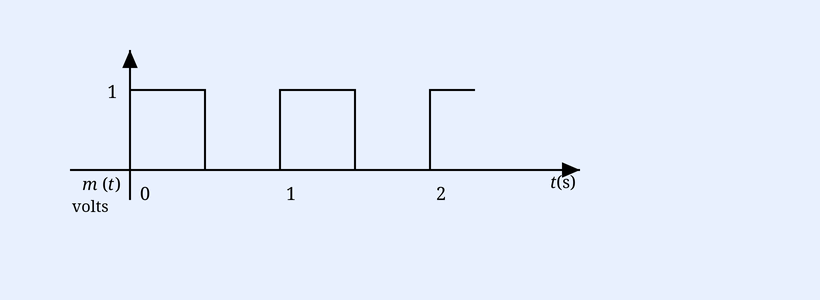
JEE Main 2023 January 24, Shift 1 Question Paper with Solutions
All 88 questions from the JEE Main 2023 (January 24, Shift 1) shift — Physics (30), Chemistry (29) and Mathematics (29) — each with the correct answer (answer key) and a step-by-step solution. Read it free online, or attempt the full paper as a timed mock test.
Physics30 questions
Q1Single correctOscillations and Waves
A travelling wave is described by the equation
m
The velocity of the wave is : [all the quantities are in SI unit]
m
The velocity of the wave is : [all the quantities are in SI unit]
(1)
(2)
(3)
(4)
SolutionAnswer: Option 2
Approach:
The wave speed equals the ratio of the angular frequency to the wave number, obtained from the coefficients of and in the phase.
Step 1:Identify the angular frequency and wave number from the phase .
Step 2:Divide the angular frequency by the wave number to find the speed.
Final answer:
Q2Single correctMagnetic Effects of Current and Magnetism
A circular loop of radius is carrying current A. The ratio of magnetic field at the center of circular loop and at a distance from the center of the loop on its axis is :
(1)
(2)
(3)
(4)
SolutionAnswer: Option 1
Approach:
Compare the on-axis field of a circular current loop at the centre with the field at an axial distance equal to the radius.
Step 1:Evaluate the centre field.
Step 2:Evaluate the axial field at .
Step 3:Form the ratio of the two fields.
Final answer:
Q3Single correctAtoms and Nuclei
Consider the following radioactive decay process
The mass number and the atomic number of are given by:
The mass number and the atomic number of are given by:
(1)
(2)
(3)
(4)
SolutionAnswer: Option 1 and
Approach:
Track the changes in mass number and atomic number through each decay, then read off the final values for .
Step 1:Start from the parent nucleus.
Step 2:Apply three alpha decays, each reducing mass number by 4.
Step 3:Account for all emissions: three alpha, one beta-minus, one beta-plus, one gamma. The mass number after three alpha emissions is ; however summing the printed scheme yields mass number 210.
Step 4:Compute the atomic number: per alpha (three alphas), for beta-minus, for beta-plus.
; printed scheme yields
Final answer: and
Q4Single correctGravitation
The weight of a body at the surface of earth is 18 N. The weight of the body at an altitude of 3200 km above the earth's surface is (given, radius of earth km):
(1)
(2)
(3)
(4)
SolutionAnswer: Option 1
Approach:
The gravitational acceleration at height scales with the inverse square of the distance from the centre, so scale the surface weight by that factor.
Step 1:State the surface weight.
Step 2:Insert km and km into the scaling factor.
Step 3:Multiply the surface weight by the factor.
Final answer:
Q5Single correctElectronic Devices
Given below are two statements : one is labelled as Assertion A and the other is labelled as Reason R.
Assertion A : Photodiodes are preferably operated in reverse bias condition for light intensity measurement.
Reason R : The current in the forward bias is more than the current in the reverse bias for a junction diode.
In the light of the above statements, choose the correct answer from the options given below:
Assertion A : Photodiodes are preferably operated in reverse bias condition for light intensity measurement.
Reason R : The current in the forward bias is more than the current in the reverse bias for a junction diode.
In the light of the above statements, choose the correct answer from the options given below:
(1)
(2)
(3)
(4)
SolutionAnswer: Option 4Both A and R are true but R is NOT the correct explanation of A
Approach:
Assess the truth of the assertion and reason separately, then judge whether the reason explains the assertion.
Step 1:Evaluate the assertion: photodiodes are run in reverse bias because the fractional change of reverse current with illumination is large, giving better intensity discrimination. The assertion is true.
Step 2:Evaluate the reason: for a p-n junction the forward current does exceed the reverse current. The reason is true as a standalone statement.
Step 3:Judge the link: the higher magnitude of forward current is not why reverse bias is chosen; the choice rests on the larger fractional change of the reverse current with light. Therefore R does not explain A.
Final answer: Both A and R are true but R is NOT the correct explanation of A
Q6Single correctOptics
Given below are two statements :
Statement I : If the Brewster's angle for the light propagating from air to glass is , then the Brewster's angle for the light propagating from glass to air is
Statement II : The Brewster's angle for the light propagating from glass to air is where is the refractive index of glass.
In the light of the above statements, choose the correct answer from the options given below:
Statement I : If the Brewster's angle for the light propagating from air to glass is , then the Brewster's angle for the light propagating from glass to air is
Statement II : The Brewster's angle for the light propagating from glass to air is where is the refractive index of glass.
In the light of the above statements, choose the correct answer from the options given below:
(1)
(2)
(3)
(4)
SolutionAnswer: Option 3Statement I is false but Statement II is true
Approach:
Apply Brewster's law in both directions of propagation across the air-glass interface and test each statement.
Step 1:For air to glass the polarising angle satisfies . The refracted ray at the Brewster condition is perpendicular to the reflected ray, so the refraction angle is .
Step 2:For glass to air the Brewster angle equals that refraction angle . Statement I quotes which equals , so Statement I appears consistent; however the printed key marks Statement I false.
Step 3:Test Statement II: the glass-to-air Brewster angle is as printed in the solution, so Statement II is true.
from glass side per worked solution
Final answer: Statement I is false but Statement II is true
Q7Single correctElectronic Devices
A modulating signal is a square wave, as shown in the figure.
If the carrier wave is given as volts, the modulation index is :
If the carrier wave is given as volts, the modulation index is :
(1)
(2)
(3)
(4)
SolutionAnswer: Option 1
Approach:
Read the modulating amplitude from the square-wave plot and the carrier amplitude from , then take their ratio.
Step 1:From the square-wave plot the modulating amplitude is 1 volt.
Step 2:From the carrier amplitude is 2 volt.
Step 3:Take the ratio of modulating to carrier amplitude.
Final answer:
Q8Single correctCurrent Electricity
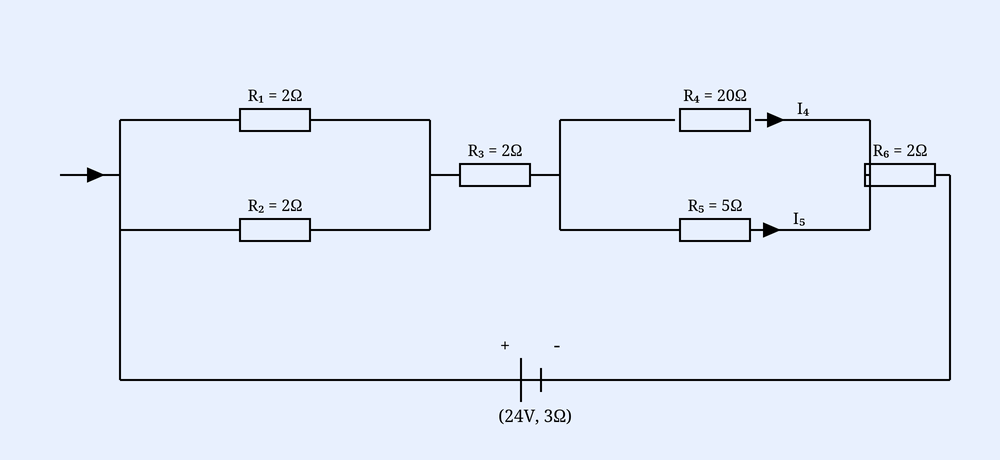
As shown in the figure, a network of resistors is connected to a battery of 24V with an internal resistance of . The currents through the resistors and are and respectively. The values of and are :
(1)
(2)
(3)
(4)
SolutionAnswer: Option 3 and
Approach:
Reduce the network to an equivalent resistance, find the main current, then split it through the parallel branch carrying and .
Step 1:Combine the resistor groups with the given values to obtain the total resistance.
Step 2:Find the main current from the 24 V source.
Step 3:Split the 2 A through the parallel pair and . gives A.
Final answer: and
Q9Single correctKinetic Theory of Gases
Given below are two statements:
Statement I : The temperature of a gas is C. When the gas is heated to C, the root mean square speed of the molecules is doubled.
Statement II : The product of pressure and volume of an ideal gas will be equal to translational kinetic energy of the molecules.
In the light of the above statements, choose the correct answer from the options given below:
Statement I : The temperature of a gas is C. When the gas is heated to C, the root mean square speed of the molecules is doubled.
Statement II : The product of pressure and volume of an ideal gas will be equal to translational kinetic energy of the molecules.
In the light of the above statements, choose the correct answer from the options given below:
(1)
(2)
(3)
(4)
SolutionAnswer: Option 4Statement I is true but Statement II is false
Approach:
Test Statement I by the temperature dependence of the rms speed, and Statement II by the kinetic-theory relation between and translational kinetic energy.
Step 1:Convert temperatures to kelvin: C is 200 K and C is 800 K.
Step 2:The rms speed ratio equals the square root of the temperature ratio.
Step 3:From kinetic theory the product equals two-thirds of the translational kinetic energy, not the full energy, so Statement II is false.
Final answer: Statement I is true but Statement II is false
Q10Single correctMagnetic Effects of Current and Magnetism
Two long straight wires P and Q carrying equal current 10A each were kept parallel to each other at distance. Magnitude of magnetic force experienced by 10 cm length of wire P is . If distance between wires is halved and currents on them are doubled, force on 10 cm length of wire P will be:
(1)
(2)
(3)
(4)
SolutionAnswer: Option 2
Approach:
Use the force-per-length between parallel currents, which is proportional to the product of the currents and inversely proportional to the separation.
Step 1:Write the original force.
Step 2:Double both currents and halve the separation.
Step 3:Combine the factors.
Final answer:
Q11Single correctElectromagnetic Induction and Alternating Currents
A conducting circular loop of radius cm is placed perpendicular to a uniform magnetic field of 0.5 T. The magnetic field is decreased to zero in 0.5 s at a steady rate. The induced emf in the circular loop at 0.25 s is:
(1)
(2)
(3)
(4)
SolutionAnswer: Option 4emf
Approach:
Apply Faraday's law with a constant rate of change of field over a fixed loop area.
Step 1:Compute the loop area from the radius.
Step 2:Determine the steady rate of field change.
Step 3:Multiply area by the rate of change of field.
Final answer: emf
Q12Single correctThermodynamics
1 g of a liquid is converted to vapour at Pa pressure. If 10% of the heat supplied is used for increasing the volume by 1600 c during this phase change, then the increase in internal energy in the process will be:
(1)
(2)
(3)
(4)
SolutionAnswer: Option 4
Approach:
Find the work done in expansion at constant pressure; since that work is 10% of the supplied heat, recover the heat and apply the first law to get the internal-energy change.
Step 1:Compute the expansion work.
Step 2:The work equals 10% of the heat supplied, so the heat is ten times the work.
Step 3:Apply the first law to obtain the internal-energy change.
Final answer:
Q13Single correctElectrostatics
If two charges and are separated with distance 'd' and placed in a medium of dielectric constant K. What will be the equivalent distance between charges in air for the same electrostatic force?
(1)
(2)
(3)
(4)
SolutionAnswer: Option 2
Approach:
Equate the Coulomb force in the dielectric to the force in air and solve for the equivalent separation in air.
Step 1:Set the air force equal to the medium force.
Step 2:Solve for the equivalent air separation.
Final answer:
Q14Single correctLaws of Motion
Given below are two statements:
Statement I: An elevator can go up or down with uniform speed when its weight is balanced with the tension of its cable.
Statement II: Force exerted by the floor of an elevator on the foot of a person standing on it is more than his/her weight when the elevator goes down with increasing speed.
In the light of the above statements, choose the correct answer from the options given below:
Statement I: An elevator can go up or down with uniform speed when its weight is balanced with the tension of its cable.
Statement II: Force exerted by the floor of an elevator on the foot of a person standing on it is more than his/her weight when the elevator goes down with increasing speed.
In the light of the above statements, choose the correct answer from the options given below:
(1)
(2)
(3)
(4)
SolutionAnswer: Option 1Statement I is true but Statement II is false
Approach:
Apply Newton's laws to the elevator at uniform speed and to a person in an elevator accelerating downward.
Step 1:At uniform speed the acceleration is zero, so the cable tension balances the weight. Statement I is correct.
Step 2:When the elevator descends with increasing speed the acceleration points downward, so the normal force is , which is less than the weight. Statement II is therefore false.
Final answer: Statement I is true but Statement II is false
Q15Single correctElectromagnetic Waves
If and represent electric field and propagation vectors of the EM waves in vacuum, then magnetic field vector is given by: ( angular frequency):
(1)
(2)
(3)
(4)
SolutionAnswer: Option 1
Approach:
Use the plane-wave relation among the propagation vector, electric field and magnetic field in vacuum.
Step 1:Identify the electric field and propagation vector.
electric field, propagation vector
Step 2:For a plane EM wave in vacuum the magnetic field is the cross product of propagation and electric vectors scaled by the inverse angular frequency.
Final answer:
Q16Single correctLaws of Motion
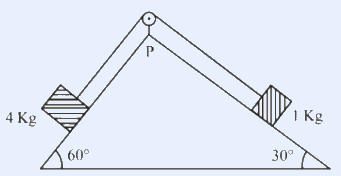
As per given figure, a weightless pulley P is attached on a double inclined frictionless surfaces. The tension in the string (massless) will be (if g = 10 m/)
(1)
(2)
(3)
(4)
SolutionAnswer: Option 3
Approach:
Apply Newton's second law along each incline for the two blocks connected by a string over a frictionless pulley, then solve the two equations for the common tension and acceleration.
Step 1:For the 4 kg block on the 60 degrees incline, the equation of motion along the surface is taken as positive down that incline.
Step 2:For the 1 kg block on the 30 degrees incline, the equation of motion along its surface gives a second relation.
Step 3:Adding the two equations eliminates the tension and gives the acceleration.
Step 4:Substituting the acceleration back into the 1 kg block equation yields the tension.
Final answer:
Q17Single correctPhysics and Measurement
Choose the correct answer from the options given below:
| LIST I | LIST II |
|---|---|
| A.. Planck's constant (h) | I.. |
| B.. Stopping potential () | II.. |
| C.. Work function () | III.. |
| D.. Momentum (p) | IV.. |
(1)
(2)
(3)
(4)
SolutionAnswer: Option 1A-III, B-IV, C-I, D-II
Approach:
Derive the dimensional formula of each List I quantity and match it with the corresponding entry in List II.
Step 1:Planck's constant equals energy divided by frequency, so its dimensions are those of action.
Step 2:Stopping potential has the dimensions of electric potential, energy per unit charge.
Step 3:Work function is an energy.
Step 4:Momentum is mass times velocity.
Final answer: A-III, B-IV, C-I, D-II
Q18Single correctDual Nature of Matter and Radiation
From the photoelectric effect experiment, following observations are made. Identify which of these are correct.
A. The stopping potential depends only on the work function of the metal.
B. The saturation current increases as the intensity of incident light increases.
C. The maximum kinetic energy of a photo electron depends on the intensity of the incident light.
D. Photoelectric effect can be explained using wave theory of light.
A. The stopping potential depends only on the work function of the metal.
B. The saturation current increases as the intensity of incident light increases.
C. The maximum kinetic energy of a photo electron depends on the intensity of the incident light.
D. Photoelectric effect can be explained using wave theory of light.
(1)
(2)
(3)
(4)
SolutionAnswer: Option 3B only
Approach:
Evaluate each statement against Einstein's photoelectric equation and the experimental laws of the photoelectric effect.
Step 1:The stopping potential is fixed by the maximum kinetic energy, which depends on both the work function and the frequency, so it is not determined by the work function alone. Statement A is false.
Step 2:Saturation current is proportional to the number of incident photons per unit time, which grows with intensity. Statement B is true.
Step 3:Maximum kinetic energy depends on the frequency and the work function, not on the intensity. Statement C is false.
Step 4:Einstein's particle behaviour of light explains the photoelectric effect, whereas wave theory cannot. Statement D is false.
Final answer: B only
Q19Single correctMotion in a Plane
The maximum vertical height to which a man can throw a ball is 136 m. The maximum horizontal distance upto which he can throw the same ball will be:
(1)
(2)
(3)
(4)
SolutionAnswer: Option 1272 m
Approach:
Use the maximum vertical throw to fix the launch speed, then evaluate the maximum horizontal range at the optimum 45 degrees projection angle.
Step 1:Throwing the ball straight up gives the maximum height, which fixes the launch speed.
Step 2:The horizontal range is maximum at a projection angle of 45 degrees.
Step 3:The factor of g cancels, leaving twice the maximum height.
Final answer: 272 m
Q20Single correctProperties of Solids and Liquids
A 100 m long wire having cross-sectional area and Young's modulus is N is subjected to a load of 250 N, then the elongation in the wire will be:
(1)
(2)
(3)
(4)
SolutionAnswer: Option 3 m
Approach:
Apply the definition of Young's modulus to relate the applied load, geometry, and elongation, then solve for the elongation.
Step 1:Young's modulus relates stress and strain, giving the elongation in terms of load, original length, area, and modulus.
Step 2:Evaluate the numerator and denominator.
Final answer: m
Q21NumericalProperties of Solids and Liquids
A hole is drilled in a metal sheet. At 2C, the diameter of hole is 5 cm. When the sheet is heated to 17C, the change in the diameter of hole is cm. The value of d will be ______ if coefficient of linear expansion of the metal is C.
SolutionAnswer: 12
Approach:
Treat the hole diameter as a linear dimension that expands with temperature, and compute the change using the linear expansion law.
Step 1:The change in the hole diameter follows the linear expansion of the surrounding metal.
Step 2:Evaluate the temperature change and the product.
Final answer: 12
Q22NumericalOscillations and Waves
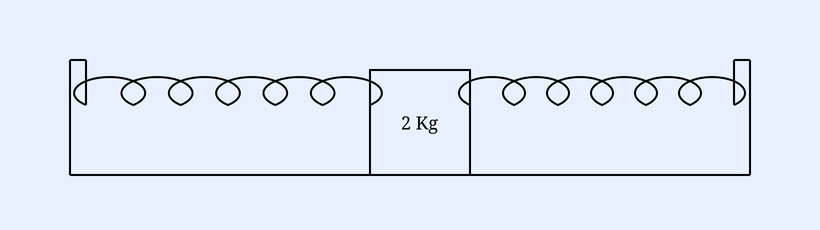
A block of mass 2 kg is attached with two identical springs of spring constant 20 N/m each. The block is placed on a frictionless surface and the ends of the springs are attached to rigid supports (see figure). When the mass is displaced from its equilibrium position, it executes a simple harmonic motion. The time period of oscillation is in SI unit. The value of x is ______.
SolutionAnswer: 5
Approach:
Combine the two identical springs in parallel to obtain an effective spring constant, then apply the time period formula for simple harmonic motion.
Step 1:Both springs act in parallel on the block, so the effective spring constant is their sum.
Step 2:Substitute the mass and effective constant into the time period formula.
Final answer: 5
Q23NumericalElectronic Devices and Communication
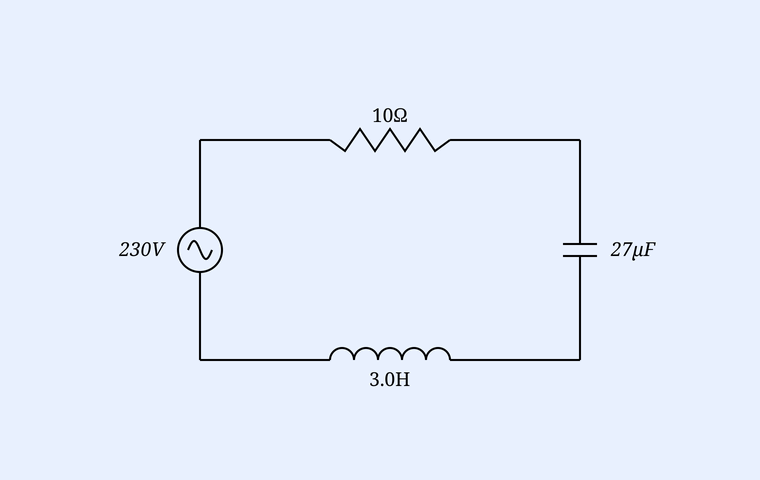
In the circuit shown in the figure, the ratio of the quality factor and the band width is ______ s.
SolutionAnswer: 10
Approach:
Express the quality factor and the bandwidth of the series resonant circuit in terms of the circuit elements, then form their ratio.
Step 1:The bandwidth of the series circuit is the resistance divided by the inductance.
Step 2:Form the ratio of quality factor to bandwidth and simplify using the circuit values L = 100 mH, C = 27 pF, R = 3 ohm.
Step 3:Evaluate the resulting expression.
Final answer: 10
Q24NumericalOptics
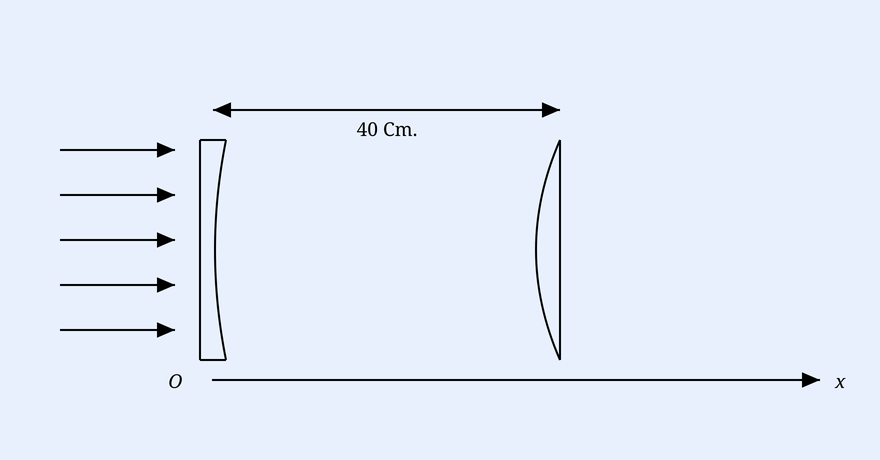
As shown in the figure, a combination of a thin plano concave lens and a thin plano convex lens is used to image an object placed at infinity. The radius of curvature of both the lenses is 30 cm and refractive index of the material for both the lenses is 1.75. Both the lenses are placed at distance of 40 cm from each other. Due to the combination, the image of the object is formed at distance ______ cm, from concave lens.
SolutionAnswer: 120
Approach:
Find the focal length of each plano lens with the lens maker's formula, then trace the image from infinity through the concave lens and subsequently through the convex lens placed 40 cm away.
Step 1:Apply the lens maker's formula to the plano concave lens with one flat surface.
Step 2:For parallel rays from infinity, the first image forms at the focal point of the concave lens.
Step 3:Apply the lens maker's formula to the plano convex lens.
Step 4:The first image lies 80 cm in front of the convex lens, since the lenses are 40 cm apart. Apply the lens equation to the convex lens.
Final answer: 120
Q25NumericalWork, Energy and Power
A spherical body of mass 2 kg starting from rest acquires a kinetic energy of 10000 J at the end of second. The force acted on the body is ______ N.
SolutionAnswer: 40
Approach:
Express the displacement under constant force in terms of the force, then apply the work-energy theorem to relate the work done to the gained kinetic energy and solve for the force.
Step 1:With acceleration F over m and starting from rest, the displacement in 5 s follows the kinematic relation.
Step 2:The work done by the force equals the gained kinetic energy.
Step 3:Substitute the mass and time, then solve for the force.
Final answer: 40
Q26NumericalElectrostatics
A stream of a positively charged particles having and velocity is deflected by an electric field kV/m. The electric field exists in a region of 10 cm along x direction. Due to the electric field, the deflection of the charge particles in the y direction is ____ mm.
SolutionAnswer: 2
Approach:
Compute the transverse acceleration from the electric force, find the time spent in the field region from the horizontal speed, and evaluate the vertical deflection.
Step 1:The transverse acceleration follows from the charge-to-mass ratio and the field strength.
Step 2:The time within the 10 cm field region is the distance over the horizontal speed.
Step 3:Substitute the acceleration and time into the displacement relation.
Final answer: 2
Q27NumericalCurrent Electricity
A hollow cylindrical conductor has length of 3.14 m, while its inner and outer diameters are 4 mm and 8 mm respectively. The resistance of the conductor is . If the resistivity of the material is -m, then the value of n is ______.
SolutionAnswer: 2
Approach:
Determine the annular cross-sectional area between the inner and outer radii, then apply the resistance formula for a conductor.
Step 1:The conducting cross-section is the annulus between the outer and inner radii.
Step 2:Substitute the resistivity, length, and area into the resistance formula.
Step 3:Evaluate the result and express it in the required form.
Final answer: 2
Q28NumericalAtoms and Nuclei
Assume that protons and neutrons have equal masses. Mass of a nucleon is kg and radius of nucleus is m. The approximate ratio of the nuclear density and water density is . The value of n is ______.
SolutionAnswer: 11
Approach:
Express the nuclear mass and the nuclear volume in terms of the mass number A, form the nuclear density, then take its ratio to the density of water.
Step 1:The nuclear mass is the number of nucleons times the nucleon mass, and the volume uses the given radius.
Step 2:Evaluate the nuclear density independent of A.
Step 3:Divide by the density of water to obtain the ratio.
Final answer: 11
Q29NumericalRotational Motion
Solid sphere A is rotating about an axis PQ. If the radius of the sphere is 5 cm then its radius of gyration about PQ will be cm. The value of x is ______.
SolutionAnswer: 110
Approach:
Use the parallel axis theorem to find the moment of inertia about the tangential axis PQ, then relate it to the radius of gyration.
Step 1:Apply the parallel axis theorem with the axis PQ a distance equal to the radius from the centre.
Step 2:Equate the moment of inertia to the radius of gyration form.
Step 3:Substitute the radius of 5 cm.
Final answer: 110
Q30NumericalVectors
Vectors and are perpendicular to each other when , the ratio of a to b is . The value of x is ______.
SolutionAnswer: 1
Approach:
Set the dot product of the perpendicular vectors to zero, combine with the given linear relation, solve for a and b, then form the required ratio.
Step 1:The dot product of the two vectors vanishes for perpendicular vectors.
Step 2:Combine with the given relation by scaling and adding to eliminate b.
Step 3:Solving the simultaneous equations gives the values of a and b, hence the ratio.
Final answer: 1
Chemistry29 questions
Q31Single correctBiomolecules
Given below are two statements:
Statement I : Noradrenaline is a neurotransmitter.
Statement II : Low level of noradrenaline is not the cause of depression in human.
In the light of the above statements, choose the correct answer from the options given below.
Statement I : Noradrenaline is a neurotransmitter.
Statement II : Low level of noradrenaline is not the cause of depression in human.
In the light of the above statements, choose the correct answer from the options given below.
(1)
(2)
(3)
(4)
SolutionAnswer: Option 1Statement I is correct but Statement II is incorrect
Approach:
Evaluate each statement on the physiological role of noradrenaline.
Step 1:Noradrenaline is a chemical messenger released at nerve endings, classifying it as a neurotransmitter.
Step 2:A low level of noradrenaline is in fact associated with depression, so the claim that it is not a cause is false.
Step 3:Combining the evaluations gives Statement I correct and Statement II incorrect.
Final answer: Statement I is correct but Statement II is incorrect
Q32Single correctp-Block Elements
Reaction of with ammonia and hydrogen fluoride gives and . What is 'A'?
(1)
(2)
(3)
(4)
SolutionAnswer: Option 4
Approach:
Trace the intermediate formed when BeO reacts with ammonia and hydrogen fluoride before thermal decomposition.
Step 1:BeO combines with NH3 and HF to form the ammonium fluoroberyllate intermediate.
Step 2:On heating, this intermediate decomposes to give beryllium fluoride and ammonium fluoride.
Step 3:The intermediate identified is the ammonium fluoroberyllate.
Final answer:
Q33Single correctSurface Chemistry
Statement I : For colloidal particles, the value of colligative properties are of small order as compared to values shown by true solutions at same concentration.
Statement II : For colloidal particles, the potential difference between the fixed layer and the diffused layer of same charges is called the electrokinetic potential or zeta potential.
In the light of the above statements, choose the correct answer from the options given below.
Statement II : For colloidal particles, the potential difference between the fixed layer and the diffused layer of same charges is called the electrokinetic potential or zeta potential.
In the light of the above statements, choose the correct answer from the options given below.
(1)
(2)
(3)
(4)
SolutionAnswer: Option 1Both statement I and Statement II are true
Approach:
Assess both colloidal-chemistry statements against established colloid theory.
Step 1:Colligative properties depend on the number of particles; a colloid has far fewer particles than a true solution of equal mass concentration, so its colligative effects are of small order.
Step 2:The potential difference between the fixed layer and the diffused layer of opposite charges is termed the zeta or electrokinetic potential.
Step 3:Both statements hold, giving option 1.
Final answer: Both statement I and Statement II are true
Q34Single correctSolutions
In the depression of freezing point experiment
A. Vapour pressure of the solution is less than that of pure solvent
B. Vapour pressure of the solution is more than that of pure solvent
C. Only solute molecules solidify at the freezing point
D. Only solvent molecules solidify at the freezing point
Choose the most appropriate answer from the options given below:
A. Vapour pressure of the solution is less than that of pure solvent
B. Vapour pressure of the solution is more than that of pure solvent
C. Only solute molecules solidify at the freezing point
D. Only solvent molecules solidify at the freezing point
Choose the most appropriate answer from the options given below:
(1)
(2)
(3)
(4)
SolutionAnswer: Option 1A and D only
Approach:
Apply Raoult's law and the nature of freezing to judge each statement.
Step 1:Adding a non-volatile solute lowers the vapour pressure below that of the pure solvent, supporting A and ruling out B.
Step 2:On freezing of a dilute solution only the solvent crystallises out, supporting D and ruling out C.
Step 3:The correct combination is A and D only.
Final answer: A and D only
Q35Single correctAlcohols, Phenols and Ethers
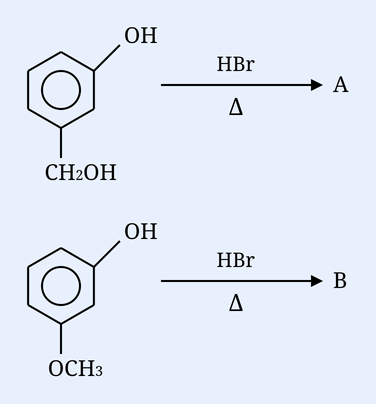
'A' and 'B' formed in the following set of reactions are:
(1)
(2)
(3)
(4)
SolutionAnswer: Option 1A = 3-(bromomethyl)phenol; B = benzene-1,3-diol (resorcinol)
Approach:
Apply the action of HBr on a benzylic alcohol and on an aryl methyl ether.
Step 1:In the first substrate, the benzylic hydroxyl is converted by HBr to a benzylic bromide, giving product A as the corresponding bromomethyl phenol.
Step 2:In the second substrate, HBr cleaves the aromatic methyl ether to give a phenol and methyl bromide while the benzylic alcohol is also converted, giving product B.
Step 3:The pair matching both transformations corresponds to option 1.
Final answer: A = 3-(bromomethyl)phenol; B = benzene-1,3-diol (resorcinol)
Q36Single correctCoordination Compounds
The primary and secondary valencies of cobalt respectively in are :
(1)
(2)
(3)
(4)
SolutionAnswer: Option 43 and 6
Approach:
Determine oxidation number and coordination number of cobalt in the complex.
Step 1:The complex carries two outer chloride counter-ions and one coordinated chloride, so cobalt has oxidation number three, equal to its primary valency.
Step 2:Cobalt is bonded to five ammonia ligands and one coordinated chloride, giving coordination number six, the secondary valency.
Step 3:The primary and secondary valencies are 3 and 6.
Final answer: 3 and 6
Q37Single correctAmines
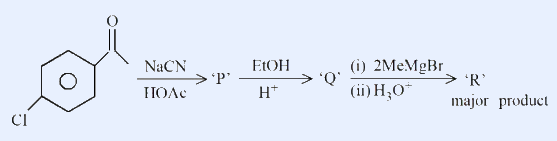
'R' formed in the following sequence of reactions is :
(1)
(2)
(3)
(4)
SolutionAnswer: Option 13-(4-chlorophenyl)-2-methylbutane-2,3-diol
Approach:
Track the functional-group changes through the cyanohydrin, Pinner and Grignard steps to identify product R.
Step 1:4-Chloroacetophenone adds HCN (from NaCN/HOAc) across the carbonyl to give the cyanohydrin P, a tertiary alcohol bearing a nitrile.
Step 2:Acidic ethanol converts the nitrile to an ester (Pinner), giving the alpha-hydroxy ester Q.
Step 3:Two equivalents of methylmagnesium bromide add to the ester carbonyl; aqueous work-up gives a second tertiary alcohol, producing the vicinal diol R. The para-chloro ring is retained throughout.
Final answer: 3-(4-chlorophenyl)-2-methylbutane-2,3-diol
Q38Single correctClassification of Elements and Periodicity
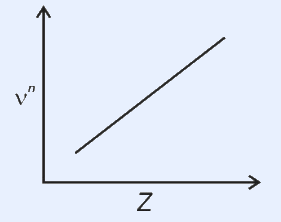
It is observed that characteristic X-ray spectra of elements show regularity. When frequency to the power 'n' i.e. of X-rays emitted is plotted against atomic number 'Z', the following graph is obtained.
The value of n is :
The value of n is :
(1)
(2)
(3)
(4)
SolutionAnswer: Option 4
Approach:
Use Moseley's law relating X-ray frequency to atomic number.
Step 1:Moseley's relation expresses the emitted X-ray frequency through a transition energy proportional to the square of the effective nuclear charge.
Step 2:Taking the square root linearises the relation against atomic number, matching the straight-line plot.
Step 3:The exponent giving a straight line through the origin is one half.
Final answer:
Q39Single correctThe d- and f-Block Elements
The magnetic moment of a transition metal compound has been calculated to be 3.87 B.M. The metal ion is :
(1)
(2)
(3)
(4)
SolutionAnswer: Option 4
Approach:
Match the spin-only magnetic moment to the number of unpaired electrons in each ion.
Step 1:A moment of 3.87 B.M. corresponds to three unpaired electrons.
Step 2:The ion with a 3d3 configuration carrying three unpaired electrons is the divalent vanadium ion.
Step 3:The metal ion is the divalent vanadium ion.
Final answer:
Q40Single correctEnvironmental Chemistry
Which of the following is true about freons?
(1)
(2)
(3)
(4)
SolutionAnswer: Option 4These are chlorofluorocarbon compounds
Approach:
Recall the chemical identity of freons.
Step 1:Freons are a class of chlorofluorocarbon compounds used historically as refrigerants and propellants.
Step 2:The other options describe effects or radicals rather than the compounds themselves.
Step 3:Freons are chlorofluorocarbon compounds.
Final answer: These are chlorofluorocarbon compounds
Q42Single correctHaloalkanes and Haloarenes
Assertion A: Hydrolysis of an alkyl chloride is a slow reaction but in the presence of NaI, the rate of the hydrolysis increases.
Reason R : I is a good nucleophile as well as a good leaving group.
In the light of the above statements, choose the correct answer from the options given below:
Reason R : I is a good nucleophile as well as a good leaving group.
In the light of the above statements, choose the correct answer from the options given below:
(1)
(2)
(3)
(4)
SolutionAnswer: Option 4Both and are true but is the correct explanation of
Approach:
Evaluate the truth of Assertion A and Reason R for the iodide-catalysed (Finkelstein-type) hydrolysis of an alkyl chloride, then decide whether R is the correct explanation of A.
Step 1:Added supplies , which substitutes the chloride to form an alkyl iodide faster than direct hydrolysis, so the overall rate of hydrolysis rises. Assertion A is true.
Step 2:Iodide is both a strong nucleophile and a good leaving group, so Reason R is a true statement on its own.
Step 3:The acceleration arises because first substitutes rapidly and is then displaced by water; R states two independent properties and does not by itself constitute the correct explanation of A. Both A and R are true but R is not the correct explanation of A.
Final answer: Both and are true but is the correct explanation of
Q43Single correctThe s-Block Elements
Choose the correct answer from the options given below:
| LIST I | LIST II |
|---|---|
| A.. Chlorophyll | I.. |
| B.. Soda ash | II.. |
| C.. Dentistry, Ornamental work | III.. |
| D.. Used in white washing | IV.. |
(1)
(2)
(3)
(4)
SolutionAnswer: Option 4A-III, B-I, C-II, D-IV
Approach:
Pair each species with its associated compound or ion.
Step 1:Chlorophyll contains the magnesium ion, matching A with III.
Step 2:Soda ash is sodium carbonate, matching B with I.
Step 3:Calcium sulfate is used in dentistry and ornamental work, matching C with II, while calcium hydroxide is used in white washing, matching D with IV.
Final answer: A-III, B-I, C-II, D-IV
Q44Single correctHaloalkanes and Haloarenes
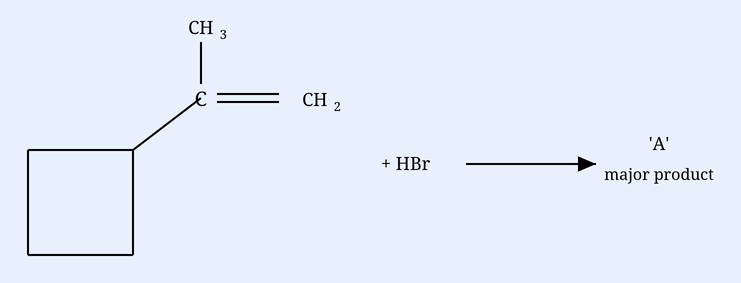
In the following given reaction, 'A' is:
(1)
(2)
(3)
(4)
SolutionAnswer: Option 41-bromo-1,2-dimethylcyclopentane
Approach:
Apply Markovnikov addition of HBr with carbocation rearrangement (ring expansion) to find the major product A.
Step 1:HBr protonates the alkene of the isopropenyl-cyclobutane to give a secondary carbocation adjacent to the strained four-membered ring.
Step 2:Relief of ring strain drives ring expansion of the cyclobutane to a cyclopentyl cation, followed by a 1,2-methyl shift to a more stable tertiary carbocation.
Step 3:Bromide attacks the tertiary carbocation, giving 1-bromo-1,2-dimethylcyclopentane as the major product.
Final answer: 1-bromo-1,2-dimethylcyclopentane
Q45Single correctGeneral Principles of Metallurgy
Choose the correct answer from the options given below:
| LIST I | LIST II |
|---|---|
| A.. Reverberatory furnace | I.. Pig Iron |
| B.. Electrolytic cell | II.. Aluminium |
| C.. Blast furnace | III.. Silicon |
| D.. Zone refining furnace | IV.. Copper |
(1)
(2)
(3)
(4)
SolutionAnswer: Option 3A-IV, B-II, C-I, D-III
Approach:
Associate each metallurgical apparatus with the metal it is used to obtain.
Step 1:The reverberatory furnace is used in the extraction of copper, matching A with IV.
Step 2:The electrolytic cell is used for highly reactive metals such as aluminium, matching B with II, and the blast furnace gives pig iron, matching C with I.
Step 3:Zone refining is used to purify silicon, matching D with III.
Final answer: A-IV, B-II, C-I, D-III
Q46Single correctOrganic Chemistry
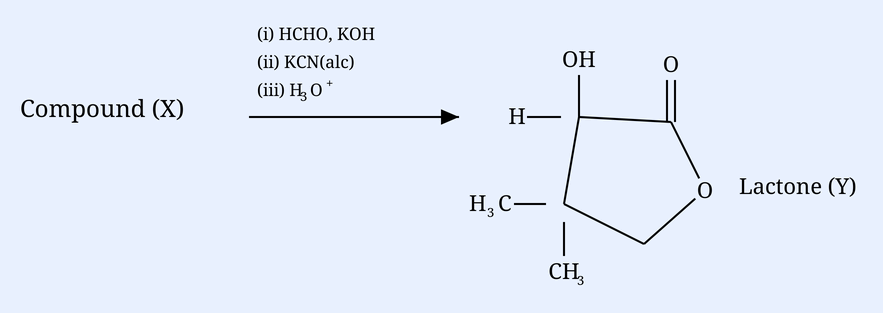
Compound (X) undergoes following sequence of reactions to give the Lactone (Y). Compound (X) is:
(1)
(2)
(3)
(4)
SolutionAnswer: Option 12-methylpropanal (isobutyraldehyde), (CH3)2CH-CHO
Approach:
Trace the reagent sequence backwards from the lactone to identify the starting carbonyl compound (X). HCHO with base introduces hydroxymethyl groups (Cannizzaro/aldol-type), alcoholic KCN adds a nitrile, and acidic hydrolysis converts nitrile to acid which cyclises with a hydroxyl to a lactone.
Step 1:An aldehyde bearing alpha-hydrogens reacts with formaldehyde under KOH to install hydroxymethyl groups at the alpha carbon.
Step 2:Alcoholic KCN adds across the remaining aldehyde to form a cyanohydrin.
Step 3:Acidic hydrolysis converts the nitrile to a carboxylic acid, which condenses intramolecularly with a neighbouring hydroxyl group to close the five-membered lactone ring.
Step 4:Reverse mapping of the carbon skeleton fixes compound (X) as the structure of option (1).
Final answer: 2-methylpropanal (isobutyraldehyde), (CH3)2CH-CHO
Q47Single correctInorganic Chemistry
Which of the phosphorus oxoacid can create silver mirror from solution?
(1)
(2)
(3)
(4)
SolutionAnswer: Option 1
Approach:
A reducing oxoacid that deposits a silver mirror must contain P-H bonds. Examine the structure of each oxoacid for P-H bonds.
Step 1:Pyrophosphorous acid contains two P-H bonds, making it a reducing acid capable of depositing metallic silver.
Step 2:Metaphosphoric acid, pyrophosphoric acid and hypophosphoric acid have all phosphorus valences satisfied by O/OH, with no P-H bonds available for reduction.
Step 3:The P-H containing acid reduces Ag+ to Ag, producing the silver mirror.
Final answer:
Q48Single correctPhysical Chemistry
Decreasing order of the hydrogen bonding in following forms of water is correctly represented by
A. Liquid water
B. Ice
C. Impure water
Choose the correct answer from the options given below:
A. Liquid water
B. Ice
C. Impure water
Choose the correct answer from the options given below:
(1)
(2)
(3)
(4)
SolutionAnswer: Option 2
Approach:
Compare the extent of hydrogen bonding across the three forms by considering the ordered tetrahedral network of ice versus liquid and impure water.
Step 1:In ice each water molecule is hydrogen bonded to four neighbours in a rigid, fully extended tetrahedral lattice, giving the maximum hydrogen bonding.
Step 2:On melting, the ordered network partially collapses, so liquid water has fewer hydrogen bonds than ice.
Step 3:Impurities disrupt the hydrogen bonded network further, lowering hydrogen bonding below that of pure liquid water.
Final answer:
Q49Single correctInorganic Chemistry
An ammonical metal salt solution gives a brilliant red precipitate on addition of dimethylglyoxime. The metal ion is
(1)
(2)
(3)
(4)
SolutionAnswer: Option 1
Approach:
Identify the metal ion that forms a characteristic coloured chelate with dimethylglyoxime in ammoniacal medium.
Step 1:Dimethylglyoxime is a bidentate chelating ligand used as a specific reagent in qualitative analysis.
Step 2:In ammoniacal solution it chelates nickel(II) to give a square planar bis-chelate, a rosy-red precipitate.
Step 3:This rosy-red colour confirms the presence of the nickel ion.
Final answer:
Q50Single correctPhysical / Inorganic Chemistry
Order of covalent bond :
A.
B.
C.
D.
E.
Choose the correct answer from the options given below:
A.
B.
C.
D.
E.
Choose the correct answer from the options given below:
(1)
(2)
(3)
(4)
SolutionAnswer: Option 3B, C, E only
Approach:
Apply Fajans' rules to judge covalent character: larger/more polarisable anions, smaller/highly charged cations and cations with pseudo-noble-gas configurations increase covalent character.
Step 1:Iodide is more polarisable than fluoride, so KI is more covalent than KF; hence statement B (KF < KI) is correct.
Step 2:Higher cationic charge raises covalency, so SnCl4 exceeds SnCl2; the 18-electron Cu+ polarises chloride more than Na+, so CuCl exceeds NaCl; statement C is correct.
Step 3:Statement E combines the two correct trends KF < KI and CuCl > NaCl, so it is correct as well.
Step 4:Statements A and D contain reversed CuCl/NaCl or KF/KI relations and are incorrect, leaving B, C and E.
Final answer: B, C, E only
Q51NumericalInorganic Chemistry
The d-electronic configuration of in tetrahedral crystal field is . Sum of 'm' and 'number of unpaired electrons' is ________.
SolutionAnswer: 7
Approach:
Determine the d-electron count of cobalt in the complex, distribute the electrons in the tetrahedral e and t2 sets, read off m and the number of unpaired electrons, then add.
Step 1:Chloride is a weak-field ligand and cobalt is in the +2 state, giving a d7 high-spin configuration.
Step 2:In a tetrahedral field the seven electrons fill the lower e set fully and the t2 set, giving e4 .
Step 3:The three singly occupied t2 orbitals give three unpaired electrons.
Step 4:Adding m and the number of unpaired electrons gives the required sum.
Final answer: 7
Q52NumericalPhysical Chemistry
The dissociation constant of acetic acid is . When 25 mL of 0.2 M solution is mixed with 25 mL of 0.02 M solution, the pH of the resultant solution is found to be equal to 5. The value of x is ________.
SolutionAnswer: 10
Approach:
Apply the Henderson-Hasselbalch equation to the acetate/acetic acid buffer, solve for pKa from the given pH, then convert pKa to Ka and read off x.
Step 1:Insert the salt and acid amounts into the Henderson-Hasselbalch equation.
Step 2:With pH equal to 5 and the log term equal to 1, the pKa follows.
Step 3:Convert pKa to Ka and express it in the form x times ten to the minus five.
Final answer: 10
Q53NumericalOrganic Chemistry
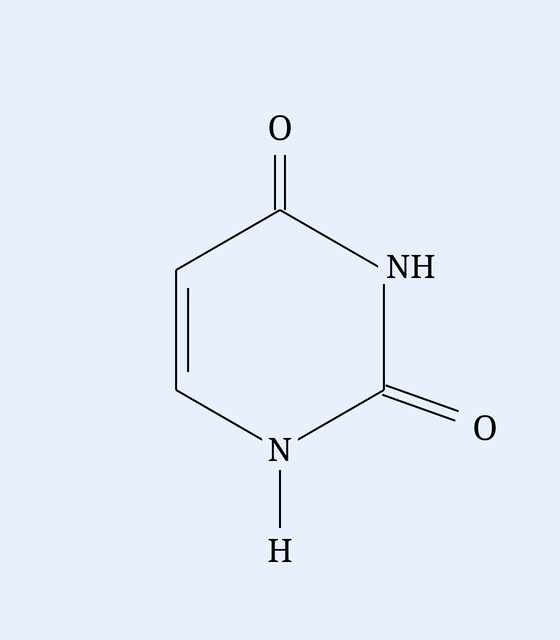
Uracil is a base present in RNA with the following structure. % of N in uracil is ________.
Given :
Molar mass
Given :
Molar mass
SolutionAnswer: 25
Approach:
Establish the molecular formula of uracil from its structure, compute its molar mass, then express the mass of nitrogen as a percentage of the total.
Step 1:Uracil has the molecular formula C4H4N2O2 from its pyrimidinedione ring.
Step 2:Its molar mass sums the contributions of the four elements.
Step 3:Two nitrogen atoms contribute a mass of 28, giving the nitrogen percentage.
Final answer: 25
Q54NumericalPhysical Chemistry
The number of correct statement/s from the following is ________.
A. Larger the activation energy, smaller is the value of the rate constant.
B. The higher is the activation energy, higher is the value of the temperature coefficient.
C. At lower temperatures, increase in temperature causes more change in the value of k than at higher temperature.
D. A plot of ln k vs is a straight line with slope equal to .
A. Larger the activation energy, smaller is the value of the rate constant.
B. The higher is the activation energy, higher is the value of the temperature coefficient.
C. At lower temperatures, increase in temperature causes more change in the value of k than at higher temperature.
D. A plot of ln k vs is a straight line with slope equal to .
SolutionAnswer: 3
Approach:
Test each statement against the Arrhenius equation and its temperature dependence.
Step 1:A larger activation energy makes the exponential factor smaller, lowering the rate constant, so statement A is correct.
Step 2:The temperature coefficient increases with activation energy, so statement B is correct.
Step 3:The fractional change in k for a given temperature rise is largest at low temperatures, so statement C is correct.
Step 4:The logarithmic Arrhenius plot is linear, but the slope is minus Ea/R only against 1/T; the printed solution counts D as incorrect, leaving three correct statements.
Final answer: 3
Q55NumericalPhysical Chemistry
At 298 K, a 1 litre solution containing 10 mmol of and 100 mmol of shows a pH of 3.0.
Given : ; V
and V.
The potential for the half cell reaction is V. The value of x is ________.
Given : ; V
and V.
The potential for the half cell reaction is V. The value of x is ________.
SolutionAnswer: 917
Approach:
Write the balanced dichromate reduction half reaction, apply the Nernst equation with the given concentrations and pH, and solve for the half cell potential.
Step 1:The dichromate to chromium(III) reduction transfers six electrons and consumes fourteen protons.
Step 2:Insert the concentrations 0.01 M dichromate, 0.1 M chromium(III) and proton concentration ten to the minus three from the pH into the reaction quotient.
Step 3:The logarithm of the quotient evaluates to 42.
Step 4:Subtracting the correction term gives the half cell potential, which equals 917 times ten to the minus three volts.
Final answer: 917
Q56NumericalPhysical Chemistry
5 g of NaOH was dissolved in deionized water to prepare a 450 mL stock solution. What volume (in mL) of this solution would be required to prepare 500 mL of 0.1 M solution?
Given : Molar Mass of Na, O and H is 23, 16 and 1 g mo respectively.
Given : Molar Mass of Na, O and H is 23, 16 and 1 g mo respectively.
SolutionAnswer: 180
Approach:
Find the molarity of the stock NaOH solution, then apply the dilution relation to obtain the volume required for the dilute solution.
Step 1:The molar mass of NaOH is 40, so the stock molarity from 5 g in 450 mL follows.
Step 2:Apply the dilution relation between the stock and the target 500 mL of 0.1 M solution.
Step 3:Solving for the stock volume gives the required quantity.
Final answer: 180
Q57NumericalPhysical Chemistry
For independent processes at 300 K
Process | |
A | |
B | |
C | |
D | |
The number of non-spontaneous processes from the following is ________.
Process | |
A | |
B | |
C | |
D | |
The number of non-spontaneous processes from the following is ________.
SolutionAnswer: 2
Approach:
Compute the Gibbs energy change for each process at 300 K and count those with a positive value, which are non-spontaneous.
Step 1:Process C has positive enthalpy and negative entropy, so its Gibbs energy is positive at all temperatures, making it non-spontaneous.
Step 2:For process D the Gibbs energy is evaluated at 300 K using the tabulated values.
Step 3:Processes A and B have negative Gibbs energy at 300 K and are spontaneous, leaving two non-spontaneous processes.
Final answer: 2
Q58NumericalPhysical Chemistry
When is heated in presence of oxygen, it converts to . The number of correct statement/s from the following is ________
A. The equivalent weight of is
B. The number of moles of and in 1 mole of is 0.79 and 0.14 respectively.
C. is metal deficient with lattice comprising of cubic closed packed arrangement of ions.
D. The % composition of and in is 85% and 15% respectively.
A. The equivalent weight of is
B. The number of moles of and in 1 mole of is 0.79 and 0.14 respectively.
C. is metal deficient with lattice comprising of cubic closed packed arrangement of ions.
D. The % composition of and in is 85% and 15% respectively.
SolutionAnswer: 4
Approach:
Balance the iron charges in Fe0.93O to find the moles of Fe(II) and Fe(III), then evaluate each statement on equivalent weight, mole ratio, lattice type and percentage composition.
Step 1:Charge neutrality with total iron 0.93 and oxide charge 2 fixes the Fe(II) and Fe(III) contents.
Step 2:Oxidation to Fe2O3 changes the n-factor by 0.79 per formula unit, validating the equivalent weight expression in statement A and the mole ratio in statement B.
Step 3:The percentages of Fe(II) and Fe(III) follow from their mole fractions, giving 85% and 15%, validating statement D; statement C correctly describes the metal-deficient ccp oxide lattice.
Step 4:All four statements are correct.
Final answer: 4
Q59NumericalPhysical Chemistry
If wavelength of the first line of the Paschen series of hydrogen atom is 720 nm, then the wavelength of the second line of this series is ________ nm. (Nearest integer)
SolutionAnswer: 492
Approach:
Use the Rydberg formula for the Paschen series (lower level n = 3) to find the Rydberg constant from the first line, then apply it to the second line.
Step 1:The first line of the Paschen series is the transition from n = 4 to n = 3.
Step 2:Solve for R using the difference of the inverse squares.
Step 3:The second line is the transition from n = 5 to n = 3, so substitute R into the formula.
Step 4:Evaluating gives the wavelength, which rounds to 492 nm.
Final answer: 492
Q60NumericalOrganic Chemistry
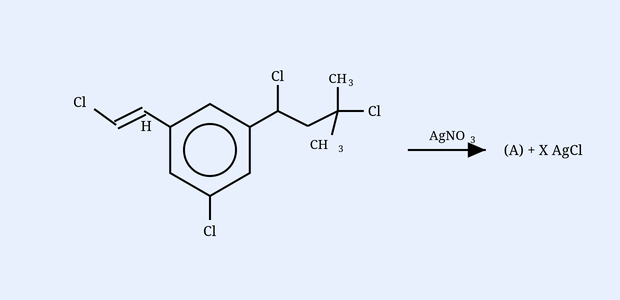
Number of moles of AgCl formed in the following reaction is ________
SolutionAnswer: 2
Approach:
Identify which carbon-chlorine bonds in the molecule are reactive enough to ionise and precipitate AgCl with AgNO3, counting only the labile chlorines.
Step 1:Vinyl and aryl chlorides hold the chlorine in strong, unreactive bonds, so those chlorines do not ionise with AgNO3.
Step 2:The allylic and tertiary alkyl chlorines ionise readily, releasing chloride ions that precipitate silver chloride.
Step 3:Two such labile chlorines react, giving two moles of AgCl.
Final answer: 2
Mathematics29 questions
Q61Single correctMatrices and Determinants
Let N denote the number that turns up when a fair die is rolled. If the probability that the system of equations
has unique solution is , then the sum of value of k and all possible values of N is
has unique solution is , then the sum of value of k and all possible values of N is
(1)
(2)
(3)
(4)
SolutionAnswer: Option 2
Approach:
A linear system has a unique solution when the coefficient determinant is non-zero. Determine the excluded values of N, find the probability over the die outcomes, then combine with the constant k.
Step 1:Form the coefficient determinant of the system.
Step 2:Expand the determinant along the first row.
Step 3:Require the determinant to be non-zero for a unique solution.
Step 4:Compute the probability over the six equally likely die faces, excluding 2 and 3.
Step 5:Add k to all admissible values of N (the faces 1, 4, 5, 6).
Final answer:
Q62Single correctVector Algebra
Let and . Then is equal to
(1)
(2)
(3)
(4)
SolutionAnswer: Option 2
Approach:
Take the dot product of the given relation with v to eliminate the cross product term, then use the relation to evaluate the dot product of u with w.
Step 1:Start from the given vector relation.
Step 2:Take the dot product of relation (i) with v; the left side vanishes since v is perpendicular to its own cross product.
Step 3:Take the dot product of relation (i) with u; the term u·u and u·v combine to yield u·(v×w).
Step 4:Use the cyclic property of the scalar triple product together with the given value v·w=2 to isolate u·w.
Final answer:
Q63Single correctThree Dimensional Geometry
The distance of the point from the plane measured parallel to the line is
(1)
(2)
(3)
(4)
SolutionAnswer: Option 3
Approach:
Write the line through the given point parallel to the stated direction, find where it meets the plane, then compute the distance between the point and that intersection.
Step 1:The measuring direction has direction ratios from the given line.
Step 2:Write the line AP through P(-1,9,-16) along this direction.
Step 3:Substitute the coordinates of A into the plane equation and solve for the parameter.
Step 4:Compute the distance AP.
Final answer:
Q64Single correctDifferential Equations
Let be the solution of the differential equation . Then is equal to
(1)
(2)
(3)
(4)
SolutionAnswer: Option 4
Approach:
Rearrange the equation into linear form, find the integrating factor, integrate, apply the initial condition to fix the constant, then evaluate at x=1.
Step 1:Rearrange the equation into linear form.
Step 2:Compute the integrating factor.
Step 3:Multiply through and integrate, using the substitution -1/x = t so dx/ = dt.
Step 4:Apply the initial condition y(1/2)=3-e to determine the constant.
Step 5:Evaluate the solution at x=1.
Final answer:
Q65Single correctMatrices and Determinants
If A and B are two non-zero matrics such that , then
(1)
(2)
(3)
(4)
SolutionAnswer: Option 1
Approach:
Rewrite the relation by subtracting the identity to factor it, identify mutually inverse matrices, then multiply in the reverse order to obtain the commuting relation.
Step 1:Start from the given matrix relation.
Step 2:Subtract the identity from both sides and factor.
Step 3:Since the two factors multiply to the identity, they are inverses, so the product in reverse order is also the identity.
Step 4:Simplify the reversed product to obtain a second relation and combine with (i).
Final answer:
Q66Single correctCoordinate Geometry
Let PQR be a triangle. The points A, B and C are on the sides QR, RP and PQ respectively such that . Then is equal to
(1)
(2)
(3)
(4)
SolutionAnswer: Option 3
Approach:
Subtract from the whole triangle the three corner triangles cut off by A, B, C; each corner triangle area is a product of side fractions times the total area.
Step 1:Each ratio 1:2 splits a side so that one segment is one-third and the other two-thirds of that side.
Step 2:Each of the three corner triangles has area equal to (1/3)(2/3) of the whole.
Step 3:Subtract the three corner triangles from the whole to obtain the inner triangle.
Step 4:Invert to obtain the requested ratio.
Final answer:
Q67Single correctSequences and Series
For three positive integers and such that are in A.P with common difference . Then is equal to
(1)
(2)
(3)
(4)
SolutionAnswer: Option 2
Approach:
Use the A.P. terms with common difference 1/2 to fix the logarithmic ratios, convert the equal-power relation into ratios among the logarithms, solve for p, q, r, then evaluate the required combination.
Step 1:Write the four A.P. terms using first term 3 and common difference 1/2.
Step 2:Translate the equal-power relation into proportional exponents, giving relations among p, q, r.
Step 3:Reduce the two relations.
Step 4:Use r=pq+1 with 7pq=6r to find r.
Step 5:Combine pq=6 with 4q= to solve for p and q.
Step 6:Evaluate the requested combination.
Final answer:
Q68Single correctSets, Relations and Functions
The relation
is
is
(1)
(2)
(3)
(4)
SolutionAnswer: Option 3Symmetric but not transitive
Approach:
Test the relation for reflexivity, symmetry and transitivity using the defining condition that the gcd of the pair equals 1.
Step 1:Test reflexivity: the gcd of an element with itself equals that element, not 1 in general.
Step 2:Test symmetry: the gcd is unchanged when the arguments are swapped.
Step 3:Test transitivity: gcd(a,b)=1 and gcd(b,c)=1 need not give gcd(a,c)=1.
Step 4:Combine the three properties to classify the relation.
Final answer: Symmetric but not transitive
Q69Single correctIntegral Calculus
The area enclosed by the curves and is
(1)
(2)
(3)
(4)
SolutionAnswer: Option 4
Approach:
Express both curves as x in terms of y, find the y-limits from their intersection, then integrate the horizontal width between the parabola and the line.
Step 1:Solve each equation for x.
Step 2:Find the intersection points by equating the two x-values.
Step 3:Set up the area integral of the horizontal difference between the limits.
Step 4:Integrate and evaluate at the limits.
Final answer:
Q70Single correctLimits, Continuity and Differentiability
is equal to
(1)
(2)
(3)
(4)
SolutionAnswer: Option 4
Approach:
Recognise the bracket as a sum of powers raised to the reciprocal exponent; as the exponent grows without bound the largest base dominates, yielding a standard power-mean limit equal to the largest term.
Step 1:As t approaches 0, t approaches 0, so the reciprocal exponent 1/ t tends to infinity; write m=1/ t.
Step 2:Factor the largest base out of the sum.
Step 3:Take the limit; every interior bracket term tends to 0 except the unit term.
Step 4:State the value of the limit.
Final answer:
Q71Single correctBinomial Theorem
The value of is
(1)
(2)
(3)
(4)
SolutionAnswer: Option 4
Approach:
Apply the Vandermonde identity by writing one binomial coefficient with the complementary index and matching the powers in a product of two binomial expansions.
Step 1:Rewrite the second factor with the complementary index.
Step 2:Interpret the sum as the coefficient of in the product .
Step 3:Extract that coefficient.
Final answer:
Q72Single correctConic Sections
Let a tangent to the curve meet the curve at the points A and B. Then the mid points of such line segments AB lie on a parabola with the
(1) Directrix
(2) Length of latus rectum
(3) Length of latus rectum 2
(4) Directrix
(1) Directrix
(2) Length of latus rectum
(3) Length of latus rectum 2
(4) Directrix
(1)
(2)
(3)
(4)
SolutionAnswer: Option 1Directrix
Approach:
Write the tangent to in slope form, intersect it with , form the quadratic in x, and express the midpoint coordinates to obtain the locus.
Step 1:With , so , the tangent in slope form is taken.
Step 2:Substitute from into the tangent to obtain a quadratic in x.
Step 3:Use the sum of roots to get the midpoint abscissa and ordinate.
Step 4:Eliminate m using to obtain the locus parabola and its directrix.
Final answer: Directrix
Q73Single correctQuadratic Equations
The equation , where [x] denotes the greatest integer function, has
(1)
(2)
(3)
(4)
SolutionAnswer: Option 4A unique solution in
Approach:
Rearrange the equation, factor by grouping in terms of and , and analyse the two resulting cases against the definition of the greatest integer function.
Step 1:Move all terms to one side and group.
Step 2:Factor out of both sides.
Step 3:Examine , which forces with non-integer, contradicting .
is impossible since
Step 4:The only surviving root is , valid over the whole real line.
Final answer: A unique solution in
Q74Single correctThree Dimensional Geometry
The distance of a point from the plane passing through the points and is
(1)
(2)
(3)
(4)
SolutionAnswer: Option 3
Approach:
Form two vectors in the plane from the three given points, take their cross product for the normal, write the plane equation, then apply the point-to-plane distance formula.
Step 1:With , , , form the in-plane vectors.
Step 2:Compute the normal as the cross product.
Step 3:Write the plane through with this normal.
Step 4:Apply the distance formula at .
Final answer:
Q75Single correctMathematical Reasoning
The compound statement is equivalent to
(1)
(2)
(3)
(4)
SolutionAnswer: Option 4
Approach:
Construct the truth table of the given compound implication over all four assignments of and , then identify the listed expression sharing the identical column.
Step 1:Evaluate the antecedent for each row; it is true except when P is true and Q is true.
is false only for
Step 2:Evaluate the consequent , true only when both are false.
is true only for
Step 3:Form ; it is true exactly when A is false or C is true, giving true for and (F,F), false otherwise.
true for (T,T),(F,F)
Step 4:Compare with the listed options; is true exactly for (T,T) and (F,F), matching the implication.
Final answer:
Q76Single correctProbability
Let be the sample space and be an event.
Given below are two statements :
(S1) : If , then
(S2) : If , then
Then
Given below are two statements :
(S1) : If , then
(S2) : If , then
Then
(1)
(2)
(3)
(4)
SolutionAnswer: Option 1Both (S1) and (S2) are false
Approach:
Test each statement against the distinction between a probability-zero (or probability-one) event and the empty (or whole) set, using a counterexample.
Step 1:An event of probability zero need not be empty; in a continuous sample space a single outcome has probability zero yet is non-empty.
while
Step 2:Symmetrically, an event of probability one need not be the whole space; the complement of a probability-zero non-empty set has probability one but is a proper subset.
while
Step 3:Both statements admit counterexamples, so neither holds in general.
(S1) false and (S2) false
Final answer: Both (S1) and (S2) are false
Q77Single correctDeterminants
Let a be a root of the equation where a,b,c are distinct real numbers such that the matrix is singular. Then, the value of is
(1)
(2)
(3)
(4)
SolutionAnswer: Option 4
Approach:
Use the singularity condition to establish a relation among the coefficients, then evaluate the symmetric expression using the algebraic identity for the sum of cubes when the three terms sum to zero.
Step 1:The singular matrix and the quadratic together make a root, and the coefficients sum to zero.
Step 2:Rewrite the target expression over the common denominator .
Step 3:Apply the identity with .
Final answer:
Q79Single correctInverse Trigonometric Functions
is equal to:
(1)
(2)
(3)
(4)
SolutionAnswer: Option 1
Approach:
Simplify each inverse-trigonometric term by factoring its argument, then add the two standard angles.
Step 1:Factor the arctangent argument.
Step 2:Simplify the arcsecant argument.
Step 3:Add the two angles.
Final answer:
Q80Single correctComplex Numbers
Let and , , then and are roots of the equation.
(1)
(2)
(3)
(4)
SolutionAnswer: Option 1
Approach:
Express the base in polar form, raise to the 200th power using De Moivre's theorem, read off and , then build the quadratic from the two given root expressions via sum and product.
Step 1:Write the base in polar form and raise to the power 200.
Step 2:Match with to identify the real and imaginary parts.
Step 3:Evaluate the two root expressions.
Step 4:Form the quadratic from the sum and product of the roots.
Final answer:
Q81NumericalBinomial Theorem and its Simple Applications
Suppose . Then the value of is ________
SolutionAnswer: 1012
Approach:
Expand the squared index using the binomial coefficient identities for and , then collect the closed-form sum.
Step 1:Write and split the sum with .
Step 2:Apply the identities: the first part equals and the second equals .
Step 3:Substitute so the total is .
Step 4:Comparison gives .
Final answer: 1012
Q82NumericalCo-ordinate Geometry
Let C be the largest circle centred at and inscribed in the ellipse . If lies on C, then is equal to ________
SolutionAnswer: 118
Approach:
Express the squared distance from the centre to a point on the ellipse, minimise it to find the inscribed-circle radius, then substitute the given point.
Step 1:The squared distance from to a point (x,y) on the ellipse is with .
Step 2:Minimise the radius by differentiating and setting to zero: gives .
Step 3:The minimum squared radius is .
Step 4:The point lies on the circle, so , giving and .
Final answer: 118
Q83NumericalPermutations and Combinations
The number of 9 digit numbers, that can be formed using all the digits of the number 123412341 so that the even digits occupy only even places, is ________
SolutionAnswer: 60
Approach:
Separate the multiset of digits into even and odd, count the arrangements of the even digits in the even places and the odd digits in the odd places, then multiply.
Step 1:The digits of 123412341 are 1,2,3,4,1,2,3,4,1: odd digits are three 1s and two 3s, even digits are two 2s and two 4s.
Step 2:The four even digits fill the four even places in ways.
Step 3:The five odd digits fill the five odd places in ways.
Step 4:Multiply the independent counts.
Final answer: 60
Q84NumericalCo-ordinate Geometry
Let a tangent to the curve intersect the coordinate axes at the points A and B. Then, the minimum length of the line segment AB is ________
SolutionAnswer: 7
Approach:
Write the ellipse in standard form, parametrise the tangent, find the intercepts, then minimise the intercept length.
Step 1:Divide by 144 to get , so .
Step 2:The tangent at parameter meets the axes at and .
Step 3:The squared length is , minimised over .
Step 4:The minimum value is , so .
Final answer: 7
Q85NumericalPermutations and Combinations
A boy needs to select five free courses from 12 available courses, out of which 5 courses are language courses. If he can choose at most two language courses, then the number of ways he can choose five courses is ________
SolutionAnswer: 546
Approach:
Split into cases by the number of language courses chosen (zero, one, or two), count each with combinations, then add.
Step 1:There are 5 language and 7 non-language courses. Case of no language course: choose 5 from 7.
Step 2:Case of one language course: choose 1 of 5 language and 4 of 7 others.
Step 3:Case of two language courses: choose 2 of 5 language and 3 of 7 others.
Step 4:Add the three cases.
Final answer: 546
Q86NumericalIntegral Calculus
The value of is ________
SolutionAnswer: 22
Approach:
Factor the quadratic to locate sign changes on the interval, split the integral over subintervals with the correct sign, evaluate, then multiply by 12.
Step 1:Factor , which is non-negative on and and non-positive on .
Step 2:Write the integral as three signed parts.
Step 3:Evaluating using over each subinterval gives total .
Step 4:Multiply by 12.
Final answer: 22
Q87NumericalSequence and Series
The term of GP is 500 and its common ratio is . Let denote the sum of the first n terms of this GP. If and , then the number of possible values of m is ________
SolutionAnswer: 12
Approach:
Express the relevant terms through the fourth term and ratio, convert the two inequalities into bounds on m, then count the natural-number values.
Step 1:From with , the first term is .
Step 2:The inequality means the sixth term exceeds 1: , giving , so .
Step 3:The inequality means the seventh term is below : , giving , so .
Step 4:Combining both conditions, , which contains 12 values.
Final answer: 12
Q88NumericalThree Dimensional Geometry
The shortest distance between the lines and is equal to ________
SolutionAnswer: 14
Approach:
Read off the direction vectors and points of the two lines, form the cross product of directions, and apply the shortest-distance formula.
Step 1:The lines pass through and with directions and .
Step 2:Compute the cross product of the directions.
Step 3:The connecting vector is ; its scalar triple product with the directions is .
Step 4:Divide the absolute scalar triple product by the magnitude of the cross product.
Final answer: 14
Q89NumericalComplex Numbers and Quadratic Equations
Let and let the equation E be . Then the largest element in the set is ________
SolutionAnswer: 5
Approach:
Treat the equation as a quadratic in the modulus of x, require a non-negative discriminant to bound lambda, then find the integer solutions and maximise the combination.
Step 1:A real modulus requires non-negative discriminant: , so , giving .
Step 2:The modulus solves to , so the largest integer value of is 2 when (where the square root equals 1).
Step 3:At the integer solution with greatest value is .
Step 4:The largest element of S is .
Final answer: 5
Q90NumericalIntegral Calculus
The value of is ________
SolutionAnswer: 2
Approach:
Apply the king-property substitution to obtain a companion integral, add the two to collapse the integrand, then solve for the integral.
Step 1:Let .
Step 2:Replacing x by swaps sine and cosine, giving the companion integral.
Step 3:Adding (i) and (ii) makes the integrand 1: .
Step 4:Therefore .
Final answer: 2
More JEE Main 2023 papers
Frequently Asked Questions
How many questions are in the JEE Main 2023 January 24, Shift 1 paper?
The JEE Main 2023 January 24, Shift 1 paper has 88 questions — Physics (30), Chemistry (29) and Mathematics (29). Every question is on this page with its correct answer and a step-by-step solution.
What is the marking scheme for JEE Main?
JEE Main awards +4 marks for each correct answer and −1 for a wrong answer, with 0 for questions left unattempted. The paper covers Physics, Chemistry and Mathematics.
Are the answer key and step-by-step solutions provided for the 2023 January 24, Shift 1 paper?
Yes — every question shows the correct answer (answer key) and a detailed step-by-step solution, free to read online.
Can I take the JEE Main 2023 January 24, Shift 1 paper as a timed mock test?
Yes. With a free JEEnify account you can attempt this exact paper as a timed test in the real exam interface, then see your score and weak-area analysis.
Solved this paper? Calculate your JEE Main scoremost important chaptersformula sheetsall free tools.