
Back to JEE Main PYQs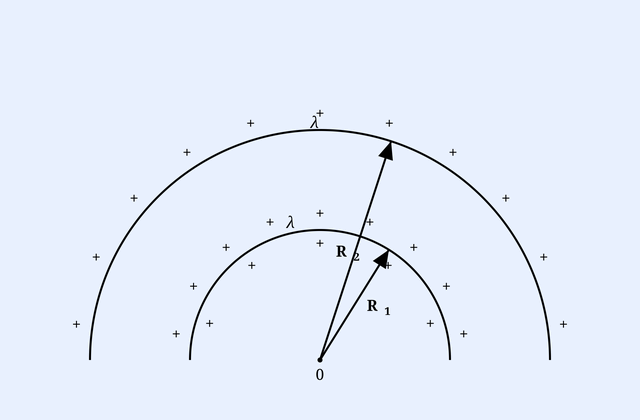
JEE Main 2023 January 24, Shift 2 Question Paper with Solutions
All 88 questions from the JEE Main 2023 (January 24, Shift 2) shift — Physics (29), Chemistry (29) and Mathematics (30) — each with the correct answer (answer key) and a step-by-step solution. Read it free online, or attempt the full paper as a timed mock test.
Physics29 questions
Q1Single correctElectrostatics
The electric potential at the centre of two concentric half rings of radii and , having same linear charge density is :
(1)
(2)
(3)
(4)
SolutionAnswer: Option 2
Approach:
The potential at the centre of a uniformly charged semicircular (half) ring of radius R and linear charge density lambda is independent of R, equal to lambda over four epsilon-naught. Summing the contributions of both half rings gives the net potential.
Step 1:The charge on a half ring of radius R is lambda times pi R, and every element lies at distance R from the centre, so the potential of one half ring is the total charge divided by four pi epsilon-naught R.
Step 2:By the same reasoning the second half ring contributes the same potential, independent of its radius.
Step 3:Potential is a scalar, so the net potential at the centre is the sum of the two contributions.
Final answer:
Q2Single correctOscillations and Waves
A body of mass 200 g is tied to a spring of spring constant 12.5 N/m, while the other end of spring is fixed at point O. If the body moves about O in a circular path on a smooth horizontal surface with constant angular speed 5 rad/s. Then the ratio of extension in the spring to its natural length will be:
(1)
(2)
(3)
(4)
SolutionAnswer: Option 3
Approach:
The spring force provides the centripetal force for circular motion of radius equal to the stretched length (natural length plus extension). Equating the spring force to the required centripetal force yields the extension-to-length ratio.
Step 1:With natural length ell and extension x, the rotating radius is ell plus x. The spring tension k x supplies the centripetal force m omega squared times that radius.
Step 2:Substituting k equal to 12.5 N/m, m equal to 0.2 kg and omega equal to 5 rad/s gives the working relation.
Step 3:Rearranging isolates ell in terms of x.
Final answer:
Q3Single correctElectromagnetic Waves
The electric field and magnetic field components of an electromagnetic wave going through vacuum is described by
Then the correct relation between and is given by
Then the correct relation between and is given by
(1)
(2)
(3)
(4)
SolutionAnswer: Option 3
Approach:
In an electromagnetic wave the ratio of the electric to magnetic field amplitudes equals the wave speed, which in turn equals omega divided by k. Equating these two expressions for the speed gives the required relation.
Step 1:For a plane electromagnetic wave the amplitudes of the field components are related by their ratio equalling the wave speed.
Step 2:The wave speed in terms of the angular frequency and wave number is omega over k.
Step 3:Cross-multiplying the two expressions yields the relation between the amplitudes.
Final answer:
Q4Single correctThermodynamics
In an isothermal change, the change in pressure and volume of a gas can be represented for three different temperature; as :
(1)
(2)
(3)
(4)
SolutionAnswer: Option 4P-V hyperbolic isotherms with T1 innermost (P3 > P2 > P1)
Approach:
Each isotherm on a pressure-volume diagram is a rectangular hyperbola, and a higher temperature isotherm lies farther from the origin. Reading off the pressures at a fixed volume orders the curves by temperature.
Step 1:For an ideal gas at fixed temperature the product of pressure and volume is constant, so each isotherm is a hyperbola in the pressure-volume plane.
Step 2:At a common volume the pressure is proportional to temperature, so the curve with the greatest pressure corresponds to the highest temperature.
Step 3:The diagram in which the highest curve corresponds to T3 and the curves are non-intersecting hyperbolas is option (4).
Final answer: P-V hyperbolic isotherms with T1 innermost (P3 > P2 > P1)
Q5Single correctGravitation
Given below are two statements:
Statement I: Acceleration due to earth's gravity decreases as you go 'up' or 'down' from earth's surface.
Statement II: Acceleration due to earth's gravity is same at a height 'h' and depth 'd' from earth's surface, if h = d.
In the light of above statements, choose the most appropriate answer from the options given below.
Statement I: Acceleration due to earth's gravity decreases as you go 'up' or 'down' from earth's surface.
Statement II: Acceleration due to earth's gravity is same at a height 'h' and depth 'd' from earth's surface, if h = d.
In the light of above statements, choose the most appropriate answer from the options given below.
(1)
(2)
(3)
(4)
SolutionAnswer: Option 2Statement I is correct but statement II is incorrect
Approach:
Compare the standard expressions for gravity at height and at depth. Gravity decreases on moving either up or down, but the rates of decrease differ, so equal h and d do not give equal g.
Step 1:Above the surface gravity falls off approximately as one minus twice the height over the radius; below the surface it falls off as one minus the depth over the radius. Both decrease relative to the surface value, so Statement I is correct.
Step 2:Setting h equal to d, the height expression decreases twice as fast as the depth expression, so the two values are not equal.
Step 3:Therefore Statement I is correct while Statement II is incorrect, which is option (2).
Final answer: Statement I is correct but statement II is incorrect
Q6Single correctCommunication Systems
Choose the correct answer from the options given below:
| List I | List II |
|---|---|
| A.. AM Broadcast | I.. 88-108 MHz |
| B.. FM Broadcast | II.. 540-1600 kHz |
| C.. Television | III.. 3.7-4.2 GHz |
| D.. Satellite Communication | IV.. 54 MHz-890 MHz |
(1)
(2)
(3)
(4)
SolutionAnswer: Option 4A-II, B-I, C-IV, D-III
Approach:
Recall the standard frequency band assigned to each broadcast and communication service and match it to the corresponding range in List II.
Step 1:AM broadcast occupies the kilohertz band, namely 540-1600 kHz, giving A matched with II.
Step 2:FM broadcast occupies 88-108 MHz, giving B matched with I.
Step 3:Television uses the 54 MHz-890 MHz range, giving C matched with IV; satellite communication uses the gigahertz band 3.7-4.2 GHz, giving D matched with III.
Final answer: A-II, B-I, C-IV, D-III
Q8Single correctAtoms and Nuclei
A photon is emitted in transition from to level in hydrogen atom. The corresponding wavelength for this transition is (given, eVs) :
(1)
(2)
(3)
(4)
SolutionAnswer: Option 3
Approach:
The photon energy for a hydrogen transition follows from the Rydberg energy formula. Equating this energy to h c over lambda and solving gives the emitted wavelength.
Step 1:The energy released equals 13.6 eV times the difference of the inverse-square level numbers for n equal to 1 and n equal to 4.
Step 2:Substituting h equal to 4 times ten to the minus fifteen eVs and c equal to 3 times ten to the eighth metres per second isolates the wavelength.
Step 3:Evaluating the expression yields the wavelength of the emitted photon.
Final answer:
Q9Single correctKinematics
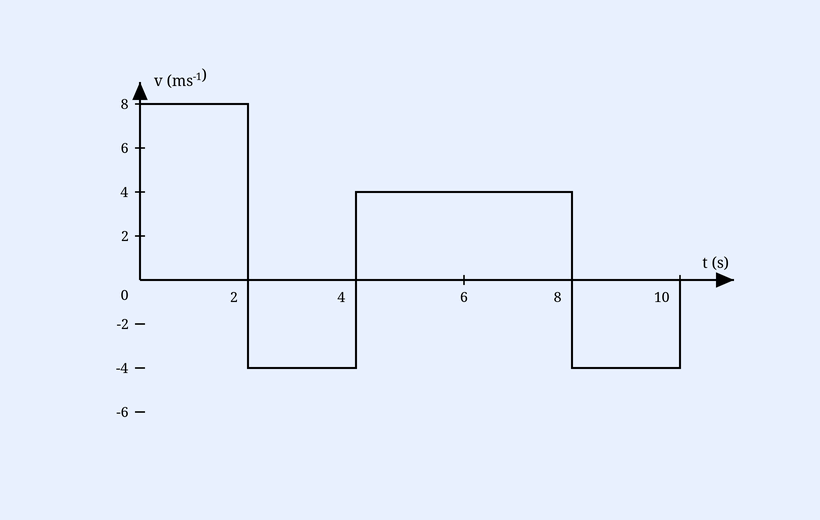
The velocity-time graph of a body moving in a straight line is shown in figure.
The ratio of displacement to distance travelled by the body in time 0 to 10 s is :
The ratio of displacement to distance travelled by the body in time 0 to 10 s is :
(1)
(2)
(3)
(4)
SolutionAnswer: Option 3
Approach:
Displacement is the signed area under the velocity-time graph, while distance is the total unsigned area. Computing both from the graph gives their ratio.
Step 1:Displacement is the algebraic sum of the areas above and below the time axis, accounting for sign.
Step 2:Distance is the arithmetic sum of the magnitudes of all areas, ignoring sign.
Step 3:Taking the ratio of displacement to distance gives the required result.
Final answer:
Q10Single correctKinetic Theory of Gases
Let be the ratio of molar specific heat at constant pressure and molar specific heat at constant volume of a monoatomic gas and be the similar ratio of diatomic gas. Considering the diatomic gas molecule as a rigid rotator, the ratio, is :
(1)
(2)
(3)
(4)
SolutionAnswer: Option 3
Approach:
The adiabatic index equals one plus two over the degrees of freedom. Evaluating it for a monoatomic gas and a rigid diatomic gas and taking the ratio gives the answer.
Step 1:A monoatomic gas has three degrees of freedom, giving an adiabatic index of five-thirds.
Step 2:A rigid diatomic gas has five degrees of freedom, giving an adiabatic index of seven-fifths.
Step 3:Dividing the two indices gives the required ratio.
Final answer:
Q11Single correctMagnetic Effects of Current
A long solenoid is formed by winding 70 turns c. If 2.0 A current flows, then the magnetic field produced inside the solenoid is
(1)
(2)
(3)
(4)
SolutionAnswer: Option 4
Approach:
The magnetic field inside a long solenoid is the product of the permeability of free space, the number of turns per unit length, and the current. Converting the turn density to per metre and substituting gives the field.
Step 1:Seventy turns per centimetre corresponds to 7000 turns per metre, and the current is 2 A.
Step 2:Substituting into the solenoid field formula gives the field in terms of pi.
Step 3:Evaluating with pi as twenty-two over seven gives the numerical field.
Final answer:
Q12Single correctProperties of Solids and Liquids
Given below are two statements: one is labelled as Assertion A and the other is labelled as Reason R
Assertion A : Steel is used in the construction of buildings and bridges.
Reason R : Steel is more elastic and its elastic limit is high.
In the light of above statements, choose the most appropriate answer from the options given below.
Assertion A : Steel is used in the construction of buildings and bridges.
Reason R : Steel is more elastic and its elastic limit is high.
In the light of above statements, choose the most appropriate answer from the options given below.
(1)
(2)
(3)
(4)
SolutionAnswer: Option 1Both A and R are correct and R is the correct explanation of A
Approach:
Assess the truth of the assertion and the reason independently, then determine whether the reason correctly explains the assertion.
Step 1:Steel is indeed used widely in construction of buildings and bridges, so the assertion is correct.
Step 2:Steel is more elastic than most materials and has a high elastic limit, so the reason is correct.
Step 3:Its high elasticity and elastic limit are precisely why steel is chosen for construction, so the reason explains the assertion.
Final answer: Both A and R are correct and R is the correct explanation of A
Q13Single correctGravitation
If the distance of the earth from Sun is km. Then the distance of an imaginary planet from Sun, if its period of revolution is 2.83 years is:
(1)
(2)
(3)
(4)
SolutionAnswer: Option 3
Approach:
Kepler's third law relates orbital period to the orbital radius through the three-halves power. Taking the ratio for the planet and the earth and substituting the known period and earth distance gives the planet's distance.
Step 1:The orbital period scales as the three-halves power of the orbital radius, so the ratio of periods equals the ratio of radii raised to three halves.
Step 2:Substituting the earth's period of one year and the planet's period of 2.83 years and taking the two-thirds power isolates the radius ratio.
Step 3:Solving for the planet's orbital radius gives the result.
Final answer:
Q14Single correctUnits and Measurements
The frequency of an oscillating liquid drop may depend upon radius (r) of the drop, density of liquid and the surface tension (s) of the liquid as : . The values of a, b and c respectively are
(1)
(2)
(3)
(4)
SolutionAnswer: Option 3
Approach:
Express the dimensions of frequency, radius, density and surface tension, then equate the powers of mass, length and time on both sides of the proposed relation to solve for the exponents.
Step 1:The dimensions are frequency as inverse time, radius as length, density as mass per length cubed and surface tension as mass per time squared.
Step 2:Equating the powers of mass gives b plus c equal to zero, and the time powers give minus two c equal to minus one.
Step 3:Equating the powers of length gives a minus three b equal to zero, fixing a.
Final answer:
Q15Single correctCurrent Electricity
A cell of emf 90 V is connected across series combination of two resistors each of 100 resistance. A voltmeter of resistance 400 is used to measure the potential difference across each resistor. The reading of the voltmeter will be :
(1)
(2)
(3)
(4)
SolutionAnswer: Option 2
Approach:
The voltmeter placed across one resistor forms a parallel combination with it. Computing the equivalent resistance of the circuit, the current and the voltage across the remaining resistor gives the voltmeter reading.
Step 1:The voltmeter of 400 ohm in parallel with one 100 ohm resistor gives 80 ohm, which adds in series with the other 100 ohm resistor to give an equivalent of 180 ohm.
Step 2:The current drawn from the 90 V cell follows from Ohm's law.
Step 3:The drop across the unmonitored series resistor is current times 100 ohm, equal to 50 V, leaving the voltmeter to read the remaining 40 V across the parallel section.
Final answer:
Q16Single correctOptics
When a beam of white light is allowed to pass through convex lens parallel to principal axis, the different colours of light converge at different point on the principle axis after refraction. This is called
(1)
(2)
(3)
(4)
SolutionAnswer: Option 2Chromatic aberration
Approach:
Identify the lens defect arising because the refractive index of the lens material differs for different wavelengths.
Step 1:The refractive index of the lens material depends on the wavelength, so each colour of white light focuses at a separate point along the axis.
Step 2:This colour-dependent variation of focal point along the principal axis defines chromatic aberration.
Final answer: Chromatic aberration
Q17Single correctDual Nature of Radiation and Matter
An -particle, a proton and an electron have the same kinetic energy. Which one of the following is correct in case of their de-Broglie wavelength?
(1)
(2)
(3)
(4)
SolutionAnswer: Option 4
Approach:
Express the de-Broglie wavelength in terms of kinetic energy and mass, then compare the masses.
Step 1:For a fixed kinetic energy K, the wavelength varies inversely with the square root of mass.
Step 2:Ordering the masses of the three particles fixes the wavelength ordering.
Final answer:
Q18Single correctSemiconductor Electronics
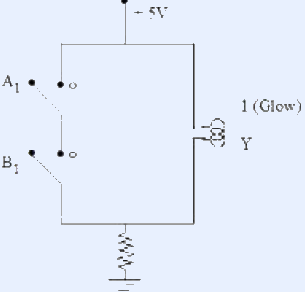
The logic gate equivalent to the given circuit diagram is :
(1)
(2)
(3)
(4)
SolutionAnswer: Option 1NAND
Approach:
Construct the truth table from the circuit and match the output column to a standard gate.
Step 1:The output is low only when both inputs are high, and high for all other input combinations.
Step 2:This truth table is identical to the NAND gate truth table.
Final answer: NAND
Q19Single correctOscillations and Waves
Given below are two statements: One is labelled as Assertion A and the other is labelled as Reason R.
Assertion A: A pendulum clock when taken to Mount Everest becomes fast.
Reason R: The value of (acceleration due to gravity) is less at Mount Everest than its value on the surface of the earth.
In the light of the above statements, choose the most appropriate answer from the options given below.
Assertion A: A pendulum clock when taken to Mount Everest becomes fast.
Reason R: The value of (acceleration due to gravity) is less at Mount Everest than its value on the surface of the earth.
In the light of the above statements, choose the most appropriate answer from the options given below.
(1)
(2)
(3)
(4)
SolutionAnswer: Option 1A is not correct but R is correct
Approach:
Evaluate the pendulum time period dependence on g at higher altitude, then judge the assertion and reason.
Step 1:At Mount Everest the altitude is higher, so the gravitational acceleration is smaller than at the surface.
Step 2:A smaller g increases the time period, so the pendulum clock runs slow rather than fast.
Final answer: A is not correct but R is correct
Q20Single correctElectromagnetic Induction and Alternating Currents
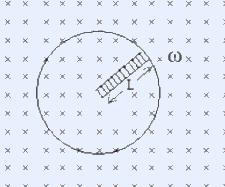
A metallic rod of length 'L' is rotated with an angular speed of '' normal to a uniform magnetic field 'B' about an axis passing through one end of rod as shown in figure. The induced emf will be
(1)
(2)
(3)
(4)
SolutionAnswer: Option 2
Approach:
Use the centre-of-mass velocity of the rod to evaluate the motional emf across its length.
Step 1:The midpoint of the rod moves with the speed corresponding to half its length.
Step 2:Substituting this velocity into the motional emf expression gives the induced emf.
Final answer:
Q21NumericalMechanical Properties of Fluids
A spherical ball of radius and density is dropped in glycerine of coefficient of viscosity and density . Viscous force on the ball when it attains constant velocity is . The value of x is (Given, and )
SolutionAnswer: 7
Approach:
At terminal speed the net force on the ball is zero, so the viscous force equals weight minus buoyancy.
Step 1:At constant velocity the viscous force balances the effective weight (weight minus buoyancy).
Step 2:Substituting the radius, densities, gravity and pi gives the viscous force magnitude.
Step 3:Matching to the given form fixes the exponent.
Final answer: 7
Q22NumericalElectrostatics
A parallel plate capacitor with air between the plate has a capacitance of . The separation between the plate becomes twice and the space between them is filled with a medium of dielectric constant 3.5. Then the capacitance becomes . The value of x is _______.
SolutionAnswer: 105
Approach:
Apply the parallel plate capacitance formula with the modified separation and dielectric, then compare with the given form.
Step 1:Doubling the separation and inserting a dielectric of constant 3.5 scales the original capacitance.
Step 2:Solving for x gives the numerator.
Final answer: 105
Q23NumericalOscillations and Waves
A mass m attached to free end of a spring executes SHM with a period of . If the mass is increased by the period of oscillation increases by one second, the value of mass m is _______ kg.
SolutionAnswer: 1
Approach:
Write the spring period for the two masses and take the ratio to eliminate the spring constant.
Step 1:The initial period corresponds to mass m and the new period of 2 s to mass m+3.
Step 2:Dividing the two relations removes the spring constant and leaves a relation in m.
Step 3:Solving the resulting equation gives the mass.
Final answer: 1
Q24NumericalMagnetic Effects of Current
A single turn current loop in the shape of a right angle triangle with sides , , is carrying a current of . The loop is in a uniform magnetic field of magnitude whose direction is parallel to the current in the side of the loop. The magnitude of the magnetic force on the side will be . The value of x is _______.
SolutionAnswer: 9
Approach:
Compute the force on the 5 cm side from F = BIL sin(theta), where theta is the angle between that side and the field along the 13 cm side.
Step 1:The field is along the 13 cm hypotenuse, and the 5 cm side makes an angle whose sine equals 12/13.
Step 2:Substituting current, field, the 5 cm length and the sine gives the force.
Final answer: 9
Q25NumericalRotational Motion
A uniform solid cylinder with radius R and length L has moment of inertia , about the axis of the cylinder. A concentric solid cylinder of radius and length is carved out of the original cylinder. If is the moment of inertia of the carved out portion of the cylinder then _______. (Both and are about the axis of the cylinder)
SolutionAnswer: 32
Approach:
Write the axial moment of inertia of each cylinder using its mass expressed through density and volume, then take the ratio.
Step 1:The axial moment of inertia in terms of density scales as the fourth power of radius times the length.
Step 2:The carved cylinder has half the radius and half the length, so its inertia is reduced by the corresponding factors.
Final answer: 32
Q26NumericalOptics
A convex lens of refractive index and focal length in air is immersed in water. The change in focal length of the lens will be _______ cm. (Given refractive index of water )
SolutionAnswer: 54
Approach:
Apply the lens maker's formula in air and in water, divide to find the new focal length, then take the change.
Step 1:In air the relative refractive index gives the focal length factor (1.5-1).
Step 2:In water the relative refractive index reduces the bending power, giving a larger focal length.
Step 3:The change in focal length is the difference between water and air values.
Final answer: 54
Q27NumericalWork, Energy and Power
A body of mass begins to move under the action of a time dependent force , where and are the unit vectors along x and y axis. The power developed by above force, at the time , will be _______ W.
SolutionAnswer: 100
Approach:
Integrate the force to obtain velocity for unit mass, then evaluate power as the dot product of force and velocity at the given time.
Step 1:With unit mass the acceleration equals the force, and integrating gives the velocity.
Step 2:Evaluating force and velocity at t = 2 s and taking the dot product gives the power.
Final answer: 100
Q28NumericalElectromagnetic Induction and Alternating Currents
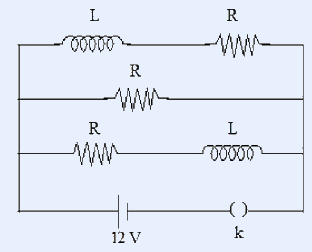
Three identical resistors with resistance and two identical inductors with self-inductance are connected to an ideal battery with emf of as shown in figure. The current through the battery long after the switch has been closed will be _______ A.
SolutionAnswer: 3
Approach:
In the steady state the inductors behave as short circuits, so reduce the resistor network and apply Ohm's law.
Step 1:Long after the switch closes the inductors act as ideal wires, shorting out the branches they are in.
Step 2:The effective circuit reduces to three 12 ohm resistors in parallel.
Step 3:Applying Ohm's law gives the battery current.
Final answer: 3
Q29NumericalNuclei
The energy released per fission of nucleus of is . The energy released if all the atoms in of pure undergo fission is _______ . (Given )
SolutionAnswer: 6
Approach:
Find the number of atoms in the given mass, then multiply by the energy released per fission.
Step 1:The given mass corresponds to half a mole, giving the number of atoms.
Step 2:Multiplying the atom count by the energy per fission gives the total energy released.
Final answer: 6
Q30NumericalCurrent Electricity
If a copper wire is stretched to increase its length by . The percentage increase in resistance of the wire is _______ %.
SolutionAnswer: 44
Approach:
Use conservation of volume on stretching, express resistance in terms of length only, then compute the percentage change.
Step 1:Volume is conserved on stretching, so the cross-section adjusts and resistance scales as the square of length.
Step 2:Increasing length by 20 percent multiplies the length by 1.2, so resistance scales by its square.
Step 3:The percentage increase follows from the change in resistance.
Final answer: 44
Chemistry29 questions
Q31Single correctHydrogen
In which of the following reactions the hydrogen peroxide acts as a reducing agent?
(1)
(2)
(3)
(4)
SolutionAnswer: Option 1
Approach:
Identify the reaction where hydrogen peroxide loses electrons and the oxidation state of oxygen rises from -1 toward 0.
Step 1:In reaction (A), the oxygen of hydrogen peroxide moves from oxidation state -1 to 0, releasing O2.
Step 2:Loss of electrons by the peroxide oxygen marks it as the reducing agent, reducing HOCl chlorine from +1 to -1.
Step 3:In (B), (C) and (D), the peroxide oxygen is reduced from -1 to -2, so it functions as an oxidising agent there.
Final answer:
Q32Single correctChemistry in Everyday Life
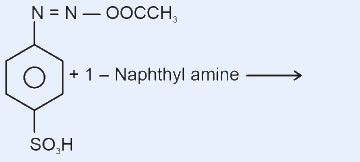
Choose the correct colour of the product for the following reaction.
[Reaction of a diazonium salt with 1-Naphthyl amine bearing an -SO3H group to give a coupled azo dye]
[Reaction of a diazonium salt with 1-Naphthyl amine bearing an -SO3H group to give a coupled azo dye]
(1)
(2)
(3)
(4)
SolutionAnswer: Option 2
Approach:
Recognise that coupling of a diazonium salt with an aromatic amine produces an extended conjugated azo chromophore whose absorption fixes its colour.
Step 1:The diazonium salt couples with 1-naphthylamine carrying a sulphonic acid group at the position para to the amino centre.
Step 2:The -N=N- azo group extends conjugation across the naphthalene system, generating a chromophore that absorbs in the green region.
Step 3:Absorption of green-yellow light leaves the transmitted colour as red, matching the known red azo dye.
Final answer:
Q33Single correctd and f Block Elements
Which one amongst the following are good oxidizing agents?
Choose the most appropriate answer from the options given below.
Choose the most appropriate answer from the options given below.
(1)
(2)
(3)
(4)
SolutionAnswer: Option 4C and D only
Approach:
Compare each ion's oxidation state with the most stable lanthanoid state of +3 to decide which species readily gains electrons.
Step 1:Cerium and terbium in the +4 state lie above the stable +3 state, so they tend to gain an electron to reach +3.
Step 2:Samarium and cerium in the +2 state lie below +3, so they tend to lose an electron and behave as reducing agents.
Step 3:Only the +4 ions C and D therefore serve as good oxidising agents.
Final answer: C and D only
Q34Single correctAmines
Given below are two statements:
Statement-I : Pure Aniline and other arylamines are usually colourless.
Statement-II : Arylamines get coloured on storage due to atmospheric reduction.
In the light of the above statements, choose the most appropriate answer from the options given below:
Statement-I : Pure Aniline and other arylamines are usually colourless.
Statement-II : Arylamines get coloured on storage due to atmospheric reduction.
In the light of the above statements, choose the most appropriate answer from the options given below:
(1)
(2)
(3)
(4)
SolutionAnswer: Option 1Statement-I is correct but Statement-II is incorrect
Approach:
Assess the truth of each statement about the appearance and storage behaviour of arylamines.
Step 1:Pure aniline and related arylamines are indeed colourless when freshly prepared.
Step 2:On storage arylamines darken because of atmospheric oxidation, not reduction.
Step 3:Thus the first statement holds while the second fails.
Final answer: Statement-I is correct but Statement-II is incorrect
Q35Single correctGeneral Principles of Metallurgy
The metal which is extracted by oxidation and subsequent reduction from its ore is
(1)
(2)
(3)
(4)
SolutionAnswer: Option 4Ag
Approach:
Identify the metal whose ore is first dissolved by oxidative leaching and then displaced by reduction.
Step 1:Silver is first extracted by oxidation, where argentite is leached by sodium cyanide in the presence of air to form a soluble complex.
Step 2:The dissolved silver complex is then reduced by zinc to recover the metal.
Step 3:This oxidation followed by reduction pathway uniquely matches silver among the options.
Final answer: Ag
Q36Single correctHydrocarbons
Given below are two statements, one is labelled as Assertion A and the other is labelled as Reason R.
Assertion A : Benzene is more stable than hypothetical cyclohexatriene.
Reason R : The delocalized electron cloud is attracted more strongly by nuclei of carbon atoms.
In the light of the above statements, choose the correct answer from the options given below.
Assertion A : Benzene is more stable than hypothetical cyclohexatriene.
Reason R : The delocalized electron cloud is attracted more strongly by nuclei of carbon atoms.
In the light of the above statements, choose the correct answer from the options given below.
(1)
(2)
(3)
(4)
SolutionAnswer: Option 2Both A and R are correct and R is the correct explanation of A
Approach:
Evaluate whether benzene's extra stability and the stated reason about its delocalized electron cloud are both correct and causally linked.
Step 1:Benzene is more stable than the hypothetical cyclohexatriene because of resonance delocalization.
Step 2:The delocalized pi electron cloud is attracted strongly by the carbon nuclei, lowering the energy of the system.
Step 3:The strong attraction described in the reason is the direct cause of the assertion, so the reason correctly explains the assertion.
Final answer: Both A and R are correct and R is the correct explanation of A
Q37Single corrects-Block Elements
Given below are two statements, one is labelled as Assertion A and the other is labelled as Reason R.
Assertion A : Beryllium has less negative value of reduction potential compared to the other alkaline earth metals.
Reason R : Beryllium has large hydration energy due to small size of B but relatively large value of atomization enthalpy.
In the light of the above statements, choose the correct answer from the options given below.
Assertion A : Beryllium has less negative value of reduction potential compared to the other alkaline earth metals.
Reason R : Beryllium has large hydration energy due to small size of B but relatively large value of atomization enthalpy.
In the light of the above statements, choose the correct answer from the options given below.
(1)
(2)
(3)
(4)
SolutionAnswer: Option 1Both A and R are correct but R is NOT the correct explanation of A
Approach:
Test both statements about beryllium's reduction potential and the energetics behind it, and judge whether the reason fully explains the assertion.
Step 1:Beryllium does have a less negative reduction potential than the other alkaline earth metals, so the assertion is correct.
Step 2:The small Be2+ ion gives large hydration energy and beryllium also has a high atomization enthalpy, so the reason is a correct statement.
Step 3:The high atomization enthalpy opposes the lowering, so the reason as stated is not the single correct explanation of the assertion.
Final answer: Both A and R are correct but R is NOT the correct explanation of A
Q38Single correctCoordination Compounds
Which of the following cannot be explained by crystal field field theory?
(1)
(2)
(3)
(4)
SolutionAnswer: Option 2Order of spectrochemical series
Approach:
Recall what crystal field theory accounts for and identify the property that lies outside its scope.
Step 1:Crystal field theory treats ligands as point charges and predicts splitting energies, so it explains colour, magnetic behaviour and stability of complexes.
Step 2:The relative field strengths that fix the order of the spectrochemical series arise from covalent ligand-metal interactions, which the point-charge model omits.
Step 3:Therefore the property outside the reach of crystal field theory is selected per the printed key.
Final answer: Order of spectrochemical series
Q39Single correctChemical Bonding and Molecular Structure
What is the number of unpaired electron(s) in the highest occupied molecular orbital of the following species: ; ; ; ?
(1)
(2)
(3)
(4)
SolutionAnswer: Option 20, 1, 2, 1
Approach:
Fill the molecular orbital diagram for each species and count the unpaired electrons in the highest occupied molecular orbital.
Step 1:Dinitrogen fills its bonding pi orbitals completely, leaving no unpaired electron in the highest occupied orbital.
Step 2:Removing one electron from N2 to form its cation leaves one unpaired electron in the sigma highest occupied orbital.
Step 3:Dioxygen places two electrons singly in the degenerate antibonding pi orbitals, giving two unpaired electrons, and its cation retains one.
Final answer: 0, 1, 2, 1
Q40Single correctSolutions
Choose the correct representation of conductometric titration of benzoic acid with sodium hydroxide.
(1)
(2)
(3)
(4)
SolutionAnswer: Option 1Conductance vs aOH curve for a weak acid (benzoic acid) titrated with NaOH
Approach:
Track the ionic conductance of the weak acid solution as a strong base is added before and after the equivalence point.
Step 1:Benzoic acid is weakly ionised, so initial conductance is low and changes only slightly as salt forms while base is consumed.
Step 2:After the equivalence point, excess sodium hydroxide supplies mobile hydroxide ions, raising the conductance sharply.
Step 3:The plot that shows a gentle initial segment followed by a steep rise matches graph 1.
Final answer: Conductance vs aOH curve for a weak acid (benzoic acid) titrated with NaOH
Q41Single correctAldehydes Ketones and Carboxylic Acids
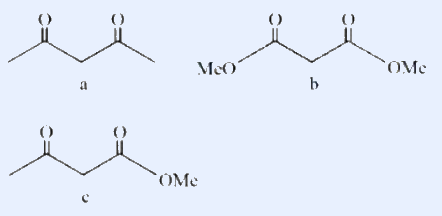
Which will undergo deprotonation most readily in basic medium?
[Three 1,3-dicarbonyl type compounds are shown: a, b (an ester MeO...OMe diketone/diester), and c (a beta-keto ester with -OMe)]
[Three 1,3-dicarbonyl type compounds are shown: a, b (an ester MeO...OMe diketone/diester), and c (a beta-keto ester with -OMe)]
(1)
(2)
(3)
(4)
SolutionAnswer: Option 2a only
Approach:
Compare the stabilization of the carbanion formed on losing the methylene proton between the two flanking carbonyl groups in each structure.
Step 1:Compound a places the acidic methylene between two ketone carbonyls, giving the most stabilized enolate on deprotonation.
Step 2:Structures b and c carry ester oxygens whose cross-conjugation reduces the carbonyl's electron-withdrawing pull, lowering the tendency to deprotonate.
Step 3:Therefore deprotonation occurs most readily for a only.
Final answer: a only
Q42Single corrects-Block Elements
Identify the correct statements about alkali metals.
A. The order of standard reduction potential (M) for alkali metal ions is Na > Rb > Li.
B. CsI is highly soluble in water.
C. Lithium carbonate is highly stable to heat.
D. Potassium dissolved in concentrated liquid ammonia is blue in colour and paramagnetic.
E. All the alkali metal hydrides are ionic solids.
Choose the correct answer from the options given below.
A. The order of standard reduction potential (M) for alkali metal ions is Na > Rb > Li.
B. CsI is highly soluble in water.
C. Lithium carbonate is highly stable to heat.
D. Potassium dissolved in concentrated liquid ammonia is blue in colour and paramagnetic.
E. All the alkali metal hydrides are ionic solids.
Choose the correct answer from the options given below.
(1)
(2)
(3)
(4)
SolutionAnswer: Option 4A and E only
Approach:
Judge each statement against the known periodic trends and properties of alkali metals.
Step 1:The order of standard reduction potential Na > Rb > Li is correct, and all alkali metal hydrides are ionic solids, so A and E hold.
Step 2:CsI is poorly soluled due to low hydration energy, lithium carbonate is thermally unstable, so B and C fail.
Step 3:Potassium in liquid ammonia gives a blue paramagnetic dilute solution but becomes bronze and diamagnetic when concentrated, so statement D as written is incorrect.
Final answer: A and E only
Q43Single correctCoordination Compounds
The hybridization and magnetic behaviour of cobalt ion in complex, respectively is
(1)
(2)
(3)
(4)
SolutionAnswer: Option 4 and diamagnetic
Approach:
Determine the d-electron configuration of cobalt in the complex with a strong field ligand and deduce the hybridisation and spin state.
Step 1:Cobalt is in the +3 state with a d6 configuration in this complex.
Step 2:Ammonia is a strong field ligand, so it pairs the d electrons and frees two inner d orbitals for bonding, giving d2sp3 hybridisation.
Step 3:With all six electrons paired the complex has no unpaired electrons, so it is diamagnetic.
Final answer: and diamagnetic
Q44Single correctEnvironmental Chemistry
Correct statement is:
(1)
(2)
(3)
(4)
SolutionAnswer: Option 1An average human being consumes nearly 15 times more air than food
Approach:
Recall the comparative daily intake of air and food for an average human.
Step 1:An average person breathes a far larger mass of air each day than the mass of food eaten.
Step 2:The standard estimate puts air consumption at about 15 times the food consumption.
Step 3:Hence the first statement matches the accepted figure.
Final answer: An average human being consumes nearly 15 times more air than food
Q46Single correctChemistry in Everyday Life
Choose the correct answer from the options given below:
| LIST I (Type) | LIST II (Name) |
|---|---|
| A.. Antifertility drug | I.. Norethindrone |
| B.. Tranquilizer | II.. Meprobromate |
| C.. Antihistamine | III.. Seldane |
| D.. Antibiotic | IV.. Ampicillin |
(1)
(2)
(3)
(4)
SolutionAnswer: Option 2A-I, B-II, C-III, D-IV
Approach:
Classify each medicinal compound by its therapeutic action and match it to the listed type.
Step 1:Norethindrone is a synthetic progesterone derivative used to control pregnancy.
Step 2:Meprobromate acts on the central nervous system to relieve anxiety.
Step 3:Seldane (terfenadine) opposes the action of histamine.
Step 4:Ampicillin is a penicillin-class antibacterial agent.
Final answer: A-I, B-II, C-III, D-IV
Q47Single correctThe d- and f-Block Elements
paper exposed with dilute turns green when exposed to
(1)
(2)
(3)
(4)
SolutionAnswer: Option 3Sulphur dioxide
Approach:
Identify the reducing gas that converts orange dichromate to green chromium(III) in acidic medium.
Step 1:In acidic medium dichromate is a strong oxidant and is reduced to the green chromium(III) ion when a suitable reductant is present.
Step 2:Sulphur dioxide is oxidised to sulphate while reducing dichromate, producing the green Cr(III) colour.
Final answer: Sulphur dioxide
Q48Single correctAldehydes, Ketones and Carboxylic Acids
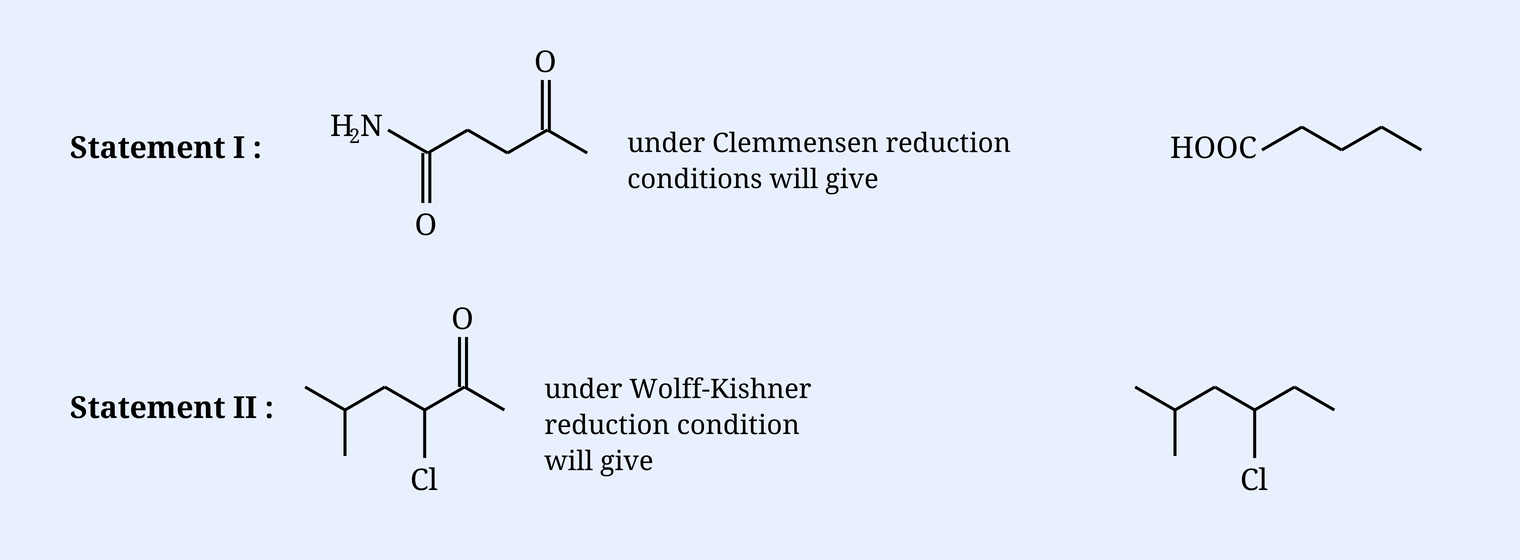
Given below are two statements:
In the light of the above statements, choose the correct answer from the options given below:
In the light of the above statements, choose the correct answer from the options given below:
(1)
(2)
(3)
(4)
SolutionAnswer: Option 1Statement I is true but Statement II is false
Approach:
Evaluate each named reduction for its scope on the drawn substrate, focusing on the fate of the carbonyl and any halide.
Step 1:Clemmensen reduction with zinc amalgam and concentrated HCl converts the carbonyl group of the keto-acid to a methylene group, leaving the carboxylic acid intact, so Statement I matches its product.
Step 2:Wolff-Kishner reduction with hydrazine and base also removes the carbonyl, but the chloro substituent undergoes elimination under the basic conditions, so the drawn saturated chloro product in Statement II is not obtained.
Final answer: Statement I is true but Statement II is false
Q49Single correctStructure of Atom
The number of s-electrons present in an ion with 55 protons in its unipositive state is
(1)
(2)
(3)
(4)
SolutionAnswer: Option 110
Approach:
Identify the element by proton count, form the unipositive ion, and total the electrons in all s-subshells.
Step 1:An atom with 55 protons is caesium, and removing one electron gives the caesium(I) ion with 54 electrons.
Step 2:The xenon configuration of Cs+ fills the 1s, 2s, 3s, 4s and 5s subshells, each holding two electrons.
Step 3:Summing the electrons across the five s-subshells gives the total s-electron count.
Final answer: 10
Q50Single correctChemical Kinetics
A student has studied the decomposition of a gas at . He obtained the following data.
p (mm Hg) | 50 | 100 | 200 | 400
relative (s) | 4 | 2 | 1 | 0.5
The order of the reaction is
p (mm Hg) | 50 | 100 | 200 | 400
relative (s) | 4 | 2 | 1 | 0.5
The order of the reaction is
(1)
(2)
(3)
(4)
SolutionAnswer: Option 32
Approach:
Relate the half-life dependence on initial pressure to the reaction order and read off the order from the proportionality.
Step 1:For an order n reaction the half-life varies inversely with the initial pressure raised to the power (n-1).
Step 2:Each doubling of pressure from 50 to 100 to 200 to 400 mm Hg halves the half-life, so the half-life is inversely proportional to the pressure.
Step 3:Solving the exponent equation gives the reaction order.
Final answer: 2
Q51NumericalHaloalkanes and Haloarenes
Maximum number of isomeric monochloro derivatives which can be obtained from 2,2,5,5-tetramethylhexane by chlorination is________.
SolutionAnswer: 3
Approach:
Identify the sets of equivalent hydrogen atoms in the symmetric skeleton, since each distinct hydrogen type gives one monochloro product.
Step 1:2,2,5,5-tetramethylhexane is symmetric about its centre, so its hydrogens fall into a few equivalence classes.
Step 2:The twelve methyl hydrogens of the tert-butyl groups form one equivalent set, and the four methylene hydrogens form a second set, while replacement at the methylene can give a stereocentre producing an optically active product as a third distinct outcome.
Step 3:Counting the structurally and stereochemically distinct products gives the total isomer count.
Final answer: 3
Q52NumericalBiomolecules
Total number of tripeptides possible by mixing of valine and proline is________.
SolutionAnswer: 8
Approach:
Count ordered sequences of length three drawn from two distinct amino acids, since peptide order matters.
Step 1:A linear tripeptide has three positions, and each position can be occupied by either valine or proline.
Step 2:The total number of distinct ordered tripeptides equals two raised to the power three.
Final answer: 8
Q53NumericalThe p-Block Elements
Sum of - bonds present in peroxodisulphuric acid and pyrosulphuric acid is ________.
SolutionAnswer: 8
Approach:
Draw each oxoacid and count the sulphur-oxygen pi bonds, then add the two totals.
Step 1:Peroxodisulphuric acid contains two sulphur atoms each bearing two terminal S=O bonds linked through a peroxide bridge.
Step 2:Pyrosulphuric acid contains two sulphur atoms each bearing two terminal S=O bonds linked through a bridging oxygen.
Step 3:Adding the pi bonds of the two acids gives the requested sum.
Final answer: 8
Q54NumericalSolutions
The total pressure observed by mixing two liquids A and B is 350 mm Hg when their mole fractions are 0.7 and 0.3 respectively.
The total pressure becomes 410 mm Hg if the mole fractions are changed to 0.2 and 0.8 respectively for A and B. The vapour pressure of pure A is ________ mm Hg. (Nearest integer). Consider the liquids and solutions behave ideally.
The total pressure becomes 410 mm Hg if the mole fractions are changed to 0.2 and 0.8 respectively for A and B. The vapour pressure of pure A is ________ mm Hg. (Nearest integer). Consider the liquids and solutions behave ideally.
SolutionAnswer: 314
Approach:
Apply Raoult's law to the two compositions to form two linear equations in the pure component pressures and solve.
Step 1:Writing Raoult's law for the first composition relates the pure pressures through the measured total pressure.
Step 2:Writing Raoult's law for the second composition gives a second equation in the same pure pressures.
Step 3:Eliminating PA between the two equations isolates the pure vapour pressure of B.
Step 4:Substituting PB back into the first equation gives the pure vapour pressure of A.
Final answer: 314
Q55NumericalEquilibrium
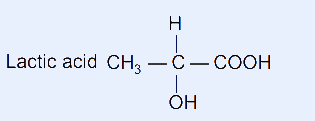
If the pKa of lactic acid is 5, then the pH of 0.005 M calcium lactate solution at C is ________ (Nearest integer)
Lactic acid [drawn structure: ]
Lactic acid [drawn structure: ]
SolutionAnswer: 85
Approach:
Treat calcium lactate as a salt of a weak acid and strong base, compute the pH of the hydrolysing lactate solution, and express the result in units of one tenth.
Step 1:Calcium lactate dissociates to give two lactate ions per formula unit, so the lactate concentration is twice the salt concentration.
Step 2:Substituting the acid strength and lactate concentration into the salt hydrolysis expression gives the pH.
Step 3:Evaluating the expression yields the solution pH, which expressed in tenths gives the integer answer.
Final answer: 85
Q56NumericalSurface Chemistry
The number of statement/s which are the characteristics of physisorption is ________
A. It is highly specific in nature
B. Enthalpy of adsorption is high
C. It decreases with increases in temperature
D. It results into unimolecular layer
E. No activation energy is needed
A. It is highly specific in nature
B. Enthalpy of adsorption is high
C. It decreases with increases in temperature
D. It results into unimolecular layer
E. No activation energy is needed
SolutionAnswer: 2
Approach:
Test each statement against the known properties of physical adsorption and count those that hold.
Step 1:Physisorption is non-specific, so statement A describing it as highly specific is incorrect.
Step 2:Physisorption involves weak van der Waals forces with low enthalpy of adsorption, so statement B is incorrect.
Step 3:Physisorption is exothermic and its extent decreases as temperature rises, so statement C is correct.
Step 4:Physisorption forms multimolecular layers rather than a single layer, so statement D is incorrect.
Step 5:Physisorption requires no activation energy, so statement E is correct, giving two correct statements.
Final answer: 2
Q57NumericalStructure of Atom
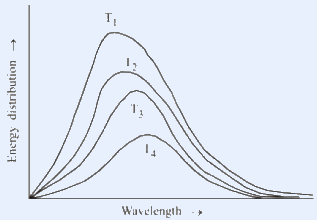
Following figure shows spectrum of an ideal black body at four different temperatures. The number of correct statement/s from the following is ________
A.
B. The black body consists of particles performing simple harmonic motion.
C. The peak of the spectrum shifts to shorter wavelength as temperature increases.
D. constant
E. The given spectrum could be explained using quantisation of energy.
A.
B. The black body consists of particles performing simple harmonic motion.
C. The peak of the spectrum shifts to shorter wavelength as temperature increases.
D. constant
E. The given spectrum could be explained using quantisation of energy.
SolutionAnswer: 2
Approach:
Read the temperature ordering from the curve heights and assess each statement against black body radiation principles, then count the valid ones.
Step 1:The highest energy distribution curve corresponds to the highest temperature, so the ordering is T1 greater than T2 greater than T3 greater than T4, making statement A incorrect.
Step 2:Black body emitters do not consist of particles undergoing simple harmonic motion, so statement B is incorrect.
Step 3:As temperature increases the peak of the spectrum shifts to shorter wavelength, so statement C is correct.
Step 4:The ratio of temperature to peak frequency is not constant for the black body curves, so statement D is incorrect.
Step 5:Planck explained the black body spectrum through quantisation of energy, so statement E is correct, giving two correct statements.
Final answer: 2
Q58NumericalStates of Matter
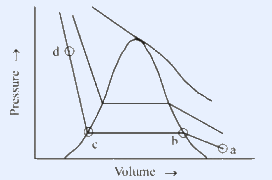
The number of statement/s which are correct with respect to the compression of carbon dioxide from point (a) in the Andrews isotherm from the following is ________
A. Carbon dioxide remains as a gas upto point (b)
B. Liquid carbon dioxide appears at point (c)
C. Liquid and gaseous carbon dioxide coexist between points (b) and (c)
D. As the volume decreases from (b) to (c), the amount of liquid decreases
A. Carbon dioxide remains as a gas upto point (b)
B. Liquid carbon dioxide appears at point (c)
C. Liquid and gaseous carbon dioxide coexist between points (b) and (c)
D. As the volume decreases from (b) to (c), the amount of liquid decreases
SolutionAnswer: 2
Approach:
Follow the compression path along the Andrews isotherm from point a and judge each statement against the gas, coexistence and liquid regions.
Step 1:On compressing from point a the carbon dioxide stays gaseous until the curve reaches point b, so statement A is correct.
Step 2:Liquid carbon dioxide first appears at point b rather than at point c, so statement B is incorrect.
Step 3:Between points b and c the flat portion of the isotherm shows gas and liquid coexisting, so statement C is correct.
Step 4:As the volume decreases from b to c the amount of liquid increases rather than decreases, so statement D is incorrect, giving two correct statements.
Final answer: 2
Q59NumericalThermodynamics
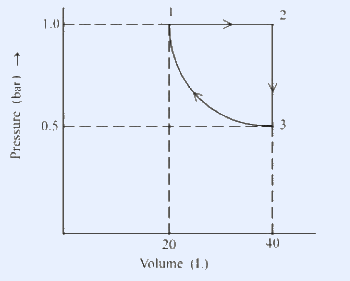
One mole of an ideal monoatomic gas is subjected to changes as shown in the graph. The magnitude of the work done (by the system or on the system) is________ J (nearest integer)
Given:
Given:
SolutionAnswer: 620
Approach:
Split the cycle into its three legs, compute the work of each leg using the appropriate process formula, and sum to get the net work magnitude.
Step 1:Along the isothermal leg from state 1 to state 2 the gas expands at constant temperature, giving a positive work contribution.
Step 2:Along the constant volume leg from state 2 to state 3 no volume change occurs, so the work is zero.
Step 3:Along the constant pressure leg from state 3 to state 1 the gas is compressed, giving a negative work contribution.
Step 4:Summing the three contributions gives the net work, whose magnitude in joules is the required answer.
Final answer: 620
Q60NumericalSolutions
The number of units, which are used to express concentration of solutions from the following is______
Mass percent, Mole, Mole fraction, Molarity, ppm, Molality
Mass percent, Mole, Mole fraction, Molarity, ppm, Molality
SolutionAnswer: 5
Approach:
Examine each listed quantity and count those that are genuine measures of solution concentration.
Step 1:Mass percent, mole fraction, molarity, ppm and molality are all valid ways to express concentration.
Step 2:Mole is a measure of the amount of substance and not a concentration unit, so it is excluded from the count.
Final answer: 5
Mathematics30 questions
Q61Single correctLimits, Continuity and Differentiability
The set of all values of a for which , where denotes the greatest integer less than or equal to is equal to
(1)
(2)
(3)
(4)
SolutionAnswer: Option 4
Approach:
Evaluate the limit using the step nature of the greatest integer function and require both floor terms to combine to zero across the neighbourhood of .
Step 1:Set the limit expression equal to zero.
Step 2:For the floors to stay constant and equal near , both arguments must lie in the same integer band, which forces to an open interval.
Final answer:
Q62Single correctMathematical Reasoning
Let p and q be two statements. Then is equivalent to
(1)
(2)
(3)
(4)
SolutionAnswer: Option 1
Approach:
Build the truth table of the given compound statement and match its column with each option.
Step 1:Rewrite the implication inside.
Step 2:Apply De Morgan to the negation.
Step 3:Confirm via the full truth table column E which reads T,F,T,T, identical to .
Final answer:
Q63Single correctCo-ordinate Geometry
The locus of the mid points of the chords of the circle which subtend an angle at the centre of the circle , is a circle of radius . If , and , then is equal to
(1)
(2)
(3)
(4)
SolutionAnswer: Option 4
Approach:
Relate the mid-point distance from the centre to the subtended angle, giving each locus radius, then apply the given quadratic relation.
Step 1:The mid-point of a chord subtending lies at distance from the centre, so the locus radius is .
Step 2:Substitute into .
Step 3:Solve for the half-angle.
Final answer:
Q64Single correctFunctions
If , then is equal to
(1)
(2)
(3)
(4)
SolutionAnswer: Option 3
Approach:
Exploit the pairing identity to collapse the sum into equal pairs.
Step 1:Compute and add to .
Step 2:Pair the terms as with , giving pairs.
Final answer:
Q65Single correctMatrices and Determinants
If the system of equations
has infinitely many solutions, then the ordered pair is equal to :
has infinitely many solutions, then the ordered pair is equal to :
(1)
(2)
(3)
(4)
SolutionAnswer: Option 2
Approach:
Impose for infinitely many solutions to find , then impose for consistency to find .
Step 1:Set the coefficient determinant to zero.
Step 2:Set for consistency.
Final answer:
Q66Single correctThree Dimensional Geometry
Let the plane containing the line of intersection of the planes and pass through the points and . Then the distance of the point from the plane is
(1)
(2)
(3)
(4)
SolutionAnswer: Option 2
Approach:
Form the family of planes through the intersection, apply the two point conditions to fix the parameter and , then use the point-to-plane distance for .
Step 1:Write the family and substitute the two given points.
Step 2:Solving the point conditions gives .
Step 3:Apply the distance formula to at .
Final answer:
Q67Single correctBinomial Theorem
If then is equal to :
(1)
(2)
(3)
(4)
SolutionAnswer: Option 3
Approach:
Use the identity derived from and Vandermonde's identity.
Step 1:Rewrite each term using .
Step 2:Express with factorials.
Final answer:
Q68Single correctThree Dimensional Geometry
If the foot of the perpendicular drawn from to the line passing through the point and parallel to the planes and is , then is equal to
(1)
(2)
(3)
(4)
SolutionAnswer: Option 4
Approach:
Find the line's direction as the cross product of the two plane normals, write the foot in parametric form, set the foot-to-given-point vector perpendicular to the direction, and solve.
Step 1:Cross the normals and .
Step 2:Parametrise the foot as and impose perpendicularity to the direction with .
Step 3:Sum the foot coordinates.
Final answer:
Q69Single correctMatrices and Determinants
Let A be a matrix such that . Then is equal to
(1)
(2)
(3)
(4)
SolutionAnswer: Option 2
Approach:
Use the determinant rule for repeated adjoints to find , then evaluate .
Step 1:For , the triple adjoint gives the exponent .
Step 2:Evaluate .
Final answer:
Q70Single correctComplex Numbers
The value of is
(1)
(2)
(3)
(4)
SolutionAnswer: Option 4
Approach:
Convert sine and cosine of into cosine and sine of a complementary angle, factor the numerator and denominator into exponential form, and apply De Moivre's theorem.
Step 1:Rewrite using and , then factor both parts.
Step 2:Cube the exponential.
Step 3:Write in the option form.
Final answer:
Q71Single correctPermutations and Combinations
The number of square matrices of order 5 with entries from the set , such that the sum of all the elements in each row is 1 and the sum of all the elements in each column is also 1, is
(1)
(2)
(3)
(4)
SolutionAnswer: Option 1
Approach:
Each such matrix has exactly one 1 per row and per column, which is precisely a permutation matrix, so count the permutations of five symbols.
Step 1:A 0-1 matrix with one 1 in every row and column corresponds to a bijection from rows to columns.
Step 2:Evaluate the factorial.
Final answer:
Q72Single correctIntegral Calculus
is equal to
(1)
(2)
(3)
(4)
SolutionAnswer: Option 4
Approach:
Apply the standard inverse-sine integral after factoring the constant out of the radical, then evaluate at the limits.
Step 1:Factor the radical as and integrate.
Step 2:Substitute the limits.
Final answer:
Q73Single correctQuadratic Equations
The number of real solutions of the equation , is
(1)
(2)
(3)
(4)
SolutionAnswer: Option 2
Approach:
Substitute to convert the equation into a quadratic in t, then test whether any resulting t is attainable by a real x.
Step 1:Replace by .
Step 2:Solve the quadratic in .
Step 3:Since real x requires , neither value is admissible.
no real x
Final answer:
Q74Single correctVector Algebra
Let and . Let be parallel to and be perpendicular to . If , then the value of is
(1)
(2)
(3)
(4)
SolutionAnswer: Option 1
Approach:
Write , use to find , then compute and dot it with .
Step 1:Dot with .
Step 2:Express , so .
Step 3:Dot with .
Final answer:
Q75Single correctSequences and Series
Let f(x) be a function such that for all . If and , then the value of n is
(1)
(2)
(3)
(4)
SolutionAnswer: Option 4
Approach:
Recognise the Cauchy-type functional equation gives , then sum the resulting geometric series and solve for n.
Step 1:From the functional equation with , the function is .
Step 2:Sum the geometric progression.
Step 3:Solve the exponential equation.
Final answer:
Q76Single correctPermutations and Combinations
The number of integers, greater than 7000 that can be formed, using the digits 3, 5, 6, 7, 8 without repetition, is
(1)
(2)
(3)
(4)
SolutionAnswer: Option 2
Approach:
Count integers exceeding 7000 formable from the five distinct digits, splitting into four-digit and five-digit cases.
Step 1:Four-digit integers greater than 7000 require the leading digit to be 7 or 8.
Step 2:Each leading choice fills the remaining three places from the four leftover digits.
Step 3:Every five-digit arrangement of all five digits exceeds 7000.
Step 4:Add the two cases.
Final answer:
Q77Single correctDifferential Calculus
If , then
(1)
(2)
(3)
(4)
SolutionAnswer: Option 1
Approach:
Determine the constant coefficients by differentiating and evaluating at the stated points, then build f explicitly and test the relations.
Step 1:Differentiate the cubic successively.
Step 2:Evaluate to fix the constants.
Step 3:Substitute back to obtain f.
Step 4:Compute the needed values.
Step 5:Test option 1.
Final answer:
Q78Single correctCoordinate Geometry
The equations of the sides AB and AC of a triangle ABC are and respectively. Its vertex A is on the y-axis and its orthocentre is . The length of the tangent from the point C to the part of the parabola in the first quadrant is :
(1)
(2)
(3)
(4)
SolutionAnswer: Option 1
Approach:
Use the y-axis vertex and the given orthocentre to fix the parameter, find C, then apply the tangent-length formula to the parabola.
Step 1:Place A on the y-axis from both line equations to fix the parameter.
Step 2:Write the side equations and use the orthocentre to locate C.
Step 3:Apply the tangent-length condition to the parabola from C.
Final answer:
Q79Single correctDifferential Equations
Let be the solution of the differential equation . Then is equal to
(1)
(2)
(3)
(4)
SolutionAnswer: Option 4
Approach:
Recognise the homogeneous form, substitute y=vx, integrate, apply the initial condition, then evaluate at x=e.
Step 1:Rewrite in slope form.
Step 2:Substitute =t after reducing; separate and integrate.
Step 3:Apply the initial condition.
Step 4:Evaluate at x=e.
Final answer:
Q80Single correctStatistics
Let the six numbers be in A.P. and . If the mean of these six numbers is and their variance is , then is equal to
(1)
(2)
(3)
(4)
SolutionAnswer: Option 4
Approach:
Express the A.P. through first term and common difference, use the mean and the given sum to solve for them, then compute the variance.
Step 1:Use the mean and the constraint to fix the A.P.
Step 2:Solve to obtain the terms.
Step 3:Compute the variance.
Step 4:Scale by eight.
Final answer:
Q81NumericalIntegral Calculus
Let f be a differentiable function defined on such that and . Then is equal to ____.
SolutionAnswer: 27
Approach:
Differentiate the integral equation, separate variables in terms of log f, integrate with the initial value, then evaluate at the required point.
Step 1:Differentiate both sides.
Step 2:Separate variables using u= f.
Step 3:Apply f(0)=e so that f=1.
Step 4:Evaluate at x=pi/6.
Final answer: 27
Q82NumericalSequences and Series
If , then the value of n is
SolutionAnswer: 5
Approach:
Replace numerator and denominator by their closed-form sums, form the ratio equation and solve for n.
Step 1:Identify the denominator general term.
Step 2:Sum the denominator.
Step 3:Form the ratio equation.
Step 4:Simplify and solve.
Final answer: 5
Q83NumericalCoordinate Geometry
The equations of the sides AB, BC and CA of a triangle ABC are : and respectively. Let be the centroid of . Then is equal to
SolutionAnswer: 122
Approach:
Find the vertices as pairwise line intersections in terms of the parameters, impose the centroid condition to solve for a and p, then compute BC squared.
Step 1:Determine the vertices from the side intersections.
Step 2:Apply the centroid x-condition.
Step 3:Solve the resulting system for the parameters.
Step 4:Use B(-3,6) and C(8,5) to compute the squared length.
Final answer: 122
Q84NumericalRelations and Functions
The minimum number of elements that must be added to the relation on the set so that it is an equivalence relation, is ____.
SolutionAnswer: 13
Approach:
Add the pairs needed for reflexivity, symmetry and transitivity, recognising that the related elements collapse into a single equivalence class.
Step 1:Add the four reflexive pairs.
Step 2:Add transitive pairs forcing a, c, d to relate to each other through b.
Step 3:Add all symmetric counterparts of the existing and new ordered pairs.
Step 4:Count all required additions.
Final answer: 13
Q85NumericalTrigonometry
Let . Then is equal to ____.
SolutionAnswer: 2
Approach:
Reduce the tangent equation to a linear condition on sin and cos, list the admissible angles, then sum the required squared sine values.
Step 1:Rewrite the equation.
Step 2:Solve for the integer condition.
Step 3:List the qualifying angles.
Step 4:Sum the squared shifted sines.
Final answer: 2
Q86NumericalIntegral Calculus
If the area of the region bounded by the curves is A, then 8 A is equal to ____.
SolutionAnswer: 36
Approach:
Find the intersection points, integrate the horizontal difference of the boundary curves with respect to y, then scale the area.
Step 1:Express x from each curve and find intersection limits.
Step 2:Set up the area integral.
Step 3:Integrate.
Step 4:Scale by eight.
Final answer: 36
Q87NumericalThree Dimensional Geometry
If the shortest distance between the lines and is 6, then the square of sum of all possible values of is
SolutionAnswer: 384
Approach:
Apply the shortest-distance formula for skew lines, equate to 6 to obtain a quadratic in lambda, then square the sum of its roots.
Step 1:Compute the cross product of the direction vectors.
Step 2:Form the distance expression and set it to 6.
Step 3:Resolve the absolute value.
Step 4:Square the sum of the values.
Final answer: 384
Q88NumericalBinomial Theorem
Let the sum of the coefficients of the first three terms in the expansion of , be 376. Then the coefficient of is ____.
SolutionAnswer: 405
Approach:
Use the first three coefficients to solve for n, then identify the term containing x to the fourth power via the general term.
Step 1:Sum the first three coefficients.
Step 2:Solve the quadratic.
Step 3:Write the general term and find the power of x.
Step 4:Compute the coefficient.
Final answer: 405
Q89NumericalProbability and Coordinate Geometry
Three urns A, B and C contain 4 red, 6 black; 5 red, 5 black, and red, 4 black balls respectively. One of the urns is selected at random and a ball is drawn. If the ball drawn is red and the probability that it is drawn from urn C is 0.4 then the square of the length of the side of the largest equilateral triangle, inscribed in the parabola with one vertex at the vertex of the parabola, is
SolutionAnswer: 432
Approach:
Apply Bayes theorem with the given posterior to solve for lambda, then use the inscribed equilateral triangle geometry on the parabola to get the side length.
Step 1:Write the posterior probability for urn C.
Step 2:Solve for lambda.
Step 3:Use the inscribed equilateral triangle condition with vertex at the origin.
Step 4:Solve and square the side.
Final answer: 432
Q90NumericalVector Algebra
Let . Then is equal to
SolutionAnswer: 8
Approach:
Use the cross-product equality to relate a-b with c, combine with the two dot-product values to fix lambda, then evaluate the required dot product.
Step 1:Rewrite the cross-product condition.
Step 2:Express a-b and dot with c using the given values.
Step 3:Combine to solve for lambda.
Step 4:Compute the absolute dot product.
Final answer: 8
More JEE Main 2023 papers
Frequently Asked Questions
How many questions are in the JEE Main 2023 January 24, Shift 2 paper?
The JEE Main 2023 January 24, Shift 2 paper has 88 questions — Physics (29), Chemistry (29) and Mathematics (30). Every question is on this page with its correct answer and a step-by-step solution.
What is the marking scheme for JEE Main?
JEE Main awards +4 marks for each correct answer and −1 for a wrong answer, with 0 for questions left unattempted. The paper covers Physics, Chemistry and Mathematics.
Are the answer key and step-by-step solutions provided for the 2023 January 24, Shift 2 paper?
Yes — every question shows the correct answer (answer key) and a detailed step-by-step solution, free to read online.
Can I take the JEE Main 2023 January 24, Shift 2 paper as a timed mock test?
Yes. With a free JEEnify account you can attempt this exact paper as a timed test in the real exam interface, then see your score and weak-area analysis.
Solved this paper? Calculate your JEE Main scoremost important chaptersformula sheetsall free tools.