
Back to JEE Main PYQs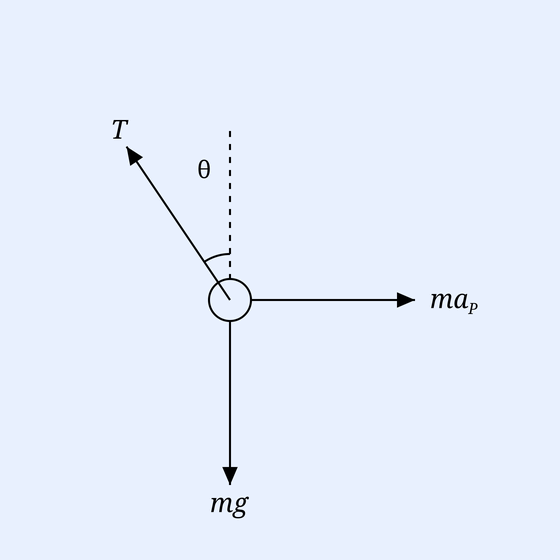
JEE Main 2023 January 25, Shift 1 Question Paper with Solutions
All 89 questions from the JEE Main 2023 (January 25, Shift 1) shift — Physics (30), Chemistry (29) and Mathematics (30) — each with the correct answer (answer key) and a step-by-step solution. Read it free online, or attempt the full paper as a timed mock test.
Physics30 questions
Q1Single correctCommunication Systems
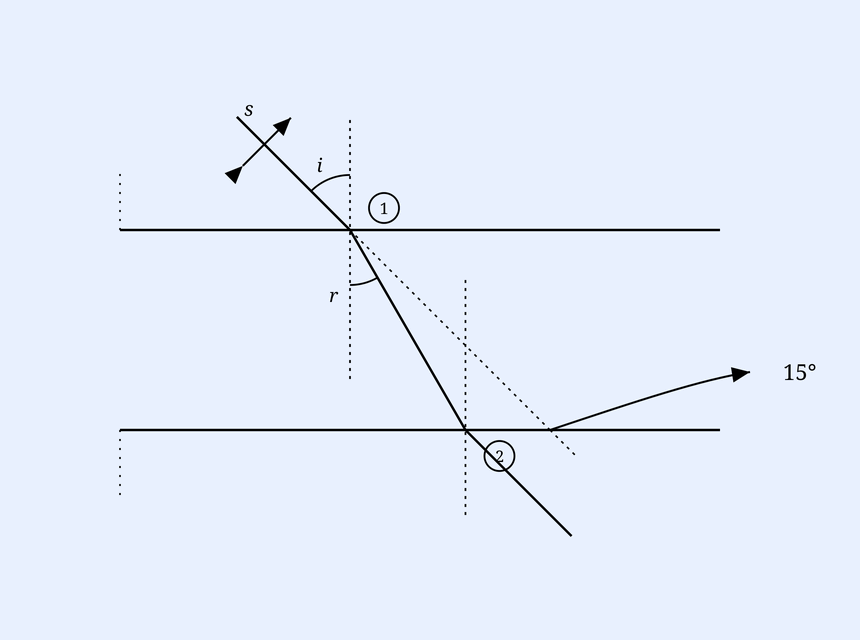
A message signal of frequency 5 kHz is used to modulate a carrier signal of frequency 2 MHz. The bandwidth for amplitude modulation is :
(1)
(2)
(3)
(4)
SolutionAnswer: Option 3
Approach:
The bandwidth required for an amplitude modulated signal equals twice the frequency of the modulating signal.
Step 1:Identify the modulating (message) signal frequency.
Step 2:Apply the amplitude modulation bandwidth relation.
Final answer:
Q2Single correctDual Nature of Matter and Radiation
Electron beam used in an electron microscope, when accelerated by a voltage of 20 kV, has a de-Broglie wavelength of . If the voltage is increased to 40 kV, then the de-Broglie wavelength associated with the electron beam would be :
(1)
(2)
(3)
(4)
SolutionAnswer: Option 3
Approach:
The de-Broglie wavelength of an accelerated electron varies inversely with the square root of the accelerating voltage.
Step 1:Express the proportionality between wavelength and voltage.
Step 2:Form the ratio for the doubled voltage.
Step 3:Solve for the new wavelength.
Final answer:
Q3Single correctKinetic Theory of Gases
The root mean square velocity of molecules of gas is
(1)
(2)
(3)
(4)
SolutionAnswer: Option 1Proportional to square root of temperature
Approach:
The root mean square speed of gas molecules follows from the kinetic theory expression relating speed to absolute temperature.
Step 1:State the kinetic theory expression for rms speed.
Step 2:Isolate the temperature dependence with all other quantities fixed.
Final answer: Proportional to square root of temperature
Q4Single correctWave Optics
In Young's double slits experiment, the position of bright fringe from the central maximum is 5 cm. The distance between slits and screen is 1 m and wavelength of used monochromatic light is 600 nm. The separation between the slits is :
(1)
(2)
(3)
(4)
SolutionAnswer: Option 2
Approach:
The position of the nth bright fringe relates the slit separation to the fringe distance, screen distance and wavelength.
Step 1:List the given quantities.
Step 2:Rearrange the fringe position formula to obtain the slit separation.
Step 3:Convert to micrometres.
Final answer:
Q5Single correctUnits and Measurements
Choose the correct answer from the options given below :
| List I | List II |
|---|---|
| A.. Surface tension | I.. |
| B.. Pressure | II.. |
| C.. Viscosity | III.. |
| D.. Impulse | IV.. |
(1)
(2)
(3)
(4)
SolutionAnswer: Option 3A-III, B-II, C-I, D-IV
Approach:
Each physical quantity is reduced to its SI dimensional units and matched against the listed combinations.
Step 1:Surface tension has units of force per length.
Step 2:Pressure has units of force per area.
Step 3:Coefficient of viscosity has units of pascal second.
Step 4:Impulse equals force times time, the unit of momentum.
Final answer: A-III, B-II, C-I, D-IV
Q6Single correctThermal Properties of Matter
A bowl filled with very hot soup cools from 9C to 8C in 2 minutes when the room temperature is 2C. How long it will take to cool from 7C to 6C?
(1)
(2)
(3)
(4)
SolutionAnswer: Option 21.4 minutes
Approach:
Newton's law of cooling relates the rate of temperature drop to the difference between the average body temperature and the surroundings.
Step 1:Apply the law to the first interval using the mean temperature.
Step 2:Apply the law to the second interval, where the temperature falls by C.
Step 3:Divide the two relations to eliminate the cooling constant.
Final answer: 1.4 minutes
Q7Single correctOscillations
is the time period of simple pendulum on the earth's surface. Its time period becomes when taken to a height (equal to earth's radius) above the earth's surface. Then, the value of will be:
(1)
(2)
(3)
(4)
SolutionAnswer: Option 3
Approach:
The pendulum period varies inversely with the square root of gravitational acceleration, which weakens with altitude.
Step 1:Evaluate gravity at a height equal to the earth's radius.
Step 2:Write the period at this height.
Step 3:Compare with the surface period.
Final answer:
Q8Single correctThermodynamics
A Carnot engine with efficiency 50% takes heat from a source at 600 K. In order to increase the efficiency to 70%, keeping the temperature of sink same, the new temperature of the source will be :
(1)
(2)
(3)
(4)
SolutionAnswer: Option 4
Approach:
Carnot efficiency fixes the ratio of sink to source temperature; the fixed sink temperature found from the first case gives the new source temperature.
Step 1:Use the 50% efficiency at the source of 600 K to find the sink temperature.
Step 2:Apply the 70% efficiency with the same sink temperature.
Step 3:Solve for the new source temperature.
Final answer:
Q9Single correctNuclei
The ratio of the density of oxygen nucleus and helium nucleus is :
(1)
(2)
(3)
(4)
SolutionAnswer: Option 3
Approach:
Nuclear radius scales with the cube root of the mass number, so the density of nuclear matter is independent of the nucleus.
Step 1:Express the nuclear volume using the radius relation.
Step 2:Form the density as mass over volume.
Step 3:Take the ratio for the two nuclei.
Final answer:
Q10Single correctLaws of Motion
A car is moving with a constant speed of 20 m/s in a circular horizontal track of radius 40 m. A bob is suspended from the roof of the car by a massless string. The angle made by the string with the vertical will be : (Take m/)
(1)
(2)
(3)
(4)
SolutionAnswer: Option 4
Approach:
In the rotating frame of the car the bob hangs under gravity and the outward pseudo (centrifugal) force; the string angle balances these.
Step 1:Equate the horizontal and vertical components acting on the bob.
Step 2:Substitute the given values.
Step 3:Solve for the angle.
Final answer:
Q11Single correctLaws of Motion
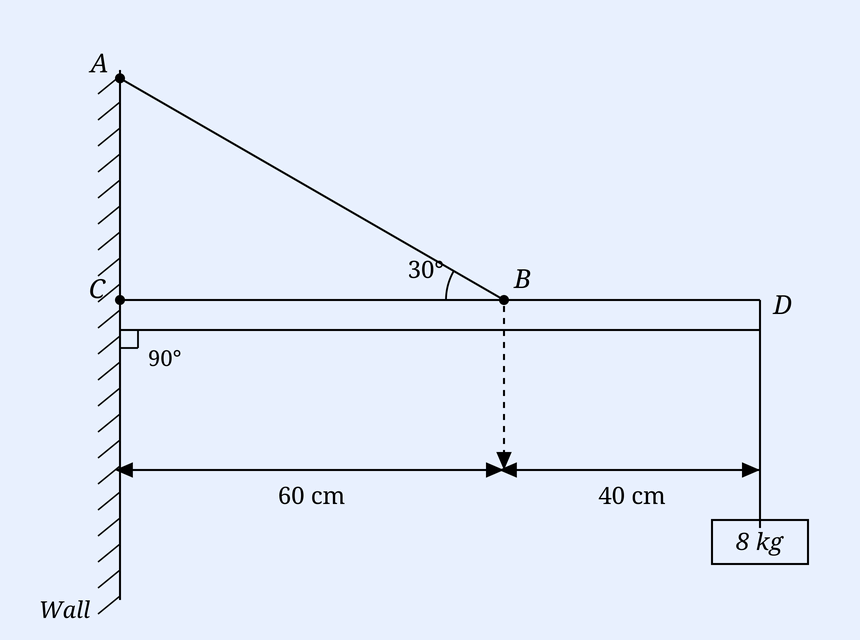
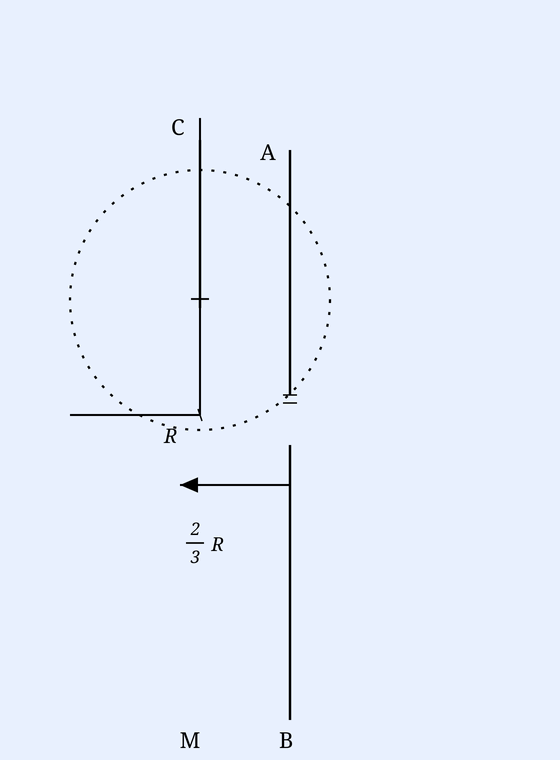
An object of mass 8 kg is hanging from one end of a uniform rod CD of mass 2 kg and length 1 m pivoted at its end C on a vertical wall as shown in figure. It is supported by a cable AB such that the system is in equilibrium. The tension in the cable is : (Take m/)
(1)
(2)
(3)
(4)
SolutionAnswer: Option 3
Approach:
Taking torques about the pivot C balances the cable tension against the rod's weight and the suspended load.
Step 1:Set the net torque about the pivot to zero, with the cable making 30 degrees and acting at 0.5 m.
Step 2:Evaluate the right-hand side.
Step 3:Solve for the tension.
Final answer:
Q12Single correctMotion in a Straight Line
A car travels a distance of 'x' with speed and then same distance 'x' with speed in the same direction. The average speed of the car is :
(1)
(2)
(3)
(4)
SolutionAnswer: Option 3
Approach:
Average speed equals total distance divided by total time for the two equal-distance segments.
Step 1:Express the total distance and total time.
Step 2:Cancel the common distance and simplify.
Final answer:
Q13Single correctElectromagnetic Waves
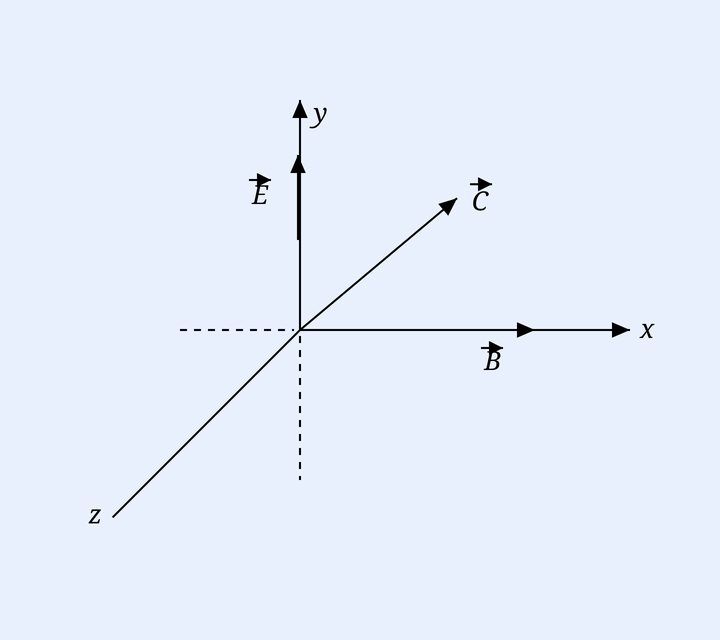
An electromagnetic wave is transporting energy in the negative direction. At a certain point and certain time the direction of electric field of the wave is along positive direction. What will be the direction of the magnetic field of the wave at that point and instant?
(1)
(2)
(3)
(4)
SolutionAnswer: Option 4Positive direction of
Approach:
For an electromagnetic wave the direction of energy flow is along the cross product of the electric and magnetic fields.
Step 1:Identify the propagation and electric field directions.
Step 2:Require the electric, magnetic and propagation directions to satisfy the cross product.
Step 3:State the magnetic field direction.
Final answer: Positive direction of
Q14Single correctCurrent Electricity
A uniform metallic wire carries a current 2 A, when 3.4 V battery is connected across it. The mass of uniform metallic wire is kg, density is kg/ and resistivity is m. The length of wire is :
(1)
(2)
(3)
(4)
SolutionAnswer: Option 3
Approach:
The resistance from Ohm's law combines with the resistivity formula, in which the area is replaced using mass and density.
Step 1:Find the resistance of the wire.
Step 2:Substitute the area in terms of mass and density into the resistance relation.
Step 3:Solve for the length.
Final answer:
Q15Single correctOscillations
In an LC oscillator, if values of inductance and capacitance become twice and eight times, respectively, then the resonant frequency of oscillator becomes x times its initial resonant frequency . The value of x is :
(1)
(2)
(3)
(4)
SolutionAnswer: Option 2
Approach:
The resonant frequency of an LC circuit varies inversely with the square root of the inductance-capacitance product.
Step 1:Replace the inductance with twice its value and the capacitance with eight times its value.
Step 2:Express the new frequency as a multiple of the original.
Final answer:
Q16Single correctMagnetic Effects of Current and Magnetism
A solenoid of 1200 turns is wound uniformly in a single layer on a glass tube 2 m long and 0.2 m in diameter. The magnetic intensity at the center of the solenoid when a current of 2 A flows through it is :
(1)
(2)
(3)
(4)
SolutionAnswer: Option 3
Approach:
The magnetic intensity inside a long solenoid is the product of the number of turns per unit length and the current.
Step 1:Compute the turns per unit length from the total turns and the length of the tube.
Step 2:Multiply by the current to find the magnetic intensity at the center.
Final answer:
Q17Single correctSemiconductor Electronics
Given below are two statements : one is labelled as Assertion A and the other is labelled as Reason R
Assertion A : Photodiodes are used in forward bias usually for measuring the light intensity.
Reason R : For a p-n junction diode, at applied voltage V the current in the forward bias is more than the current in the reverse bias for where is the threshold voltage and is the breakdown voltage.
In the light of the above statements, choose the correct answer from the options given below
Assertion A : Photodiodes are used in forward bias usually for measuring the light intensity.
Reason R : For a p-n junction diode, at applied voltage V the current in the forward bias is more than the current in the reverse bias for where is the threshold voltage and is the breakdown voltage.
In the light of the above statements, choose the correct answer from the options given below
(1)
(2)
(3)
(4)
SolutionAnswer: Option 1A is false but R is true
Approach:
Evaluate the operating mode of a photodiode against the stated assertion and the diode current relation in the reason.
Step 1:A photodiode used to measure light intensity is operated in reverse bias, where the reverse current varies linearly with illumination, so the assertion is false.
Step 2:The reason correctly describes that for a p-n junction the forward-bias current exceeds the reverse-bias current in the stated voltage range, so the reason is true.
Final answer: A is false but R is true
Q18Single correctOscillations
Assume that the earth is a solid sphere of uniform density and a tunnel is dug along its diameter throughout the earth. It is found that when a particle is released in this tunnel, it executes a simple harmonic motion. The mass of the particle is 100 g. The time period of the motion of the particle will be (approximately)
(Take , radius of earth )
(Take , radius of earth )
(1)
(2)
(3)
(4)
SolutionAnswer: Option 41 hour 24 minutes
Approach:
A particle in a tunnel through the earth experiences a restoring force proportional to displacement, giving simple harmonic motion with period set by the surface gravity and earth radius.
Step 1:Substitute the earth radius and surface gravity into the period expression.
Step 2:Evaluate the period in seconds.
Step 3:Convert the period to hours and minutes.
Final answer: 1 hour 24 minutes
Q19Single correctElectrostatics
A parallel plate capacitor has plate area and plates separation 2 mm. The space between the plates is filled with a dielectric medium of a thickness 1 mm and dielectric constant 5. The capacitance of the system is :
(1)
(2)
(3)
(4)
SolutionAnswer: Option 2
Approach:
Treat the partially filled capacitor as a series combination of a vacuum gap and a dielectric slab, using the standard partial-fill capacitance formula.
Step 1:Insert the plate area, total separation, slab thickness and dielectric constant into the partial-fill formula.
Step 2:Simplify the numerator and denominator to obtain the capacitance.
Final answer:
Q20Single correctMagnetic Effects of Current and Magnetism
Choose the correct answer from the options given below :
| List I (Current configuration) | List II (Magnitude of Magnetic Field at point P) |
|---|---|
A.. 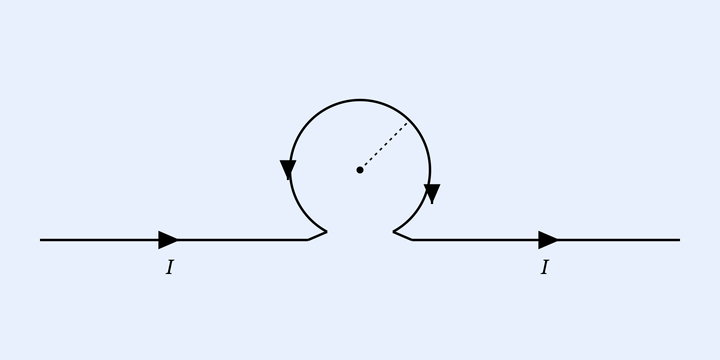 | I.. |
B.. 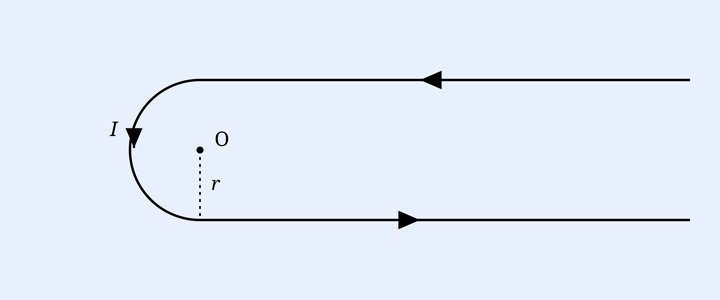 | II.. |
C.. 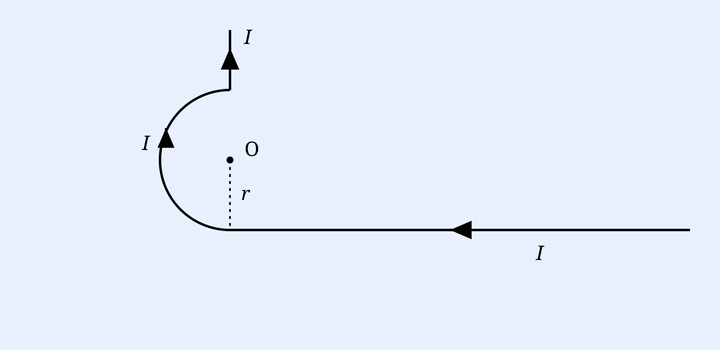 | III.. |
D.. 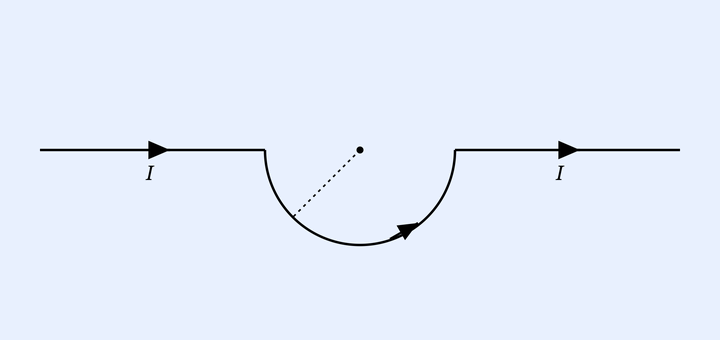 | IV.. |
(1)
(2)
(3)
(4)
SolutionAnswer: Option 3A-III, B-I, C-IV, D-II
Approach:
Compute the net magnetic field at the marked point for each current configuration by superposing the contributions of the straight segments and circular arcs, then match to List II.
Step 1:For configuration A, the arc and straight portions combine to give the field proportional to the bracket pi minus one.
Step 2:For configuration B, the contributions add to the bracket pi plus two.
Step 3:For configuration C, the field reduces to the bracket pi plus one.
Step 4:For configuration D, a complete circular loop gives the field of a full circle.
Final answer: A-III, B-I, C-IV, D-II
Q21NumericalWork, Energy and Power
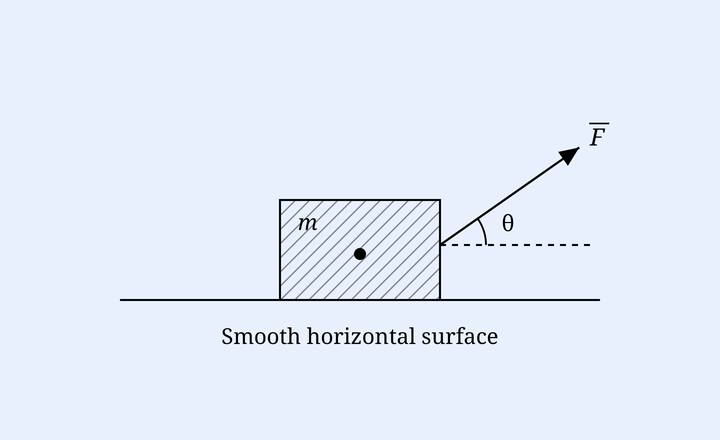
An object of mass 'm' initially at rest on a smooth horizontal plane starts moving under the action of force . In the process of its linear motion, the angle (as shown in figure) between the direction of force and horizontal varies as , where k is a constant and x is the distance covered by the object from its initial position. The expression of kinetic energy of the object will be , the value of n is ______.
SolutionAnswer: 2
Approach:
Use the work-energy theorem, integrating the horizontal component of the force over the displacement with the angle varying as a linear function of distance.
Step 1:Express the kinetic energy as the integral of the horizontal force component, with the angle equal to k times distance.
Step 2:Evaluate the integral to obtain the kinetic energy in terms of the angle.
Step 3:Compare with the given form to read off the numerator constant.
Final answer: 2
Q22NumericalProperties of Solids
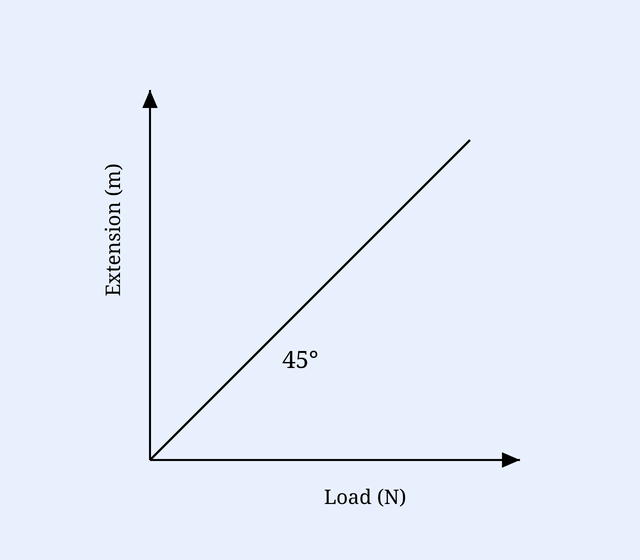
As shown in the figure, in an experiment to determine Young's modulus of a wire, the extension-load curve is plotted. The curve is a straight line passing through the origin and makes an angle of with the load axis. The length of wire is and its diameter is 4 mm. The Young's modulus is found to be . The value of x is ______.
SolutionAnswer: 5
Approach:
Relate Young's modulus to the slope of the extension-load line through the wire geometry, then evaluate with the slope equal to one for a forty-five degree line.
Step 1:Write Young's modulus as the reciprocal slope times the geometric factor of length over cross-sectional area.
Step 2:Substitute the length and radius with unit slope and evaluate.
Step 3:Compare with the given form to read off the coefficient.
Final answer: 5
Q23NumericalElectrostatics
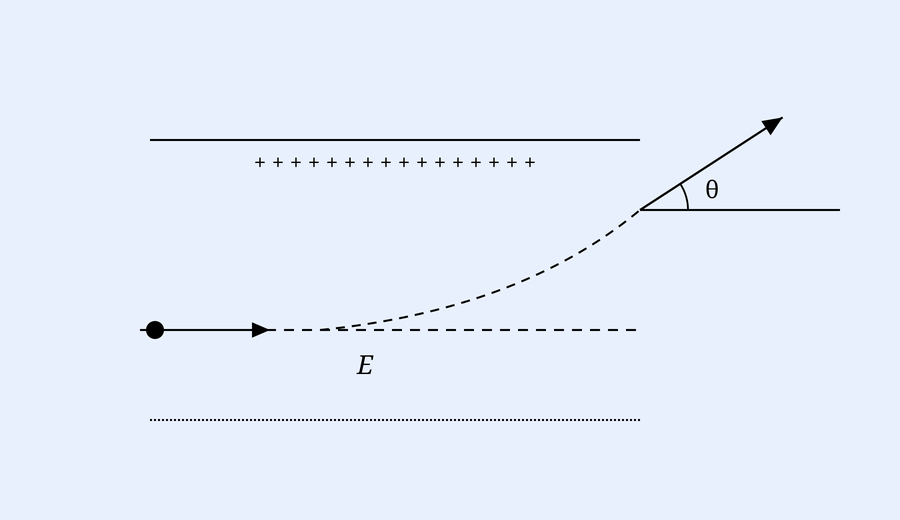
A uniform electric field of 10 N/C is created between two parallel charged plates (as shown in figure). An electron enters the field symmetrically between the plates with a kinetic energy 0.5 eV. The length of each plate is 10 cm. The angle () of deviation of the path of electron as it comes out of the field is ______ (in degree).
SolutionAnswer: 45
Approach:
Find the transverse velocity gained from the electric force over the time of flight inside the plates and compare it with the entry velocity to obtain the deflection angle.
Step 1:Express the tangent of the deflection angle as the transverse velocity from the electric acceleration over the entry velocity, using the time of flight equal to the plate length over the entry velocity.
Step 2:Substitute the field, plate length and kinetic energy, with the electronic charge cancelling against the kinetic energy in electron volts.
Step 3:Take the inverse tangent to obtain the deflection angle.
Final answer: 45
Q24NumericalAlternating Current
An LCR series circuit of capacitance 62.5 nF and resistance of , is connected to an A.C. source of frequency 2.0 kHz. For maximum value of amplitude of current in circuit, the value of inductance is ______ mH.
(Take )
(Take )
SolutionAnswer: 100
Approach:
Maximum current amplitude occurs at resonance, where the inductive and capacitive reactances are equal; solve for the inductance.
Step 1:At resonance the inductive reactance equals the capacitive reactance, giving the inductance in terms of angular frequency and capacitance.
Step 2:Substitute the angular frequency and capacitance, using pi squared equal to ten.
Final answer: 100
Q25NumericalCurrent Electricity
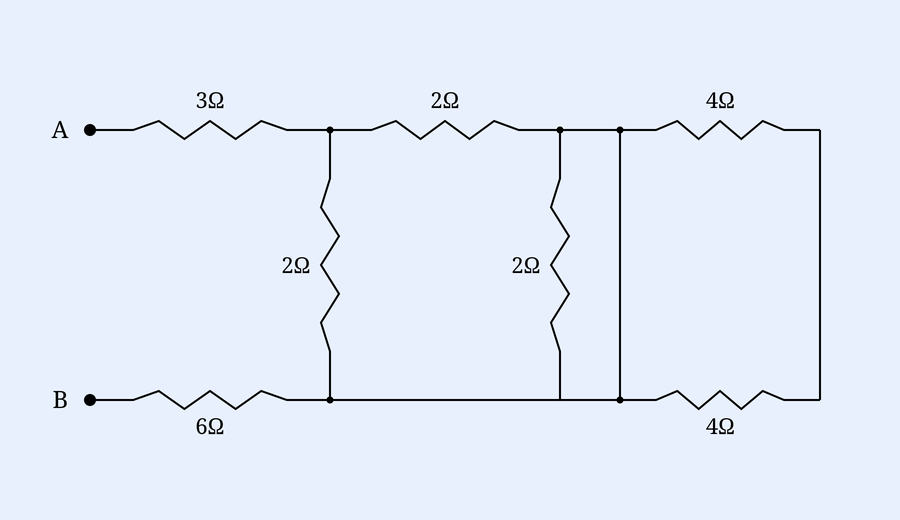
In the given circuit, the equivalent resistance between the terminal A and B is ______ .
SolutionAnswer: 10
Approach:
Redraw the network to identify series and parallel combinations, then reduce stepwise to a single equivalent resistance between the terminals.
Step 1:Redraw the circuit so that the three-ohm resistor is in series with the parallel grouping of the remaining resistors.
Step 2:Combine the parallel and series branches to obtain the equivalent resistance between A and B.
Final answer: 10
Q26NumericalWaves
The distance between two consecutive points with phase difference of in a wave of frequency 500 Hz is 6.0 m. The velocity with which wave is traveling is ______ km/s.
SolutionAnswer: 18
Approach:
Relate the given path difference and phase difference to the wavelength, then use the wave speed equation with the frequency.
Step 1:Convert the sixty degree phase difference to a fraction of the wavelength and equate to the given separation.
Step 2:Multiply the wavelength by the frequency to find the wave speed.
Final answer: 18
Q27NumericalSystem of Particles and Rotational Motion
is the moment of inertia of a circular disc about an axis (CM) passing through its center and perpendicular to the plane of disc. is its moment of inertia about an axis AB perpendicular to plane and parallel to axis CM at a distance from center. Where R is the radius of the disc. The ratio of and is . The value of x is ______.
SolutionAnswer: 17
Approach:
Apply the parallel axis theorem to shift the perpendicular axis from the center to a point two-thirds of the radius away, then form the requested ratio.
Step 1:Add the shift term for a distance of two-thirds the radius to the central moment of inertia.
Step 2:Form the ratio of the shifted moment of inertia to the central moment of inertia.
Step 3:Compare the ratio with x to nine to read off the value of x.
Final answer: 17
Q28NumericalRay Optics
A ray of light is incident from air on a glass plate having thickness cm and refractive index . The angle of incidence of a ray is equal to the critical angle for glass-air interface. The lateral displacement of the ray when it passes through the plate is ______ cm. (given )
SolutionAnswer: 52
Approach:
Find the critical angle as the angle of incidence, determine the refraction angle inside the plate, then apply the lateral displacement formula for a parallel plate.
Step 1:Set the angle of incidence equal to the critical angle for the glass-air interface.
Step 2:Apply Snell's law at the air-to-glass entry to find the refraction angle.
Step 3:Substitute into the lateral displacement formula with the given sine of fifteen degrees.
Step 4:Express the displacement in the requested units.
Final answer: 52
Q29NumericalVectors
If and then, the unit vector in the direction of is . The value of x is ______.
SolutionAnswer: 4
Approach:
Evaluate the cross product of the two vectors, take its magnitude, and identify the normalizing factor that produces the stated unit vector.
Step 1:Expand the determinant to obtain the cross product vector.
Step 2:Compute the magnitude of the cross product.
Step 3:Divide by the magnitude and factor out one quarter to match the given form.
Final answer: 4
Q30NumericalAtoms and Nuclei
The wavelength of the radiation emitted is when an electron jumps from the second excited state to the first excited state of hydrogen atom. If the electron jumps from the third excited state to the second excited state of hydrogen atom, the wavelength of the radiation emitted will be . The value of x is ______.
SolutionAnswer: 27
Approach:
Use the Rydberg relation for each transition, form the ratio of the two wavelengths, and equate to the given expression to find x.
Step 1:Write the reciprocal wavelength for the transition from the second excited state to the first excited state, that is from level three to level two.
Step 2:Write the reciprocal wavelength for the transition from the third excited state to the second excited state, that is from level four to level three.
Step 3:Take the ratio of the wavelengths and simplify to match the given form.
Final answer: 27
Chemistry29 questions
Q31Single correctOrganic Compounds Containing Nitrogen
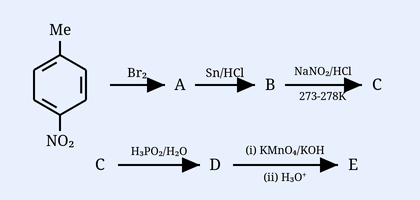
Identify the product formed (A and E)
(1)
(2)
(3)
(4)
SolutionAnswer: Option 2A = 2-bromo-4-nitrotoluene; E = 2-bromobenzoic acid
Approach:
Track the functional group transformations of p-nitrotoluene through bromination, reduction, diazotisation and subsequent steps to identify intermediates A and final product E.
Step 1:Bromination of the toluene ring directs ortho to methyl giving the brominated nitrotoluene as A.
Step 2:Sn/HCl reduces the nitro group; diazotisation, deamination and oxidation of the methyl convert the chain to the carboxylic acid bearing bromine, giving E.
Final answer: A = 2-bromo-4-nitrotoluene; E = 2-bromobenzoic acid
Q33Single correctp-Block Elements
Reaction of thionyl chloride with white phosphorus forms a compound [A], which on hydrolysis gives [B], a dibasic acid. [A] and [B] are respectively
(1)
(2)
(3)
(4)
SolutionAnswer: Option 2
Approach:
Determine the product of white phosphorus with thionyl chloride and identify the dibasic acid produced on its hydrolysis.
Step 1:White phosphorus reacts with thionyl chloride to form phosphorus trichloride as compound A.
Step 2:Hydrolysis of phosphorus trichloride yields phosphorous acid, a dibasic acid B.
Final answer:
Q34Single correctSome Basic Concepts in Chemistry
'25 volume' hydrogen peroxide means
(1)
(2)
(3)
(4)
SolutionAnswer: Option 4
Approach:
Convert the volume strength to molarity using the standard relation, then find the mass of hydrogen peroxide in one litre.
Step 1:Divide the volume strength by 11.2 to obtain the molarity.
Step 2:Multiply molarity by the molar mass 34 to obtain the mass of hydrogen peroxide in one litre.
Final answer:
Q35Single correctAlcohols, Phenols and Ethers
In the cumene to phenol preparation in presence of air, the intermediate is
(1)
(2)
(3)
(4)
SolutionAnswer: Option 2Cumene hydroperoxide, Ph-C(CH3)2-O-O-H
Approach:
Identify the species formed when cumene reacts with air before acid-catalysed rearrangement to phenol and acetone.
Step 1:Aerial oxidation of the benzylic carbon of cumene gives cumene hydroperoxide as the intermediate.
Step 2:Acid treatment of this hydroperoxide rearranges it to phenol and acetone.
Final answer: Cumene hydroperoxide, Ph-C(CH3)2-O-O-H
Q36Single correctAtomic Structure
The radius of the 2 orbit of L is x. The expected radius of the 3 orbit of B is
(1)
(2)
(3)
(4)
SolutionAnswer: Option 3
Approach:
Apply the Bohr radius dependence on principal quantum number squared over nuclear charge to both ions and take their ratio.
Step 1:For the second orbit of lithium ion the radius equals the base radius times four over three, fixing the base radius.
Step 2:For the third orbit of beryllium ion the radius equals the base radius times nine over four.
Step 3:Substituting the base radius gives the required radius in terms of x.
Final answer:
Q37Single correctGeneral Principles of Metallurgy
Which one of the following reactions does not occur during extraction of copper?
(1)
(2)
(3)
(4)
SolutionAnswer: Option 1
Approach:
Recall the slag-forming and roasting reactions of the copper extraction process and identify the reaction not part of it.
Step 1:During copper extraction iron(II) oxide is removed as ferrous silicate slag, and copper sulphide and iron sulphide undergo roasting.
Step 2:Calcium oxide combining with silica to form calcium silicate belongs to other metallurgies and does not occur here.
Final answer:
Q38Single correctBiomolecules
Correct match is
| Row I | Row II |
|---|---|
A. 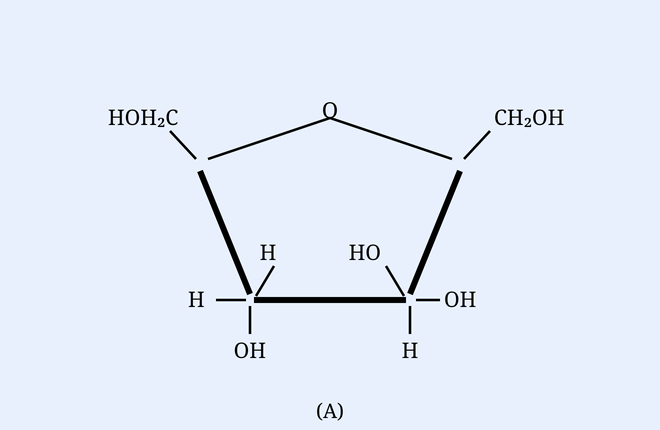 | (i). |
B. 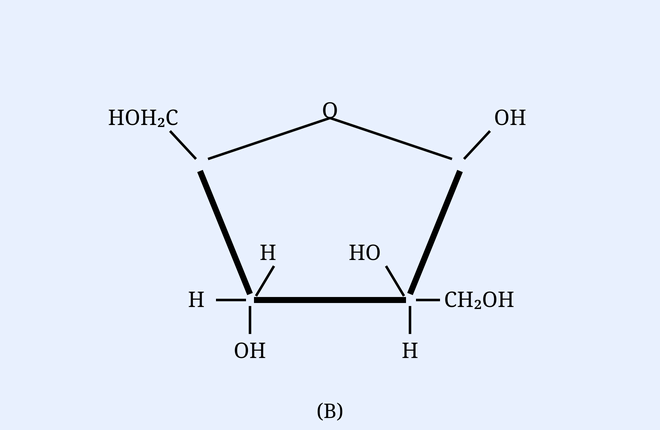 | (ii). |
C. 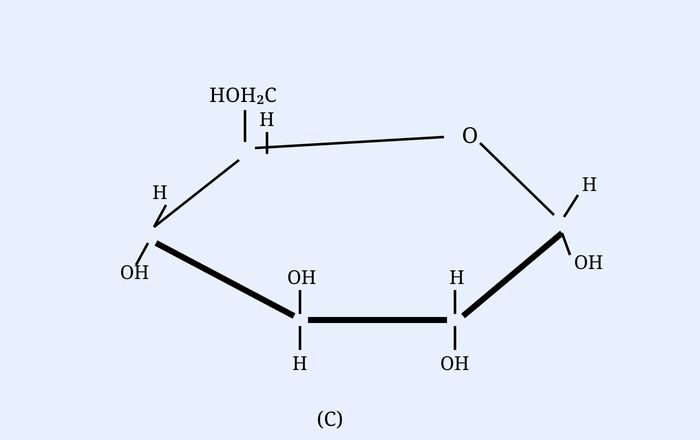 | (iii). |
D. 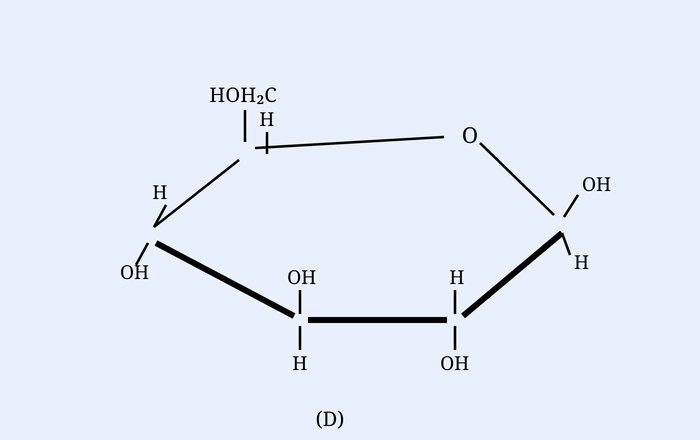 | (iv). |
(1)
(2)
(3)
(4)
SolutionAnswer: Option 1
Approach:
Identify each Haworth structure in Row I as a pyranose or furanose with its anomeric configuration and match to the names in Row II.
Step 1:Structures A and B are six-membered glucopyranose rings differing in anomeric hydroxyl orientation, matching the alpha and beta glucopyranose names.
Step 2:Structures C and D are five-membered fructofuranose rings, matching the alpha and beta fructofuranose names.
Final answer:
Q39Single correctChemistry in Everyday Life
Which of the following statements is incorrect for antibiotics?
(1)
(2)
(3)
(4)
SolutionAnswer: Option 1
Approach:
Recall the defining properties of antibiotics and identify the statement contradicting them.
Step 1:Antibiotics inhibit the growth or survival of microorganisms rather than promote it, so the first statement is incorrect.
Step 2:The remaining statements correctly describe antibiotics as low-concentration metabolic or synthetic-analogue agents.
Final answer:
Q40Single corrects-Block Elements
Choose the correct answer from the options given below :
| LIST I (Elements) | LIST II (Colour imparted to the flame) |
|---|---|
| A. | I. |
| B. | II. |
| C. | III. |
| D. | IV. |
(1)
(2)
(3)
(4)
SolutionAnswer: Option 1
Approach:
Assign the characteristic flame colour of each metal and match to the list.
Step 1:Potassium gives a violet flame and calcium gives a brick red flame.
Step 2:Strontium gives a crimson red flame and barium gives an apple green flame.
Final answer:
Q41Single correctHaloalkanes and Haloarenes
The compound which will have the lowest rate towards nucleophilic aromatic substitution on treatment with OH is
(1)
(2)
(3)
(4)
SolutionAnswer: Option 21-chloro-3-nitrobenzene (meta isomer)
Approach:
Compare the position of the electron-withdrawing nitro group relative to the halogen in each structure to rank the rate of nucleophilic aromatic substitution.
Step 1:Aryl halides bearing the nitro group at the ortho or para position to the halogen react faster than the meta isomer.
Step 2:The structure with the nitro group meta to the chlorine has the lowest rate, identifying option 2.
Final answer: 1-chloro-3-nitrobenzene (meta isomer)
Q42Single correctHydrocarbons
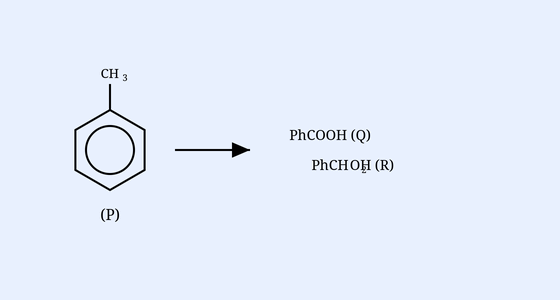
The correct sequence of reagents for the preparation of Q and R is:
(1)
(2)
(3)
(4)
SolutionAnswer: Option 2
Approach:
Trace the conversion of the n-alkane P through aromatisation and side-chain oxidation to give benzoic acid Q and benzyl alcohol R, selecting the matching reagent sequence.
Step 1:Aromatisation of the alkane over chromium(III) oxide at high temperature and pressure forms the toluene ring system.
Step 2:Chromyl chloride oxidation gives an aldehyde, which through base-mediated Cannizzaro-type steps and acidification yields benzoic acid and benzyl alcohol.
Final answer:
Q43Single correctAldehydes, Ketones and Carboxylic Acids
Given below are two statements: one is labelled as Assertion A and the other is labelled as Reason R:
Assertion A: Acetal/Ketal is stable in basic medium.
Reason R: The high leaving tendency of alkoxide ion gives the stability to acetal/ketal in basic medium.
In the light of the above statements, choose the correct answer from the options given below:
Assertion A: Acetal/Ketal is stable in basic medium.
Reason R: The high leaving tendency of alkoxide ion gives the stability to acetal/ketal in basic medium.
In the light of the above statements, choose the correct answer from the options given below:
(1)
(2)
(3)
(4)
SolutionAnswer: Option 4
Approach:
Assess the truth of the assertion about acetal stability and the reason about alkoxide leaving tendency.
Step 1:Acetals and ketals are stable in basic conditions but hydrolyse readily under acidic conditions, so the assertion is true.
Step 2:Alkoxide is a poor leaving group, so the high leaving tendency stated in the reason is false.
Final answer:
Q44Single correctSome Basic Principles of Organic Chemistry
Which of the following conformations will be the most stable?
(1)
(2)
(3)
(4)
SolutionAnswer: Option 1Anti (staggered) Newman projection of n-butane
Approach:
Rank the Newman projection conformations of butane by torsional and steric strain to find the most stable one.
Step 1:The stability order of butane conformers places the anti form highest, followed by gauche, partially eclipsed and fully eclipsed.
Step 2:The anti conformation with the two methyl groups opposite corresponds to option 1.
Final answer: Anti (staggered) Newman projection of n-butane
Q45Single correctOrganic Compounds Containing Nitrogen
The correct order in aqueous medium of basic strength in case of methyl substituted amines is:
(1)
(2)
(3)
(4)
SolutionAnswer: Option 1
Approach:
Balance inductive electron donation, steric hindrance and solvation of the conjugate acid to order the basic strength of methylamines in water.
Step 1:In aqueous medium the combined effect of inductive donation and solvation makes the secondary amine the strongest base.
Step 2:The tertiary amine suffers reduced solvation and the unsubstituted ammonia is weakest, completing the order.
Final answer:
Q46Single corrects-Block Elements
Compound A reacts with and forms a compound B. Compound B reacts with and excess of to form compound C which on passing through or reaction with saturated solution forms sodium hydrogen carbonate. Compound A, B and C, are respectively
(1)
(2)
(3)
(4)
SolutionAnswer: Option 2
Approach:
Identify the species in the Solvay (ammonia-soda) process. Slaked lime reacts with ammonium chloride to liberate ammonia, which with water and carbon dioxide forms ammonium bicarbonate, the precursor to sodium bicarbonate.
Step 1:Compound A, slaked lime, treated with ammonium chloride releases ammonia gas.
Step 2:Compound B, ammonia, with water and excess carbon dioxide forms ammonium bicarbonate.
Step 3:Compound C reacts with saturated brine to precipitate sodium bicarbonate, confirming the assignment.
Final answer:
Q47Single correctQualitative Analysis
Correct match is
| List-I (Cations) | List-II (Group reagents) |
|---|---|
| A. | (i). gas in presence of dilute |
| B. | (ii). in presence of |
| C. | (iii). in presence of |
| D. | (iv). in presence of |
(1)
(2)
(3)
(4)
SolutionAnswer: Option 1
Approach:
Assign each cation pair to its analytical group reagent in the classical scheme of qualitative inorganic analysis.
Step 1:Group II cations precipitate as sulphides with hydrogen sulphide in dilute acid.
Step 2:Group III cations precipitate as hydroxides with ammonia in presence of ammonium chloride.
Step 3:Group IV cations precipitate as sulphides with hydrogen sulphide in ammoniacal medium.
Step 4:Group V cations precipitate as carbonates with ammonium carbonate in ammoniacal medium.
Final answer:
Q48Single correctChemical Kinetics
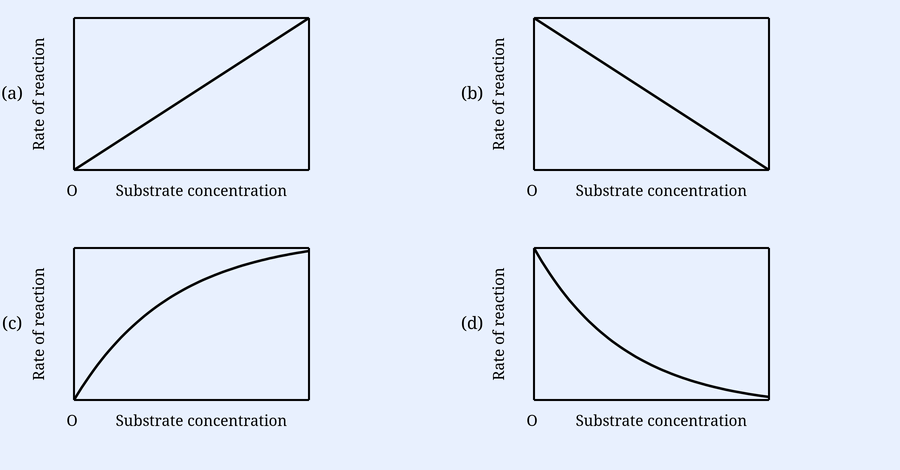
The variation of the rate of an enzyme catalyzed reaction with substrate concentration is correctly represented by graph
(1)
(2)
(3)
(4)
SolutionAnswer: Option 4(c)
Approach:
Apply the saturation behaviour of enzyme catalysis: rate rises with substrate concentration and then levels off as the enzyme becomes saturated.
Step 1:At low substrate concentration the rate increases nearly linearly with substrate concentration.
Step 2:At high substrate concentration every enzyme active site is occupied, so the rate becomes independent of substrate concentration and reaches a plateau.
Step 3:The plot that rises and then flattens to a maximum is graph (c).
Final answer: (c)
Q49Single correctEnvironmental Chemistry
Some reactions of relevant to photochemical smog formation are
Identify A, B, X and Y.
Identify A, B, X and Y.
(1)
(2)
(3)
(4)
SolutionAnswer: Option 2
Approach:
Trace the photochemical chain of nitrogen dioxide photolysis that generates ground-level ozone.
Step 1:Sunlight dissociates nitrogen dioxide into nitric oxide and atomic oxygen.
Step 2:Atomic oxygen combines with molecular oxygen of the air.
Step 3:The printed solution assigns A as molecular oxygen and B as ozone, consistent with option (2).
Final answer:
Q50Single correctPeriodic Properties
Inert gases have positive electron gain enthalpy. Its correct order is
(1)
(2)
(3)
(4)
SolutionAnswer: Option 1
Approach:
Compare the magnitudes of the (positive) electron gain enthalpies of the noble gases from the tabulated values.
Step 1:List the positive electron gain enthalpy values in kilojoule per mole.
Step 2:Order the four listed gases by increasing magnitude of electron gain enthalpy.
Step 3:The increasing order corresponds to option (1).
Final answer:
Q51NumericalSolutions
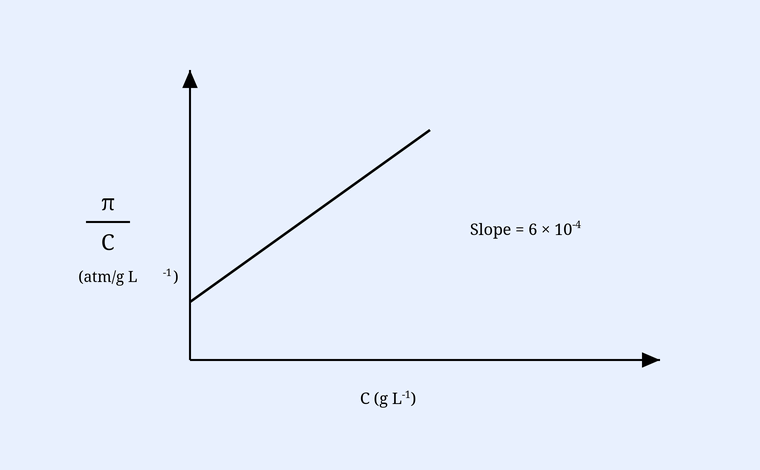
The osmotic pressure of solutions of PVC in cyclohexanone at 300 K are plotted on the graph. The molar mass of PVC is _______ g (Nearest integer)
(Given : R = 0.083 L atm )
(Given : R = 0.083 L atm )
SolutionAnswer: 41500
Approach:
Relate the slope of the osmotic-pressure-versus-concentration plot to the molar mass through the van't Hoff equation.
Step 1:Express osmotic pressure in terms of mass concentration and molar mass.
Step 2:Identify the slope of the plot with the quantity RT divided by molar mass.
Step 3:Solve for the molar mass using R, T and the slope.
Final answer: 41500
Q52NumericalSome Basic Concepts of Chemistry
The density of a monobasic strong acid (Molar mass 24.2 g/mol) is 1.21 kg/L. The volume of its solution required for the complete neutralization of 25 mL of 0.24 M NaOH is _______ mL (Nearest integer)
SolutionAnswer: 12
Approach:
Equate the moles of monobasic acid to the moles of sodium hydroxide, expressing acid moles through its density and molar mass.
Step 1:Compute the molarity of the pure monobasic acid from its density and molar mass.
Step 2:Apply the milliequivalence balance for a monobasic acid and a monoacidic base.
Step 3:Solve for the required volume of acid.
Final answer: 12
Q53NumericalIonic Equilibrium
A litre of buffer solution contains 0.1 mole of each of and . On the addition of 0.02 mole of HCl by dissolving gaseous HCl, the pH of the solution is found to be _______ (Nearest integer)
[Given :
]
[Given :
]
SolutionAnswer: 9079
Approach:
Update the base and salt amounts after the added acid consumes ammonia, then apply the Henderson-Hasselbalch equation for the basic buffer and convert pOH to pH.
Step 1:Added hydrochloric acid converts an equal amount of ammonia into ammonium ion.
Step 2:Apply the buffer equation for the new amounts.
Step 3:Convert the pOH to pH at 298 K.
Final answer: 9079
Q54NumericalCoordination Compounds
The number of paramagnetic species from the following is _______.
and
and
SolutionAnswer: 4
Approach:
Determine the number of unpaired electrons in each complex from the metal oxidation state and the ligand field strength, then count those with at least one unpaired electron.
Step 1:Evaluate the nickel complexes for unpaired electrons.
Step 2:Evaluate the iron and copper complexes for unpaired electrons.
Step 3:Total the paramagnetic complexes.
Final answer: 4
Q55NumericalPurification and Characterisation of Organic Compounds
In sulphur estimation, 0.471 g of an organic compound gave 1.4439 g of barium sulphate. The percentage of sulphur in the compound is _______ (Nearest Integer)
(Given: Atomic mass Ba: 137 u, S: 32 u, O:16 u)
(Given: Atomic mass Ba: 137 u, S: 32 u, O:16 u)
SolutionAnswer: 42
Approach:
In the Carius method all sulphur of the compound is precipitated as barium sulphate; the sulphur fraction of barium sulphate scaled by its mass gives the sulphur percentage.
Step 1:Compute the molar mass of barium sulphate.
Step 2:Apply the sulphur percentage formula with the measured masses.
Step 3:Evaluate the expression.
Final answer: 42
Q56NumericalChemical Kinetics
For the first order reaction , the half life is 30 min. The time taken for 75% completion of the reaction is_______ min. (Nearest integer)
Given :
Given :
SolutionAnswer: 60
Approach:
For a first order reaction the time for 75 percent completion equals two half lives, since three quarters reacted corresponds to one quarter remaining.
Step 1:After 75 percent completion the fraction remaining is one quarter, which equals two successive halvings.
Step 2:Express the time as twice the half life.
Step 3:State the result.
Final answer: 60
Q57Numericald- and f-Block Elements
How many of the following metal ions have similar value of spin only magnetic moment in gaseous state? _______
(Given : Atomic number : V, 23; Cr, 24; Fe, 26; Ni, 28)
(Given : Atomic number : V, 23; Cr, 24; Fe, 26; Ni, 28)
SolutionAnswer: 2
Approach:
Find the number of unpaired d electrons for each ion and compare their spin only magnetic moments, counting how many share the same value.
Step 1:Determine unpaired electrons and magnetic moments for the d-configurations.
Step 2:Identify the ions sharing the same magnetic moment.
Step 3:Count the matching ions.
Final answer: 2
Q58NumericalElectrochemistry
Consider the cell
Given and ,
If the potential of the cell is 0.712 V, the ratio of concentration of to is _______ (Nearest integer)
Given and ,
If the potential of the cell is 0.712 V, the ratio of concentration of to is _______ (Nearest integer)
SolutionAnswer: 10
Approach:
Write the Nernst equation for the single-electron cell, insert the standard and measured potentials, and solve for the concentration ratio.
Step 1:With unit hydrogen ion concentration and unit hydrogen pressure the reaction quotient reduces to the ratio of iron ion concentrations.
Step 2:Isolate the logarithm of the concentration ratio.
Step 3:Convert from the logarithm to the ratio.
Final answer: 10
Q59NumericalChemical Bonding
The total number of lone pairs of electrons on oxygen atoms of ozone is_______
SolutionAnswer: 6
Approach:
Draw the resonance Lewis structure of ozone and count the lone pairs on the central and terminal oxygen atoms.
Step 1:The central oxygen carries a positive charge with one lone pair, bonded by a single and a double bond to the terminal atoms.
Step 2:The singly bonded terminal oxygen bears a negative charge with three lone pairs; the doubly bonded terminal oxygen has two lone pairs.
Step 3:Sum the lone pairs over all three oxygen atoms.
Final answer: 6
Q60NumericalThermodynamics
An athlete is given 100 g of glucose () for energy. This is equivalent to 1800kJ of energy. The 50% of this energy gained is utilized by the athlete for sports activities at the event. In order to avoid storage of energy, the weight of extra water he would need to perspire is_______ g (Nearest integer)
Assume that there is no other way of consuming stored energy.
Given : The enthalpy of evaporation of water is 45 kJ
Molar mass of C, H & O are 12, 1 and 16 g
Assume that there is no other way of consuming stored energy.
Given : The enthalpy of evaporation of water is 45 kJ
Molar mass of C, H & O are 12, 1 and 16 g
SolutionAnswer: 360
Approach:
The unused half of the glucose energy must be dissipated by evaporating water; divide that energy by the molar enthalpy of evaporation and convert moles of water to mass.
Step 1:Half of the 1800 kJ supplied by glucose remains as the energy to be removed.
Step 2:Determine the moles of water whose evaporation absorbs this energy.
Step 3:Convert moles of water to mass.
Final answer: 360
Mathematics30 questions
Q61Single correctStatistics
The mean and variance of the marks obtained by the students in a test are 10 and 4 respectively. Later, the marks of one of the points and revised is increased from 8 to 12. If the new mean of the marks of the students is increased from 8 to 12, then their new variance is equal to :
(1)
(2)
(3)
(4)
SolutionAnswer: Option 3
Approach:
Find the number of students from the original mean and variance, then recompute mean and variance after one mark changes from 8 to 12.
Step 1:From the original mean and variance, determine the number of students.
Step 2:Changing one mark from 8 to 12 raises the mean to 10.2, fixing N.
Step 3:Update the sum of squares and compute the new variance.
Final answer:
Q62Single correctMathematical Reasoning
The statement is
(1)
(2)
(3)
(4)
SolutionAnswer: Option 4a tautology
Approach:
Construct the truth table for the compound statement over all truth-value assignments of p and q.
Step 1:Evaluate the antecedent and the consequent.
Step 2:If is true, then p is true and is true, so is true.
Step 3:The full implication is true in every row of the truth table.
Final answer: a tautology
Q63Single correctCo-ordinate Geometry
The points of intersection of the line and the circle are and . The image of the circle with AB as a diameter in the line is :
(1)
(2)
(3)
(4)
SolutionAnswer: Option 1
Approach:
Find A and B on the circle, form the circle with AB as diameter, then reflect its centre in the given line.
Step 1:A and B lie on the line and circle.
Step 2:Circle on AB as diameter has centre at the midpoint and radius half the length AB.
Step 3:Reflect the centre in .
Step 4:Write the reflected circle with the same radius.
Final answer:
Q64Single correct3D Geometry
Consider the lines and given by
A line having direction ratios , intersects and at the points P and Q respectively. Then the length of line segment PQ is
A line having direction ratios , intersects and at the points P and Q respectively. Then the length of line segment PQ is
(1)
(2)
(3)
(4)
SolutionAnswer: Option 2
Approach:
Parametrize P on L1 and Q on L2, impose that PQ is parallel to (1,-1,-2), then compute the length.
Step 1:Take general points on each line.
Step 2:Direction ratios of PQ are proportional to .
Step 3:Solve the resulting equations.
Step 4:Compute the distance PQ.
Final answer:
Q65Single correctFunctions
Let be a function defined by , and . Consider
(I) g is an increasing function in
(II) g is one-one in
Then,
(I) g is an increasing function in
(II) g is one-one in
Then,
(1)
(2)
(3)
(4)
SolutionAnswer: Option 2Both (I) and (II) are true
Approach:
Simplify g(x), differentiate, and analyze its sign to determine monotonicity and injectivity.
Step 1:Form g(x) from f(-x) and f(x).
Step 2:Differentiate g(x).
Step 3:A positive derivative makes g increasing, therefore one-one.
Final answer: Both (I) and (II) are true
Q66Single correctMatrices and Determinants
Let and be respectively the sets of all for which the system of linear equations
has unique solution and infinitely many solutions. Then
has unique solution and infinitely many solutions. Then
(1)
(2)
(3)
(4)
SolutionAnswer: Option 2 and
Approach:
Evaluate the coefficient determinant; if it is nonzero for all admissible a, the system has a unique solution for every such a.
Step 1:Form the coefficient determinant.
Step 2:Expanding gives a nonzero quadratic in a after factoring out a.
Step 3:The quadratic has no real root, so for every the determinant is nonzero.
Step 4:Hence the unique-solution set is all admissible a and the infinite-solution set is empty.
Final answer: and
Q67Single correctIntegral Calculus
The minimum value of the function is
(1)
(2)
(3)
(4)
SolutionAnswer: Option 3
Approach:
Split the integral over the cases x<0, 0<=x<=2 and x>2, evaluate f(x) in each region, and locate the minimum.
Step 1:For x>2 the integrand is .
Step 2:For x<0 the integrand is .
Step 3:For split at t=x.
Step 4:Minimize over ; the minimum occurs at x=1.
Final answer:
Q68Single correctSequence and Series
Let . Then at is equal to
(1)
(2)
(3)
(4)
SolutionAnswer: Option 1
Approach:
Expand y(x) using the telescoping product, then differentiate and evaluate at x=-1.
Step 1:Multiply and divide by (1-x) to telescope the product.
Step 2:Differentiate term by term and evaluate at x=-1.
Step 3:Differentiate again and evaluate at x=-1.
Step 4:Combine the two values.
Final answer:
Q69Single correctDifferential Calculus
Let be a local minima of the function . If M is local maximum value of the function f in , then
(1)
(2)
(3)
(4)
SolutionAnswer: Option 1
Approach:
Differentiate f, factor the cubic derivative using the given local minimum, locate the local maximum, and evaluate f there.
Step 1:Differentiate f(x).
Step 2:Factor using the known root x=2.
Step 3:Solve the quadratic for the other critical points.
Step 4:Evaluate f at the local maximum.
Final answer:
Q70Single correctLimits
The value of
is :
is :
(1)
(2)
(3)
(4)
SolutionAnswer: Option 2
Approach:
Express the numerator as a sum of products and the denominator via leading-order growth, then take the dominant-term limit.
Step 1:Write the numerator as a sum of triple products.
Step 2:Leading order of numerator is the sum of products of order .
Step 3:Denominator leading order.
Step 4:Divide leading terms and rationalize.
Final answer:
Q71Single correctCo-ordinate Geometry
The distance of the point from the common tangent , of the curves and is
(1)
(2)
(3)
(4)
SolutionAnswer: Option 4
Approach:
Write the tangent lines to both parabolas, equate them to find the common tangent, then apply the point-to-line distance formula.
Step 1:Tangent to .
Step 2:Tangent to .
Step 3:Equate the intercepts and solve for m.
Step 4:Common tangent and distance from the given point.
Final answer:
Q72Single correctMatrices and Determinants
Let and . Then is equal to :
(1)
(2)
(3)
(4)
SolutionAnswer: Option 3
Approach:
Compute |A| using change-of-base for logarithms, then apply the adjugate-determinant identity twice.
Step 1:Express all entries with a common logarithm base.
Step 2:Evaluate the resulting determinant.
Step 3:Apply the adjugate identity (n=3) twice to .
Step 4:Substitute |A| = 2.
Final answer:
Q73Single correctIntegral Calculus
Let . If , then is equal to
(1)
(2)
(3)
(4)
SolutionAnswer: Option 3
Approach:
Substitute t = , integrate by partial fractions, use the given value to fix the constant, then evaluate f(4).
Step 1:Substitute .
Step 2:Resolve into partial fractions and integrate.
Step 3:Apply the given value f(3) to find C.
Step 4:Evaluate f(4).
Final answer:
Q74Single correct3D Geometry
The distance of the point from the line passing through the point and parallel to a line with direction ratios is equal to
(1)
(2)
(3)
(4)
SolutionAnswer: Option 4
Approach:
Form the vector from the line's point A to P, project it onto the direction, and use the Pythagorean relation to get the perpendicular distance.
Step 1:Vector from A(-3,2,3) to P(4,6,-2).
Step 2:Projection of AP onto the direction .
Step 3:Apply the Pythagorean relation.
Step 4:Take the square root.
Final answer:
Q75Single correctProbability
Let M be the maximum value of the product of two positive integers when their sum is 66. Let the sample space and the event . Then P(A) is equal to
(1)
(2)
(3)
(4)
SolutionAnswer: Option 3
Approach:
Maximize the product under the fixed-sum constraint, determine the sample space from the inequality, count the favourable multiples of 3, and form the probability.
Step 1:Maximum product when the two integers are equal.
Step 2:Solve the defining inequality of S.
Step 3:Count integers in S and the multiples of 3.
Step 4:Form the probability.
Final answer:
Q76Single correctVector Algebra
Let and be three non zero vectors such that and . If be a vector such that , then is equal to
(1)
(2)
(3)
(4)
SolutionAnswer: Option 1
Approach:
Apply the vector triple product expansion to extract the dot products, then use the scalar quadruple product identity to evaluate the required expression.
Step 1:Expand the given triple product and compare with the right-hand side.
Step 2:Apply the scalar quadruple product identity with the given orthogonality .
Step 3:Substitute and .
Final answer:
Q77Single correctBinomial Theorem
If is the coefficient of in the Binomial expansion of , then is equal to
(1)
(2)
(3)
(4)
SolutionAnswer: Option 1
Approach:
Express the ratio of consecutive binomial coefficients, square it, and evaluate the resulting summation using standard power sum formulas.
Step 1:Write the coefficient ratio and square it.
Step 2:Multiply by and simplify the summand.
Step 3:Apply the power-sum formulas with .
Final answer:
Q78Single correctDifferential Equations
Let be the solution curve of the differential equation . Then is equal to
(1)
(2)
(3)
(4)
SolutionAnswer: Option 3
Approach:
Reduce the equation to a Bernoulli form in , integrate, then apply the initial condition to fix the constant.
Step 1:Rearrange and substitute , giving a linear-type relation in t.
Step 2:Apply to evaluate the constant.
Step 3:Solve for and simplify the logarithmic terms.
Final answer:
Q79Single correctComplex Numbers and Quadratic Equations
Let and . The set represents a
(1)
(2)
(3)
(4)
SolutionAnswer: Option 3straight line with the sum of its intercepts on the coordinate axes equals
Approach:
Write , expand the modulus condition into a linear equation, then find the axis intercepts.
Step 1:Substitute and the given points; expand both squared moduli.
Step 2:Simplify to the line equation.
Step 3:Read off the intercepts: -intercept , -intercept .
Final answer: straight line with the sum of its intercepts on the coordinate axes equals
Q80Single correctVector Algebra
The vector is rotated through a right angle, passing through the y-axis in its way and the resulting vector is . Then the projection of on is
(1)
(2)
(3)
(4)
SolutionAnswer: Option 4
Approach:
Use the rotation-through- via the y-axis condition to determine , then compute the scalar projection of onto .
Step 1:Pass through the y-axis: with , giving .
Step 2:Choose and form .
Step 3:Project onto , with .
Final answer:
Q81NumericalThree Dimensional Geometry
Let the equation of the plane passing through the line and parallel to the line be . Then the distance of the point (a,b,c) from the plane is _____.
SolutionAnswer: 9
Approach:
Form the family of planes through the given line, impose parallelism with the second line to fix the parameter, then compute the point-plane distance.
Step 1:Take the plane and require its normal to be perpendicular to the second line's direction; solve for .
Step 2:Identify the coefficients.
Step 3:Apply the distance formula to the plane .
Final answer: 9
Q82NumericalConic Sections
The vertices of a hyperbola H are and its eccentricity is . Let N be the normal to H at a point in the first quadrant and parallel to the line . If d is the length of the line segment of N between H and the y-axis then is equal to _____.
SolutionAnswer: 216
Approach:
Determine the hyperbola from its vertices and eccentricity, find the first-quadrant point where the normal has the given slope, then compute the squared segment length to the -axis.
Step 1:With and , obtain .
Step 2:Impose the normal slope equal to that of (slope ) to locate the first-quadrant point.
Step 3:Compute the segment of the normal from this point to the -axis and square it.
Final answer: 216
Q83NumericalComplex Numbers and Quadratic Equations
Let . Then the maximum value of for which the equation has real roots, is _____.
SolutionAnswer: 25
Approach:
Solve the logarithmic equation for via a substitution, evaluate the two required summations over S, then impose the non-negative discriminant condition to bound .
Step 1:Set , reduce the log equation to a linear relation and solve.
Step 2:Evaluate the summations over .
Step 3:Impose on .
Final answer: 25
Q84NumericalRelations and Functions
For some , let and . If , then is equal to _____.
SolutionAnswer: 2039
Approach:
Invert symbolically, match it to the given inverse to read off , then evaluate the two composite values.
Step 1:Match with .
Step 2:Evaluate .
Step 3:Evaluate and add.
Final answer: 2039
Q85NumericalPermutations and Combinations
Let x and y be distinct integers where and . Then, the number of ways of choosing x and y, such that is divisible by , is _____.
SolutionAnswer: 120
Approach:
Classify the integers to by their residue modulo , count residue pairs whose sum is divisible by , then subtract the equal cases.
Step 1:Each residue class contains numbers from to .
Step 2:Pairs summing to a multiple of : residue pairs; count ordered choices of distinct integers.
Step 3:Confirm exclusion of cases (already removed in distinctness).
Final answer: 120
Q86NumericalBinomial Theorem
The constant term in the expansion of is _____.
SolutionAnswer: 1080
Approach:
Factor out to convert the trinomial into a polynomial, then find the coefficient of the power of x that cancels the factored term.
Step 1:Write the expression as .
Step 2:The term with uses one factor of raised so that ; matching gives coefficient from .
Step 3:Multiply out.
Final answer: 1080
Q87NumericalPermutations and Combinations
Let . The number of non-empty subsets of S that have the sum of all elements a multiple of , is _____.
SolutionAnswer: 43
Approach:
Group the elements by residue modulo , then count subsets in each residue group whose combined residue sums to , multiplying independent choices.
Step 1:Classify: one element is of type, three are of type, and three are of type.
Step 2:Count subset combinations whose total residue is across the groups (the element is free in ways).
Step 3:Remove the empty subset.
Final answer: 43
Q88NumericalInverse Trigonometric Functions
If the sum of all the solutions of is , then is equal to _____.
SolutionAnswer: 2
Approach:
Split the domain by the sign of x, reduce each inverse term using the double-angle substitution , solve for x on each branch, then sum the solutions.
Step 1:Case : the identity gives .
Step 2:Case : leads to a second root.
Step 3:Sum the solutions and match to .
Final answer: 2
Q89NumericalSequences and Series
Let be the three A.P. with the same common difference d and having their first terms as , respectively. Let a,b,c be the terms of , respectively such that . If , then the sum of first terms of an AP whose first term is and common difference is , is equal to _____.
SolutionAnswer: 495
Approach:
Express in terms of and , use and the determinant condition to solve for and the required quantities, then apply the AP sum formula.
Step 1:Write , , ; use and the determinant condition to solve.
Step 2:Form the AP with first term and common difference .
Step 3:Apply the sum formula for terms.
Final answer: 495
Q90NumericalIntegral Calculus
In the area enclosed by the parabolas and is equal to the area enclosed by and , then is equal to _____.
SolutionAnswer: 600
Approach:
Find the intersection of the two parabolas, compute the enclosed area , then set the area between and the line equal to it and solve for .
Step 1:Intersect and : gives . Compute .
Step 2:Area between and the line from to .
Step 3:Equate and solve.
Final answer: 600
More JEE Main 2023 papers
Frequently Asked Questions
How many questions are in the JEE Main 2023 January 25, Shift 1 paper?
The JEE Main 2023 January 25, Shift 1 paper has 89 questions — Physics (30), Chemistry (29) and Mathematics (30). Every question is on this page with its correct answer and a step-by-step solution.
What is the marking scheme for JEE Main?
JEE Main awards +4 marks for each correct answer and −1 for a wrong answer, with 0 for questions left unattempted. The paper covers Physics, Chemistry and Mathematics.
Are the answer key and step-by-step solutions provided for the 2023 January 25, Shift 1 paper?
Yes — every question shows the correct answer (answer key) and a detailed step-by-step solution, free to read online.
Can I take the JEE Main 2023 January 25, Shift 1 paper as a timed mock test?
Yes. With a free JEEnify account you can attempt this exact paper as a timed test in the real exam interface, then see your score and weak-area analysis.
Solved this paper? Calculate your JEE Main scoremost important chaptersformula sheetsall free tools.