JEEnify Logo
JEEnify
All formula sheets

Dual Nature of Radiation & Matter Formula Sheet — JEE Main Physics

Every key Dual Nature of Radiation & Matter formula, definition and theorem for JEE Main Physics in one place — with common examiner traps and worked examples. Free to read; blurt from memory, then check your gaps.

Syllabus — topics coveredNTA · 8 sub-topics

  • Dual nature of radiation
  • Photoelectric effect
  • Hertz and Lenard's observations
  • Einstein's photoelectric equation
  • Particle nature of light
  • Matter waves
  • Wave nature of particle
  • de-Broglie relation

Electron Emission & Work Function

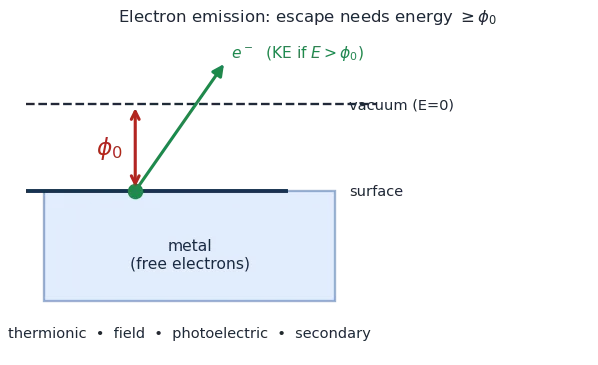
Work function : The energy a free electron needs to just escape a metal surface; in eV (J). Lower electrons emitted more easily.
Energy to escape
threshold frequency / wavelength of the metal
Four ways to supply the energy
  • — heat the metal (CRT filament).
  • — strong external E-field (V/m).
  • — light with .
  • — bombard with fast particles.
Potential-well picture: a free electron at the metal surface needs energy at least equal to the work function to reach the vacuum level and escape with kinetic energy
An electron escapes only if energy given .
Metal (eV)
Cs2.14
Na2.75
Ca3.20
W4.5
Cu4.65
Ni5.15
Pt5.65
🚫 Examiner Trap · Work function
(1) is the escape energy — given energy below it gives NO emission, however long you wait. (2) Alkali metals (Cs, Na, K) have the photosensitive to visible light (photocathodes). (3) links work function to threshold frequency. (4) Work in eV but convert to joules before using SI formulae.

Photoelectric Effect — Experiment & Laws

Photoelectric effect: Emission of electrons from a metal when light of falls on it. Discovered by (1887); studied by Hallwachs & Lenard.
Max KE & stopping potential
stopping potential — reverse voltage that just halts the fastest electron
Experimental laws
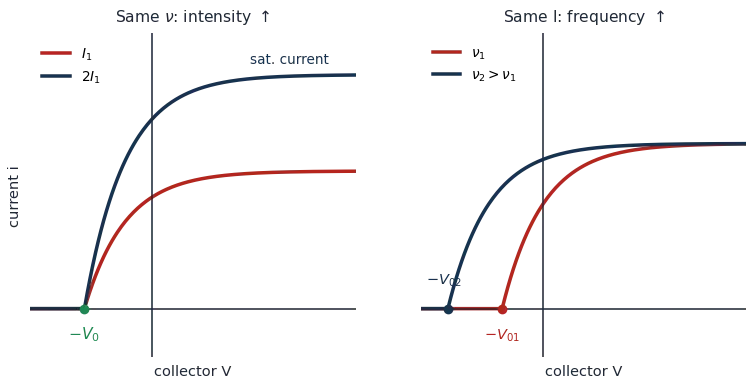
  • : photocurrent intensity, but unchanged.
  • : (hence ) rises linearly with ; independent of intensity.
  • : no emission below , however intense.
  • : emission within s (no lag).
Left: photocurrent vs collector voltage for two intensities — same stopping potential, higher saturation current. Right: two frequencies at fixed intensity — same saturation current, larger stopping potential for higher frequency
Intensity raises saturation current (same ); raises .
Comparative: vary intensity vs frequency
IncreaseSaturation current /
Intensity (same )risesunchanged
Frequency (same )unchangedrises
🚫 Examiner Trap · Photoelectric laws
(1) depends on , NOT intensity; intensity sets only the of electrons (saturation current). (2) Below there is emission even at huge intensity. (3) Emission is — no time lag. (4) Classical wave theory fails on all three counts — needs photons.

Einstein's Photoelectric Equation

Einstein's equation
one photon absorbed by one electron
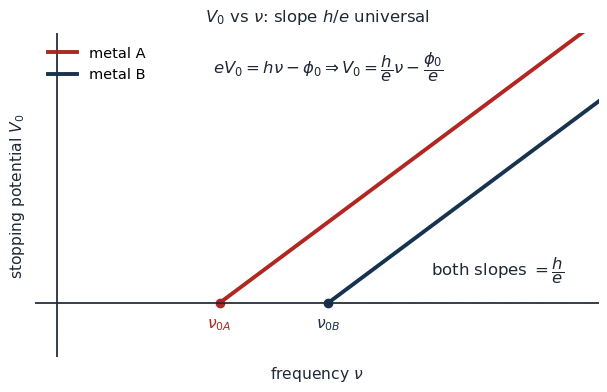
Stopping potential
a straight line vs , slope
Threshold
Stopping potential versus frequency: two parallel straight lines for two metals, same slope h/e, with different x-intercepts at their threshold frequencies
vs : slope is the SAME for all metals.
✎ Example · Stopping potential
Light nm on a metal of eV. Find .
  1. eV
V
🚫 Examiner Trap · Einstein's equation
(1) Slope of is , UNIVERSAL (Millikan) — only the intercept () changes with metal. (2) — subtract the FULL work function, not twice. (3) Use eV nm to convert (nm)energy(eV) fast. (4) One photon ejects at most one electron.

Photon — Particle Nature of Light

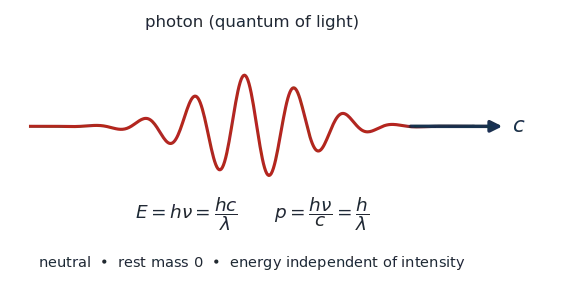
Photon: A quantum of EM radiation: a packet of energy and momentum , moving at c, electrically , with .
Photon energy
Photon momentum
momentum despite zero rest mass
Photon flux
source power, area
A photon depicted as a localized wave packet moving at speed c, labelled with energy E=hν=hc/λ and momentum p=hν/c=h/λ
Photon: energy & momentum in one neutral, massless quantum.
✎ Example · Photons per second
A mW laser emits nm. Photons/s?
  1. J
photons/s
🚫 Examiner Trap · Photon
(1) Photon has momentum despite — don't use . (2) Raising intensity at fixed adds more photons, NOT more energy per photon. (3) Photon is electrically neutral; its energy/momentum are unaffected by E or B fields. (4) In photon–electron collisions both energy AND momentum are conserved.

de Broglie Matter Waves

Matter wave (de Broglie, 1924): Every moving particle has a wave of wavelength . Significant only for light particles (electrons); negligible for macroscopic bodies.
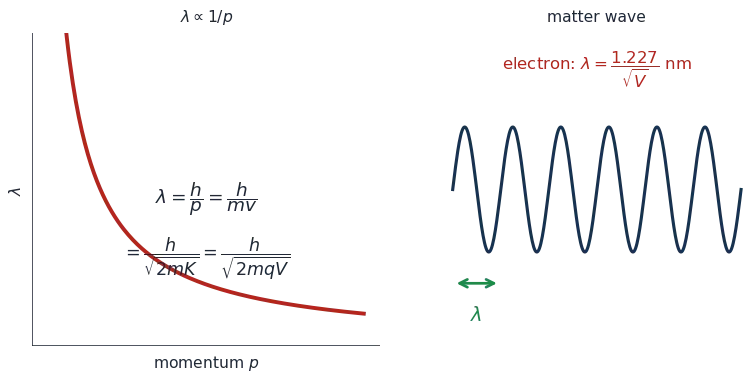
de Broglie wavelength
for charge accelerated through
Accelerated electron
V in volts; nm
Left: λ versus momentum showing inverse relation λ=h/p. Right: a sinusoidal matter wave with wavelength marked, with the accelerated-electron formula λ=1.227/√V nm
— heavier/faster particles have shorter waves.
✎ Example · Shortest wavelength
Electron, proton, with the SAME KE — shortest ?
  1. heaviest shortest;
-particle has the shortest
🚫 Examiner Trap · de Broglie waves
(1) Same : (heavier shorter). Same : equal . Same : . (2) Use nm ONLY for electrons (in volts). (3) Macroscopic bodies have unmeasurably tiny . (4) Thermal: .

Davisson–Germer Experiment

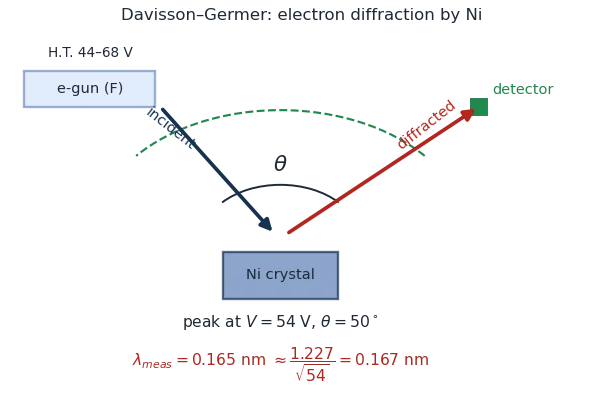
First direct proof of electron waves (Davisson & Germer, 1927): an accelerated electron beam strikes a ; scattered intensity is read by a movable detector at angle .
Observation
  • Sharp at V, .
  • Measured wavelength nm.
Agreement with de Broglie
theory matches experiment confirms
Davisson–Germer apparatus: electron gun directs an incident beam onto a nickel crystal; the diffracted beam at angle θ is detected by a movable collector on a circular scale; peak at 54 V, 50°
Diffraction peak at V, confirms electron waves.
Further confirmations
  • — electron diffraction through foils (1937 Nobel).
  • Electron microscope exploits matter-wave optics (high resolution).
  • Later: electron & molecule double-slit interference.
🚫 Examiner Trap · Davisson–Germer
(1) The peak appears at a V and (54 V, 50) — constructive interference of electron waves off the Ni lattice. (2) The measured matches — this is the of de Broglie. (3) It proves (matter) diffract, the matter-wave analogue of light diffraction.

Wave–Particle Duality & Uncertainty

Wave–particle duality: Radiation and matter both show wave behaviour (interference, diffraction) particle behaviour (photoelectric, collisions). Which shows up depends on the experiment — never both at once.
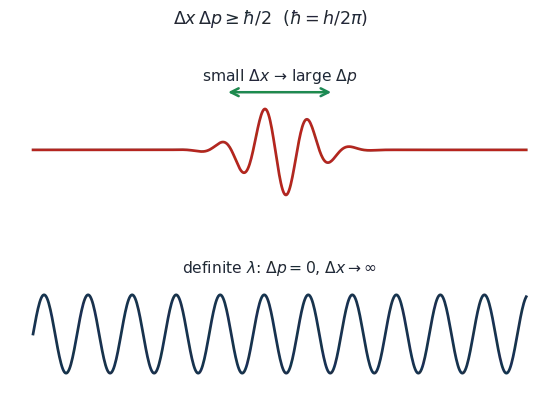
Heisenberg uncertainty
position and momentum cannot both be exact
Energy–time form
Top: a localized wave packet — small position spread but large momentum spread. Bottom: an extended wave of definite wavelength — momentum spread zero but position spread infinite
Localized packet vs definite- wave — the trade-off.
Quick constants
ConstantValue
J s
J s
eV nm
kg
eVJ
🚫 Examiner Trap · Duality & uncertainty
(1) Use the picture for propagation/interference; the picture for emission/absorption/collisions — never both in one measurement. (2) A definite momentum () means a wave spread over (). (3) Uncertainty is fundamental, not a measurement flaw. (4) Use , not h, in .

More JEE Main Physics formula sheets

Frequently Asked Questions

What are the most important Dual Nature of Radiation & Matter formulas for JEE Main?

This Dual Nature of Radiation & Matter formula sheet covers all the high-yield Physics formulas, definitions and theorems you need for JEE Main, across Dual nature of radiation, Photoelectric effect, Hertz and Lenard's observations, Einstein's photoelectric equation, Particle nature of light — each shown with the key result and, where useful, a worked example.

Is this Dual Nature of Radiation & Matter formula sheet free?

Yes — the full chapter formula sheet is free to read online, no login or payment required.

How should I revise Dual Nature of Radiation & Matter formulas?

Blurt the Dual Nature of Radiation & Matter formulas from memory, then check against this sheet to find your gaps — and practise a few previous-year questions on the chapter to make sure you can apply them under time pressure.

Also useful: all formula sheets · JEE Main previous-year papers · most important chapters.