JEEnify Logo
JEEnify
All formula sheets

Gravitation Formula Sheet — JEE Main Physics

Every key Gravitation formula, definition and theorem for JEE Main Physics in one place — with common examiner traps and worked examples. Free to read; blurt from memory, then check your gaps.

Syllabus — topics coveredNTA · 10 sub-topics

  • The universal law of gravitation
  • Acceleration due to gravity and its variation with altitude and depth
  • Gravitational potential energy
  • Gravitational potential
  • Escape velocity
  • Orbital velocity of a satellite
  • Geo-stationary satellites
  • Kepler's laws of planetary motion
  • Gravitational potential energy near the surface of the earth
  • Gravitational potential in the gravitational field

Universal Law & Gravitational Field

Newton's universal law
masses, centre-to-centre separation, (universal); always attractive, along the join line
  • Vector form: , and (Newton's third law).
  • : net force on a mass vector sum of forces from every other mass, .
  • Strictly for ; a uniform sphere acts as if all mass is at its centre (shell theorem).
  • G measured by the torsion-balance experiment ('weighing the Earth').
Gravitational field intensity: Force per unit test mass ; for a point mass M, — numerically equal to the acceleration g it produces (units ).
⚡ Shortcut · vs field
Gravitational field and acceleration g are the at a point — compute whichever is easier; is the cause, g the effect on a free body.
Field of standard bodies
total mass, body radius, distance from centre/axis
Point / outside any sphere ()
Ring, on its axis
Ring — maximum field
Solid sphere, inside ()
Shell, inside ()
Shell theorem (NCERT):A uniform spherical shell attracts an point mass as if its entire mass were at the centre; it exerts force on a point mass it.
💡 Tip · No shielding
Gravitational — unlike a conductor for electric fields, a shell does not screen the field of outside masses on a particle inside.
🚫 Examiner Trap · Universal law & field
(1) r is the distance, NOT the surface gap — for two spheres add both radii. (2) Force only for points / external spheres; a solid sphere (rises from ). (3) G (universal constant) (local, varies). (4) Inside a shell but a shell does shield — outside fields still act.

Acceleration due to Gravity & its Variation
Surface value
Earth mass, Earth radius, mean density; , independent of the falling body's mass
Altitude above surface
height above surface; binomial approximation valid only for
Depth below surface
depth; only the inner sphere of radius contributes (shell outside cancels); at the centre
Latitude (Earth's rotation)
latitude, Earth's spin rate; max at poles (), min at equator;
⚡ Shortcut · Equal fall, equal cause
For small , g falls the same amount at height h as at depth (since vs ). Useful to compare 'up vs down' problems fast.
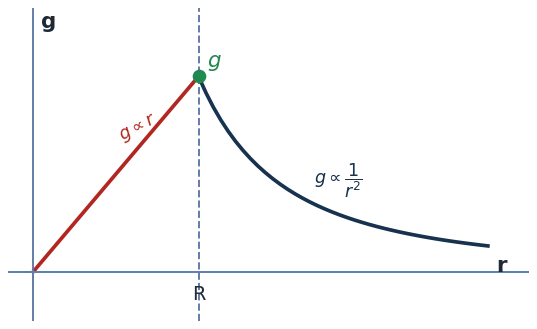
g vs distance from centre: rises linearly (g proportional to r) inside, then falls as 1/r^2 outside, peaking at the surface r=R
g is : inside , outside .
Comparative: how changes
CauseFormulaEffect on Inside variation
Altitude decreases--
Depth decreases (linear)
Latitude min equator, max pole--
Rotation decreasesequator only
  • Near the surface the depth fall () is than the altitude fall ().
  • Earth is an oblate ellipsoid: km, so (with rotation, ).
  • At the equator gravity would vanish if rose ( min) — bodies would float.
★ Remember
Both altitude depth g. A body weighs most at the poles and at the surface.
🚫 Examiner Trap · Variation of
(1) is only the for — for large h use the exact . (2) Depth uses (factor ), altitude uses (factor ) — do NOT swap. (3) Rotation reduces g at the , not the poles (). (4) g is independent of the test body's mass — heavier objects do not fall faster.

Gravitational Potential & Potential Energy
Gravitational potential
work per unit mass to bring it from (scalar, J/kg); always negative, at ; field points down the potential gradient
Potential of standard bodies ( total, radius)
Ring (centre axis x)
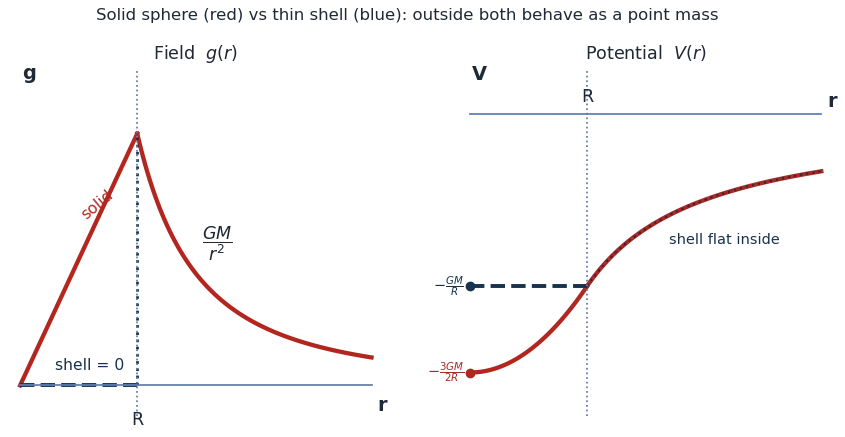
Shell, inside ()
Solid sphere, inside ()
Solid sphere, centre
Two panels: field g(r) and potential V(r) for a solid sphere (rising/parabolic inside) and a thin shell (zero field, constant potential inside); both behave as a point mass outside
Solid sphere (red) vs thin shell (blue) — identical outside.
🚫 Examiner Trap · Potential
(1) V is a and always (zero only at ) — never add it like a vector. (2) Inside a shell V is (NOT zero) even though . (3) Surface potential of a solid sphere is but the is deeper, . (4) — a flat V means , not the reverse.
Potential energy
Two point masses
interaction PE (J); system PE sum over all pairs (superposition); for a mass in a field
Mass with Earth
centre distance; mgh is the approximation of the true PE difference, valid only for
Self-energy (assembling a body)
work done by gravity in assembling the mass from ; solid sphere is more tightly bound (more negative)
🎯 Exam · Field potential
Field can be zero where potential is not (inside a shell: but ). The field points toward potential.
⚡ Shortcut · to height h
Exact rise: . Reduces to mgh for ; use the full form whenever h is comparable to R (e.g. raising a satellite).

Escape Velocity & Projectile Paths

Escape velocity
min surface speed to reach with ; for Earth, for the Moon
  • Independent of the of the body and of the of projection.
  • — escape speed is the surface orbital speed.
  • Extra speed to escape : .
  • The Moon retains no atmosphere because its low lets gas molecules escape.
Comparative: orbital vs escape velocity
Orbital Escape
Surface formula
Earth valuekm/skm/s
Relation
Total energy (just escapes)
★ Remember
A bound body has . It just escapes when (minimum at , reaching infinity with zero speed).
Speed of projection path
Projection speed Resulting path
ellipse (falls back / decays)
circle
ellipse (larger orbit)
parabola (just escapes)
hyperbola (escapes with surplus KE)
💡 Tip · Perigee vs apogee
For a horizontal projection at distance r, the launch point is the when (body curves inward) and the when (body moves outward).
🚫 Examiner Trap · Escape & paths
(1) is independent of mass and launch — angle does not matter (no air). (2) ONLY at the same radius; do not mix surface with a high orbit's . (3) gives a (E), not a straight line; is a hyperbola. (4) Escaping from a circular orbit needs only extra, not a full .

Kepler's Laws of Planetary Motion

The three laws
  • : every planet moves in an ellipse with the Sun at one focus.
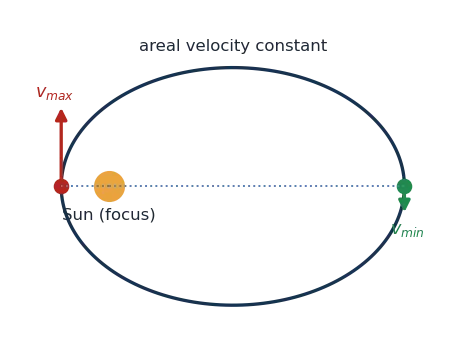
  • : the radius vector sweeps equal areas in equal times — areal velocity const (fastest at perihelion).
  • : , i.e. , with semi-major axis.
Areal velocity (law of areas)
angular momentum, planet mass; constant because gravity is a central force (no torque)
Perihelion / aphelion speeds
nearest/farthest distances; from angular-momentum conservation, since
⚡ Shortcut · Period ratio
For two orbits, — only the semi-major axis a matters, NOT eccentricity. A circle and a thin ellipse of the same a have the same T.
Elliptical orbit with the Sun at one focus; velocity tangent and maximum at perihelion, minimum at aphelion; equal areas swept in equal times
Areal velocity constant: fast near the Sun, slow far away.
Consequences
  • Gravity is a , so angular momentum is conserved and the motion is planar.
  • Kepler's 3rd law applies to Earth satellites too: .
Binary star
separation; both stars share one period about the common centre of mass; heavier star orbits closer & slower
🚫 Examiner Trap · Kepler's laws
(1) The Sun is at a , not the centre of the ellipse. (2) Equal (not equal arcs / equal angles) in equal times — speed is highest at perihelion. (3) In , a is the , not the radius or the focal distance. (4) Areal velocity is constant; linear speed v is NOT — it varies along the orbit.

Satellites — Orbital Motion & Energy
Orbital velocity
orbit radius (from Earth's centre), Earth radius; near the surface (first cosmic speed)
Time period
(Kepler 3); near-Earth
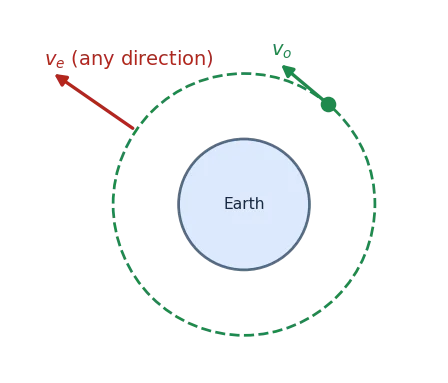
Earth with a satellite on a circular orbit showing tangential orbital velocity v_o, and escape velocity v_e directed outward
Orbital speed (tangential) vs escape speed .
⚡ Shortcut · Higher orbit = slower
As : (as ), (as ), KE, (less negative), but total (less negative). A satellite slows as it climbs.
Energy of a satellite
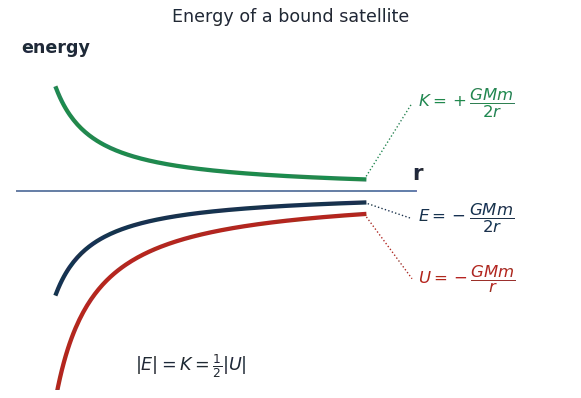
K, U, E in a circular orbit
satellite mass; ; binding energy (to free it)
Energy vs orbital radius: kinetic energy positive and decreasing, potential energy negative, total energy negative and half the potential energy magnitude
KE positive, total energy negative for any bound orbit.
Energy to raise orbit
(): positive energy supplied to move to a higher orbit
🚫 Examiner Trap · Satellite energy
(1) Total energy is (); a positive E means the body is not bound. (2) and — note (virial). (3) Orbital is independent of the satellite's , but its energy is not. (4) To raise an orbit you ADD energy, yet the satellite ends up (KE drops) — the drag/firing paradox.

Geostationary & Polar Satellites · Special Topics

Geostationary satellite
  • h, in the plane, moving WE (synchronous with Earth's spin).
  • Height km; orbital radius km.
  • Appears fixed in the sky — used for telecommunication and broadcasting (e.g. INSAT).
Geostationary radius
s (one sidereal day); fixes a unique radius — every geostationary satellite shares the same orbit
Polar (sun-synchronous) satellite
  • Low altitude km; period min in a NS orbit.
  • Scans the whole Earth strip-by-strip — used for remote sensing, weather and surveillance.
Comparative: geostationary vs polar
FeatureGeostationaryPolar
Period h min
Height km km
Planeequatorialpasses both poles
Usetelecom / broadcastremote sensing / weather
🎯 Exam · Weightlessness
In an orbiting satellite apparent weight is zero: satellite and astronaut are in with the same acceleration g' toward Earth, so the normal force .
Tunnel through the Earth
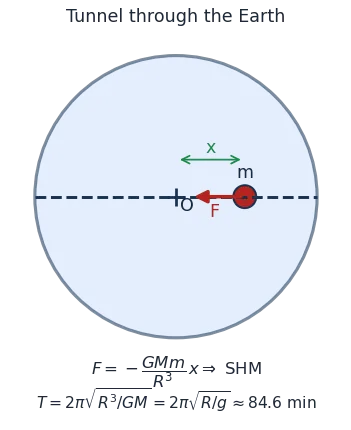
A mass dropped into a diametric tunnel through the Earth experiences a restoring force proportional to displacement, executing simple harmonic motion
Linear restoring force SHM.
Tunnel SHM
displacement from centre; min — equal to the near-Earth orbital period
💡 Tip · Cavity field
Inside a spherical cavity in a uniform solid sphere the field is : , directed along the line joining the two centres ( centre-to-centre vector).
🚫 Examiner Trap · Special topics
(1) Weightlessness in orbit is with , NOT zero gravity — g' is still large at that height. (2) A geostationary satellite MUST be equatorial; a 24-h inclined orbit only looks fixed from the poles, not from the equator. (3) Tunnel motion is SHM only for a Earth and a tunnel; period min is the same for any chord, not just a diameter. (4) Polar geostationary — polar satellites move relative to the ground.

More JEE Main Physics formula sheets

Frequently Asked Questions

What are the most important Gravitation formulas for JEE Main?

This Gravitation formula sheet covers all the high-yield Physics formulas, definitions and theorems you need for JEE Main, across The universal law of gravitation, Acceleration due to gravity and its variation with altitude and depth, Gravitational potential energy, Gravitational potential, Escape velocity — each shown with the key result and, where useful, a worked example.

Is this Gravitation formula sheet free?

Yes — the full chapter formula sheet is free to read online, no login or payment required.

How should I revise Gravitation formulas?

Blurt the Gravitation formulas from memory, then check against this sheet to find your gaps — and practise a few previous-year questions on the chapter to make sure you can apply them under time pressure.

Also useful: all formula sheets · JEE Main previous-year papers · most important chapters.