
Electromagnetic Waves Formula Sheet — JEE Main Physics
Syllabus — topics coveredNTA · 5 sub-topics
- Basic idea of displacement current
- Electromagnetic waves
- Their characteristics
- Transverse nature (qualitative ideas only)
- Electromagnetic spectrum (radio waves, microwaves, infrared, visible, ultraviolet, X-rays, gamma rays) including elementary facts about their uses
Displacement Current & Ampere-Maxwell Law
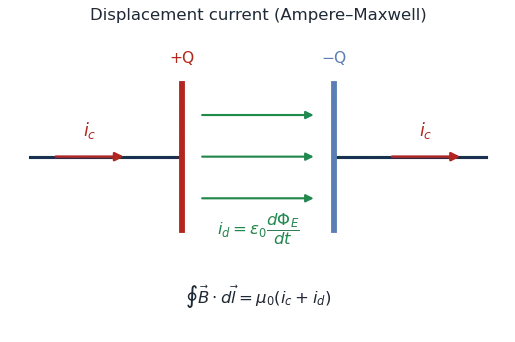
- ▸Outside a charging capacitor: only ; between the plates: only , and .
- ▸Total current () is — gives the same B for any surface.
- ▸Symmetry: a changing makes , just as a changing makes (Faraday).
Maxwell's Equations & Sources
| Law | Equation | Says |
|---|---|---|
| Gauss (E) | charges make E | |
| Gauss (M) | no monopoles | |
| Faraday | changing B makes E | |
| Ampere-Maxwell | current + changing E make B |

- ▸Only charges radiate — static charges and steady currents do NOT.
- ▸Wave frequency frequency of the oscillating charge (LC oscillator / antenna).
- ▸First produced & detected by Hertz (1887).
Nature of Electromagnetic Waves
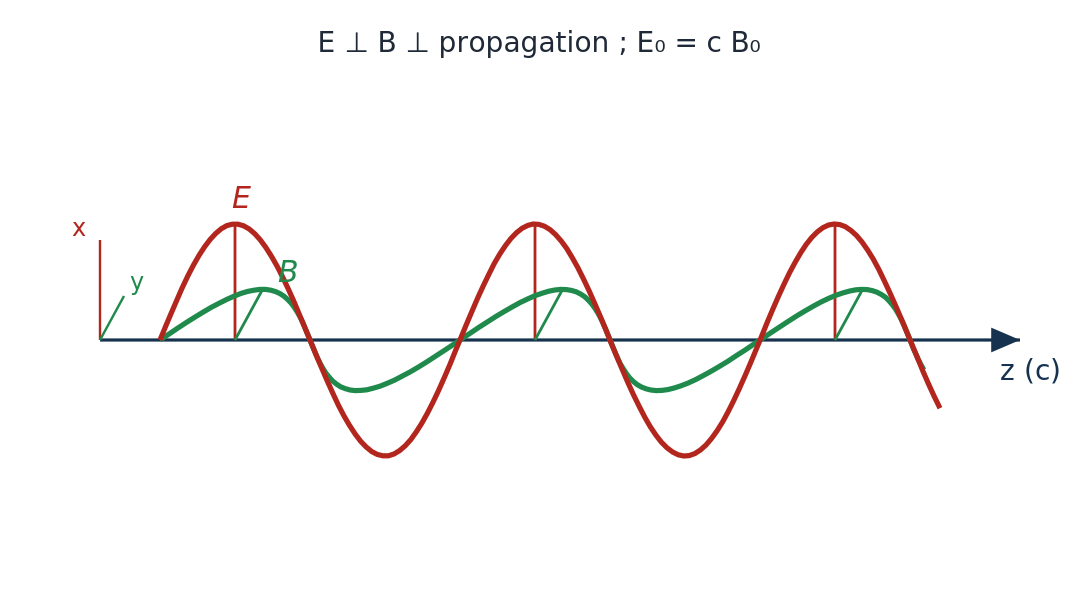
- ▸: direction of propagation.
- ▸ and oscillate , same frequency; propagation along .
- ▸Need (non-mechanical); travel through vacuum at c.
Speed & Energy of EM Waves
Intensity, Momentum & Radiation Pressure
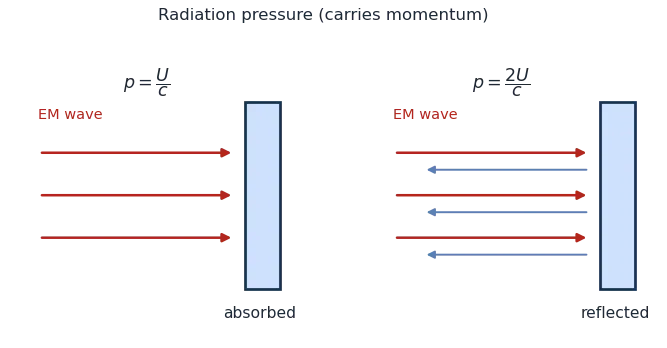
| Surface | Momentum | Pressure |
|---|---|---|
| Perfect absorber | ||
| Perfect reflector |
- ▸EM waves carry both energy and momentum (Nichols & Hull, 1903).
- ▸Radiation pressure is tiny but real — comet tails point away from the Sun; solar sails.
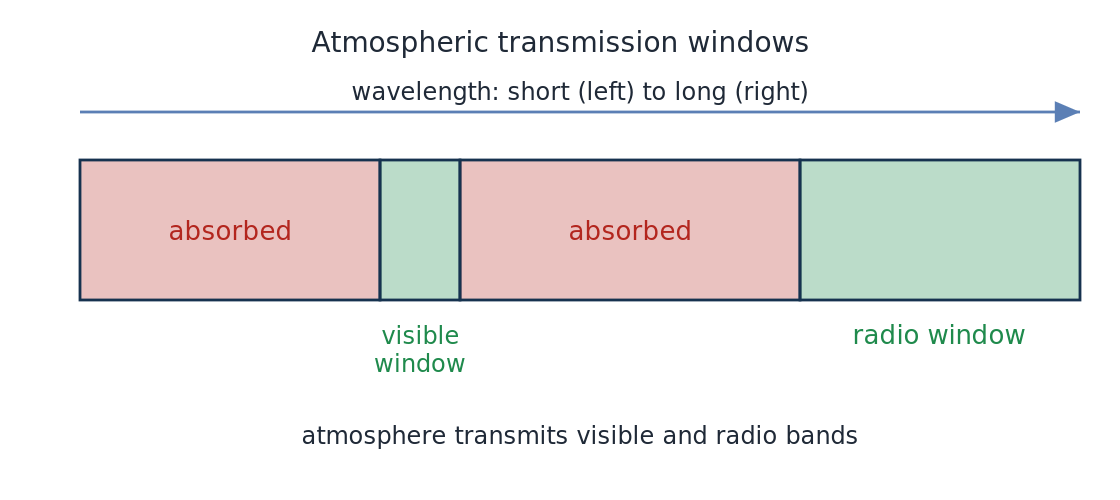
Electromagnetic Spectrum
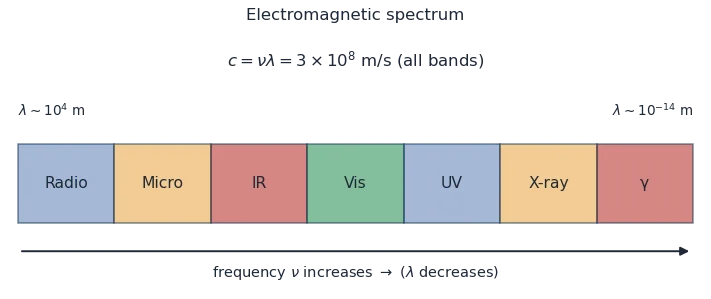
| Band | Wavelength | Production |
|---|---|---|
| Radio | m | accelerating charges in aerials |
| Microwave | 0.1 m–1 mm | klystron / magnetron |
| Infrared | 1 mm–700 nm | molecular vibration |
| Visible | 700–400 nm | electron transitions |
| Ultraviolet | 400–1 nm | inner-shell electrons |
| X-ray | 1 nm–1 nm | fast electrons hit metal |
| -ray | nm | radioactive nuclei |
Properties & Applications of Each Band
| Band | Main uses |
|---|---|
| Radio | TV, AM/FM, cellular |
| Microwave | radar, speed guns, ovens (water resonance) |
| Infrared | heating, remotes, night vision, greenhouse |
| Visible | sight, optical instruments |
| Ultraviolet | sterilisation, LASIK (ozone absorbs it) |
| X-ray | medical imaging, crystallography |
| -ray | cancer therapy, sterilising; from nuclei |
More JEE Main Physics formula sheets
Frequently Asked Questions
What are the most important Electromagnetic Waves formulas for JEE Main?
This Electromagnetic Waves formula sheet covers all the high-yield Physics formulas, definitions and theorems you need for JEE Main, across Basic idea of displacement current, Electromagnetic waves, Their characteristics, Transverse nature (qualitative ideas only), Electromagnetic spectrum (radio waves, microwaves, infrared, visible, ultraviolet, X-rays, gamma rays) including elementary facts about their uses — each shown with the key result and, where useful, a worked example.
Is this Electromagnetic Waves formula sheet free?
Yes — the full chapter formula sheet is free to read online, no login or payment required.
How should I revise Electromagnetic Waves formulas?
Blurt the Electromagnetic Waves formulas from memory, then check against this sheet to find your gaps — and practise a few previous-year questions on the chapter to make sure you can apply them under time pressure.
Also useful: all formula sheetsJEE Main previous-year papersmost important chapters.