JEEnify Logo
JEEnify
All formula sheets

Kinetic Theory of Gases Formula Sheet — JEE Main Physics

Every key Kinetic Theory of Gases formula, definition and theorem for JEE Main Physics in one place — with common examiner traps and worked examples. Free to read; blurt from memory, then check your gaps.

Syllabus — topics coveredNTA · 11 sub-topics

  • Equation of state of a perfect gas
  • Work done on compressing a gas
  • Kinetic theory assumptions
  • Concept of pressure
  • Kinetic interpretation of temperature
  • RMS speed of gas molecules
  • Degrees of freedom
  • Law of equipartition of energy
  • Applications to specific heat capacities
  • Mean free path
  • Avogadro's number

Ideal Gas Equation & Gas Laws

Ideal gas equation
moles, number of molecules, mass, molar mass, absolute temp (K)
Constants
  • (universal gas constant).
  • (Boltzmann).
  • ; molar volume at STP L.
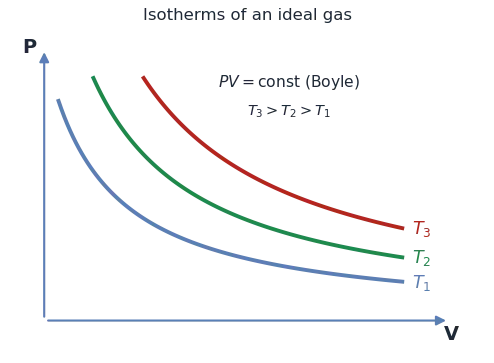
Three P-V isotherms (hyperbolae PV=const) of an ideal gas at increasing temperatures
Each isotherm: const (Boyle's law); higher curve higher .
⚡ Shortcut · Combined gas law
For a fixed mass of gas — covers Boyle/Charles/Gay-Lussac in one step. Density form: const.
Comparative: the gas laws
LawHeld constRelation
Boyle const ()
Charles const ()
Gay-Lussac const ()
Avogadroequal equal N
Dalton (partials)
🚫 Examiner Trap · Ideal gas & gas laws
(1) T MUST be in in every gas law — using C is the #1 blunder. (2) and L/mol at STP hold only for an gas — best at , . (3) Use for molecules but for moles — don't mix N with . (4) Charles/Gay-Lussac are linear in , NOT in C.

Kinetic Theory — Assumptions & Pressure

Assumptions
  • Large number of identical molecules in random motion; molecular size inter-molecular distance.
  • No intermolecular forces except during collisions.
  • Collisions (with walls and each other) are perfectly elastic; collision duration negligible.
  • Between collisions molecules move in straight lines (Newton's first law).

Pressure of an ideal gas
mean-square speed ; density; molecules
Pressure kinetic energy
total translational KE; pressure of translational KE per unit volume
A molecule strikes a wall with velocity +v_x and rebounds with -v_x, transferring momentum 2mv_x
Pressure rate of momentum transfer ( per elastic bounce).
⚡ Shortcut · Pressure from rms speed
Since , just write . The result is — only n and matter.
🚫 Examiner Trap · Pressure & mean-square speed
(1) is the , NOT — and . (2) The comes from averaging over 3 axes () — don't drop it. (3) Pressure relates to KE only; rotation/vibration don't push the wall.

Kinetic Interpretation of Temperature

Mean translational KE per molecule
depends on T — same for every gas at a given temperature
Total translational KE
for N molecules / moles (translational part only)
Average kinetic energy increases linearly with absolute temperature through the origin
— a kinetic definition of temperature.
Internal energy (ideal gas)
degrees of freedom; ideal-gas depends only on , never on or
⚡ Shortcut · Same KE, different speed
At equal T, He, , share the per molecule, but — lighter faster. Compare speeds via mass ratios alone.
🚫 Examiner Trap · Temperature & internal energy
(1) is KE per molecule; total U uses , not . (2) Absolute zero zero translational KE (classical) — T here is . (3) is independent of mass/pressure — only T. (4) Real-gas U also has intermolecular PE; ideal-gas U does not.

Molecular Speeds

Root-mean-square speed
molar mass (kg/mol in SI), mass of one molecule
Average & most-probable
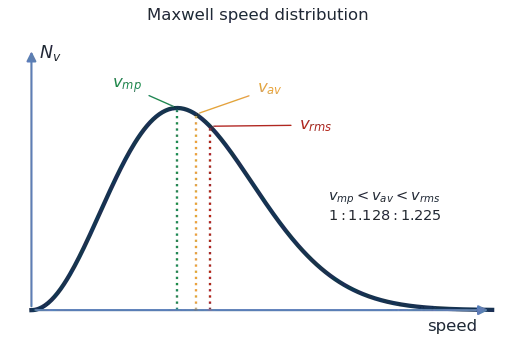
arithmetic mean speed; peak of the distribution
Maxwell speed distribution curve with most-probable, average and rms speeds marked in increasing order
Skewed distribution: (tail pulls highest).
Comparative: the three speeds
SpeedFormula ()vs
⚡ Shortcut · Memorise the ratio
. All three , so quadruple T to double any speed.
🚫 Examiner Trap · Molecular speeds
(1) Put M in (e.g. O) — using g/mol gives v off by . (2) , so doubling multiplies by , NOT 2. (3) — don't swap the order. (4) Graham: diffusion rate — lighter gases diffuse faster.

Degrees of Freedom & Equipartition

Degrees of freedom : The number of independent ways a molecule stores energy: translational (), rotational ( linear, non-linear), plus vibrational (each mode quadratic terms).
Comparative: DOF by molecule type
MoleculeTransRot (room )
Monatomic (He)303
Diatomic ()325
Diatomic + vib.327 (high )
Polyatomic (non-linear)336
Monatomic molecule with three translational axes and a diatomic dumbbell with three translational and two rotational axes
Monatomic () vs diatomic ().
★ Remember · Law of equipartition
In equilibrium each degree of freedom carries average energy per molecule ( per mole).
Internal energy
sum over all degrees of freedom f
🚫 Examiner Trap · Degrees of freedom
(1) A mode counts as quadratic terms (KE PE) energy , not . (2) Monatomic gas has rotational DOF (a point has no moment of inertia); a linear molecule has only . (3) At room T vibration is usually — use diatomic , not 7. (4) f is per molecule; multiply by , not .

Specific Heats of Gases

Molar specific heats
Mayer's relation (per mole) holds for every ideal gas; active DOF
Gas
Monatomic3
Diatomic (rigid)5
Polyatomic (non-linear)6
Trends & mixtures
  • Larger f larger but .
  • Diatomic with vibration: , .
  • Mixture: (mole-weighted).
🎯 Exam · Solids (Dulong–Petit)
A solid atom has quadratic DOF ( KE PE) molar specific heat .
🚫 Examiner Trap · Specific heats of gases
(1) is ; for (per kg) heats divide by M. (2) always (extra R for expansion work). (3) Use the DOF at that T — vibration frozen at room T diatomic . (4) At very T DOFs 'freeze out' (quantum) and falls below these values.

Mean Free Path & Real Gases

Mean free path
number density, molecular diameter; the accounts for relative motion of molecules
Collision frequency
collisions per second; collision time
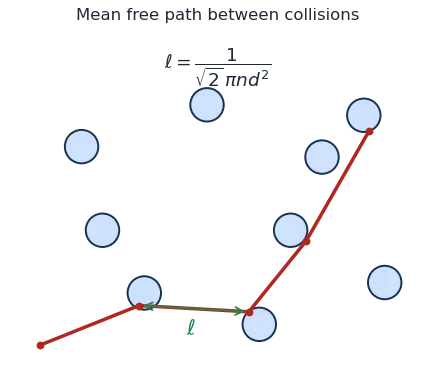
Zigzag path of a molecule between successive collisions with other molecules, one segment labelled mean free path
Average straight-line distance between successive collisions.
Dependence
  • — rises in a vacuum, falls at high pressure.
  • — smaller molecules travel farther.
  • Air at STP: m molecular size.
Comparative: real-gas (van der Waals) corrections
TermCorrects forEffect
(add to P)molecular attractionreal lower
(subtract from )finite molecular sizefree smaller
🚫 Examiner Trap · Mean free path & real gases
(1) — at fixed T, raising P ; in a good vacuum can exceed the vessel size. (2) Keep the factor (it comes from relative speed). (3) Real gases deviate most at , (van der Waals ). (4) Brownian motion is direct evidence of molecular motion, not a deviation.

More JEE Main Physics formula sheets

Frequently Asked Questions

What are the most important Kinetic Theory of Gases formulas for JEE Main?

This Kinetic Theory of Gases formula sheet covers all the high-yield Physics formulas, definitions and theorems you need for JEE Main, across Equation of state of a perfect gas, Work done on compressing a gas, Kinetic theory assumptions, Concept of pressure, Kinetic interpretation of temperature — each shown with the key result and, where useful, a worked example.

Is this Kinetic Theory of Gases formula sheet free?

Yes — the full chapter formula sheet is free to read online, no login or payment required.

How should I revise Kinetic Theory of Gases formulas?

Blurt the Kinetic Theory of Gases formulas from memory, then check against this sheet to find your gaps — and practise a few previous-year questions on the chapter to make sure you can apply them under time pressure.

Also useful: all formula sheets · JEE Main previous-year papers · most important chapters.