JEEnify Logo
JEEnify
All formula sheets

Magnetic Effects of Current and Magnetism Formula Sheet — JEE Main Physics

Every key Magnetic Effects of Current and Magnetism formula, definition and theorem for JEE Main Physics in one place — with common examiner traps and worked examples. Free to read; blurt from memory, then check your gaps.

Syllabus — topics coveredNTA · 18 sub-topics

  • Biot-Savart law
  • Application to current carrying circular loop
  • Ampere's law
  • Applications to infinitely long straight wire and solenoid
  • Force on moving charge in magnetic and electric fields
  • Force on current-carrying conductor
  • Force between parallel current carrying conductors
  • Definition of ampere
  • Torque on current loop in magnetic field
  • Moving coil galvanometer
  • Conversion to ammeter and voltmeter
  • Current loop as magnetic dipole
  • Bar magnet as equivalent solenoid
  • Magnetic field lines
  • Magnetic field due to magnetic dipole
  • Torque on magnetic dipole
  • Para-, dia- and ferromagnetic substances
  • Effect of temperature on magnetic properties

Magnetic Force on a Moving Charge
Lorentz force
charge, velocity, field; magnetic part does NO work
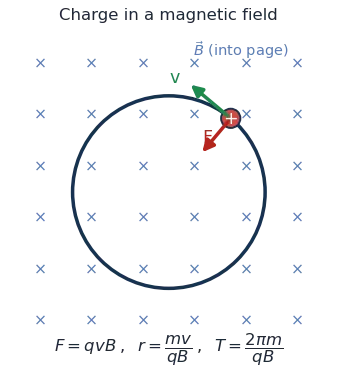
Circular motion ()
T,f (cyclotron) are and radius
A positive charge moving in a magnetic field into the page follows a circular path with the magnetic force pointing to the centre
Force is centripetal; the charge circles.
Comparative: orientation of to
vs PathForce
parallelstraight line
perpendicularcircle, (centripetal)
at angle helix
Helical motion
pitch axial advance per revolution
⚡ Shortcut · Velocity selector & cyclotron
Crossed : undeflected when . Cyclotron exit energy (independent of the gap voltage).
🚫 Examiner Trap · Magnetic force on a charge
(1) Magnetic force is , so it does — speed and KE never change, only direction. (2) is — faster charges just take bigger circles. (3) A charge at rest, or moving , feels NO magnetic force. (4) The pitch uses , the radius uses — don't swap.

Force on a Current-Carrying Conductor

Force on a conductor
current, length, angle between and ; element
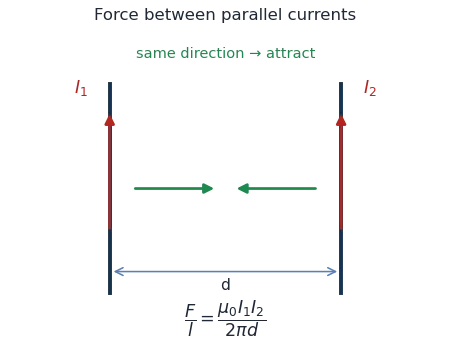
Two parallel wires carrying currents in the same direction attract each other
Parallel currents attract; antiparallel repel.
Force between parallel wires
separation; same direction attract, opposite repel
Field of a moving charge
unit vector from charge to field point
⚡ Shortcut · Definition of the ampere
A the current which, in two infinite parallel wires m apart, gives a force of N/m. (This fixes .)
🚫 Examiner Trap · Force on conductors
(1) Parallel currents , antiparallel — the OPPOSITE of like/unlike charges. (2) : a wire feels NO force. (3) Force is on the wire as a whole via — use the direction of I. (4) The field a current makes does not exert a force on its own wire.

Biot-Savart Law & Magnetic Fields

Biot-Savart law
T m/A; direction by right-hand rule
Comparative: field of standard shapes
Geometry
Finite wire
Infinite wire
Arc (angle rad)
Semicircle
Loop centre
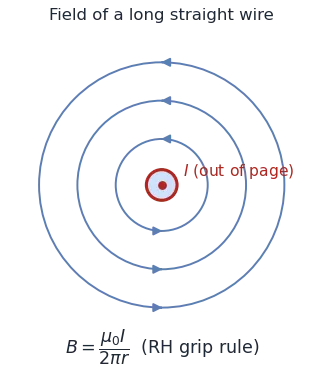
Concentric circular magnetic field lines around a long straight current-carrying wire
Field circles the wire (RH grip rule).
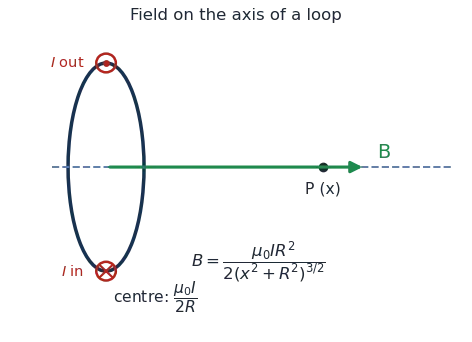
Circular loop ( turns), on axis
loop radius, axial distance; centre
Magnetic field on the axis of a circular current loop pointing along the axis
On-axis field of a current loop.
🚫 Examiner Trap · Biot-Savart & fields
(1) A straight segment the point () gives field. (2) Arc angle must be in . (3) Finite wire uses (angles from the foot of perpendicular) — for a semi-infinite wire one term is . (4) for a wire but far on a loop's axis.

Ampere's Circuital Law

Ampere's circuital law
current threading the Amperian loop; use only with high symmetry
Comparative: solid wire (radius , uniform )
Region
Inside () ()
Outside () ()
Hollow pipe, inside
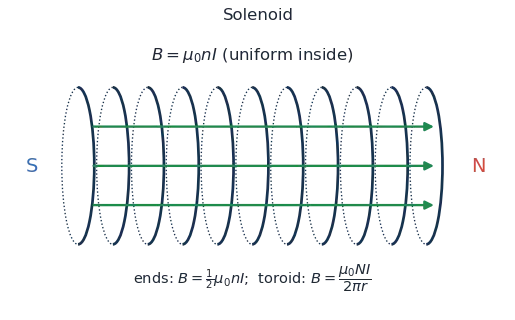
A solenoid with a uniform magnetic field along its axis inside
Solenoid: uniform field inside.
Solenoid / toroid
turns per unit length
🚫 Examiner Trap · Ampere's law
(1) Works only for fields (infinite wire/sheet/solenoid/toroid) — otherwise can't be pulled out of the integral. (2) Field at a solenoid is HALF the inside value (). (3) Field is uniform a long solenoid, outside. (4) Inside a hollow current-carrying pipe ().

Magnetic Dipole, Torque & Galvanometer
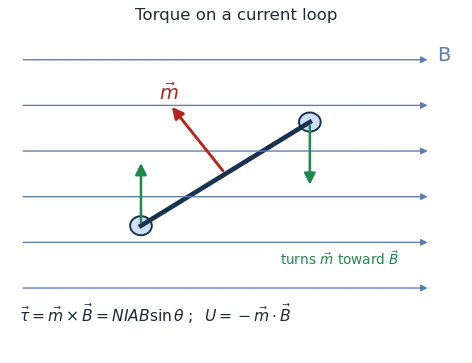
Magnetic moment & torque
angle between and ; stable at , max at
A current loop in a uniform field experiences a torque that tends to align its magnetic moment with the field
Torque aligns with .
Moving-coil galvanometer
torsional constant; current sensitivity , voltage sensitivity
Comparative: ammeter vs voltmeter
AmmeterVoltmeter
Connectionseriesparallel
Resistancelow ( ideal)high ( ideal)
From G viashunt series
🚫 Examiner Trap · Dipole, torque & galvanometer
(1) Torque is (m B), — opposite to many guesses. (2) A uniform field gives torque but . (3) The galvanometer's field makes (linear scale) and keeps . (4) Increasing N raises sensitivity but also resistance.

Bar Magnet & Earth's Magnetism

Bar magnet
  • Behaves like a solenoid / magnetic dipole; magnetic poles exist (no monopole).
  • Magnetic moment (pole strength length); points S N inside.
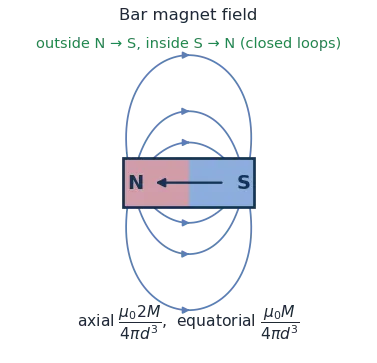
Field of a short bar magnet
distance from centre;
Field lines of a bar magnet emerging from the north pole and entering the south pole
Field lines run N → S outside, S → N inside.
Magnetisation
moment per unit volume, magnetising field, susceptibility (dimensionless)
Earth's magnetic elements
dip/inclination; declination angle between magnetic & geographic meridians
🚫 Examiner Trap · Bar magnet & earth's field
(1) Axial field is the equatorial at the same distance; both fall as . (2) Dip at the magnetic , at the poles ( max at equator). (3) Breaking a magnet gives two smaller magnets — never an isolated pole. (4) Inside the magnet field runs SN (opposite to outside).

Magnetic Materials

Comparative: dia / para / ferro
PropertyDiaParaFerro
small vesmall velarge ve
In a fieldweakly repelledweakly attractedstrongly attracted
With independent fallsferropara at
ExampleBi, Cu, OAl, Na, Fe, Co, Ni
Curie law
ferromagnetic paramagnetic above the Curie temperature
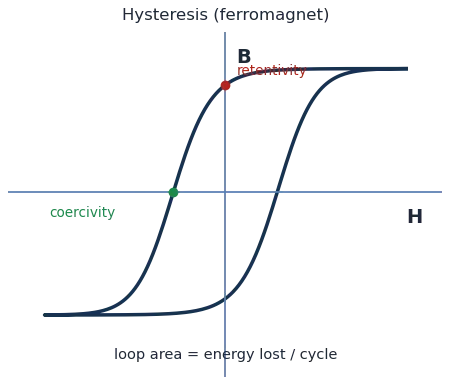
B-H hysteresis loop of a ferromagnet showing retentivity and coercivity
Hysteresis: B lags H; loop area energy lost/cycle.
Reading the loop
  • : residual B at ; : reverse H needed to make .
  • (narrow loop, low coercivity) transformers, electromagnets.
  • (wide loop, high coercivity) permanent magnets.
🚫 Examiner Trap · Magnetic materials
(1) Diamagnetism is but weak; it shows only when there's no para/ferro to mask it. is T-independent. (2) Curie law is for — susceptibility FALLS as T rises. (3) Choose the material by loop: for cores (low loss), for permanent magnets. (4) Above a ferromagnet becomes paramagnetic.

More JEE Main Physics formula sheets

Frequently Asked Questions

What are the most important Magnetic Effects of Current and Magnetism formulas for JEE Main?

This Magnetic Effects of Current and Magnetism formula sheet covers all the high-yield Physics formulas, definitions and theorems you need for JEE Main, across Biot-Savart law, Application to current carrying circular loop, Ampere's law, Applications to infinitely long straight wire and solenoid, Force on moving charge in magnetic and electric fields — each shown with the key result and, where useful, a worked example.

Is this Magnetic Effects of Current and Magnetism formula sheet free?

Yes — the full chapter formula sheet is free to read online, no login or payment required.

How should I revise Magnetic Effects of Current and Magnetism formulas?

Blurt the Magnetic Effects of Current and Magnetism formulas from memory, then check against this sheet to find your gaps — and practise a few previous-year questions on the chapter to make sure you can apply them under time pressure.

Also useful: all formula sheets · JEE Main previous-year papers · most important chapters.