JEEnify Logo
JEEnify
All formula sheets

Thermodynamics Formula Sheet — JEE Main Physics

Every key Thermodynamics formula, definition and theorem for JEE Main Physics in one place — with common examiner traps and worked examples. Free to read; blurt from memory, then check your gaps.

Syllabus — topics coveredNTA · 7 sub-topics

  • Thermal equilibrium and definition of temperature
  • Heat, work and internal energy
  • First law of thermodynamics
  • Isothermal and adiabatic processes
  • Second law of thermodynamics
  • Reversible and irreversible processes
  • Heat engine and refrigerator

Fundamentals & First Law

Zeroth law: If A and B are each in thermal equilibrium with C, then A and B are in thermal equilibrium with each other — this defines as the property shared at equilibrium.
State variables
  • P,V,T,U describe an equilibrium state; linked by .
  • : (size-independent). : U,V,M.
  • U is a (path-independent); Q and W are (path functions).
Internal energy (ideal gas)
degrees of freedom, number of moles, , absolute temp (K); U depends only on T
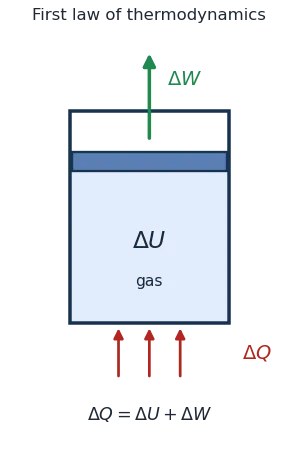
Gas in a cylinder: heat Q added at the base, work W done by the piston, change in internal energy U
Heat in raises and/or does work.
First law of thermodynamics
heat added to system, change in internal energy, work done by system; an energy-conservation statement
Sign convention
  • : heat by the system (heat out ).
  • : work done the system (expansion; compression ).
  • : temperature rises (ideal gas).
for an ideal gas
molar heat capacity at constant V; holds for process (not only isochoric), because only
★ Remember
Over any process depends only on the end states. For an ideal gas — true for process, not just isochoric.
🚫 Examiner Trap · First law & sign convention
(1) Q and W are functions — never write '' as a state change. (2) Sign slip: is work done the gas; many texts write — pick one convention and keep it. (3) even for isobaric/isothermal/adiabatic, only constant-V. (4) U of an ideal gas depends on T alone — on P or V separately.

Work Done & P–V Diagrams

Work done by a gas
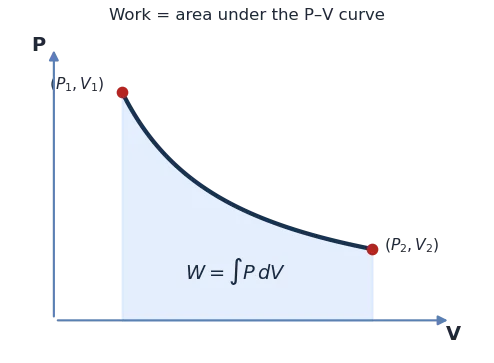
along the actual path; expansion () , compression
Area under a P-V curve between two states equals the work done by the gas
Work is path-dependent — it is the area beneath the curve.
★ Remember
Both Q and W depend on the between two states; only is path-independent.
🎯 Exam · Quasi-static process
An infinitely slow process keeping the system in equilibrium throughout — the only kind for which P,T are well defined at every step and applies.
Work in simple processes
Isobaric ( const)
Isochoric ( const)
Isothermal
Adiabatic
Comparative: work for the same
Process formula
Isobaric
Isochoric
Isothermal
Adiabatic
⚡ Shortcut · Area = work, on sight
Read W straight off the P–V plot as the under the path. Equal end-states but a higher path more . A vertical line (V const) encloses zero area ; a horizontal line (P const) gives instantly.
🚫 Examiner Trap · Work & P–V diagrams
(1) W is the area under the curve for a quasi-static path — free/irreversible expansion has against vacuum. (2) Same two end-points, different W (and Q). (3) Isochoric but (it equals ). (4) Use in kelvin for .

Isothermal & Adiabatic Processes

Isothermal ( constant)
slope ; isothermal bulk modulus ; needs a slow process in contact with a reservoir
Adiabatic ()
(adiabatic index); adiabatic bulk modulus ; no heat exchange ()
Adiabatic work
; expansion cools the gas, compression heats it;
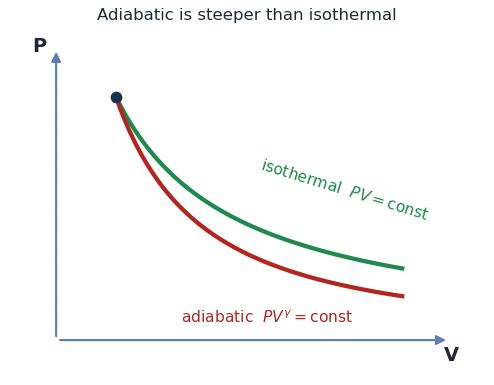
On a P-V diagram the adiabatic curve through a point is steeper than the isothermal curve
Adiabatic curve is steeper: .
Comparative: isothermal vs adiabatic
FeatureIsothermalAdiabatic
ConstantT (so )
Law const const
slope (steeper)
Bulk modulus
First law
🎯 Exam
At the same point an adiabatic is times steeper than an isothermal. For a free (irreversible) expansion into vacuum — temperature unchanged for an ideal gas.
⚡ Shortcut · Polytropic master form
Both are const: isothermal, adiabatic, isobaric, isochoric. Molar heat , work () — one formula covers all four straight lines/curves.
🚫 Examiner Trap · Isothermal & adiabatic
(1) holds for isothermal , for adiabatic — do not swap them. (2) The adiabatic is (factor ), never the isothermal. (3) Adiabatic expansion (into vacuum) is irreversible: and T unchanged, so const does apply. (4) Adiabatic expansion lowers T; do not assume T constant just because .

Internal Energy, Cp, Cv & Equipartition

Molar specific heats
molar heat capacities at constant V, P; degrees of freedom; Mayer's relation
Adiabatic exponent
degrees of freedom; always, and decreases as f grows
★ Remember · Equipartition of energy
Each degree of freedom carries average energy per molecule; internal energy .
⚡ Shortcut · Get from f instantly
: monatomic , diatomic , polyatomic . For a mixture use .
Gas
Monatomic (He, Ar)3
Diatomic (H₂, O₂)5
Polyatomic (non-linear)6
Refinements
  • Diatomic: add to f () if vibration is active at high T.
  • Mixture: .
  • For a solid, (Dulong–Petit).
Degrees of freedom
  • Monatomic: translational. Diatomic: trans rot .
  • Linear rotational; non-linear rotational.
  • Each active vibrational mode adds ( KE PE).
🚫 Examiner Trap · Heat capacities & equipartition
(1) always (extra R for expansion work) — never . (2) is per ; for specific heats divide by molar mass. (3) Use the f that is at that T — vibration is usually frozen at room T, so diatomic not . (4) Process-dependent heat can be (adiabatic) or even negative — 'C' is not always or .

Cyclic Processes & the Second Law

Cyclic process
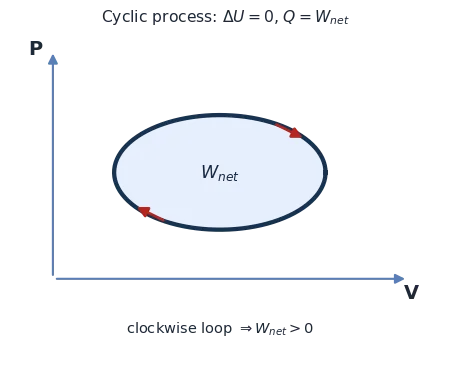
because the system returns to its initial state; clockwise loop , anticlockwise
Closed loop on a P-V diagram; the enclosed area equals the net work done in one cycle
Net work in a cycle = enclosed P–V area.
Reversible vs irreversible
  • Reversible: quasi-static no dissipation (friction/viscosity) — an idealisation.
  • All real processes (free expansion, finite heat flow, friction) are irreversible.
  • Irreversible total entropy of system surroundings increases.
ReversibleIrreversible
Speedinfinitely slowfinite/real
Dissipationnonefriction/viscosity
Equilibriumevery steponly end-states
Second law of thermodynamics
🎯 Exam · Kelvin–Planck statement
No process is possible whose sole result is the complete conversion of heat from a reservoir into work (, so ).
🎯 Exam · Clausius statement
No process is possible whose sole result is the transfer of heat from a colder to a hotter body (a refrigerator needs work, ).
★ Remember
The two statements are equivalent. The first law allows ; the second law forbids it.
🚫 Examiner Trap · Cyclic & second law
(1) In one full cycle , so — but Q and W on each leg are zero. (2) Clockwise loop on P–V does net work (engine); anticlockwise is a refrigerator. (3) The second law , even though the first law allows it. (4) Kelvin–Planck ' in one step' — heat can fully convert to work in a expansion (isothermal), but not in a .

Heat Engines & Refrigerators

Heat engine efficiency
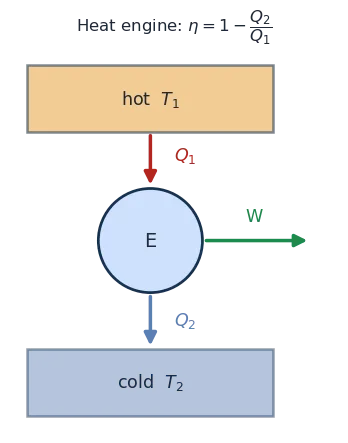
heat absorbed from source, heat rejected to sink, net work output;
Heat engine: Q1 from hot reservoir, work W out, Q2 rejected to cold reservoir
Engine: heat work, .
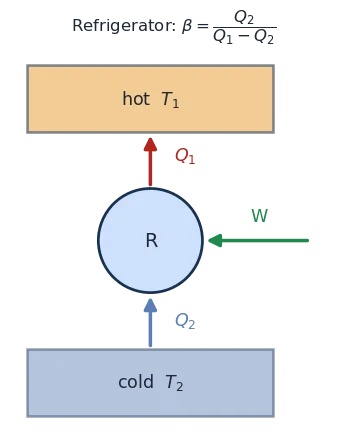
Refrigerator / heat pump (COP)
coefficient of performance; heat drawn from cold space, work input; and COP can exceed 1
Refrigerator: Q2 extracted from cold reservoir, work W input, Q1 dumped to hot reservoir
Reverse of an engine: work pumps heat uphill.
Comparative: engine vs fridge vs heat pump
DeviceUseful outPerformance
Heat enginework
Refrigerator (cooling)
Heat pump (heating)
★ Remember
A refrigerator is a heat engine run in reverse: delivered to the hot reservoir.
⚡ Shortcut · Carnot COP from temperatures
For a Carnot (reversible) device: , , and . Always between the same reservoirs.
🚫 Examiner Trap · Engines & refrigerators
(1) Efficiency uses in the denominator; COP uses W — do not mix. (2) can be ; can be . (3) (the pump also delivers the work as heat). (4) — count rejected heat , the most-forgotten term.

Carnot Engine

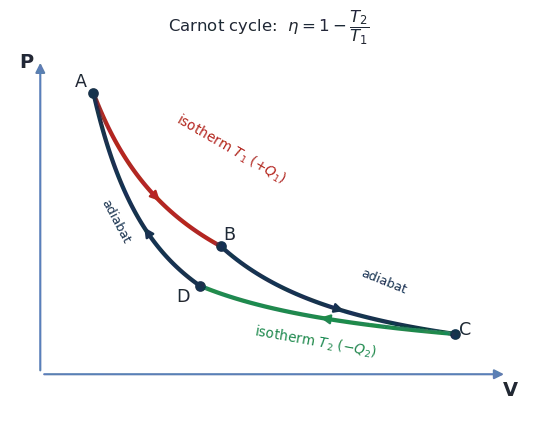
Carnot cycle (reversible)
  • : isothermal expansion at (absorbs ).
  • : adiabatic expansion ().
  • : isothermal compression at (rejects ).
  • : adiabatic compression ().
Carnot efficiency
source temp, sink temp, both in ; depends only on the two reservoir temperatures, not the working substance
Heat–temperature ratio (Carnot)
in kelvin; defines the absolute (thermodynamic) temperature scale
Carnot cycle on a P-V diagram: two isotherms (T1, T2) joined by two adiabats forming a closed loop
Two isotherms + two adiabats.
StepProcessHeat
isothermal exp.
adiabatic exp.
isothermal comp.
adiabatic comp.
🎯 Exam · Carnot's theorem
No engine working between two temperatures can exceed the Carnot efficiency, and it is . Hence defines the absolute temperature scale.
★ Remember
only if K (unattainable) or — so a perfectly efficient engine is impossible.
🚫 Examiner Trap · Carnot engine
(1) Temperatures must be in — using C is the classic blunder. (2) depends on , never on the gas or on . (3) is the ; a real engine is always less. (4) Raising by helps less than lowering by the same . (5) The cycle is — running it backward gives a Carnot refrigerator.

More JEE Main Physics formula sheets

Frequently Asked Questions

What are the most important Thermodynamics formulas for JEE Main?

This Thermodynamics formula sheet covers all the high-yield Physics formulas, definitions and theorems you need for JEE Main, across Thermal equilibrium and definition of temperature, Heat, work and internal energy, First law of thermodynamics, Isothermal and adiabatic processes, Second law of thermodynamics — each shown with the key result and, where useful, a worked example.

Is this Thermodynamics formula sheet free?

Yes — the full chapter formula sheet is free to read online, no login or payment required.

How should I revise Thermodynamics formulas?

Blurt the Thermodynamics formulas from memory, then check against this sheet to find your gaps — and practise a few previous-year questions on the chapter to make sure you can apply them under time pressure.

Also useful: all formula sheets · JEE Main previous-year papers · most important chapters.