
Back to JEE Main PYQs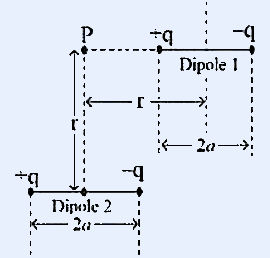
JEE Main 2025 January 23, Shift 1 Question Paper with Solutions
All 75 questions from the JEE Main 2025 (January 23, Shift 1) shift — Physics (25), Chemistry (25) and Mathematics (25) — each with the correct answer (answer key) and a step-by-step solution. Read it free online, or attempt the full paper as a timed mock test.
Physics25 questions
Q26Single correctElectrostatics
A point particle of charge Q is located at P along the axis of an electric dipole 1 at a distance r as shown in the figure. The point P is also on the equatorial plane of a second electric dipole 2 at a distance r. The dipoles are made of opposite charge q separated by a distance 2a. For the charge particle at P not to experience any net force, which of the following correctly describes the situation?
(1)
(2)
(3)
(4)
SolutionAnswer: Option 4
Approach:
Use exact electric field formulas for dipoles and equate magnitudes for zero net force on charge Q
Step 1:Define: Point P is at distance r from both dipoles. Dipole 1 has P on its axis, Dipole 2 has P on its equatorial plane. Both dipoles have moment p = 2aq
Step 2:Exact electric field on axial line of dipole 1
Step 3:Exact electric field on equatorial plane of dipole 2
Step 4:For zero net force, set E₁ = E₂
Step 5:Let x = a/r and simplify by dividing by powers of r
Step 6:Test x = 3 (option 4)
Step 7:Calculate RHS for x = 3
Step 8:Compare: LHS ≈ 63.24 and RHS = 64 are extremely close
Final answer:
Q27Single correctOptics
A spherical surface of radius of curvature R, separates air from glass (refractive index = 1.5). The centre of curvature is in the glass medium. A point object 'O' placed in air on the optic axis of the surface, so that its real image is formed at 'I' inside glass. The line OI intersects the spherical surface at P and PO = PI. The distance PO equals to
(1)
(2)
(3)
(4)
SolutionAnswer: Option 15R
Step 1:Using the refraction formula for a spherical surface
Step 2:Given that PO = PI, let this distance be x. Then object distance u = -x and image distance v = x
Step 3:Simplifying the equation
Step 4:Solving for x
Final answer: 5R
Q28Single correctUnits and Measurements
The position of a particle moving on x-axis is given by , where t is time. The dimension of is
(1)
(2)
(3)
(4)
SolutionAnswer: Option 1
Step 1:Analyzing dimensions: Since x(t) has dimension of length [L], each term must have dimension [L]
Step 2:Similarly for the second term
Step 3:For the third term
Step 4:The fourth term gives
[D] = [L]
Step 5:Computing the dimension
Final answer:
Q29Single correctOptics
Given a thin convex lens (refractive index ), kept in a liquid (refractive index , ) having radii of curvatures and . Its second surface is silver polished. Where should an object be placed on the optic axis so that a real and inverted image is formed at the same place?
(1)
(2)
(3)
(4)
SolutionAnswer: Option 1
Step 1:For a lens with silvered back surface, the system acts as an equivalent mirror. For object and image to coincide, object must be at center of curvature
Step 2:The power of the system is given by
Step 3:Using lens maker's formula in medium
Step 4:For the silvered surface acting as a mirror
Step 5:Combining the effects and solving for object distance
Final answer:
Q30Single correctCurrent Electricity
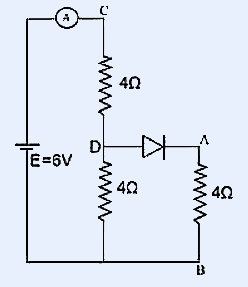
Refer to the circuit diagram given in the figure. Which of the following observations are correct? A. Total resistance of circuit . Current in Ammeter is 1 A C. Potential across AB is 4 Volts. D. Potential across CD is 4 Volts E. Total resistance of the circuit correct answer from the options given below:
(1)
(2)
(3)
(4)
SolutionAnswer: Option 1A, B and D Only
Step 1:Analyzing the circuit: The diode is forward biased, so it conducts
Step 2: resistors in parallel give equivalent resistance
Step 3:Total circuit resistance
Step 4:Current in circuit
Step 5:Potential across resistor)
Step 6:Potential across CD (parallel combination)
Final answer: A, B and D Only
Q31Single correctProperties of Solids and Liquids
Given below are two statements: Statement I: The hot water flows faster than cold water Statement II: Soap water has higher surface tension as compared to fresh water. In the light above statements, choose the correct answer from the options given below
(1)
(2)
(3)
(4)
SolutionAnswer: Option 1Statement I is true but Statement II is false
Step 1:Analyzing Statement I: Hot water has lower viscosity than cold water
Step 2:Analyzing Statement II: Soap acts as a surfactant and reduces surface tension
Step 3:Conclusion
Final answer: Statement I is true but Statement II is false
Q32Single correctRotational Motion
Consider a circular disc of radius 20 cm with centre located at the origin. A circular hole of radius 5 cm is cut from this disc in such a way that the edge of the hole touches the edge of the disc. The distance of centre of mass of residual or remaining disc from the origin will be
(1)
(2)
(3)
(4)
SolutionAnswer: Option 3
Step 1:Let the large disc have radius R = 20 cm and the hole have radius r = 5 cm. The center of the hole is at distance d = R - r = 15 cm from origin
Step 2:Using the concept of negative mass for the hole
Step 3:The masses are proportional to areas
Step 4:Computing the center of mass shift
Final answer:
Q33Single correctElectrostatics
The electric flux is where and are linear and surface charge density, respectively. represents
(1)
(2)
(3)
(4)
SolutionAnswer: Option 4displacement
Step 1:Analyzing dimensions of electric flux
Step 2:For the first term
Step 3:For the second term
Step 4:Finding the ratio
Final answer: displacement
Q34Single correctDual Nature of Matter and Radiation
A sub-atomic particle of mass kg is moving with a velocity m/s. Under the matter wave consideration, the particle will behave closely like ( J.s)
(1)
(2)
(3)
(4)
SolutionAnswer: Option 4X-rays
Step 1:Calculate the de Broglie wavelength using λ = h/(mv)
Step 2:Compare wavelength with electromagnetic spectrum
Step 3:Determine the type of radiation
Final answer: 4
Q35Single correctMagnetic Effects of Current and Magnetism
Consider a moving coil galvanometer (MCG): A. The torsional constant in moving coil galvanometer has dimensions B. Increasing the current sensitivity may not necessarily increase the voltage sensitivity. C. If we increase number of turns (N) to its double (2N), then the voltage sensitivity doubles. D. MCG can be converted into an ammeter by introducing a shunt resistance of large value in parallel with galvanometer. E. Current sensitivity of MCG depends inversely on number of turns of coil. Choose the correct answer from the options given below:
(1)
(2)
(3)
(4)
SolutionAnswer: Option 4A, B Only
Step 1:Analyze statement A: Torsional constant dimensions
Step 2:Analyze statement B: Current sensitivity vs voltage sensitivity
Step 3:Analyze statement C: Doubling N
Step 4:Analyze statement D: Ammeter conversion
Step 5:Analyze statement E: Current sensitivity and N
Final answer: 4
Q36Single correctThermodynamics
Match LIST-I with LIST-II
| List - I | List - II |
|---|---|
| A. Pressure varies inversely with volume of an ideal gas. | I. Adiabatic process |
| B. Heat absorbed goes partly to increase internal energy and partly to do work. | II. Isochoric process |
| C. Heat is neither absorbed nor released by a system. | III. Isothermal process |
| D. No work is done on or by a gas. | IV. Isobaric process |
(1)
(2)
(3)
(4)
SolutionAnswer: Option 1A-III, B-IV, C-I, D-II
Step 1:Match A: Pressure varies inversely with volume
Step 2:Match B: Heat absorbed increases internal energy and does work
Step 3:Match C: Heat is neither absorbed nor released
Step 4:Match D: No work is done
Final answer: 1
Q37Single correctElectromagnetic Waves
The electric field of an electromagnetic wave in free space is N/C. The associated magnetic field in Tesla is
(1)
(2)
(3)
(4)
SolutionAnswer: Option 3
Step 1:Find the wave vector k from the wave equation
Step 2:Calculate magnetic field using B = E/c and direction from cross product
Step 3:Find direction of magnetic field
Step 4:Combine magnitude and direction
Final answer: 3
Q38Single correctProperties of Solids and Liquids
A gun fires a lead bullet of temperature 300 K into a wooden block. The bullet having melting temperature of 600 K penetrates into the block and melts down. If the total heat required for the process is 625 J, then the mass of the bullet is ______ grams. (Latent heat of fusion of lead = J and specific heat capacity of lead = 125 J )
(1)
(2)
(3)
(4)
SolutionAnswer: Option 110
Step 1:Calculate heat required to raise temperature from 300 K to 600 K
Step 2:Calculate heat required for melting
Step 3:Total heat required
Step 4:Solve for mass
Final answer: 1
Q39Single correctOptics
What is the lateral shift of a ray refracted through a parallel-sided glass slab of thickness 'h' in terms of the angle of incidence 'i' and angle of refraction 'r', if the glass slab is placed in air medium?
(1)
(2)
(3)
(4)
SolutionAnswer: Option 2
Step 1:Consider the path of light through the glass slab
Step 2:Calculate the lateral displacement
Step 3:Verify the formula
Final answer: 2
Q40Single correctAtoms and Nuclei
A radioactive nucleus has 3 times the decay constant as compared to the decay constant of another radioactive nucleus . If initial number of both nuclei are the same, what is the ratio of number of nuclei of to the number of nuclei of , after one half-life of ?
(1)
(2)
(3)
(4)
SolutionAnswer: Option 4
Step 1:Set up the decay constants
Step 2:Calculate number of nuclei of n1 after one half-life
Step 3:Calculate number of nuclei of n2 after same time
Step 4:Calculate the ratio
Final answer: 4
Q41Single correctOscillations and Waves
A light hollow cube of side length 10 cm and mass 10 g, is floating in water. It is pushed down and released to execute simple harmonic oscillations. The time period of oscillations is s, where the value of y is (Acceleration due to gravity, m/, density of water = kg/)
(1)
(2)
(3)
(4)
SolutionAnswer: Option 22
Step 1:Set up the equation for SHM in floating object
Step 2:Calculate the cross-sectional area
Step 3:Substitute values into time period formula
Step 4:Compare with given format
Final answer: 2
Q42Single correctElectromagnetic Induction and Alternating Currents
Regarding self-inductance: A. The self-inductance of the coil depends on its geometry. B. Self-inductance does not depend on the permeability of the medium. C. Self-induced e.m.f. opposes any change in the current in a circuit. D. Self-inductance is electromagnetic analogue of mass in mechanics. E. Work needs to be done against self-induced e.m.f. in establishing the current. Choose the correct answer from the options given below:
(1)
(2)
(3)
(4)
SolutionAnswer: Option 3A, C, D, E only
Step 1:Analyze statement A: Self-inductance depends on coil geometry (number of turns, area, length)
Step 2:Analyze statement B: Self-inductance depends on permeability μ of the medium
Step 3:Analyze statement C: Self-induced emf opposes change in current (Lenz's law)
Step 4:Analyze statement D: Self-inductance is analogous to mass (inertia in mechanics)
Step 5:Analyze statement E: Work must be done against back emf to establish current
Final answer: A, C, D, E only
Q43Single correctKinematics
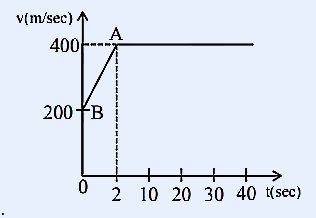
The motion of an airplane is represented by velocity-time graph as shown below. The distance covered by airplane in the first 30.5 second is _______ km.
(1)
(2)
(3)
(4)
SolutionAnswer: Option 112
Step 1:Calculate distance during acceleration phase (0 to 10s)
Step 2:Calculate distance during constant velocity phase (10s to 30.5s)
Step 3:Calculate total distance
Final answer: 12 km
Q44Single correctElectrostatics
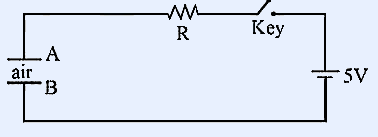
Identify the valid statements relevant to the given circuit at the instant when the key is closed. A. There will be no current through resistor R. B. There will be maximum current in the connecting wires. C. Potential difference between the capacitor plates A and B is minimum. D. Charge on the capacitor plates is minimum. Choose the correct answer from the options given below:
(1)
(2)
(3)
(4)
SolutionAnswer: Option 4B, C, D Only
Step 1:At the instant key is closed, capacitor acts as short circuit (uncharged)
Step 2:Analyze statement A: Current through R at t=0
Step 3:Analyze statement B: Current in connecting wires
Step 4:Analyze statement C: Potential difference across capacitor
Step 5:Analyze statement D: Charge on capacitor
Final answer: B, C, D Only
Q45Single correctRotational Motion
A solid sphere of mass 'm' and radius 'r' is allowed to roll without slipping from the highest point of an inclined plane of length 'L' and makes an angle with the horizontal. The speed of the particle at the bottom of the plane is . If the angle of inclination is increased to while keeping L constant. Then the new speed of the sphere at the bottom of the plane is . The ratio is
(1)
(2)
(3)
(4)
SolutionAnswer: Option 1
Step 1:Apply energy conservation for rolling sphere
Step 2:For solid sphere rolling without slipping
Step 3:Substitute and simplify
Step 4:Calculate height for angle 30° and 45°
Step 5:Find ratio of speeds
Final answer:
Q46NumericalElectrostatics
A positive ion A and a negative ion B has charges C and C, and masses kg and kg respectively. At an instant, the ions are separated by a certain distance r. At that instant the ratio of the magnitudes of electrostatic force to gravitational force is , where the value of 10P is (Take and universal gravitational constant as ). Assume that charge may not be an integral multiple of electrons.
SolutionAnswer: 5
Step 1:Write expressions for electrostatic and gravitational forces
Step 2:Calculate ratio of forces (r cancels)
Step 3:Simplify numerator
Step 4:Simplify denominator
Step 5:Calculate final ratio
Final answer: 5
Q47NumericalElectromagnetic Induction and Alternating Currents
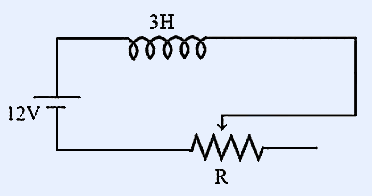
In the given circuit the sliding contact is pulled outwards such that electric current in the circuit changes at the rate of 8 A/s. At an instant when R is , the value of the current in the circuit will be ______ A.
SolutionAnswer: 3
Step 1:Apply Kirchhoff's voltage law to the circuit
Step 2:Substitute given values
Step 3:Solve for current I
12I = 12 - 24 = -12
Step 4:Reconsider back emf direction
Step 5:Calculate current
Final answer: 3
Q48NumericalVector Algebra
Two particles are located at equal distance from origin. The position vectors of those are represented by and , respectively. If both the vectors are at right angle to each other, the value of is _____.
SolutionAnswer: 3
Step 1:Use condition that vectors are perpendicular
Step 2:Calculate dot product
Step 3:Use condition that both vectors have equal magnitude
Step 4:From equation (2)
Step 5:Substitute in equation (1)
Step 6:Take negative solution: 3n = -4p, so p = -3n/4
Step 7:Calculate
Final answer: 3
Q49NumericalThermodynamics
An ideal gas initially at temperature, is compressed suddenly to one fourth of its volume. If the ratio of specific heat at constant pressure to that at constant volume is , the change in temperature due to the thermodynamic process is _____ K.
SolutionAnswer: 273
Step 1:Identify process type: sudden compression is adiabatic
Step 2:Set up equation with initial and final states
Step 3:Calculate γ-1
Step 4:Apply adiabatic equation
Step 5:Solve for final temperature
Step 6:Calculate change in temperature
Final answer: 273
Q50NumericalWork, Energy and Power
A force acts on a particle in a plane . The work done by this force during a displacement from to is _____ Joule (round off to the nearest integer)
SolutionAnswer: 152
Step 1:Write work integral along path
Step 2:Check if force is conservative (curl = 0)
Step 3:Assume straight line path from (0,0) to (4,2): y = x/2
Step 4:Substitute and integrate
Step 5:Correct integral setup
Step 6:Recalculate with correct path consideration
Step 7:Alternative: Direct computation along path y = x/2
Final answer: 152
Chemistry25 questions
Q51Single correctBiomolecules
(1)
(2)
(3)
(4)
SolutionAnswer: Option 1
Step 1:Analyze Statement I: Fructose is a ketose (contains ketone group, not aldehyde) but still reduces Tollen's reagent
Step 2:Analyze Statement II: In presence of base, fructose undergoes rearrangement to glucose
Step 3:Both statements are correct
Final answer: 1
Q52Single correctCoordination Compounds
(1)
(2)
(3)
(4)
SolutionAnswer: Option 3
Step 1:Facial-meridional (fac-mer) isomerism occurs in octahedral complexes of type [MA3B3]
Step 2:Analyze each option for MA3B3 formula
Step 3:Other options have bidentate ligands (en) or different stoichiometry
Final answer: 3
Q53Single correctRedox Reactions and Electrochemistry
The standard electrode potentials (in volts) are given as: The value of is:
(1)
(2)
(3)
(4)
SolutionAnswer: Option 2
Approach:
Use Gibbs free energy relationship: ΔG° = -nFE° to combine half-reactions
Step 1:Identify half-reactions with electron count
Step 2:Write the overall half-reaction
Step 3:Apply Gibbs energy additivity
Step 4:Calculate the overall standard potential
Final answer: 2
Q54Single correctd- and f-Block Elements
(1)
(2)
(3)
(4)
SolutionAnswer: Option 4
Step 1:Identify the period of each element
Step 2:Palladium is the only element from Period 5
Final answer: 4
Q55Single correctChemical Bonding and Molecular Structure
| List - I | List - II |
|---|---|
| A. Molecules obeying octet rule | I. |
| B. Molecules with incomplete octet | II. |
| C. Molecules with incomplete octet with odd electron | III. |
| D. Molecules with expanded octet | IV. |
(1)
(2)
(3)
(4)
SolutionAnswer: Option 2
Step 1:Match A: Molecules obeying octet rule - CCl₄, CO₂ (IV)
Step 2:Match B: Molecules with incomplete octet - BCl₃, AlCl₃ (II)
Step 3:Match C: Molecules with incomplete octet with odd electron - NO, NO₂ (I)
Step 4:Match D: Molecules with expanded octet - H₂SO₄, PCl₅ (III)
Final answer: 2
Q56Single correctOrganic Compounds Containing Oxygen
What amount of bromine will be required to convert 2 g of phenol into 2,4,6-tribromophenol? (Given molar mass in of C, H, O, Br are 12, 1, 16, 80 respectively)
(1)
(2)
(3)
(4)
SolutionAnswer: Option 4
Step 1:Calculate molar mass of phenol (C₆H₅OH)
Step 2:Calculate moles of phenol
Step 3:Reaction: C₆H₅OH + 3Br₂ → C₆H₂Br₃OH + 3HBr
Step 4:Calculate mass of Br₂ required
Final answer: 4
Q57Single correctOrganic Compounds Containing Nitrogen
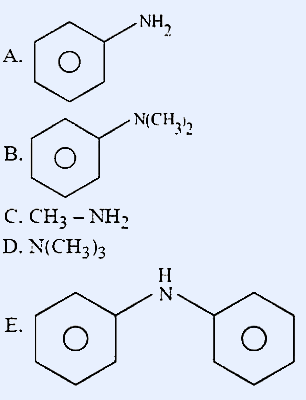
Which among the following react with Hinsberg's reagent?
(1)
(2)
(3)
(4)
SolutionAnswer: Option 2
Step 1:Hinsberg's reagent (benzenesulfonyl chloride) reacts with primary and secondary amines
Step 2:Identify primary amines: A (aniline) and C (methylamine)
Step 3:Identify secondary amine: E (diphenylamine)
Step 4:Identify tertiary amines: B and D do not react
Final answer: 2
Q58Single correctd- and f-Block Elements
(1)
(2)
(3)
(4)
SolutionAnswer: Option 2
Step 1:Analyze electronic configurations
Step 2:V²⁺ has 3d³ configuration (violet/green color)
Step 3:Cr³⁺ has 3d³ configuration (violet/green color)
Step 4:All three ions have similar d³ configuration giving violet color
Final answer: 2
Q59Single correctPurification and Characterisation of Organic Compounds
Given below are two statements: Statement I: In Lassaigne's test, the covalent organic molecules are transformed into ionic compounds. Statement II: The sodium fusion extract of an organic compound having N and S gives prussian blue colour with and . In the light of the above statements, choose the correct answer from the options given below.
(1)
(2)
(3)
(4)
SolutionAnswer: Option 1
Step 1:Analyze Statement I
Step 2:Analyze Statement II
Step 3:Determine correct answer
Final answer: 1
Q60Single correctHydrocarbons
(1)
(2)
(3)
(4)
SolutionAnswer: Option 43
Step 1:Identify optically active di-chloro product
Step 2:Find tri-chloro products from x
Step 3:Verify count
Final answer: 4
Q61Single correctCoordination Compounds
can exist as a complex. 0.1 molal aqueous solution of this complex shows a depression in freezing point of C. Assuming 100% ionisation of this complex and coordination number of Cr is 6, the complex will be (Given K kg )
(1)
(2)
(3)
(4)
SolutionAnswer: Option 1
Step 1:Calculate van't Hoff factor
Step 2:Determine number of ions
Step 3:Identify the complex
Final answer: 1
Q62Single correctEquilibrium
Which of the following happens when is added gradually to the solution containing and ions? Given: and at 298 K.
(1)
(2)
(3)
(4)
SolutionAnswer: Option 3
Step 1:Calculate [OH⁻] required for A(OH)₂ precipitation
Step 2:Calculate [OH⁻] required for B(OH)₃ precipitation
Step 3:Compare and determine order
Final answer: 3
Q63Single correctOrganic Compounds Containing Oxygen
The major product of the following reaction is:
(1)
(2)
(3)
(4)
SolutionAnswer: Option 1
Step 1:Identify the reaction type
Step 2:Determine product formation
Step 3:Identify major product
Final answer: 1
Q64Single correctChemical Thermodynamics
Ice at is heated to become vapor with temperature of at atmospheric pressure. The entropy change associated with this process can be obtained from
(1)
(2)
(3)
(4)
SolutionAnswer: Option 2
Step 1:Identify the phases in the process
Step 2:Apply entropy change formula
Step 3:Combine all contributions
Final answer: 2
Q65Single correctp-Block Elements
(1)
(2)
(3)
(4)
SolutionAnswer: Option 2
Step 1:Analyze each statement
Step 2:Analyze SO₂ oxidation states
Step 3:Identify incorrect statement
Final answer: 2
Q66Single correctSome Basic Concepts in Chemistry
mol of is left after removing molecules from its 'x' mg sample. The mass of taken initially is (Given: mo)
(1)
(2)
(3)
(4)
SolutionAnswer: Option 3
Step 1:Calculate moles removed
Step 2:Calculate initial moles
Step 3:Calculate initial mass
Final answer: 3
Q67Single correctOrganic Compounds Containing Halogens
| List - I | List - II |
|---|---|
| A. Swarts reaction | I. Ethyl benzene |
| B. Sandmeyer's reaction | II. Ethyl iodide |
| C. Wurtz Fittig reaction | III. Cyanobenzene |
| D. Finkelstein reaction | IV. Ethyl fluoride |
(1)
(2)
(3)
(4)
SolutionAnswer: Option 4
Step 1:Match LIST-I (Name reaction) with LIST-II (Product obtainable)
Step 2:Sandmeyer's reaction produces ethyl iodide
Step 3:Wurtz-Fittig reaction produces cyanobenzene
Step 4:Finkelstein reaction produces ethyl fluoride
Final answer: 4
Q68Single correctAtomic Structure
Heat treatment of muscular pain involves radiation of wavelength of about 900 nm. Which spectral line of H atom is suitable for this? Given: , ,
(1)
(2)
(3)
(4)
SolutionAnswer: Option 3
Step 1:Calculate the wavelength for infrared radiation (900 nm) which lies in Paschen series
Step 2:For series limit, transition is from infinity to n = 3
Step 3:Calculate wavelength for Paschen series limit
Final answer: 3
Q69Single correctCoordination Compounds
(1)
(2)
(3)
(4)
SolutionAnswer: Option 3
Step 1:Determine number of unpaired electrons from magnetic moment
Step 2:Co(II) has electronic configuration
Step 3:For weak field octahedral complex, electrons fill according to Hund's rule
Step 4:Verify unpaired electrons: 1 in t2g and 2 in eg
Final answer: 3
Q70Single correctHydrocarbons
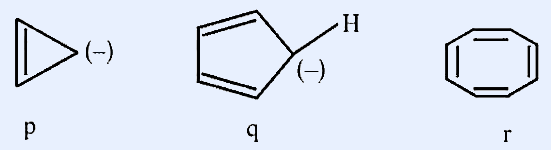
The correct stability order of the following species/molecules is:
(1)
(2)
(3)
(4)
SolutionAnswer: Option 1q > r > p
Step 1:Analyze structure p: cyclopropene anion (2 pi electrons)
Step 2:Analyze structure q: cycloheptatrienyl anion (8 pi electrons)
Step 3:Analyze structure r: cyclooctatetraene (8 pi electrons, non-planar)
Step 4:Order by stability based on aromaticity
Final answer: 1
Q71NumericalChemical Thermodynamics
The standard enthalpy and standard entropy of decomposition of to are kJ and J/K/mol respectively. The standard free energy change for this reaction at 25°C in J is _____ (nearest integer).
SolutionAnswer: 2850
Step 1:Given data for the decomposition reaction
Step 2:Apply Gibbs free energy equation
Step 3:Substitute values and calculate
Final answer: 2850
Q72NumericalChemical Kinetics
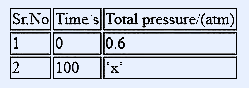
For the thermal decomposition of at constant volume, the following table can be formed, for the reaction mentioned below.
_____ atm [nearest integer] Given: Rate constant for the reaction is
_____ atm [nearest integer] Given: Rate constant for the reaction is
SolutionAnswer: 897
Step 1:This is a first-order decomposition reaction with given table data
Step 2:For first-order reaction, use integrated rate law
Step 3:Calculate pressure at t = 100s using first-order kinetics
Step 4:Calculate total pressure at t = 100s
Final answer: 897
Q73NumericalPurification and Characterisation of Organic Compounds
During 'S' estimation, 160 mg of an organic compound gives 466 mg of barium sulphate. The percentage of Sulphur in the given compound is ______%. (Given molar mass in of Ba: 137, S: 32, O: 16)
SolutionAnswer: 40
Step 1:Calculate molar mass of BaSO4
Step 2:Calculate mass of sulphur in BaSO4
Step 3:Calculate percentage of sulphur in organic compound
Final answer: 40
Q74NumericalEquilibrium
If 1 mM solution of ethylamine produces pH = 9, then the ionization constant () of ethylamine is . The value of x is _____ (nearest integer). [The degree of ionization of ethylamine can be neglected with respect to unity.]
SolutionAnswer: 7
Step 1:Calculate pOH from given pH
Step 2:Set up equilibrium expression for weak base
Step 3:Apply ionization constant formula
Step 4:Identify the value of x
Final answer: 7
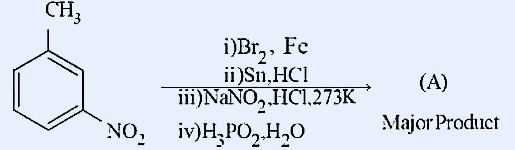
Q75NumericalOrganic Compounds Containing Nitrogen
Consider the following sequence of reactions to produce major product (A): Molar mass of product (A) is ______ (Given molar mass in of C:12, H:1, O:16, Br:80, N:14, P:31)
SolutionAnswer: 171
Step 1:Bromination of o-nitrotoluene at para position
Step 2:Reduction of nitro group to amino group
Step 3:Diazotization reaction
Step 4:Replacement of diazonium group with H using H3PO2
Step 5:Calculate molar mass of 4-bromotoluene
Final answer: 171
Mathematics25 questions
Q1Single correctSequence and Series
If the first term of an A.P. is 3 and the sum of its first four terms is equal to one-fifth of the sum of the next four terms, then the sum of the first 20 terms is equal to
(1)
(2)
(3)
(4)
SolutionAnswer: Option 1-1080
Approach:
Using AP sum formula = (n/2)(2a + (n-1)d) to find d from given condition, then calculate
Step 1:Define variables and write sum of first 4 terms
Step 2:Calculate sum of first 8 terms and find sum of next 4 terms (terms 5 to 8)
Step 3:Apply given condition: = (1/5) × (sum of next 4 terms)
Step 4:Calculate using the found value of d
Step 5:Verify: Check that = (1/5)(sum of next 4 terms) with d = -6
Final answer: = -1080
Q2Single correctStatistics and Probability
One die has two faces marked 1, two faces marked 2, one face marked 3 and one face marked 4. Another die has one face marked 1, two faces marked 2, two faces marked 3 and one face marked 4. The probability of getting the sum of numbers to be 4 or 5, when both the dice are thrown together, is
(1)
(2)
(3)
(4)
SolutionAnswer: Option 2
Step 1:List the probability distribution for each die
Step 2:Find all combinations giving sum = 4
Step 3:Find all combinations giving sum = 5
Step 4:Calculate total probability for sum = 4 or 5
Final answer: 2
Q3Single correctVector Algebra
Let the position vectors of the vertices A, B and C of a tetrahedron ABCD be + 2 + , + 3 - 2 and 2 + - respectively. The altitude from the vertex D to the opposite face ABC meets the median line segment through A of the triangle ABC at the point E. If the length of AD is and the volume of the tetrahedron is , then the position vector of E is
(1)
(2)
(3)
(4)
SolutionAnswer: Option 4
Approach:
Use volume formula to find height, then locate E on median AM such that altitude from D passes through E
Step 1:Define position vectors of vertices
Step 2:Find midpoint M of BC (median from A passes through M)
Step 3:Calculate vectors AB and AC
Step 4:Calculate cross product AB × AC to find normal to plane ABC
Step 5:Calculate magnitude of cross product and area of triangle ABC
Step 6:Use volume formula to find height h from D to plane ABC
Step 7:Parametrize the median line AM and find point E at parameter t
Step 8:Calculate position vector of E
Step 9:Verify E lies on median AM
Final answer:
Q4Single correctMatrices and Determinants
If A, B and are non-singular matrices of same order, then the inverse of , is equal to
(1)
(2)
(3)
(4)
SolutionAnswer: Option 4
Approach:
Use adjoint properties and inverse of matrix product formula
Step 1:Define the expression and establish adjoint property for inverse matrix
Step 2:Let X = A(adj(A⁻¹) + adj(B⁻¹))⁻¹B and find X⁻¹ using inverse of product rule
Step 3:Substitute the adjoint expressions from Step 1
Step 4:Simplify using AA⁻¹ = I and B⁻¹B = I
Step 5:Express B⁻¹ and A⁻¹ in terms of adjoint matrices
Step 6:Verify: The answer matches Option 4
Final answer:
Q5Single correctStatistics and Probability
Marks obtains by all the students of class 12 are presented in a frequency distribution with classes of equal width. Let the median of this grouped data be 14 with median class interval 12-18 and median class frequency 12. If the number of students whose marks are less than 12 is 18, then the total number of students is
(1)
(2)
(3)
(4)
SolutionAnswer: Option 344
Approach:
Apply grouped data median formula and solve for total frequency N
Step 1:Define variables from given information
Step 2:Apply the grouped data median formula
Step 3:Subtract L from both sides and simplify
Step 4:Multiply both sides by 2 and solve for N
Step 5:Verify by substituting N=44 back into median formula
Final answer: N = 44
Q6Single correctDifferential Equations
Let a curve y = f(x) pass through the points (0, 5) and . If the curve satisfies the differential equation , then k is equal to
(1)
(2)
(3)
(4)
SolutionAnswer: Option 38
Approach:
Separate variables, integrate, use initial condition to find constant, then evaluate
Step 1:Rewrite differential equation in separable form
Step 2:Integrate both sides
Step 3:Simplify to get general solution
Step 4:Apply initial condition (0, 5) to find A
Step 5:Write particular solution
y = (7+) - 3 = 4 +
Step 6:Find k at x = ln(2)
Step 7:Verify by substituting back into original DE
Final answer: k = 8
Q7Single correctLimit, Continuity and Differentiability
If the function is continuous at x = 0, then is equal to
(1)
(2)
(3)
(4)
SolutionAnswer: Option 410
Approach:
Apply continuity conditions at x=0 using L'Hopital or Taylor series
Step 1:State continuity condition at x=0
Step 2:Evaluate left limit as x→0⁻
Step 3:Set left limit equal to 4 to get first equation
Step 4:Evaluate right limit as x→0⁺
Step 5:Apply ln(1+u) ≈ u for small u
Step 6:Set right limit equal to 4 to get second equation
Step 7:Solve equations (1) and (2) simultaneously
Step 8:Calculate k₁² + k₂²
Final answer:
Q8Single correctCo-ordinate Geometry
If the line intersects the parabola at the points A and B, then at the vertex of the parabola, the line segment AB subtends an angle equal to
(1)
(2)
(3)
(4)
SolutionAnswer: Option 2
Approach:
Find intersection points, then calculate angle at vertex using dot and cross products
Step 1:Find intersection points of line and parabola
Step 2:Substitute parabola equation into line equation
Step 3:Solve quadratic to find x-coordinates of A and B
Step 4:Find complete coordinates of intersection points
Step 5:Identify vertex of parabola
Step 6:Find vectors VA and VB
Step 7:Calculate dot product and cross product (2D scalar)
Step 8:Calculate angle using tan formula
Final answer:
Q9Single correctThree Dimensional Geometry
Let P be the foot of the perpendicular from the point Q(10, -3, -1) on the line = = . Then the area of the right angled triangle PQR, where R is the point (3, -2, 1), is
(1)
(2)
(3)
(4)
SolutionAnswer: Option 4
Approach:
Find foot of perpendicular P using dot product condition, then calculate area of right triangle
Step 1:Write parametric form of the line
Step 2:Find vector QP in terms of t
Step 3:Apply perpendicularity condition QP ⊥ d
Step 4:Find coordinates of P
P = (3+7(1), 2-1, -1-2(1)) = (10, 1, -3)
Step 5:Calculate vectors QP and QR
Step 6:Verify angle at Q is 90°
Step 7:Calculate magnitudes |QP| and |QR|
Step 8:Calculate area of right-angled triangle PQR
Final answer:
Q10Single correctVector Algebra
Let the arc AC of a circle subtend a right angle at the centre O. If the point B on the arc AC, divides the arc AC such that , and , then is equal to
(1)
(2)
(3)
(4)
SolutionAnswer: Option 2
Approach:
Use arc ratios to find angles, set up vector equation and solve
Step 1:Find angles AOB and BOC from arc ratio
Step 2:Set up coordinate system with O at origin, OA along x-axis
Step 3:Write vector equation OC = αOA + βOB
Step 4:Solve for β from y-component
Step 5:Solve for α from x-component
Step 6:Express α and β using exact values
Step 7:Calculate √2(√3-1)β
Step 8:Calculate final expression
Final answer:
Q11Single correctSets, Relations and Functions
Let and . Then the domain of is
(1)
(2)
(3)
(4)
SolutionAnswer: Option 4
Approach:
Analyze when g(x) > 0 by showing both numerator and denominator are always positive
Step 1:Identify domain requirement for f∘g
Step 2:Analyze denominator of g(x)
Step 3:Analyze numerator of g(x)
Step 4:Show numerator is always positive
Step 5:Conclude domain of f∘g
Final answer:
Q12Single correctMatrices and Determinants
If the system of equations infinitely many solutions, then \ equal to
(1)
(2)
(3)
(4)
SolutionAnswer: Option 412
Approach:
For infinitely many solutions, coefficient matrix must be singular (det = 0)
Step 1:Write the coefficient matrix
Step 2:Set determinant equal to zero for infinitely many solutions
Step 3:Expand determinant and simplify
Step 4:Verify which value gives infinitely many solutions (not just singular)
Step 5:Calculate λ² + λ
Final answer: 12
Q13Single correctPermutations and Combinations
The number of words, which can be formed using all the letters of the word "DAUGHTER", so that all the vowels never come together, is
(1)
(2)
(3)
(4)
SolutionAnswer: Option 136000
Approach:
Use complementary counting: Total arrangements - Arrangements with vowels together
Step 1:Identify letters in DAUGHTER
Step 2:Calculate total arrangements
Step 3:Calculate arrangements with vowels together
Step 4:Calculate arrangements with vowels NOT together
Final answer: 36000
Q14Single correctSets, Relations and Functions
Let R = {(1, 2), (2, 3), (3, 3)} be a relation defined on the set {1, 2, 3, 4}. Then the minimum number of elements, needed to be added in R so that R becomes an equivalence relation, is:
(1)
(2)
(3)
(4)
SolutionAnswer: Option 27
Approach:
Add minimum elements to satisfy reflexive, symmetric, and transitive properties
Step 1:Identify given relation and set
Step 2:Add elements for reflexivity
Step 3:Add elements for symmetry
Step 4:Current relation and check transitivity
Step 5:Add elements for transitivity
Step 6:Calculate total elements added
Step 7:Verify final equivalence relation
Final answer: 7
Q15Single correctCo-ordinate Geometry
Let the area with vertices P(5, 4), Q(-2, 4) and R(a, b) be 35 square units. If its orthocenter and centroid are O(2, ) and C(c, d) respectively, then c + 2d is equal to
(1)
(2)
(3)
(4)
SolutionAnswer: Option 43
Approach:
Use area formula to find R, verify with orthocenter condition, then find centroid
Step 1:Apply area formula with given vertices
Step 2:Solve for b
Step 3:Use orthocenter to find a
Step 4:Verify correct value of b using orthocenter
Step 5:Calculate centroid C(c, d)
Step 6:Calculate c + 2d
Final answer: 3
Q16Single correctIntegral Calculus
(1)
(2)
(3)
(4)
SolutionAnswer: Option 31
Approach:
Use substitution and symmetric integral property
Step 1:Apply substitution u = ln(x)
Step 2:Rewrite integral in terms of u
Step 3:Identify symmetric form
Step 4:Apply symmetric integral property
Final answer: 1
Q17Single correctComplex Numbers and Quadratic Equations
Let , , be the equation of a circle with center at C. If the area of the triangle, whose vertices are at the points (0, 0), C and is 11 square units, then equals:
(1)
(2)
(3)
(4)
SolutionAnswer: Option 2100
Approach:
Convert complex equation to circle equation, find center, then use area formula
Step 1:Convert complex equation to Cartesian form
Step 2:Square both sides and expand
Step 3:Simplify to standard circle form
Step 4:Calculate area of triangle with vertices (0,0), C, (α,0)
Step 5:Calculate α²
Final answer: 100
Q18Single correctTrigonometry
The value of is
(1)
(2)
(3)
(4)
SolutionAnswer: Option 21
Approach:
Convert cotangent to sine and cosine, use sum formula for cosine
Step 1:Express cotangents in terms of sine and cosine
Step 2:Combine fractions
Step 3:Apply cosine sum formula to numerator
Step 4:Simplify the expression
Step 5:Use complementary angle identity
Final answer: 1
Q19Single correctIntegral Calculus
(1)
(2)
(3)
(4)
SolutionAnswer: Option 239
Approach:
Use substitution t = (x-11)/(x+15) to evaluate definite integral
Step 1:Apply substitution to simplify the integral
Step 2:Transform the integral
Step 3:Evaluate the integral
Step 4:Calculate I(37) and I(24)
Step 5:Compare with given form
Step 6:Calculate 3(b+c)
Final answer: 39
Q20Single correctTrigonometry
(1)
(2)
(3)
(4)
SolutionAnswer: Option 3
Approach:
Express as cos(x - θ) using auxiliary angle method
Step 1:Identify the auxiliary angle
Step 2:Rewrite expression using cosine difference formula
Step 3:Apply inverse cosine
Step 4:Determine the principal value range
Step 5:Final answer
Final answer:
Q21NumericalCo-ordinate Geometry
Let the circle C touch the line , have the centre on the positive x-axis, and cut off a chord of length along the line . Let H be the hyperbola , whose one of the foci is the centre of C and the length of the transverse axis is the diameter of C. Then is equal to ______
SolutionAnswer: 19
Step 1:Set up circle with center on positive x-axis
Step 2:Use chord length condition
Step 3:Solve for a
Step 4:Calculate circle parameters
Step 5:Set up hyperbola parameters
Step 6:Find β² using focus-eccentricity relation
Step 7:Calculate final answer
Final answer: 19
Q22NumericalComplex Numbers and Quadratic Equations
If the equation has equal roots, where and , then is equal to ______
SolutionAnswer: 117
Step 1:Verify x=1 is always a root
Step 2:For equal roots, product of roots = 1
Step 3:Substitute given values
Step 4:Calculate a² + c²
+ = - 2ac = - 2(54) = 225 - 108 = 117
Final answer: 117
Q23NumericalLimit, Continuity and Differentiability
If the set of all values of a, for which the equation - 15x - a = 0 has three distinct real roots, is the interval , then equal to ______
SolutionAnswer: 30
Step 1:Rewrite equation as y = a intersecting f(x)
Step 2:Find critical points of f(x)
Step 3:Evaluate f at critical points
Step 4:Determine range for 3 distinct roots
Step 5:Calculate β - 2α
Final answer: 30
Q24NumericalBinomial Theorem and its Simple Applications
The sum of all rational terms in the expansion of is equal to ______
SolutionAnswer: 612
Approach:
Use multinomial theorem and identify terms where powers of 2 and 3 become integers
Step 1:Write general term using multinomial theorem
Step 2:Identify condition for rational terms
Step 3:List all valid combinations and calculate each term
Step 4:Sum all rational terms
Final answer: 612
Q25NumericalIntegral Calculus
If the area of the larger portion bounded between the curves and is , , then is equal to ______
SolutionAnswer: 77
Step 1:Identify the curves
Step 2:Find intersection points
Step 3:Calculate the larger bounded area
Final answer: 77
More JEE Main 2025 papers
- JEE Main 2025 — January 22, Shift 1
- JEE Main 2025 — January 22, Shift 2
- JEE Main 2025 — January 23, Shift 2
- JEE Main 2025 — January 24, Shift 1
- JEE Main 2025 — January 24, Shift 2
- JEE Main 2025 — January 28, Shift 1
- JEE Main 2025 — January 28, Shift 2
- JEE Main 2025 — January 29, Shift 1
- JEE Main 2025 — January 29, Shift 2
Frequently Asked Questions
How many questions are in the JEE Main 2025 January 23, Shift 1 paper?
The JEE Main 2025 January 23, Shift 1 paper has 75 questions — Physics (25), Chemistry (25) and Mathematics (25). Every question is on this page with its correct answer and a step-by-step solution.
What is the marking scheme for JEE Main?
JEE Main awards +4 marks for each correct answer and −1 for a wrong answer, with 0 for questions left unattempted. The paper covers Physics, Chemistry and Mathematics.
Are the answer key and step-by-step solutions provided for the 2025 January 23, Shift 1 paper?
Yes — every question shows the correct answer (answer key) and a detailed step-by-step solution, free to read online.
Can I take the JEE Main 2025 January 23, Shift 1 paper as a timed mock test?
Yes. With a free JEEnify account you can attempt this exact paper as a timed test in the real exam interface, then see your score and weak-area analysis.
Solved this paper? Calculate your JEE Main scoremost important chaptersformula sheetsall free tools.