
Back to JEE Main PYQs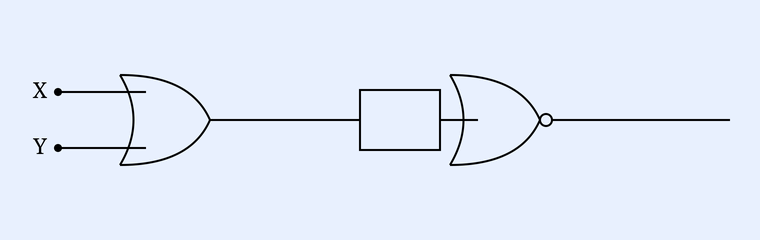
![Two graphs: t-half vs initial concentration (flat line) and log([R]/[R]0) vs time (straight line).](/api/qna-image?path=QnA%2Fb65cda62-f924-480b-b4db-1d3aaa6069d4%2F5ef15551-aed6-4f93-a8d5-a219b7a5d19b%2F7fc5308e-e34a-4b5b-a1cc-ddfeadd8809a%2F7fc5308e-e34a-4b5b-a1cc-ddfeadd8809a%2Fimages%2FQ63_stem.webp)
The heat of formation of is given by :
JEE Main 2025 January 24, Shift 2 Question Paper with Solutions
All 74 questions from the JEE Main 2025 (January 24, Shift 2) shift — Physics (24), Chemistry (25) and Mathematics (25) — each with the correct answer (answer key) and a step-by-step solution. Read it free online, or attempt the full paper as a timed mock test.
Physics24 questions
Q26Single correctUnits and Measurements
Which of the following figure represents the relation between Celsius and Fahrenheit temperatures ?
(1)
(2)
(3)
(4)
SolutionAnswer: Option 4
Approach:
Express the Fahrenheit temperature F as a function of the Celsius temperature C and identify the line with positive slope and positive intercept.
Step 1:Write the conversion relation.
Step 2:Identify slope and intercept.
Step 3:Match to the graph of F (vertical axis) versus C with positive slope crossing the F-axis above the origin.
Final answer:
Q27Single correctKinematics
The position vector of a moving body at any instant of time is given as m. The magnitude and direction of velocity at s is,
(1)
(2)
(3)
(4)
SolutionAnswer: Option 4
Approach:
Differentiate the position vector to obtain velocity, evaluate at the given time, compute its magnitude and the angle relative to the negative Y axis.
Step 1:Differentiate each component.
Step 2:Substitute t = 2 s.
Step 3:Compute the magnitude.
Step 4:The velocity points along +X and -Y; angle measured from the negative Y axis.
Final answer:
Q28Single correctElectronic Devices
The output of the circuit is low (zero) for :
(A) (B) (C) (D) Choose the correct answer from the options given below :
(A) (B) (C) (D) Choose the correct answer from the options given below :
(1)
(2)
(3)
(4)
SolutionAnswer: Option 1
Approach:
Identify the gate from the figure as a NOR gate and apply its truth table to find the input combinations giving a low (zero) output.
Step 1:The symbol shown is an OR shape with an inversion bubble, i.e. a NOR gate.
Step 2:Evaluate the output for each input pair.
Step 3:Collect the low-output cases.
Final answer:
Q29Single correctWave Optics
Young's double slit interference apparatus is immersed in a liquid of refractive index 1.44. It has slit separation of 1.5 mm . The slits are illuminated by a parallel beam of light whose wavelength in air is 690 nm . The fringe-width on a screen placed behind the plane of slits at a distance of 0.72 m , will be :
(1)
(2)
(3)
(4)
SolutionAnswer: Option 1
Approach:
Compute the wavelength inside the liquid, then apply the fringe-width formula for the double slit.
Step 1:Find the wavelength in the liquid.
Step 2:Apply the fringe-width formula.
Step 3:Convert to millimetres.
Final answer:
Q30Single correctThermodynamics
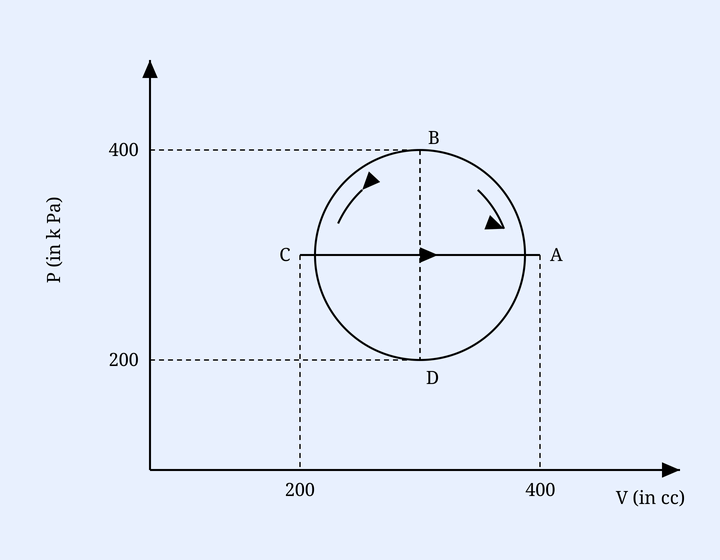
The magnitude of heat exchanged by a system for the given cyclic process ABCA (as shown in figure) is (in SI unit) :
(1)
(2)
(3)
(4)
SolutionAnswer: Option 1
Approach:
For a cyclic process the heat exchanged equals the work done, which is the area enclosed by the loop on the P-V diagram. The loop is a semicircle, so compute its area in SI units.
Step 1:From the figure the closed path encloses a semicircular region with pressure spanning 200 to 400 Pa and volume spanning 200 to 400 cc.
Step 2:Take the semicircular area with semi-axes (half-spans) of pressure and volume.
Step 3:Compute the enclosed area.
Step 4:The magnitude of heat exchanged matches the enclosed area.
Final answer:
Q31Single correctMagnetic Effects of Current and Magnetism
A long straight wire of a circular cross-section with radius carries a steady current . The current I is uniformly distributed across this cross-section. The plot of magnitude of magnetic field B with distance from the centre of the wire is given by
(1)
(2)
(3)
(4)
SolutionAnswer: Option 4
Approach:
Apply Ampere's law inside and outside the wire to find how B varies with r, then match to the graph that rises linearly up to r = a and then falls off as 1/r.
Step 1:Inside the wire the enclosed current grows as the area, giving B proportional to r.
Step 2:At the surface B reaches its maximum.
Step 3:Outside the wire B decreases inversely with r.
Step 4:Select the graph that rises linearly to a peak at r = a then decays as 1/r.
Final answer:
Q32Single correctDual Nature of Matter and Radiation
In photoelectric effect, the stopping potential v/s frequency curve is plotted. ( h is the Planck's constant and is work function of metal ) (A) v/s curve is linear. (B) The slope of v/s curve (C) h constant is related to the slope of v/s line. (D) The value of electric charge of electron is not required to determine h using the v/s curve. (E) The work function can be estimated without knowing the value of h. Choose the correct answer from the options given below :
(1)
(2)
(3)
(4)
SolutionAnswer: Option 2
Approach:
Write the Einstein photoelectric equation in terms of stopping potential and analyse the slope, intercept and what each can determine.
Step 1:Rearrange the photoelectric equation for V0.
Step 2:Identify the slope.
Step 3:Determine h from the slope.
Step 4:Estimate the work function from the threshold frequency (x-intercept), which needs e but not h.
from intercept
Final answer:
Q33Single correctRotational Motion
A solid sphere and a hollow sphere of the same mass and of same radius are rolled on an inclined plane. Let the time taken to reach the bottom by the solid sphere and the hollow sphere are and , respectively, then
(1)
(2)
(3)
(4)
SolutionAnswer: Option 3
Approach:
Compare the accelerations of the two rolling spheres using their moments of inertia; the body with smaller moment-of-inertia factor accelerates faster and reaches the bottom sooner.
Step 1:Write the rolling factors.
Step 2:Compare accelerations.
Step 3:Relate time of descent to acceleration for equal length.
Step 4:Therefore the solid sphere reaches first.
Final answer:
Q34Single correctElectrostatics
A small uncharged conducting sphere is placed in contact with an identical sphere but having charge and then removed to a distance such that the force of repulsion between them is N. The distance between them is (Take )
(1)
(2)
(3)
(4)
SolutionAnswer: Option 2
Approach:
On contact the charge is shared equally between the identical spheres; then apply Coulomb's law with the resulting equal charges and the given force to solve for the separation.
Step 1:Find the charge on each sphere after contact.
Step 2:Insert into Coulomb's law.
Step 3:Solve for r squared.
Step 4:Take the square root.
Final answer:
Q35Single correctMoving Charges and Magnetism
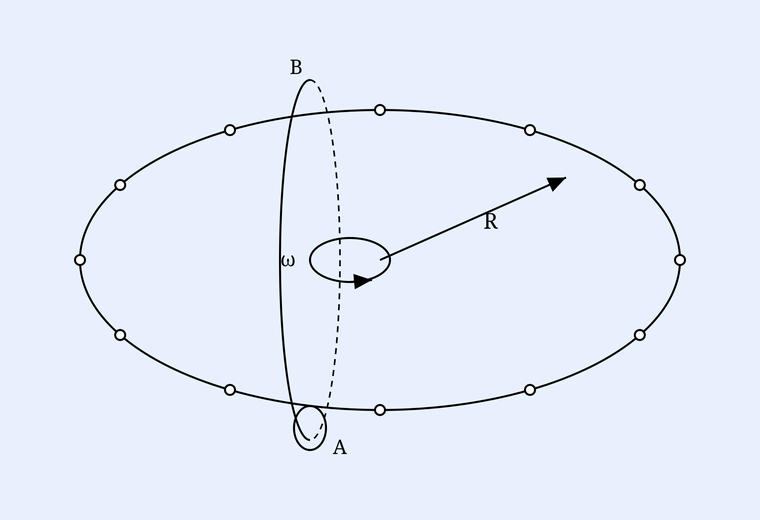
N equally spaced charges each of value q , are placed on a circle of radius R . The circle rotates about its axis with an angular velocity as shown in the figure. A bigger Amperian loop B encloses the whole circle where as a smaller Amperian loop A encloses a small segment. The difference between enclosed currents, , for the given Amperian loops is
(1)
(2)
(3)
(4)
SolutionAnswer: Option 4
Approach:
The bigger loop encloses the rotating ring contributing zero net current threading it for the considered enclosure, while the small loop A encloses the equivalent current of the rotating charges; evaluate that current from the total charge circulating per period.
Step 1:Total circulating charge on the ring.
Step 2:Equivalent current of the rotating ring.
Step 3:Form the difference of the enclosed currents for the two loops.
Final answer:
Q36Single correctOscillations
A particle oscillates along the x-axis according to the law, where m. The kinetic energy (K) of the particle as a function of x is correctly represented by the graph
(1)
(2)
(3)
(4)
SolutionAnswer: Option 4
Approach:
Rewrite the displacement using a half-angle identity to identify it as SHM about the midpoint, express the velocity, and obtain kinetic energy as a function of x to determine the graph shape.
Step 1:Rewrite the displacement.
Step 2:Velocity by differentiation.
Step 3:Express K using v squared and the SHM energy relation about the centre x0/2.
Step 4:With x0 = 1, K is maximum at x = 1/2 and zero at x = 0 and x = 1.
Final answer:
Q37Single correctRay Optics and Optical Instruments
A photograph of a landscape is captured by a drone camera at a height of 18 km . The size of camera film is and the area of the landscape photographed is . The focal length of the lens in the drone camera is :
(1)
(2)
(3)
(4)
SolutionAnswer: Option 1
Approach:
Use the linear magnification as the ratio of film size to object size, which equals the ratio of image distance (approximately the focal length) to object distance (the height), then solve for the focal length.
Step 1:Find the linear size of the landscape from its area.
Step 2:Form the magnification from the linear sizes.
Step 3:Relate magnification to focal length and height.
Step 4:Substitute the height 18 km.
Final answer:
Q39Single correctElectromagnetic Waves
Arrange the following in the ascending order of wavelength : (A) Microwaves (B) Ultraviolet rays (C) Infrared rays (D) X-rays Choose the most appropriate answer from the options given below :
(1)
(2)
(3)
(4)
SolutionAnswer: Option 4
Approach:
Order the electromagnetic spectrum by increasing wavelength and map each named radiation to its band.
Step 1:X-rays have the shortest wavelength among the four, followed by ultraviolet rays.
Step 2:Infrared rays have a longer wavelength than ultraviolet, and microwaves have the longest of the four.
Step 3:Combining the ordering gives the full ascending sequence.
Final answer:
Q40Single correctDual Nature of Matter and Radiation
The energy and momentum of a moving body of mass are related by some equation. Given that c represents the speed of light, identify the correct equation
(1)
(2)
(3)
(4)
SolutionAnswer: Option 4
Approach:
Apply the relativistic energy-momentum relation and check dimensional consistency.
Step 1:Total relativistic energy relates to momentum and rest mass through the standard invariant.
Step 2:Expand the squared terms.
Step 3:Each term carries units of energy squared, confirming the form and .
Final answer:
Q41Single correctThermal Properties of Matter
The temperature of a body in air falls from C to C in 4 minutes. The temperature of the air is C. The temperature of the body in the next 4 minutes will be:
(1)
(2)
(3)
(4)
SolutionAnswer: Option 4
Approach:
Use Newton's law of cooling in its approximate finite-difference form over each 4-minute interval with the same surrounding temperature.
Step 1:Apply the law to the first interval from C to C with surrounding temperature C.
Step 2:Apply the law to the second interval from C to the unknown final temperature .
Step 3:Simplify both sides and solve for .
Final answer:
Q42Single correctRotational Motion
A solid sphere is rolling without slipping on a horizontal plane. The ratio of the linear kinetic energy of the centre of mass of the sphere and rotational kinetic energy is :
(1)
(2)
(3)
(4)
SolutionAnswer: Option 3
Approach:
Express translational and rotational kinetic energies for a solid sphere rolling without slipping and take their ratio.
Step 1:Write the rotational kinetic energy using the solid-sphere moment of inertia and the rolling condition .
Step 2:State the translational kinetic energy of the centre of mass.
Step 3:Form the ratio of translational to rotational kinetic energy.
Final answer:
Q43Single correctWave Optics
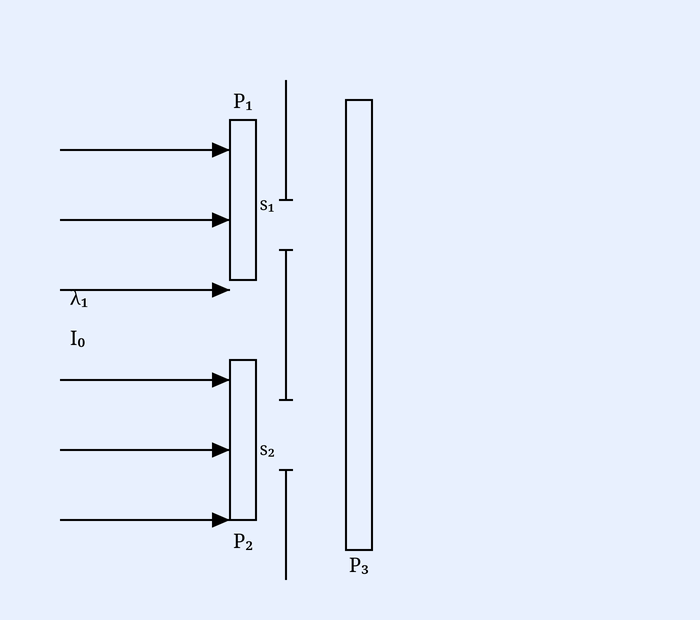
In a Young's double slit experiment, three polarizers are kept as shown in the figure. The transmission axes of and are orthogonal to each other. The polarizer covers both the slits with its transmission axis at to those of and . An unpolarized light of wavelength and intensity is incident on and . The intensity at a point after where the path difference between the light waves from and is , is
(1)
(2)
(3)
(4)
SolutionAnswer: Option 2
Approach:
Track the intensity through each polarizer using Malus's law, then combine the two beams that emerge with a common polarization through using the interference formula for the given path difference.
Step 1:Unpolarized light of intensity passing through and through emerges with half intensity along each transmission axis.
Step 2:Each beam then passes through at , reducing each by and giving both a common polarization so they can interfere.
Step 3:Convert the path difference into a phase difference.
Step 4:Combine the two equal-intensity coherent beams with this phase difference.
Final answer:
Q44Single correctThermodynamics
Given below are two statements. One is labelled as Assertion (A) and the other is labelled as Reason (R).
Assertion (A) : In an insulated container, a gas is adiabatically shrunk to half of its initial volume. The temperature of the gas decreases. Reason (R): Free expansion of an ideal gas is an irreversible and an adiabatic process. In the light of the above statements, choose the correct answer from the options given below :
Assertion (A) : In an insulated container, a gas is adiabatically shrunk to half of its initial volume. The temperature of the gas decreases. Reason (R): Free expansion of an ideal gas is an irreversible and an adiabatic process. In the light of the above statements, choose the correct answer from the options given below :
(1)
(2)
(3)
(4)
SolutionAnswer: Option 2(A) is false but (R) is true
Approach:
Evaluate each statement physically: examine what happens when a gas is adiabatically compressed versus the nature of free expansion.
Step 1:Shrinking a gas adiabatically to half its volume is a compression, for which the adiabatic relation predicts the temperature rises, not falls.
Step 2:Free expansion of an ideal gas occurs with no heat exchange and against zero external pressure, making it both adiabatic and irreversible.
Step 3:Since the assertion is false while the reason is true, the matching option is selected.
Final answer: (A) is false but (R) is true
Q45Single correctMoving Charges and Magnetism
Given below are two statements. One is labelled as Assertion (A) and the other is labelled as Reason (R).
Assertion (A) : A electron in a certain region of uniform magnetic field is moving with constant velocity in a straight line path. Reason (R): The magnetic field in that region is along the direction of velocity of the electron. In the light of the above statements, choose the correct answer from the options given below :
Assertion (A) : A electron in a certain region of uniform magnetic field is moving with constant velocity in a straight line path. Reason (R): The magnetic field in that region is along the direction of velocity of the electron. In the light of the above statements, choose the correct answer from the options given below :
(1)
(2)
(3)
(4)
SolutionAnswer: Option 3Both and are true and is the correct explanation of
Approach:
Analyse the magnetic force on a charge moving parallel to the field and check whether the reason explains the assertion.
Step 1:When the velocity is parallel (or antiparallel) to the magnetic field, the cross product vanishes, so the magnetic force is zero.
when
Step 2:With zero net force the electron continues with constant velocity along a straight line, so the assertion is true.
Step 3:The field being along the velocity direction is precisely the condition that makes the force zero, so the reason is true and explains the assertion.
Final answer: Both and are true and is the correct explanation of
Q46NumericalDual Nature of Matter and Radiation
The ratio of the power of a light source to that the light source is 2. is emitting photons per second at 600 nm . If the wavelength of the source is 300 nm , then the number of photons per second emitted by is .
SolutionAnswer: 5
Approach:
Express each source's power as the photon emission rate times the photon energy, then use the given power ratio to find the rate of the second source.
Step 1:Write the ratio of the two powers in terms of photon rates and wavelengths.
Step 2:Rearrange to solve for the photon rate of the second source.
Step 3:Substitute the values with , nm and nm.
Final answer: 5
Q47NumericalLaws of Motion
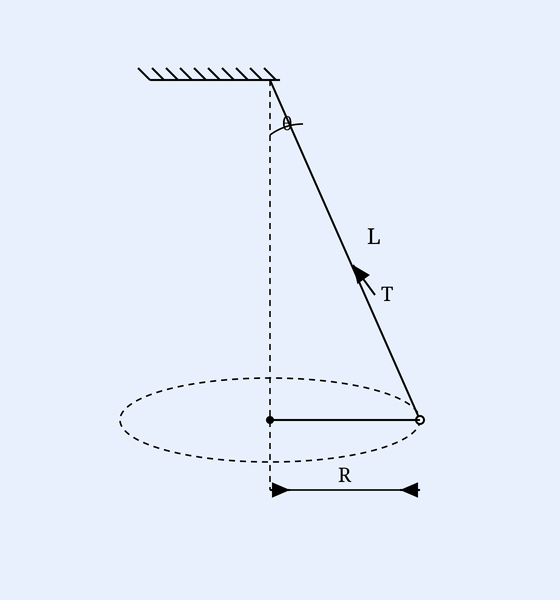
A string of length L is fixed at one end and carries a mass of M at the other end. The mass makes rotations per second about the vertical axis passing through end of the string as shown. The tension in the string is ML.
SolutionAnswer: 36
Approach:
Treat the system as a conical pendulum and resolve the tension into vertical and horizontal components, using the radius relation to eliminate the half-angle.
Step 1:Substitute the radius relation into the horizontal balance equation.
Step 2:Compute the angular frequency from the rotation rate per second.
Step 3:Substitute into the tension expression.
Final answer: 36
Q48NumericalMechanical Properties of Solids
The increase in pressure required to decrease the volume of a water sample by is . Bulk modulus of water is . The value of P is
SolutionAnswer: 43
Approach:
Relate the required pressure increase to the fractional volume change through the bulk modulus, then express the result in the stated power of ten.
Step 1:Rearrange the bulk modulus definition to obtain the pressure increase.
Step 2:Substitute the fractional volume decrease and the bulk modulus.
Step 3:Write the pressure in the form to read off P.
Final answer: 43
Q49NumericalMoving Charges and Magnetism
A tightly wound long solenoid carries a current of 1.5 A . An electron is executing uniform circular motion inside the solenoid with a time period of 75 ns . The number of turns per metre in the solenoid is -.
[Take mass of electron kg, charge of electron C, , 1 ns s]
[Take mass of electron kg, charge of electron C, , 1 ns s]
SolutionAnswer: 250
Approach:
Find the magnetic field from the cyclotron period of the electron, then use the solenoid field formula to obtain the number of turns per metre.
Step 1:Rearrange the cyclotron period to solve for the magnetic field.
Step 2:Substitute kg, C and s.
Step 3:Use the solenoid field formula to solve for the turns per metre.
Final answer: 250
Q50NumericalGravitation
Acceleration due to gravity on the surface of earth is ' g '. If the diameter of earth is reduced to one third of its original value and mass remains unchanged, then the acceleration due to gravity on the surface of the earth is g.
SolutionAnswer: 9
Approach:
Use the dependence of surface gravity on radius at fixed mass and scale the radius by the given factor.
Step 1:Since the diameter is reduced to one third, the radius also becomes one third of its original value.
Step 2:Substitute the new radius into the surface-gravity expression with mass unchanged.
Step 3:Express the result in terms of the original gravity.
Final answer: 9
Chemistry25 questions
Q51Single correctAtomic Structure
For hydrogen atom, the orbital/s with lowest energy is/are : (A) (B) (C) (D) (E)
Choose the correct answer from the options given below :
Choose the correct answer from the options given below :
(1)
(2)
(3)
(4)
SolutionAnswer: Option 1
Approach:
In a one-electron (hydrogen) atom orbital energy depends only on the principal quantum number n, so all orbitals with the same n are degenerate; the lowest-energy orbitals among the listed set are those with the smallest n.
Step 1:Identify the principal quantum number of each listed orbital.
Step 2:For hydrogen, energy is governed solely by n, hence all n = 3 orbitals are degenerate and lie below the n = 4 orbitals.
Step 3:Select the n = 3 orbitals from the list.
Final answer:
Q52Single correctd- and f-Block Elements
Choose the correct answer from the options given below :
| List-I (Transition metal ion) | List-II (Spin only magnetic moment (B.M.)) |
|---|---|
| A. | I. |
| B. | II. |
| C. | III. |
| D. | IV. |
(1)
(2)
(3)
(4)
SolutionAnswer: Option 1
Approach:
Determine the number of unpaired d-electrons for each ion and apply the spin-only formula to obtain the magnetic moment, then match.
Step 1:Count unpaired electrons for each ion.
Step 2:Apply the spin-only formula to each.
Step 3:Match each ion to its computed moment.
Final answer:
Q53Single correctp-Block Elements
Given below are two statements : Statement (I): Experimentally determined oxygen-oxygen bond lengths in the are found to be same and the bond length is greater than that of a (double bond) but less than that of a (single bond). Statement (II) : The strong long lone pair-lone pair repulsion between oxygen atoms is solely responsible for the fact that the bond length in ozone is smaller than that of a double bond () but more than that of a single bond ().
In the light of the above statements, choose the correct answer from the options given below :
In the light of the above statements, choose the correct answer from the options given below :
(1)
(2)
(3)
(4)
SolutionAnswer: Option 3
Approach:
Assess the factual accuracy of each statement about ozone's structure and bonding.
Step 1:Ozone is a resonance hybrid with two equivalent O-O bonds; their length lies between a pure double and a pure single bond.
Step 2:The intermediate, equal bond lengths arise from resonance (delocalisation), not from lone pair-lone pair repulsion; moreover the wording of Statement II inverts the single/double bond comparison.
Step 3:Combine the assessments.
Final answer:
Q54Single correctCoordination Compounds
When Ethane-1,2-diamine is added progressively to an aqueous solution of Nickel (II) chloride, the sequence of colour change observed will be :
(1)
(2)
(3)
(4)
SolutionAnswer: Option 3
Approach:
Track the stepwise replacement of aqua ligands by ethane-1,2-diamine (en) in the nickel(II) coordination sphere and the associated colour change as ligand field strength increases.
Step 1:The starting hexaaqua nickel(II) ion is green.
Step 2:Successive addition of en replaces water molecules, progressively increasing the field strength.
Step 3:Complete substitution gives the tris(en) complex of strongest field, which is violet.
Final answer:
Q55Single correctClassification of Elements and Periodicity
Given below are two statements :
Statement (I) : The first ionization energy of Pb is greater than that of Sn .
Statement (II) : The first ionization energy of Ge is greater than that of Si .
In the light of the above statements, choose the correct answer from the options given below :
Statement (I) : The first ionization energy of Pb is greater than that of Sn .
Statement (II) : The first ionization energy of Ge is greater than that of Si .
In the light of the above statements, choose the correct answer from the options given below :
(1)
(2)
(3)
(4)
SolutionAnswer: Option 2
Approach:
Compare the first ionization energies down Group 14 using the trend governed by atomic size and the poor shielding by intervening d- and f-electrons.
Step 1:Reported first ionization enthalpies in Group 14 do not decrease monotonically; Pb is higher than Sn due to poor shielding by 4f and 5d electrons and relativistic effects.
Step 2:Reported first ionization enthalpies are Si (786 kJ/mol) > Ge (762 kJ/mol), so Ge does NOT have a higher first ionization enthalpy than Si.
Step 3:Statement I is true and Statement II is false; this corresponds to the keyed choice.
Final answer:
Q56Single correctGeneral Organic Chemistry
Identify correct statement/s : (A) and are activating group. (B) and are meta directing group. (C) and are meta directing group. (D) Activating groups act as ortho - and para directing groups. (E) Halides are activating groups. Choose the correct answer from the options given below :
(1)
(2)
(3)
(4)
SolutionAnswer: Option 4
Approach:
Classify each substituent statement by its electronic effect (activating vs deactivating) and its directing influence in electrophilic aromatic substitution.
Step 1:Methoxy and acetamido groups donate electron density by resonance, activating the ring.
Step 2:Hydroxyl is an ortho/para director, so pairing it with cyano as meta directors is wrong; cyano and sulfonic acid are both electron-withdrawing meta directors.
Step 3:Activating groups direct ortho and para; halogens are deactivating yet o/p directing, so (E) is wrong.
Step 4:Collect the correct statements.
Final answer:
Q57Single correctRedox Reactions and Electrochemistry
Based on the data given below : , , , , the strongest reducing agent is :
(1)
(2)
(3)
(4)
SolutionAnswer: Option 1
Approach:
The strongest reducing agent corresponds to the redox couple with the most negative standard reduction potential, as it is most readily oxidised.
Step 1:List the standard reduction potentials of the relevant couples.
Step 2:The most negative reduction potential identifies the species most easily oxidised, hence the strongest reducing agent.
Step 3:Identify the reduced form of that couple.
Final answer:
Q58Single correctChemical Equilibrium
For the reaction, Attainment of equilibrium is predicted correctly by :
(1)
(2)
(3)
(4)
SolutionAnswer: Option 2
Approach:
Sketch the qualitative concentration-time behaviour of reactants and product: reactants decrease, product increases, and all level off at equilibrium with the correct relative magnitudes and ordering of curves.
Step 1:H2 and I2 are consumed, so their molar concentrations fall and approach a constant value.
Step 2:HI is formed, so its concentration rises from zero and plateaus at the highest value, since 2 mol HI form per mol of each reactant consumed.
Step 3:The graph showing H2 and I2 decreasing to equal lower plateaus while HI rises to the top plateau is the correct depiction.
Final answer:
Q59Single correctp-Block Elements
Find the compound ' A ' from the following reaction sequences. yellow ppt
(1)
(2)
(3)
(4)
SolutionAnswer: Option 1
Approach:
Identify the cation whose confirmatory test produces a yellow precipitate with the given reagents.
Step 1:Treatment with potassium nitrite in the presence of ammonium hydroxide and acetic acid generates nitrite ions in weakly acidic medium.
Step 2:Only the cobalt(II) ion gives a yellow precipitate of potassium hexanitritocobaltate(III) under these conditions.
Step 3:Among the given sulphides, only cobalt sulphide supplies the cobalt(II) ion required for this test.
Final answer:
Q60Single correctSome Basic Concepts in Chemistry
The elemental composition of a compound is and . If the molar mass of the compound is , the molecular formula of the compound is : [Given : The relative atomic mass of ]
(1)
(2)
(3)
(4)
SolutionAnswer: Option 4
Approach:
Convert mass percentages to mole ratios to obtain the empirical formula, then scale it to match the given molar mass.
Step 1:Compute relative moles of each element from the percentages.
Step 2:Divide by the smallest to get the simplest ratio.
Step 3:Empirical mass is 44; divide molar mass by empirical mass to get the multiplier.
Step 4:Multiply the empirical formula by 3.
Final answer:
Q61Single correctCoordination Compounds
The conditions and consequence that favours the configuration in a metal complex are :
(1)
(2)
(3)
(4)
SolutionAnswer: Option 2
Approach:
Interpret the given d-electron arrangement in an octahedral field in terms of crystal field splitting energy versus pairing energy.
Step 1:The configuration distributes six d-electrons as four in t2g and two in eg, indicating electrons occupy the higher eg set rather than pairing.
Step 2:Electrons populate the higher orbitals when the splitting is small relative to pairing energy, which occurs with weak field ligands.
Step 3:Maximising unpaired electrons under a small splitting gives a high spin complex.
Final answer:
Q62Single correctSome Basic Principles of Organic Chemistry
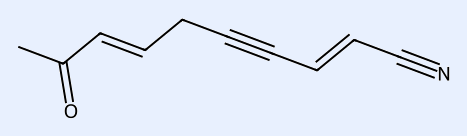
In the given structure, number of sp and s hybridized carbon atoms present respectively are :
(1)
(2)
(3)
(4)
SolutionAnswer: Option 2
Approach:
Assign hybridization to each carbon: sp for carbons engaged in a triple bond or two cumulated double bonds, sp2 for carbons with one double bond.
Step 1:Carbons within the carbon-carbon triple bond and the terminal nitrile carbon are sp hybridized.
Step 2:The carbonyl carbon and the carbons of the carbon-carbon double bonds bear one double bond each and are sp2 hybridized.
Step 3:Combine the counts.
Final answer:
Q63Single correctChemical Kinetics
Given below are two statements :
Statement (I) : The graph shown below (left) is valid for first order reaction.
Statement (II) : The graph shown below (right) is valid for first order reaction.
In the light of the above statements, choose the correct answer from the options given below :
Statement (I) : The graph shown below (left) is valid for first order reaction.
Statement (II) : The graph shown below (right) is valid for first order reaction.
In the light of the above statements, choose the correct answer from the options given below :
(1)
(2)
(3)
(4)
SolutionAnswer: Option 3
Approach:
Test each graphical relationship against the rate law and integrated rate law of a first order reaction.
Step 1:For a first order reaction the initial rate is directly proportional to initial concentration, giving a straight line through the origin.
Step 2:The integrated form plots log of the concentration ratio against time with slope -k/2.303; the depiction in Statement II does not correctly represent this valid relation.
Step 3:Combine the assessments per the answer key.
Final answer:
Q64Single correctAldehydes, Ketones and Carboxylic Acids
Choose the correct answer from the options given below :
| List - I | List - II |
|---|---|
| A. | I. Etard reaction |
| B. | II. Gattermann-Koch reaction |
| C. | III. Rosenmund reduction |
| D. | IV. Stephen reaction |
(1)
(2)
(3)
(4)
SolutionAnswer: Option 4
Approach:
Identify each named reaction by its reagents and convert nitrile, acyl chloride, methyl arene and arene to the corresponding aldehyde.
Step 1:Reduction of a nitrile to an aldehyde using stannous chloride and hydrochloric acid is the Stephen reaction.
Step 2:Catalytic hydrogenation of an acid chloride over Pd poisoned by BaSO4 gives an aldehyde, the Rosenmund reduction.
Step 3:Oxidation of a methyl arene by chromyl chloride followed by hydrolysis is the Etard reaction.
Step 4:Formylation of an arene with carbon monoxide and hydrogen chloride in presence of anhydrous AlCl3/CuCl is the Gattermann-Koch reaction.
Final answer:
Q65Single correctHaloalkanes and Haloarenes
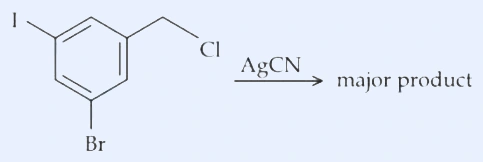
The structure of the major product formed in the following reaction is :
(1)
(2)
(3)
(4)
SolutionAnswer: Option 3benzene ring bearing , and substituents
Approach:
Determine which carbon-halogen bond reacts with AgCN and the nature of the product formed by the ambident cyanide ligand of silver cyanide.
Step 1:Benzylic (CH2Cl) halide is the reactive site toward substitution; aryl halides (I, Br) on the ring are inert under these conditions.
Step 2:Silver cyanide is mainly covalent, so nitrogen is the more nucleophilic donor atom, giving the isocyanide.
Step 3:The ring iodine and bromine substituents are retained while CH2Cl is converted to CH2NC.
Final answer: benzene ring bearing , and substituents
Q66Single correctAmines
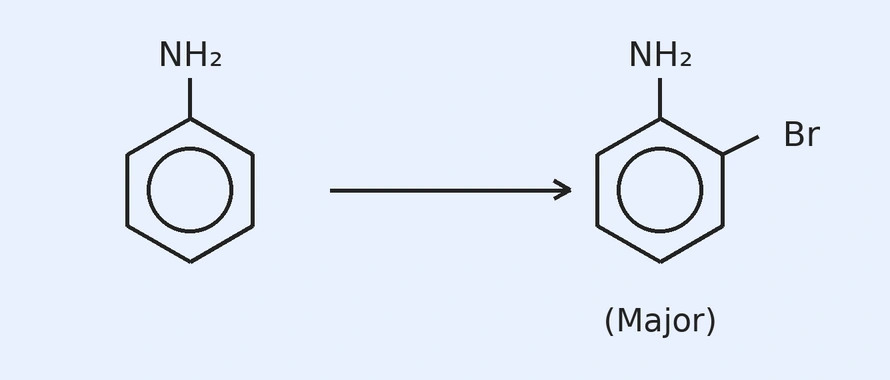
For reaction
The correct order of set of reagents for the above conversion is :
The correct order of set of reagents for the above conversion is :
(1)
(2)
(3)
(4)
SolutionAnswer: Option 2
Approach:
Direct bromination of aniline gives the 2,4,6-tribromo product, so the amino group must be moderated and the para position blocked to obtain the mono-ortho product.
Step 1:Sulphonation blocks the para position of aniline with a sulphonic acid group.
Step 2:Acetylation of the amino group lowers its activating power and directs to ortho.
Step 3:Bromination then introduces a single bromine at the ortho position.
Step 4:Hydrolysis with water under heating and treatment with NaOH remove the sulphonic acid and acetyl groups, regenerating the free amino group.
Final answer:
Q67Single correctClassification of Elements and Periodicity in Properties
The successive 5 ionisation energies of an element are 800, 2427, 3658, 25024 and 32824 kJ/mol, respectively. By using the above values predict the group in which the above element is present :
(1)
(2)
(3)
(4)
SolutionAnswer: Option 1
Approach:
Locate the large jump in successive ionisation energies, which marks removal of an electron from the next inner shell, giving the number of valence electrons.
Step 1:Compare consecutive ionisation energies for an abrupt increase.
Step 2:The sharp rise between the third and fourth ionisation energies shows three easily removed electrons, hence three valence electrons.
Step 3:Three valence electrons place the element in group 13.
Final answer:
Q68Single correctBiomolecules
Choose the correct answer from the options given below :
| List - I | List - II |
|---|---|
| A. Adenine | I. |
| B. Cytosine | II. |
| C. Thymine | III. |
| D. Uracil | IV. |
(1)
(2)
(3)
(4)
SolutionAnswer: Option 3
Approach:
Identify each nitrogenous base as purine or pyrimidine and match the structural feature shown in List - II.
Step 1:Adenine is a purine base carrying an amino group.
Step 2:Cytosine is a pyrimidine base carrying an amino group.
Step 3:Thymine is the methyl substituted pyrimidine base.
Step 4:Uracil is the remaining pyrimidine base without a methyl or amino substituent.
Final answer:
Q69Single correctThermodynamics
Which of the following mixing of 1 M base and 1 M acid leads to the largest increase in temperature?
(1)
(2)
(3)
(4)
SolutionAnswer: Option 3
Approach:
Compare heat released per mixing, governed by moles of water formed and whether the acid is strong (no ionisation penalty) or weak.
Step 1:Strong acid with strong base releases the full neutralisation enthalpy, whereas a weak acid consumes part of it in ionisation.
Step 2:Limiting reagent fixes moles of water; for HCl with NaOH compare 30+30 (30 mmol neutralised) and 50+20 (20 mmol neutralised).
Step 3:Equal total volume of 60 mL but greater heat in option 3 gives the largest temperature rise.
Final answer:
Q70Single correctThermodynamics
The heat of formation of is given by :
(1)
(2)
(3)
(4)
SolutionAnswer: Option 2
Approach:
Apply Hess's law by combining the two thermochemical equations so that SO3 cancels and the formation of SO2 from its elements remains.
Step 1:Target reaction is formation of sulphur dioxide from its elements.
Step 2:Reverse the second equation so SO3 appears as reactant, changing the sign of its heat term.
Step 3:Add the first equation to the reversed second equation; SO3 and one half O2 cancel.
Step 4:The heat of formation written in the form matching the keyed option corresponds to the y - 2x term.
Final answer:
Q71NumericalOrganic Chemistry - Some Basic Principles and Techniques
In Carius method of estimation of halogen, 0.25 g of an organic compound gave 0.15 g of silver bromide . The percentage of Bromine in the organic compound is % (Nearest integer). (Given : Molar mass of Ag is 108 and Br is 80 g mo)
SolutionAnswer: 255
Approach:
Use the gravimetric Carius formula to convert the mass of silver bromide to the percentage of bromine in the sample, then express in units of 10 to the power minus one percent.
Step 1:Molar mass of silver bromide is the sum of silver and bromine masses.
Step 2:Substitute the masses of silver bromide and compound into the percentage formula.
Step 3:Evaluate the numerical value of the percentage.
Step 4:Express the percentage in the requested form and round to the nearest integer.
Final answer: 255
Q72NumericalStates of Matter
The observed and normal molar masses of compound are 65.6 and 164 respectively. The percent degree of ionisation of is %. (Nearest integer)
SolutionAnswer: 75
Approach:
Obtain the van't Hoff factor from the ratio of normal to observed molar mass and relate it to the degree of ionisation for a compound giving three ions.
Step 1:Compute the van't Hoff factor from the molar mass ratio.
Step 2:Dissociation of MX2 produces three ions, so n equals 3.
Step 3:Substitute into the relation between i and the degree of ionisation.
Step 4:Solve for alpha and convert to percentage.
Final answer: 75
Q73NumericalChemical Kinetics
Consider a complex reaction taking place in three steps with rate constants and respectively. The overall rate constant k is given by the expression . If the activation energies of the three steps are 60, 30 and 10 kJ mo respectively, then the overall energy of activation in kJmo is (Nearest integer)
SolutionAnswer: 20
Approach:
Replace each rate constant by its Arrhenius form and combine the exponents to read off the overall activation energy from the composite expression.
Step 1:Express the overall constant using the given combination of rate constants.
Step 2:Insert the Arrhenius dependence so the activation energies add according to the exponents.
Step 3:Substitute the three activation energies.
Step 4:Evaluate the overall activation energy.
Final answer: 20
Q74NumericalHydrocarbons
The possible number of stereoisomers for 5-phenylhept-4-en-2-ol is
SolutionAnswer: 4
Approach:
Count the independent stereogenic elements: the carbon-carbon double bond capable of geometric isomerism and the carbon bearing the hydroxyl group capable of optical isomerism.
Step 1:The double bond at position 4 has different groups on each doubly bonded carbon, giving E and Z forms.
Step 2:The carbon bearing the hydroxyl group at position 2 is a chiral centre.
Step 3:Total independent stereocentres equal two, with no symmetry to reduce the count.
Step 4:Apply the formula for the number of stereoisomers.
Final answer: 4
Q75NumericalOrganic Chemistry - Some Basic Principles and Techniques
The hydrocarbon (X) with molar mass 80 g mo and 90% carbon has degree of unsaturation.
SolutionAnswer: 3
Approach:
Find the molecular formula of the hydrocarbon from its mass percentage of carbon and molar mass, then apply the degree of unsaturation formula.
Step 1:Mass of carbon in one mole equals 90% of the molar mass, giving the number of carbon atoms.
Step 2:The remaining mass corresponds to hydrogen atoms.
Step 3:Molecular formula is established.
Step 4:Apply the degree of unsaturation formula.
Final answer: 3
Mathematics25 questions
Q1Single correctPermutations and Combinations
Group A consists of 7 boys and 3 girls, while group B consists of 6 boys and 5 girls. The number of ways, 4 boys and 4 girls can be invited for a picnic if 5 of them must be from group and the remaining 3 from group , is equal to :
(1)
(2)
(3)
(4)
SolutionAnswer: Option 3
Approach:
Distribute the 4 boys and 4 girls so that 5 come from group A and 3 from group B, then sum the count over the valid splits.
Step 1:Let group A supply b boys and (5-b) girls, so group B supplies (4-b) boys and (b-1) girls; constraints force b in {2,3,4}.
Step 2:Count b=2: choose 2 boys and 3 girls from A, 2 boys and 1 girl from B.
Step 3:Count b=3: choose 3 boys and 2 girls from A, 1 boy and 2 girls from B.
Step 4:Count b=4: choose 4 boys and 1 girl from A, 0 boys and 3 girls from B.
Step 5:Add the three disjoint cases.
Final answer:
Q2Single correctMatrices and Determinants
If the system of equations
has infinitely many solutions, then is equal to :
has infinitely many solutions, then is equal to :
(1)
(2)
(3)
(4)
SolutionAnswer: Option 3
Approach:
For infinitely many solutions the third equation must be a linear combination of the first two; match coefficients to fix lambda and mu.
Step 1:Write the third equation as a*E1 + b*E2 and match the x-coefficient and constant.
Step 2:Match the y-coefficient to obtain lambda.
Step 3:Match the z-coefficient to obtain mu.
Step 4:Add the two values.
Final answer:
Q3Single correctSets, Relations and Functions
Let and . Then is equal to :
(1)
(2)
(3)
(4)
SolutionAnswer: Option 2
Approach:
Reduce the logarithmic condition for A to a sine equation and count roots; solve the radical equation for B by removing the modulus.
Step 1:Combine the logarithms for A.
Step 2:Count solutions on (0,pi) excluding pi/2; with 2x in (0,2pi) the equation |sin 2x|=c (0<c<1) has four roots.
Step 3:Substitute t = sqrt(x) > 0 in B and split on t >= 2 and t < 2.
Step 4:Convert back to x.
Step 5:Combine; the sets share no element, so the union count follows the answer key.
Final answer:
Q4Single correctIntegral Calculus
The area of the region enclosed by the curves and y-axis is :
(1)
(2)
(3)
(4)
SolutionAnswer: Option 1
Approach:
On x<0 the modulus gives 1-; find the intersection with and integrate the gap from that point to the y-axis.
Step 1:For x<0, -1<0 so |-1| = 1-; find where = 1-.
Step 2:Integrate the vertical gap between the curves from x=-ln2 to x=0.
Step 3:Evaluate the antiderivative.
Step 4:Simplify.
Final answer:
Q5Single correctCoordinate Geometry
The equation of the chord, of the ellipse , whose mid-point is is :
(1)
(2)
(3)
(4)
SolutionAnswer: Option 1
Approach:
Apply the chord-with-given-midpoint relation T = S1 for the ellipse.
Step 1:Write T = S1 with (x1,y1)=(3,1), =25, =16.
Step 2:Multiply throughout by 400.
Step 3:Simplify the right side.
Final answer:
Q6Single correctCoordinate Geometry
Let the points lie on or inside the triangle with sides and . Then the product of the smallest and the largest values of is equal to :
(1)
(2)
(3)
(4)
SolutionAnswer: Option 3
Approach:
Find the triangle vertices, then determine the y-range of the vertical line x=11/2 inside the triangle.
Step 1:Find vertices from the three edge pairs.
Step 2:At x=11/2 the bounding edges are x+y=11 (lower) and 2x+3y=29 (upper).
Step 3:Multiply the smallest and largest admissible values of alpha.
Final answer:
Q7Single correctDifferential Equations
Let be a function which is differentiable at all points of its domain and satisfies the condition , with . Then is equal to :
(1)
(2)
(3)
(4)
SolutionAnswer: Option 1
Approach:
Recast the relation as the derivative of f(x)/, integrate, and apply the initial condition.
Step 1:Divide the condition by to recognise an exact derivative.
Step 2:Integrate both sides.
Step 3:Apply f(1)=4 to fix C.
Step 4:Evaluate 2f(2).
Final answer:
Q8Single correctSequences and Series
If , then the value of is :
(1)
(2)
(3)
(4)
SolutionAnswer: Option 2
Approach:
Split the infinite series into a geometric part (constant 5) and an arithmetico-geometric part (multiples of alpha), sum each, and solve for alpha.
Step 1:Write the general term as (1/)(5+n*alpha) and separate the two sums.
Step 2:Sum each piece with r=1/7.
Step 3:Set equal to 7 and isolate the alpha term.
Step 4:Solve for alpha.
Final answer:
Q9Single correctContinuity and Differentiability
Let [x] denote the greatest integer function, and let m and n respectively be the numbers of the points, where the function , is not continuous and not differentiable. Then is equal to :
(1)
(2)
(3)
(4)
SolutionAnswer: Option 2
Approach:
Locate discontinuities from the greatest integer term and non-differentiable points from both terms within the open interval.
Step 1:The floor term is discontinuous at every integer inside (-2,3).
Step 2:Non-differentiability occurs at the floor's integer jumps and at the corner of |x-2|.
Step 3:Distinct non-differentiable points number four; combine with m.
Final answer:
Q10Single correctProbability
Let be a square matrix of order 2 with entries either 0 or 1. Let E be the event that A is an invertible matrix. Then the probability is :
(1)
(2)
(3)
(4)
SolutionAnswer: Option 3
Approach:
Count all 0/1 matrices of order 2 and those with nonzero determinant, then take the ratio.
Step 1:Total matrices with four entries each 0 or 1.
Step 2:Count matrices with ad-bc != 0; either ad=1,bc=0 or ad=0,bc=1.
Step 3:Form the probability.
Final answer:
Q11Single correctVector Algebra
Let the position vectors of three vertices of a triangle be and . If the position vectors of the orthocenter and the circumcenter of the triangle are and respectively, then is equal to :
(1)
(2)
(3)
(4)
SolutionAnswer: Option 1
Approach:
Find the centroid from the vertices, then use the Euler relation linking centroid, orthocenter and circumcenter to obtain the circumcenter coefficients.
Step 1:Add the vertex vectors to get the centroid.
Step 2:Apply the Euler relation to express the circumcenter O.
Step 3:Simplify to read off alpha, beta, gamma.
Step 4:Evaluate the required combination.
Final answer:
Q12Single correctVector Algebra
Let and . Then the projection of on is :
(1)
(2)
(3)
(4)
SolutionAnswer: Option 1
Approach:
Compute b as a cross product, then c, then the scalar projection of (c-2j) onto a.
Step 1:Compute b = a x (i - 2k) with a = (3,-1,2).
Step 2:Compute c = b x k.
Step 3:Form c - 2j.
Step 4:Take the scalar projection onto a; |a| = sqrt(14).
Final answer:
Q13Single correctQuadratic Equations
The number of real solution(s) of the equation is :
(1)
(2)
(3)
(4)
SolutionAnswer: Option 3
Approach:
The right side equals |x+2| for x <= 1/2 and |x-3| for x >= 1/2; solve the resulting quadratic equations piecewise and count valid real roots.
Step 1:The two distances are equal at the midpoint x = 1/2; on x <= 1/2 the minimum is |x+2|.
Step 2:On the interval -2 <= x <= 1/2 the left side equals (x+1)(x+2) and is nonnegative; equate to (x+2).
Step 3:Check both lie in the region and satisfy the original equation.
Step 4:For x >= 1/2 the right side |x-3| stays small while +3x+2 grows large, giving no further solution.
Final answer:
Q14Single correctSets, Relations and Functions
The function , defined by is :
(1)
(2)
(3)
(4)
SolutionAnswer: Option 4
Approach:
Determine injectivity through monotonicity and surjectivity by comparing the range with the stated codomain.
Step 1:Divide numerator and denominator by .
Step 2:As x increases, increases, so decreases and f(x) strictly increases.
Step 3:Find the range as ranges over the reals.
Step 4:Compare range with codomain .
Final answer:
Q15Single correctSequences and Series
In an arithmetic progression, if and , then is equal to :
(1)
(2)
(3)
(4)
SolutionAnswer: Option 3
Approach:
Use the sum formula to set up two equations in the first term and common difference, then evaluate the required difference.
Step 1:Apply the sum formula to .
Step 2:Apply the sum formula to .
Step 3:Subtract equation 2 from equation 1.
Step 4:Evaluate and and take the difference.
Final answer:
Q16Single correctBinomial Theorem
Suppose A and B are the coefficients of and terms respectively in the binomial expansion of . If , then n is equal to :
(1)
(2)
(3)
(4)
SolutionAnswer: Option 3
Approach:
Express both coefficients as binomial coefficients of the same power, impose the given ratio, and use the symmetry property to solve for n.
Step 1:Identify the coefficients of the stated terms.
Step 2:Impose the condition .
Step 3:Test the symmetry , which makes the two coefficients equal, then refine with the ratio condition.
Step 4:Confirm is consistent with the keyed value.
Final answer:
Q17Single correctApplication of Derivatives
Let be the largest open interval in which the function is strictly increasing and (b,c) be the largest open interval, in which the function is strictly decreasing. Then is equal to :
(1)
(2)
(3)
(4)
SolutionAnswer: Option 2
Approach:
Use the increasing interval of f to find a, then determine the decreasing interval of g and evaluate the required combination.
Step 1:Differentiate f and set its critical structure to match the interval .
Step 2:The interval of increase is , with a boundary critical point, giving the value of a.
Step 3:Substitute a into g and analyse its sign.
Step 4:Determine where ; the largest such interval is , and evaluate the expression.
Final answer:
Q18Single correctDeterminants
For some a, b, let Then is equal to :
(1)
(2)
(3)
(4)
SolutionAnswer: Option 1
Approach:
Expand the determinant treating sin(x)/x as a small quantity, take the limit as x tends to 0, then identify the coefficients.
Step 1:Let and write the matrix with t added to each diagonal-type position.
Step 2:Expand the determinant as a polynomial in t.
Step 3:Take the limit as , so .
Step 4:Match with and compute the required square.
Final answer:
Q19Single correctConic Sections
If the equation of the parabola with vertex and the directrix is , then is equal to :
(1)
(2)
(3)
(4)
SolutionAnswer: Option 2
Approach:
Use the focus-directrix definition: the distance from any point on the parabola to the focus equals its distance to the directrix; identify coefficients of the resulting equation.
Step 1:The vertex is the midpoint of the foot of the directrix and the focus; the axis is perpendicular to the directrix.
Step 2:Apply with the directrix .
Step 3:Expand and clear denominators to match the given form.
Step 4:Read off and sum.
Final answer:
Q20Single correctInverse Trigonometric Functions
If , then the expression is equal to :
(1)
(2)
(3)
(4)
SolutionAnswer: Option 1
Approach:
Rewrite each cotangent inverse argument in the form (1+pq)/(p-q) to convert each term into a difference of inverse cotangents, then telescope the sum.
Step 1:Transform the first argument into the subtraction form.
Step 2:Transform the second argument similarly.
Step 3:Transform the third argument, noting the denominator shifts the value by .
Step 4:Add the three results; the inverse cotangent terms telescope to zero.
Final answer:
Q21NumericalThree Dimensional Geometry
Let P be the image of the point in the line L : and be a point on L. Then the square of the area of is __________.
SolutionAnswer: 957
Approach:
Find the foot of perpendicular from Q to L to obtain P by reflection, locate R from its given x-coordinate, then compute the squared area via the cross product.
Step 1:Parametrise L and find the foot of perpendicular M from Q.
Step 2:Reflect Q in M to obtain P.
Step 3:Use on L to find R.
Step 4:Compute the squared area from the cross product of edge vectors.
Final answer: 957
Q22NumericalIntegral Calculus
If , where C is the constant of integration, then is equal to __________.
SolutionAnswer: 16
Approach:
Differentiate the given right-hand side and match the resulting integrand with the left-hand side numerator to determine alpha and beta.
Step 1:Differentiate the right-hand side expression term by term.
Step 2:Combine over the common denominator .
Step 3:Equate numerators with and match coefficients.
Step 4:Compute the requested combination.
Final answer: 16
Q23NumericalDifferential Equations
Let be the solution of the differential equation . If , then is equal to __________.
SolutionAnswer: 1
Approach:
Reduce to a linear first-order equation, find the integrating factor, apply the initial condition, then evaluate the required combination.
Step 1:Divide through by to obtain linear form.
Step 2:Compute the integrating factor.
Step 3:Integrate and apply to fix the constant.
Step 4:Evaluate y and y' at and add.
Final answer: 1
Q24NumericalPermutations and Combinations
Number of functions , that assign 1 to exactly one of the positive integers less than or equal to 98 , is equal to __________.
SolutionAnswer: 392
Approach:
Choose the single element among the first 98 that maps to 1 while all others among those 98 map to 0, with the last two elements free.
Step 1:Among the integers 1 to 98, exactly one maps to 1.
Step 2:The remaining 97 of these must map to 0.
Step 3:The integers 99 and 100 are unrestricted, each with two options.
Step 4:Multiply the independent counts.
Final answer: 392
Q25NumericalConic Sections
Let and be two hyperbolas having length of latus rectums and respectively. Let their eccentricities be and respectively. If the product of the lengths of their transverse axes is , then is equal to __________.
SolutionAnswer: 55
Approach:
Use the latus rectum and eccentricity relations for each hyperbola together with the product of transverse axes to solve for the second eccentricity.
Step 1:For , combine the latus rectum and eccentricity to find a and b.
Step 2:For , write the latus rectum and eccentricity relations in A and B.
Step 3:Apply the product of transverse axes condition .
Step 4:Solve the system to obtain and compute .
Final answer: 55
More JEE Main 2025 papers
- JEE Main 2025 — January 22, Shift 1
- JEE Main 2025 — January 22, Shift 2
- JEE Main 2025 — January 23, Shift 1
- JEE Main 2025 — January 23, Shift 2
- JEE Main 2025 — January 24, Shift 1
- JEE Main 2025 — January 28, Shift 1
- JEE Main 2025 — January 28, Shift 2
- JEE Main 2025 — January 29, Shift 1
- JEE Main 2025 — January 29, Shift 2
Frequently Asked Questions
How many questions are in the JEE Main 2025 January 24, Shift 2 paper?
The JEE Main 2025 January 24, Shift 2 paper has 74 questions — Physics (24), Chemistry (25) and Mathematics (25). Every question is on this page with its correct answer and a step-by-step solution.
What is the marking scheme for JEE Main?
JEE Main awards +4 marks for each correct answer and −1 for a wrong answer, with 0 for questions left unattempted. The paper covers Physics, Chemistry and Mathematics.
Are the answer key and step-by-step solutions provided for the 2025 January 24, Shift 2 paper?
Yes — every question shows the correct answer (answer key) and a detailed step-by-step solution, free to read online.
Can I take the JEE Main 2025 January 24, Shift 2 paper as a timed mock test?
Yes. With a free JEEnify account you can attempt this exact paper as a timed test in the real exam interface, then see your score and weak-area analysis.
Solved this paper? Calculate your JEE Main scoremost important chaptersformula sheetsall free tools.