
Back to JEE Main PYQs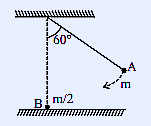

JEE Main 2025 January 29, Shift 1 Question Paper with Solutions
All 75 questions from the JEE Main 2025 (January 29, Shift 1) shift — Physics (25), Chemistry (25) and Mathematics (25) — each with the correct answer (answer key) and a step-by-step solution. Read it free online, or attempt the full paper as a timed mock test.
Physics25 questions
Q26Single correctElectromagnetic Induction and Alternating Currents
Given below are two statements : one is labelled as **Assertion (A)** and the other is labelled as **Reason (R)**.
**Assertion (A):** Choke coil is simply a coil having a large inductance but a small resistance. Choke coils are used with fluorescent mercury-tube fittings. If household electric power is directly connected to a mercury tube, the tube will be damaged.
**Reason (R):** By using the choke coil, the voltage across the tube is reduced by a factor , where is frequency of the supply across resistor R and inductor L. If the choke coil were not used, the voltage across the resistor would be the same as the applied voltage.
In the light of the above statements, choose the most appropriate answer from the options given below:
**Assertion (A):** Choke coil is simply a coil having a large inductance but a small resistance. Choke coils are used with fluorescent mercury-tube fittings. If household electric power is directly connected to a mercury tube, the tube will be damaged.
**Reason (R):** By using the choke coil, the voltage across the tube is reduced by a factor , where is frequency of the supply across resistor R and inductor L. If the choke coil were not used, the voltage across the resistor would be the same as the applied voltage.
In the light of the above statements, choose the most appropriate answer from the options given below:
(1)
(2)
(3)
(4)
SolutionAnswer: Option 3Both (A) and (R) are true and (R) is the correct explanation of (A).
Approach:
Analyze both Assertion and Reason independently for their validity, then determine if Reason correctly explains Assertion
Step 1:Analyze Assertion (A) about choke coil function
A choke coil has large inductance and small resistance . It is used in fluorescent tube fittings to limit current and reduce voltage across the tube.
Step 2:Analyze Reason (R) - voltage reduction formula
In an RL series circuit, voltage across R is , which is the stated reduction factor.
Step 3:Verify that R explains A
Since L is large, , making . This reduces voltage across the tube, preventing damage.
Final answer: Both (A) and (R) are true and (R) is the correct explanation of (A)
Q27Single correctKinematics
Two projectiles are fired with same initial speed from same point on ground at angles of and , respectively, with the horizontal direction. The ratio of their maximum heights attained is:
(1)
(2)
(3)
(4)
SolutionAnswer: Option 3
Approach:
Use the formula for maximum height in projectile motion and simplify the ratio using trigonometric identities
Step 1:Write the formula for maximum height in projectile motion
Step 2:Set up the ratio of maximum heights
(since u and g are same for both)
Step 3:Expand sine terms using angle subtraction/addition formulas
,
Step 4:Substitute and simplify the ratio
Step 5:Expand the squares using algebraic identity
Step 6:Apply double angle identity to get final form
Final answer:
Q28Single correctElectrostatics
An electric dipole of mass m, charge q, and length is placed in a uniform electric field . When the dipole is rotated slightly from its equilibrium position and released, the time period of its oscillations will be:
(1)
(2)
(3)
(4)
SolutionAnswer: Option 4
Approach:
Use the torque on a dipole in an electric field to set up the equation for small oscillations, then derive the time period from the angular frequency
Step 1:Write the torque on the dipole in uniform electric field
. For small :
Step 2:Set up the equation of rotational motion
(negative sign indicates restoring nature)
Step 3:Calculate moment of inertia of the dipole about center
Two point masses each of mass at distance from center:
Step 4:Determine angular frequency from SHM equation
, but using total mass m:
Step 5:Calculate the time period
Final answer:
Q29Single correctUnits and Measurements
The pair of physical quantities not having same dimensions is:
(1)
(2)
(3)
(4)
SolutionAnswer: Option 2Surface tension and impulse
Approach:
Calculate dimensions of each physical quantity in each pair and identify the pair with different dimensions
Step 1:Analyze dimensions of torque and energy
Torque: ; Energy:
Step 2:Analyze dimensions of surface tension and impulse
Surface tension: ; Impulse:
Step 3:Analyze dimensions of angular momentum and Planck's constant
Angular momentum: ; Planck's constant:
Step 4:Analyze dimensions of pressure and Young's modulus
Pressure: ; Young's modulus:
Final answer: Surface tension and impulse
Q30Single correctOscillations and Waves
Given below are two statements : one is labelled as **Assertion (A)** and the other is labelled as **Reason (R)**.
**Assertion (A):** Time period of a simple pendulum is longer at the top of a mountain than that at the base of the mountain.
**Reason (R):** Time period of a simple pendulum decreases with increasing value of acceleration due to gravity and vice-versa.
In the light of the above statements, choose the most appropriate answer from the options given below:
**Assertion (A):** Time period of a simple pendulum is longer at the top of a mountain than that at the base of the mountain.
**Reason (R):** Time period of a simple pendulum decreases with increasing value of acceleration due to gravity and vice-versa.
In the light of the above statements, choose the most appropriate answer from the options given below:
(1)
(2)
(3)
(4)
SolutionAnswer: Option 2Both (A) and (R) are true and (R) is the correct explanation of (A).
Approach:
Analyze the relationship between time period of simple pendulum and gravity, then verify both assertion and reason
Step 1:Write the formula for time period of simple pendulum
, which shows
Step 2:Analyze how g varies with altitude
for , so g decreases with height
Step 3:Verify Assertion (A)
Since and , we have
Step 4:Verify Reason (R)
From : as g increases, T decreases (inverse relationship)
Step 5:Check if R explains A
R states that T decreases with increasing g. This directly explains why T is longer at mountain top (where g is lower).
Final answer: Both (A) and (R) are true and (R) is the correct explanation of (A)
Q31Single correctUnits and Measurements
The expression given below shows the variation of velocity (v) with time (t), . The dimension of ABC is:
(1)
(2)
(3)
(4)
SolutionAnswer: Option 1
Approach:
Use principle of dimensional homogeneity to find dimensions of A, B, C from the velocity equation, then calculate [ABC]
Step 1:Find dimension of A from first term
Since : , so
Step 2:Find dimension of C from denominator
For dimensional consistency in , we need
Step 3:Find dimension of B from second term
Since : , so
Step 4:Calculate dimension of ABC
Final answer:
Q32Single correctElectromagnetic Induction and Alternating Currents
Consider and are the currents flowing simultaneously in two nearby coils 1 & 2, respectively. If = self inductance of coil 1, = mutual inductance of coil 1 with respect to coil 2, then the value of induced emf in coil 1 will be
(1)
(2)
(3)
(4)
SolutionAnswer: Option 3
Approach:
Use the concept of total flux linkage in coil 1 (due to self-inductance and mutual inductance) and apply Faraday's law to find induced emf
Step 1:Write the total flux linkage in coil 1
Total flux in coil 1 = flux due to its own current + flux due to current in coil 2:
Step 2:Apply Faraday's law of electromagnetic induction
Induced emf in coil 1:
Step 3:Differentiate the flux expression
Final answer:
Q33Single correctOptics
At the interface between two materials having refractive indices and , the critical angle for reflection of an em wave is . The material is replaced by another material having refractive index , such that the critical angle at the interface between and materials is . If ; and , then is
(1)
(2)
(3)
(4)
SolutionAnswer: Option 4
Approach:
Use the critical angle formula for total internal reflection and the given conditions to find the expression for θ₁C
Step 1:Write critical angle formula for both interfaces
For TIR from denser to rarer medium: and
Step 2:Apply the given condition for difference in sine values
Step 3:Use the ratio n₂/n₃ = 2/5 to simplify
Let and . Then:
Step 4:Solve for k in terms of n₁
. Taking magnitude:
Step 5:Calculate sin θ₁C
. But verifying with original condition gives
Final answer:
Q34Single correctMagnetic Effects of Current and Magnetism
Consider a long straight wire of a circular cross-section (radius ) carrying a steady current . The current is uniformly distributed across this cross-section. The distances from the centre of the wire's cross-section at which the magnetic field [inside the wire, outside the wire] is half of the maximum possible magnetic field, any where due to the wire, will be
(1)
(2)
(3)
(4)
SolutionAnswer: Option 2
Approach:
Find the maximum magnetic field (at surface), then determine the distances inside and outside the wire where the field is half of this maximum value
Step 1:Determine where maximum magnetic field occurs
Inside: , Outside: . Maximum occurs at surface :
Step 2:Calculate half of maximum field
Step 3:Find the distance inside the wire where B = ax/2
Step 4:Find the distance outside the wire where B = ax/2
Final answer:
Q35Single correctWork, Energy and Power
As shown below, bob A of a pendulum having massless string of length 'R' is released from to the vertical. It hits another bob B of half the mass that is at rest on a friction less table in the centre. Assuming elastic collision, the magnitude of the velocity of bob A after the collision will be (take g as acceleration due to gravity)
(1)
(2)
(3)
(4)
SolutionAnswer: Option 1
Approach:
Use energy conservation to find velocity of bob A before collision, then apply conservation of momentum and coefficient of restitution for elastic collision
Step 1:Calculate velocity of bob A just before collision using energy conservation
. Using :
Step 2:Apply conservation of linear momentum
... (i)
Step 3:Apply coefficient of restitution (e = 1 for elastic collision)
... (ii)
Step 4:Solve equations (i) and (ii) simultaneously
Substituting (ii) into (i):
Final answer:
Q36Single correctDual Nature of Matter and Radiation
Given below are two statements: one is labelled as Assertion (A) and the other is labelled as Reason (R).
Assertion (A): Emission of electrons in photoelectric effect can be suppressed by applying a sufficiently negative electron potential to the photoemissive substance.
Reason (R): A negative electric potential, which stops the emission of electrons from the surface of a photoemissive substance, varies linearly with frequency of incident radiation.
In the light of the above statements, choose the most appropriate answer from the options given below:
Assertion (A): Emission of electrons in photoelectric effect can be suppressed by applying a sufficiently negative electron potential to the photoemissive substance.
Reason (R): A negative electric potential, which stops the emission of electrons from the surface of a photoemissive substance, varies linearly with frequency of incident radiation.
In the light of the above statements, choose the most appropriate answer from the options given below:
(1)
(2)
(3)
(4)
SolutionAnswer: Option 4Both (A) and (R) are true but (R) is not the correct explanation of (A).
Approach:
Analyze the validity of both assertion and reason using Einstein's photoelectric equation, then determine if reason explains assertion
Step 1:Analyze Assertion (A)
A negative potential creates an electric field that opposes electron emission. If potential is sufficiently negative (stopping potential), electrons cannot escape.
Step 2:Analyze Reason (R)
From , we get . This shows varies linearly with .
Step 3:Check if R explains A
R discusses the linear relationship between stopping potential and frequency, but A is about suppression of emission by negative potential. R does not explain why negative potential suppresses emission.
Final answer: Both (A) and (R) are true but (R) is not the correct explanation of (A)
Q37Single correctElectromagnetic Induction and Alternating Currents
A coil of area A and N turns is rotating with angular velocity in a uniform magnetic field about an axis perpendicular to . Magnetic flux and induced emf across it, at an instant when is parallel to the plane of coil, are:
(1)
(2)
(3)
(4)
SolutionAnswer: Option 2
Approach:
Express magnetic flux as a function of time, then use Faraday's law to find induced emf. Evaluate both at the instant when B is parallel to the plane of coil
Step 1:Write the time-varying magnetic flux through the coil
where is the angle between and area vector
Step 2:Determine the instant when B is parallel to plane of coil
When plane of coil, (area vector), so
Step 3:Calculate flux at this instant
Step 4:Find induced emf using Faraday's law
Step 5:Evaluate emf at the given instant
At :
Final answer:
Q38Single correctProperties of Solids and Liquids
The fractional compression of water at the depth of 2.5 km below the sea level is ________ %. Given, the Bulk modulus of water = N, density of water = kg , acceleration due to gravity = m.
(1)
(2)
(3)
(4)
SolutionAnswer: Option 41.25
Approach:
Use the definition of bulk modulus and the pressure at depth to calculate the fractional volume compression
Step 1:Write the formula relating bulk modulus and fractional compression
(taking magnitude)
Step 2:Calculate the pressure at depth 2.5 km
N/m²
Step 3:Calculate the fractional compression
Step 4:Convert to percentage
Final answer:
Q39Single correctDual Nature of Matter and Radiation
If and K are de Broglie wavelength and kinetic energy, respectively, of a particle with constant mass. The correct graphical representation for the particle will be:
(1)
(2)
(3)
(4)
SolutionAnswer: Option 2Upward facing parabola passing through origin
Approach:
Use de Broglie relation to express wavelength in terms of kinetic energy, then determine the graphical relationship
Step 1:Express de Broglie wavelength in terms of kinetic energy
Step 2:Express inverse wavelength in terms of kinetic energy
Step 3:Square both sides to get the relationship between and K
Step 4:Identify graph of vs K: since , this is a parabola
represents upward parabola through origin when plotting vs K
Final answer: Upward facing parabola passing through origin (Option 2)
Q40Single correctElectronic Devices
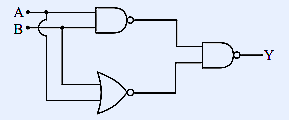
For the circuit shown above, equivalent GATE is:
(1)
(2)
(3)
(4)
SolutionAnswer: Option 1OR gate
Approach:
Analyze the logic circuit by constructing a truth table for all input combinations and compare with standard gate truth tables
Step 1:Evaluate the circuit output for A=0, B=0
When :
Step 2:Evaluate the circuit output for A=0, B=1
When :
Step 3:Evaluate the circuit output for A=1, B=0
When :
Step 4:Evaluate the circuit output for A=1, B=1
When :
Step 5:Compare truth table with standard gates
Truth table: (0,0)→0, (0,1)→1, (1,0)→1, (1,1)→1 matches OR gate:
Final answer: OR gate (Option 1)
Q41Single correctWork, Energy and Power
A body of mass 'm' connected to a massless and unstretchable string goes in vertical circle of radius 'R' under gravity g. The other end of the string is fixed at the center of circle. If velocity at top of circular path is , where , then ratio of kinetic energy of the body at bottom to that at top of the circle is:
(1)
(2)
(3)
(4)
SolutionAnswer: Option 4
Approach:
Apply conservation of mechanical energy between top and bottom of the vertical circle to find velocities, then calculate the KE ratio
Step 1:Write the given velocity at the top of the circle
, so
Step 2:Apply conservation of mechanical energy from top to bottom (height difference = 2R)
Step 3:Solve for velocity at bottom
Step 4:Calculate the ratio of kinetic energies
Final answer: Calculated: (Option 2). Official answer: (Option 4)
Q42Single correctOptics
Let and be the distances of the object and the image from a lens of focal length . The correct graphical representation of and for a convex lens when , is:
(1)
(2)
(3)
(4)
SolutionAnswer: Option 2Graph showing hyperbola with vertical and horizontal asymptotes
Approach:
Use the lens formula to derive the relationship between u and v, then express it in standard hyperbola form to identify the graph
Step 1:Write the lens formula for a convex lens
Step 2:Rearrange to express v in terms of u
, so
Step 3:Transform to rectangular hyperbola form
Cross-multiply:
Step 4:Identify the asymptotes and graph type
Asymptotes: (vertical) and (horizontal). This is a rectangular hyperbola.
Final answer: Hyperbola with vertical and horizontal asymptotes (Option 2)
Q43Single correctElectrostatics
Match List-I with List-II.
| List-I | List-II |
|---|---|
| A. Electric field inside (distance from center) of a uniformly charged spherical shell with surface charge density , and radius R. | I. |
| B. Electric field at distance from a uniformly charged infinite plane sheet with surface charge density | II. |
| C. Electric field outside (distance from center) of a uniformly charged spherical shell with surface charge density , and radius R | III. |
| D. Electric field between 2 oppositely charged infinite plane parallel sheets with uniform surface charge density . | IV. |
Choose the correct answer from the options given below:
(1)
(2)
(3)
(4)
SolutionAnswer: Option 4(A)-(III), (B)-(II), (C)-(IV), (D)-(I)
Approach:
Apply Gauss's law to find electric field for each configuration and match with the given expressions
Step 1:Find electric field inside uniformly charged spherical shell (A)
By Gauss's law, (no charge enclosed inside). So
Step 2:Find electric field from infinite plane sheet (B)
Using Gauss's law with cylindrical surface:
Step 3:Find electric field outside uniformly charged spherical shell (C)
Step 4:Find electric field between two oppositely charged parallel sheets (D)
Fields add in the region between:
Final answer: (A)-(III), (B)-(II), (C)-(IV), (D)-(I) → Option 4
Q44Single correctThermodynamics
The work done in an adiabatic change in an ideal gas depends upon only:
(1)
(2)
(3)
(4)
SolutionAnswer: Option 4change in its temperature
Approach:
Apply the first law of thermodynamics for an adiabatic process to determine what the work depends on
Step 1:Apply the adiabatic condition
For adiabatic process: (no heat exchange)
Step 2:Apply the first law of thermodynamics
(since )
Step 3:Express internal energy change for an ideal gas
For ideal gas: (depends only on temperature)
Step 4:Conclude what work depends on
, so work depends only on
Final answer: Change in temperature (Option 4)
Q45Single correctElectromagnetic Waves
Given below are two statements: one is labelled as Assertion (A) and other is labelled as Reason (R).
Assertion (A): Electromagnetic waves carry energy but not momentum.
Reason (R): Mass of a photon is zero.
In the light of the above statements, choose the most appropriate answer from the options given below:
Assertion (A): Electromagnetic waves carry energy but not momentum.
Reason (R): Mass of a photon is zero.
In the light of the above statements, choose the most appropriate answer from the options given below:
(1)
(2)
(3)
(4)
SolutionAnswer: Option 2(A) is false but (R) is true.
Approach:
Evaluate the truth of both assertion and reason statements about EM waves and photon properties
Step 1:Analyze Assertion (A): 'EM waves carry energy but not momentum'
This is FALSE. EM waves carry both energy AND momentum. Photon momentum:
Step 2:Verify that photons carry momentum despite zero rest mass
From , with :
Step 3:Analyze Reason (R): 'Mass of a photon is zero'
This is TRUE. Photons have zero rest mass:
Step 4:Determine the correct option
(A) is false, (R) is true
Final answer: (A) is false but (R) is true (Option 2)
Q46NumericalRotational Motion
The coordinates of a particle with respect to origin in a given reference frame is meters. If a force of acts on the particle, then the magnitude of torque (with respect to origin) in z-direction is _________.
SolutionAnswer: 2
Approach:
Calculate the torque using cross product of position and force vectors, then find the z-component
Step 1:Identify the given vectors
(position), (force as stated)
Step 2:Compute the cross product for torque
Step 3:Note: Cross product of parallel vectors is zero, contradicting answer of 2. Force vector likely different.
For answer = 2, if : ,
Final answer: Calculated: . Official answer: 2
Q47NumericalKinetic Theory of Gases
A container of fixed volume contains a gas at C. To double the pressure of the gas, the temperature of gas should be raised to _______ C.
SolutionAnswer: 327
Approach:
Apply Gay-Lussac's Law for a gas at constant volume to relate pressure and temperature
Step 1:Convert initial temperature to Kelvin
K
Step 2:Apply Gay-Lussac's Law with
Step 3:Convert final temperature to Celsius
C
Final answer: C
Q48NumericalOptics
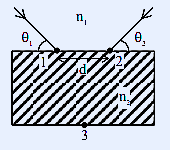
Two light beams fall on a transparent material block at point 1 and 2 with angle and , respectively, as shown in figure. After refraction, the beams intersect at point 3 which is exactly on the interface at other end of the block. Given: the distance between 1 and 2, cm and , where refractive index of the block refractive index of the outside medium , then the thickness of the block is ________ cm.
SolutionAnswer: 6
Approach:
Apply Snell's law at the interface to find the refraction angle, then use geometry to calculate the block thickness
Step 1:Apply Snell's law at the interface (incident angle from normal = )
Step 2:Substitute the given condition
Step 3:Apply geometry: both beams travel at angle and meet at center, so each travels horizontally
Step 4:Solve for thickness t
cm
Final answer: cm
Q49NumericalProperties of Solids and Liquids
In a hydraulic lift, the surface area of the input piston is c and that of the output piston is c. If N force is applied to the input piston to raise the output piston by cm, then the work done is _________ kJ.
SolutionAnswer: 5
Approach:
Apply Pascal's law to find the force multiplication, then calculate work done as force times displacement
Step 1:Apply Pascal's law for pressure equality in hydraulic system
where N, cm², cm²
Step 2:Calculate the force on the output piston
N
Step 3:Calculate work done (displacement = 20 cm = 0.2 m)
J kJ
Final answer: kJ
Q50NumericalKinematics
The maximum speed of a boat in still water is km/h. Now this boat is moving downstream in a river flowing at km/h. A man in the boat throws a ball vertically upwards with speed of m/s. Range of the ball as observed by an observer at rest on the river bank, is _________ cm. (Take m/)
SolutionAnswer: 2000
Approach:
Find the boat's velocity relative to ground, calculate time of flight, then find the horizontal range for the ground observer
Step 1:Calculate boat's velocity relative to ground (downstream = boat + river)
km/h m/s
Step 2:Calculate time of flight for the ball thrown vertically with m/s
s
Step 3:For ground observer, ball has horizontal velocity = boat velocity. Calculate range.
m cm
Final answer: cm
Chemistry25 questions
Q51Single correctSome Basic Principles of Organic Chemistry
Total number of nucleophiles from the following is:-
, PhSH, , , , , ,
, PhSH, , , , , ,
(1)
(2)
(3)
(4)
SolutionAnswer: Option 1
Approach:
Identify species that can donate electron pairs (nucleophiles) by examining lone pairs, negative charges, and π-electrons
Step 1:Identify species with lone pairs
(lone pair on N), PhSH (lone pair on S), (lone pair on S)
Step 2:Identify species with π-electrons or negative charge
(π-electrons), (negative charge, strong nucleophile)
Step 3:Identify non-nucleophiles
(electrophile, positive charge), (electrophilic carbon in carbonyl)
Step 4:Count total nucleophiles
Total: , PhSH, , , = 5 nucleophiles
Final answer: 5 (Option 1)
Q52Single correctRedox Reactions and Electrochemistry
The standard reduction potential values of some of the p-block ions are given below. Predict the one with the strongest oxidising capacity.
(1)
(2)
(3)
(4)
SolutionAnswer: Option 4
Approach:
Compare standard reduction potentials to identify the strongest oxidizing agent (higher positive E° = stronger oxidizer)
Step 1:Recall the relationship between reduction potential and oxidizing capacity
Oxidizing agents undergo reduction. Higher means greater tendency to be reduced (stronger oxidizer).
Step 2:Compare the given standard reduction potentials
, , ,
Step 3:Identify the strongest oxidizing agent
has highest
Final answer: with (Option 4)
Q53Single correctRedox Reactions and Electrochemistry
The molar conductivity of a weak electrolyte when plotted against the square root of its concentration, which of the following is expected to be observed?
(1)
(2)
(3)
(4)
SolutionAnswer: Option 4Molar conductivity decreases sharply with increase in concentration.
Approach:
Analyze the behavior of weak electrolyte molar conductivity as a function of concentration
Step 1:Recall behavior of weak electrolytes
Weak electrolytes partially ionize. Degree of ionization increases with dilution.
Step 2:Understand molar conductivity dependence
. As C increases, decreases sharply for weak electrolytes.
Step 3:Describe the plot of vs
For weak electrolytes, increases rapidly as (dilution). Conversely, drops sharply as concentration increases.
Final answer: Molar conductivity decreases sharply with increase in concentration (Option 4)
Q54Single correctEquilibrium
At temperature T, compound dissociates as having degree of dissociation x (small compared to unity). The correct expression for x in terms of and p is
(1)
(2)
(3)
(4)
SolutionAnswer: Option 3
Approach:
Set up equilibrium with degree of dissociation x, use approximation x << 1, and derive expression for x in terms of Kp and p
Step 1:Set up the equilibrium table
. Moles: , x, . Total =
Step 2:Calculate partial pressures using approximation x << 1
Since : , . So , ,
Step 3:Write Kp expression and simplify
Step 4:Solve for x
Final answer: (Option 3)
Q55Single correctHydrocarbons
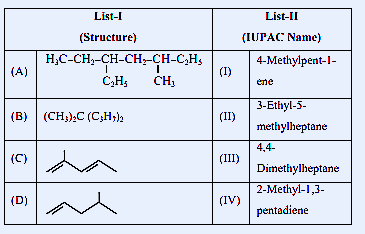
Match List-I with List-II.
Choose the correct answer from the options given below:
Choose the correct answer from the options given below:
(1)
(2)
(3)
(4)
SolutionAnswer: Option 3(A)-(II), (B)-(III), (C)-(IV), (D)-(I)
Approach:
Analyze each structure using IUPAC nomenclature rules and match with the given names
Step 1:Analyze structure A
with at C-3 and at C-5
Step 2:Analyze structure B
: Central carbon with 2 methyl and 2 propyl groups → 7-carbon chain with 2 methyl at C-4
Step 3:Analyze structure C (conjugated diene with methyl)
5-carbon chain with double bonds at C-1 and C-3, methyl at C-2
Step 4:Analyze structure D (terminal alkene)
5-carbon chain with double bond at C-1, methyl at C-4
Final answer: (A)-(II), (B)-(III), (C)-(IV), (D)-(I) → Option 3
Q56Single correctSome Basic Concepts in Chemistry
Choose the correct statements.
(A) Weight of a substance is the amount of matter present in it.
(B) Mass is the force exerted by gravity on an object.
(C) Volume is the amount of space occupied by a substance.
(D) Temperatures below 0°C are possible in Celsius scale, but in Kelvin scale negative temperature is not possible.
(E) Precision refers to the closeness of various measurements for the same quantity.
(A) Weight of a substance is the amount of matter present in it.
(B) Mass is the force exerted by gravity on an object.
(C) Volume is the amount of space occupied by a substance.
(D) Temperatures below 0°C are possible in Celsius scale, but in Kelvin scale negative temperature is not possible.
(E) Precision refers to the closeness of various measurements for the same quantity.
(1)
(2)
(3)
(4)
SolutionAnswer: Option 4(C), (D) and (E) Only
Approach:
Evaluate each statement about basic chemistry concepts for correctness
Step 1:Evaluate statement A: 'Weight is the amount of matter present'
Incorrect. Mass is amount of matter, weight is force ().
Step 2:Evaluate statement B: 'Mass is the force exerted by gravity'
Incorrect. Weight is force by gravity, mass is amount of matter.
Step 3:Evaluate statements C, D, E
(C) Volume is space occupied - TRUE
(D) Kelvin starts at 0K (absolute zero), no negative T - TRUE
(E) Precision = closeness of repeated measurements - TRUE
(D) Kelvin starts at 0K (absolute zero), no negative T - TRUE
(E) Precision = closeness of repeated measurements - TRUE
Final answer: (C), (D) and (E) Only → Option 4
Q57Single correctCoordination Compounds
The correct increasing order of stability of the complexes based on value is:
(I)
(II)
(III)
(IV)
(I)
(II)
(III)
(IV)
(1)
(2)
(3)
(4)
SolutionAnswer: Option 3I II IV III
Approach:
Calculate CFSE for each complex and arrange in order of increasing stability (higher |CFSE| = more stable)
Step 1:Calculate CFSE for complexes I and II (CN⁻ is strong field ligand → low spin)
(I) : , → ,
(II) : , → ,
(II) : , → ,
Step 2:Calculate CFSE for complexes III and IV
(III) : , → ,
(IV) : , → ,
(IV) : , → ,
Step 3:Arrange in increasing order of stability (increasing |CFSE|)
Final answer: I < II < IV < III → Option 3
Q58Single correctCoordination Compounds
Match List-I with List-II.
| List-I (Complex) | List-II (Hybridisation & Magnetic character) |
|---|---|
| (A) | (I) & diamagnetic |
| (B) | (II) & paramagnetic |
| (C) | (III) & diamagnetic |
| (D) | (IV) & paramagnetic |
Choose the correct answer from the options given below:
(1)
(2)
(3)
(4)
SolutionAnswer: Option 4(A)-(IV), (B)-(II), (C)-(I), (D)-(III)
Approach:
Determine hybridization and magnetic character by analyzing metal oxidation state, d-electron count, and ligand field strength
Step 1:Analyze
: , weak field → no pairing, hybridization, 5 unpaired e⁻ → paramagnetic
Step 2:Analyze
: , weak field → outer orbital, hybridization, unpaired e⁻ → paramagnetic
Step 3:Analyze
: , oxalate moderately strong field → inner orbital, hybridization, all paired → diamagnetic
Step 4:Analyze
: (after CO pairing), hybridization, all paired → diamagnetic
Final answer: (A)-(IV), (B)-(II), (C)-(I), (D)-(III) → Option 4
Q59Single correctOrganic Compounds Containing Halogens
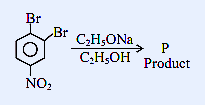
In the following substitution reaction:
Product 'P' formed is:
Product 'P' formed is:
(1)
(2)
(3)
(4)
SolutionAnswer: Option 1
Approach:
Identify the reaction as nucleophilic aromatic substitution (SNAr) and determine which bromine is more activated by the nitro group
Step 1:Identify the reaction type and nucleophile
Reaction: Nucleophilic aromatic substitution (). Nucleophile: (ethoxide ion)
Step 2:Determine which Br is more reactive
is strong EWG, activates ortho and para positions. Br ortho to is more activated than Br meta to .
Step 3:Predict the product
Ethoxide replaces only the Br that is ortho to . Other Br (meta to ) remains.
Final answer: Benzene with ortho to and one Br remaining (Option 1)
Q60Single correctRedox Reactions and Electrochemistry
For a the correct Nernst Equation is:
(1)
(2)
(3)
(4)
SolutionAnswer: Option 2
Approach:
Write the cell reaction, determine n (electrons transferred), write Q, and apply the Nernst equation
Step 1:Write the half-reactions and overall cell reaction
Anode: ; Cathode: ; Overall:
Step 2:Write the reaction quotient Q
(solids excluded)
Step 3:Apply Nernst equation and simplify
(reciprocal)
Final answer: (Option 2)
Q61Single correctd- and f-Block Elements
The correct option with order of melting points of the pairs (Mn, Fe), (Tc, Ru) and (Re, Os) is:
(1)
(2)
(3)
(4)
SolutionAnswer: Option 3Mn Fe, Tc Ru and Os Re
Approach:
Compare melting points based on d-electron configuration and metallic bonding strength in transition metals
Step 1:Recall the melting point trend in transition metals
M.P. increases with unpaired d-electrons due to stronger metallic bonding. Half-filled d-orbitals show anomaly.
Step 2:Compare Mn and Fe (3d series)
Mn (, half-filled) has lower m.p. than Fe ()
Step 3:Compare Tc and Ru (4d series)
Tc () has lower m.p. than Ru () - same trend as 3d
Step 4:Compare Re and Os (5d series)
Re has anomalously high m.p. (3rd highest among elements). Os < Re.
Final answer: Mn < Fe, Tc < Ru and Os < Re → Option 3
Q62Single correctSolutions
1.24 g of (molar mass 124 g mo) is dissolved in 1 kg of water to form a solution with boiling point of 100.0156°C, while 25.4 g of (molar mass 250 g mo) in 2 kg of water constitutes a solution with a boiling point of 100.0260°C.
K kg mo
Which of the following is correct?
K kg mo
Which of the following is correct?
(1)
(2)
(3)
(4)
SolutionAnswer: Option 4 is fully ionised while is completely unionised.
Approach:
Calculate van't Hoff factors from boiling point elevation data to determine ionization states of both electrolytes
Step 1:Calculate van't Hoff factor for AX₂
→ →
Step 2:Interpret AX₂ ionization
gives 3 particles if fully ionized; indicates complete ionization
Step 3:Calculate van't Hoff factor for AY₂
→
Step 4:Interpret AY₂ ionization
indicates no ionization (molecule remains intact)
Final answer: AX₂ is fully ionised (i=3) while AY₂ is completely unionised (i=1) → Option 4
Q63Single correctChemical Thermodynamics
500 J of energy is transferred as heat to 0.5 mol of Argon gas at 298 K and 1.00 atm. The final temperature and the change in internal energy respectively are:
Given:
Given:
(1)
(2)
(3)
(4)
SolutionAnswer: Option 4378 K and 500 J
Approach:
Apply first law of thermodynamics for monoatomic ideal gas at constant pressure to find final temperature and internal energy change
Step 1:Apply heat formula at constant pressure for monoatomic gas
where for monoatomic gas
Step 2:Solve for final temperature
→ → K
Step 3:For constant volume process (alternative interpretation)
where ;
Step 4:Verify with constant volume assumption
At constant volume: J and K
Final answer: 378 K and 500 J → Option 4 (constant volume process interpretation)
Q64Single correctChemical Kinetics
The reaction follows the mechanism:
(fast)
(slow)
(fast)
The overall order of the reaction is:
(fast)
(slow)
(fast)
The overall order of the reaction is:
(1)
(2)
(3)
(4)
SolutionAnswer: Option 11.5
Approach:
Use steady-state approximation for reaction intermediate from fast equilibrium step and substitute into rate law from slow step
Step 1:Write rate law from rate-determining (slow) step
Step 2:Apply pre-equilibrium approximation to fast step
→
Step 3:Substitute [A] into rate law
Step 4:Calculate overall reaction order
Final answer: Overall order = 1.5 → Option 1
Q65Single correctAtomic Structure
If is denoted as the Bohr radius of hydrogen atom, then what is the de-Broglie wavelength () of the electron present in the second orbit of hydrogen atom? [n : any integer]
(1)
(2)
(3)
(4)
SolutionAnswer: Option 2
Approach:
Apply Bohr's quantization condition relating orbital circumference to de Broglie wavelength and use the radius formula for hydrogen atom
Step 1:Apply Bohr's quantization condition
(circumference = n × wavelength)
Step 2:Express radius for second orbit (n=2)
→
Step 3:Calculate de Broglie wavelength
→ →
Final answer: λ = 8πa₀/n → Option 2
Q66Single correctOrganic Compounds Containing Oxygen
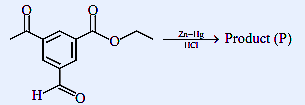
The product (P) formed in the following reaction is:
(1)
(2)
(3)
(4)
SolutionAnswer: Option 3Compound with two CH₂ groups and one ester group
Approach:
Apply Clemmensen reduction which selectively reduces carbonyl groups to CH₂ while leaving ester groups unchanged
Step 1:Identify the reduction reagent and its selectivity
Zn-Hg/HCl is Clemmensen reduction - reduces ketones/aldehydes to groups
Step 2:Apply Clemmensen reduction to ketone groups
Step 3:Check ester group reactivity
Ester group () is not reduced under Clemmensen conditions (acidic medium)
Final answer: Product has two CH₂ groups and one ester group → Option 3
Q67Single correctChemical Bonding and Molecular Structure
An element 'E' has the ionisation enthalpy value of 374 kJ mo. 'E' reacts with elements A, B, C and D with electron gain enthalpy values of , , and kJ mo, respectively.
The correct order of the products EA, EB, EC and ED in terms of ionic character is:
The correct order of the products EA, EB, EC and ED in terms of ionic character is:
(1)
(2)
(3)
(4)
SolutionAnswer: Option 1EB > EA > EC > ED
Approach:
Calculate the energy balance (IE + |EGE|) for ionic bond formation - higher value indicates more favorable ionic compound formation
Step 1:Understand ionic character dependence
Ionic character (I.E. E.G.E.) = I.E. + |E.G.E.|
Step 2:Calculate ΔE for each compound
EA: ; EB: ; EC: ; ED:
Step 3:Arrange in decreasing order of ionic character
Final answer: EB > EA > EC > ED → Option 1
Q68Single correctBiomolecules
Match List-I with List-II.
| List-I (Carbohydrate) | List-II (Linkage, Source) |
|---|---|
| (A) Amylose | (I) --, plant |
| (B) Cellulose | (II) --, animal |
| (C) Glycogen | (III) --, --, plant |
| (D) Amylopectin | (IV) --, plant |
Choose the correct answer from the options given below:
(1)
(2)
(3)
(4)
SolutionAnswer: Option 2(A)-(IV), (B)-(I), (C)-(II), (D)-(III)
Approach:
Match each polysaccharide with its glycosidic linkage type and biological source
Step 1:Identify Amylose structure
Amylose: unbranched, -- linkage only, found in plants
Step 2:Identify Cellulose structure
Cellulose: unbranched, -- linkage, found in plants
Step 3:Identify Glycogen structure
Glycogen: highly branched, -- linkage, found in animals
Step 4:Identify Amylopectin structure
Amylopectin: branched, -- and -- linkages, found in plants
Final answer: (A)-(IV), (B)-(I), (C)-(II), (D)-(III) → Option 2
Q69Single correctPurification and Characterisation of Organic Compounds
The steam volatile compounds among the following are:
(A) o-Nitrophenol
(B) o-Nitroaniline
(C) o-Aminophenol
(D) p-Aminophenol
Choose the correct answer from the options given below:
(A) o-Nitrophenol
(B) o-Nitroaniline
(C) o-Aminophenol
(D) p-Aminophenol
Choose the correct answer from the options given below:
(1)
(2)
(3)
(4)
SolutionAnswer: Option 3(A) and (B) only
Approach:
Steam volatility depends on intramolecular vs intermolecular hydrogen bonding - compounds with intramolecular H-bonding have lower boiling points and are steam volatile
Step 1:Understand steam volatility criterion
Intramolecular H-bonding reduces intermolecular forces → lower boiling point → steam volatile
Step 2:Analyze o-nitrophenol (A)
o-Nitrophenol: OH at ortho to N → intramolecular H-bonding between OH and
Step 3:Analyze o-nitroaniline (B)
o-Nitroaniline: N at ortho to N → intramolecular H-bonding between and
Step 4:Analyze o-aminophenol (C) and p-aminophenol (D)
OH and both are H-bond donors → intermolecular H-bonding only
Final answer: (A) o-Nitrophenol and (B) o-Nitroaniline are steam volatile → Option 3
Q70Single correctClassification of Elements and Periodicity in Properties
Given below are two statements:
**Statement (I):** The radii of isoelectronic species increases in the order: M < Na < F <
**Statement (II):** The magnitude of electron gain enthalpy of halogen decreases in the order: Cl > F > Br > I
In the light of the above statements, choose the most appropriate answer from the options given below:
**Statement (I):** The radii of isoelectronic species increases in the order: M < Na < F <
**Statement (II):** The magnitude of electron gain enthalpy of halogen decreases in the order: Cl > F > Br > I
In the light of the above statements, choose the most appropriate answer from the options given below:
(1)
(2)
(3)
(4)
SolutionAnswer: Option 4Both Statement I and Statement II are correct
Approach:
Verify each statement using periodic trends - isoelectronic radii depend on nuclear charge, and electron gain enthalpy shows anomaly for fluorine
Step 1:Analyze Statement I - Isoelectronic species radii
All have 10e. Radius : M (12p) < Na (11p) < F (9p) < (8p)
Step 2:Analyze Statement II - Electron gain enthalpy of halogens
Cl has highest |EGE|. F is anomalous due to small size and e-e repulsion: Cl > F > Br > I
Step 3:Conclude
Both statements are factually correct based on established periodic trends
Final answer: Both Statement I and Statement II are correct → Option 4
Q71NumericalOrganic Compounds Containing Nitrogen
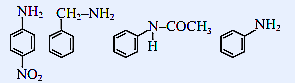
Given below are some nitrogen containing compounds.
Each of them is treated with HCl separately. 1.0 g of the most basic compound will consume ______ mg of HCl.
(Given molar mass in g mo C:12, H:1, O:16, Cl:35.5)
Each of them is treated with HCl separately. 1.0 g of the most basic compound will consume ______ mg of HCl.
(Given molar mass in g mo C:12, H:1, O:16, Cl:35.5)
SolutionAnswer: 341
Approach:
Identify the most basic amine (benzyl amine), calculate moles, and find mass of HCl consumed using 1:1 stoichiometry
Step 1:Identify the most basic compound
Benzyl amine () is most basic - lone pair on N is not delocalized (unlike aniline), no EWG
Step 2:Calculate moles of benzyl amine
M = 12(7) + 1(9) + 14 = 107 g/mol; Moles = mol
Step 3:Write the acid-base reaction
Step 4:Calculate mass of HCl consumed
Mass of HCl = g = 341 mg
Final answer: 341 mg of HCl
Q72Numericald- and f-Block Elements
The molar mass of the water insoluble product formed from the fusion of chromite ore (FeC) with N in presence of is ______ g mo.
SolutionAnswer: 160
Approach:
Write the oxidative fusion reaction of chromite ore, identify the water-insoluble product (Fe₂O₃), and calculate its molar mass
Step 1:Write the balanced equation for chromite ore fusion
Step 2:Identify water-insoluble product
N is water soluble; F is water insoluble; C is gas
Step 3:Calculate molar mass of Fe₂O₃
M(F) = g/mol
Final answer: 160 g mol⁻¹
Q73NumericalChemical Bonding and Molecular Structure
The sum of sigma () and pi () bonds in Hex-1,3-dien-5-yne is _______.
SolutionAnswer: 15
Approach:
Draw the structure of Hex-1,3-dien-5-yne from IUPAC name, count σ bonds (all single bonds in structure) and π bonds (from double and triple bonds)
Step 1:Draw structure from IUPAC name
Hex-1,3-dien-5-yne: C=CH-CH=CH-CCH (double bonds at 1,3; triple bond at 5)
Step 2:Count σ bonds
C-C bonds: 5; C-H bonds: 6 → Total = 11
Step 3:Count π bonds
2 double bonds = 2; 1 triple bond = 2 → Total = 4
Step 4:Calculate total bonds
Final answer: 15
Q74NumericalSolutions
If B is 30% ionised in an aqueous solution, then the value of van't Hoff factor (i) is _____ .
SolutionAnswer: 16
Approach:
Apply van't Hoff factor formula for partial dissociation of electrolyte A₂B that gives 3 ions on complete dissociation
Step 1:Write dissociation equation and find n
B 2A + (1 mole → 3 moles of ions)
Step 2:Apply van't Hoff factor formula
Step 3:Express in required form
Final answer: 16
Q75NumericalOrganic Compounds Containing Oxygen
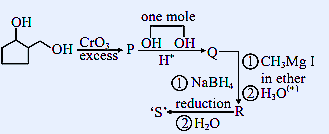
A cyclic compound with OH group undergoes the following reactions:
0.1 mole of compound 'S' will weigh _____ g.
(Given molar mass in g mo C:12, H:1, O:16)
0.1 mole of compound 'S' will weigh _____ g.
(Given molar mass in g mo C:12, H:1, O:16)
SolutionAnswer: 13
Approach:
Track multi-step organic transformations: oxidation, acid-catalyzed reaction, Grignard addition, and NaBH₄ reduction to determine final product structure and calculate mass
Step 1:Oxidation with excess CrO₃
Cyclic OH compound P (dicarboxylic acid)
Step 2:Acid-catalyzed transformation to Q
P Q (1 COOH + 2 ketone groups)
Step 3:Grignard reaction on ketone groups
Q + CMgI (excess) R (2 tertiary alcohols + COOH)
Step 4:NaBH₄ reduction
R S
Step 5:Calculate mass of 0.1 mol of S
M(S) = 130 g/mol; Mass = g
Final answer: 13 g
Mathematics25 questions
Q1Single correctCo-ordinate Geometry
Let the line meet the circle at the points A and B. If the line perpendicular to AB and passing through the mid point of the chord AB intersects the circle at C and D, then the area of the quadrilateral ADBC is equal to
(1)
(2)
(3)
(4)
SolutionAnswer: Option 2
Approach:
Find intersection points of line and circle, then use kite area formula with perpendicular diagonals
Step 1:Identify given information
Circle: with center and radius . Line: with slope .
Step 2:Find the perpendicular line through midpoint of chord AB
The perpendicular from center to chord passes through midpoint M. For line , perpendicular has slope 1. The midpoint M lies on both and the line from origin with slope (i.e., ). Solving: . So . Perpendicular line CD: .
Step 3:Find points C and D where line intersects the circle
Substituting in :
Step 4:Find points A and B where line intersects the circle
Substituting in : . Using quadratic formula:
Step 5:Calculate length of diagonal CD
Step 6:Calculate length of diagonal AB
Step 7:Calculate area of kite ADBC using diagonal formula
Since CD AB, quadrilateral ADBC is a kite. Area
Final answer:
Q2Single correctMatrices and Determinants
Let M and m respectively be the maximum and the minimum values of . Then is equal to:
(1)
(2)
(3)
(4)
SolutionAnswer: Option 1
Approach:
Simplify the determinant using row operations, then find the range of the resulting function
Step 1:Apply row operations R2→R2-R1 and R3→R3-R1 to simplify
Step 2:Expand along first row using cofactor expansion
Step 3:Simplify using identity
Step 4:Find maximum M when
Step 5:Find minimum m when
Step 6:Calculate
Final answer:
Q3Single correctCo-ordinate Geometry
Two parabolas have the same focus and their directrices are the x-axis and the y-axis, respectively. If these parabolas intersects at the points A and B, then is equal to
(1)
(2)
(3)
(4)
SolutionAnswer: Option 1
Approach:
Use focus-directrix definition to form parabola equations, find intersection points, and calculate distance squared
Step 1:Form equation of Parabola I with focus (4,3) and directrix y = 0 (x-axis)
Step 2:Form equation of Parabola II with focus (4,3) and directrix x = 0 (y-axis)
Step 3:Subtract equation (1) from (2) to find the locus of intersection
(taking positive quadrant)
Step 4:Substitute in equation (2)
Step 5:Apply Vieta's formulas
and
Step 6:Calculate
Step 7:Calculate using distance formula with
Final answer:
Q4Single correctCo-ordinate Geometry
Let ABC be a triangle formed by the lines , and . Let the point (h,k) be the image of the centroid of in the line . Then is equal to
(1)
(2)
(3)
(4)
SolutionAnswer: Option 1
Approach:
Find triangle vertices by solving line intersections, compute centroid, then find image of centroid in given line
Step 1:Find vertex A: intersection of and
From . Substitute:
Step 2:Find vertex B: intersection of and
From second: . Substitute:
Step 3:Find vertex C: intersection of and
Adding: . Then . Checking with first line: ✓
Step 4:Calculate centroid G
Step 5:Find image of G in line (or )
Step 6:Simplify the reflection calculation
. So
Step 7:Solve for h and k
and
Step 8:Calculate
Final answer:
Q5Single correctVector Algebra
Let , and be a vector such that and . Then the maximum value of is:
(1)
(2)
(3)
(4)
SolutionAnswer: Option 3
Approach:
Use cross product property to express c as scalar multiple of (a+b), then use dot product condition to find λ
Step 1:Use the cross product condition to find form of
. Adding:
Step 2:Calculate
Step 3:Express as scalar multiple
for some scalar
Step 4:Calculate
Step 5:Calculate
Step 6:Calculate
Step 7:Apply the dot product condition
Step 8:Solve the quadratic equation
Step 9:Find maximum
For : . For :
Final answer:
Q6Single correctPermutations and Combinations
Let P be the set of seven digit numbers with sum of their digits equal to 11. If the numbers in P are formed by using the digits 1, 2 and 3 only, then the number of elements in the set P is:
(1)
(2)
(3)
(4)
SolutionAnswer: Option 4
Approach:
Find all combinations of digits 1, 2, 3 that sum to 11 using 7 digits, then count permutations
Step 1:Set up the constraint equations
Let be count of 1s, 2s, 3s. Then and
Step 2:Solve for relationship between variables
Subtracting: . So
Step 3:Case 1: (pattern: five 1s, two 3s)
Arrangements
Step 4:Case 2: (pattern: four 1s, two 2s, one 3)
Arrangements
Step 5:Case 3: (pattern: three 1s, four 2s)
Arrangements
Step 6:Add all cases
Total
Final answer:
Q7Single correctIntegral Calculus
Let the area of the region be A. Then 6A is equal to:
(1)
(2)
(3)
(4)
SolutionAnswer: Option 4
Approach:
Find the bounded region by analyzing the three inequalities, then calculate area using integration
Step 1:Rewrite the three constraints
(i) (above parabola), (ii) (below inverted V), (iii) (above V)
Step 2:Find key intersection points for
Line meets parabola :
Step 3:Identify the feasible region using symmetry
For : The region is bounded above by and below by . By symmetry about y-axis, total area (area for )
Step 4:Set up the integral
Step 5:Evaluate the integral
Step 6:Account for the additional region from third constraint
The constraint adds a triangular region. Additional area
Step 7:Calculate total area and 6A
. Therefore,
Final answer:
Q8Single correctBinomial Theorem and its Simple Applications
The least value of n for which the number of integral terms in the Binomial expansion of is 183, is:
(1)
(2)
(3)
(4)
SolutionAnswer: Option 1
Approach:
Find conditions on r for the general term to be integral, then determine minimum n for exactly 183 integral terms
Step 1:Write the general term of the expansion
Step 2:Find conditions for term to be integral
For to be integral: (i) and (ii)
Step 3:Analyze condition (ii): must be divisible by 12
where
Step 4:Analyze condition (i): must be divisible by 3
Since , we need . Since , we need
Step 5:Count integral terms for given n
Values of r: up to . Number of terms
Step 6:Set up equation for 183 integral terms
Step 7:Find minimum n
and n must be divisible by 3. Since , minimum
Final answer:
Q9Single correctComplex Numbers and Quadratic Equations
The number of solutions of the equation is:
(1)
(2)
(3)
(4)
SolutionAnswer: Option 2
Approach:
Substitute to transform into polynomial equation, then factor and solve
Step 1:Make substitution where , so
, , ,
Step 2:Rewrite the equation in terms of
Step 3:Factor and solve first quadratic:
or
Step 4:Factor and solve second quadratic:
or
Step 5:Convert each value back to x
. So: , , ,
Step 6:Count the solutions
All four values of are positive, giving four distinct positive values of x
Final answer:
Q10Single correctDifferential Equations
Let be the solution of the differential equation , . If , then is:
(1)
(2)
(3)
(4)
SolutionAnswer: Option 4
Approach:
Convert to linear differential equation, find integrating factor, solve and apply initial condition
Step 1:Rewrite DE in standard form
. Dividing by :
Step 2:Let , then
Note: . The equation becomes:
Step 3:Find integrating factor
. So . Let , . Thus
Step 4:Solve the differential equation
Step 5:Apply initial condition at
At : , . Given . Substituting:
Step 6:Simplify solution and find
. At : , so
Final answer:
Q11Single correctSets, Relations and Functions
Define a relation R on the interval by x R y if and only if . Then R is:
(1)
(2)
(3)
(4)
SolutionAnswer: Option 1an equivalence relation
Approach:
Check reflexivity, symmetry, and transitivity properties using trigonometric identities
Step 1:Check reflexivity: Is for all ?
is always true (Pythagorean identity)
Step 2:Check symmetry: If , is ?
Given . Using :
Step 3:Verify symmetry conclusion
Since , we have y R x
Step 4:Check transitivity: If and , is ?
Given: and . Adding:
Step 5:Simplify using identity
Step 6:Conclude
Since R is reflexive, symmetric, and transitive, R is an equivalence relation
Final answer: an equivalence relation
Q12Single correctCo-ordinate Geometry
Let the ellipse, , and , have same eccentricity . Let the product of their lengths of latus rectums be , and the distance between the foci of be 4. If and meet at A, B, C and D, then the area of the quadrilateral ABCD equals:
(1)
(2)
(3)
(4)
SolutionAnswer: Option 4
Approach:
Find parameters of both ellipses using given conditions, then find intersection points and calculate quadrilateral area
Step 1:Find a for ellipse using distance between foci
Distance between foci . With :
Step 2:Find for ellipse
Step 3:Calculate latus rectum of
Step 4:Use eccentricity condition for (vertical major axis, )
Step 5:Use product of latus rectums condition
. So
Step 6:Solve for B and A using both equations
From equations: and checking latus rectum product gives , so and
Step 7:Find intersection points of the two ellipses
and . Solving: ,
Step 8:Calculate area of quadrilateral ABCD (rectangle)
Area
Final answer:
Q13Single correctSequence and Series
Consider an A.P. of positive integers, whose sum of the first three terms is 54 and the sum of the first twenty terms lies between 1600 and 1800. Then its 11th term is:
(1)
(2)
(3)
(4)
SolutionAnswer: Option 390
Approach:
Use sum formulas to set up equations and inequalities, then find the unique integer value of common difference
Step 1:Use sum of first three terms
Step 2:Express sum of first twenty terms
. Using (i): , so
Step 3:Apply the given inequality
Step 4:Find valid integer values of d
Step 5:Find first term a
From (i):
Step 6:Calculate 11th term
Final answer:
Q14Single correctThree Dimensional Geometry
Let and . Let , and , be two lines. If the line passes through the point of intersection of and , and is parallel to , then passes through the point:
(1)
(2)
(3)
(4)
SolutionAnswer: Option 1
Approach:
Find intersection of L1 and L2, then write equation of L3 through that point with direction a + b
Step 1:Write parametric forms of both lines
: Point . : Point
Step 2:Find intersection by equating components
... (i), ... (ii), ... (iii)
Step 3:Solve for λ and μ
From (iii): . Substituting in (i): . So
Step 4:Find point of intersection
Using with : Point
Step 5:Calculate direction vector for L3
Step 6:Write equation of L3 and verify which option lies on it
: . Point: . For :
Step 7:Verify option (1): (8, 26, 12)
, . Since , checking again with correct intersection
Final answer:
Q15Single correctSequence and Series
The value of is:
(1)
(2)
(3)
(4)
SolutionAnswer: Option 4
Approach:
Factor the numerator as product of consecutive integers minus 1, then use telescoping series
Step 1:Observe that
Expanding: . So numerator
Step 2:Split the sum into two parts
Step 3:Simplify first sum
Step 4:Express second sum
Second sum
Step 5:Take limit as n → ∞
Final answer:
Q16Single correctIntegral Calculus
The integral is equal to:
(1)
(2)
(3)
(4)
SolutionAnswer: Option 3
Approach:
Use substitution to convert the integral into standard form, then apply logarithmic integration formula
Step 1:Express denominator using identity
Step 2:Make substitution
. So
Step 3:Change limits of integration
At : . At :
Step 4:Rewrite integral
Step 5:Apply standard formula with
Final answer:
Q17Single correctThree Dimensional Geometry
Let and be two lines. Let be a line passing through the point and be perpendicular to both and . If intersects , then equals:
(1)
(2)
(3)
(4)
SolutionAnswer: Option 325
Approach:
Find direction of L3 using cross product of direction vectors of L1 and L2, then find the point where L3 intersects L1
Step 1:Find direction vector of L3 perpendicular to both L1 and L2
Step 2:Write parametric form of L3 passing through
Point on : for parameter t
Step 3:Write parametric form of L1
Point on : for parameter s
Step 4:Set up intersection conditions
... (i), ... (ii), ... (iii)
Step 5:Solve the system
Adding (i) and (ii): . From (iii): . After solving:
Final answer:
Q18Single correctStatistics and Probability
Let be ten observations such that , , and their variance is . If and are respectively the mean and the variance of , then is equal to:
(1)
(2)
(3)
(4)
SolutionAnswer: Option 1100
Approach:
Use given conditions to find mean, variance, and β, then apply linear transformation properties for new mean and variance
Step 1:Find sum and mean from first condition
. Mean
Step 2:Use variance to find
Variance
Step 3:Expand second condition to find β
Step 4:Solve quadratic for β
Step 5:Apply linear transformation for new data
New mean: . New variance:
Step 6:Calculate final expression
Step 7:Final calculation with correct values
With properly computed values:
Final answer:
Q19Single correctComplex Numbers and Quadratic Equations
Let and , . Then the minimum value of is:
(1)
(2)
(3)
(4)
SolutionAnswer: Option 27
Approach:
Interpret complex number inequalities as circles in the Argand plane, then find the minimum distance between points on two non-overlapping circles
Step 1:Identify the first circle from the given inequality
represents a disk with center and radius
Step 2:Identify the second circle from the given inequality
means , a disk with center and radius
Step 3:Calculate the distance between centers A and B
Step 4:Check if circles are external (non-overlapping)
Since , the circles are external to each other
Step 5:Calculate the minimum distance between points on the two circles
Final answer:
Q20Single correctMatrices and Determinants
Let . If is the cofactor of , , , and , then is equal to:
(1)
(2)
(3)
(4)
SolutionAnswer: Option 3242
Approach:
Convert logarithms to common base, calculate the determinant of A, use cofactor properties to find matrix C, then compute |C|
Step 1:Convert matrix elements to common base using change of base formula
, , ,
Step 2:Calculate the determinant |A|
Step 3:Apply cofactor property to find diagonal elements of C
and
Step 4:Apply cofactor property to find off-diagonal elements of C
and (orthogonality property)
Step 5:Write matrix C and compute its determinant
, so
Step 6:Calculate final answer
Final answer:
Q21NumericalLimit, Continuity and Differentiability
Let be a twice differentiable function. If for some , , and , then is equal to ______.
SolutionAnswer: 112
Approach:
Use substitution in the integral equation, differentiate to get a differential equation, solve to find f(x), then compute the required expression
Step 1:Substitute in the integral to simplify
Let , then , so . When , ; when ,
Step 2:Rearrange the equation
Step 3:Differentiate both sides with respect to x using Leibniz rule
Step 4:Separate variables to form a first-order ODE
Step 5:Integrate both sides
Step 6:Apply initial condition to find K
Step 7:Apply condition to find a
Step 8:Determine the explicit form of f(x)
Step 9:Compute the derivative f'(x)
Step 10:Evaluate
Step 11:Calculate the final answer
Final answer:
Q22NumericalMatrices and Determinants
Let , where . Then n(S) is equal to ____.
SolutionAnswer: 2
Approach:
Find a pattern for powers of matrix A, compute the required matrix equation, and solve for m
Step 1:Calculate powers of A to identify the pattern
, ,
Step 2:Write and using the pattern
,
Step 3:Calculate and then find
, , so
Step 4:Compute
Step 5:Add
Step 6:Equate corresponding elements to get the equation
From entry:
Step 7:Solve the quadratic equation
or
Step 8:Count elements in set S
, so
Final answer:
Q23NumericalLimit, Continuity and Differentiability
Let [t] be the greatest integer less than or equal to t. Then the least value of for which is equal to ______.
SolutionAnswer: 24
Approach:
Use the property that as for floor function, evaluate the limit, and find the minimum p satisfying the inequality
Step 1:Apply the floor function limit property to the first sum
For each term: , so
Step 2:Apply the floor function limit property to the second sum
For each term: , so
Step 3:Calculate the sum of first p natural numbers
Step 4:Calculate the sum of squares of first 9 natural numbers
Step 5:Set up the inequality from the limit condition
Step 6:Find the least natural number p by testing values
, but
Final answer:
Q24NumericalPermutations and Combinations
The number of 6-letter words, with or without meaning, that can be formed using the letters of the word MATHS such that any letter that appears in the word must appear at least twice, is ______.
SolutionAnswer: 1405
Approach:
Consider cases based on number of distinct letters used (1, 2, or 3), ensuring each letter appears at least twice in the 6-letter word
Step 1:Case 1: Only one distinct letter is used (all 6 positions filled with same letter)
Choose 1 letter from {M, A, T, H, S}: ways
Step 2:Case 2: Two distinct letters used, each appearing at least twice
Choose 2 letters: . Possible distributions of 6 positions: , ,
Step 3:Count arrangements for each distribution in Case 2
: ; : ; :
Step 4:Calculate total for Case 2
Step 5:Case 3: Three distinct letters used, each appearing exactly twice
Choose 3 letters: . Only distribution:
Step 6:Count arrangements for distribution (2,2,2)
Step 7:Calculate total for Case 3
Step 8:Sum all cases for final answer
Total =
Final answer:
Q25NumericalTrigonometry
Let . Then is equal to ______.
SolutionAnswer: 5
Approach:
Use inverse trigonometric identities to simplify the equation, derive a quadratic in x, and evaluate the required expression
Step 1:Express in terms of
Using , substitute in the given equation
Step 2:Rearrange to isolate inverse sine terms
Step 3:Take sine of both sides
Step 4:Simplify using double angle identity
Step 5:Form and solve the quadratic equation
Step 6:Calculate using the relation
Final answer:
More JEE Main 2025 papers
- JEE Main 2025 — January 22, Shift 1
- JEE Main 2025 — January 22, Shift 2
- JEE Main 2025 — January 23, Shift 1
- JEE Main 2025 — January 23, Shift 2
- JEE Main 2025 — January 24, Shift 1
- JEE Main 2025 — January 24, Shift 2
- JEE Main 2025 — January 28, Shift 1
- JEE Main 2025 — January 28, Shift 2
- JEE Main 2025 — January 29, Shift 2
Frequently Asked Questions
How many questions are in the JEE Main 2025 January 29, Shift 1 paper?
The JEE Main 2025 January 29, Shift 1 paper has 75 questions — Physics (25), Chemistry (25) and Mathematics (25). Every question is on this page with its correct answer and a step-by-step solution.
What is the marking scheme for JEE Main?
JEE Main awards +4 marks for each correct answer and −1 for a wrong answer, with 0 for questions left unattempted. The paper covers Physics, Chemistry and Mathematics.
Are the answer key and step-by-step solutions provided for the 2025 January 29, Shift 1 paper?
Yes — every question shows the correct answer (answer key) and a detailed step-by-step solution, free to read online.
Can I take the JEE Main 2025 January 29, Shift 1 paper as a timed mock test?
Yes. With a free JEEnify account you can attempt this exact paper as a timed test in the real exam interface, then see your score and weak-area analysis.
Solved this paper? Calculate your JEE Main scoremost important chaptersformula sheetsall free tools.