
Back to JEE Main PYQs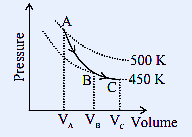
JEE Main 2025 January 29, Shift 2 Question Paper with Solutions
All 75 questions from the JEE Main 2025 (January 29, Shift 2) shift — Physics (25), Chemistry (25) and Mathematics (25) — each with the correct answer (answer key) and a step-by-step solution. Read it free online, or attempt the full paper as a timed mock test.
Physics25 questions
Q26Single correct
The difference of temperature in a material can convert heat energy into electrical energy. To harvest the heat energy, the material should have
(1)
(2)
(3)
(4)
SolutionAnswer: Option 3
Approach:
Apply the principles of thermoelectric effect (Seebeck effect) to determine optimal material properties for heat harvesting.
Step 1:Identify the physical phenomenon
Thermoelectric effect (Seebeck effect) converts temperature difference into electrical voltage
Step 2:Understand the role of thermal conductivity
Low thermal conductivity () helps maintain the temperature gradient across the material
Step 3:Understand the role of electrical conductivity
High electrical conductivity () allows efficient transport of charge carriers
Step 4:Apply the figure of merit concept
Thermoelectric efficiency depends on
Step 5:Select the correct option
Material should have: Low thermal conductivity + High electrical conductivity
Final answer: Option
Q27Single correct
Given below are two statements. One is labelled as Assertion (A) and the other is labelled as Reason (R).
Assertion (A): With the increase in the pressure of an ideal gas, the volume falls off more rapidly in an isothermal process in comparison to the adiabatic process.
Reason (R): In isothermal process, PV = constant, while in adiabatic process PV^γ = constant. Here γ is the ratio of specific heats, P is the pressure and V is the volume of the ideal gas.
In the light of the above statements, choose the correct answer from the options given below:
Assertion (A): With the increase in the pressure of an ideal gas, the volume falls off more rapidly in an isothermal process in comparison to the adiabatic process.
Reason (R): In isothermal process, PV = constant, while in adiabatic process PV^γ = constant. Here γ is the ratio of specific heats, P is the pressure and V is the volume of the ideal gas.
In the light of the above statements, choose the correct answer from the options given below:
(1)
(2)
(3)
(4)
SolutionAnswer: Option 4
Approach:
Compare the slopes of isothermal and adiabatic curves on a P-V diagram to determine which process shows more rapid volume change with pressure.
Step 1:Write the equations for both processes
Isothermal: (constant); Adiabatic: (constant)
Step 2:Verify the Reason (R) statement
R states: (isothermal) and (adiabatic)
Step 3:Calculate the slope for isothermal process
From :
Step 4:Calculate the slope for adiabatic process
From :
Step 5:Compare the magnitudes of slopes
Step 6:Interpret the physical meaning
Steeper slope means larger for same , i.e., volume changes more rapidly
Step 7:Verify Assertion (A)
A claims volume falls more rapidly in isothermal - this is INCORRECT
Step 8:Determine the final answer
A is false, R is true
Final answer: Option
Q28Single correct
An electric dipole is placed at a distance of 2 cm from an infinite plane sheet having positive charge density σ. Choose the correct option from the following.
(1)
(2)
(3)
(4)
SolutionAnswer: Option 3
Approach:
Analyze the behavior of an electric dipole in the uniform electric field of an infinite charged plane sheet.
Step 1:Determine the electric field of the infinite plane sheet
, directed perpendicular to the sheet (away from it for positive )
Step 2:Analyze the net force on the dipole
In a uniform field:
Step 3:Identify the stable equilibrium position
Dipole aligns parallel to (along the field direction, )
Step 4:Calculate torque at equilibrium
0°
Step 5:Calculate potential energy at equilibrium
0° (minimum value)
Step 6:Select the correct option
At equilibrium: Potential energy is minimum AND torque is zero
Final answer: Option
Q29Single correct
In an experiment with photoelectric effect, the stopping potential:
(1)
(2)
(3)
(4)
SolutionAnswer: Option 3
Approach:
Analyze each option using Einstein's photoelectric equation and the definition of stopping potential.
Step 1:Write Einstein's photoelectric equation
where W is work function, is maximum KE
Step 2:Relate stopping potential to maximum KE
Step 3:Analyze Option 1: Effect of wavelength
; as increases, decreases
Step 4:Analyze Option 2: Effect of intensity
Intensity affects number of photons, not energy per photon
Step 5:Analyze Option 3: Relationship between and
Step 6:Analyze Option 4: Another claim about intensity
Again, intensity does not affect or
Step 7:Select the correct answer
Only Option 3 is correct:
Final answer: Option
Q30Single correct
A point charge causes an electric flux of -2 × 1 N to pass through a spherical Gaussian surface of 8.0 cm radius, centred on the charge. The value of the point charge is:
(Given ε = 8.85 × 1 )
(Given ε = 8.85 × 1 )
(1)
(2)
(3)
(4)
SolutionAnswer: Option 1
Approach:
Apply Gauss's law to find the enclosed charge from the given electric flux through the spherical Gaussian surface.
Step 1:List the given data
N/C, cm,
Step 2:Apply Gauss's law
Step 3:Rearrange to find enclosed charge
Step 4:Substitute the values
Step 5:Calculate the result
C C
Step 6:Note about the radius
The radius of the Gaussian surface does not affect the flux calculation (flux depends only on enclosed charge)
Final answer: Option
Q31Single correct
A poly-atomic molecule ( = 3R, = 4R, where R is gas constant) goes from phase space point A( = 1 Pa, = 4 × 1 ) to point B ( = 5 × 1 Pa, = 6 × 1 ) to point C ( = 1 Pa, = 8 × 1 ). A to B is an adiabatic path and B to C is an isothermal path. The net heat absorbed per unit mole by the system is:
(1)
(2)
(3)
(4)
SolutionAnswer: Option 2
Approach:
Calculate heat absorbed in each process: zero for adiabatic (A→B) and for isothermal (B→C).
Step 1:Identify the given data
Pa, ; Pa, ; Pa,
Step 2:Calculate heat for process A→B (Adiabatic)
(by definition of adiabatic process)
Step 3:Find temperature at point B using ideal gas law
Step 4:Calculate temperature at point B
Step 5:Confirm isothermal nature of B→C
Process B→C is isothermal, so K
Step 6:Calculate heat for process B→C (Isothermal)
Step 7:Simplify the logarithm
Step 8:Calculate total heat absorbed
Step 9:Select the correct option
Net heat absorbed per mole
Final answer: Option
Q32Single correct
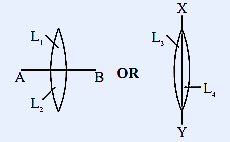
Two identical symmetric double convex lenses of focal length f are cut into two equal parts , by AB plane and , by XY plane as shown in figure respectively. The ratio of focal lengths of lenses and is
(1)
(2)
(3)
(4)
SolutionAnswer: Option 4
Approach:
Apply the lens maker's formula to analyze how focal length changes when a symmetric double convex lens is cut in different planes.
Step 1:Write the lens maker's formula for original lens
For symmetric double convex lens:
Step 2:Analyze cut by AB plane (horizontal through optical axis)
Horizontal cut creates two identical plano-convex lenses and
Step 3:Calculate focal length of (plano-convex)
Step 4:Express in terms of original f
Since , we get
Step 5:Analyze cut by XY plane (vertical through optical axis)
Vertical cut creates two half-lenses and , each retaining both curved surfaces with same R
Step 6:Apply lens maker's formula to
Step 7:Account for reduced aperture effect
Vertical cut halves the lens aperture. For a lens with reduced width, effective power decreases by factor of 2
Step 8:Calculate the ratio
Final answer: Option
Q33Single correct
A plane electromagnetic wave propagates along the +x direction in free space. The components of the electric field, E⃗ and magnetic field, B⃗ vectors associated with the wave in Cartesian frame are:
(1)
(2)
(3)
(4)
SolutionAnswer: Option 2
Approach:
Apply the properties of electromagnetic waves: direction of propagation is given by , with , mutually perpendicular and both perpendicular to direction of propagation.
Step 1:Identify the key properties of EM waves
For EM waves: , , and are mutually perpendicular (transverse wave)
Step 2:Write the direction of propagation formula
(Poynting vector direction)
Step 3:Given condition
Wave propagates along direction, so
Step 4:Analyze Option 1: ,
(along , not )
Step 5:Analyze Option 2: ,
(along ) ✓
Step 6:Analyze Option 3: ,
means , but must be to propagation direction
Step 7:Analyze Option 4: ,
(along , not )
Step 8:Conclude the answer
Only , gives
Final answer: Option
Q34Single correctOptics
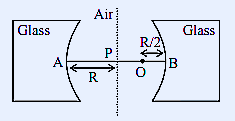
Two concave refracting surfaces of equal radii of curvature and refractive index 1.5 face each other in air as shown in figure. A point object O is placed midway, between P and B. The separation between the images of O, formed by each refracting surface is:
(1)
(2)
(3)
(4)
SolutionAnswer: Option 20.114R
Approach:
Apply the refraction formula at curved surfaces for each refracting surface separately, then find the separation between the two images formed.
Step 1:Identify the given data
, , both surfaces have radius R, object O at midpoint
Step 2:Set up refraction at surface B (closer to O)
For surface B: (object distance), (air), (glass), (concave)
Step 3:Apply refraction formula for surface B
Step 4:Solve for image position from surface B
, so
Step 5:Set up refraction at surface A (farther from O)
For surface A: (object distance from A), , ,
Step 6:Apply refraction formula for surface A
Step 7:Solve for image position from surface A
, so
Step 8:Calculate separation between images
Separation
Step 9:Compute final answer
Separation
Final answer:
Q35Single correctSimple Harmonic Motion
Two bodies A and B of equal mass are suspended from two massless springs of spring constant and , respectively. If the bodies oscillate vertically such that their amplitudes are equal, the ratio of the maximum velocity of A to the maximum velocity of B is
(1)
(2)
(3)
(4)
SolutionAnswer: Option 1
Approach:
Use the SHM relations for maximum velocity and angular frequency to find the ratio of maximum velocities given equal amplitudes.
Step 1:Write the expression for maximum velocity in SHM
where A = amplitude, = angular frequency
Step 2:Write angular frequency for spring-mass system
Step 3:Find angular frequencies for both bodies
and
Step 4:Write maximum velocities for A and B
and
Step 5:Apply given condition
Given: (equal amplitudes)
Step 6:Calculate the ratio of maximum velocities
Step 7:Substitute angular frequency expressions
Step 8:State the final answer
Final answer:
Q36Single correctCollision
Given below are two statements. One is labelled as Assertion (A) and the other is labelled as Reason (R).
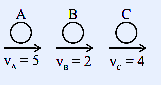
Assertion (A): Three identical spheres of same mass undergo one dimensional motion as shown in figure with initial velocities vA = 5 m/s, vB = 2 m/s, vC = 4 m/s. If we wait sufficiently long for elastic collision to happen, then vA = 4 m/s, vB = 2 m/s, vC = 5 m/s will be the final velocities.
Reason (R): In an elastic collision between identical masses, two objects exchange their velocities.
In the light of the above statements, choose the correct answer from the options given below:
Assertion (A): Three identical spheres of same mass undergo one dimensional motion as shown in figure with initial velocities vA = 5 m/s, vB = 2 m/s, vC = 4 m/s. If we wait sufficiently long for elastic collision to happen, then vA = 4 m/s, vB = 2 m/s, vC = 5 m/s will be the final velocities.
Reason (R): In an elastic collision between identical masses, two objects exchange their velocities.
In the light of the above statements, choose the correct answer from the options given below:
(1)
(2)
(3)
(4)
SolutionAnswer: Option 4(A) is false but (R) is true
Approach:
Apply the property of elastic collision between identical masses (velocity exchange) step by step to verify the assertion, then evaluate both A and R.
Step 1:State the given initial velocities
m/s, m/s, m/s (all moving in same direction)
Step 2:Verify Reason (R)
In elastic collision between identical masses, velocities ARE exchanged
Step 3:Analyze first collision: A catches up with B
Since , A collides with B first
Step 4:Apply velocity exchange for A-B collision
After collision: m/s, m/s
Step 5:Analyze second collision: B catches up with C
Now m/s m/s, so B collides with C
Step 6:Apply velocity exchange for B-C collision
After collision: m/s, m/s
Step 7:Determine final velocities after all collisions
m/s, m/s, m/s (no more collisions as )
Step 8:Compare with Assertion (A)
A claims: m/s, m/s, m/s
Step 9:Evaluate Assertion
Assertion (A) is FALSE (wrong final velocities for A and B)
Step 10:Final conclusion
(A) is false but (R) is true
Final answer: Option
Q37Single correctPower and Momentum
A sand dropper drops sand of mass m(t) on a conveyor belt at a rate proportional to the square root of speed (v) of the belt, i.e. . If P is the power delivered to run the belt at constant speed then which of the following relationship is true?
(1)
(2)
(3)
(4)
SolutionAnswer: Option 4
Approach:
Apply Newton's second law for variable mass systems to find force, then calculate power using P = Fv, and determine the relationship between P and v.
Step 1:Write the given condition
, so where C is constant
Step 2:Apply force equation for variable mass system
For sand landing on belt at constant speed:
Step 3:Substitute the mass rate expression
Step 4:Calculate power delivered to the belt
Step 5:Find the relationship between and v
Squaring:
Step 6:Select the correct option
From , Option 4 is correct
Final answer: Option :
Q38Single correctOptics - Lens
A convex lens made of glass (refractive index = 1.5) has focal length 24 cm in air. When it is totally immersed in water (refractive index = 1.33), its focal length changes to
(1)
(2)
(3)
(4)
SolutionAnswer: Option 296 cm
Approach:
Apply lens maker's formula in air and water medium, then find the ratio of focal lengths to determine the new focal length.
Step 1:List the given data
(glass), (water), cm (in air)
Step 2:Write lens maker's formula in air
Step 3:Write lens maker's formula in water
Step 4:Calculate the relative refractive index
Step 5:Substitute in the formula
Step 6:Divide the two equations
Step 7:Calculate the new focal length
cm
Step 8:State the final answer
The focal length changes from 24 cm to 96 cm when immersed in water
Final answer: cm
Q39Single correctCapacitors
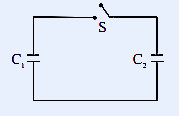
A capacitor, = F is charged to a potential difference of = 5V using a 5V battery. The battery is removed and another capacitor, = F is inserted in place of the battery. When the switch 'S' is closed, the charge flows between the capacitors for some time until equilibrium condition is reached. What are the charges ( and ) on the capacitors and when equilibrium condition is reached?
(1)
(2)
(3)
(4)
SolutionAnswer: Option 3
Approach:
Apply charge conservation and the condition that at equilibrium both capacitors have the same potential when connected in parallel.
Step 1:List the given data
F, F, Initial voltage on : V
Step 2:Calculate initial charge on
C
Step 3:Initial charge on
(uncharged)
Step 4:Apply charge conservation
C (charge is conserved)
Step 5:Apply equilibrium condition
At equilibrium: (common potential)
Step 6:Express charges in terms of common potential
and
Step 7:Apply charge conservation equation
Step 8:Solve for common potential
V
Step 9:Calculate final charge on
C
Step 10:Calculate final charge on
C
Step 11:State the final answer
C, C
Final answer: C, C
Q40Single correctAngular Momentum
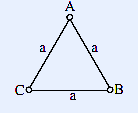
Three equal masses m are kept at vertices (A, B, C) of an equilateral triangle of side a in free space. At t = 0, they are given an initial velocity V⃗A = AC̅, V⃗B = BA̅ and V⃗C = CB̅. Here, AC̅, CB̅ and BA̅ are unit vectors along the edges of the triangle. If the three masses interact gravitationally, then the magnitude of the net angular momentum of the system at the point of collision is:
(1)
(2)
(3)
(4)
SolutionAnswer: Option 3
Approach:
Calculate the angular momentum of each mass about the centroid (collision point), using the perpendicular distance from centroid to the velocity direction.
Step 1:Understand the motion
Each mass moves along an edge towards the opposite vertex (tangential to inscribed circle)
Step 2:Identify the collision point
Due to symmetry and equal masses, all three collide at the centroid
Step 3:Find perpendicular distance from centroid to velocity direction
The velocity is along an edge; perpendicular distance = inradius
Step 4:Calculate inradius of equilateral triangle
For equilateral triangle:
Step 5:Calculate angular momentum of one mass
Step 6:Check direction of angular momentum
All three masses rotate in the same sense about the centroid (clockwise or anticlockwise)
Step 7:Calculate total angular momentum
Step 8:Simplify the expression
Step 9:Apply conservation of angular momentum
Since no external torque acts, remains constant till collision
Step 10:State the final answer
Final answer:
Q41Single correctUnits and Measurements
Match List-I with List-II.
| List-I | List-II |
|---|---|
| A. Young's Modulus | I. |
| B. Torque | II. |
| C. Coefficient of Viscosity | III. |
| D. Gravitational Constant | IV. |
(1)
(2)
(3)
(4)
SolutionAnswer: Option 4(A)-(II), (B)-(IV), (C)-(I), (D)-(III)
Approach:
Calculate the dimensional formula for each physical quantity and match with the given options.
Step 1:Calculate dimensions of Young's Modulus
Step 2:Calculate dimensions of Torque
Step 3:Calculate dimensions of Coefficient of Viscosity
Step 4:Calculate dimensions of Gravitational Constant
Step 5:Verify the complete matching
Final answer: Option (4): (A)-(II), (B)-(IV), (C)-(I), (D)-(III)
Q42Single correctMagnetic Effects of Current and Magnetism
Match List-I with List-II.
| List-I | List-II |
|---|---|
| A. Magnetic induction | I. Ampere mete |
| B. Magnetic intensity | II. Weber |
| C. Magnetic flux | III. Gauss |
| D. Magnetic moment | IV. Ampere meter |
(1)
(2)
(3)
(4)
SolutionAnswer: Option 2(A)-(III), (B)-(IV), (C)-(II), (D)-(I)
Approach:
Match each magnetic quantity with its correct unit by analyzing the physical dimensions and standard unit systems.
Step 1:Match Magnetic induction (A) with its unit
Magnetic induction is measured in Gauss in CGS system
Step 2:Match Magnetic intensity (B) with its unit
Magnetic intensity , measured in Ampere/meter
Step 3:Match Magnetic flux (C) with its unit
Magnetic flux , measured in Weber
Step 4:Match Magnetic moment (D) with its unit
Magnetic moment , measured in Ampere-mete
Step 5:Compile the final matching
A-III, B-IV, C-II, D-I
Final answer: Option (2): (A)-(III), (B)-(IV), (C)-(II), (D)-(I)
Q43Single correctElectronic Devices
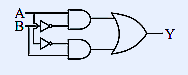
The truth table for the circuit given below is :
(1)
(2)
(3)
(4)
SolutionAnswer: Option 1
Approach:
Analyze the given circuit diagram to identify the logic gate and construct its truth table. The circuit represents an XOR (Exclusive OR) gate.
Step 1:Identify the circuit as XOR gate
Step 2:For A=0, B=0
Step 3:For A=0, B=1
Step 4:For A=1, B=0
Step 5:For A=1, B=1
Step 6:Construct truth table
XOR gate gives output 1 when inputs are different, output 0 when inputs are same
Final answer: Option (1) - XOR gate truth table
Q44Single correctHeat and Thermodynamics
A cup of coffee cools from C to C inminutes when the room temperature is C. The time taken by the similar cup of coffee to cool from C to C at the same room temperature is :
(1)
(2)
(3)
(4)
SolutionAnswer: Option 1
Approach:
Apply Newton's law of cooling using average temperature method to find the time taken for the second cooling interval.
Step 1:Apply Newton's law for first cooling (C to C)
Step 2:Simplify the first equation
Step 3:Apply Newton's law for second cooling (C to C)
Step 4:Simplify the second equation
Step 5:Divide equation (i) by equation (ii)
Step 6:Calculate final answer
Final answer: Option (1):
Q45Single correctAtoms and Nuclei
The number of spectral lines emitted by atomic hydrogen that is in the 4th energy level, is
(1)
(2)
(3)
(4)
SolutionAnswer: Option 16
Approach:
Calculate the number of possible transitions from n=4 energy level to all lower levels using the formula for spectral lines.
Step 1:Identify the energy level
(electron is in 4th energy level)
Step 2:List all possible downward transitions from n=4
From:; From:; From:
Step 3:Apply the formula for number of spectral lines
Step 4:Verify by counting transitions
Transitions:,,,,,= 6 lines
Final answer: Option (1): 6 spectral lines
Q46NumericalMagnetic Effects of Current and Magnetism
The magnetic field inside a 200 turns solenoid of radius 10 cm isTesla. If the solenoid carries a current of 0.29 A, then the length of the solenoid is __________cm.
SolutionAnswer: 8
Approach:
Use the formula for magnetic field inside a long solenoid and solve for length.
Step 1:Write the formula for magnetic field inside a solenoid
Step 2:Rearrange to solve for length
Step 3:Substitute values
Step 4:Simplify the numerator
Step 5:Calculate the result
m
Step 6:Express in the required format
Length =cm, so answer is 8
Final answer:
Q47NumericalElectrostatics
A parallel plate capacitor consisting of two circular plates of radius 10 cm is being charged by a constant current of 0.15 A. If the rate of change of potential difference between the plates isV/s then the integer value of the distance between the parallel plates is _________m. (Take,,)
SolutionAnswer: 1320
Approach:
Use the capacitor charging equation relating current, capacitance, and rate of voltage change to find the distance.
Step 1:Write the relationship between voltage, charge, and capacitance
Step 2:Differentiate with respect to time
Step 3:Rearrange to solve for distance d
Step 4:Substitute the given values
Step 5:Simplify the calculation
Step 6:Complete the calculation
m
Final answer:
Q48NumericalUnits and Measurements
A physical quantity Q is related to four observables a, b, c, d as follows:where,Pa;m;m, then the percentage error in Q is, wherex= ______.
SolutionAnswer: 77
Approach:
Apply error propagation rules for the formula to find the percentage error.
Step 1:Write the relative error formula for the given expression
Step 2:Calculate each fractional error term
; ; ;
Step 3:Substitute into the error formula
Step 4:Add all terms to get total relative error
Step 5:Convert to percentage error
Step 6:Express in the required form
Final answer:
Q49NumericalGravitation
Two planets, A and B are orbiting a common star in circular orbits of radii, respectively, with. The planet B istimes more massive than planet A. The ratioof angular momentumof planet B to that of planet Ais closest to integer __________.
SolutionAnswer: 8
Approach:
Calculate angular momentum for each planet using orbital mechanics and find their ratio.
Step 1:Write angular momentum formula for circular orbit
Step 2:Express angular momentum in simplified form
Step 3:Write ratio of angular momenta
Step 4:Substitute the given values
Step 5:Simplify the result
Final answer:
Q50NumericalMotion in a Plane
Two cars P and Q are moving on a road in the same direction. Acceleration of car P increases linearly with time whereas car Q moves with a constant acceleration. Both cars cross each other at time, for the first time. The maximum possible number of crossing(s) (including the crossing at) is ________.
SolutionAnswer: 3
Approach:
Analyze relative motion between cars P and Q with different acceleration patterns to determine maximum possible crossings.
Step 1:Define accelerations
(linear),(constant)
Step 2:Calculate relative acceleration
Step 3:Case I: Initial velocities and acceleration in same direction
Ifare in same direction initially
Step 4:Case II: Initial velocity and acceleration in opposite directions
Ifare in opposite directions
Step 5:Analyze Case II for maximum crossings
With, the relative motion can have up to 2 turning points
Step 6:Determine maximum
Maximum crossings occur when initial conditions favor Case II
Final answer:
Chemistry25 questions
Q51Single correctCoordination Compounds
The calculated spin-only magnetic moments ofrespectively are :
(1)
(2)
(3)
(4)
SolutionAnswer: Option 25.92 and 4.90 B.M.
Approach:
Calculate the spin-only magnetic moment using the formula μ = ) B.M., where n is the number of unpaired electrons. Determine the oxidation state of Fe and electronic configuration in each complex.
Step 1:Determine oxidation state of Fe in ]
Step 2:Electronic configuration of F
Step 3:Calculate magnetic moment for ]
B.M.
Step 4:Determine oxidation state of Fe in ]
Step 5:Electronic configuration of F
Step 6:Calculate magnetic moment for ]
B.M.
Final answer: 5.92 and 4.90 B.M.
Q52Single correctAtomic Structure
For hydrogen like species, which of the following graphs provides the most appropriate representation of E vs Z plot for a constant n? [E : Energy of the stationary state, Z : atomic number, n = principal quantum number]
(1)
(2)
(3)
(4)
SolutionAnswer: Option 2Parabola opening downward
Approach:
Use the energy formula for hydrogen-like species to determine the relationship between E and Z at constant n.
Step 1:Write the energy formula for hydrogen-like species
eV
Step 2:At constant n, analyze the relationship
(negative quadratic relationship)
Step 3:Determine the graph shape
Since, this is a parabola opening downward
Step 4:Verify key features
At,; asincreases,becomes more negative
Final answer: Parabola opening downward
Q53Single correctSurface Chemistry
Given below are two statements: Statement (I): In partition chromatography, stationary phase is thin film of liquid present in the inert support. Statement (II): In paper chromatography, the material of paper acts as a stationary phase. In the light of the above statements, choose the correct answer from the options given below:
(1)
(2)
(3)
(4)
SolutionAnswer: Option 2Statement I is true but Statement II is false
Approach:
Evaluate each statement based on the principles of partition chromatography and paper chromatography.
Step 1:Analyze Statement I about partition chromatography
In partition chromatography, the stationary phase is a thin liquid film present on an inert support
Step 2:Analyze Statement II about paper chromatography
In paper chromatography, the stationary phase is water absorbed in the cellulose fibers, NOT the paper material itself
Step 3:Determine the correct option
Statement I is true, Statement II is false
Final answer: Statement I is true but Statement II is false
Q54Single correctBiomolecules
Identify the essential amino acids from below: (A) Valine (B) Proline (C) Lysine (D) Threonine (E) Tyrosine. Choose the correct answer from the options given below:
(1)
(2)
(3)
(4)
SolutionAnswer: Option 1(A), (C) and (D) only
Approach:
Identify which amino acids are essential (cannot be synthesized by the human body and must be obtained from diet).
Step 1:Check if Valine (A) is essential
Valine is an essential amino acid
Step 2:Check if Proline (B) is essential
Proline is a non-essential amino acid (can be synthesized)
Step 3:Check if Lysine (C) is essential
Lysine is an essential amino acid
Step 4:Check if Threonine (D) is essential
Threonine is an essential amino acid
Step 5:Check if Tyrosine (E) is essential
Tyrosine is a non-essential amino acid (can be synthesized from phenylalanine)
Step 6:Compile essential amino acids
Essential amino acids are: Valine (A), Lysine (C), and Threonine (D)
Final answer: (A), (C) and (D) only
Q55Single correctHaloalkanes and Haloarenes
Which among the following halides will generate the most stable carbocation in Nucleophilic substitution reaction?
(1)
(2)
(3)
(4)
SolutionAnswer: Option 4Triphenylmethyl bromide
Approach:
Compare carbocation stability based on resonance stabilization and the number of phenyl groups that can stabilize the positive charge.
Step 1:Analyze benzyl bromide carbocation
has 1 phenyl group for resonance stabilization
Step 2:Analyze bromobenzene carbocation
Cannot form stable carbocation as Br is on aromatic ring (very unstable)
Step 3:Analyze cyclohexyl bromide carbocation
Forms secondary carbocation with no resonance stabilization
Step 4:Analyze triphenylmethyl bromide carbocation
has 3 phenyl groups providing extensive resonance stabilization
Step 5:Apply carbocation stability order
Stability:
Final answer: Triphenylmethyl bromide
Q56Single correctChemical Equilibrium
Consider the equilibrium. If the pressure applied over the system increases by two fold at constant temperature then (A) Concentration of reactants and products increases. (B) Equilibrium will shift in forward direction. (C) Equilibrium constant increases since concentration of products increases. (D) Equilibrium constant remains unchanged as concentration of reactants and products remain same. Choose the correct answer from the options given below:
(1)
(2)
(3)
(4)
SolutionAnswer: Option 1(A) and (B) only
Approach:
Apply Le Chatelier's principle and analyze the effect of pressure increase on the equilibrium system.
Step 1:Count moles on each side
Reactants:moles, Products:moles
Step 2:Analyze statement A - concentration increase
When pressure increases, volume decreases, soincreases for all species
Step 3:Analyze statement B - equilibrium shift
Increased pressure favors side with fewer moles (forward direction, products side)
Step 4:Analyze statement C - equilibrium constant
depends only on temperature, NOT on pressure or concentration changes
Step 5:Analyze statement D - equilibrium constant
remains constant at constant temperature, but individual concentrations DO change
Final answer: (A) and (B) only
Q57Single correctSolutions
Given below are two statements: Statement (I): NaCl is added to the ice at C, present in the ice cream box to prevent the melting of ice cream. Statement (II): On addition of NaCl to ice at C, there is a depression in freezing point. In the light of the above statements, choose the correct answer from the options given below:
(1)
(2)
(3)
(4)
SolutionAnswer: Option 2Both Statement I and Statement II are true
Approach:
Evaluate both statements using the principle of freezing point depression.
Step 1:Analyze Statement II on freezing point depression
Adding NaCl to ice causes(depression in freezing point below C)
Step 2:Understand the mechanism
The ice-salt mixture has freezing point < C, creating a colder environment
Step 3:Analyze Statement I on ice cream preservation
The colder ice-salt mixture (below C) prevents ice cream from melting by maintaining lower temperature
Step 4:Determine the correct option
Both statements are scientifically accurate and related
Final answer: Both Statement I and Statement II are true
Q58Single correctHydrocarbons
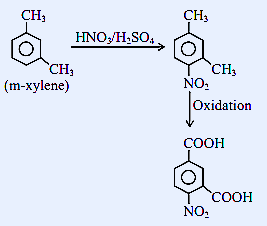
Given below are two statements: Statement (I): On nitration of m-xylene with,followed by oxidation, 4-nitrobenzene-1,3-dicarboxylic acid is obtained as the major product. Statement (II):group is o/p-directing whilegroup is m-directing group. In the light of the above statements, choose the correct answer from the options given below:
(1)
(2)
(3)
(4)
SolutionAnswer: Option 3Both Statement I and Statement II are true
Approach:
Analyze the nitration of m-xylene followed by oxidation, considering the directing effects of substituents.
Step 1:Analyze Statement II on directing effects
is ortho/para directing (activating),is meta directing (deactivating)
Step 2:Consider m-xylene structure
m-xylene hasgroups at positions 1 and 3
Step 3:Determine nitration position
Bothgroups directto position 4 (between them)
Step 4:Analyze oxidation step
Oxidation converts bothgroups togroups
Step 5:Evaluate Statement I
The product matches the description in Statement I
Final answer: Both Statement I and Statement II are true
Q59Single correctChemical Kinetics and Equilibrium
0.1 M solution of KI reacts with excess of and KIsolution. According to equationIdentify the correct statements: (A) 200 mL of KI solution reacts with 0.004 mol of KI(B) 200 mL of KI solution reacts with 0.006 mol of (C) 0.5 L of KI solution produced 0.005 mol of (D) Equivalent weight of KIis equal to
(1)
(2)
(3)
(4)
SolutionAnswer: Option 1(A) and (D) only
Approach:
Analyze each statement based on stoichiometry of the given reaction between KI, , and KI
Step 1:From the balanced equation, determine molar ratios
mol Ireacts with1mol IOto produce3mol
Step 2:Statement (A): 200 mL of 0.1 M KI contains how many moles of KI?
Moles of KI =mol
Step 3:From stoichiometry, moles of KIrequired
Moles of KI=mol
Step 4:Statement (D): Equivalent weight of KI
In the reaction IOgains 5 electrons. Equivalent weight =
Final answer: Correct statements are (A) and (D) only, which is option (1)
Q60Single correctElectrochemistry
Match List-I with List-II:
| List-I (Applications) | List-II (Batteries/Cell) |
|---|---|
| A. Transistors | I. Anode - Zn/Hg; Cathode - HgO + C |
| B. Hearing aids | II. Hydrogen fuel cell |
| C. Invertors | III. Anode - Zn; Cathode - Carbon |
| D. Apollo space ship | IV. Anode - Pb; Cathode - Pb | Pb |
(1)
(2)
(3)
(4)
SolutionAnswer: Option 1A-III, B-I, C-IV, D-II
Approach:
Match each application with the appropriate battery type based on their characteristics and usage
Step 1:Transistors (A) use dry cells
Dry cell = Anode - Zn; Cathode - Carbon (III)
Step 2:Hearing aids (B) use button cells
Button cell = Anode - Zn/Hg; Cathode - HgO + C (I)
Step 3:Invertors (C) use lead storage batteries
Lead storage battery = Anode - Pb; Cathode - Pb | Pb(IV)
Step 4:Apollo space ship (D) used fuel cells
Hydrogen fuel cell (II)
Final answer: A-III, B-I, C-IV, D-II, which is option (1)
Q61Single correctElectrochemistry
gas will be evolved as a product of electrolysis of: (A) an aqueous solution of AgNusing silver electrodes. (B) an aqueous solution of AgNusing platinum electrodes. (C) a dilute solution of using platinum electrodes. (D) a high concentration solution of using platinum electrodes. Choose the correct answer from the options given below:
(1)
(2)
(3)
(4)
SolutionAnswer: Option 1(B) and (C) only
Approach:
Analyze anode reactions in each case to determine when gas is evolved
Step 1:Case (A): AgNwith silver electrodes
Silver electrode is reactive. Anode: . No evolution
Step 2:Case (B): AgNwith platinum electrodes
Platinum is inert. At anode, OHor O oxidizes:
Step 3:Case (C): Dilute with platinum electrodes
At anode, O oxidizes:
Final answer: (B) and (C) only, which is option (1)
Q62Single correctCoordination Compounds
Identify the homoleptic complexes with odd number of d electrons in the central metal. (A) (B) (C) (D) (E) Choose the correct answer from the options given below:
(1)
(2)
(3)
(4)
SolutionAnswer: Option 1(B) and (D) only
Approach:
Identify homoleptic complexes (same type of ligands) and count d electrons in central metal
Step 1:Define homoleptic complex
Homoleptic complex has ALL ligands of the SAME type
Step 2:Analyze (B): [Fe(CN
Homoleptic (all CN ligands). Fe oxidation state:. F: 3(odd)
Step 3:Analyze (D): [CoC
Homoleptic (all Cl ligands). Co oxidation state:. C: 3(odd)
Final answer: (B) and (D) only, which is option (1)
Q63Single correctOrganic Chemistry
Total number of sigma () _____ and pi () _____ bonds respectively present in hex-1-en-4-yne are:
(1)
(2)
(3)
(4)
SolutionAnswer: Option 113 and 3
Approach:
Draw the structure of hex-1-en-4-yne and count all sigma and bonds systematically using bond analysis rules for alkenes and alkynes.
Step 1:Draw structure of hex-1-en-4-yne
C=CH-C-CC-C
Step 2:Count C-C bonds
5 C-C bonds (one in each C-C linkage)
Step 3:Count C-H bonds
: 2H, : 1H, : 2H, : 3H. Total = 8 C-H bonds
Step 4:Total bonds
Totalbonds = 5 + 8 = 13
Step 5:Count bonds
One C=C (1) + One CC (2) = 3bonds
Final answer: 13 bonds and 3 bonds, which is option (1)
Q64Single correctThermodynamics
If C(diamond) C(graphite) + X kJ mo, C(diamond) + (g) C(g) + Y kJ mo, C(graphite) + (g) C(g) + Z kJ mo at constant temperature. Then
(1)
(2)
(3)
(4)
SolutionAnswer: Option 4X = Y - Z
Approach:
Apply Hess's Law to relate the three given thermochemical equations
Step 1:Equation (1): Diamond to graphite transformation
C(diamond)C(graphite),
Step 2:Equation (2): Diamond combustion
C(diamond) + C,
Step 3:Equation (3): Graphite combustion
C(graphite) + C,
Step 4:Apply Hess's Law: Equation (1) = Equation (2) - Equation (3)
Final answer: X = Y - Z, which is option (4)
Q65Single correctAtomic Structure
Given below are two statements: Statement (I): It is impossible to specify simultaneously with arbitrary precision, both the linear momentum and the position of a particle. Statement (II): If the uncertainty in the measurement of position and uncertainty in measurement of momentum are equal for an electron, then the uncertainty in the measurement of velocity is. In the light of the above statements, choose the correct answer from the options given below:
(1)
(2)
(3)
(4)
SolutionAnswer: Option 2Both Statement I and Statement II are true.
Approach:
Verify both statements using Heisenberg Uncertainty Principle
Step 1:Verify Statement I
Step 2:Given condition for Statement II
Given:, From HUP:
Step 3:Calculate uncertainty in velocity
, so
Final answer: Both Statement I and Statement II are true, which is option (2)
Q66Single correctOrganic Chemistry - Some Basic Principles and Techniques
Which one of the following reaction sequences will give an azo dye?
(1)
(2)
(3)
(4)
SolutionAnswer: Option 1
Approach:
Azo dyes are formed by coupling reaction of diazonium salts with phenols or aromatic amines. The sequence must include reduction of nitro group to amine, diazotization, and coupling with phenol/amine.
Step 1:Reduction of nitrobenzene to aniline using Sn/HCl
Step 2:Diazotization of aniline with NaN/HCl at 0-C
Step 3:Coupling of diazonium salt with β-naphthol in alkaline medium
Step 4:Verification that this produces an azo dye
Final answer: Option 1 is correct: Nitrobenzene → Sn/HCl → NaN/HCl → β-naphthol/NaOH gives an azo dye
Q67Single correctPhysical Chemistry - Chemical Kinetics
Drug X becomes ineffective after 50% decomposition. The original concentration of drug in a bottle was 16 mg/mL which becomes 4 mg/mL in 12 months. The expiry time of the drug in months is _____. Assume that the decomposition of the drug follows first order kinetics.
(1)
(2)
(3)
(4)
SolutionAnswer: Option 46
Approach:
For first order kinetics, use the integrated rate equation to find the rate constant, then calculate the time for 50% decomposition (expiry time).
Step 1:Identify initial and final concentrations
Step 2:Calculate the rate constant using first order equation
Step 3:Calculate time for 50% decomposition (expiry time)
Step 4:Alternatively, observe that 16 → 4 represents two half-lives
, somonths
Step 5:Calculate expiry time when 50% decomposition occurs
Final answer: 6 months
Q68Single correctPeriodic Table and Properties
The type of oxide formed by the element among Li, Na, Be, Mg, B and Al that has the least atomic radius is:
(1)
(2)
(3)
(4)
SolutionAnswer: Option 1
Approach:
Compare atomic radii of given elements to identify the smallest, then determine its oxide type based on oxidation state.
Step 1:List given elements with their groups and periods
Step 2:Apply periodic trends for atomic radius
Step 3:Compare B and Al (both Period 2 < Period 3)
Step 4:Determine oxidation state and oxide type of Boron
Step 5:Verify oxide formula
Final answer: (Boron oxide - )
Q69Single correctPeriodic Table and Properties
First ionisation enthalpy values of first four group 15 elements are given below. Choose the correct value for the element that is a main component of apatite family:
(1)
(2)
(3)
(4)
SolutionAnswer: Option 1
Approach:
Identify the main component of apatite family minerals, then match with the correct first ionization enthalpy from Group 15 elements.
Step 1:Identify main component of apatite family
Step 2:List first four Group 15 elements
Step 3:Apply ionization energy trend
Step 4:Match typical first ionization enthalpy values
Step 5:Confirm phosphorus is in apatite
Final answer: 1012 kJ mo (Phosphorus)
Q70Single correctOrganic Chemistry - Alcohols, Phenols and Ethers
Which one of the following, with HBr will give a phenol?
(1)
(2)
(3)
(4)
SolutionAnswer: Option 2Anisole structure: Benzene ring with
Approach:
Identify which compound undergoes SN2 cleavage with HBr to yield phenol. Anisole (phenyl methyl ether) reacts with HBr to give phenol and methyl bromide.
Step 1:Identify anisole structure
Step 2:Protonation of oxygen atom by HBr
Step 3:SN2 attack by bromide ion on methyl carbon
Step 4:Explain selectivity of cleavage
Step 5:Verify product is phenol
Final answer: Option 2: Anisole (-O-C) gives phenol with HBr
Q71NumericalCoordination Chemistry
Consider the following low-spin complexes ], ], ], C] and Z]. The sum of the spin-only magnetic moment values of complexes having yellow colour is _______ B.M. (answer is nearest integer)
SolutionAnswer: 0
Approach:
Identify yellow colored complexes from the list, determine their electronic configurations in low-spin state, and calculate spin-only magnetic moments.
Step 1:Identify yellow colored low-spin complexes
Step 2:Determine oxidation state and d-electron count for Co complex
Step 3:Apply low-spin configuration for C with N (strong field ligand)
Step 4:Calculate magnetic moment for Co complex
Step 5:Determine oxidation state and d-electron count for Fe complex
Step 6:Apply low-spin configuration for F with CN (strong field ligand)
Step 7:Calculate magnetic moment for Fe complex
Step 8:Sum the magnetic moments of yellow colored complexes
Final answer:
Q72NumericalOrganic Chemistry - Hydrocarbons
Isomeric hydrocarbonsnegative Baeyer's test (Molecular formula ). The total number of isomers from above with four different non-aliphatic substitution sites is -
SolutionAnswer: 2
Approach:
Identify isomers that give negative Baeyer's test (no C=C bonds, i.e., aromatic) and have four different aromatic substitution sites.
Step 1:Calculate degree of unsaturation for
Step 2:Identify that negative Baeyer's test means aromatic compound
Step 3:Determine possible substituent patterns on benzene
Step 4:Identify isomers with four different substitution sites
Step 5:Analyze 1,2,4-trimethylbenzene
Step 6:Analyze 1,2,3-trimethylbenzene
Step 7:Check other isomers for symmetry
Step 8:Count total isomers meeting criteria
Final answer:
Q73NumericalOrganic Chemistry - Aldehydes, Ketones and Carboxylic Acids
In the Claisen-Schmidt reaction to prepare dibenzalacetone from 5.3 g benzaldehyde, a total of 3.51 g of product was obtained. The percentage yield in this reaction was ______ %.
SolutionAnswer: 60
Approach:
Calculate theoretical yield of dibenzalacetone from given benzaldehyde, then determine percentage yield using actual yield obtained.
Step 1:Calculate moles of benzaldehyde
Step 2:Calculate moles from given mass
Step 3:Determine stoichiometry of reaction
Step 4:Calculate theoretical moles of product
Step 5:Calculate molar mass of dibenzalacetone
Step 6:Calculate theoretical yield in grams
Step 7:Calculate percentage yield
Final answer:
Q74NumericalOrganic Chemistry - Some Basic Principles and Techniques
In the sulphur estimation, 0.20 g of a pure organic compound gave 0.40 g of barium sulphate. The percentage of sulphur in the compound is ____%. (Molar mass: O = 16, S = 32, Ba = 137 in g mo)
SolutionAnswer: 275
Approach:
Calculate mass of sulphur from mass of BaS formed, then determine percentage of sulphur in the original compound.
Step 1:Calculate molar mass of BaS
Step 2:Calculate moles of BaS formed
Step 3:Determine moles of sulphur (1:1 ratio with BaS)
Step 4:Calculate mass of sulphur
Step 5:Calculate percentage of sulphur in compound
Step 6:Simplify calculation
Step 7:Express answer in required format (× 1)
Final answer:
Q75NumericalChemical Bonding and Molecular Structure
Total number of non bonded electrons present in NOion based on Lewis theory is _____.
SolutionAnswer: 12
Approach:
Draw Lewis structure of N ion, count total valence electrons, then subtract bonding electrons to find non-bonding electrons.
Step 1:Count total valence electrons in N
Step 2:Draw Lewis structure with resonance
Step 3:Analyze bonding in resonance structures
Step 4:Count bonding electrons
Step 5:Calculate non-bonding electrons
Step 6:Verify electron distribution
Final answer:
Mathematics25 questions
Q1Single correctComplex Numbers and Quadratic Equations
If the set of all, for which the equationhas no real root, is the interval, and, thenis equal to
(1)
(2)
(3)
(4)
SolutionAnswer: Option 32139
Approach:
Use discriminant condition for no real roots, solve the quadratic inequality, find integer values in the interval, and calculate sum of squares.
Step 1:For no real roots, discriminant must be negative
Step 2:Expand and simplify the inequality
Step 3:Factor the quadratic
Step 4:Solve the inequality
Step 5:Find integers in the interval
Step 6:Calculate sum of squares
Step 7:Apply sum of squares formula
Final answer:
Q2Single correctTrigonometry
If,, thenis equal to
(1)
(2)
(3)
(4)
SolutionAnswer: Option 32
Approach:
From the given condition, derive that, then simplify the expression.
Step 1:From given condition, find relation
Step 2:Derive another relation
Step 3:Substitute in the expression
Expression =
Step 4:Factor and simplify using binomial theorem
Step 5:Use relation
Final answer:
Q3Single correctIntegral Calculus
Let the area enclosed between the curves. If;are integers, then the value ofequals
(1)
(2)
(3)
(4)
SolutionAnswer: Option 433
Approach:
Calculate area using integration in first quadrant and multiply by 4 due to symmetry.
Step 1:Identify curves: parabola and circle
Step 2:Calculate area in first quadrant
Step 3:Evaluate the integral
Step 4:Simplify to get
Step 5:Multiply by 9
Step 6:Calculate the answer
Final answer:
Q4Single correctLimit, Continuity and Differentiability
If the domain of the functionand the domain of the function, thenis equal to:
(1)
(2)
(3)
(4)
SolutionAnswer: Option 3186
Approach:
Find domain conditions for both logarithmic functions and calculate sum of squares.
Step 1:Domain of first function
Step 2:Solve the inequality
Step 3:Domain conditions for second function
Step 4:Factor and analyze the rational function
Step 5:Combine all conditions
Step 6:Calculate the answer
Final answer:
Q5Single correctLimit, Continuity and Differentiability
Let the functionbe not differentiable at the two points. Then the distance of the pointfrom the lineis equal to:
(1)
(2)
(3)
(4)
SolutionAnswer: Option 13
Approach:
Analyze non-differentiability points of and find distance from the given line.
Step 1:Identify the non-differentiability source
is differentiable everywhere. Non-differentiability comes from
Step 2:Determine condition for non-differentiability at
For non-differentiability at : gives
Step 3:Find the roots of
or
Step 4:Check differentiability at
At : , so
Step 5:Identify the second non-differentiability point
Given , and second point must satisfy the problem constraints
Step 6:Calculate distance from to line
Final answer: (Option 1)
Q6Single correctThree Dimensional Geometry
Let a straight line L pass through the point P(2, -1, 3) and be perpendicular to the lines. If the line L intersects the yz-plane at the point Q, then the distance between the points P and Q is:
(1)
(2)
(3)
(4)
SolutionAnswer: Option 33
Approach:
Find direction ratios of L using cross product, write equation of L, find intersection with yz-plane, calculate distance.
Step 1:Find direction ratios of L perpendicular to both lines
Step 2:Write equation of line L
Step 3:General point on L
Step 4:Intersection with yz-plane (x = 0)
Step 5:Find coordinates of Q
Step 6:Calculate distance PQ
Final answer:
Q7Single correctSets, Relations and Functions
Let. Define a relation R from S toby:. Then, the sum of all the elements in the range of R is equal to
(1)
(2)
(3)
(4)
SolutionAnswer: Option 2
Approach:
Express y in terms of x, identify as geometric series, and calculate sum to .
Step 1:Express y in terms of x
Step 2:List range elements for x = 0, 1, 2, ...
Step 3:Calculate sum of geometric series
Step 4:Simplify the sum
Final answer:
Q8Single correctTrigonometry
Let the linemeet the axes of x and y at A and B, respectively. A right-angled triangle AMN is inscribed in the triangle OAB, where O is the origin and the points M and N lie on the lines OB and AB, respectively. If the area of the triangle AMN isof the area of the triangle OAB and AN:NB =:1, then the sum of all possible value(s) ofis:
(1)
(2)
(3)
(4)
SolutionAnswer: Option 42
Approach:
Use geometry and trigonometry to relate areas and ratios, solve for angle parameter, find lambda values.
Step 1:Setup: OAB is right triangle at O with OA = OB = 1
,
Step 2:Let angle at A in AMN be45°
45°,45°,45°
Step 3:Calculate area of AMN
45°
Step 4:Solve for theta
Step 5:Calculate ratio
Step 6:Sum of all values
(only one valid value)
Final answer:
Q9Single correctCo-ordinate Geometry
Ifis the equation of the chord of the ellipse, whose mid point is, thenis equal to
(1)
(2)
(3)
(4)
SolutionAnswer: Option 358
Approach:
Use the T = formula for finding the equation of a chord with given midpoint on an ellipse
Step 1:Identify ellipse parameters
, so,
Step 2:Apply T = formula with midpoint (5/2, 1/2)
Step 3:Simplify left side
Step 4:Calculate right side
Step 5:Multiply throughout by 144 to clear denominators
Step 6:Calculate α + β
Final answer:
Q10Single correctPermutations and Combinations
If all the words with or without meaning made using all the letters of the word "KANPUR" are arranged as in a dictionary, then the word at 440th position in this arrangement, is:
(1)
(2)
(3)
(4)
SolutionAnswer: Option 3PRKAUN
Approach:
Count permutations systematically in dictionary order starting from each letter
Step 1:Arrange letters in alphabetical order
A, K, N, P, R, U
Step 2:Count words starting with A
Words starting with A =
Step 3:Count words starting with K
Words starting with K =
Step 4:Count words starting with N
Words starting with N =
Step 5:Count words starting with PA, PK, PN
Words starting with PA =, PK =, PN =
Step 6:Count words starting with PRA
Words starting with PRA =
Step 7:List next words
Position 439: PRKANU, Position 440: PRKAUN
Final answer: PRKAUN
Q11Single correctMatrices and Determinants
Let) be the values of m, for which the equations;have infinitely many solutions. Then the value ofis equal to:
(1)
(2)
(3)
(4)
SolutionAnswer: Option 1440
Approach:
For infinitely many solutions, the determinant of coefficient matrix must be zero, and consistency conditions must be satisfied
Step 1:Write coefficient matrix determinant
Step 2:For infinite solutions, set up consistency condition
. This gives
Step 3:Solve quadratic equation
Step 4:Calculate the sum
Final answer:
Q12Single correctMatrices and Determinants
Letbe a matrix of order, with. If the sum of all the elements in the third row of,, thenis equal to
(1)
(2)
(3)
(4)
SolutionAnswer: Option 4224
Approach:
Construct matrix A using the given formula, calculate , and sum elements of the third row
Step 1:Construct matrix A
Step 2:Factor out 2 from A
Step 3:Calculate = 4 × (matrix product)
Step 4:Calculate third row elements of
,,
Step 5:Sum elements of third row
Step 6:Calculate α + β
Final answer:
Q13Single correctThree Dimensional Geometry
Let P be the foot of the perpendicular from the point (1, 2, 2) on the line L:. Let the line,, intersect the line L at Q. Thenis equal to:
(1)
(2)
(3)
(4)
SolutionAnswer: Option 127
Approach:
Find foot of perpendicular P from given point to line L, find intersection point Q of second line with L, calculate distance PQ
Step 1:Write parametric form of line L
Point on L:for parameter
Step 2:Find foot of perpendicular P using perpendicularity condition
Step 3:Find coordinates of P
Step 4:Find intersection point Q by equating second line with L
. Solving:,
Step 5:Find coordinates of Q
in line L)
Step 6:Calculate P
Step 7:Calculate 2(PQ
Final answer:
Q14Single correctCo-ordinate Geometry
Let a circle C pass through the points (4, 2) and (0, 2), and its centre lie on. Then the length of the chord, of the circle C, whose midpoint is (1, 2), is:
(1)
(2)
(3)
(4)
SolutionAnswer: Option 2
Approach:
Find center of circle using perpendicular bisector and given line constraint, calculate radius, then use chord-midpoint relation
Step 1:Find midpoint of (4,2) and (0,2)
. Since slope of AB is 0, perpendicular bisector is vertical:
Step 2:Center lies on both x=2 and 3x+2y+2=0
Step 3:Calculate radius using distance from center to (4,2)
Step 4:Calculate distance from center O(2,-4) to chord midpoint N(1,2)
Step 5:Apply chord-midpoint formula
Final answer:
Q15Single correctStatistics and Probability
Let A =be amatrix such thatfor all i and j. Let the random variable X denote the possible values of the determinant of the matrix A. Then, the variance of X is:
(1)
(2)
(3)
(4)
SolutionAnswer: Option 2
Approach:
Enumerate all possible 2×2 matrices with entries {0,1}, calculate determinants, find probability distribution, compute variance
Step 1:Count total possible matrices
Total matrices =(4 entries, each 0 or 1)
Step 2:Determinant can be -1, 0, or 1
takes values in
Step 3:Count matrices with det = -1 (when = 0 and = 1)
3 matrices have det = -1
Step 4:Count matrices with det = 0 (when = )
10 matrices have det = 0
Step 5:Count matrices with det = 1 (when = 1 and = 0)
3 matrices have det = 1
Step 6:Calculate E[X]
Step 7:Calculate E[]
Step 8:Calculate Var(X)
Final answer:
Q16Single correctProbability
Bag 1 contains 4 white balls and 5 black balls, and Bag 2 contains n white balls and 3 black balls. One ball is drawn randomly from Bag 1 and transferred to Bag 2. A ball is then drawn randomly from Bag 2. If the probability that the ball drawn is white , then n is equal to:
(1)
(2)
(3)
(4)
SolutionAnswer: Option 46
Approach:
Use total probability theorem with conditional probabilities for ball transfer scenarios
Step 1:Identify the given information
,
Step 2:Case 1: White ball transferred from Bag 1 to Bag 2
, After transfer: Bag 2 has white, 3 black
Step 3:Case 2: Black ball transferred from Bag 1 to Bag 2
, After transfer: Bag 2 has n white, 4 black
Step 4:Apply total probability theorem
Step 5:Simplify the equation
→
Step 6:Cross multiply and solve for n
→
Step 7:Calculate n
Final answer:
Q17Single correctNumber Theory
The remainder, when is divided by 23, is equal to:
(1)
(2)
(3)
(4)
SolutionAnswer: Option 114
Approach:
Use Fermat's Little Theorem and modular arithmetic to find mod 23
Step 1:Apply Fermat's Little Theorem
Since 23 is prime,
Step 2:Express 103 in terms of 22
, so
Step 3:Calculate mod 23
Step 4:Calculate mod 23
Step 5:Calculate mod 23
Step 6:Calculate = × × × 7
Step 7:Final answer
Final answer:
Q18Single correctCalculus - Integration and Maxima-Minima
Let,. If the range offis, thenequals:
(1)
(2)
(3)
(4)
SolutionAnswer: Option 1157
Approach:
Find f'(x) to locate critical points, evaluate f(x) at boundary and critical points to find range.
Step 1:Find f'(x) using Fundamental Theorem
Step 2:Analyze sign of f'(x) on [1, 5]
For:(increasing). For:(decreasing)
Step 3:Integrate to find f(x)
Step 4:Calculate f(1)
Step 5:Calculate f(4)
Step 6:Calculate f(5)
Step 7:Determine range
Minimum =. Maximum =
Step 8:Calculate final answer
Final answer:
Q19Single correctVector Algebra
Letbe a unit vector perpendicular to the vectors, and makes an angle ofwith the vector. Ifmakes an angle ofwith the vector, then the value ofis:
(1)
(2)
(3)
(4)
SolutionAnswer: Option 3
Approach:
Find unit vector perpendicular to b and c using cross product, then use angle conditions to find α
Step 1:Calculate cross product b × c
Step 2:Find unit vector â
Step 3:Use angle condition with î + ĵ + k̂
. For:
Step 4:Verify with correct sign
For:
Step 5:Apply second angle condition with /3
Step 6:Set up equation using cos(/3) = 1/2
Step 7:Solve for α
Final answer:
Q20Single correctDifferential Equations
If for the solution curveof the differential equation,,, thenis equal to:
(1)
(2)
(3)
(4)
SolutionAnswer: Option 4
Approach:
Solve first-order linear ODE using integrating factor method
Step 1:Identify the linear ODE form
Step 2:Find integrating factor
Step 3:Multiply by IF and integrate
Step 4:Use substitution t = tan(x/2)
After integration:
Step 5:Apply initial condition f(/3) = /10
At:
Step 6:Evaluate at x = /4
At:,
Step 7:Calculate f(/4)
Final answer:
Q21NumericalDefinite Integration
If, wheredenotes the greatest integer function, thenis equal to _______.
SolutionAnswer: 12
Approach:
Split the integral based on sign changes of absolute value and greatest integer function, then evaluate each part separately
Step 1:Find where the argument of absolute value is zero
Step 2:Analyze the greatest integer function [2sin x]
For : so ; For : so
Step 3:Split the integral into parts
Step 4:Evaluate absolute value integral for x < /48
Step 5:Evaluate integral for x > /48
Step 6:Evaluate GIF integral
Step 7:Combine all parts
Step 8:Compare with given form and find α
Final answer:
Q22NumericalLimits and Integration
If, thenis equal to _______.
SolutionAnswer: 64
Approach:
Recognize the indeterminate form, convert using logarithm, apply L'Hôpital's rule, and evaluate the resulting integral.
Step 1:Identify the indeterminate form
At :
Step 2:Take natural logarithm and convert to quotient form
Let , then
Step 3:Apply L'Hôpital's rule
Step 4:Evaluate at t = 0
Step 5:Substitute to evaluate the integral
Let , . When , ; when ,
Step 6:Apply integration formula for ln u
Step 7:Rewrite using logarithm properties
Step 8:Exponentiate to find L
Step 9:Simplify to match the given form
and
Step 10:Compare with given expression to find α
Comparing with
Final answer:
Q23NumericalArithmetic Progression
Letbe an Arithmetic Progression such that. Thenis equal to _______.
SolutionAnswer: 11132
Approach:
Use the property that in an AP, sum of terms equidistant from ends is constant. Analyze the given sum structure and find , then compute the total sum.
Step 1:Apply the equidistant property of AP
In an AP:
Step 2:Identify the sequence in the middle sum
The sequence is an AP with first term , common difference
Step 3:Count the number of terms in the middle sequence
Number of terms
Step 4:Pair up the middle terms using equidistant property
, , etc.
Step 5:Count the number of pairs
Number of pairs
Step 6:Express the middle sum
Step 7:Substitute in the given equation
Step 8:Solve for
Step 9:Calculate the sum of all 2024 terms
Step 10:Compute the final answer
Final answer:
Q24NumericalComplex Numbers
Let integers be such that . Then the number of all possible ordered pairs (a, b), for which and , , where and are the roots of , is equal to _______.
SolutionAnswer: 10
Approach:
Analyze two conditions: the locus condition and the determinant condition involving cube roots of unity. Find values of satisfying both, then count valid pairs .
Step 1:Analyze the first condition
Step 2:Interpret geometrically
Perpendicular bisector passes through and is to real axis (if )
Step 3:Note the properties of cube roots of unity
are roots of , so and
Step 4:Evaluate the determinant
Step 5:Simplify using
Adding rows:
Step 6:Factor out z from first row and expand
Taking z common from row 1: det
Step 7:Set determinant equal to 1 and solve
(cube roots of unity)
Step 8:Apply condition for z = 1
for (real)
Step 9:Solve the two cases
Case 1: (excluded since ); Case 2:
Step 10:Count pairs with
Valid pairs:
Step 11:Apply condition for and
For : where
Step 12:Simplify using
Step 13:Solve the equation
Step 14:Count pairs with and
Valid pairs:
Step 15:Calculate total
Total pairs
Final answer:
Q25NumericalConic Sections - Parabola
Letbe the parabola andSbe its focus. LetPQbe a focal chord of the parabola such that. LetCbe the circle described takingPQas a diameter. If the equation of circleCis, thenis equal to _______.
SolutionAnswer: 1328
Approach:
Identify parabola parameters, use focal chord properties to find endpoints and , then derive the circle equation with as diameter.
Step 1:Identify parabola parameters
Step 2:Write parametric coordinates for focal chord endpoints
Let and since
Step 3:Calculate and
and
Step 4:Apply the given condition
Step 5:Solve the equation
Step 6:Solve the quadratic in
Step 7:Choose with (negative for P below x-axis)
Step 8:Find coordinates of Q using
Step 9:Write circle equation with PQ as diameter
Step 10:Expand the x-terms
Step 11:Expand the y-terms
Step 12:Combine to get circle equation
Step 13:Multiply entire equation by 64
Step 14:Compare with given form
and
Step 15:Calculate the final answer
Final answer:
More JEE Main 2025 papers
- JEE Main 2025 — January 22, Shift 1
- JEE Main 2025 — January 22, Shift 2
- JEE Main 2025 — January 23, Shift 1
- JEE Main 2025 — January 23, Shift 2
- JEE Main 2025 — January 24, Shift 1
- JEE Main 2025 — January 24, Shift 2
- JEE Main 2025 — January 28, Shift 1
- JEE Main 2025 — January 28, Shift 2
- JEE Main 2025 — January 29, Shift 1
Frequently Asked Questions
How many questions are in the JEE Main 2025 January 29, Shift 2 paper?
The JEE Main 2025 January 29, Shift 2 paper has 75 questions — Physics (25), Chemistry (25) and Mathematics (25). Every question is on this page with its correct answer and a step-by-step solution.
What is the marking scheme for JEE Main?
JEE Main awards +4 marks for each correct answer and −1 for a wrong answer, with 0 for questions left unattempted. The paper covers Physics, Chemistry and Mathematics.
Are the answer key and step-by-step solutions provided for the 2025 January 29, Shift 2 paper?
Yes — every question shows the correct answer (answer key) and a detailed step-by-step solution, free to read online.
Can I take the JEE Main 2025 January 29, Shift 2 paper as a timed mock test?
Yes. With a free JEEnify account you can attempt this exact paper as a timed test in the real exam interface, then see your score and weak-area analysis.
Solved this paper? Calculate your JEE Main scoremost important chaptersformula sheetsall free tools.