
Back to JEE Main PYQs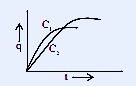
JEE Main 2025 January 28, Shift 1 Question Paper with Solutions
All 75 questions from the JEE Main 2025 (January 28, Shift 1) shift — Physics (25), Chemistry (25) and Mathematics (25) — each with the correct answer (answer key) and a step-by-step solution. Read it free online, or attempt the full paper as a timed mock test.
Physics25 questions
Q26Single correctElectrostatics
Two capacitors and are connected in parallel to a battery. Charge-time graph is shown below for the two capacitors. The energy stored with them are and , respectively. Which of the given statements is true?
(1)
(2)
(3)
(4)
SolutionAnswer: Option 4,
Approach:
Define: Analyze capacitors in parallel with charge-time graph. Expand: Apply C=q/V and U=(1/2)CV². Verify: Check consistency. Conclude: Determine relationship.
Step 1:Define: Identify given information from graph
From charge-time graph: at steady state, . For parallel connection, voltage V is same across both capacitors.
Step 2:Expand: Compare capacitances using q = CV
Since and V is same: , . Since , we get .
Step 3:Expand: Compare energies using U = (1/2)CV²
. Since V is same for both and :
Step 4:Verify: Alternative check using U = q²/2C
. With and :
Step 5:Conclude: State final answer
and
Final answer: , (Option 4)
Q27Single correctProperties of Solids and Liquids
In the experiment for measurement of viscosity '' of given liquid with a ball having radius R, consider following statements. A. Graph between terminal velocity V and R will be a parabola B. The terminal velocities of different diameter balls are constant for a given liquid. C. Measurement of terminal velocity is dependent on the temperature. D. This experiment can be utilized to assess the density of a given liquid. E. If balls are dropped with some initial speed, the value of will change. Choose the correct answer from the options given below:
(1)
(2)
(3)
(4)
SolutionAnswer: Option 2A, C and D only
Approach:
Use Stoke's law for terminal velocity to analyze each statement
Step 1:Terminal velocity formula shows dependence
Step 2:Different R gives different terminal velocities
depends on
Step 3:Viscosity depends on temperature
varies with temperature, so depends on temperature
Step 4:Can find liquid density from the formula
From formula, can be calculated if other quantities known
Step 5:Terminal velocity independent of initial speed
is material property, doesn't change with initial speed
Final answer: A, C and D only
Q28Single correctProperties of Solids and Liquids
Consider following statements: A. Surface tension arises due to extra energy of the molecules at the interior as compared to the molecules at the surface, of a liquid. B. As the temperature of liquid rises, the coefficient of viscosity increases. C. As the temperature of gas increases, the coefficient of viscosity increases. D. The onset of turbulence is determined by Reynold's number. E. In a steady flow two stream lines never intersect. Choose the correct answer from the options given below:
(1)
(2)
(3)
(4)
SolutionAnswer: Option 2C, D, E only
Approach:
Analyze each statement based on fluid mechanics principles
Step 1:Surface tension arises from extra energy at surface, not interior
Surface molecules have higher energy than interior molecules
Step 2:For liquids, viscosity decreases with temperature
As T increases for liquid, decreases
Step 3:For gases, viscosity increases with temperature
As T increases for gas, increases
Step 4:Reynolds number determines turbulence onset
Turbulence occurs at high Reynolds number
Step 5:Streamlines never intersect in steady flow
In steady flow, streamlines are unique paths
Final answer: C, D, E only
Q29Single correctElectrostatics
Three infinitely long wires with linear charge density are placed along the x-axis, y-axis and z-axis respectively. Which of the following denotes an equipotential surface?
(1)
(2)
(3)
(4)
SolutionAnswer: Option 3
Approach:
Calculate net potential from three infinite line charges
Step 1:Potential due to wire along x-axis
Step 2:Potential due to wire along y-axis
Step 3:Potential due to wire along z-axis
Step 4:Total potential is sum of individual potentials
Step 5:For equipotential surface v = constant
Final answer:
Q30Single correctOptics
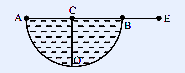
A hemispherical vessel is completely filled with a liquid of refractive index . A small coin is kept at the lowest point (O) of the vessel as shown in figure. The minimum value of the refractive index of the liquid so that a person can see the coin from point E (at the level of the vessel) is______.
(1)
(2)
(3)
(4)
SolutionAnswer: Option 3
Approach:
Apply total internal reflection at critical angle
Step 1:For viewing from E, light must reach at critical angle
Light ray from O to E makes angle with normal
Step 2:From geometry of hemisphere
Angle at surface is (E at rim level)
Step 3:Apply critical angle formula
Step 4:Calculate minimum refractive index
Final answer:
Q31Single correctMagnetic Effects of Current and Magnetism
Consider a long thin conducting wire carrying a uniform current I. A particle having mass 'M' and charge 'q' is released at a distance 'a' from the wire with a speed along the direction of current in the wire. The particle gets attracted to the wire due to magnetic force. The particle turns round when it is at distance x from the wire. The value of x is [ is vacuum permeability]
(1)
(2)
(3)
(4)
SolutionAnswer: Option 4
Approach:
Use magnetic force equations and integrate to find turning point
Step 1:Write force components from Lorentz force
,
Step 2:Relate velocity change to position
Step 3:Integrate using substitution
Let , integrate over path
Step 4:Solve for turning point where particle reverses
Step 5:Calculate final turning distance
Final answer:
Q32Single correctThermodynamics
A Carnot engine (E) is working between two temperatures 473K and 273K. In a new system two engines - engine works between 473K to 373K and engine works between 373K to 273K. If , and are the efficiencies of the engines E, and , respectively, then
(1)
(2)
(3)
(4)
SolutionAnswer: Option 1
Approach:
Calculate Carnot efficiencies and compare
Step 1:Calculate efficiency of engine E
Step 2:Calculate efficiency of engine E1
Step 3:Calculate efficiency of engine E2
Step 4:Sum efficiencies of two engines
Step 5:Compare single engine with two engines
Final answer:
Q33Single correctOscillations and Waves
Given below are two statements: one is labelled as Assertion A and the other is labelled as Reason R. Assertion A: A sound wave has higher speed in solids than gases. Reason R: Gases have higher value of Bulk modulus than solids. In the light of the above statements, choose the correct answer from the options given below
(1)
(2)
(3)
(4)
SolutionAnswer: Option 4A is true but R is false
Approach:
Analyze assertion and reason using sound speed formula
Step 1:Analyze Assertion A about sound speed
Sound speed in solids is higher than in gases
Step 2:Recall speed formula depends on bulk modulus
where B is bulk modulus
Step 3:Analyze Reason R about bulk modulus
Gases have higher bulk modulus than solids
Step 4:State correct fact
Solids have higher bulk modulus than gases
Step 5:Combine results
A is true (sound faster in solids), R is false (solids have higher B)
Final answer: A is true but R is false
Q34Single correctKinetic Theory
For a particular ideal gas which of the following graphs represents the variation of mean square velocity () of the gas molecules with temperature?
(1)
(2)
(3)
(4)
SolutionAnswer: Option 1Straight line passing through origin with positive slope
Approach:
Define: Find relationship between mean square velocity () and temperature. Expand: Use kinetic theory formula. Verify: Check proportionality. Conclude: Identify graph shape.
Step 1:Define: State the RMS velocity formula from kinetic theory
where R is gas constant, T is temperature, M is molar mass
Step 2:Expand: Square the RMS velocity to get mean square velocity ()
Step 3:Expand: For a particular ideal gas, identify constants
For a given gas, is a constant (say k). Thus
Step 4:Verify: Check at T = 0
At : . Graph passes through origin.
Step 5:Conclude: Identify graph type
vs T is a straight line passing through origin with positive slope
Final answer: Straight line passing through origin with positive slope (Option 1)
Q35Single correctWork, Energy and Power
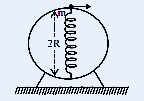
A bead of mass 'm' slides without friction on the wall of a vertical circular hoop of radius 'R' as shown in figure. The bead moves under the combined action of gravity and a massless spring (k) attached to the bottom of the hoop. The equilibrium length of the spring is 'R'. If the bead is released from top of the hoop with (negligible) zero initial speed, velocity of bead, when the length of spring becomes 'R', would be (spring constant is 'k', g is acceleration due to gravity)
(1)
(2)
(3)
(4)
SolutionAnswer: Option 4
Approach:
Find bead position when spring length = R, then apply energy conservation
Step 1:Define: Set up geometry with center of hoop as reference
Vertical hoop of radius . Bottom at height 0, center at height , top at height . Spring attached to bottom, natural length = .
Step 2:Expand: Find distance from bead to bottom of hoop
Bead at angle from top: position . Distance to bottom:
Step 3:Expand: Find bead position when spring length = R
When :
Step 4:Expand: Calculate heights above bottom
Initial (top, ): . Final ():
Step 5:Expand: Calculate spring extensions
Initial: length , extension . Final: length , extension
Step 6:Expand: Write energy conservation equation
Step 7:Expand: Simplify and solve for v²
Step 8:Expand: Solve for velocity
Multiply by :
Step 9:Verify: Check energy balance
Gravitational PE lost = . Spring PE released = . Total = ✓
Step 10:Conclude: State final answer
Final answer: (Option 4)
Q36Single correctLaws of Motion
Given below are two statements: one is labelled as Assertion A and the other is labelled as Reason R Assertion A: In a central force field, the work done is independent of the path chosen Reason R: Every force encountered in mechanics does not have an associated potential energy. In the light of the above statements, choose the most appropriate answer from the options given below
(1)
(2)
(3)
(4)
SolutionAnswer: Option 2Both A and R are true but R is NOT the correct explanation of A
Approach:
Analyze the assertion about central forces and the reason about potential energy separately
Step 1:Assertion A is correct - central forces are conservative
Central force field is conservative, so work is path-independent
Step 2:Reason R is also true - not all forces have potential energy
Friction and other non-conservative forces don't have associated PE
Step 3:R is not the correct explanation of A
A is true because central forces ARE conservative and DO have potential energy
Final answer: Option 2
Q37Single correctNuclei
Choose the correct nuclear process from the below options [p: proton, n: neutron, e: electron, e: positron, u: neutrino, : antineutrino]
(1)
(2)
(3)
(4)
SolutionAnswer: Option 1
Approach:
Apply conservation laws for beta decay: mass number, charge, and lepton number
Step 1:Define: Understand beta-minus decay process
In decay, a neutron converts to proton:
Step 2:Expand: Check charge conservation
Initial charge: 0 (neutron). Final charge: +1 (proton) + (-1) (electron) = 0 ✓
Step 3:Expand: Check mass number conservation
Initial mass number: 1. Final: 1 (proton) + 0 (electron) + 0 (neutrino) = 1 ✓
Step 4:Expand: Apply lepton number conservation
Initial lepton number: 0. Electron has lepton number +1, so we need a particle with lepton number -1 (antineutrino )
Step 5:Conclude: Write complete decay equation
(Option 1 is correct)
Final answer: Option 1: n → p + e⁻ + ν̄
Q38Single correctSemiconductor Electronics
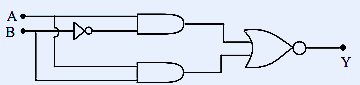
Which of the following circuits has the same output as that of the given circuit? [Circuit shows A going through NOT gate, then NAND with B]
(1)
(2)
(3)
(4)
SolutionAnswer: Option 1NOT gate with input A (Y = )
Approach:
Analyze the circuit stage by stage using Boolean algebra and simplify
Step 1:Define: Identify the circuit components
Circuit has two AND gates feeding into a NOR gate. Input B passes through a NOT gate before one AND gate.
Step 2:Expand: Analyze upper AND gate
Upper AND gate inputs: A and (B inverted). Output =
Step 3:Expand: Analyze lower AND gate
Lower AND gate inputs: A and B. Output =
Step 4:Expand: Apply NOR gate to both outputs
Step 5:Expand: Factor out A using distributive law
Step 6:Expand: Apply complement law
, so
Step 7:Expand: Apply outer NOT from NOR gate
Step 8:Verify: Check with truth table
When : . When : . This is NOT gate behavior on input A.
Step 9:Conclude: Identify equivalent gate
is a NOT gate acting solely on input A
Final answer: NOT gate (Option 1)
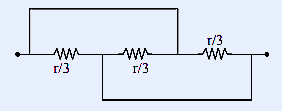
Q39Single correctCurrent Electricity
Find the equivalent resistance between two ends of the following circuit. [Three resistors of r/3 each forming a triangle]
(1)
(2)
(3)
(4)
SolutionAnswer: Option 3
Approach:
Redraw the circuit to identify parallel connection, then apply parallel resistance formula
Step 1:Define: Identify the circuit configuration
Three resistors, each with resistance , connected between two nodes
Step 2:Expand: Redraw the circuit to identify connections
The jump wires connect: (1) input node to start of third resistor, (2) end of first resistor to output node. All three resistors share the same start and end nodes.
Step 3:Expand: Apply parallel resistance formula for 3 resistors
Step 4:Expand: Simplify each term
Step 5:Expand: Take reciprocal to find equivalent resistance
Step 6:Verify: Check dimensional consistency
Each resistor has resistance proportional to r, and parallel combination reduces resistance. ✓
Step 7:Conclude: State final answer
Final answer: (Option 3)
Q40Single correctCurrent Electricity
A wire of resistance R is bent into an equilateral triangle and an identical wire is bent into a square. The ratio of resistance between the two end points of an edge of the triangle to that of the square is
(1)
(2)
(3)
(4)
SolutionAnswer: Option 432/27
Approach:
Define: Wire bent into triangle and square. Expand: Calculate equivalent resistances. Verify: Check calculations. Conclude: Find ratio.
Step 1:Define: Wire bent into equilateral triangle
Total resistance R divided into 3 equal parts. Each side =
Step 2:Expand: Calculate triangle equivalent resistance (between adjacent vertices)
Path 1: , Path 2: .
Step 3:Define: Wire bent into square
Total resistance R divided into 4 equal parts. Each side =
Step 4:Expand: Calculate square equivalent resistance (between adjacent vertices)
Path 1: , Path 2: .
Step 5:Expand: Calculate ratio
Step 6:Verify: Double-check arithmetic
✓
Step 7:Conclude: State final answer
Final answer: 32/27 (Option 4)
Q41Single correctElectromagnetic Waves
Due to presence of an em-wave whose electric component is given by E = 100 sin(t - kx) N, a cylinder of length 200 cm holds certain amount of em-energy inside it. If another cylinder of same length but half diameter than previous one holds same amount of em-energy, the magnitude of the electric field of the corresponding em-wave should be modified as
(1)
(2)
(3)
(4)
SolutionAnswer: Option 2200 sin(t - kx) N
Approach:
Use energy density formula and equate total energies
Step 1:Energy in cylinder 1
Step 2:Energy in cylinder 2 with R2 = R1/2
Step 3:Equate energies U1 = U2
Step 4:Calculate new amplitude
N
Final answer: 200 sin(t - kx) N (Option 2)
Q42Single correctElectrostatics
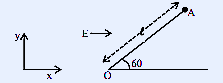
A particle of mass 'm' and charge 'q' is fastened to one end 'A' of a massless string having equilibrium length , whose other end is fixed at point 'O'. The whole system is placed on a frictionless horizontal plane and is initially at rest. If uniform electric field is switched on along the direction as shown in figure, then the speed of the particle when it crosses the x-axis is
(1)
(2)
(3)
(4)
SolutionAnswer: Option 3
Approach:
Apply work-energy theorem considering the work done by electric force
Step 1:Define: Identify the setup
Particle (mass m, charge q) attached to string of length . Electric field E along x-direction. Particle starts at rest.
Step 2:Expand: Analyze the motion
String constrains particle to move in a circle of radius . Electric force acts horizontally.
Step 3:Expand: Determine displacement in x-direction
From the figure, particle starts on y-axis and swings to x-axis. The x-displacement depends on initial position. For this configuration, effective x-displacement =
Step 4:Expand: Calculate work done by electric field
Step 5:Expand: Apply work-energy theorem
Step 6:Expand: Solve for velocity
Step 7:Verify: Check dimensions
✓
Step 8:Conclude: State final answer
Final answer: (Option 3)
Q43Single correctDual Nature of Radiation and Matter
A proton of mass '' has same energy as that of a photon of wavelength ''. If the proton is moving at non-relativistic speed, then ratio of its de Broglie wavelength to the wavelength of photon is.
(1)
(2)
(3)
(4)
SolutionAnswer: Option 3
Approach:
Use de Broglie wavelength formula and photon energy relation
Step 1:Photon wavelength from energy
Step 2:Proton momentum from kinetic energy
Step 3:Proton de Broglie wavelength
Step 4:Calculate ratio
Final answer: (Option 3)
Q44Single correctSystem of Particles and Rotational Motion
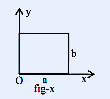
The centre of mass of a thin rectangular plate (fig-x) with sides of length a and b, whose mass per unit area () varies as (where is a constant), would be
(1)
(2)
(3)
(4)
SolutionAnswer: Option 1
Approach:
Use center of mass formula with variable density
Step 1:Since σ varies only with x, m = b/2
Step 2:Calculate m using integration
Step 3:Combine results
Final answer: (Option 1)
Q45Single correctRay Optics and Optical Instruments
A thin prism with angle 4° made of glass having refractive index 1.54, is combined with another thin prism made of glass having refractive index 1.72 to get dispersion without deviation. The angle of the prism in degrees is
(1)
(2)
(3)
(4)
SolutionAnswer: Option 23
Approach:
Use condition for dispersion without deviation
Step 1:For dispersion without deviation, net deviation = 0
Step 2:Substitute values
Step 3:Solve for A2
Final answer: 3° (Option 2)
Q46NumericalUnits and Measurements
A tiny metallic rectangular sheet has length and breadth of 5 mm and 2.5 mm, respectively. Using a specially designed screw gauge which has pitch of 0.75 mm and 15 divisions in the circular scale, you are asked to find the area of the sheet. In this measurement, the maximum fractional error will be where x is
SolutionAnswer: 3
Approach:
Use condition for dispersion without deviation with two prisms
Step 1:Define: Set up the condition for no deviation
For dispersion without deviation: (prisms must have opposite deviations)
Step 2:Expand: Substitute given values
Given: , , . Substituting:
Step 3:Expand: Solve for A₂
→ →
Step 4:Conclude: Final answer
The angle of prism is 3°
Final answer: Option 2: 3°
Q47NumericalSystem of Particles and Rotational Motion
The moment of inertia of a solid disc rotating along its diameter is 2.5 times higher than the moment of inertia of a ring rotating in similar way. The moment of inertia of a solid sphere which has same radius as the disc and rotating in similar way, is n times higher than the moment of inertia of the given ring. Here, n = _____. Consider all the bodies have equal masses.
SolutionAnswer: 4
Approach:
Use moment of inertia formulas for different shapes
Step 1:Given: isc = 2.5 × ing
Step 2:Find ratio phere/ing
Step 3:Calculate n
Final answer: 4
Q48NumericalUnits and Measurements
In a measurement, it is asked to find modulus of elasticity per unit torque applied on the system. The measured quantity has dimension of [ ]. If b = -3, the value of c is _____
SolutionAnswer: 4
Approach:
Define: Find dimensions of modulus of elasticity per unit torque. Expand: Calculate dimensional formula. Verify: Check exponents. Conclude: Find c.
Step 1:Define: Write dimension of modulus of elasticity
Modulus of elasticity = Stress = Force/Area.
Step 2:Define: Write dimension of torque
Torque = Force × distance.
Step 3:Expand: Calculate dimension of E/τ
Step 4:Verify: Identify exponents
, ,
Step 5:Conclude: Find value of c
From dimensional analysis, .
Final answer: 4
Q49NumericalSystem of Particles and Rotational Motion
Two iron solid discs of negligible thickness have radii and and moment of inertia and , respectively. For = 2, the ratio of and would be 1/x, where x = _____
SolutionAnswer: 16
Approach:
Use MOI formula for disc considering mass dependence on radius
Step 1:Mass proportional to R²
Step 2:MOI proportional to MR²
Step 3:Calculate ratio
Final answer: 16
Q50NumericalWave Optics
A double slit interference experiment performed with a light of wavelength 600 nm forms an interference fringe pattern on a screen with 10th bright fringe having its centre at a distance of 10 mm from the central maximum. Distance of the centre of the same 10th bright fringe from the central maximum when the source of light is replaced by another source of wavelength 660 nm would be _____ mm.
SolutionAnswer: 11
Approach:
Use fringe position formula and proportionality
Step 1:Position proportional to wavelength
Step 2:Calculate new position
Step 3:New position
mm
Final answer: 11 mm
Chemistry25 questions
Q51Single correctClassification of Elements and Periodicity in Properties
The incorrect decreasing order of atomic radii is:
(1)
(2)
(3)
(4)
SolutionAnswer: Option 3Be > Mg > Al > Si
Approach:
Compare atomic radii trends: increases down a group, decreases across a period (left to right)
Step 1:Define: Recall periodic trends for atomic radii
Atomic radii increase down a group (more electron shells) and decrease across a period (higher effective nuclear charge)
Step 2:Expand: Analyze Option 1 (Mg > Al > C > O)
Mg (Period 3, Group 2), Al (Period 3, Group 13), C (Period 2, Group 14), O (Period 2, Group 16). Mg > Al (same period, Mg is left), C > O (same period, C is left), Mg > C (Mg has more shells)
Step 3:Expand: Analyze Option 2 (Al > B > N > F)
Al (Period 3), B, N, F (Period 2). Al > B (Al has more shells), B > N > F (same period, decreasing left to right)
Step 4:Expand: Analyze Option 3 (Be > Mg > Al > Si)
Be (Period 2, Group 2), Mg (Period 3, Group 2). Since Mg is below Be in same group, Mg > Be (NOT Be > Mg)
Step 5:Expand: Analyze Option 4 (Si > P > Cl > F)
Si, P, Cl (Period 3), F (Period 2). Si > P > Cl (same period decreasing), Cl > F (Cl has more shells)
Step 6:Conclude: Identify the incorrect order
Option 3 states Be > Mg, but correct order is Mg > Be since atomic radius increases down a group
Final answer: Option 3: Be > Mg > Al > Si (incorrect order)
Q52Single correctRedox Reactions
Given below are two statements: Statement I: In the oxalic acid vs KMn (in the presence of dil ) titration the solution needs to be heated initially to 60°C, but no heating is required in Ferrous ammonium sulphate (FAS) vs KMn titration (in the presence of dil ) Statement II: In oxalic acid vs KMn titration, the initial formation of MnS takes place at high temperature, which then acts as catalyst for further reaction. In the case of FAS vs KMn, heating oxidizes F into F by oxygen of air and error may be introduced in the experiment. In the light of the above statements, choose the correct answer from the options given below:
(1)
(2)
(3)
(4)
SolutionAnswer: Option 2Both Statement I and Statement II are true
Approach:
Analyze statements about oxalic acid vs KMnO4 and FAS vs KMnO4 titrations
Step 1:Define: Understand Statement I about heating requirements
Statement I: Oxalic acid vs KMn titration requires heating to 60°C initially, but FAS vs KMn does not require heating
Step 2:Expand: Explain why oxalic acid titration needs heating
The reaction is slow at room temperature but becomes fast at 60°C
Step 3:Expand: Explain autocatalysis in oxalic acid titration
Once ions are formed, they act as autocatalyst, making the reaction faster. This is why heating is only needed initially.
Step 4:Expand: Explain why FAS titration doesn't need heating
FAS () reaction with KMn is fast at room temperature. Heating would cause to be oxidized to by atmospheric oxygen, introducing errors.
Step 5:Verify: Statement II explanation
Statement II correctly explains: (1) MnS formation and autocatalysis for oxalic acid, (2) F oxidation by air at high temperature for FAS
Step 6:Conclude: Both statements are true
Statement I is true (heating requirements differ) and Statement II correctly explains the reasons
Final answer: Option 2: Both Statement I and Statement II are true
Q53Single correctRedox Reactions
Match the List-I with List-II List-I (Redox Reaction) A. C(g) + 2(g) → C(g) + 2O(l) B. 2NaH(s) → 2Na(s) + (g) C. (s) + 5Ca(s) → 2V(s) + 5CaO(s) D. 2(aq) → 2O(l) + (g) List-II (Type of Redox Reaction) (I) Disproportionation reaction (II) Combination reaction (III) Decomposition reaction (IV) Displacement reaction
(1)
(2)
(3)
(4)
SolutionAnswer: Option 1A-II, B-III, C-IV, D-I
Approach:
Match each redox reaction with its type: combination, decomposition, displacement, or disproportionation
Step 1:Define: Analyze Reaction A - CH4 + 2O2 → CO2 + 2H2O
C + 2 → C + 2O is a combustion reaction. Two reactants combine with oxygen, which is a combination reaction.
Step 2:Expand: Analyze Reaction B - 2NaH → 2Na + H2
2NaH → 2Na + : One compound (NaH) breaks down into elements. This is decomposition reaction.
Step 3:Expand: Analyze Reaction C - V2O5 + 5Ca → 2V + 5CaO
+ 5Ca → 2V + 5CaO: Ca displaces V from . More reactive Ca displaces less reactive V.
Step 4:Expand: Analyze Reaction D - 2H2O2 → 2H2O + O2
2 → 2O + : Oxygen in (oxidation state -1) is both oxidized to (0) and reduced to O (-2).
Step 5:Conclude: Match the correct pairs
A-II (Combination), B-III (Decomposition), C-IV (Displacement), D-I (Disproportionation)
Final answer: Option 1: A-II, B-III, C-IV, D-I
Q54Single correctHaloalkanes and Haloarenes
Given below are two statements: Statement I: (Et)₂N-CH₂-Cl will undergo alkaline hydrolysis at a faster rate than (Et)₂CH-Cl Statement II: In (Et)₂N-CH₂-Cl, intramolecular substitution takes place first by involving lone pair of electrons on nitrogen. In the light of the above statements, choose the most appropriate answer from the options given below:
(1)
(2)
(3)
(4)
SolutionAnswer: Option 3Both Statement I and Statement II are correct
Approach:
Analyze neighboring group participation (NGP) and intramolecular substitution reactions
Step 1:Define: Identify the compounds being compared
Compound (a): (with N lone pair) vs Compound (b): (no lone pair)
Step 2:Expand: Explain neighboring group participation in (a)
In compound (a), the nitrogen lone pair attacks the carbon bearing Cl intramolecularly, forming a 3-membered aziridinium ion intermediate
Step 3:Expand: Draw the aziridinium intermediate
Step 4:Expand: Compare reaction rates
Intramolecular reactions (NGP) are faster than intermolecular reactions because: (1) entropy factor is favorable, (2) effective concentration of nucleophile is higher
Step 5:Verify: Statement I - Rate comparison
Statement I says rate of (a) > rate of (b), which is correct due to NGP
Step 6:Verify: Statement II - Intramolecular substitution
Statement II correctly explains that N lone pair is involved in intramolecular substitution first
Step 7:Conclude: Both statements are correct
Both Statement I (rate comparison) and Statement II (mechanism explanation) are correct
Final answer: Option 3: Both Statement I and Statement II are correct
Q55Single correctEquilibrium
A weak acid HA has degree of dissociation x. Which option gives the correct expression of (pH - p)?
(1)
(2)
(3)
(4)
SolutionAnswer: Option 4
Approach:
Define: Set up equilibrium for weak acid. Expand: Derive pH and pKa expressions. Verify: Calculate pH - pKa. Conclude: Find final expression.
Step 1:Define: Set up equilibrium for weak acid HA with initial concentration C
. At equilibrium: , ,
Step 2:Expand: Write Ka expression
Step 3:Expand: Calculate pH
Step 4:Expand: Calculate pKa
Step 5:Expand: Calculate pH - pKa
Step 6:Expand: Simplify
Step 7:Verify: Check dimensions - both sides are dimensionless ✓
LHS: difference of pH values. RHS: log of ratio (dimensionless)
Step 8:Conclude: State final answer
Final answer: (Option 4)
Q56Single correctChemical Bonding and Molecular Structure
Consider 'n' is the number of lone pair of electrons present in the equatorial position of the most stable structure of Cl. The ions from the following with 'n' number of unpaired electrons are: A. B. T C. C D. N E. T
(1)
(2)
(3)
(4)
SolutionAnswer: Option 2A, D and E only
Approach:
Determine lone pairs in ClF3 (equatorial position) and count unpaired electrons in given ions
Step 1:Define: Analyze ClF3 structure
Cl in Cl: 7 valence electrons, 3 bond pairs with F, leaves 2 lone pairs. Hybridization: sd (trigonal bipyramidal electron geometry)
Step 2:Expand: Determine position of lone pairs
In trigonal bipyramidal arrangement, lone pairs occupy equatorial positions to minimize repulsion. Both lone pairs are in equatorial plane.
Step 3:Expand: Calculate unpaired electrons in
: [Ar]3 - Two unpaired electrons (Hund's rule: _ _ _)
Step 4:Expand: Calculate unpaired electrons in T
T: [Ar]3 - One unpaired electron ( _ _ _ _)
Step 5:Expand: Calculate unpaired electrons in C
C: [Ar]3 - One unpaired electron ( )
Step 6:Expand: Calculate unpaired electrons in N
N: [Ar]3 - Two unpaired electrons ( )
Step 7:Expand: Calculate unpaired electrons in T
T: [Ar]3 - Two unpaired electrons ( _ _ _)
Step 8:Conclude: Identify ions with n=2 unpaired electrons
Ions with 2 unpaired electrons: (A), N (D), T (E)
Final answer: Option 2: A, D and E only
Q57Single correctChemical Kinetics
For a given reaction R → P, is related to [A as given in table: [A/mol : 0.100, 0.025 /min: 200, 100 Given: log 2 = 0.30 Which of the following is true? A. The order of the reaction is 1/2 B. If [A is 1M, then is 200√10 min C. The order changes to 1 if concentration changes from 0.100 M to 0.500 M D. is 800 min for [A = 1.6 M
(1)
(2)
(3)
(4)
SolutionAnswer: Option 3A, B and D only
Approach:
Determine order from half-life data and verify statements
Step 1:Determine order from t₁/₂ ratio
→ n = 1/2
Step 2:Verify B: t₁/₂ for [A]₀ = 1M
t₁/₂ = 200√10 min
Step 3:C is false - order doesn't change with concentration
Order is fixed for a reaction
Step 4:Verify D: t₁/₂ for [A]₀ = 1.6M
t₁/₂ = 800 min
Final answer: A, B and D only (Option 3)
Q58Single correctOrganic Chemistry - Some Basic Principles
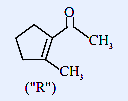
A molecule ("P") on treatment with acid undergoes rearrangement and gives ("Q"). ("Q") on ozonolysis followed by reflux under alkaline condition gives ("R"). The structure of ("R") is given below (cyclopentanone with two methyl groups). The structure of ("P") is
(1)
(2)
(3)
(4)
SolutionAnswer: Option 2Cyclohexanol
Approach:
Work backwards from product through ozonolysis and rearrangement
Step 1:R is formed by aldol condensation of diketone
Aldol under alkaline conditions
Step 2:Q comes from ozonolysis of alkene
Ring expansion product
Step 3:P undergoes acid-catalyzed rearrangement
Ring expansion from cyclohexanol
Final answer: Cyclohexanol (Option 2)
Q59Single correctStates of Matter
Ice and water are placed in a closed container at a pressure of 1 atm and temperature 273.15 K. If pressure of the system is increased 2 times, keeping temperature constant, then identify correct observation from following:
(1)
(2)
(3)
(4)
SolutionAnswer: Option 4The solid phase (ice) disappears completely
Approach:
Use phase diagram of water
Step 1:At 273.15 K and 1 atm, ice and water coexist
On phase boundary
Step 2:Increasing pressure at constant T moves into liquid region
Water has negative slope for solid-liquid line
Step 3:At 2 atm and 273.15 K, only liquid exists
Solid phase disappears
Final answer: The solid phase (ice) disappears completely (Option 4)
Q60Single correctChemical Bonding and Molecular Structure
The molecules having square pyramidal geometry are
(1)
(2)
(3)
(4)
SolutionAnswer: Option 1Br & XeO
Approach:
Determine molecular geometry using VSEPR
Step 1:BrF₅: 5 bond pairs + 1 lone pair = octahedral electron geometry
Square pyramidal molecular geometry
Step 2:XeOF₄: 5 bond pairs + 1 lone pair
Square pyramidal molecular geometry
Step 3:SbF₅ and PCl₅ are trigonal bipyramidal
No lone pairs
Final answer: Br & XeO (Option 1)
Q61Single correctCoordination Compounds
The metal ion whose electronic configuration is not affected by the nature of the ligand and which gives a violet colour in non-luminous flame under hot condition in borax bead test is
(1)
(2)
(3)
(4)
SolutionAnswer: Option 2N
Approach:
Use borax bead test characteristics and electronic configuration analysis
Step 1:Define: Understand borax bead test
Borax bead test: N + metal oxide → colored bead (metaborate). Different metals give characteristic colors.
Step 2:Expand: Identify metal giving violet bead in non-luminous flame
N gives violet/reddish-brown bead in non-luminous (oxidizing) flame when hot
Step 3:Expand: Analyze electronic configuration of N
N: [Ar]3. In octahedral field: t regardless of field strength
Step 4:Expand: Explain why configuration is unaffected by ligand
For in octahedral field: Both weak field (t) and strong field (t) give same configuration because all are filled before
Step 5:Conclude: Identify the answer
N satisfies both conditions: (1) gives violet bead in non-luminous flame, (2) configuration unaffected by ligand nature
Final answer: Option 2: N
Q62Single correctAldehydes, Ketones and Carboxylic Acids
Both acetaldehyde and acetone (individually) undergo which of the following reactions? A. Iodoform Reaction B. Cannizzaro Reaction C. Aldol condensation D. Tollen's Test E. Clemmensen Reduction
(1)
(2)
(3)
(4)
SolutionAnswer: Option 2A, C and E only
Approach:
Check each reaction for both compounds
Step 1:Iodoform: Both have CH₃CO- group
A: Both positive
Step 2:Cannizzaro: No α-H needed, but both have α-H
B: Neither undergo
Step 3:Aldol: Both have α-H
C: Both positive
Step 4:Tollen's: Only aldehydes give positive
D: Only acetaldehyde
Step 5:Clemmensen: Both can be reduced
E: Both positive
Final answer: A, C and E only (Option 2)
Q63Single correctStructure of Atom
In a multielectron atom, which of the following orbitals described by three quantum numbers will have same energy in absence of electric and magnetic fields? A. n=1, l=0, =0 B. n=2, l=0, =0 C. n=2, l=1, =1 D. n=3, l=2, =1 E. n=3, l=2, =0
(1)
(2)
(3)
(4)
SolutionAnswer: Option 4D and E only
Approach:
Identify orbitals with same energy (degenerate) using quantum numbers
Step 1:Define: Identify each orbital from quantum numbers
A: n=1, =0, m=0 → 1s; B: n=2, =0, m=0 → 2s; C: n=2, =1, m=1 → 2p; D: n=3, =2, m=1 → 3d; E: n=3, =2, m=0 → 3d
Step 2:Expand: Understand degeneracy in multi-electron atoms
In multi-electron atoms, orbitals with same n and same are degenerate (have same energy) in absence of external fields
Step 3:Expand: Compare orbital energies
1s (n=1, =0): lowest energy; 2s (n=2, =0): higher; 2p (n=2, =1): higher than 2s; 3d (n=3, =2): D and E both 3d
Step 4:Expand: Identify degenerate orbitals
D and E both have n=3 and =2 (3d orbitals). They differ only in m value (magnetic quantum number), which doesn't affect energy in absence of external fields.
Step 5:Conclude: Final answer
Only D (3d, m=1) and E (3d, m=0) have same energy since they belong to same subshell (3d)
Final answer: Option 4: D and E only
Q64Single correctHaloalkanes and Haloarenes
The products A and B in the following reactions, respectively are: A ← C-C-C-Br → B
(1)
(2)
(3)
(4)
SolutionAnswer: Option 4C-C-C-N, C-C-C-NC
Approach:
Apply ambident nucleophile behavior of AgNO2 and AgCN
Step 1:Define: Understand ambident nucleophiles
Ambident nucleophiles have two nucleophilic sites. NO can attack via N or O; CN can attack via C or N
Step 2:Expand: Reaction with AgNO2
AgN is covalent (soft). In reaction with R-X, attack occurs through N (harder site): C-C-C-Br + AgN → C-C-C-N
Step 3:Expand: Explain why N attacks in AgNO2
In NO, N is harder center (more electronegative). With Ag (soft metal), the covalent AgN makes N more available for nucleophilic attack
Step 4:Expand: Reaction with AgCN
AgCN is covalent. Attack occurs through C (softer site): C-C-C-Br + AgCN → C-C-C-NC
Step 5:Expand: Explain why C attacks in AgCN
In CN, C is softer center. AgCN being covalent makes C more nucleophilic, giving isocyanide (R-NC) not nitrile (R-CN)
Step 6:Conclude: Identify products A and B
A = C-C-C-N (1-nitropropane); B = C-C-C-NC (propyl isocyanide)
Final answer: Option 4: C-C-C-N, C-C-C-NC
Q65Single correctSolutions
What is the freezing point depression constant of a solvent, 50 g of which contain 1 g non volatile solute (molar mass 256 g mo) and the decrease in freezing point is 0.40 K?
(1)
(2)
(3)
(4)
SolutionAnswer: Option 15.12 K kg mo
Approach:
Define: Identify given values. Expand: Calculate molality and apply formula. Verify: Check units. Conclude: Find Kf.
Step 1:Define: List given values
Mass of solvent = 50 g = 0.050 kg, Mass of solute = 1 g, Molar mass = 256 g/mol, = 0.40 K
Step 2:Expand: Calculate moles of solute
mol
Step 3:Expand: Calculate molality
mol/kg
Step 4:Expand: Apply freezing point depression formula
Step 5:Expand: Calculate Kf
K kg mol⁻¹
Step 6:Verify: Check units
✓
Step 7:Conclude: State final answer
K kg mol⁻¹
Final answer: 5.12 K kg mol⁻¹ (Option 1)
Q66Single correctThe p-Block Elements
Consider the following elements In, Tl, Al, Pb, Sn and Ge. The most stable oxidation states of elements with highest and lowest first ionisation enthalpies, respectively, are
(1)
(2)
(3)
(4)
SolutionAnswer: Option 3+4 and +1
Approach:
Compare first ionisation enthalpies and identify stable oxidation states
Step 1:Define: List the elements and their properties
Elements given: In (Group 13, Period 5), Tl (Group 13, Period 6), Al (Group 13, Period 3), Pb (Group 14, Period 6), Sn (Group 14, Period 5), Ge (Group 14, Period 4)
Step 2:Expand: Determine element with highest IE1
Among given elements, Ge has highest I because: (1) smaller size than Sn, Pb; (2) Group 14 has higher IE than Group 13 in same period
Step 3:Expand: Determine stable oxidation state of Ge
Ge shows +4 (most stable) and +2 oxidation states. +4 is more stable as inert pair effect is not prominent in 4th period
Step 4:Expand: Determine element with lowest IE1
Among given elements, In has lowest I because: large size, Group 13, and being in Period 5 makes electrons easier to remove
Step 5:Expand: Determine stable oxidation state of In
In shows +3 (most stable) and +1 oxidation states. +3 is more stable, though +1 exists due to mild inert pair effect
Step 6:Conclude: Match answer with options
Highest I (Ge): +4 oxidation state; Lowest I (In): +3 oxidation state
Final answer: Option 2: +4 and +3
Q67Single correctOrganic Chemistry - Basic Principles
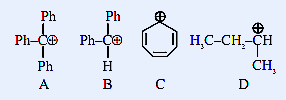
The correct order of stability of following carbocations is: A. Ph-C⁺(Ph)(Ph) B. Ph-C⁺(Ph)(H) C. Cyclopentadienyl cation D. C-C-CH⁺-C
(1)
(2)
(3)
(4)
SolutionAnswer: Option 4C > A > B > D
Approach:
Compare carbocation stability using aromaticity, resonance, and hyperconjugation
Step 1:Define: Identify each carbocation structure
A: P (triphenylmethyl), B: P (diphenylmethyl), C: Cyclopentadienyl cation (aromatic), D: C (secondary)
Step 2:Expand: Analyze carbocation C (cyclopropenyl cation)
C is cyclopentadienyl cation with 6 electrons (4n+2, n=1). It satisfies Hückel's rule and is aromatic, giving exceptional stability.
Step 3:Expand: Analyze carbocations A and B
A (P): Three phenyl groups stabilize by resonance. B (P): Two phenyl groups stabilize by resonance. More phenyl groups = more resonance structures.
Step 4:Expand: Analyze carbocation D
D (C): Secondary carbocation stabilized only by hyperconjugation from adjacent C-H bonds. No resonance stabilization.
Step 5:Conclude: Determine stability order
Stability: Aromatic (C) > Resonance with 3 Ph (A) > Resonance with 2 Ph (B) > Hyperconjugation (D). Order: C > A > B > D
Final answer: Option 4: C > A > B > D
Q68Single correctOrganic Compounds Containing Oxygen
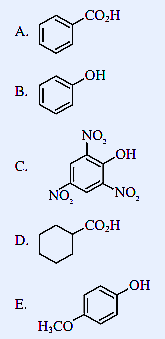
The compounds that produce C with aqueous NaHC solution are: A. Benzoic acid B. Phenol C. 2,4,6-trinitrophenol (picric acid) D. Salicylic acid E. 4-methoxyphenol
(1)
(2)
(3)
(4)
SolutionAnswer: Option 3A, C and D only
Approach:
Compare acidities with carbonic acid
Step 1:Only acids stronger than H₂CO₃ react with NaHCO₃
pKa < 6.35
Step 2:Carboxylic acids (A, D) and picric acid (C) are strong enough
A, C, D produce CO₂
Step 3:Phenol and methoxyphenol are weaker
B, E don't react
Final answer: A, C and D only (Option 3)
Q69Single correctThe d- and f-Block Elements
Which of the following oxidation reactions are carried out by both and KMn in acidic medium? A. I → B. → S C. F → F D. I → IO E. → SO
(1)
(2)
(3)
(4)
SolutionAnswer: Option 3A, B and C only
Approach:
Identify oxidation reactions performed by both KMnO4 and K2Cr2O7 in acidic medium
Step 1:Define: List the oxidation reactions to analyze
A: I → ; B: → S; C: F → F; D: I → IO; E: → SO
Step 2:Expand: Analyze reaction A (I⁻ → I₂)
Both KMn and can oxidize I to in acidic medium: 2I → + 2e
Step 3:Expand: Analyze reaction B (S²⁻ → S)
Both oxidizing agents can oxidize to elemental S in acidic medium: → S + 2e
Step 4:Expand: Analyze reaction C (Fe²⁺ → Fe³⁺)
Both KMn and can oxidize F to F: F → F + e. This is basis of ferrous estimation.
Step 5:Expand: Analyze reaction D (I⁻ → IO₃⁻)
I → IO requires alkaline medium (strong oxidation). In acidic medium, I typically gives , not IO.
Step 6:Expand: Analyze reaction E (S₂O₃²⁻ → SO₄²⁻)
In acidic medium: → S↓ + SO (disproportionation occurs). Complete oxidation to SO occurs in alkaline medium.
Step 7:Conclude: Identify common reactions
Both KMn and in acidic medium perform: A (I → ), B ( → S), C (F → F)
Final answer: Option 3: A, B and C only
Q70Single correctBiomolecules
Given below are two statements: Statement I: D-glucose pentaacetate reacts with 2,4-dinitrophenylhydrazine. Statement II: Starch, on heating with concentrated sulfuric acid at 100°C and 2-3 atmosphere pressure produces glucose. In the light of the above statements, choose the correct answer from the options given below
(1)
(2)
(3)
(4)
SolutionAnswer: Option 2Statement I is false but Statement II is true
Approach:
Analyze statements about glucose pentaacetate and starch hydrolysis
Step 1:Define: Understand Statement I about glucose pentaacetate
Statement I: D-glucose pentaacetate reacts with 2,4-dinitrophenylhydrazine (2,4-DNP)
Step 2:Expand: Analyze glucose pentaacetate structure
In glucose pentaacetate, all 5 -OH groups (including the hemiacetal -OH at C1) are acetylated. This means the -CHO group cannot form (ring stays closed)
Step 3:Expand: Determine if it reacts with 2,4-DNP
2,4-DNP reacts with aldehydes and ketones (carbonyl compounds). Since glucose pentaacetate has no free -CHO group, it cannot react with 2,4-DNP
Step 4:Define: Understand Statement II about starch hydrolysis
Statement II: Starch on heating with concentrated at 100°C and 2-3 atm produces glucose
Step 5:Expand: Verify starch hydrolysis
Starch is a polymer of glucose. Acid hydrolysis: . This occurs with under heat and pressure.
Step 6:Conclude: Final answer
Statement I is false (no reaction with 2,4-DNP), Statement II is true (starch hydrolysis gives glucose)
Final answer: Option 2: Statement I is false but Statement II is true
Q71NumericalElectrochemistry
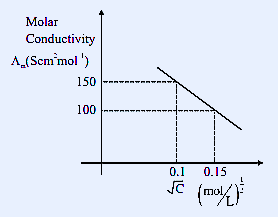
Given below is the plot of the molar conductivity vs for KCl in aqueous solution. If, for the higher concentration of KCl solution, the resistance of the conductivity cell is 100Ω, then the resistance of the same cell with the dilute solution is 'x' Ω. The value of x is ___
SolutionAnswer: 150
Approach:
Use conductivity-resistance relationship
Step 1:From graph: concentrated solution Λm = 100, √C = 0.15
C₁ = 0.0225 M
Step 2:Dilute solution: Λm = 150, √C = 0.1
C₂ = 0.01 M
Step 3:Using ratio of conductivities and resistances
Final answer: 150
Q72NumericalSome Basic Concepts of Chemistry
Quantitative analysis of an organic compound (X) shows following % composition: C: 14.5%, Cl: 64.46%, H: 1.8%. (Empirical formula mass of the compound (X) is _____ × 1
SolutionAnswer: 1655
Approach:
Calculate empirical formula from percent composition
Step 1:Calculate moles of each element
C: 14.5/12 = 1.21, Cl: 64.46/35.5 = 1.82, H: 1.8, O: (100-14.5-64.46-1.8)/16 = 1.2
Step 2:Simplest ratio
C:Cl:H:O = 2:3:3:2
Step 3:Calculate empirical formula mass
24 + 3 + 106.5 + 32 = 165.5
Final answer: 1655
Q73NumericalSome Basic Concepts of Chemistry
The molarity of a 70% (mass/mass) aqueous solution of a monobasic acid (X) is _____ M (Nearest integer) [Given: Density of aqueous solution of (X) is 1.25 g m, Molar mass of the acid is 70 g mo]
SolutionAnswer: 125
Approach:
Define: Identify parameters. Expand: Apply molarity formula. Verify: Check calculation. Conclude: State answer.
Step 1:Define: List given values
Mass percent = 70%, density d = 1.25 g/mL, Molar mass = 70 g/mol
Step 2:Expand: Derive formula from first principles
In 100 g solution: 70 g acid, 30 g water. Volume = 100/1.25 = 80 mL = 0.08 L
Step 3:Expand: Calculate moles and molarity
Moles = 70/70 = 1 mol. Molarity = 1/0.08 = 12.5 M
Step 4:Verify: Using direct formula
M ✓
Step 5:Conclude: Express in required format
12.5 M = 125 × 10⁻¹ M
Final answer: 125
Q74NumericalOrganic Chemistry - Reactions
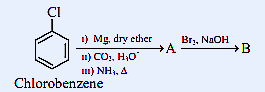
Consider the following sequence of reactions: Chlorobenzene →(i) Mg, dry ether, (ii) CO₂, H₃O⁺, (iii) NH₃, Δ→ A →(Br₂, NaOH)→ B 11.25 mg of chlorobenzene will produce _____ × 1 mg of product B.
SolutionAnswer: 93
Approach:
Track the reaction sequence and calculate product mass
Step 1:Chlorobenzene → Benzoic acid → Benzamide (A)
Grignard followed by amide formation
Step 2:Hofmann bromamide reaction: A → Aniline (B)
Benzamide + Br₂/NaOH → Aniline
Step 3:Moles of chlorobenzene = moles of aniline
Final answer: 93
Q75NumericalThermodynamics
The formation enthalpies, ΔH for H(g) and O(g) are 220.0 and 250.0 kJ mo, respectively, at 298.15 K, and ΔH for O(g) is -242.0 kJ mo at the same temperature. The average bond enthalpy of the O-H bond in water at 298.15 K is _____ kJ mo (nearest integer).
SolutionAnswer: 466
Approach:
Define: Identify enthalpy values. Expand: Apply Hess's law. Verify: Check energy balance. Conclude: Find bond enthalpy.
Step 1:Define: List given formation enthalpies
kJ/mol, kJ/mol, kJ/mol
Step 2:Expand: Write reaction for H₂O formation from gaseous atoms
Step 3:Expand: Calculate enthalpy change for this reaction
Step 4:Expand: Substitute values
kJ/mol
Step 5:Expand: Calculate single O-H bond enthalpy
Bond enthalpy of O-H = kJ/mol
Step 6:Verify: Bond enthalpy is positive (energy needed to break bond) ✓
Standard O-H bond enthalpy ≈ 463-467 kJ/mol (literature value)
Step 7:Conclude: State final answer
Average O-H bond enthalpy = 466 kJ/mol
Final answer: 466
Mathematics25 questions
Q1Single correctPermutations and Combinations
The number of different 5 digit numbers greater than 50000 that can be formed using the digits 0, 1, 2, 3, 4, 5, 6, 7, such that the sum of their first and last digits should not be more than 8, is
(1)
(2)
(3)
(4)
SolutionAnswer: Option 44607
Approach:
Case-wise counting based on first and last digit constraints
Step 1:Define: Identify constraints
For 5-digit number : First digit . Condition: First + Last
Step 2:Expand: Count valid (first, last) pairs
First=5: Last (4 choices) First=6: Last (3 choices) First=7: Last (2 choices)
Step 3:Expand: Count middle digit choices
Middle 3 positions: Each can be any of Choices =
Step 4:Expand: Calculate total before exclusion
Step 5:Expand: Exclude number 50000 (not strictly > 50000)
Number 50000 has first=5, last=0, middle=000. This satisfies conditions but
Step 6:Conclude: Final answer
Final answer: 4607
Q2Single correctCo-ordinate Geometry
Let ABCD be a trapezium whose vertices lie on the parabola . Let the sides AD and BC of the trapezium be parallel to y-axis. If the diagonal AC is of length and it passes through the point , then the area of ABCD is:
(1)
(2)
(3)
(4)
SolutionAnswer: Option 1
Approach:
Use parametric form of parabola and focal chord properties
Step 1:Define: Set up parametric coordinates
Parabola has , focus at Let and
Step 2:Expand: Apply focal chord condition
Since AC passes through focus : Therefore
Step 3:Expand: Calculate length of AC
Step 4:Expand: Solve for t₁
Given (taking positive root) or
Step 5:Expand: Find all vertices
With : , AD y-axis, BC y-axis B on parabola with same x as C: D on parabola with same x as A:
Step 6:Expand: Calculate trapezium area
Height (horizontal distance) Area
Step 7:Verify: Check vertices lie on parabola
: ✓ : ✓ : ✓ : ✓
Step 8:Conclude: Final answer
Area of trapezium ABCD
Final answer:
Q3Single correctStatistics and Probability
Two numbers and are randomly chosen from the set of natural numbers. Then, the probability that the value of , is non-zero, equals
(1)
(2)
(3)
(4)
SolutionAnswer: Option 3
Approach:
Use cyclic property of powers of i to count favorable cases
Step 1:Define: Identify possible values of
has period 4: for
Step 2:Expand: Count total outcomes
and each give 4 equally likely residues mod 4 Total outcomes =
Step 3:Expand: Identify when sum equals zero
when they are negatives:
Step 4:Expand: Count favorable cases
Favorable cases = Total - Unfavorable =
Step 5:Conclude: Calculate probability
Step 6:Verify: List all non-zero sums
, , , , etc. 12 non-zero sums confirmed
Final answer:
Q4Single correctSequence and Series
If , then is equal to:
(1)
(2)
(3)
(4)
SolutionAnswer: Option 2
Approach:
Use functional property f(x) + f(1-x) = 1 to pair terms
Step 1:Define: Given function
Step 2:Expand: Prove f(x) + f(1-x) = 1
Multiply num and denom by : Let :
Step 3:Expand: Pair terms in sum
Pairs:
Step 4:Expand: Find middle term
Middle term:
Step 5:Conclude: Calculate total sum
Step 6:Verify: Check pair count
k from 1 to 81: 81 terms total 40 pairs + 1 middle term = 81 terms ✓
Final answer:
Q5Single correctLimit, Continuity and Differentiability
Let be a function defined by , . If , then the value of is:
(1)
(2)
(3)
(4)
SolutionAnswer: Option 4675
Approach:
Use functional equation to determine coefficients, then compute sum
Step 1:Define: Express f(x) in general form
where , ,
Step 2:Expand: Compare f(x+y) with f(x) + f(y) + 1 - (2/7)xy
Step 3:Expand: Compare coefficients of xy
Coefficient of xy: , so
Step 4:Expand: Compare constant terms
Constants: , so Therefore
Step 5:Expand: Find B
Step 6:Expand: Write final f(x)
Step 7:Expand: Calculate f(1) through f(5)
Step 8:Conclude: Calculate 28∑|f(i)|
Step 9:Verify: Check functional equation
✓
Final answer: 675
Q6Single correctThree Dimensional Geometry
Let A(x, y, z) be a point in xy-plane, which is equidistant from three points , and . Let and . Then among the statements (S1): is an isosceles right angled triangle and (S2): the area of is .
(1)
(2)
(3)
(4)
SolutionAnswer: Option 2only (S1) is true
Approach:
Find point A using equidistant condition, then verify triangle properties
Step 1:Define: Set up the problem
A in xy-plane P = (0,3,2), Q = (2,0,3), R = (0,0,1) B = (1,4,-1), C = (2,0,-2)
Step 2:Expand: Apply AP² = AQ²
... (1)
Step 3:Expand: Apply AP² = AR²
Step 4:Expand: Find x from equation (1)
Therefore
Step 5:Expand: Calculate AB, AC, BC
, , ,
Step 6:Verify S1: Isosceles right triangle
(isosceles) (right angle at A) is isosceles right-angled
Step 7:Verify S2: Area = 9√2/2?
Area . S2 claims area , which is incorrect.
Step 8:Conclude
Only S1 is true
Final answer: only (S1) is true
Q7Single correctSets, Relations and Functions
The relation is:
(1)
(2)
(3)
(4)
SolutionAnswer: Option 3an equivalence relation
Approach:
Check reflexive, symmetric, and transitive properties
Step 1:Define: State the relation
Step 2:Expand: Check reflexivity
For any : is always even Therefore for all x
Step 3:Expand: Check symmetry
If , then is even Since , we have is even Therefore
Step 4:Expand: Check transitivity
If and : is even is even By transitivity of congruence: Therefore is even, so
Step 5:Conclude
R is reflexive, symmetric, and transitive Therefore R is an equivalence relation
Step 6:Verify: Give example
since is even since is even since is even ✓
Final answer: an equivalence relation
Q8Single correctCo-ordinate Geometry
Let the equation of the circle, which touches x-axis at the point , and cuts off an intercept of length b on y-axis be . If the circle lies below x-axis, then the ordered pair is equal to:
(1)
(2)
(3)
(4)
SolutionAnswer: Option 4
Approach:
Use circle properties for tangency to x-axis and y-intercept formula
Step 1:Define: Identify the given circle equation
Circle: . Comparing with standard form: , ,
Step 2:Expand: Apply condition for touching x-axis at (a, 0)
Since circle touches x-axis at , the center's x-coordinate equals a. Thus
Step 3:Expand: Apply tangency condition to x-axis
Condition for touching x-axis: . Here , so
Step 4:Expand: Calculate y-intercept length
Y-intercept length = . Given this equals b.
Step 5:Expand: Solve for b²
Step 6:Verify: Check consistency of results
From step 2: . From step 5: . Both expressions are in terms of circle parameters.
Step 7:Conclude: State the ordered pair
Final answer: (Option 4)
Q9Single correctSequence and Series
Let be a sequence such that , and , Then is equal to:
(1)
(2)
(3)
(4)
SolutionAnswer: Option 2
Approach:
Solve characteristic equation, find general term, compute sum
Step 1:Define: Write characteristic equation from recurrence
From : Characteristic equation:
Step 2:Expand: Solve characteristic equation
or
Step 3:Expand: Write general solution
Step 4:Expand: Apply initial conditions
: : Substituting: Therefore
Step 5:Expand: Write explicit formula
Step 6:Expand: Compute the sum
Step 7:Expand: Express in terms of a₁₀₀
Since Sum
Step 8:Verify: Check with small values
✓ Check: , ✓
Step 9:Conclude
Final answer:
Q10Single correctTrigonometry
is equal to:
(1)
(2)
(3)
(4)
SolutionAnswer: Option 2
Approach:
Convert inverse sines to inverse tangents, use addition formula
Step 1:Define: Let the three angles be α, β, γ
, ,
Step 2:Expand: Convert to tan⁻¹ form
, , , , , ,
Step 3:Expand: Calculate tan(α + β)
Step 4:Expand: Recognize complementary relationship
and Note: Therefore:
Step 5:Conclude: Apply cosine
Step 6:Verify: Check cos calculations
✓ ✓ ✓
Final answer:
Q11Single correctSequence and Series
Let be the term of an A.P. If for some m, , and , then is equal to:
(1)
(2)
(3)
(4)
SolutionAnswer: Option 2
Approach:
Use AP formulas to find a, d, m, then calculate the required sum
Step 1:Define: Set up equations from given conditions
... (1) ... (2) ... (3)
Step 2:Expand: Use sum equation
Step 3:Expand: Find a using equations (2) and the result
From (2):
Step 4:Expand: Find d
Step 5:Expand: Find m from equation (1)
Step 6:Expand: Calculate S₄₀ and S₁₉
Step 7:Expand: Calculate Σ(from m to 2m)
Step 8:Conclude: Calculate final answer
Step 9:Verify: Check T₂₀ and T₂₅
✓ ✓
Final answer:
Q12Single correctThree Dimensional Geometry
If the image of the point in the line is , then is equal to
(1)
(2)
(3)
(4)
SolutionAnswer: Option 1
Approach:
Find foot of perpendicular, then use midpoint formula for image
Step 1:Define: Identify point and line
Point Line: Direction ratios: , Point on line:
Step 2:Expand: Write general point on line
Step 3:Expand: Find vector PQ
Step 4:Expand: Apply perpendicularity condition
Step 5:Expand: Find foot of perpendicular Q
Step 6:Expand: Use midpoint formula for image
Q is midpoint of P and image :
Step 7:Conclude: Calculate sum
Step 8:Verify: Check Q is midpoint
Midpoint of and : ✓
Final answer:
Q13Single correctIntegral Calculus
If , , then equals:
(1)
(2)
(3)
(4)
SolutionAnswer: Option 3
Approach:
Use King's property for definite integrals and solve the symmetric integral
Step 1:Define: Apply King's property to the integral
. Using King's property with substitution
Step 2:Expand: Add original and transformed integrals
Step 3:Expand: Simplify the sum
Step 4:Expand: Use even function property
Step 5:Expand: Split and evaluate integrals
. First part:
Step 6:Expand: Evaluate second integral by parts
Step 7:Expand: Calculate final result
Step 8:Conclude: Calculate
Final answer: 100
Q14Single correctLimit, Continuity and Differentiability
The sum of all local minimum values of the function
(1)
(2)
(3)
(4)
SolutionAnswer: Option 3
Approach:
Analyze each piece of the piecewise function, find critical points, and identify local minima
Step 1:Define: Expand the middle piece using |x|
For : When : , so When : , so
Step 2:Expand: Rewrite complete piecewise function
Step 3:Expand: Calculate function values at boundary points
Step 4:Expand: Analyze behavior in each region
For : has slope (decreasing) For : has slope (decreasing) For : has slope (increasing)
Step 5:Expand: Identify first local minimum at x = 0
At : Function changes from decreasing to increasing This is a local minimum (Point A in graph)
Step 6:Expand: Analyze the parabola for x > 2
Vertex at Since coefficient , parabola opens upward
Step 7:Expand: Calculate minimum value of parabola
Step 8:Expand: Verify this is a local minimum
At : (from linear piece) Check continuity: ✓ Since , vertex at is local minimum (Point B)
Step 9:Expand: Sum of local minimum values
Sum
Step 10:Conclude: Final answer
Sum of all local minimum values
Final answer:
Q15Single correctComplex Numbers and Quadratic Equations
The sum of the squares of all the roots of the equation is:
(1)
(2)
(3)
(4)
SolutionAnswer: Option 3
Approach:
Split by cases based on absolute value sign, solve quadratics
Step 1:Define: Split into cases based on |2x - 3|
Case I: , then Case II: , then
Step 2:Expand: Solve Case I
Step 3:Expand: Check validity of Case I roots
✓ ✗
Step 4:Expand: Solve Case II
Step 5:Expand: Check validity of Case II roots
✗ ✓
Step 6:Expand: Calculate sum of squares
Sum
Step 7:Conclude: Simplify
Step 8:Verify: Check roots satisfy original equation
For : ✓
Final answer:
Q16Single correctDifferential Equations
Let for some function , , and . Then is equal to:
(1)
(2)
(3)
(4)
SolutionAnswer: Option 1
Approach:
Differentiate using Leibniz rule, then solve the differential equation
Step 1:Define: Given integral equation
, with
Step 2:Expand: Differentiate both sides with respect to x
LHS: (Leibniz rule) RHS: (Product rule)
Step 3:Expand: Simplify to get differential equation
(dividing by x)
Step 4:Expand: Integrate both sides
Step 5:Expand: Apply initial condition
:
Step 6:Conclude: Find f(6)
Step 7:Verify: Check original equation
✓
Final answer:
Q17Single correctCoordinate Geometry
Let , and . Let , and be the vertices of a triangle ABC, where t is a parameter. If , is the locus of the centroid of triangle ABC, then equals:
(1)
(2)
(3)
(4)
SolutionAnswer: Option 120
Approach:
Use ratio of consecutive binomial coefficients to find n and r, then calculate centroid of triangle ABC and find locus equation.
Step 1:Use ratio of consecutive binomial coefficients
Step 2:Use another ratio to form second equation
Step 3:Substitute n = 3r - 1 into the second equation
Step 4:Find n from r
Step 5:Verify: Check binomial coefficients
, ,
Step 6:Calculate coordinates of fixed point C
Step 7:Find centroid G of triangle ABC
Step 8:Let centroid be (x, y) and express in terms of t
and
Step 9:Square and add to eliminate parameter t
Step 10:Expand RHS using identity
Step 11:Simplify using sin²t + cos²t = 1
Step 12:Locus of centroid
Final answer:
Q18Single correctAlgebra
Let O be the origin, the point A be , the point be such that and . Then
(1)
(2)
(3)
(4)
SolutionAnswer: Option 4ABO is an obtuse angled isosceles triangle
Approach:
Calculate |z1|, then |z2| using given ratio. Find z2 using polar form. Calculate distances OA, OB, AB to determine triangle type.
Step 1:Calculate |z1|
Step 2:Calculate |z2| from given condition √3|z2| = |z1|
Step 3:Find argument of z1
Step 4:Find argument of z2
Step 5:Calculate OA and OB (distances from origin)
,
Step 6:Check if isosceles: Compare OA and OB
Step 7:Calculate AB using distance formula for complex numbers
Step 8:Substitute values
Step 9:Compare AB with OB
Step 10:Check angles: angle at O is π/6 (acute)
, which is acute
Step 11:Find angle at A using sine rule
Step 12:Determine angle at B
. Since AB = OB with OA > AB, angle B is obtuse:
Step 13:Conclusion
Triangle ABO is isosceles (AB = OB) with obtuse angle at B
Final answer: ABO is an obtuse angled isosceles triangle
Q19Single correctStatistics and Probability
Three defective oranges are accidentally mixed with seven good ones and on looking at them, it is not possible to differentiate between them. Two oranges are drawn at random from the lot. If denotes the number of defective oranges, then the variance of is:
(1)
(2)
(3)
(4)
SolutionAnswer: Option 1
Approach:
Use hypergeometric distribution. Calculate P(X=0), P(X=1), P(X=2), then find E(X), E(X²), and Var(X) = E(X²) - [E(X)]².
Step 1:Identify parameters: Total oranges N=10, defective K=3, good=7, draw n=2
, (defective), (drawn)
Step 2:Calculate P(X=0): Both oranges are good
Step 3:Calculate P(X=1): One defective, one good
Step 4:Calculate P(X=2): Both oranges are defective
Step 5:Verify probabilities sum to 1
✓
Step 6:Calculate E(X)
Step 7:Calculate E(X²)
Step 8:Calculate Var(X) = E(X²) - [E(X)]²
Step 9:Find common denominator (75) and compute
Final answer:
Q20Single correctCalculus
The area (in sq. units) of the region is
(1)
(2)
(3)
(4)
SolutionAnswer: Option 2
Approach:
Find where the two upper bounds intersect (2|x|+1 = x²+1), determine which function is smaller in each region, and integrate to find total area.
Step 1:Define: Identify the region
Region: ,
Step 2:Expand: Find intersection points
Step 3:Expand: Determine which function is smaller
At : , . So for . At : , . So for .
Step 4:Expand: Set up integral using symmetry
Step 5:Expand: Calculate
Step 6:Expand: Calculate
Step 7:Conclude: Calculate total area
Final answer:
Q21NumericalAlgebra
Let M denote the set of all real matrices of order and let . Let , , . If , then equals.
SolutionAnswer: 1613
Approach:
Use inclusion-exclusion principle to count n(S₁ ∪ S₂ ∪ S₃), noting that S₂ is empty since 0 ∉ S
Step 1:Define: Identify set S and key observation
has 5 elements. Critical observation:
Step 2:Expand: Count n(S₁) - Symmetric matrices
For symmetric matrix: . Free positions: 3 diagonal + 3 upper triangular = 6 positions.
Step 3:Expand: Count n(S₂) - Skew-symmetric matrices
For skew-symmetric: . But , so no valid diagonal entries exist.
Step 4:Expand: Count valid diagonal combinations for S₃ (trace = 0)
Need with each . Valid combinations:
Step 5:Expand: Count n(S₃) - Trace zero matrices
12 diagonal choices × off-diagonal choices =
Step 6:Expand: Count n(S₁ ∩ S₃) - Symmetric with trace 0
12 valid diagonal combinations × upper triangular choices =
Step 7:Expand: Apply inclusion-exclusion (S₂ terms vanish)
Step 8:Expand: Calculate final count
Step 9:Verify: Check 201625 = 125α
Step 10:Conclude: State final answer
Final answer: 1613
Q22NumericalAlgebra
If , then the distance of the point from the line is _______
SolutionAnswer: 5
Approach:
First calculate α using binomial identity, then use point-to-line distance formula.
Step 1:Write out the sum explicitly
Step 2:Calculate individual binomial coefficients
, , , , ,
Step 3:Substitute and calculate
Step 4:Simplify the sum
Step 5:Line equation with α = 1
Line:
Step 6:Calculate distance from (12, √3) to the line
Final answer:
Q23NumericalAlgebra
Let , and . If is a vector such that , and the angle between and is , then is equal to _____
SolutionAnswer: 6
Approach:
Find vector c using given conditions, then compute the required expression
Step 1:Define: Calculate d = a × b
, .
Step 2:Expand: Set up equations for c = (x, y, z)
Condition 1:
Step 3:Expand: Use condition 2
Step 4:Expand: Use angle condition (angle π/4 between d and c)
Step 5:Expand: From equations (1) and (3)
From (1): , From (3): . Subtracting:
Step 6:Expand: Find relationship between x and y
. Also , so . Thus
Step 7:Expand: Substitute into condition 2
. Expanding:
Step 8:Expand: Calculate b·c
.
Step 9:Expand: Calculate first term
Step 10:Expand: Calculate d × c
Step 11:Expand: Calculate second term
Step 12:Conclude: Final answer
Final answer: 6
Q24NumericalCalculus
Let where denotes greatest integer function. If and are the number of points, where f is not continuous and is not differentiable, respectively, then equals _______
SolutionAnswer: 5
Approach:
Analyze each piece of the function. Check continuity and differentiability at junction points (x=0, x=2) and where GIF jumps (x=1).
Step 1:Analyze function for 0 ≤ x < 1 where [x] = 0
since
Step 2:Analyze function for 1 ≤ x < 2 where [x] = 1
Step 3:Check at x = 2 where [x] = 2
Step 4:Check continuity at x = 0
, ,
Step 5:Check continuity at x = 1
, , Jump discontinuity!
Step 6:Check continuity at x = 2
, ,
Step 7:Count discontinuities
(at x = 1 and x = 2)
Step 8:Check differentiability at x = 0
, . Not equal, so not differentiable at x = 0
Step 9:At discontinuity points, function is automatically not differentiable
x = 1 and x = 2 are discontinuities, hence not differentiable there
Step 10:Count non-differentiable points
(at x = 0, 1, 2)
Step 11:Calculate α + β
Final answer:
Q25NumericalCoordinate Geometry
Let be an ellipse. Ellipses 's are constructed such that their centres and eccentricities are same as that of , and the length of minor axis of is the length of major axis of . If is the area of the ellipse , then , is equal to _______
SolutionAnswer: 54
Approach:
Find the pattern of axes for successive ellipses. Since minor axis of Eᵢ = major axis of Eᵢ₊₁, and eccentricity is constant, derive the geometric series for areas.
Step 1:Identify E1 parameters
Step 2:Calculate eccentricity
Step 3:Determine axes pattern: minor axis of Eᵢ = major axis of Eᵢ₊₁
Step 4:Express b in terms of a using constant eccentricity
Step 5:Find recurrence for aᵢ
Step 6:Express aᵢ in terms of a₁
Step 7:Express bᵢ in terms of a₁
Step 8:Calculate area Aᵢ
Step 9:Sum the infinite series
Step 10:Calculate final answer
Final answer:
More JEE Main 2025 papers
- JEE Main 2025 — January 22, Shift 1
- JEE Main 2025 — January 22, Shift 2
- JEE Main 2025 — January 23, Shift 1
- JEE Main 2025 — January 23, Shift 2
- JEE Main 2025 — January 24, Shift 1
- JEE Main 2025 — January 24, Shift 2
- JEE Main 2025 — January 28, Shift 2
- JEE Main 2025 — January 29, Shift 1
- JEE Main 2025 — January 29, Shift 2
Frequently Asked Questions
How many questions are in the JEE Main 2025 January 28, Shift 1 paper?
The JEE Main 2025 January 28, Shift 1 paper has 75 questions — Physics (25), Chemistry (25) and Mathematics (25). Every question is on this page with its correct answer and a step-by-step solution.
What is the marking scheme for JEE Main?
JEE Main awards +4 marks for each correct answer and −1 for a wrong answer, with 0 for questions left unattempted. The paper covers Physics, Chemistry and Mathematics.
Are the answer key and step-by-step solutions provided for the 2025 January 28, Shift 1 paper?
Yes — every question shows the correct answer (answer key) and a detailed step-by-step solution, free to read online.
Can I take the JEE Main 2025 January 28, Shift 1 paper as a timed mock test?
Yes. With a free JEEnify account you can attempt this exact paper as a timed test in the real exam interface, then see your score and weak-area analysis.
Solved this paper? Calculate your JEE Main scoremost important chaptersformula sheetsall free tools.