JEEnify Logo
JEEnify
All formula sheets

Complex Numbers and Quadratic Equations Formula Sheet — JEE Main Mathematics

Every key Complex Numbers and Quadratic Equations formula, definition and theorem for JEE Main Mathematics in one place — with common examiner traps and worked examples. Free to read; blurt from memory, then check your gaps.

Syllabus — topics coveredNTA · 11 sub-topics

  • Complex numbers as ordered pairs of reals
  • Representation of complex numbers in the form a+ib
  • Argand plane and polar representation
  • Algebra of complex numbers
  • Modulus and argument of complex numbers
  • Square root of a complex number
  • Triangle inequality
  • Quadratic equations in real and complex number system and their solutions
  • Relation between roots and coefficients
  • Nature of roots
  • Formation of quadratic equations with given roots

Complex Numbers — i, Algebra & Conjugate

Complex number: where , and (so ). Two complex numbers are equal their real parts are equal their imaginary parts are equal.
Algebra of
OperationResult
(so )
(real)
— divide via the conjugate
★ Remember · Powers of i repeat every 4
, , , . So to find , take the remainder of on division by (here ) .
🎯 Exam · Conjugate is your division tool
, , so . To divide, multiply top and bottom by the conjugate of the denominator: .
⚠️ Watch out · √a·√b ≠ √(ab) for negatives
for , but . Convert each to i-form first: .
🚫 Examiner Trap · Examiner traps
(1) FAILS for negatives: , NOT — always pull out i first. (2) has period 4: reduce the exponent mod 4 (). (3) Equate real and imaginary parts SEPARATELY: AND . (4) To divide, multiply top and bottom by the conjugate of the DENOMINATOR; is real.

Modulus, Argument & Polar Form

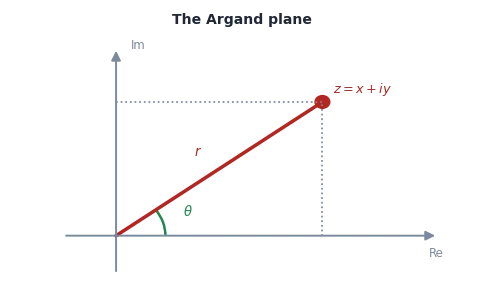
A point on the Argand plane with its modulus r and argument theta, the polar and Euler forms, and the modulus/argument property list
The Argand point, the polar form, and the key properties.
Polar / Euler form
  • (distance from the origin).
  • — fix the quadrant from the signs of x,y.
  • .
  • Principal argument: .
★ Remember · Modulus & argument multiply/divide
and ; and . Multiplication adds angles — the seed of rotation.
🎯 Exam · Triangle inequality
and . Equality in the first holds when point the same way ().
⚠️ Watch out · tan⁻¹ alone gives the wrong quadrant
returns a value in , so for z in the 2nd/3rd quadrant you must add or subtract . Always sketch the Argand point before quoting .
🚫 Examiner Trap · Examiner traps
(1) ONLY gives the right quadrant after you check the signs of x,y — a raw calculator value can be off by . (2) Principal argument lies in . (3) (triangle) with equality only when they are like-directed. (4) but may need to stay principal; .

De Moivre's Theorem, nth Roots & Cube Roots of Unity
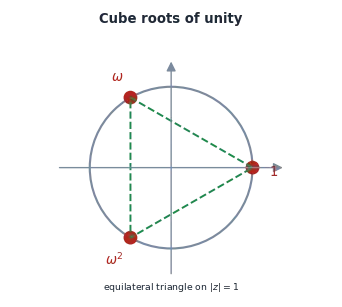
De Moivre's theorem and the n-th roots of unity on the unit circle, the cube roots of unity as an equilateral triangle, and the working properties of omega
De Moivre, the n-th roots of unity, and working with .
De Moivre's theorem: for integer n. In Euler form this is just — the quickest way to take powers and roots of complex numbers.
Cube roots of unity 1, ω, ω²
  • , , .
  • and .
  • .
  • They are the vertices of an equilateral triangle on .
🎯 Exam · n-th roots of unity
The n solutions of are , — equally spaced on the unit circle. Their and they form a regular n-gon.
★ Remember · ω turns sums into zero
Because , any symmetric combination collapses: simplifies fast, and , .
⚠️ Watch out · Reduce the exponent mod 3 (or mod 4 for i)
For high powers of use (work mod 3); for high powers of i use (work mod 4). E.g. since .
🚫 Examiner Trap · Examiner traps
(1) The n n-th roots are EQUALLY spaced on , apart — find one, then rotate. (2) For (cube root of unity): and — reduce any power mod 3. (3) Sum of all n-th roots ; product . (4) and are conjugates: ; use .

Argand Plane — Geometry, Rotation & Locus
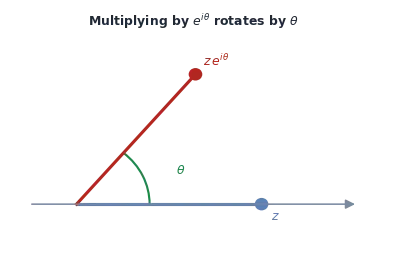
Rotation of a point by multiplying by e^{i theta}, the standard loci (circle, perpendicular bisector, ray, Apollonius circle), and geometry shortcuts
Rotation about the origin and the standard complex loci.
★ Remember · Multiplying by rotates
rotates z by angle about the origin (modulus unchanged). To rotate about another point : . Multiplying by i is a rotation.
Standard loci
  • : circle, centre , radius r.
  • : perpendicular bisector of segment .
  • : a ray starting at .
  • : circle if , straight line if .
🎯 Exam · Read the geometry from the algebra
is an ellipse (foci ); a hyperbola. Three points are collinear is real.
★ Remember · Distance & section work like coordinates
is the distance between the points, and the section/midpoint formulas carry over directly — so coordinate-geometry intuition transfers straight onto the Argand plane.
🚫 Examiner Trap · Examiner traps
(1) Multiplying by ROTATES by about O (no scaling, since ). (2) is a CIRCLE; is the perpendicular BISECTOR of ab (a line, not a circle). (3) is a circle for but a LINE when . (4) Rotate about by : — subtract the centre first.

Quadratic Equations — Discriminant & Nature of Roots

Quadratic equation: () has roots . The quantity (the ) decides everything about the nature of the roots.
Nature of roots (real )
Discriminant Roots
real and distinct
real and equal
conjugate complex pair
, perfect squarerational (if rational)
, not perfect squareirrational conjugate surds
🎯 Exam · Conjugate-pair rule
With coefficients, complex roots occur in conjugate pairs . With coefficients, irrational (surd) roots occur in conjugate pairs . So a quadratic with one root must have as the other.
★ Remember · Degree n ⇒ n roots
By the fundamental theorem of algebra, a degree-n polynomial has exactly n roots (counting multiplicity and complex roots). A quadratic always has roots — real or complex.
⚠️ Watch out · ‘Real coefficients’ is the catch
The conjugate-pair rule needs real coefficients. If the coefficients are themselves complex, the roots need be conjugates — solve directly with the formula instead.
🚫 Examiner Trap · Examiner traps
(1) : real distinct, real equal, complex conjugate — and 'rational roots' needs D a PERFECT SQUARE with rational a,b,c. (2) Complex/surd roots occur in CONJUGATE PAIRS ONLY when coefficients are real/rational. (3) does NOT mean 'no roots' — it means one repeated root . (4) A degree-n polynomial has exactly n roots counting multiplicity.

Roots & Coefficients, Formation & Common Roots

★ Remember · Sum and product of roots
If are the roots of : and . To build an equation from roots: , i.e. .
Symmetric functions (S = α+β, P = αβ)
  • .
  • (note ).
  • .
  • .
🎯 Exam · Common roots
common root of and : . roots common: .
★ Remember · Read conditions off the coefficients
Reciprocal roots ; roots equal in magnitude, opposite sign ; one root zero ; roots of opposite sign (product negative).
🚫 Examiner Trap · Examiner traps
(1) Sign trap: (NEGATIVE ), . (2) Build the equation as with sum, product — don't drop the minus on S. (3) and . (4) Condition for a COMMON root: .

Quadratic Expression — Graph, Sign & Max/Min
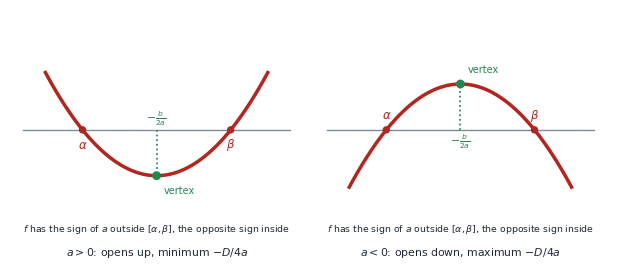
Parabolas opening up (a>0, minimum) and down (a<0, maximum) with their vertices, the vertex and extreme-value formulas, and the sign analysis and position of roots
The parabola, its vertex/extremum, and sign analysis.
★ Remember · Vertex and extreme value
is a parabola opening if , if . Vertex at ; the extreme value is (a minimum if , a maximum if ).
Sign of f(x)
  • : f(x) keeps the sign of a for x (no real root).
  • : f has the sign of a outside the roots, the opposite sign between them.
  • Always positive and ; always negative and .
  • Range of f: if , if .
🎯 Exam · Where do the roots sit?
A number k lies the roots . Both roots needs , and (the vertex on the right side).
⚠️ Watch out · Don't forget the a > 0 / a < 0 split
Every sign and position statement flips with the sign of a. When you reduce a question to '', remember it really means '' — check whether the parabola opens up or down first.
🚫 Examiner Trap · Examiner traps
(1) Parabola opens UP if (minimum) and DOWN if (maximum) — the extreme value is at . (2) f(x) keeps the sign of a for ALL x when . (3) 'k lies between the roots' (a single condition); both roots needs , AND . (4) Don't forget the requirement for a quadratic.

More JEE Main Mathematics formula sheets

Frequently Asked Questions

What are the most important Complex Numbers and Quadratic Equations formulas for JEE Main?

This Complex Numbers and Quadratic Equations formula sheet covers all the high-yield Mathematics formulas, definitions and theorems you need for JEE Main, across Complex numbers as ordered pairs of reals, Representation of complex numbers in the form a+ib, Argand plane and polar representation, Algebra of complex numbers, Modulus and argument of complex numbers — each shown with the key result and, where useful, a worked example.

Is this Complex Numbers and Quadratic Equations formula sheet free?

Yes — the full chapter formula sheet is free to read online, no login or payment required.

How should I revise Complex Numbers and Quadratic Equations formulas?

Blurt the Complex Numbers and Quadratic Equations formulas from memory, then check against this sheet to find your gaps — and practise a few previous-year questions on the chapter to make sure you can apply them under time pressure.

Also useful: all formula sheets · JEE Main previous-year papers · most important chapters.