
JEEnify Logo
JEEnify
All formula sheets

Permutations and Combinations Formula Sheet — JEE Main Mathematics

Every key Permutations and Combinations formula, definition and theorem for JEE Main Mathematics in one place — with common examiner traps and worked examples. Free to read; blurt from memory, then check your gaps.

Syllabus — topics coveredNTA · 5 sub-topics

  • Fundamental principle of counting
  • Factorial n
  • Permutations and combinations
  • Derivation of formulae and their connections
  • Simple applications

Counting Principle & Factorials

Fundamental principle of counting: for tasks done in succession ('this AND then that'); for mutually exclusive alternatives ('this OR that'). Almost every counting problem is built from these two rules.
★ Remember · AND multiplies, OR adds
Filling several places in a row (each a sub-choice) the counts. Splitting into separate non-overlapping cases the case counts. Getting these two backwards is the most common slip.
🎯 Exam · Factorial essentials
, with and . The ratio is exactly r falling factors — the backbone of .
★ Remember · Highest power of a prime in n!
The exponent of a prime p in n! is (Legendre's formula) — useful for trailing-zero and divisibility questions about factorials.
🚫 Examiner Trap · Examiner traps
(1) AND MULTIPLY (multiplication principle); OR (mutually exclusive) ADD — mixing these up is the #1 error. (2) by convention (not ). (3) The addition rule needs the cases to be MUTUALLY EXCLUSIVE, else subtract the overlap. (4) Exponent of a prime p in n! is (Legendre) — used for trailing zeros.

Permutations — Arrangements & Repetition

Permutation: An in which order matters. The number of arrangements of n distinct objects taken r at a time (no repetition) is .
Key permutation counts
  • All n taken together: .
  • Repetition allowed, r places from n kinds: .
  • and .
  • Link to selections: .
★ Remember · Think in slots
Draw the r blanks. Fill the first in n ways, the next in , and so on (no repetition) — multiplying gives . If repetition is allowed, every blank has n choices, giving .
⚠️ Watch out · Order matters ⇒ permutation
Use a permutation when rearranging gives a outcome (a ranking, a number, a seating). If swapping two chosen items changes nothing (a committee, a hand of cards), it is a instead.
🚫 Examiner Trap · Examiner traps
(1) Permutation order MATTERS; combination order doesn't — decide this first. (2) (a selection its arrangements). (3) With repetition allowed it's , NOT . (4) and (no slip).

Permutations — Restrictions, Alike Objects & Circular
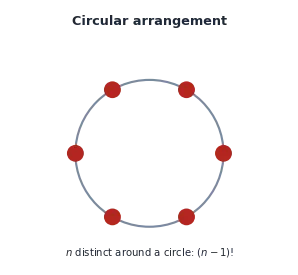
Arrangements with repeated (alike) objects, the together and never-together rules, circular permutations, and the gap and necklace methods
Restricted arrangements, the gap method and circular permutations.
★ Remember · When some objects are alike
If among n objects p are alike of one kind, q of another, ..., the number of distinct arrangements is (e.g. the letters of MISSISSIPPI). Divide out the rearrangements you cannot tell apart.
Together / not together / circular
  • : tie the k items into one block .
  • : total together, or the gap method.
  • : arrange m others (m!), drop the rest into the gaps.
  • of n distinct: ; necklace/garland: .
🎯 Exam · Why circular is (n−1)!
On a round table, every arrangement can be rotated into n identical-looking copies, so we fix one person and arrange the remaining : . If a flip also looks the same (beads on a string), halve it to .
⚠️ Watch out · Gap method needs the rest placed first
For 'no two of a set together', arrange the unrestricted items, slot the restricted ones into the gaps — never the other way round, or you over-count adjacencies.
🚫 Examiner Trap · Examiner traps
(1) Alike objects DIVIDE: n things with alike . (2) Circular arrangements are (fix one to kill rotation), and for a necklace/garland (reflection counts as same). (3) 'Together' tie into one block ; 'never together' total together (or GAP method). (4) Gap method: arrange m free items (m!), then drop the rest into the gaps.

Combinations — nCr & Its Identities

Combination: A where order does not matter. The number of ways to choose r from n distinct objects is — a permutation is a selection followed by an arrangement.
Combination identities
IdentityFormula
Symmetry
Pascal
Row sum
Ratio
or
Greatest term largest at
Identities to know
  • Symmetry: .
  • Pascal: .
  • Row sum: .
  • If then or .
🎯 Exam · The ratio trick
— the fastest way to find where is increasing/decreasing. It is greatest at (the middle term).
★ Remember · Selection then arrangement
Many 'word' problems split into two steps: first the letters (), then them (multiply by the appropriate permutation count). Keep the two steps separate to avoid double counting.
🚫 Examiner Trap · Examiner traps
(1) (symmetry) — use the smaller r to compute. (2) OR (don't drop the second case). (3) Pascal: . (4) is largest at (middle term); .

Selection Patterns — Subsets, 'At Least' & Repetition

Subsets and 'at least'
  • Total subsets of n distinct objects: (each object in or out).
  • Select at least one: (drop the empty set).
  • At least one from groups of alike: .
  • Number of divisors of : .
🎯 Exam · Selection with repetition
Choosing r objects from n kinds with unlimited repetition (order irrelevant) is — the same stars-and-bars count as putting r identical balls into n boxes.
★ Remember · Complementary counting
For 'at least one' conditions it is almost always faster to count the and subtract the 'none' case: . The formula is exactly this idea.
⚠️ Watch out · Alike vs distinct changes everything
Selecting from objects uses the 'how many to take' factor; selecting from objects uses or . Read carefully whether the objects are identical or not before choosing a formula.
🚫 Examiner Trap · Examiner traps
(1) 'At least one' (total) (none): total subsets , so at-least-one . (2) Select from groups of p,q,r ALIKE (the removes 'pick nothing'). (3) Choose r with repetition from n kinds . (4) Number of divisors of is — count exponent choices.

Distribution of Objects into Groups & Boxes

★ Remember · Stars and bars (identical objects)
Distributing n objects into r boxes = non-negative integer solutions of : each box gives ; each box gives .
Distinct objects
  • Into r distinct boxes (any number each): .
  • Into labelled groups of sizes p,q,s: .
  • If groups are equal-sized and unlabelled: divide by an extra .
  • Onto distributions (no empty box) need inclusion–exclusion.
🎯 Exam · Labelled vs unlabelled groups
52 cards to 4 named players of 13 each: . The same cards into 4 equal piles: — divide by because the piles are indistinguishable.
⚠️ Watch out · Equal groups need the extra k!
Forgetting to divide by k! when k groups have the same size is the classic over-counting error. Always ask: are the groups (named) or not?
🚫 Examiner Trap · Examiner traps
(1) IDENTICAL objects into distinct boxes (stars & bars): , — pick the right floor. (2) DISTINCT objects into r distinct boxes (each object chooses a box). (3) Dividing into groups of sizes p,q,s: labelled ; if k groups are EQUAL and UNLABELLED, divide by an extra k!. (4) Don't double-count equal unnamed piles.

Applications — Geometry, Word Rank & Derangements
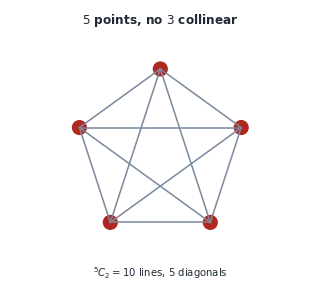
Geometry counting from n points (lines, triangles, diagonals, handshakes), a pentagon example, and the rank-of-a-word and derangement methods
Geometry counting, word rank, and derangements.
★ Remember · Geometry from n points (no 3 collinear)
Lines , triangles , diagonals of an n-gon , handshakes . If m points are collinear, subtract from lines and from triangles.
🎯 Exam · Rank of a word
List letters in dictionary order. Scanning left to right, at each position count the unused letters than the current one, multiply by the factorial of the remaining places, sum these, and add for the word itself.
★ Remember · Derangements
No object in its original place: , so (also ).
⚠️ Watch out · Watch for repeated letters in rank problems
When a word has repeated letters, the factorial of the remaining places must be divided by the factorials of the repeats (the alike-objects rule) at each step — otherwise the rank comes out too large.
🚫 Examiner Trap · Examiner traps
(1) With n points, no 3 collinear: lines , triangles , diagonals of an n-gon . (2) If m points ARE collinear, SUBTRACT lines (they give 1 not ) and triangles. (3) Word rank: count smaller unused letters at each position, factorial of remaining places, sum . (4) Derangements ; .

More JEE Main Mathematics formula sheets

Frequently Asked Questions

What are the most important Permutations and Combinations formulas for JEE Main?

This Permutations and Combinations formula sheet covers all the high-yield Mathematics formulas, definitions and theorems you need for JEE Main, across Fundamental principle of counting, Factorial n, Permutations and combinations, Derivation of formulae and their connections, Simple applications — each shown with the key result and, where useful, a worked example.

Is this Permutations and Combinations formula sheet free?

Yes — the full chapter formula sheet is free to read online, no login or payment required.

How should I revise Permutations and Combinations formulas?

Blurt the Permutations and Combinations formulas from memory, then check against this sheet to find your gaps — and practise a few previous-year questions on the chapter to make sure you can apply them under time pressure.

Also useful: all formula sheets · JEE Main previous-year papers · most important chapters.