JEEnify Logo
JEEnify
All formula sheets

Limit, Continuity and Differentiability Formula Sheet — JEE Main Mathematics

Every key Limit, Continuity and Differentiability formula, definition and theorem for JEE Main Mathematics in one place — with common examiner traps and worked examples. Free to read; blurt from memory, then check your gaps.

Syllabus — topics coveredNTA · 10 sub-topics

  • Real valued functions
  • Algebra of functions
  • Polynomial, rational, trigonometric, logarithmic and exponential functions
  • Graphs of simple functions
  • Limits, continuity
  • Differentiation of sum, difference, product and quotient of functions
  • Differentiation of trigonometric, inverse trigonometric, logarithmic, exponential, composite and implicit functions
  • Derivatives of order up to two
  • Rolle's and Lagrange's Mean Value Theorems
  • Applications of derivatives: rate of change of quantities, monotonic functions, maxima and minima

Limits — Definition & Evaluation

Limit: means f(x) gets arbitrarily close to L as . It the left-hand limit equals the right-hand limit (LHL RHL); the value f(a) itself is irrelevant to the limit.
How to evaluate
  • — if you get a finite number, that's the limit.
  • : factor and cancel, or rationalise a surd.
  • (as ): divide top and bottom by the highest power of x.
  • or : combine into a single fraction first.
🎯 Exam · The seven indeterminate forms
. Only these need extra work; for take logarithms first.
⚠️ Watch out · 2/0 is not indeterminate
A form like or is — it is (or undefined) and respectively. Only the seven forms above are genuinely indeterminate.
★ Remember · Use LHL and RHL for piecewise/GIF
For piecewise functions, , the greatest-integer [x] or -type behaviour, always compute the LHL () and RHL () separately — the limit exists only if they match.
🚫 Examiner Trap · Examiner traps
(1) A limit EXISTS only if LHL RHL (both finite and equal) — and that value need NOT equal f(a). (2) or is NOT indeterminate — it is (or undefined); only are. (3) Substitute first; only do extra work if you hit an indeterminate form. (4) only when both limits EXIST.

Standard Limits & Indeterminate-Form Tricks

Standard limits (as )
LimitValue
(as )
Memorise (all as x → 0 unless shown)
  • , , .
  • , , .
  • and .
  • as .
★ Remember · L'Hopital's rule
For a or form, — differentiate numerator and denominator (not as a quotient), then re-evaluate; repeat if still indeterminate.
🎯 Exam · The 1^∞ shortcut
If and , then . For example .
⚠️ Watch out · L'Hopital only for 0/0 or ∞/∞
You may only apply L'Hopital once the form is genuinely or . For , first convert to one of those (take logs or combine fractions).
🚫 Examiner Trap · Examiner traps
(1) The standard limits hold as in RADIANS: , (note the ). (2) form: when — don't just write . (3) L'Hôpital applies ONLY to or ; convert other forms first. (4) (base matters); .

Continuity

Continuity at a point: f is continuous at iff — that is, , with all three existing and equal. A break in any one of these makes f discontinuous there.
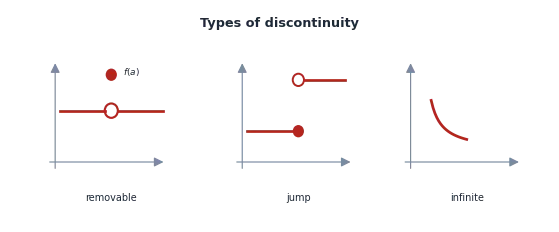
The definition of continuity, sketches of removable, jump and infinite discontinuities, and the properties of continuous functions
Continuity, the kinds of discontinuity, and the properties.
Types of discontinuity
  • : the limit exists but (a single hole).
  • : LHL and RHL both exist but differ.
  • : a one-sided limit is (a vertical asymptote).
  • Polynomials, are continuous everywhere.
🎯 Exam · Continuity at a join
For a piecewise f, continuity at the join needs — set up these equalities to solve for any unknown constants in the definition.
★ Remember · Building continuous functions
Sums, differences, products, quotients (where the denominator is nonzero) and of continuous functions are continuous. So you rarely check from the definition unless there is a join or a removable hole.
⚠️ Watch out · Limit existing ≠ continuous
A function can have a perfectly good limit at a yet be discontinuous there if f(a) is missing or has the 'wrong' value (a removable discontinuity). Continuity requires the limit to f(a).
🚫 Examiner Trap · Examiner traps
(1) Continuity at a needs ALL THREE: exists, f(a) defined, and they're EQUAL. (2) Removable (hole) vs jump vs infinite discontinuity — a redefinable point is removable only. (3) At a join of a piecewise function set LHL RHL to find the unknown constant. (4) A function continuous on a CLOSED interval attains its max & min there (and every value between).

Differentiability

Derivative at a point: , the slope of the tangent at . It exists iff the (and both are finite).
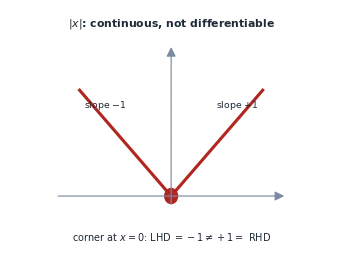
The derivative as a limit, the graph of |x| with its corner showing continuity without differentiability, and the key implication that differentiable implies continuous
The derivative, the corner, and the key implication.
★ Remember · Differentiable ⇒ continuous (not conversely)
Every differentiable function is continuous, but a continuous function need not be differentiable. is the classic example: continuous everywhere, but its corner at has LHD RHD.
Where differentiability fails
  • (like ): the two one-sided slopes differ.
  • and : the slope blows up.
  • Any point of (a break can't have a tangent).
  • To test at a join: confirm continuity first, then equate LHD and RHD.
🎯 Exam · The standard test at a point
For f defined piecewise around a: (1) check it is continuous at a; (2) compute LHD and RHD similarly; (3) f is differentiable at a iff they are equal and finite.
⚠️ Watch out · Continuous everywhere ≠ differentiable everywhere
Don't assume a continuous-looking function is differentiable. Absolute values, definitions, and the greatest-integer function all create corners or breaks where the derivative fails to exist.
🚫 Examiner Trap · Examiner traps
(1) Differentiable continuous, but NOT conversely ( is continuous, not differentiable at ). (2) Fails at corners, cusps, vertical tangents and any discontinuity. (3) Differentiable at a needs LHD RHD (both finite) — check continuity FIRST, then equate the one-sided derivatives. (4) 'Differentiable at a?' usually hides a corner/break — don't assume.

Differentiation Rules & Standard Derivatives

Standard derivatives
★ Remember · The three rules
; ; chain: . The chain rule underlies almost every non-trivial derivative.
Standard derivatives
  • ; ; ; .
  • ; ; .
  • ; .
  • Inverse co-functions just flip the sign: , etc.
🎯 Exam · Differentiate outside-in
For nested functions like , differentiate the outermost layer, then multiply by the derivative of the inside, repeatedly: .
⚠️ Watch out · Don't quotient-rule what you can simplify
Simplify before differentiating where possible (cancel, use log/exponent laws, split a sum). A messy quotient rule is a common source of algebra errors when a quick simplification was available.
🚫 Examiner Trap · Examiner traps
(1) Quotient rule numerator is (in THAT order) over — sign and order matter. (2) Chain rule: differentiate outside-in and MULTIPLY by the inner derivative (most-missed factor). (3) (the is essential); , . (4) and derivatives carry a MINUS sign.

Methods of Differentiation

★ Remember · Implicit & parametric
: differentiate both sides w.r.t. x treating y as a function (every y brings a via the chain rule), then solve for . : .
🎯 Exam · Logarithmic differentiation
For (a variable base AND a variable power) or a big product/quotient, take of both sides first, then differentiate: , and multiply back by y at the end.
More tools
  • : ; differentiate again for
  • : .
  • : simplify inverse-trig forms (e.g. put ) before differentiating.
  • For a parametric second derivative, differentiate w.r.t. t then divide by .
⚠️ Watch out · Parametric d²y/dx² isn't (d²y/dt²)/(d²x/dt²)
The second parametric derivative is — you differentiate the again, the second t-derivatives separately.
🚫 Examiner Trap · Examiner traps
(1) Logarithmic differentiation is REQUIRED for (variable base AND power) — power/exponent rules alone fail. (2) Implicit: differentiate both sides w.r.t. x, treating y as a function (chain rule), then solve for . (3) Parametric: , and — NOT . (4) Simplify inverse-trig by substitution () before differentiating.

Applications of Derivatives

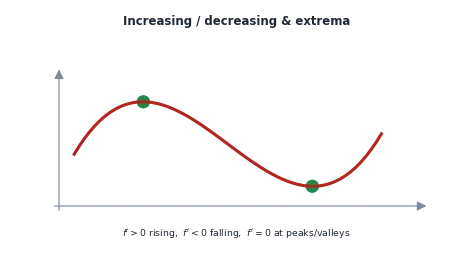
Increasing/decreasing and extrema on a curve, the second-derivative test for maxima/minima, and tangents, normals, rate of change and the mean value theorems
Monotonicity, extrema, tangents/normals and the MVTs.
★ Remember · Increasing / decreasing & extrema
f is increasing where and decreasing where . Maxima/minima occur at ( or undefined); use max, min, or the sign change of f'.
Tangents, normals & rates
  • Tangent at : slope ; slope .
  • Related rates: (chain rule).
  • On a closed interval, test endpoints as well as interior critical points.
  • Absolute (global) extremum = the largest/smallest of all these candidate values.
🎯 Exam · The mean value theorems
: if f is continuous on [a,b], differentiable on (a,b) and , then for some . : for some .
⚠️ Watch out · Check the hypotheses first
Rolle's and Lagrange's theorems require f [a,b] (a,b). If f has a corner or break in the interval, the theorem need not apply — verify the hypotheses before quoting the conclusion.
🚫 Examiner Trap · Examiner traps
(1) Critical points are where OR f' is undefined — don't forget the second kind. (2) max, min; if use the sign change of f'. (3) On a CLOSED interval also test the ENDPOINTS for the global max/min. (4) Rolle needs ; MVT gives — both need continuity on [a,b] and differentiability on (a,b).

More JEE Main Mathematics formula sheets

Frequently Asked Questions

What are the most important Limit, Continuity and Differentiability formulas for JEE Main?

This Limit, Continuity and Differentiability formula sheet covers all the high-yield Mathematics formulas, definitions and theorems you need for JEE Main, across Real valued functions, Algebra of functions, Polynomial, rational, trigonometric, logarithmic and exponential functions, Graphs of simple functions, Limits, continuity — each shown with the key result and, where useful, a worked example.

Is this Limit, Continuity and Differentiability formula sheet free?

Yes — the full chapter formula sheet is free to read online, no login or payment required.

How should I revise Limit, Continuity and Differentiability formulas?

Blurt the Limit, Continuity and Differentiability formulas from memory, then check against this sheet to find your gaps — and practise a few previous-year questions on the chapter to make sure you can apply them under time pressure.

Also useful: all formula sheets · JEE Main previous-year papers · most important chapters.