JEEnify Logo
JEEnify
All formula sheets

Integral Calculus Formula Sheet — JEE Main Mathematics

Every key Integral Calculus formula, definition and theorem for JEE Main Mathematics in one place — with common examiner traps and worked examples. Free to read; blurt from memory, then check your gaps.

Syllabus — topics coveredNTA · 12 sub-topics

  • Integral as an anti-derivative
  • Fundamental integrals involving algebraic, trigonometric, exponential and logarithmic functions
  • Integration by substitution
  • Integration by parts
  • Integration by partial fractions
  • Integration by parts and by partial fractions
  • Integration using trigonometric identities
  • Evaluation of simple integrals
  • Definite integrals as a limit of a sum
  • Fundamental Theorem of Calculus
  • Basic properties of definite integrals
  • Evaluation of definite integrals

Indefinite Integration — Standard Integrals

Indefinite integral: where — integration undoes differentiation. The C makes the answer a whole family of curves, so never omit it.
Standard integrals (add )
IntegralResult
()
The ones to know cold
  • (); .
  • ; .
  • ; ; .
  • ; .
★ Remember · Linearity
. Constants pull out and sums split — so simplify or split the integrand before reaching for a heavier method.
🎯 Exam · The n = −1 exception
The power rule fails at (it would divide by zero); that case is the logarithm . Keep the — the domain includes negative x.
⚠️ Watch out · Check by differentiating
An antiderivative is only right if differentiating it gives back the integrand. When unsure, — it is the fastest way to catch a sign or chain-rule slip.
🚫 Examiner Trap · Examiner traps
(1) NEVER drop the constant on an indefinite integral. (2) FAILS at — there (absolute value!). (3) , — memorise the log forms. (4) but — don't swap the .

Integration by Substitution & Particular Forms

★ Remember · The substitution idea
Put so : then . Two patterns to spot instantly: and .
Particular forms (with a)
  • .
  • .
  • .
  • .
🎯 Exam · Complete the square
For or , complete the square to turn the quadratic into , then match one of the particular forms above.
⚠️ Watch out · Don't forget to change dx
When you substitute , you must replace dx using — the integral has to be written in terms of u before you integrate. Leaving a stray x or dx is the classic error.
🚫 Examiner Trap · Examiner traps
(1) After substituting you MUST replace dx via — a leftover x means the wrong substitution. (2) and — spot the derivative on top. (3) Distinguish () from () from (/). (4) For , COMPLETE THE SQUARE first.

Integration by Parts

Integration by parts: (from the product rule). Choose which factor is u by — Inverse-trig, Logarithmic, Algebraic, Trigonometric, Exponential — taking the earliest in that list as u (the one to differentiate).
★ Remember · The (f + f') shortcut
. Recognising this shape (e.g. ) saves a full by-parts computation.
Standard by-parts integrals
  • .
  • .
  • : parts twice, then solve for the integral (it reappears).
  • : repeated parts lowers the power of x step by step.
🎯 Exam · Log and inverse-trig come first
When the integrand is just or (no obvious second factor), take that function and (so ). ILATE puts L and I before A, so they are almost always the u.
⚠️ Watch out · Pick u so the integral gets simpler
The goal of by parts is that is than the original. If your choice makes it worse, swap u and dv. ILATE is a guide, not a law — but it works almost every time.
🚫 Examiner Trap · Examiner traps
(1) Choose u by ILATE (Inverse-trig, Log, Algebraic, Trig, Exponential) — the EARLIER one is u. (2) The formula is ; the minus sign and the second integral are easy to drop. (3) — recognise this shape. (4) For apply parts TWICE and solve for the integral (it reappears).

Partial Fractions & Trigonometric Integrals

Partial fractions
  • Make the rational function first (divide if the degree of the top the bottom).
  • Linear factor ; repeated .
  • Irreducible quadratic .
  • Find by substituting roots or comparing coefficients, then integrate each piece.
★ Remember · Trig integral techniques
Power-reduce: , . Turn products into sums (). For with an odd power, substitute; for rational-in-, use .
🎯 Exam · Pick the method from the shape
partial fractions; by parts; substitution; trig identities first.
⚠️ Watch out · Make it proper before decomposing
Partial fractions only work on a fraction (numerator degree denominator degree). If it isn't, do the polynomial division first; the quotient integrates trivially and the remainder becomes the proper fraction.
🚫 Examiner Trap · Examiner traps
(1) Make the rational function PROPER (divide) BEFORE partial fractions. (2) A repeated factor needs BOTH and ; an irreducible quadratic needs . (3) For even powers of use ; for an ODD power, substitute. (4) type: use (Weierstrass).

Definite Integrals — FTC & Limit of a Sum

Fundamental Theorem of Calculus: If then — no constant needed. Also (Leibniz), linking the definite integral back to the derivative.
The Fundamental Theorem of Calculus, the definite integral as a limit of a sum of rectangles, and the steps for evaluating a definite integral
The FTC, the limit-of-a-sum picture, and evaluation.
★ Remember · Definite integral as a limit of a sum
with — the signed area under the curve, approximated by rectangles. This is the definition behind 'evaluate the limit of a sum' problems.
Evaluating cleanly
  • Find an antiderivative , then compute .
  • On a substitution, to the new variable (or back-substitute first).
  • The value is a (signed area), not a function .
  • Area below the -axis is negative — split at the roots for the true (unsigned) area.
🎯 Exam · Leibniz rule for variable limits
— differentiate an integral whose limits are functions of x without evaluating it.
⚠️ Watch out · Watch for discontinuities in [a, b]
The FTC needs f continuous on [a,b]. If the integrand blows up inside the interval (e.g. ), the integral is — naively applying gives a wrong (often negative) answer.
🚫 Examiner Trap · Examiner traps
(1) FTC: — a definite integral is a NUMBER, no . (2) On substitution either CHANGE the limits to the new variable or back-substitute before applying them — don't mix. (3) Area below the x-axis counts as NEGATIVE in ; for true (unsigned) area split at the roots and take . (4) (Leibniz) — differentiate the upper limit.

Properties of Definite Integrals

Properties of definite integrals
PropertyFormula
Dummy variable
Reverse limits
Split the interval
King's rule
to
Even / odd (even); (odd)
to
Periodic
★ Remember · King's rule
. Adding the integral to its 'king' copy often makes the integrand collapse to a constant — the single most powerful definite-integral trick (e.g. ).
The properties
  • (split anywhere).
  • if f is even, if f is odd.
  • .
  • Periodic (): .
🎯 Exam · Even/odd is a free win
Always check the symmetry of the integrand on a symmetric interval : an part integrates to , so and only the even part survives (). This kills many integrals instantly.
⚠️ Watch out · King's rule keeps the same limits
When you apply , the — only the integrand is rewritten with . A common slip is to alter the limits as well.
🚫 Examiner Trap · Examiner traps
(1) King's rule — the workhorse for symmetric integrands; add the two to simplify. (2) Even/odd over : if even, if ODD — check the symmetry first. (3) Reversing limits flips the SIGN. (4) ; equals only when .

Area Under & Between Curves

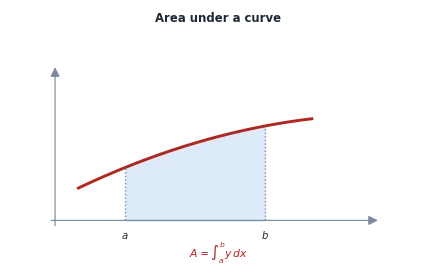
Area under a curve as the integral of y dx, area between two curves as the integral of upper minus lower, and tips for setting up an area integral
Area under a curve, area between curves, and how to set it up.
★ Remember · The area formulas
Area under (above the axis) from a to b: . Area two curves: , with the limits given by the intersection points; integrate w.r.t. y () when x is the easier variable.
Setting it up
  • the region first and find where the curves meet (these are the limits).
  • Use where present — integrate half the region and double.
  • If the curve dips below the x-axis, take (split at the roots) for true area.
  • Choose vertical strips () or horizontal strips () — whichever needs fewer integrals.
🎯 Exam · Upper minus lower, always
Between two curves the integrand is over the whole region, which keeps the area positive automatically. If the curves cross inside [a,b], split at the crossing and swap which is on top.
⚠️ Watch out · Signed integral ≠ geometric area
A plain gives the area and can be zero or negative even when the region has positive area (e.g. ). For geometric area, integrate by splitting at the zeros.
🚫 Examiner Trap · Examiner traps
(1) Area — always top MINUS bottom; the result is positive. (2) SKETCH first and find intersection points (they set the limits). (3) If the curve dips below the axis, take (split at the roots) for actual area, else signed area is wrong. (4) Choose vertical strips (dx) or horizontal strips (dy, integrate ) — whichever needs fewer pieces.

More JEE Main Mathematics formula sheets

Frequently Asked Questions

What are the most important Integral Calculus formulas for JEE Main?

This Integral Calculus formula sheet covers all the high-yield Mathematics formulas, definitions and theorems you need for JEE Main, across Integral as an anti-derivative, Fundamental integrals involving algebraic, trigonometric, exponential and logarithmic functions, Integration by substitution, Integration by parts, Integration by partial fractions — each shown with the key result and, where useful, a worked example.

Is this Integral Calculus formula sheet free?

Yes — the full chapter formula sheet is free to read online, no login or payment required.

How should I revise Integral Calculus formulas?

Blurt the Integral Calculus formulas from memory, then check against this sheet to find your gaps — and practise a few previous-year questions on the chapter to make sure you can apply them under time pressure.

Also useful: all formula sheets · JEE Main previous-year papers · most important chapters.