
JEEnify Logo
JEEnify
All formula sheets

Differential Equations Formula Sheet — JEE Main Mathematics

Every key Differential Equations formula, definition and theorem for JEE Main Mathematics in one place — with common examiner traps and worked examples. Free to read; blurt from memory, then check your gaps.

Syllabus — topics coveredNTA · 6 sub-topics

  • Ordinary differential equations
  • Order and degree
  • Formation of differential equations
  • Solution of differential equations by method of separation of variables
  • Solution of homogeneous differential equations of first order and first degree
  • Solutions of linear differential equation

Order, Degree & Classification

Differential equation: An equation relating x, y and the derivatives . The is the order of the highest derivative present; the is the power of that highest-order derivative (when the equation is a polynomial in the derivatives).
Reading off order and degree
  • = highest derivative; = its power (polynomial form only).
  • : order 2, degree .
  • Clear radicals/fractions of derivatives first (e.g. square ).
  • If a derivative sits inside , the .
★ Remember · Order = number of arbitrary constants
A general solution carries exactly as many independent arbitrary constants as the order of the equation. So a 2nd-order DE has a two-parameter family of solutions (), and a 1st-order DE a one-parameter family.
🎯 Exam · Linear differential equation
A DE is if y and all its derivatives appear to the first power with no products among them, i.e. . Anything like y\,y', or makes it non-linear.
⚠️ Watch out · Make it a polynomial in derivatives first
Degree is only defined once the equation is free of radicals and fractional powers of the derivatives. must be squared before you can read its degree (here ).
🚫 Examiner Trap · Examiner traps
(1) DEGREE is defined ONLY when the equation is polynomial in the derivatives — or a /fraction of a derivative has NO degree until you clear it. (2) Square/rationalise FIRST, then read order & degree (degree power of the HIGHEST-order derivative). (3) Order highest derivative present (independent of degree). (4) The general solution has as many arbitrary constants as the ORDER.

Formation of a Differential Equation

★ Remember · The procedure
Given a family with n independent arbitrary constants, n and eliminate the constants between the original equation and its derivatives. The resulting constant-free equation is a DE of order n.
Worked ideas
  • ( constants) differentiate twice .
  • ( constant) .
  • ( constants) a 2nd-order linear DE.
  • Count the constants first — that fixes the order.
🎯 Exam · Independent constants only
Combine constants that aren't truly independent before counting: has only arbitrary constant, so it gives a first-order DE, not second.
⚠️ Watch out · Eliminate, don't just differentiate
Differentiating is only half the job — you must then every arbitrary constant. A correct formed DE contains x,y and derivatives but of the original constants.
🚫 Examiner Trap · Examiner traps
(1) To form a DE, count the INDEPENDENT arbitrary constants — that number is the ORDER, and you differentiate that many times. (2) Eliminate ALL constants; the final equation must be free of them. (3) (2 constants) order 2 (); (1 constant) order 1. (4) Don't count a removable/duplicate constant twice.

Variable Separable Equations

Variable separable: If , the variables can be separated: gather all the y's (with dy) on one side and the x's (with dx) on the other, then integrate — .
Recognising & handling
  • Anything that factors as (x-only)(y-only) is separable.
  • separates as .
  • : substitute to make it separable.
  • Apply the initial condition at the end to find C.
🎯 Exam · The t = ax + by + c substitution
For , let so . This converts it into a separable equation in t and x — a very common exam disguise.
⚠️ Watch out · Don't lose constant solutions
Dividing by g(y) silently assumes . If , then is also a solution — check these , since they can be the very answer asked for.
🚫 Examiner Trap · Examiner traps
(1) Get ALL y (with dy) on one side and ALL x (with dx) on the other BEFORE integrating — half-separated is the common slip. (2) Don't LOSE constant solutions: if then is also a solution. (3) is made separable by . (4) Add and apply any initial condition at the END to get the particular solution.

Homogeneous Differential Equations

Homogeneous equation: A first-order DE is homogeneous if it can be written — equivalently with P,Q homogeneous of the . The substitution reduces it to a separable equation.
★ Remember · Put y = vx
With , , so — now separable: . Integrate, then substitute back at the end.
How to spot one
  • Every term has the same total degree: .
  • Both numerator and denominator of are homogeneous of equal degree.
  • If it appears as instead, put .
  • After substituting it is variable-separable in the new variable.
⚠️ Watch out · Substitute v back at the end
A common slip is to leave the answer in terms of v. After integrating, replace everywhere so the solution is in x and y. Keep the constant C throughout.
🎯 Exam · Non-homogeneous-in-x,y but reducible
Equations like are made homogeneous by shifting to kill the constants (choose h,k as the intersection point of the two lines).
🚫 Examiner Trap · Examiner traps
(1) Homogeneous means (every term same total degree) — substitute , so (DON'T forget the term). (2) After substituting it ALWAYS becomes variable-separable in v,x. (3) If it's instead, put . (4) Remember to put back at the end.

Linear Equations & the Integrating Factor

Linear first-order equation: An equation of the form , where P,Q are functions of x alone. It is solved with the , which turns the left side into an exact derivative.
★ Remember · The solution formula
, and the solution is . (Multiplying by the IF makes the left side , which is why it works.)
The three steps
  • Write it in standard form to read off and .
  • Compute (no constant needed here).
  • Apply .
  • If y is awkward but x is linear, swap roles: .
🎯 Exam · The dx/dy variant
When is not linear in y but the equation is linear in x, treat x as the dependent variable: with and .
⚠️ Watch out · P and Q must be single-variable
For the IF method, P and Q must depend on x (or y only in the variant). If a stray y remains on the coefficient side, the equation isn't yet in linear form — rearrange or try Bernoulli.
🚫 Examiner Trap · Examiner traps
(1) Write in STANDARD form first; P,Q must be functions of x ALONE (no y). (2) Integrating factor — no inside this exponent. (3) Solution: . (4) If y isn't linear but x is, swap roles: with .

Reducible Forms — Bernoulli & Exact

★ Remember · Bernoulli equation
: divide by and substitute . This gives , a equation in v — finish with the integrating factor.
🎯 Exam · Exact equations
is iff . Then the solution is , where (the terms of N not containing x, integrated in y).
Quick recognition
  • A power of y multiplying the right side (, ) Bernoulli.
  • is already linear; is separable — so Bernoulli is the in-between case.
  • with exact (no substitution needed).
  • If not exact, an integrating factor (in or only) can sometimes fix it.
⚠️ Watch out · Don't forget the (1 − n) factors
When you substitute , the derivative brings a factor , so the linear equation is — carry the through, including its sign when .
🚫 Examiner Trap · Examiner traps
(1) Bernoulli : divide by and substitute to LINEARISE — then use the IF method. (2) , so the linear form is (don't drop the ). (3) Exact IFF . (4) Solution via (terms of N free of x).

Applications & the Solution-Method Map
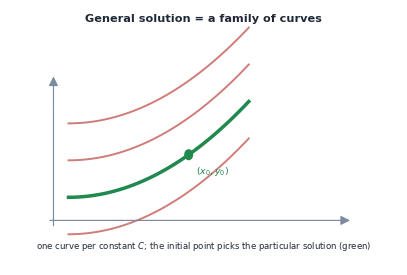
General solution as a family of curves vs a particular solution, a map for choosing the solution method, and modelling applications like growth/decay and Newton's cooling
General/particular solutions, the method map, and modelling.
Which method? — match the form
Form of the equationMethod
variable separable
homogeneous (put )
linear (integrating factor)
Bernoulli ()
exact
★ Remember · Which method?
Separates into ; (); (IF); ().
Modelling
  • Growth/decay: (population, radioactivity, interest).
  • Newton's cooling: — temperature heads toward .
  • Geometry: a prescribed slope or tangent/normal condition becomes a first-order DE.
  • Translate words , solve, then apply the condition for the particular solution.
🎯 Exam · General vs particular
The solution is a family of curves (one for each value of the arbitrary constant). A solution is the single member of that family passing through the given initial point.
⚠️ Watch out · Apply conditions after integrating
Find the general solution (with C) , then substitute the initial/boundary condition to evaluate C. Plugging in too early — before the constant of integration appears — loses the particular solution.
🚫 Examiner Trap · Examiner traps
(1) Method map: separable separate; homogeneous (); linear (IF); Bernoulli. (2) Growth/decay (population/radioactivity/interest). (3) Newton cooling — note the MINUS and . (4) 'Slope …' or tangent/normal conditions translate into a first-order DE — turn the words into first.

More JEE Main Mathematics formula sheets

Frequently Asked Questions

What are the most important Differential Equations formulas for JEE Main?

This Differential Equations formula sheet covers all the high-yield Mathematics formulas, definitions and theorems you need for JEE Main, across Ordinary differential equations, Order and degree, Formation of differential equations, Solution of differential equations by method of separation of variables, Solution of homogeneous differential equations of first order and first degree — each shown with the key result and, where useful, a worked example.

Is this Differential Equations formula sheet free?

Yes — the full chapter formula sheet is free to read online, no login or payment required.

How should I revise Differential Equations formulas?

Blurt the Differential Equations formulas from memory, then check against this sheet to find your gaps — and practise a few previous-year questions on the chapter to make sure you can apply them under time pressure.

Also useful: all formula sheets · JEE Main previous-year papers · most important chapters.