
Back to JEE Main PYQs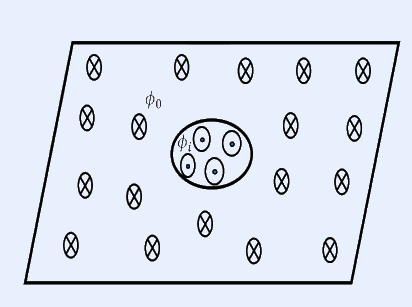

JEE Main 2020 January 07, Shift 1 Question Paper with Solutions
All 74 questions from the JEE Main 2020 (January 07, Shift 1) shift — Physics (25), Chemistry (25) and Mathematics (24) — each with the correct answer (answer key) and a step-by-step solution. Read it free online, or attempt the full paper as a timed mock test.
Physics25 questions
Q1Single correctOptics
A polarizer-analyzer set is adjusted such that the intensity of light coming out of the analyzer is just 10 % of the original intensity. Assuming that the polarizer-analyzer set does not absorb any light, the angle by which the analyzer need to be rotated further to reduce the output intensity to be zero is :
(1)
(2)
(3)
(4)
SolutionAnswer: Option 4
Approach:
Apply Malus's law to find the present analyzer angle that gives 10% transmission, then determine the extra rotation needed to reach the crossed (zero-intensity) position at .
Step 1:Set transmitted intensity to 10% of incident.
Step 2:Solve for the current analyzer angle.
Step 3:Intensity becomes zero when the analyzer is at to the polarizer. Compute the additional rotation required.
Final answer:
Q2Single correctElectronic Devices
Which of the following gives reversible operation?
(1)
(2)
(3)
(4)
SolutionAnswer: Option 3
Approach:
A reversible logic operation is one in which the inputs can be uniquely recovered from the output, which requires a one-to-one (bijective) mapping. Among the standard two-input gates shown, only a gate with a single output that has exactly one input level mapping is non-reversible; the NOT (inverter) operation, with one input and one output, is bijective and hence reversible.
Step 1:A logic operation is reversible only if the input state can be uniquely determined from the output state.
Step 2:Two-input gates (AND, OR, NAND, NOR) map four input combinations to two output states, so they are not reversible.
Step 3:A gate having a single input and single output (the inverter shown in option c) maps each input uniquely to an output.
Final answer: Option (c) — the single-input (NOT) gate gives reversible operation.
Q3Single correctWork, Energy and Power
A 60 HP electric motor lifts an elevator with a maximum total load capacity of 2000 kg. If the frictional force on the elevator is 4000 N, the speed of the elevator at full load is close to (Given 1 HP W, )
(1)
(2)
(3)
(4)
SolutionAnswer: Option 4
Approach:
At maximum (constant) speed the motor force balances weight plus friction. Compute the total opposing force, convert the motor power to watts, and use to find the speed.
Step 1:Compute the total force the motor must supply against gravity and friction.
Step 2:Convert 60 HP to watts.
Step 3:Solve for the speed.
Final answer:
Q4Single correctElectromagnetic Induction and Alternating Currents
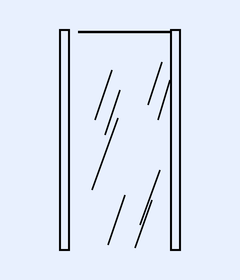
A long solenoid of radius R carries a time (t) dependent current . A ring of radius 2R is placed coaxially near its middle. During the time instant , the induced current and the induced EMF in the ring changes as :
(1)
(2)
(3)
(4)
SolutionAnswer: Option 3At direction of reverses and is zero
Approach:
The flux through the ring depends only on the solenoid cross-section (). Differentiate the flux to get the EMF, find where the EMF (and induced current) is zero and where the current direction reverses.
Step 1:Flux linked with the ring equals field times solenoid area (ring radius 2R does not increase area, since field is zero outside).
Step 2:Induced EMF is the negative time derivative of flux.
Step 3:Set EMF to zero to find the turning instant.
Step 4:At the EMF (and hence induced current) is zero and changes sign, so the induced current reverses direction.
Final answer: At direction of reverses and is zero
Q5Single correctKinetic Theory of Gases
Two moles of an ideal gas with are mixed with 3 moles of another ideal gas with . The value of for the mixture is
(1)
(2)
(3)
(4)
SolutionAnswer: Option 2
Approach:
Find and for each gas from its , then combine them as mole-weighted averages to obtain the mixture's .
Step 1:For the first gas .
Step 2:For the second gas .
Step 3:Combine with , .
Final answer:
Q6Single correctMagnetic Effects of Current and Magnetism
Consider a circular coil of wire carrying current I, forming a magnetic dipole. The magnetic flux through an infinite plane that contains the circular coil and excluding the circular coil area is given by . The magnetic flux through the area of the circular coil area is given by . Which of the following option is correct?
(1)
(2)
(3)
(4)
SolutionAnswer: Option 1
Approach:
Magnetic field lines form closed loops, so the net flux through any infinite plane is zero. The plane is divided into the coil area (flux ) and the remaining region (flux ); their sum must vanish.
Step 1:All field lines threading the coil area must return through the rest of the infinite plane, since lines are closed.
Step 2:Sum of the two contributions equals zero.
Final answer:
Q7Single correctCurrent Electricity
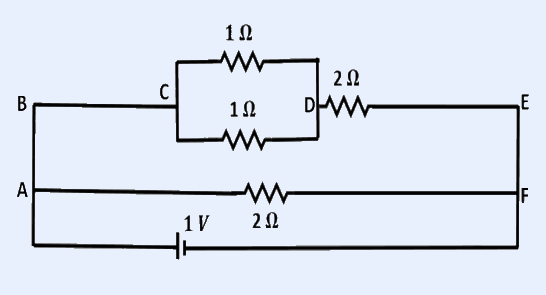
The current (in A) flowing through resistor in the following circuit is :
(1)
(2)
(3)
(4)
SolutionAnswer: Option 2
Approach:
Reduce the network of resistors to an equivalent resistance, find the total current from the 1 V source, then use current division to get the current in the relevant resistor.
Step 1:The two parallel resistors across CD give , in series and parallel with the resistors reduce the branch resistance.
Step 2:Combine the branch with the parallel path across BE.
Step 3:Total current from the 1 V cell.
Step 4:Voltage across BE equals voltage across the upper branch BF = 1 V; current in that branch and division gives the current.
Final answer:
Q8Single correctElectrostatics
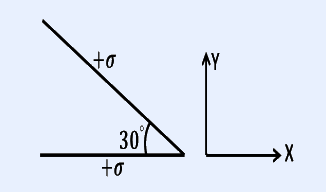
Two infinite planes each with uniform surface charge density are kept in such a way that the angle between them is . The electric field in the region shown between them is given by :
(1)
(2)
(3)
(4)
SolutionAnswer: Option 1
Approach:
Each infinite charged plane produces a uniform field directed away from it. Add the field of the horizontal plane (along ) to the field of the inclined plane (at ), resolving into components.
Step 1:The horizontal plane gives a field along .
Step 2:The inclined plane at gives a field directed into the region; its components are and .
Step 3:Add the two contributions.
Final answer:
Q9Single correctElectromagnetic Waves
If the magnetic field in a plane electromagnetic wave is given by then what will be expression for electric field?
(1)
(2)
(3)
(4)
SolutionAnswer: Option 4
Approach:
The electric-field amplitude equals c times the magnetic-field amplitude. The direction is fixed by requiring to point along the propagation direction.
Step 1:Compute the electric-field amplitude.
Step 2:The wave propagates along (argument ); with along , the electric field must lie along to give along .
Step 3:Write the field with the same phase.
Final answer:
Q10Single correctAtoms and Nuclei
The time period of revolution of electron in its ground state orbit in a hydrogen atom is s. The frequency of revolution of the electron in its first excited state (in ) is :
(1)
(2)
(3)
(4)
SolutionAnswer: Option 3
Approach:
In the Bohr model the orbital period scales as . Scale the ground-state period to , then take its reciprocal for the frequency.
Step 1:Ratio of periods between first excited () and ground () states.
Step 2:Compute the first-excited-state period.
Step 3:Frequency is the reciprocal of the period.
Final answer:
Q11Single correctElectromagnetic Induction and Alternating Currents
A LCR circuit behaves like a damped harmonic oscillator. Comparing it with a physical spring-mass damped oscillator having damping constant 'b', the correct equivalence would be :
(1)
(2)
(3)
(4)
SolutionAnswer: Option 4
Approach:
Write the differential equation for a damped mechanical oscillator and for an LCR circuit, then match coefficients of the corresponding derivative terms.
Step 1:Mechanical equation from Newton's second law.
Step 2:LCR circuit equation from Kirchhoff's voltage law.
Step 3:Compare coefficient by coefficient.
Final answer:
Q12Single correctOptics
Visible light of wavelength cm falls normally on a single slit and produces a diffraction pattern. It is found that the second diffraction minima is at from the central maxima. If the first minimum is produced at , then is close to
(1)
(2)
(3)
(4)
SolutionAnswer: Option 4
Approach:
Single-slit diffraction: position of the n-th minimum from the central maximum.
Step 1:The second minimum is at 60 degrees, giving d in terms of wavelength.
Step 2:The first minimum corresponds to n=1.
Step 3:Taking the inverse sine.
Final answer:
Q13Single correctRotational Motion
The radius of gyration of a uniform rod of length about an axis passing through a point away from the center of the rod, and perpendicular to it is :
(1)
(2)
(3)
(4)
SolutionAnswer: Option 1
Approach:
Apply the parallel-axis theorem to shift the moment of inertia from the rod's center to a point away, then obtain the radius of gyration from .
Step 1:Shift axis by .
Step 2:Add the two terms over a common denominator.
Step 3:Radius of gyration from .
Final answer:
Q14Single correctGravitation
A satellite of mass m is launched vertically upward with an initial speed u from the surface of the earth. After it reaches height R ( R = radius of earth ), it ejects a rocket of mass so that subsequently the satellite moves in a circular orbit. The kinetic energy of the rocket is (G = gravitational constant; M is the mass of the earth):
(1)
(2)
(3)
(4)
SolutionAnswer: Option 1
Approach:
Use energy conservation to find the satellite speed at height R, then apply momentum conservation during the impulsive ejection and energy bookkeeping to obtain the rocket's kinetic energy for the satellite to enter a circular orbit at radius 2R.
Step 1:Find the satellite speed v at height R using energy conservation between the surface and radius 2R.
Step 2:Orbital speed required at radius 2R for a circular orbit.
Step 3:Apply momentum conservation (radial and tangential) for the impulsive split and combine the kinetic energies; the rocket carries the residual energy.
Final answer:
Q15Single correctSystem of Particles and Rotational Motion
Three point particles of mass 1 kg, 1.5 kg and 2.5 kg are placed at three corners of a right angle triangle of sides 4.0 cm, 3.0 cm and 5.0 cm as shown in the figure. The center of mass of the system is at the point:
(1)
(2)
(3)
(4)
SolutionAnswer: Option 10.9 cm right and 2.0 cm above 1 kg mass
Approach:
Place the 1 kg mass at the origin, locate the other two masses along the legs of the right triangle, and compute the mass-weighted average of the coordinates.
Step 1:Take 1 kg at origin (0,0), 1.5 kg at (3,0) cm and 2.5 kg at (0,4) cm.
Step 2:Compute x coordinate of the centre of mass.
Step 3:Compute y coordinate of the centre of mass.
Final answer: 0.9 cm right and 2.0 cm above 1 kg mass
Q16Single correctRay Optics and Optical Instruments
If we need a magnification of 375 from a compound microscope of tube length 150 mm and an objective of focal length 5 mm, the focal length of the eye-piece, should be close to:
(1)
(2)
(3)
(4)
SolutionAnswer: Option 122
Approach:
Use the compound microscope magnification formula with the tube length as objective focal distance and the near point at 25 cm to solve for the eyepiece focal length.
Step 1:Substitute L = 150 mm, f0 = 5 mm, D = 250 mm and M = 375.
Step 2:Isolate the eyepiece term.
Step 3:Solve for the eyepiece focal length.
Final answer: 22
Q17Single correctWaves
Speed of transverse wave on a straight wire (mass 6 g, length 60 cm and area of cross-section 1.0 ) is 90 . If the Young's modulus of wire is , the extension of wire over its natural length is:
(1)
(2)
(3)
(4)
SolutionAnswer: Option 10.03
Approach:
Find the tension from the wave speed and linear mass density, then use Young's modulus to obtain the extension.
Step 1:Compute tension from the wave speed; linear density mu = M/L.
Step 2:Rearrange Young's modulus for the extension.
Step 3:Evaluate numerically.
Final answer: 0.03
Q18Single correctThermodynamics
1 liter of dry air at STP expands adiabatically to a volume of 3 litres. If , the work done by air is () (take air to be an ideal gas)
(1)
(2)
(3)
(4)
SolutionAnswer: Option 290.5
Approach:
Find the final pressure from the adiabatic relation, then apply the adiabatic work formula.
Step 1:Initial conditions: P1 = 1 atm, V1 = 1 L expanding to V2 = 3 L.
Step 2:Apply the adiabatic work formula with 1 atm = 101.325 kPa and 1 L = .
Step 3:Round to the closest option.
Final answer: 90.5
Q19Single correctSystem of Particles and Rotational Motion
A bob of mass m is tied by a massless string whose other end portion is wound on a fly wheel (disc) of radius r and mass m. When released from the rest the bob starts falling vertically. When it has covered a distance h, the angular speed of the wheel will be:
(1)
(2)
(3)
(4)
SolutionAnswer: Option 2
Approach:
Apply energy conservation: the loss in gravitational potential energy equals the translational kinetic energy of the bob plus the rotational kinetic energy of the disc, with the rolling constraint v = r omega.
Step 1:Substitute I and the constraint into the energy equation.
Step 2:Solve for omega squared.
Step 3:Take the square root.
Final answer:
Q20Single correctElectrostatic Potential and Capacitance
A parallel plate capacitor has plates of area A separated by distance 'd' between them. It is filled with a dielectric which has a dielectric constant varies as where 'x' is the distance measured from one of the plates. If , the total capacitance of the system is best given by the expression:
(1)
(2)
(3)
(4)
SolutionAnswer: Option 2
Approach:
Treat the dielectric as infinitesimal series capacitors, integrate the reciprocal capacitance over the gap, then expand the logarithm for small alpha d.
Step 1:Integrate the series reciprocal capacitance from 0 to d.
Step 2:Expand the logarithm for small alpha d.
Step 3:Invert and approximate to first order.
Final answer:
Q21NumericalThermal Properties of Matter
A non- isotropic solid metal cube has coefficient of linear expansion as along the x-axis and along y-axis and z-axis. If the coefficient of volumetric expansion of the solid is then the value of C is ........
SolutionAnswer: 60
Approach:
For an anisotropic solid the volumetric expansion coefficient is the sum of the three linear expansion coefficients along the principal axes.
Step 1:Sum the linear expansion coefficients.
Step 2:Compare with C times .
Final answer: 60
Q22NumericalElectromagnetic Induction
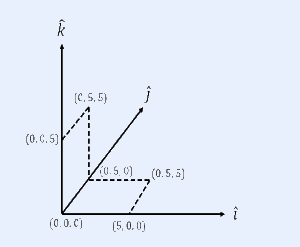
A loop ABCDEFA of straight edges has six corner points A(0,0,0), B(5,0,0), C(5,5,0), D(0,5,0), E(0,5,5), F(0,0,5) and the magnetic field in this region is . The quantity of flux through the loop ABCDEFA (in Wb) is .........
SolutionAnswer: 175
Approach:
Split the loop into two planar areas, express each as a vector area, sum them, and take the dot product with the magnetic field.
Step 1:The loop encloses a square ABCD in the xy-plane (area vector along +z) and a square ADEF in the yz-plane (area vector along +x), each of side 5.
Step 2:Take the dot product with B = 3 i + 4 k.
Step 3:Add the contributions.
Final answer: 175
Q23NumericalThermodynamics
A carnot engine operates between two reservoirs of temperature 900 K and 300 K. The engine performs 1200 J of work per cycle. The heat energy in(J) delivered by the engine to the low temperature reservoir, in a cycle, is .........
SolutionAnswer: 600
Approach:
Find the Carnot efficiency from the reservoir temperatures, obtain the heat absorbed from the work output, then subtract the work to get the heat rejected.
Step 1:Compute efficiency.
Step 2:Heat absorbed from the hot reservoir using W = eta Q1.
Step 3:Heat delivered to the cold reservoir.
Final answer: 600
Q24NumericalWork, Energy and Power
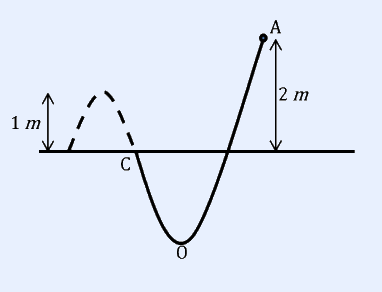
A particle of mass 1 kg slides down a frictionless track (AOC) starting from rest at a point A(height 2 m). After reaching C, the particle continues to move freely in air as a projectile. When it reaches its highest point P(height 1 m) the kinetic energy of the particle (in J) is:(Figure drawn is schematic and not to scale; take ) .........
SolutionAnswer: 10
Approach:
Apply energy conservation between the starting point A and the highest point P; the kinetic energy at P equals the loss of potential energy from A to P.
Step 1:Total energy at A equals total energy at P (frictionless track and projectile in air).
Step 2:Substitute m = 1 kg, g = 10, = 2 m, = 1 m.
Final answer: 10
Q25NumericalDual Nature of Radiation and Matter
A beam of electromagnetic radiation of intensity is comprised of wavelength, . It falls normally on a metal (work function ) of surface area of . If one in photons ejects an electron, total number of electrons ejected in 1s is (), then x is .........
SolutionAnswer: 11
Approach:
Find the incident power on the surface, the energy per photon, hence the photon flux per second, then apply the one-in-1000 ejection ratio.
Step 1:Incident power on the 1 surface.
Step 2:Photon energy at 310 nm exceeds the 2 eV work function (4 eV), so emission occurs; number of incident photons per second.
Step 3:One in 1000 photons ejects an electron.
Final answer: 11
Chemistry25 questions
Q26Single correctStates of Matter
The relative strength of interionic/ intermolecular forces in decreasing order is:
(1)
(2)
(3)
(4)
SolutionAnswer: Option 3ion-ion > ion-dipole > dipole-dipole
Approach:
Rank the electrostatic interactions by the magnitude of the charges involved.
Step 1:Ion-ion interactions occur between full charges and are the strongest.
Step 2:Ion-dipole interactions involve one full charge and a partial charge, weaker than ion-ion.
Step 3:Dipole-dipole interactions involve only partial charges and are the weakest of the three.
Final answer: ion-ion > ion-dipole > dipole-dipole
Q27Single corrects-Block Elements
Oxidation number of potassium in , and , respectively, is :
(1)
(2)
(3)
(4)
SolutionAnswer: Option 3 and
Approach:
Alkali metals exhibit a fixed +1 oxidation state in all their oxides; the oxygen oxidation state varies.
Step 1:In oxide, oxygen is -2; in peroxide, oxygen is -1; in superoxide, oxygen is -1/2.
Step 2:Potassium, an alkali metal, retains a +1 oxidation state in every case.
Final answer: and
Q28Single correctSolutions
At C, the vapour pressure of is 512 mm Hg and that of acetone is 344 mm Hg. A solution of in acetone has a total vapour pressure of 600 mm Hg. The false statement amongst the following is :
(1)
(2)
(3)
(4)
SolutionAnswer: Option 4a mixture of 100 mL and 100 mL acetone has a volume mL.
Approach:
Compare the observed total vapour pressure with the maximum predicted by Raoult's law to identify the type of deviation.
Step 1:The maximum ideal total pressure occurs at the higher pure component value, 512 mm Hg.
Step 2:Observed pressure 600 mm Hg exceeds 512 mm Hg, so the system shows positive deviation from Raoult's law.
Step 3:Positive deviation implies weaker A-B interactions, endothermic mixing, and a volume increase on mixing.
Step 4:Therefore the statement that the mixed volume is less than 200 mL is false.
Final answer: a mixture of 100 mL and 100 mL acetone has a volume mL.
Q29Single correctd- and f-Block Elements
The atomic radius of Ag is closest to :
(1)
(2)
(3)
(4)
SolutionAnswer: Option 3Au
Approach:
Use the effect of lanthanide contraction on the atomic radii of the 5d series.
Step 1:Lanthanide contraction reduces the expected increase in size on moving from the 4d to the 5d series.
Step 2:As a result the atomic radii of corresponding 4d and 5d elements become nearly equal, so Au (5d) is close to Ag (4d).
Final answer: Au
Q30Single correctChemical Bonding
The dipole moments of , and are in the order:
(1)
(2)
(3)
(4)
SolutionAnswer: Option 3
Approach:
Use molecular symmetry to determine which molecules have a net dipole moment.
Step 1:Both CCl4 and CH4 are regular tetrahedral and fully symmetric, so their bond dipoles cancel.
Step 2:CHCl3 lacks this symmetry, so its bond dipoles do not cancel and it has a non-zero dipole moment.
Final answer:
Q31Single correctHydrogen
By using the zeolite process for the removal of permanent hardness, the synthetic resins method is :
(1)
(2)
(3)
(4)
SolutionAnswer: Option 4more efficient as it can exchange both cations as well as anions
Approach:
Compare the ion-exchange capability of zeolite with that of synthetic ion-exchange resins.
Step 1:Zeolite (sodium aluminosilicate) exchanges only cations responsible for hardness.
Step 2:Synthetic resins include both cation and anion exchangers, removing all ions and giving demineralised water.
Final answer: more efficient as it can exchange both cations as well as anions
Q32Single correctSome Basic Concepts of Chemistry
Amongst the following statements, that which was not proposed by Dalton was :
a) matter consists of indivisible atoms
b) when gases combine or reproduced in a chemical reaction they do so in a simple ratio by volume provided all gases are at the same T & P.
c) Chemical reactions involve reorganisation of atoms. These are neither created nor destroyed in a chemical reaction.
d) all the atoms of a given element have identical properties including identical mass. Atoms of different elements differ in mass.
a) matter consists of indivisible atoms
b) when gases combine or reproduced in a chemical reaction they do so in a simple ratio by volume provided all gases are at the same T & P.
c) Chemical reactions involve reorganisation of atoms. These are neither created nor destroyed in a chemical reaction.
d) all the atoms of a given element have identical properties including identical mass. Atoms of different elements differ in mass.
(1)
(2)
(3)
(4)
SolutionAnswer: Option 2when gases combine or reproduced in a chemical reaction they do so in a simple ratio by volume provided all gases are at the same T & P.
Approach:
Identify which statement belongs to a different law rather than Dalton's atomic theory.
Step 1:Indivisible atoms, conservation of atoms in reactions, and identical atoms of an element are postulates of Dalton's atomic theory.
Step 2:The statement about gases combining in simple volume ratios at the same temperature and pressure is Gay-Lussac's law of gaseous volumes.
Final answer: when gases combine or reproduced in a chemical reaction they do so in a simple ratio by volume provided all gases are at the same T & P.
Q33Single correctOrganic Chemistry - Basic Principles
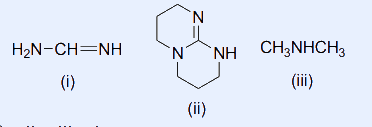
The increasing order of for the following compounds will be :
(1)
(2)
(3)
(4)
SolutionAnswer: Option 4
Approach:
Rank the three nitrogen compounds by basicity, then invert to get the pKb order (stronger base means lower pKb).
Step 1:Compound (ii) is a guanidine-type structure whose protonated form is strongly resonance-stabilised, making it the most basic.
Step 2:Compound (i) has an sp2-hybridised nitrogen of higher electronegativity, lowering availability of its lone pair, so it is less basic than the sp3 amine (iii).
Step 3:Thus basicity order is ii > i > iii, hence the increasing pKb order is the reverse: ii < i < iii.
Final answer:
Q34Single correctOrganic Chemistry - Hydrocarbons
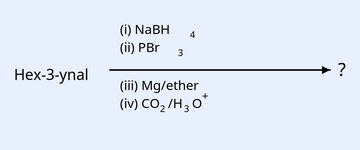
What is the product of the following reaction?
(1)
(2)
(3)
(4)
SolutionAnswer: Option 2
Approach:
Track the functional group transformations: aldehyde reduction to alcohol, conversion to bromide, Grignard formation, then carboxylation.
Step 1:NaBH4 reduces the aldehyde of hex-3-ynal to a primary alcohol while the alkyne is untouched.
Step 2:PBr3 converts the primary alcohol to the corresponding primary alkyl bromide.
Step 3:Mg in ether forms the Grignard reagent, which reacts with CO2 and acidic workup to give a carboxylic acid with one extra carbon.
Step 4:The retained internal triple bond and the new carboxylic acid match option b.
Q35Single correctStructure of Atom
The number of orbitals associated with quantum number , is :
(1)
(2)
(3)
(4)
SolutionAnswer: Option 325
Approach:
Count the total orbitals in the shell n = 5 using the relation n squared.
Step 1:For n = 5 the subshells are 5s, 5p, 5d, 5f and 5g with 1, 3, 5, 7 and 9 orbitals.
Step 2:Summing gives the total number of orbitals in the shell.
Final answer: 25
Q36Single correctGeneral Principles of Metallurgy
The purest form of commercial iron is :
(1)
(2)
(3)
(4)
SolutionAnswer: Option 2wrought iron
Approach:
Compare the carbon content of the commercial forms of iron.
Step 1:Cast iron and pig iron contain the highest carbon content, about 2-4 percent.
Step 2:Wrought iron has the lowest carbon content, below 0.5 percent, making it the purest commercial form.
Final answer: wrought iron
Q37Single correctCoordination Compounds
The theory that can completely/ properly explain the nature of bonding in is:
(1)
(2)
(3)
(4)
SolutionAnswer: Option 3Molecular Orbital Theory
Approach:
Assess which bonding theory accounts for metal-carbonyl synergic bonding.
Step 1:Bonding in Ni(CO)4 involves sigma donation from CO and pi back-donation from the metal, a synergic interaction.
Step 2:Only Molecular Orbital Theory describes this back-bonding properly, unlike Werner, CFT or VBT.
Final answer: Molecular Orbital Theory
Q38Single correctCoordination Compounds
The IUPAC name of the complex is :
(1)
(2)
(3)
(4)
SolutionAnswer: Option 1Diamminechlorido(methanamine)platinum(II)chloride
Approach:
Name the cationic complex by alphabetical order of ligands, using correct ligand names, then the metal oxidation state and counter ion.
Step 1:Ligands are two ammine, one chlorido and one methanamine; cited alphabetically as ammine, chlorido, methanamine.
Step 2:Two NH3 ligands give diammine; the complex cation is paired with chloride counter ion and Pt is +2.
Step 3:Combining gives Diamminechlorido(methanamine)platinum(II)chloride.
Final answer: Diamminechlorido(methanamine)platinum(II)chloride
Q39Single correctOrganic Chemistry - Some Basic Principles and Techniques
1-methyl ethylene oxide when treated with an excess of HBr produces:
(1)
(2)
(3)
(4)
SolutionAnswer: Option 3
Approach:
Open the epoxide (1-methyl ethylene oxide, i.e. propylene oxide) with HBr, then the resulting bromohydrin reacts further with excess HBr to substitute the hydroxyl, giving a vicinal dibromide.
Step 1:Protonation of the epoxide oxygen and attack of bromide at the more substituted carbon opens the ring to give the bromohydrin.
Step 2:Excess HBr converts the hydroxyl group into a second C-Br bond.
Step 3:The product is the vicinal dibromide bearing the methyl group, matching option c.
Q40Single correctOrganic Chemistry - Some Basic Principles and Techniques
Consider the following reaction:
The product 'X' is used:
The product 'X' is used:
(1)
(2)
(3)
(4)
SolutionAnswer: Option 4in acid-base titration as an indicator
Approach:
Identify product X from the coupling of N,N-dimethylaniline with the diazonium salt of sulphanilic acid, then recall its use.
Step 1:The diazonium salt of sulphanilic acid couples at the para position of N,N-dimethylaniline.
Step 2:Product X is methyl orange.
Step 3:Methyl orange is used as an acid-base indicator, matching option d.
Final answer: in acid-base titration as an indicator
Q41Single correctBiomolecules
Match the following
| List I | List II |
|---|---|
| i. Riboflavin | p. Beri beri |
| ii. Thiamine | q. Scurvy |
| iii. Ascorbic acid | r. Cheilosis |
| iv. Pyridoxine | s. Convulsions |
(1)
(2)
(3)
(4)
SolutionAnswer: Option 2i) r ii) p iii) q iv) s
Approach:
Match each vitamin with the disease caused by its deficiency.
Step 1:Riboflavin (vitamin B2) deficiency causes cheilosis (i-r).
Step 2:Thiamine (vitamin B1) deficiency causes beri beri (ii-p).
Step 3:Ascorbic acid (vitamin C) deficiency causes scurvy (iii-q).
Step 4:Pyridoxine (vitamin B6) deficiency causes convulsions (iv-s), matching option b.
Final answer: i) r ii) p iii) q iv) s
Q42Single correctElectrochemistry
Given that the standard potential: of and are 0.34 V and 0.522 V respectively, the of is :
(1)
(2)
(3)
(4)
SolutionAnswer: Option 1 V
Approach:
Combine the two given half-reactions using Gibbs energies (ΔG = -nFE°), since electrode potentials are not directly additive when the electron counts differ.
Step 1:Write the two reductions: Cu2+ + 2e- -> Cu (E° = 0.34 V, n = 2) and Cu+ + e- -> Cu (E° = 0.522 V, n = 1).
Step 2:For Cu2+ + e- -> Cu+, subtract the second from the first using ΔG values.
Step 3:Solve for E°.
Final answer: V
Q43Single correctOrganic Chemistry - Some Basic Principles and Techniques
A solution of m-chloroaniline, m-chlorophenol and m-chlorobenzoic acid in ethyl acetate was extracted initially with a saturated solution of to give fraction A. The left over organic phase was extracted with dil. NaOH solution to give fraction B. The final organic layer was labelled as fraction C. Fractions A, B and C, contain respectively:
(1)
(2)
(3)
(4)
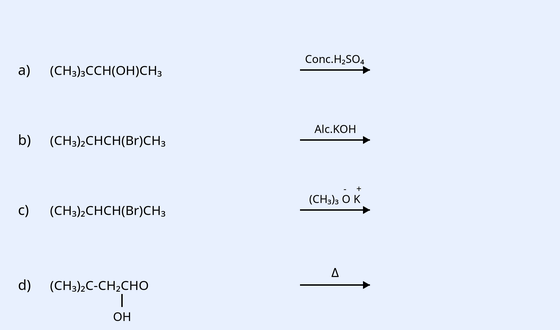
SolutionAnswer: Option 1m-chlorobenzoic acid, m-chlorophenol and m-chloroaniline
Approach:
Use the relative acidity of the three substrates to determine which base extracts each one.
Step 1:The weak base NaHCO3 deprotonates only the strongest acid, m-chlorobenzoic acid, placing it in fraction A.
Step 2:The stronger base dil. NaOH then deprotonates the next acid, m-chlorophenol, placing it in fraction B.
Step 3:m-chloroaniline, being basic, is not extracted by either base and remains in the organic layer as fraction C, matching option a.
Final answer: m-chlorobenzoic acid, m-chlorophenol and m-chloroaniline
Q44Single correctClassification of Elements and Periodicity in Properties
The electron gain enthalpy (in kJ/mol) of fluorine, chlorine, bromine, and iodine, respectively, are:
(1)
(2)
(3)
(4)
SolutionAnswer: Option 2-333, -349, -325 and -296
Approach:
Apply the known anomalous trend of electron gain enthalpy in group 17, where chlorine has the most negative value, not fluorine.
Step 1:The magnitude order of electron gain enthalpy for halogens is Cl > F > Br > I.
Step 2:Assign the values: F = -333, Cl = -349, Br = -325, I = -296.
Step 3:In the order F, Cl, Br, I the set is -333, -349, -325, -296, matching option b.
Final answer: -333, -349, -325 and -296
Q45Single correctHaloalkanes and Haloarenes
Consider the following reactions:
Which of these reaction(s) will not produce Saytzeff product?
Which of these reaction(s) will not produce Saytzeff product?
(1)
(2)
(3)
(4)
SolutionAnswer: Option 4c only
Approach:
Examine each elimination/dehydration reaction and decide whether it follows Saytzeff (more substituted alkene) or gives a different (Hofmann/aldehyde/non-Saytzeff) product.
Step 1:Reactions a, b and d give the more substituted alkene, i.e. the Saytzeff product.
Step 2:Reaction c does not yield a Saytzeff alkene under the given conditions.
Step 3:Only reaction c fails to give the Saytzeff product, matching option d.
Final answer: c only
Q46NumericalEquilibrium
Two solutions A and B each of 100 L was made by dissolving 4 g of NaOH and 9.8 g of in water, respectively. The pH of the resulting solution obtained from mixing 40 L of Solution A and 10 L of Solution B is:
SolutionAnswer: 10.6
Approach:
Find the moles of NaOH and H2SO4 taken from each solution, find the excess equivalents after neutralization, then compute pOH and pH.
Step 1:Molarity of NaOH = 4 g in 100 L = (4/40)/100 = M; molarity of H2SO4 = 9.8 g in 100 L = (9.8/98)/100 = M.
Step 2:Equivalents of NaOH = M x V x n = x 40 x 1 = 0.04; equivalents of H2SO4 = x 10 x 2 = 0.02.
Step 3:Total volume = 40 + 10 = 50 L, so [OH-] = 0.02/50 = 4 x M.
Step 4:pOH = -log(4 x ) = 4 - 2log2 = 3.4, so pH = 14 - 3.4 = 10.6.
Final answer: 10.6
Q47NumericalChemical Kinetics
During the nuclear explosion, one of the products is with half life of 6.93 years. If 1 g of was absorbed in the bones of a newly born baby in place of Ca, how much time, in years, is required to reduce it by 90% if it is not lost metabolically.
SolutionAnswer: 23.03
Approach:
Treat the decay as first order, obtain the rate constant from the half-life, then use the first-order integrated rate law to find the time for 90% reduction.
Step 1:Compute the decay constant from the half-life.
Step 2:After 90% reduction, the remaining fraction is 0.1, so a0/at = 1/0.1 = 10.
Step 3:Substitute into the rate law.
Final answer: 23.03
Q48NumericalChemical Bonding and Molecular Structure
Chlorine reacts with hot and concentrated NaOH and produces compounds (X) and (Y). Compound (X) gives white precipitate with silver nitrate solution. The average bond order between Cl and O atoms in (Y) is
SolutionAnswer: 1.67
Approach:
Identify the disproportionation products of Cl2 in hot concentrated NaOH, identify Y as the chlorate ion, then compute the average Cl-O bond order from its resonance structures.
Step 1:Hot concentrated NaOH disproportionates Cl2 into NaCl (X) and NaClO3 (Y); X gives white AgCl with AgNO3.
Step 2:The chlorate ion has 5 Cl-O bonds distributed over 3 equivalent resonance structures.
Step 3:Average bond order = 5/3.
Final answer: 1.67
Q49NumericalOrganic Chemistry - Some Basic Principles and Techniques
The number of chiral carbons in chloramphenicol is:
SolutionAnswer: 2
Approach:
Draw the structure of chloramphenicol and count the carbon atoms bonded to four different groups.
Step 1:Chloramphenicol contains two adjacent stereocentres along the side chain bearing the hydroxyl and the amide-bearing carbon.
Step 2:Each of these two carbons is attached to four different substituents.
Step 3:Therefore the number of chiral carbons is 2.
Final answer: 2
Q50NumericalThermodynamics
For the reaction
kcal, cal at 300 K, Hence in kcal is
kcal, cal at 300 K, Hence in kcal is
SolutionAnswer: -2.7
Approach:
Convert ΔU to ΔH using Δ, then apply ΔG = ΔH - TΔS.
Step 1:The change in moles of gas is Δ = 2 - 0 = 2; with R = 2 cal and T = 300 K, ΔH = 2100 + 2 x 2 x 300 = 3300 cal.
Step 2:Compute TΔS = 300 x 20 = 6000 cal.
Step 3:ΔG = 3300 - 6000 = -2700 cal = -2.7 kcal.
Final answer: -2.7
Mathematics24 questions
Q51Single correctIntegral Calculus
The area of the region, enclosed by the circle which is not common to the region bounded by the parabola and the straight line , is
(1)
(2)
(3)
(4)
SolutionAnswer: Option 2
Approach:
Subtract the area of the region bounded by the parabola and the line (the common region inside the circle) from the total area of the circle.
Step 1:Total area of the circle of radius .
Step 2:The line and parabola meet at the origin and . The common bounded region area is found by integrating in y from to .
Step 3:Required area equals circle area minus the common region.
Final answer:
Q52Single correctPermutations and Combinations
Total number of six-digit numbers in which only and all the five digits and appear, is
(1)
(2)
(3)
(4)
SolutionAnswer: Option 4
Approach:
All five distinct odd digits must appear in a six-digit number, so exactly one digit repeats. Choose the repeated digit, then count arrangements accounting for the repetition.
Step 1:Six positions must contain all of ; one of these is used twice. Choose the repeated digit.
Step 2:Arrange the six digits where one digit occurs twice.
Step 3:Multiply the choices.
Final answer:
Q53Single correctProbability
An unbiased coin is tossed 5 times. Suppose that a variable is assigned the value when consecutive heads are obtained for , otherwise takes the value . The expected value of , is
(1)
(2)
(3)
(4)
SolutionAnswer: Option 1
Approach:
Find probabilities for the longest run of consecutive heads being exactly 3, 4 and 5 in five tosses, assign values, and the remaining outcomes take value .
Step 1:Total outcomes are . Probability of exactly consecutive heads (longest run ).
Step 2:Probability of exactly consecutive heads and of consecutive heads.
Step 3:Remaining outcomes take value .
Step 4:Compute the expected value.
Final answer:
Q54Single correctComplex Numbers
If , where , then the point (x, y) lies on a
(1)
(2)
(3)
(4)
SolutionAnswer: Option 3circle whose diameter is .
Approach:
Substitute , rationalize, take the real part, set it equal to 1 and simplify to a conic; identify its centre and diameter.
Step 1:Write the quotient with and rationalize.
Step 2:Set the real part equal to 1.
Step 3:Clear the denominator and simplify.
Step 4:Identify centre and radius of this circle.
Step 5:Diameter is twice the radius.
Final answer: circle whose diameter is .
Q55Single correctIntegral Calculus
If , where a and b are fixed positive real numbers, then is equal to
(1)
(2)
(3)
(4)
SolutionAnswer: Option 3
Approach:
Use the symmetry together with the king property to evaluate the integral, then shift variables.
Step 1:From the given relation, .
Step 2:Let and apply the king property over [a,b].
Step 3:Add both forms; the terms cancel.
Step 4:Shift the first integral by to align ranges, giving , hence shift to .
Final answer:
Q56Single correctCoordinate Geometry
If the distance between the foci of an ellipse is 6 and the distance between its directrices is 12, then the length of its latus rectum is
(1)
(2)
(3)
(4)
SolutionAnswer: Option 4
Approach:
Use distance between foci and distance between directrices to find a and e, then compute the latus rectum .
Step 1:Set up the two conditions.
Step 2:Multiply and divide to solve for and .
Step 3:Find using .
Step 4:Compute the latus rectum.
Final answer:
Q57Single correctMathematical Reasoning
The logical statement is equivalent to
(1)
(2)
(3)
(4)
SolutionAnswer: Option 1
Approach:
Construct the truth table for over all combinations of p,q and compare the resulting column with the basic statements.
Step 1:Evaluate the compound statement for each truth assignment.
TT: .
TF: .
FT: .
FF: .
TT: .
TF: .
FT: .
FF: .
Step 2:Compare the result column with , which is F,F,T,T for .
Final answer:
Q58Single correctNumber Theory
The greatest positive integer k, for which is a factor of the sum , is
(1)
(2)
(3)
(4)
SolutionAnswer: Option 463
Approach:
Sum the geometric series, factor it to expose a divisor of the form , and determine the largest such k.
Step 1:Sum the series of terms.
Step 2:Factor .
Step 3:Since is an integer, , so divides S.
Step 4:Thus the greatest such is .
Final answer: 63
Q60Single correctDifferential Calculus
If where , then at is
(1)
(2)
(3)
(4)
SolutionAnswer: Option 34
Approach:
Simplify the expression under the root to a perfect form, take the square root over the given interval, then differentiate and evaluate at .
Step 1:Simplify the first term: .
Step 2:Write to complete the square.
Step 3:On , , so , giving .
Step 4:Differentiate and evaluate at .
Final answer: 4
Q61Single correctCoordinate Geometry
If is a tangent to both the parabolas, and , then b is equal to
(1)
(2)
(3)
(4)
SolutionAnswer: Option 3
Approach:
Use the tangency condition of to to find m, then impose that the same line is tangent to to solve for b.
Step 1:For , the tangent is . Comparing with gives .
Step 2:Substitute into .
Step 3:Apply tangency to this quadratic in .
Step 4:Solve, rejecting .
Final answer:
Q62Single correctMatrices and Determinants
Let be a root of the equation and the matrix , then the matrix is equal to
(1)
(2)
(3)
(4)
SolutionAnswer: Option 3
Approach:
Recognize as a complex cube root of unity, compute and to find the period of powers of A, then reduce the exponent 31.
Step 1:The roots of are the non-real cube roots of unity, so and .
Step 2:Computing gives pattern leading to .
Step 3:Then .
Step 4:Reduce the exponent: .
Final answer:
Q63Single correctSets, Relations and Functions
If and , then is equal to
(1)
(2)
(3)
(4)
SolutionAnswer: Option 2
Approach:
Use with ; set and solve the resulting quadratic at .
Step 1:Let , so .
Step 2:Put : the right side becomes .
Step 3:Solve the perfect-square quadratic.
Step 4:Hence .
Final answer:
Q64Single correctTrigonometry
Let and be two real roots of the equation , where and are real numbers. If , then value of is
(1)
(2)
(3)
(4)
SolutionAnswer: Option 3
Approach:
Treat the given equation as a quadratic in with roots and , apply sum and product of roots, then use the tangent addition formula.
Step 1:Rewrite the equation as and identify root relations.
Step 2:Apply the addition formula.
Step 3:Square and equate to the given value.
Step 4:Solve for .
Final answer:
Q65Single correctThree Dimensional Geometry
Let be a plane passing through the points and and be any point . Then the image of in the plane is:
(1)
(2)
(3)
(4)
SolutionAnswer: Option 2
Approach:
Find the plane through the three points using the normal from a cross product, then reflect across that plane.
Step 1:With , form edge vectors.
Step 2:Compute the normal.
Step 3:Plane equation through .
Step 4:Reflect : parametrize and find foot.
Step 5:Compute the image coordinates.
Final answer:
Q66Single correctDifferential Calculus
Let , and , then k is
(1)
(2)
(3)
(4)
SolutionAnswer: Option 3
Approach:
Differentiate the relation implicitly to express , then match with the given differential equation.
Step 1:Differentiate both sides.
Step 2:Solve for the derivative.
Step 3:Match exponents with the given equation .
Final answer:
Q67Single correctDifferential Calculus
Let the function, be continuous on and differentiable on . If and , for all , then for all such functions f, lies in the interval:
(1)
(2)
(3)
(4)
SolutionAnswer: Option 2
Approach:
Apply the Mean Value Theorem on and to bound and from above, then add.
Step 1:On , .
Step 2:On , .
Step 3:Add the two bounds; no lower bound is imposed.
Final answer:
Q68Single correctDifferential Equations
If is the solution of the differential equation, such that , then is equal to
(1)
(2)
(3)
(4)
SolutionAnswer: Option 4
Approach:
Substitute to linearise, then integrate with the initial condition.
Step 1:Expand: . With this is .
Step 2:Integrating factor gives .
Step 3:Apply : , so .
Step 4:Set .
Final answer:
Q69Single correctSequences and Series
Five numbers are in A.P., whose sum is 25 and product is 2520. If one of these five numbers is , then the greatest number amongst them is
(1)
(2)
(3)
(4)
SolutionAnswer: Option 1
Approach:
Represent the five terms symmetrically as , use the sum to find , then the product to find .
Step 1:Sum condition gives .
Step 2:Product: , i.e. .
Step 3:Expand and solve: , giving or .
Step 4:The value requires (then and ). Greatest term is .
Final answer:
Q70Single correctLinear Algebra
If the system of linear equations
,
where are non-zero and distinct; has non-zero solution, then
,
where are non-zero and distinct; has non-zero solution, then
(1)
(2)
(3)
(4)
SolutionAnswer: Option 3 are in A.P.
Approach:
A non-trivial solution requires the coefficient determinant to vanish; expand it and simplify.
Step 1:Set the determinant of coefficients to zero.
Step 2:Apply and .
Step 3:Expand along the first column.
Step 4:Simplify: . Dividing by gives the harmonic relation.
Final answer: are in A.P.
Q71NumericalDifferential Calculus
is equal
SolutionAnswer: 36
Approach:
Substitute to convert the expression into a rational function of t, then take the limit.
Step 1:Put ; as , . Numerator becomes , denominator becomes .
Step 2:Multiply numerator and denominator by .
Step 3:Factor: .
Step 4:Evaluate at .
Final answer: 36
Q72NumericalStatistics
If variance of first n natural numbers is 10 and variance of first m even natural numbers is 16, is equal .
SolutionAnswer: 18
Approach:
Use the variance formula for the first natural numbers, then note the variance of even numbers scales by .
Step 1:Set the natural-number variance equal to 10.
Step 2:Variance of first even numbers is times the variance of first natural numbers.
Step 3:Solve for .
Step 4:Add.
Final answer: 18
Q73NumericalBinomial Theorem
If the sum of the coefficients of all even powers of x in the product is 61, then n is equal
SolutionAnswer: 30
Approach:
Write the product as and use the substitutions and to isolate the sum of even-power coefficients.
Step 1:At each factor has terms equal to 1, so . Thus .
Step 2:At , the second factor sums to and the first to , giving . Thus .
Step 3:Add the two relations to isolate even-power coefficients.
Step 4:Set equal to 61 and solve.
Final answer: 30
Q74NumericalDifferential Calculus
Let S be the set of points where the function, , is not differentiable. Then, the value of is equal .
SolutionAnswer: 3
Approach:
Identify the corner points of the nested modulus function, then evaluate at each such point and sum.
Step 1:Inner has a corner at ; outer modulus adds corners where , i.e. .
Step 2:Evaluate at the corner points.
Step 3:Compute for each.
Step 4:Sum the values.
Final answer: 3
Q75NumericalCoordinate Geometry
Let be the vertices of a triangle ABC. If P is a point inside the triangle ABC such that the triangles APC, APB and BPC have equal areas, then the length of the line segment PQ, where Q is the point
SolutionAnswer: 5
Approach:
Equal sub-triangle areas force to be the centroid; compute it, then use the distance formula to .
Step 1:Equal areas of mean is the centroid.
Step 2:Evaluate the centroid coordinates.
Step 3:Apply the distance formula with .
Step 4:Simplify.
Final answer: 5
More JEE Main 2020 papers
Frequently Asked Questions
How many questions are in the JEE Main 2020 January 07, Shift 1 paper?
The JEE Main 2020 January 07, Shift 1 paper has 74 questions — Physics (25), Chemistry (25) and Mathematics (24). Every question is on this page with its correct answer and a step-by-step solution.
What is the marking scheme for JEE Main?
JEE Main awards +4 marks for each correct answer and −1 for a wrong answer, with 0 for questions left unattempted. The paper covers Physics, Chemistry and Mathematics.
Are the answer key and step-by-step solutions provided for the 2020 January 07, Shift 1 paper?
Yes — every question shows the correct answer (answer key) and a detailed step-by-step solution, free to read online.
Can I take the JEE Main 2020 January 07, Shift 1 paper as a timed mock test?
Yes. With a free JEEnify account you can attempt this exact paper as a timed test in the real exam interface, then see your score and weak-area analysis.
Solved this paper? Calculate your JEE Main scoremost important chaptersformula sheetsall free tools.