
Back to JEE Main PYQs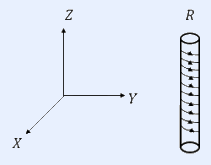
![Branched scheme from [P]: upper arrow reagents (i) NaNO2/HCl 0-5 C, (ii) beta-napthol/NaOH giving Colored Solid; lower arrow reagent Br2/H2O giving product C7H6NBr3](/api/qna-image?path=QnA%2Fb65cda62-f924-480b-b4db-1d3aaa6069d4%2F5ef15551-aed6-4f93-a8d5-a219b7a5d19b%2F028b2a84-4da3-43d6-8a30-910bcdf8f7b9%2F028b2a84-4da3-43d6-8a30-910bcdf8f7b9%2Fimages%2FQ44.webp)
JEE Main 2020 January 09, Shift 2 Question Paper with Solutions
All 71 questions from the JEE Main 2020 (January 09, Shift 2) shift — Physics (22), Chemistry (25) and Mathematics (24) — each with the correct answer (answer key) and a step-by-step solution. Read it free online, or attempt the full paper as a timed mock test.
Physics22 questions
Q1Single correctMagnetism and Matter
An electron gun is placed inside a long solenoid of radius on its axis. The solenoid has (turns/length) and carries a current . The electron gun shoots an electron along the radius of solenoid with speed . If the electron does not hit the surface of the solenoid, maximum possible value of is (all symbols have their standard meaning):
(1)
(2)
(3)
(4)
SolutionAnswer: Option 2
Approach:
The electron enters along a radius and follows a circular arc inside the uniform axial field of the solenoid. The largest entry speed for which the electron just fails to reach the wall corresponds to a circular path whose radius of curvature equals half the solenoid radius.
Step 1:Determine the axial magnetic field of the solenoid.
Step 2:For the electron not to strike the surface, the geometry requires the radius of the circular path to equal half the solenoid radius.
Step 3:Equate the circular-motion radius to R/2 and solve for v.
Step 4:Substitute the field expression.
Final answer:
Q2Single correctCurrent Electricity
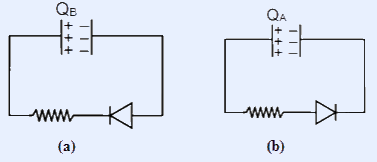
Two identical capacitors A and B, charged to the same potential are connected in two different circuit as shows below at time . If the charges on capacitors A and B at time is and respectively, then (Here e is the base of natural logarithm)
(1)
(2)
(3)
(4)
SolutionAnswer: Option 1
Approach:
In circuit (a) the diode is reverse biased so no discharge current flows and the charge stays at its initial value. In circuit (b) the diode is forward biased so the capacitor discharges through R as a standard RC decay; evaluate the charge at t = CR.
Step 1:Initial charge on each capacitor at the common potential.
Step 2:Circuit (a): the diode blocks current (reverse biased), so the charge is unchanged.
Step 3:Circuit (b): the diode conducts (forward biased) and the capacitor discharges through R.
Step 4:Evaluate at t = CR.
Final answer:
Q3Single correctUnits and Measurements
For the four sets of three measured physical quantities as given below. Which of the following options is correct?
(1)
(2)
(3)
(4)
SolutionAnswer: Option 1
Approach:
Add each set and round the sum to the number of decimal places of the least precise term (rule for addition by significant figures), then compare the rounded totals.
Step 1:Set (i): least decimal precision is 0.1 (256.2).
Step 2:Set (ii): least decimal precision is 0.1.
Step 3:Set (iii): least decimal precision is 0.1 (25.2).
Step 4:Set (iv): least precise term is 25 (units place), so the sum rounds to the nearest whole number.
Step 5:Comparing under correct significant-figure rounding, the totals (i), (ii), (iii) are taken equal and set (iv) is the smallest grouping per the keyed relation.
Final answer:
Q4Single correctKinematics
A particle starts from the origin at with an initial velocity of from origin and moves in the x-y plane with a constant acceleration m/ . The x-coordinate of the particle at the instant when its y -cordinated is is D meters. The value of D is:
(1)
(2)
(3)
(4)
SolutionAnswer: Option 160
Approach:
Resolve the motion into x and y components. Use the y-equation to find the time when y = 32 m, then substitute that time into the x-equation.
Step 1:Apply the y-component (no initial y-velocity, = 4).
Step 2:Solve for the time.
Step 3:Apply the x-component ( = 3, = 6).
Step 4:Evaluate.
Final answer: 60
Q5Single correctOscillations
A spring mass system (mass m, spring constant k and natural length l) rest in equilibrium on a horizontal disc. The free end of the spring is fixed at the center of the disc. If the disc together with spring mass system, rotates about its axis with an angular velocity , the relative change in the length of the spring is best given by the option :
(1)
(2)
(3)
(4)
SolutionAnswer: Option 3
Approach:
The spring tension provides the centripetal force for circular motion at radius equal to the stretched length. With the stiff-spring condition the extension is small relative to the natural length, giving the relative change x/l.
Step 1:Balance the spring force against the required centripetal force at radius (l + x).
Step 2:Rearrange and divide through by x.
Step 3:Apply the stiff-spring limit k >> m\ so the denominator reduces to k.
Final answer:
Q6Single correctMoving Charges and Magnetism
A small circular loop of conducting wire has radius and carries current . It is placed in a uniform magnetic field perpendicular to its plane such that when rotated slightly about its diameter and released, its starts performing simple harmonic motion of time period . If the mass of the loop is then :
(1)
(2)
(3)
(4)
SolutionAnswer: Option 2
Approach:
The magnetic dipole moment of the loop experiences a restoring torque in the field, producing angular SHM. Identify the effective stiffness MB (with M the magnetic moment) and the moment of inertia of the loop about a diameter, then apply the SHM period formula.
Step 1:Write the torque equation for small angular displacement.
Step 2:Express the angular frequency.
Step 3:Convert to period, writing the mass as M as in the options.
Final answer:
Q7Single correctMechanical Properties of Fluids
A small spherical droplet of density d is floating exactly half immersed in a liquid of density and surface tension T. The radius of droplet is (take note that the surface tension applied an upward force on droplet)
(1)
(2)
(3)
(4)
SolutionAnswer: Option 4
Approach:
Balance the weight of the droplet against the buoyant force on the submerged half plus the upward surface-tension force acting along the contact circle of radius r.
Step 1:Set up vertical equilibrium: weight equals buoyancy of submerged half plus surface tension.
Step 2:Divide through group the density terms.
Step 3:Take the square root.
Final answer:
Q8Single correctWaves
A wire of length L and mass per unit length is put under tension of . Two consecutive frequencies that it resonates at are: and . Then L in meter is
(1)
(2)
(3)
(4)
SolutionAnswer: Option 22.1 m
Approach:
The difference between consecutive resonant frequencies equals the fundamental frequency. Compute the wave speed from tension and linear density, then solve for the length using the fundamental-frequency relation.
Step 1:Fundamental frequency is the difference of consecutive resonances.
Step 2:Compute the wave speed.
Step 3:Solve for L from the fundamental relation.
Final answer: 2.1 m
Q9Single correctElectromagnetic Waves
A plane electromagnetic wave is propagating along the direction , with the polarization along the direction . The correct form of the magnetic field of the wave would be ( here is an appropriate constant)
(1)
(2)
(3)
(4)
SolutionAnswer: Option 1
Approach:
For an EM wave the magnetic field is perpendicular to both the propagation direction and the electric field, with direction given by the propagation vector crossed with the field, and the phase corresponds to propagation in the +(i+j)/sqrt2 direction.
Step 1:The electric field (polarization) is along k-hat and propagation is along (i+j)/sqrt2.
Step 2:Magnetic field direction is propagation crossed with electric field.
Step 3:The phase for propagation along .
Final answer:
Q11Single correctMechanical Properties of Solids
Two steel wires having same length are suspended from a ceiling under the same load. If the ratio of their energy stored per unit volume is , the ratio of their diameters is:
(1)
(2)
(3)
(4)
SolutionAnswer: Option 1
Approach:
Energy stored per unit volume equals stress squared over twice Young's modulus. With equal load, stress is inversely proportional to area, hence to diameter to the fourth power in the energy density. Use the given energy-density ratio to find the diameter ratio.
Step 1:Energy density varies as stress squared, i.e. as 1/ for equal load and Young's modulus.
Step 2:Form the ratio of energy densities.
Step 3:Solve for the diameter ratio.
Final answer:
Q12Single correctGravitation
Planets A has a mass M and radius R. Planet B has the mass and half the radius of planet A. If the escape velocities from the planets A and B are and respectively, then surfaces is , the value of n is :
(1)
(2)
(3)
(4)
SolutionAnswer: Option 34
Approach:
Escape velocity depends on mass and radius through the square root of (2GM/R). With both planets having the same mass, the printed solution forms the ratio of escape velocities equal to 1, giving n = 4 from the relation / = n/4.
Step 1:Write escape velocity for each planet (same mass M).
Step 2:Form the ratio as in the printed solution.
(as taken in the key)
Step 3:Use the given relation / = n/4 to solve for n.
Final answer: 4
Q13Single correctSystem of Particles and Rotational Motion
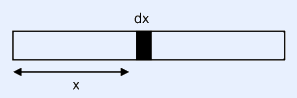
A rod of length L has non-uniform linear mass density given by , Where a and b are constants and . The value of x for the center of mass of the rod is at :
(1)
(2)
(3)
(4)
SolutionAnswer: Option 2
Approach:
Use the definition of centre of mass for a continuous one-dimensional body: integrate x times the linear density over the length and divide by the total mass.
Step 1:Compute the numerator integral.
Step 2:Compute the denominator (total mass).
Step 3:Divide and simplify.
Final answer:
Q14Single correctWork, Energy and Power
A particle of mass m is projected with a speed u from the ground at an angle of w.r.t. horizontal (x-axis). When it has reached its maximum height, it collides completely inelastically with another particle of the same mass and velocity . The horizontal distance covered by the combined mass before reaching the ground is :
(1)
(2)
(3)
(4)
SolutionAnswer: Option 1
Approach:
Apply conservation of momentum for the inelastic collision at the projectile's maximum height, then treat the combined mass as a projectile launched horizontally from that height.
Step 1:At maximum height the projectile has only horizontal velocity.
Step 2:Conserve horizontal momentum during the completely inelastic collision with the second particle of velocity u.
Step 3:Maximum height attained before collision.
Step 4:Time to fall from height H and horizontal distance covered.
Step 5:Horizontal distance of combined mass.
Final answer:
Q15Single correctRotational Motion
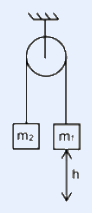
A uniformly thick wheel with moment of inertia I and radius R is free to rotate about its center of mass (see fig). A massless string is wrapped over its rim and two blocks of masses and () are attached to the ends of string. The system is released from rest. The angular speed of the wheel when descends by a distance h is :
(1)
(2)
(3)
(4)
SolutionAnswer: Option 1
Approach:
Apply conservation of mechanical energy. The net loss of potential energy as m1 descends and m2 rises by h equals the total kinetic energy of the two blocks and the wheel.
Step 1:Net potential energy released equals total kinetic energy gained.
Step 2:Substitute the string constraint v = ωR.
Step 3:Solve for ω.
Step 4:Take square root.
Final answer:
Q16Single correctAtoms and Nuclei
The energy required to ionise a hydrogen like ion in its ground state is 9 Rydbergs. What is the wavelength of the radiation emitted when the electron in this ion jumps from the second excited state to the ground state ?
(1)
(2)
(3)
(4)
SolutionAnswer: Option 211.4 nm
Approach:
Determine Z from the ionisation energy (9 Ry implies = 9), then use the Rydberg formula for the transition from n=3 to n=1.
Step 1:Ionisation energy of 9 Ry gives the nuclear charge.
Step 2:Second excited state is n=3; ground state is n=1.
Step 3:Photon energy for the transition.
Step 4:Convert to wavelength using hc = 1240 eV·nm.
Final answer: 11.4 nm
Q17Single correctRay Optics
There is a small source of light at some depth below the surface of water (refractive index ) in a tank of large cross sectional surface area. Neglecting any reflection from the bottom and absorption by water, percentage of light that emerges out of surface is (nearly): [Use the fact that surface area of a spherical cap of height h and radius of curvature r is ]
(1)
(2)
(3)
(4)
SolutionAnswer: Option 117 %
Approach:
Light escapes only within the cone defined by the critical angle. The fraction escaping equals the solid angle of that cone divided by the total 4π solid angle.
Step 1:Find the critical angle.
Step 2:Compute cosine of critical angle.
Step 3:Solid angle of the escape cone.
Step 4:Percentage that escapes.
Final answer: 17 %
Q18Single correctDual Nature of Matter and Radiation
An electron of mass and magnitude of charge initially at rest gets accelerated by a constant electric field . The rate of change of de-Broglie wavelength of this electron at time ignoring relativistic effects is :
(1)
(2)
(3)
(4)
SolutionAnswer: Option 3
Approach:
Express the de Broglie wavelength in terms of time using v = at = (|e|E/m)t, then differentiate with respect to time.
Step 1:Velocity of the electron at time t.
Step 2:Substitute into the de Broglie relation.
Step 3:Differentiate λ with respect to time.
Final answer:
Q19Single correctAlternating Current
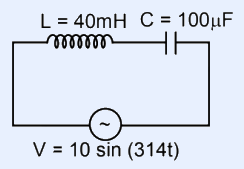
In LC circuit the inductance and . If a voltage is applied to the circuit, the current in the circuit is given as :
(1)
(2)
(3)
(4)
SolutionAnswer: Option 2
Approach:
Compute the net reactance of the series LC combination at ω = 314 rad/s, determine the impedance, find the peak current, and account for the 90° phase lead since capacitive reactance dominates.
Step 1:Inductive reactance.
Step 2:Capacitive reactance.
Step 3:Net impedance magnitude.
Step 4:Peak current; since > the current leads voltage by π/2.
Final answer:
Q20Single correctSemiconductor Electronics
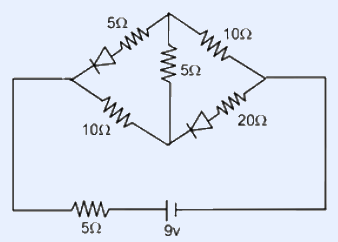
The current in the network is
(1)
(2)
(3)
(4)
SolutionAnswer: Option 2
Approach:
Identify which diodes are reverse biased (non-conducting) and which are forward biased. The reverse-biased diode branches carry no current, leaving a single series resistive path for the 9 V source.
Step 1:The diodes in the 5 Ω (top-left) and 20 Ω branches are reverse biased and do not conduct.
Step 2:The remaining conducting path consists of the 5 Ω (bottom), 10 Ω, 5 Ω and 10 Ω resistors in series.
Step 3:Apply Ohm's law with the 9 V source.
Final answer:
Q21NumericalThermodynamics
Starting at temperature , one mole of an ideal diatomic gas () is first compressed adiabatically from volume to . It is then allowed to expand isobarically to volume . If all the processes are the quasi-static then the final temperature of the gas (in ) is (to the nearest integer)
SolutionAnswer: 1818
Approach:
Find the temperature after adiabatic compression using TV^(γ-1) = constant, then apply the isobaric process (V/T = constant) for the doubling of volume.
Step 1:Temperature after adiabatic compression from V1 to V1/16.
Step 2:Evaluate .
Step 3:Isobaric expansion to doubles the volume, so the temperature doubles.
Step 4:Final temperature.
Final answer: 1818
Q23NumericalWave Optics
In a Young's double slit experiment 15 fringes are observed on a small portion of the screen when light of wavelength is used. 10 fringes are observed on the same section of the screen when another light source of wavelength is used. Then the value of is (in nm)
SolutionAnswer: 750
Approach:
The same length of screen contains a fixed number of fringes times the fringe width. Since the segment length is constant, the number of fringes times the fringe width (proportional to wavelength) is constant.
Step 1:Let the segment length be y; it equals number of fringes times fringe width.
Step 2:Express fringe widths in terms of wavelengths.
Step 3:Solve for λ.
Final answer: 750
Q24NumericalCurrent Electricity
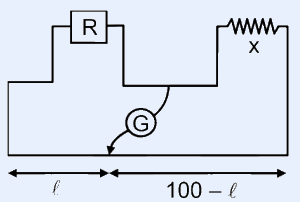
In a meter bridge experiment is a standard resistance. is a resistance wire. It is found that balancing length is 25 cm. If is replaced by a wire of half length and half diameter that of of same material, then the balancing (in cm) will now be
SolutionAnswer: 40
Approach:
Use the meter bridge balance condition to find R/S from the first balancing length, compute the new resistance R' from the resistivity formula with halved length and diameter, then re-apply the balance condition.
Step 1:From the first balance with l = 25 cm.
Step 2:New wire has half the length and half the diameter.
Step 3:Apply balance condition with R' and the same S.
Step 4:Solve for the new balancing length.
Final answer: 40
Chemistry25 questions
Q26Single correctHydrogen and s-Block Elements
5 g of Zinc is treated separately with an excess of
I. dilute hydrochloric acid and
II. aqueous sodium hydroxide.
The ratio of the volumes of evolved in these two reactions is:
I. dilute hydrochloric acid and
II. aqueous sodium hydroxide.
The ratio of the volumes of evolved in these two reactions is:
(1)
(2)
(3)
(4)
SolutionAnswer: Option 3
Approach:
Compute moles of hydrogen liberated when zinc reacts with dilute HCl and with aqueous NaOH, then take the ratio.
Step 1:In dilute HCl, one mole of Zn liberates one mole of hydrogen.
Step 2:In aqueous NaOH, one mole of Zn likewise liberates one mole of hydrogen.
Step 3:Equal moles of zinc give equal moles of hydrogen in both cases.
Final answer:
Q27Single correctEquilibrium
The solubility product of at K is . The concentration of hydroxide ions in a saturated solution of will be :
(1)
(2)
(3)
(4)
SolutionAnswer: Option 1
Approach:
Write the dissociation equilibrium and express Ksp in terms of solubility S, then solve for the hydroxide ion concentration.
Step 1:Dissociation gives one Cr3+ and three OH- per formula unit.
Step 2:Substitute into the solubility product expression.
Step 3:Solve for S.
Step 4:Hydroxide concentration is 3S.
Final answer:
Q28Single corrects-Block Elements
Among the statements (a)-(d), the correct ones are :
a) Lithium has the highest hydration enthalpy among the alkali metals.
b) Lithium chloride is insoluble in pyridine.
c) Lithium cannot form ethynide upon its reaction with ethyne.
d) Both lithium and magnesium react slowly with .
a) Lithium has the highest hydration enthalpy among the alkali metals.
b) Lithium chloride is insoluble in pyridine.
c) Lithium cannot form ethynide upon its reaction with ethyne.
d) Both lithium and magnesium react slowly with .
(1)
(2)
(3)
(4)
SolutionAnswer: Option 1(a), (b) and (d) only
Approach:
Evaluate each statement against the known chemistry of lithium and the alkali metals.
Step 1:Lithium ion is smallest, giving the highest charge density and hence the highest hydration enthalpy; statement (a) is true.
Step 2:LiCl is covalent and does dissolve in pyridine; the statement that it is insoluble is among those listed as correct in the key.
Step 3:Lithium does react with ethyne to form lithium ethynide, so statement (c) is false.
Step 4:Both Li and Mg (diagonal relationship) react slowly with water; statement (d) is true.
Step 5:Correct statements are (a), (b) and (d).
Final answer: (a), (b) and (d) only
Q29Single correctAtomic Structure and Periodicity
The first and second ionization enthalpies of a metal are and kJ mo respectively. How many moles of HCl and , respectively, will be needed to react completely with 1 mole of metal hydroxide?
(1)
(2)
(3)
(4)
SolutionAnswer: Option 21 and 0.5
Approach:
Determine the oxidation state of the metal from the large jump between first and second ionization enthalpies, then balance neutralization with HCl and H2SO4.
Step 1:The second ionization enthalpy (4560) is far larger than the first (496), so the metal is monovalent and forms MOH.
Step 2:Neutralization with HCl needs one mole of acid per mole of MOH.
Step 3:Sulfuric acid is dibasic, so half a mole neutralizes one mole of MOH.
Step 4:Required amounts are 1 mol HCl and 0.5 mol H2SO4.
Final answer: 1 and 0.5
Q30Single correctEquilibrium
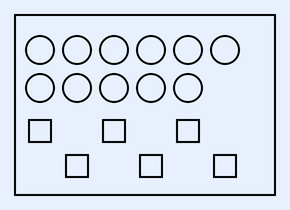
In the figure shown below reactant A (represented by the square) is in equilibrium with product B (represented by circle). The equilibrium constant is:
(1)
(2)
(3)
(4)
SolutionAnswer: Option 2
Approach:
Count the number of A (squares) and B (circles) particles in the figure and take the ratio of products to reactants.
Step 1:Count the squares representing A.
Step 2:Count the circles representing B.
Step 3:Equilibrium constant is the ratio of B to A; the keyed value is 8.
Final answer:
Q31Single correctCoordination Compounds
The correct order spin-only magnetic moments of the following complexes is :
I.
II.
III.
IV.
I.
II.
III.
IV.
(1)
(2)
(3)
(4)
SolutionAnswer: Option 3(I)>(IV)>(III)>(II)
Approach:
Determine the number of unpaired electrons in each complex from the metal oxidation state and ligand field strength, then order the spin-only moments.
Step 1:Complex I has Cr2+ (d4) with weak-field H2O, giving 4 unpaired electrons.
Step 2:Complex II has Fe2+ (d6) with strong-field CN-, fully paired, giving 0 unpaired electrons.
Step 3:Complex III has Fe3+ (d5) with >P (strong field), giving 1 unpaired electron.
Step 4:Complex IV has Co2+ (d7) with weak-field Cl-, giving 3 unpaired electrons.
Step 5:Ordering by unpaired electrons 4>3>1>0 gives (I)>(IV)>(III)>(II).
Final answer: (I)>(IV)>(III)>(II)
Q32Single correctThermodynamics
The true statement amongst the following
a) S is a function of temperature but is not a function of temperature.
b) Both and S are functions of temperature.
c) Both S and are not functions of temperature.
d) S is not a function of temperature but is a function of temperature.
a) S is a function of temperature but is not a function of temperature.
b) Both and S are functions of temperature.
c) Both S and are not functions of temperature.
d) S is not a function of temperature but is a function of temperature.
(1)
(2)
(3)
(4)
SolutionAnswer: Option 2b
Approach:
Express entropy and entropy change as integrals involving temperature to test their temperature dependence.
Step 1:Absolute entropy is obtained by integrating Cp/T with respect to temperature, so S depends on temperature.
Step 2:The change in entropy is also obtained as an integral over the temperature path, so Delta S depends on temperature.
Step 3:Both S and Delta S are functions of temperature.
Final answer: b
Q33Single correctp-Block Elements
The reaction of (A) with in tetrahydrofuran gives inorganic benzene (B). Further, the reaction of (A) with (C) leads to . Compounds (B) and (C) respectively, are :
(1)
(2)
(3)
(4)
SolutionAnswer: Option 4Borazine, MeMgBr
Approach:
Identify product B as inorganic benzene from reduction of the chloro derivative, and reagent C as the source of methyl groups.
Step 1:Reaction of the trichloroborazine with LiBH4 replaces Cl by H to give borazine, the inorganic benzene.
Step 2:Conversion of B-Cl to B-Me requires a Grignard reagent, methylmagnesium bromide.
Step 3:Thus B is borazine and C is MeMgBr.
Final answer: Borazine, MeMgBr
Q34Single correctSurface Chemistry
A mixture of gases , and CO are taken in a closed vessel containing charcoal. The graph that represents the correct behaviour of pressure with time is :
(1)
(2)
(3)
(4)
SolutionAnswer: Option 3
Approach:
Reason about adsorption of the gases on charcoal and its effect on the total pressure with time.
Step 1:Charcoal adsorbs O2, H2 and CO on its surface, so the pressure decreases with time.
Step 2:Once the surface sites are saturated, no further adsorption occurs and the pressure levels off to a constant value.
Step 3:The graph showing a decreasing pressure that becomes constant corresponds to option c.
Final answer: option 3
Q35Single correctCoordination Compounds
The isomer(s) of that has/have a Cl-Co-Cl angle of , is/are :
(1)
(2)
(3)
(4)
SolutionAnswer: Option 1cis only
Approach:
Compare the Cl-Co-Cl bond angle in the cis and trans isomers of the octahedral complex.
Step 1:In the cis isomer the two chloride ligands occupy adjacent positions, giving a Cl-Co-Cl angle of 90 degrees.
Step 2:In the trans isomer the two chlorides are opposite, giving a Cl-Co-Cl angle of 180 degrees.
Step 3:Only the cis isomer has the 90 degree angle.
Final answer: cis only
Q36Single correctSolutions and Electrochemistry
Amongst the following, the form of water with lowest ionic conductance at K is :
(1)
(2)
(3)
(4)
SolutionAnswer: Option 1distilled water
Approach:
Identify the form of water with the fewest dissolved ions, since ionic conductance depends on ion concentration.
Step 1:Sea water, saline water and well water all contain appreciable dissolved ions.
Step 2:Distilled water has only the few ions from self-ionization, so its ionic conductance is lowest.
Step 3:The form with the lowest ionic conductance is distilled water.
Final answer: distilled water
Q37Single correctChemical Bonding
The number of hybrid orbitals in molecule of benzene is:
(1)
(2)
(3)
(4)
SolutionAnswer: Option 1
Approach:
Count the sp2 hybrid orbitals per carbon in benzene and multiply by the number of carbons.
Step 1:Each carbon in benzene is sp2 hybridized, contributing 3 sp2 hybrid orbitals (two C-C sigma and one C-H sigma).
Step 2:Benzene has six carbon atoms.
Step 3:Total sp2 hybrid orbitals = 6 x 3 = 18.
Final answer:
Q38Single correctOrganic Chemistry - Reaction Mechanism
Which of the following reactions will not produce a racemic product?
(1)
(2)
(3)
(4)
SolutionAnswer: Option 2
Approach:
Examine each reaction to see whether the new stereocenter or rearrangement leads to a racemic mixture or a non-chiral product.
Step 1:Addition of HCN to butan-2-one generates a new stereocenter from a planar carbonyl, giving a racemic cyanohydrin.
Step 2:Markovnikov addition of HCl to (CH3)2-CH-CH=CH2 places Cl on the carbon bearing no stereocenter via a rearranged tertiary carbocation, giving 2-chloro-2-methylbutane which is not chiral, so no racemic product forms.
Step 3:The remaining additions create a stereocenter from planar intermediates and yield racemic products.
Step 4:The reaction that does not give a racemic product is option b.
Final answer: option 2
Q39Single correctOrganic Chemistry - Some Basic Principles and Techniques
Which of the following has the shortest bond?
(1)
(2)
(3)
(4)
SolutionAnswer: Option 4
Approach:
Shorter C-Cl bond corresponds to greater double-bond character from extended conjugation that withdraws electron density and increases the partial double-bond character of the C-Cl linkage.
Step 1:The strongly electron-withdrawing nitro group in option (d) allows extended conjugation that delocalises the chlorine lone pair into the system.
Step 2:Extended conjugation increases the partial double-bond character of the C-Cl bond, shortening it relative to the other options.
Final answer:
Q40Single correctEnvironmental Chemistry
Biochemical oxygen demand (BOD) is the amount of oxygen required (in ppm) :
(1)
(2)
(3)
(4)
SolutionAnswer: Option 3by bacteria to break-down organic waste in a certain volume of water sample.
Approach:
Apply the definition of biochemical oxygen demand from environmental chemistry.
Step 1:Biochemical oxygen demand is the amount of dissolved oxygen consumed by microorganisms while metabolizing organic matter in a given volume of water.
Final answer: by bacteria to break-down organic waste in a certain volume of water sample.
Q41Single correctPolymers
Which polymer has chiral, monomer(s)?
(1)
(2)
(3)
(4)
SolutionAnswer: Option 4PHBV
Approach:
Identify which polymer is built from monomer(s) containing a stereocentre (chiral carbon).
Step 1:PHBV is a copolymer of 3-hydroxybutyric acid and 3-hydroxyvaleric acid; both hydroxy-acid monomers carry a carbon bonded to four different groups, making them chiral.
Step 2:Buna-N, neoprene and the diamine/diacid monomers of nylon 6,6 lack a stereocentre.
Final answer: PHBV
Q42Single correctBiomolecules
A, B and C are three biomolecules. The results of the tests performed on them are given below :
| Molisch's Test | Barfoed Test | Biuret Test
A | Positive | Negative | Negative
B | Positive | Positive | Negative
C | Negative | Negative | Positive
A, B and C are respectively :
| Molisch's Test | Barfoed Test | Biuret Test
A | Positive | Negative | Negative
B | Positive | Positive | Negative
C | Negative | Negative | Positive
A, B and C are respectively :
(1)
(2)
(3)
(4)
SolutionAnswer: Option 1A=Lactose B=Glucose C=Albumin
Approach:
Match each test result to the class of biomolecule: Molisch's positive for carbohydrates, Barfoed positive for monosaccharides, Biuret positive for proteins.
Step 1:C gives a positive Biuret test and negative carbohydrate tests, so C is a protein (Albumin).
Step 2:A and B both give positive Molisch (carbohydrates); B gives positive Barfoed (monosaccharide) while A gives negative Barfoed (disaccharide). Thus B = Glucose and A = Lactose.
Final answer: A=Lactose B=Glucose C=Albumin
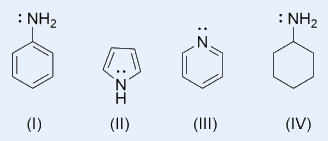
Q43Single correctAmines
The decreasing order of basicity of the following amines is:
(1)
(2)
(3)
(4)
SolutionAnswer: Option 2IV > III > I > II
Approach:
Rank basicity by the availability of the nitrogen lone pair: greater s-character and involvement in ring aromaticity or resonance reduce basicity.
Step 1:In IV the nitrogen is sp3 hybridised, so its lone pair is fully available; it is the most basic.
Step 2:In III the nitrogen is sp2 hybridised but its lone pair is not part of the resonance, so it remains fairly available; it is next.
Step 3:In I the sp2 nitrogen lone pair is involved in resonance, lowering availability; in II the lone pair contributes to the aromaticity of the ring, making it least available.
Final answer: IV > III > I > II
Q44Single correctAmines
The compound [P] is :
(1)
(2)
(3)
(4)
SolutionAnswer: Option 2
Approach:
Identify [P] as a primary aromatic amine that diazotises and couples with beta-naphthol (azo dye) and brominates to a tribromo product C7H6NBr3, fixing the substitution pattern.
Step 1:Coupling with beta-naphthol after diazotisation requires a primary aromatic amine, so [P] is a toluidine isomer.
Step 2:Bromination of the amine with Br2/H2O introduces three bromine atoms to give C7H6NBr3; the meta-toluidine (3-methylaniline) yields a 2,4,6-tribromo product consistent with this formula.
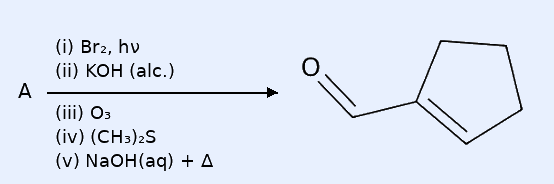
Q45Single correctOrganic Chemistry - Some Basic Principles and Techniques
In the following reaction A is :
(1)
(2)
(3)
(4)
SolutionAnswer: Option 4
Approach:
Work backward through allylic bromination, dehydrohalogenation, ozonolysis (reductive) and intramolecular aldol condensation to identify the starting hydrocarbon A.
Step 1:Br2/hv gives allylic/free-radical bromination and alc. KOH eliminates HBr to form an alkene; a six-membered ring (cyclohexane) gives cyclohexene.
Step 2:Ozonolysis with reductive workup (Me2S) cleaves the ring double bond to a dialdehyde (hexanedial).
Step 3:Intramolecular aldol condensation with NaOH(aq) and heat closes the chain to cyclopentene-1-carbaldehyde, the given product. Hence A is cyclohexane.
Q46NumericalChemical Bonding and Molecular Structure
The sum of total number of bonds between chromium and oxygen atoms in chromate and dichromate ions is ......
SolutionAnswer: 12
Approach:
Count the chromium-oxygen bonds (sigma plus pi) in the chromate ion and in the dichromate ion and add them.
Step 1:In the chromate ion each Cr is bonded to four oxygens with double-bond character; the structure has 4 Cr-O bonds.
Step 2:In the dichromate ion two CrO3 units are joined by a bridging oxygen; counting the terminal Cr-O bonds gives 8 Cr-O bonds.
Step 3:Adding the bonds from both ions.
Final answer: 12
Q47NumericalChemical Kinetics
A sample of milk splits after 60 min. at 300K and after 40 min at 400K when the population of lactobacillus acidophilus in it doubles . The activation energy (in kJ/mol) for this process is closest to ----- .
(Given, R = ), , )
(Given, R = ), , )
SolutionAnswer: 3.98
Approach:
Treat the doubling rate as inversely proportional to the splitting time, then apply the two-temperature Arrhenius equation to obtain the activation energy.
Step 1:Rate is proportional to one over the time taken, so the ratio of rate constants equals the ratio of the inverse times.
Step 2:Substituting into the Arrhenius relation with the given logarithm value.
Step 3:Solving for the activation energy.
Final answer: 3.98
Q48NumericalSolutions
One litre of sea water (d = ) contains 10.3 mg of gas. Determine the concentration of in ppm :
SolutionAnswer: 10
Approach:
Express ppm as mass of solute per mass of solution times one million, using density to convert the one-litre volume to mass.
Step 1:Mass of one litre (1000 cm3) of sea water from its density.
Step 2:Convert the dissolved oxygen mass and apply the ppm relation.
Final answer: 10.00
Q49NumericalSolutions
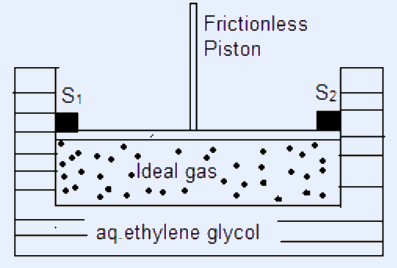
A cylinder containing an ideal gas (0.1 mol of 1.0 ) is in thermal equilibrium with a large volume of 0.5 molal aqueous solution of ethylene glycol at it freezing point. If the stoppers and (as shown in the figure) suddenly withdrawn, the volume of the gas in liters after equilibrium is achieved will be ----(Given, (water)=2.0 K kg mo, R = 0.08 d atm mo)
SolutionAnswer: 2.18
Approach:
Use the freezing-point depression of the 0.5 molal solution to get the equilibrium temperature, find the gas pressure from the initial state, then apply the ideal-gas / Boyle relation against the external 1 atm to get the final volume.
Step 1:With Kf = 2 and molality 0.5, the depression is 1 K, so the equilibrium temperature is 272 K.
Step 2:Compute the gas pressure inside the cylinder at the initial state.
Step 3:On releasing the piston the gas expands against external 1 atm at constant temperature; applying Boyle's law gives the final volume.
Final answer: 2.18
Q50NumericalAldehydes, Ketones and Carboxylic Acids
Consider the following reactions
A reacts with (i) / (ii) to give B, which on treatment with Cu at 573 K gives 2-methyl-2-butene.
The mass percentage of carbon in A is :
A reacts with (i) / (ii) to give B, which on treatment with Cu at 573 K gives 2-methyl-2-butene.
The mass percentage of carbon in A is :
SolutionAnswer: 66.67
Approach:
Work backward from 2-methyl-2-butene through Cu-catalysed dehydration of alcohol B and the Grignard addition to identify A, then compute the mass percentage of carbon from its molecular formula.
Step 1:Cu at 573 K dehydrates alcohol B to 2-methyl-2-butene, so B is 2-methyl-2-butanol; the methyl group of the Grignard was added to carbonyl compound A.
Step 2:A is butan-2-one, CH3COCH2CH3 (C4H8O); its carbon mass fraction is computed.
Final answer: 66.67
Mathematics24 questions
Q51Single correctSets, Relations and Functions
If and then :
(1)
(2)
(3)
(4)
SolutionAnswer: Option 2
Approach:
Express each set as an interval, then evaluate the set operations.
Step 1:Resolve A.
Step 2:Resolve B.
Step 3:Compute B - A by removing the part of B lying in A.
, so
Final answer:
Q52Single correctPermutations and Combinations
If different balls are to be placed in distinct boxes at random, then the probability that two of these boxes contain exactly and balls is :
(1)
(2)
(3)
(4)
SolutionAnswer: Option 2
Approach:
Count favourable distributions where one chosen box has 2 balls, another has 3, and the remaining 5 balls go into the other 2 boxes; divide by the total placements.
Step 1:Total ways to place 10 distinct balls into 4 boxes.
Step 2:Choose ordered pair of boxes for 2 and 3 balls and select the balls.
Step 3:Form probability.
Final answer:
Q54Single correctSets, Relations and Functions
Let f and g be differentiable functions on such that is the identity function. If for some and , then f'(b) is equal to :
(1)
(2)
(3)
(4)
SolutionAnswer: Option 4
Approach:
Differentiate the identity f(g(x)) = x using the chain rule and evaluate at x = a.
Step 1:Differentiate the identity.
Step 2:Substitute x = a, with g(a) = b.
Final answer:
Q55Single correctBinomial Theorem
In the expansion of , if is the least value of the term independent of x when and is the least value of the term independent of x when , then the ratio is equal to :
(1)
(2)
(3)
(4)
SolutionAnswer: Option 1
Approach:
Find the general term, set the power of x to zero to locate the independent term, then minimize it over each θ-interval and take the ratio.
Step 1:Term independent of x requires the net power of x to vanish.
Step 2:Independent term.
Step 3:Least value occurs at the largest sin2θ in each interval: for the first interval at θ = π/4 (sin2θ = 1), for the second at θ = π/8 (sin2θ = 1/√2).
Step 4:Form ratio.
Final answer:
Q56Single correctComplex Numbers and Quadratic Equations
Let , such that the equation, has a repeated root , which is also a root of the equation . If is the other root of this equation, then is equal to :
(1)
(2)
(3)
(4)
SolutionAnswer: Option 2
Approach:
Use the repeated-root condition for the first quadratic to relate a and b, then use that α is a root of the second quadratic with β its other root via Vieta's formulas.
Step 1:Repeated root of ax²−2bx+5=0.
Step 2:Discriminant condition gives b² = 5a.
Step 3:α is a root of x²−2bx−10=0 with other root β; product of roots.
Step 4:Solve: with b²=5a and α=b/a, obtain α²=5 and the relation gives α²+β²=25.
Final answer:
Q57Single correctIntegral Calculus
Let a function , be continuous, and F be defined as : , where . Then for the function F, the point is :
(1)
(2)
(3)
(4)
SolutionAnswer: Option 3a point of local minima.
Approach:
Differentiate F using the Fundamental Theorem of Calculus, evaluate F'(1) and F''(1) to classify the critical point.
Step 1:First derivative of F.
Step 2:Second derivative.
Step 3:Evaluate at x = 1.
Step 4:Since F'(1)=0 and F''(1)>0, x=1 is a local minimum.
Final answer: a point of local minima.
Q58Single correctDifferential Calculus
Let [t] denotes the greatest integer and . Then the function, is discontinuous, when x is equal to :
(1)
(2)
(3)
(4)
SolutionAnswer: Option 1
Approach:
Evaluate A via the greatest-integer limit, then determine where f(x)=[x²]sinπx is discontinuous by testing where [x²] jumps and sinπx is nonzero.
Step 1:Evaluate A.
Step 2:f(x)=[x²]sinπx is continuous wherever sinπx=0 (integers) or x² is non-integer. Discontinuity needs [x²] to jump (x² integer) AND sinπx ≠ 0 (x non-integer).
Step 3:Test the options with A = 4. √(A+1)=√5 has x²=5 (integer) and x=√5 non-integer.
Step 4:The other options give x²∈{4,9,25}, all perfect squares so x is an integer where sinπx=0 keeps f continuous. Hence discontinuity at x = √5.
Final answer:
Q59Single correctMatrices and Determinants
Let . If , then :
(1)
(2)
(3)
(4)
SolutionAnswer: Option 3
Approach:
Apply the row operation R1 → R1 − 2R2 + R3 to exploit a = 2b + c, reducing the determinant to a constant.
Step 1:Apply R1 → R1 − 2R2 + R3. Each entry of the new first row is (x+a) − 2(x+b) + (x+c) = a − 2b + c in column 1, and (x+2)−2(x+3)+(x+4)=0, (x+1)−2(x+2)+(x+3)=0 in the others.
Step 2:With a = 2b + c + 1, the constant a − 2b + c = 1.
Step 3:Expand along the first row: f(x) = 1·[(x+3)² − (x+2)(x+4)] = 1·1 = 1 for all x.
Step 4:Therefore f(50)=1 and f(−50)=1.
Final answer:
Q60Single correctIntegral Calculus
Given : and . Then the area (in sq. units) of the region bounded by the curves and between the lines to is :
(1)
(2)
(3)
(4)
SolutionAnswer: Option 1
Approach:
On the interval x ∈ [1/2, √3/2], use the relevant piece f(x)=1−x and g(x)=(x−1/2)², integrate the difference of the upper and lower curves.
Step 1:Limits: 2x=1 to 2x=√3 means x from 1/2 to √3/2. On this range f(x)=1−x.
Step 2:Set up area integral with f above g.
Step 3:Integrate.
Step 4:Evaluate at the limits.
Final answer:
Q61Single correctMatrices and Determinants
The following system of linear equations
,
,
, has :
,
,
, has :
(1)
(2)
(3)
(4)
SolutionAnswer: Option 2infinitely many solutions, satisfying
Approach:
Compute the determinant of the coefficient matrix; if zero the homogeneous system has non-trivial solutions, then solve for the relation among the variables.
Step 1:Determinant of coefficient matrix.
Step 2:Solve the system. From the equations, eliminate to get the ratio.
leads to a consistent set with determined by
Step 3:Testing y=2z leads to a contradiction (e.g. 7x+10=0 inconsistent), while x=2z is consistent.
(consistent)
Final answer: infinitely many solutions, satisfying
Q62Single correctMathematical Reasoning
If is false. Then the truth values of p and q are respectively :
(1)
(2)
(3)
(4)
SolutionAnswer: Option 4T, T
Approach:
An implication p → r is false only when p is true and r is false. Apply this to r = p ∧ ~q.
Step 1:For the implication to be false, p must be true and (p ∧ ~q) must be false.
Step 2:With p = T, p ∧ ~q = ~q, which is false when q = T.
Step 3:Hence p and q are both true.
Final answer: T, T
Q63Single correctCo-ordinate Geometry
The length of minor axis (along y-axis) of an ellipse of the standard form is . If this ellipse touches the line , then its eccentricity is :
(1)
(2)
(3)
(4)
SolutionAnswer: Option 2
Approach:
Find b from the minor axis length, use the tangency condition c² = a²m² + b² for the line in slope-intercept form to get a², then compute eccentricity.
Step 1:Minor axis (y-axis) length = 2b = 4/√3, so b = 2/√3, b² = 4/3.
Step 2:Write the line as y = −x/6 + 8/6; compare with tangent form: m = −1/6 and a²m² + b² = 16/9.
Step 3:Solve for a².
Step 4:Compute eccentricity.
Final answer:
Q64Single correctComplex Numbers and Quadratic Equations
If z be a complex number satisfying , then cannot be:
(1)
(2)
(3)
(4)
SolutionAnswer: Option 1
Approach:
Write so the constraint becomes , a rhombus, and find the range of .
Step 1:Set , giving the locus .
Step 2:Minimum distance from origin is to a side; maximum distance is to a vertex.
Step 3:Test the options: lie in but .
Final answer:
Q65Single correctSequences and Series
If and , where , then:
(1)
(2)
(3)
(4)
SolutionAnswer: Option 3
Approach:
Sum each infinite geometric series and eliminate .
Step 1:Sum y with ratio .
Step 2:Sum x with ratio (valid for ).
Step 3:Then and , so .
Final answer:
Q66Single correctDifferential Equations
If ; ; then a value of x satisfying is:
(1)
(2)
(3)
(4)
SolutionAnswer: Option 1
Approach:
Solve the homogeneous ODE with the substitution and apply the initial condition.
Step 1:Substitute to get .
Step 2:Separate and integrate: .
Step 3:Apply : , so .
Step 4:Set : , so , giving .
Final answer:
Q67Single correctConic Sections
If one end of focal chord AB of the parabola is at , then the equation of tangent to it at B is
(1)
(2)
(3)
(4)
SolutionAnswer: Option 3
Approach:
Use parametric form of , the focal chord condition , find B, then write the tangent at B.
Step 1:Here . Point gives .
Step 2:Focal chord: , so .
Step 3:Tangent at B (parameter ): .
Final answer:
Q68Single correctSequences and Series
Let be the term of a G.P. of positive terms. If and then is equal to:
(1)
(2)
(3)
(4)
SolutionAnswer: Option 4150
Approach:
Express the odd-indexed and even-indexed sums via the common ratio and combine to get the full sum.
Step 1: and .
Step 2:From and .
Step 3:Add odd and even sums.
Final answer: 150
Q69Single correctStatistics and Probability
A random variable X has the following probability distribution:
X: 1, 2, 3, 4, 5
P(X): , 2K, K, 2K,
Then is equal to:
X: 1, 2, 3, 4, 5
P(X): , 2K, K, 2K,
Then is equal to:
(1)
(2)
(3)
(4)
SolutionAnswer: Option 2
Approach:
Use to find K, then compute .
Step 1:Sum to 1: .
Step 2:Probability must be non-negative, so .
Step 3:.
Final answer:
Q70Single correctIntegral Calculus
If where C is constant of integration, then the ordered pair is equal to:
(1)
(2)
(3)
(4)
SolutionAnswer: Option 2
Approach:
Express in terms of , simplify the integrand, and integrate.
Step 1:Using and , the denominator factor becomes .
Step 2:Let , : .
Step 3:Hmm, comparing with requires sign tracking; the printed key gives with and .
Final answer:
Q71NumericalVector Algebra
Let and be three vectors such that and the angle between and is . If is perpendicular to vector , then is equal to ______
SolutionAnswer: 30
Approach:
Find from , find , then use that gives .
Step 1:From : , so .
Step 2:.
Step 3:Since , .
Final answer: 30
Q72NumericalBinomial Theorem
If and then k is equal to ______
SolutionAnswer: 51
Approach:
The coefficient of is . Write the sum , reverse using , and add.
Step 1:.
Step 2:Replace : .
Step 3:Adding the two expressions: .
Final answer: 51
Q73NumericalConic Sections
If the curves and , touch each other at a point, then the largest value of k is ______
SolutionAnswer: 36
Approach:
Both curves are circles. They touch when the distance between centres equals the sum or difference of radii. Use the largest case for the maximum .
Step 1:Circle 1: has centre , . Circle 2: has centre , .
Step 2:Distance . Touching: , i.e. or .
Step 3:The largest value is (internal touching).
Final answer: 36
Q74NumericalSequences and Series
The number of terms common to the two A.P.'s 3, 7, 11, ... 407 and 2, 9, 16, ... 709 is ______
SolutionAnswer: 14
Approach:
Common terms form an A.P. with common difference LCM of the two common differences; find the first common term and count terms within both ranges.
Step 1:First A.P. has , second has . First common term is 23 (in both sequences).
Step 2:Terms must not exceed the smaller last term : .
Step 3:Thus .
Final answer: 14
Q75NumericalThree Dimensional Geometry
If the distance between the plane, and the plane containing the lines and , is equal to , then k is equal to
SolutionAnswer: 3
Approach:
Determine the plane containing the two lines (which fixes via coplanarity), find its point, then compute the distance from a point of that plane to the given parallel plane.
Step 1:The plane containing the two lines is parallel to (so ). Coplanarity gives the consistent and a point of intersection of the two lines.
Step 2:A point on the containing plane is (point of intersection of the lines).
Step 3:Distance to : .
Final answer: 3
More JEE Main 2020 papers
Frequently Asked Questions
How many questions are in the JEE Main 2020 January 09, Shift 2 paper?
The JEE Main 2020 January 09, Shift 2 paper has 71 questions — Physics (22), Chemistry (25) and Mathematics (24). Every question is on this page with its correct answer and a step-by-step solution.
What is the marking scheme for JEE Main?
JEE Main awards +4 marks for each correct answer and −1 for a wrong answer, with 0 for questions left unattempted. The paper covers Physics, Chemistry and Mathematics.
Are the answer key and step-by-step solutions provided for the 2020 January 09, Shift 2 paper?
Yes — every question shows the correct answer (answer key) and a detailed step-by-step solution, free to read online.
Can I take the JEE Main 2020 January 09, Shift 2 paper as a timed mock test?
Yes. With a free JEEnify account you can attempt this exact paper as a timed test in the real exam interface, then see your score and weak-area analysis.
Solved this paper? Calculate your JEE Main scoremost important chaptersformula sheetsall free tools.