
Back to JEE Main PYQs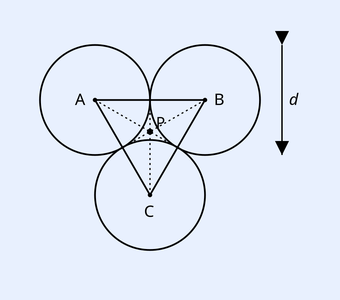


JEE Main 2020 January 09, Shift 1 Question Paper with Solutions
All 75 questions from the JEE Main 2020 (January 09, Shift 1) shift — Physics (25), Chemistry (25) and Mathematics (25) — each with the correct answer (answer key) and a step-by-step solution. Read it free online, or attempt the full paper as a timed mock test.
Physics25 questions
Q1Single correctRotational Motion
Three identical solid spheres each have mass 'm' and diameter 'd' are touching each other as shown in the figure. Calculate ratio of moment of inertia about the axis perpendicular to plane of paper and passing through point P and B as shown in the figure. Given P is centroid of the triangle
(1)
(2)
(3)
(4)
SolutionAnswer: Option 1
Approach:
Compute the moment of inertia of the three-sphere system about the axis through the centroid P, then about the axis through vertex B, using the parallel-axis theorem, and take the ratio.
Step 1:Moment of inertia of one solid sphere about its own central axis.
Step 2:Distance of centroid P from the centre of each sphere, with side length d, equals of the median .
Step 3:Moment of inertia about axis through P, summing three spheres with parallel-axis shift .
Step 4:Moment of inertia about axis through vertex B. One sphere at B contributes only its central inertia; the other two are at distance d.
Step 5:Take the ratio.
Final answer:
Q2Single correctElectrostatics
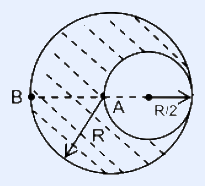
A solid sphere having a radius R and uniform charge density . If a sphere of radius R/2 is carved out of it as shown in the figure. Find the ratio of the magnitude of electric field at point A and B
(1)
(2)
(3)
(4)
SolutionAnswer: Option 3
Approach:
Model the carved sphere as a full sphere of density superposed with a small sphere of density (radius R/2). Add fields at A and B using superposition, then take the ratio.
Step 1:Point A lies on the surface of the carved cavity (radius R/2). Field of the full sphere at A is interior; field of the negative small sphere at A is zero (A is at the cavity's own surface centre line giving the small-sphere interior field).
Step 2:Point B lies on the outer surface, opposite the cavity. Full-sphere field at B is ; the negative small sphere of radius R/2 (centre at R/2 from O) acts at distance giving an outside-field contribution.
Step 3:Take the ratio of the magnitudes.
Final answer:
Q3Single correctMagnetic Effects of Current
Consider an infinitely long current carrying cylindrical straight wire having radius 'a'. Then the ratio of magnetic field due to wire at distance and , respectively from axis of wire is
(1)
(2)
(3)
(4)
SolutionAnswer: Option 22/3
Approach:
Use Ampere's law. Inside the wire the field grows linearly with r; outside it falls as 1/r. Evaluate at (inside) and (outside) and take the ratio.
Step 1:Field at (inside).
Step 2:Field at (outside).
Step 3:Take the ratio.
Final answer: 2/3
Q4Single correctWork, Energy and Power
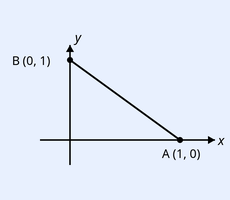
Particle moves from point A to point B along the line shown in figure under the action of force . Determine the work done on the particle by in moving the particle from point A to point B (all quantities are in SI units)
(1)
(2)
(3)
(4)
SolutionAnswer: Option 11 J
Approach:
Work equals the line integral of the force along the path from A(1,0) to B(0,1). Integrate the x and y components over their respective limits.
Step 1:Write the dot product with .
Step 2:Integrate x from 1 to 0 and y from 0 to 1.
Step 3:Evaluate.
Final answer: 1 J
Q5Single correctThermodynamics
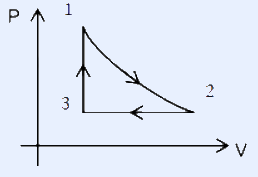
For the given graph of an ideal gas, choose the correct graph. Process is adiabatic. (Graphs are schematic and not to scale)
(1)
(2)
(3)
(4)
SolutionAnswer: Option 1
Approach:
Identify each process from the P-V diagram and translate it to a V-T plot. Process 3-1 is isochoric, 1-2 is isothermal, and 2-3 (BC) is adiabatic; match the resulting V-T curve.
Step 1:Process 3-1: volume is constant, so it is a vertical line on the V-T plot (isochoric).
Step 2:Process 1-2: and , hence T is constant, giving a horizontal line on the V-T plot (isothermal).
Step 3:Process 2-3 is adiabatic: . As V increases, T decreases and the relation is non-linear, so the curve is not a straight line.
Step 4:The V-T graph combining a vertical isochore, a horizontal isotherm, and a non-linear adiabatic curve corresponds to option a.
Final answer: option a
Q6Single correctElectrostatics
An electric dipole of moment Cm is at the origin (0,0,0). The electric field due to this dipole at is parallel to [Note that ]
(1)
(2)
(3)
(4)
SolutionAnswer: Option 3
Approach:
Since , the field point lies on the equatorial line of the dipole, where the field is anti-parallel to . Hence the field is parallel to .
Step 1:Verify the field point is equatorial: is given.
Step 2:On the equatorial line, the field is directed opposite to the dipole moment.
Step 3:Compute direction.
Final answer:
Q7Single correctGravitation
A body A of mass m is revolving around a planet in a circular orbit of radius R. At the instant the particle B has velocity , another particle of mass moving at velocity of collides perfectly inelastically with the first particle. Then, the combined body
(1)
(2)
(3)
(4)
SolutionAnswer: Option 4d. Start moving in an elliptical orbit around the planet
Approach:
Apply conservation of linear momentum along the orbital velocity direction to find the post-collision speed, then compare it with the orbital and escape speeds to identify the new trajectory.
Step 1:Conserve momentum along the line of orbital motion.
Step 2:Solve for the combined velocity.
Step 3:Compare with the orbital speed V and escape speed . Since , the body cannot remain circular and is below escape speed, so it moves on an elliptical orbit.
Final answer: d. Start moving in an elliptical orbit around the planet
Q8Single correctWork, Energy and Power
Two particles of equal mass m have respective initial velocities and . They collide completely inelastically. Find the loss in kinetic energy.
(1)
(2)
(3)
(4)
SolutionAnswer: Option 4
Approach:
Use conservation of momentum in x and y to find the common final velocity, then compute the difference between initial and final kinetic energies.
Step 1:Find common velocity components by conserving momentum.
Step 2:Initial kinetic energy of both particles.
Step 3:Final kinetic energy of the combined mass.
Step 4:Loss in kinetic energy.
Final answer:
Q9Single correctWave Optics
Three harmonic waves of same frequency (v) and intensity having initial phase angles they are superimposed, the resultant intensity is close to
(1)
(2)
(3)
(4)
SolutionAnswer: Option 1
Approach:
Since intensity is proportional to amplitude squared, add the three amplitude phasors at phases , find the resultant amplitude, and square it.
Step 1:With each wave amplitude A (where ), the y-components of the phasors cancel; add the x-components.
Step 2:Resultant intensity is proportional to the square of the resultant amplitude.
Step 3:Evaluate numerically.
Final answer:
Q10Single correctMechanical Properties of Fluids
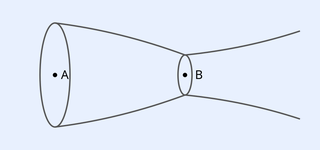
An ideal liquid (water) flowing through a tube of non-uniform cross-sectional area, where area at A and B are 40 c and 20 c respectively. If pressure difference between A & B is 700 N/, then volume flow rate is (density of water = 1000 kg )
(1)
(2)
(3)
(4)
SolutionAnswer: Option 12720 c/s
Approach:
Apply the continuity equation to relate the velocities at A and B, then use Bernoulli's equation with the given pressure difference to solve for the velocity, and compute the volume flow rate.
Step 1:From continuity, with c and c.
Step 2:Apply Bernoulli with N/.
Step 3:Solve for .
Step 4:Volume flow rate with c.
Final answer: 2720 c/s
Q11Single correctUnits and Measurements
A screw gauge advances by 3 mm on main scale in 6 rotations. There are 50 divisions on circular scale. Find least count of screw gauge?
(1)
(2)
(3)
(4)
SolutionAnswer: Option 20.001 cm
Approach:
Find the pitch (linear advance per rotation), then divide by the number of circular-scale divisions to get the least count.
Step 1:Compute the pitch from 3 mm advance in 6 rotations.
Step 2:Divide by 50 circular-scale divisions.
Step 3:Convert to centimetres.
Final answer: 0.001 cm
Q12Single correctWave Optics
A telescope of aperture diameter 5 m is used to observe the moon from the earth. Distance between the moon and earth is km. The minimum distance between two points on the moon's surface which can be resolved using this telescope is close to (Wavelength of light is 5500 Å)
(1)
(2)
(3)
(4)
SolutionAnswer: Option 160 m
Approach:
Use the Rayleigh criterion to find the minimum angular resolution, then multiply by the Earth-Moon distance to get the minimum resolvable linear separation.
Step 1:Minimum resolvable angle from the Rayleigh criterion.
Step 2:Multiply by the distance km m.
Step 3:Substitute m, m.
Final answer: 60 m
Q13Single correctDual Nature of Matter and Radiation
Radiation with wavelength 6561 Å falls on a metal surface to produce photoelectrons. The electrons are made to enter a uniform magnetic field of T. If the radius of largest circular path followed by electron is 10 mm, then work function of metal is close to
(1)
(2)
(3)
(4)
SolutionAnswer: Option 31.1 eV
Approach:
Find the maximum kinetic energy of the photoelectrons from the radius of the circular path in the magnetic field, then use Einstein's photoelectric equation to obtain the work function.
Step 1:Photon energy.
Step 2:From , solve for the kinetic energy using mm and T.
Step 3:So eV. Substitute into the photoelectric equation.
Final answer: 1.1 eV
Q14Single correctDual Nature of Matter and Radiation
Kinetic energy of the particle is E and it's de-Broglie wavelength is . On increasing its K.E by , it's new de-Broglie wavelength becomes . Then is
(1)
(2)
(3)
(4)
SolutionAnswer: Option 1
Approach:
Relate de-Broglie wavelength to kinetic energy and use the given halving of wavelength to find the new energy.
Step 1:Express wavelength in terms of kinetic energy.
Step 2:Form the ratio of the new wavelength to the original.
Step 3:Square and solve for the new energy.
Step 4:Determine the change in kinetic energy.
Final answer:
Q15Single correctPhysics and Measurement
A quantity f is given by where c is speed of light, G is universal gravitational constant and h is the Planck's constant. Dimension of f is that of
(1)
(2)
(3)
(4)
SolutionAnswer: Option 2energy
Approach:
Substitute the dimensions of h, c and G into the expression and simplify.
Step 1:Use that energy times wavelength equals hc, giving its dimensions.
Step 2:Write the dimensions of the gravitational constant.
Step 3:Form the ratio under the root.
Step 4:Take the square root.
Final answer: energy
Q16Single correctOptics
A vessel of depth is half filled with a liquid of refractive index in upper half and with a liquid of refractive index in lower half. The apparent depth of inner top surface of the bottom of the vessel will be
(1)
(2)
(3)
(4)
SolutionAnswer: Option 1
Approach:
Compute apparent depth of each layer as seen from the layer above and sum the contributions, viewing from outside air.
Step 1:Apparent depth of bottom surface as seen from the upper liquid of index sqrt(2).
Step 2:Add the geometric depth of the upper liquid to get total depth seen from the top of the upper liquid.
Step 3:Now view this from outside air through the upper liquid of index sqrt(2).
Step 4:Rationalise the result.
Final answer:
Q17Single correctCurrent Electricity
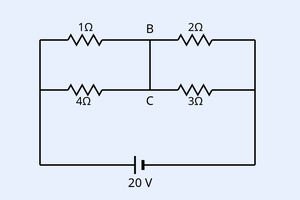
In the given circuit diagram, a wire is joining point B & C. Find the current in this wire
(1)
(2)
(3)
(4)
SolutionAnswer: Option 2
Approach:
Reduce the parallel resistor pairs, find the total current from the source, then determine the share flowing through branch BC.
Step 1:Combine the 1 ohm and 4 ohm resistors in parallel.
Step 2:Combine the 2 ohm and 3 ohm resistors in parallel.
Step 3:Add the two equivalent resistances in series.
Step 4:Find the total current from the 20 V source.
Step 5:Current divides inversely with resistance; current through branch BC is the difference of the two branch currents.
Final answer:
Q18Single correctElectromagnetic Waves
Two plane electromagnetic waves are moving in vacuum in whose electric field vectors are given by and . At A charge q is at origin with velocity (c is speed of light in vacuum). The instantaneous force on this charge (all data are in SI units) is
(1)
(2)
(3)
(4)
SolutionAnswer: Option 2
Approach:
Obtain the magnetic field of each wave from its propagation direction, then compute the total Lorentz force at the origin at t=0.
Step 1:Wave 1 propagates along x with E along j, so its B is along k; wave 2 propagates along y with E along k, so its B is along i.
Step 2:At the origin and t=0 all cosines equal 1, so total E and B fields are evaluated.
Step 3:Compute the magnetic force using v = 0.8c j.
Step 4:Add the electric force qE.
Final answer:
Q19Single correctKinetic Theory of Gases
Consider two ideal diatomic gases A and B at some temperature T. Molecules of the gas A are rigid, and have a mass m. Molecules of the gas B have an additional vibration mode and have a mass . The ratio of the molar specific heat at constant volume that gas A and B is
(1)
(2)
(3)
(4)
SolutionAnswer: Option 4
Approach:
Count the degrees of freedom for each gas and use the equipartition expression for molar specific heat at constant volume; mass is irrelevant.
Step 1:Gas A is rigid diatomic with degrees of freedom 5.
Step 2:Gas B is diatomic with an extra vibrational mode contributing 2 to the degrees of freedom.
Step 3:Form the ratio of the molar specific heats.
Final answer:
Q20Single correctElectrostatics and Magnetism
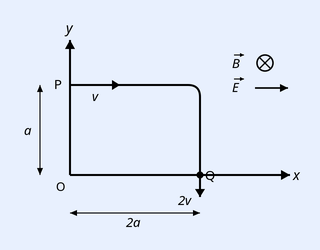
A charged particle of mass 'm' and charge 'q' is moving under the influence of uniform electric field and a uniform magnetic field follow a trajectory from P to Q as shown in figure. The velocities at P and Q are respectively and . Then which of the following statements (A, B, C, D) are correct? (Trajectory shown is schematic and not to scale)
A. Magnitude of electric field
B. Rate of work done by electric field at P is
C. Rate of work done by both fields at Q is zero
D. The difference between the magnitude of angular momentum of the particle at P and Q is
A. Magnitude of electric field
B. Rate of work done by electric field at P is
C. Rate of work done by both fields at Q is zero
D. The difference between the magnitude of angular momentum of the particle at P and Q is
(1)
(2)
(3)
(4)
SolutionAnswer: Option 2A, B and C are correct
Approach:
Use the work-energy theorem (magnetic force does no work) to find E, compute power at P, evaluate net power at Q, and compute the change in angular momentum about the origin.
Step 1:Magnetic force does zero work; apply work-energy theorem with displacement 2a along x from P to Q.
Step 2:Statement A is therefore correct.
Step 3:Rate of work of electric force at P equals qEv.
Step 4:At Q the velocity is along minus j while E is along i, so electric power is zero and magnetic power is always zero.
Step 5:Angular momentum about origin: at P, = mv(2a); at Q, = m(2v)(a); the magnitudes are equal so their difference is zero, not 2mva.
Final answer: A, B and C are correct
Q21NumericalElectromagnetic Induction and Alternating Currents
In a fluorescent lamp choke (a small transformer) 100 V of reversible voltage is produced when choke changes current in from 0.25 A to 0 A in 0.025 ms. The self-inductance of choke (in mH) is estimated to be
SolutionAnswer: 10
Approach:
Apply Faraday's law for induced EMF across an inductor and solve for the self-inductance.
Step 1:Write the magnitude of the induced EMF in terms of L and the rate of change of current.
Step 2:Solve for L.
Step 3:Convert to millihenry.
Final answer: 10
Q22NumericalProperties of Solids and Liquids
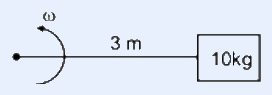
A wire of length m and area of cross section c and breaking stress N/ is attached with block of mass 10 kg. Find the maximum possible value of angular velocity () with which block can be moved in a circle with string fixed at one end.
SolutionAnswer: 4
Approach:
Set the maximum tension (breaking stress times area) equal to the centripetal force and solve for the maximum angular velocity.
Step 1:Express the maximum tension via the breaking stress and equate to the centripetal force.
Step 2:Solve for omega squared with A = = .
Step 3:Take the square root.
Final answer: 4
Q23NumericalKinematics
The distance x covered by a particle in one dimension motion varies as with time t as , where a, b, c are constants. Acceleration of particle depend on x as , the value of n is
SolutionAnswer: 3
Approach:
Differentiate the given relation to obtain velocity, then differentiate again to obtain acceleration and express its dependence on x.
Step 1:Differentiate = + 2bt + c with respect to time.
Step 2:Differentiate the velocity relation to bring in acceleration.
Step 3:Substitute v and simplify the numerator using the original relation.
Step 4:Identify the exponent.
Final answer: 3
Q24NumericalRotational Motion
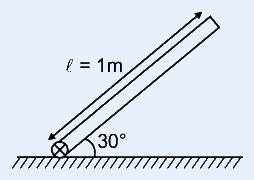
A rod of length 1 m pivoted at one end is released from rest when it makes from the horizontal as shown in the figure below.
If of rod is at the moment it hits the ground, then find n
If of rod is at the moment it hits the ground, then find n
SolutionAnswer: 15
Approach:
Use conservation of energy: the loss in gravitational potential energy of the centre of mass equals the rotational kinetic energy about the pivot.
Step 1:Equate the drop in PE of the centre of mass to the rotational KE about the pivot.
Step 2:Substitute l = 1 m, sin 30 = 1/2 and g = 10 m/ and solve for omega squared.
Step 3:Express omega and identify n.
Final answer: 15
Q25NumericalElectronic Devices
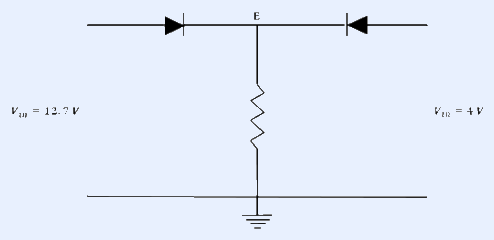
In the given circuit both diodes have ideal having zero forward resistance and built-in potential of 0.7 V. Find the potential of point E in volts
SolutionAnswer: 12
Approach:
Apply nodal analysis on both sides of the network and check which diode conducts, accounting for the 0.7 V built-in potential.
Step 1:Assume node E sits at 0 V and test conduction of each diode using its terminal voltages 12.7 V on the left and 4 V on the right.
Step 2:If the diode between A and E conducts, E would rise to 12 V (12.7 - 0.7), which reverse biases the diode between E and H.
Step 3:Test the alternative: if E were at 3.3 V (4 - 0.7), the left diode would be forward biased with a 12 - 3.3 difference, which is not allowable, so this state fails.
Step 4:Therefore current flows through the left diode only and node E rests at 12 V.
Final answer: 12
Chemistry25 questions
Q26Single correctStructure of Atom
The de Broglie wavelength of an electron in the 4th Bohr orbit is:
(1)
(2)
(3)
(4)
SolutionAnswer: Option 3
Approach:
Apply the Bohr quantization condition expressed through de Broglie wavelength, where the orbit circumference equals an integral number of wavelengths.
Step 1:The circumference of the nth Bohr orbit accommodates n de Broglie wavelengths.
Step 2:Substitute the radius of the nth orbit.
Step 3:Substitute n = 4 for the fourth Bohr orbit.
Final answer:
Q27Single correctChemical Bonding and Molecular Structure
If the magnetic moment of a dioxygen species is 1.73 B.M, it may be:
(1)
(2)
(3)
(4)
SolutionAnswer: Option 2 or
Approach:
A magnetic moment of 1.73 B.M corresponds to one unpaired electron; identify dioxygen species whose MO configuration contains exactly one unpaired electron.
Step 1:Compute the number of unpaired electrons from the magnetic moment.
Step 2:Examine pi-antibonding electron count. Neutral has two unpaired electrons in orbitals, giving 2.83 B.M.
Step 3:Removing or adding one electron leaves one unpaired electron in the pi-antibonding set for both ions.
Final answer: or
Q28Single correctThermodynamics
If enthalpy of atomisation for is x kJ/mol and bond enthalpy for is y kJ/mol, the relation between them:
(1)
(2)
(3)
(4)
SolutionAnswer: Option 1is x y
Approach:
Atomisation of liquid bromine includes vaporisation followed by bond dissociation, whereas bond enthalpy refers only to dissociation of the gaseous molecule.
Step 1:Atomisation of liquid bromine proceeds in two stages: vaporisation of the liquid then dissociation of the gaseous molecule.
Step 2:Since the vaporisation enthalpy is positive, the atomisation enthalpy exceeds the bond enthalpy.
Final answer: is x y
Q29Single correctClassification of Elements and Periodicity
Which of the following oxides are acidic, basic and amphoteric, respectively?
(1)
(2)
(3)
(4)
SolutionAnswer: Option 2
Approach:
Classify each oxide by nature: non-metal oxides are acidic, alkali/alkaline-earth metal oxides are basic, and oxides such as alumina are amphoteric.
Step 1:Non-metal oxides are acidic in nature.
Step 2:Alkali metal oxides are basic in nature.
Step 3:Alumina reacts with both acids and bases.
Final answer:
Q30Single correctCoordination Compounds
Complex X of composition has a spin only magnetic moment of 3.83 BM. It reacts with and shows geometrical isomerism. The IUPAC nomenclature of X is :
(1)
(2)
(3)
(4)
SolutionAnswer: Option 2Tetraaquadichlorido chromium(III) chloride dihydrate
Approach:
Determine the oxidation state from the magnetic moment, then deduce the coordination sphere consistent with reaction with silver nitrate and geometrical isomerism.
Step 1:Find the number of unpaired electrons from the magnetic moment.
Step 2:Three unpaired electrons correspond to a configuration, fixing chromium in the +3 state.
Step 3:Reaction with silver nitrate and geometrical isomerism require ionisable chloride outside and two chlorides plus four water molecules inside the sphere.
Final answer: Tetraaquadichlorido chromium(III) chloride dihydrate
Q31Single correctThe d- and f-Block Elements
The electronic configuration of bivalent europium and trivalent cerium are, respectively:
(Atomic Number : Xe = 54, Ce = 58, Eu = 63)
(Atomic Number : Xe = 54, Ce = 58, Eu = 63)
(1)
(2)
(3)
(4)
SolutionAnswer: Option 1
Approach:
Write the ground configurations of the neutral atoms, then remove electrons (6s and 4f as needed) to obtain the requested ions.
Step 1:Europium has the configuration with a half-filled 4f set.
Step 2:Removing two 6s electrons gives bivalent europium.
Step 3:Cerium configuration is ; removing three electrons gives trivalent cerium.
Final answer:
Q32Single correctEquilibrium
The for the following dissociation is .
Which of the following choices is correct for a mixture of 300 mL 0.134 M and 100mL 0.4 M ?
Which of the following choices is correct for a mixture of 300 mL 0.134 M and 100mL 0.4 M ?
(1)
(2)
(3)
(4)
SolutionAnswer: Option 1
Approach:
Compute the diluted concentrations of the ions in the combined volume, evaluate the reaction quotient, and compare with the solubility product.
Step 1:Find moles of lead ion and dilute to the total volume of 400 mL.
Step 2:Find moles of chloride ion and dilute to 400 mL.
Step 3:Evaluate the reaction quotient.
Step 4:Compare the quotient with the solubility product.
Final answer:
Q33Single correctRedox Reactions
The compound that cannot act both as oxidising and reducing agent is :
(1)
(2)
(3)
(4)
SolutionAnswer: Option 3
Approach:
A species can act as both oxidising and reducing agent only when its central atom is in an intermediate oxidation state; identify the one fixed at its maximum state.
Step 1:When the oxidation state is maximum, the species can only be reduced and acts as an oxidising agent.
Step 2:In the other species the central atom lies between its extremes and can be oxidised or reduced.
Step 3:Phosphorus already at +5 cannot be oxidised further, so phosphoric acid cannot act as a reducing agent.
no higher state
Final answer:
Q34Single correctClassification of Elements and Periodicity
B has a smaller first ionization enthalpy than Be. Consider the following statements:
(i) It is easier to remove 2p electron than 2s electron
(ii) 2p electron of B is more shielded from the nucleus by the inner core of electrons than the 2s electron of Be
(iii) 2s electron has more penetration power than 2p electron
(iv) Atomic radius of B is more than Be
[Atomic number B=5, Be=4]
The correct statements are :
(i) It is easier to remove 2p electron than 2s electron
(ii) 2p electron of B is more shielded from the nucleus by the inner core of electrons than the 2s electron of Be
(iii) 2s electron has more penetration power than 2p electron
(iv) Atomic radius of B is more than Be
[Atomic number B=5, Be=4]
The correct statements are :
(1)
(2)
(3)
(4)
SolutionAnswer: Option 1(i), (ii), and (iii)
Approach:
Compare the valence electrons being removed from boron and beryllium and assess each statement against penetration, shielding and atomic-radius trends.
Step 1:Boron loses a 2p electron while beryllium loses a 2s electron.
Step 2:The 2p electron is higher in energy, more shielded and easier to remove; the 2s electron penetrates more (statements i, ii, iii valid).
penetration
Step 3:Across the period the nuclear charge increases, so boron is in fact smaller than beryllium, making statement (iv) incorrect.
Final answer: (i), (ii), and (iii)
Q35Single correctCoordination Compounds
has n number of geometrical isomers. Then, the spin-only magnetic moment and crystal field stabilisation energy [CFSE] of , respectively, [Note: Ignore pairing energy].
(1)
(2)
(3)
(4)
SolutionAnswer: Option 11.73 BM and
Approach:
Count the geometrical isomers of the square-planar palladium complex to fix n, then evaluate the magnetic moment and crystal field stabilisation energy of the resulting iron complex.
Step 1:A square-planar complex with four different ligands has three geometrical isomers.
Step 2:The complex becomes , placing iron in the +3 state with cyanide as a strong field ligand causing pairing.
Step 3:One unpaired electron gives the magnetic moment.
Step 4:Compute the CFSE for the low-spin configuration.
Final answer: 1.73 BM and
Q36Single correctGeneral Principles and Processes of Isolation of Elements
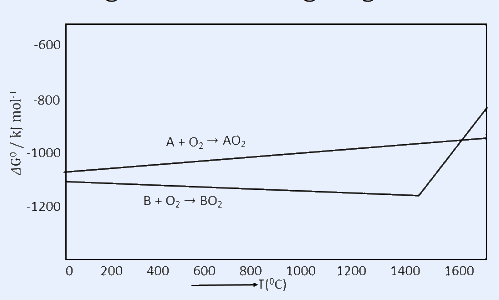
According to the following diagram, A reduces when the temperature is:
(1)
(2)
(3)
(4)
SolutionAnswer: Option 1C
Approach:
In an Ellingham diagram a metal reduces an oxide when its formation line lies below that of the oxide; identify the temperature range where line A drops below line B.
Step 1:Element A can reduce the oxide of B only when the A line lies below the B line in the Ellingham diagram.
Step 2:From the diagram the A line falls below the B line beyond 1400 degrees Celsius.
Final answer: C
Q37Single correctChemical Kinetics
For following reactions
;
.
It was found that the is decreased by 30 kJ/mol in the presence of catalyst. If the rate remains unchanged , the activation energy for catalysed reaction is (Assume pre exponential factor is same)
;
.
It was found that the is decreased by 30 kJ/mol in the presence of catalyst. If the rate remains unchanged , the activation energy for catalysed reaction is (Assume pre exponential factor is same)
(1)
(2)
(3)
(4)
SolutionAnswer: Option 3105 kJ/mol
Approach:
Equate the Arrhenius rate constants of the uncatalysed reaction at 973 K and the catalysed reaction at 500 K (same pre-exponential factor and rate) to relate the two activation energies.
Step 1:Equal rates with the same pre-exponential factor give equal exponential terms.
Step 2:Insert the catalyst lowering and the temperatures 973 K and 500 K.
Step 3:Solve for the catalysed activation energy.
Final answer: 105 kJ/mol
Q38Single correctChemical Bonding and Molecular Structure
'X' melts at low temperature and is a bad conductor of electricity in both liquid and solid state. X is:
(1)
(2)
(3)
(4)
SolutionAnswer: Option 4carbon tetrachloride
Approach:
Identify a substance that is molecular, non-polar and covalent, accounting for a low melting point and the absence of electrical conduction in either state.
Step 1:Mercury conducts as a metal, while silicon carbide and zinc sulphide are high-melting solids, excluding them.
Step 2:Carbon tetrachloride is a non-polar covalent molecular liquid with a low melting point and no free charge carriers.
Final answer: carbon tetrachloride
Q39Single correctOrganic Chemistry
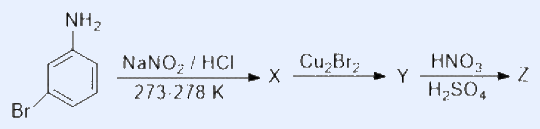
The major product Z obtained in the following reaction scheme is:
(1)
(2)
(3)
(4)
SolutionAnswer: Option 3
Approach:
Trace the reaction sequence starting from 3-bromoaniline: diazotisation, Sandmeyer bromination, then nitration.
Step 1:3-Bromoaniline is diazotised with sodium nitrite and HCl at 273-278 K to form the diazonium salt X.
Step 2:The Sandmeyer reaction with cuprous bromide replaces the diazonium group by bromine, giving 1,3-dibromobenzene Y.
Step 3:Nitration of 1,3-dibromobenzene with concentrated nitric and sulphuric acids directs the nitro group para to one bromine and ortho to the other, avoiding the sterically hindered 2-position between the two bromines.
Q40Single correctOrganic Chemistry
Which of these will produce the highest yield in Friedel-Craft's reaction?
(1)
(2)
(3)
(4)
SolutionAnswer: Option 2
Approach:
Identify which substrate undergoes Friedel-Crafts reaction most efficiently based on activation of the ring and compatibility with the Lewis-acid catalyst.
Step 1:Aniline and phenol both possess strong +R activating groups, whereas chlorobenzene is deactivated and benzamide bears an electron-withdrawing amide group.
Step 2:Aniline acts as a Lewis base and forms a complex with the Lewis-acid catalyst (e.g. AlCl3), deactivating the ring and the catalyst, so it gives a poor yield.
Step 3:Phenol is strongly activated and does not poison the catalyst, hence it gives the highest yield in the Friedel-Crafts reaction.
Q41Single correctOrganic Chemistry
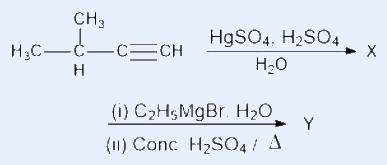
The major product (Y) in the following reactions is :
(1)
(2)
(3)
(4)
SolutionAnswer: Option 1
Approach:
Carry out acid-catalysed Markovnikov hydration of the terminal alkyne to a methyl ketone, then add ethyl Grignard and dehydrate.
Step 1:Markovnikov hydration of the terminal alkyne (3-methylbut-1-yne) gives the methyl ketone X, 3-methylbutan-2-one.
Step 2:Ethylmagnesium bromide adds to the carbonyl of X to give a tertiary alkoxide, which on workup gives a tertiary alcohol.
Step 3:Dehydration with concentrated sulphuric acid on heating yields the more substituted alkene as the major product Y (option a).
Q42Single correctOrganic Chemistry
The correct order of heat of combustion for following alkadienes is :
(1)
(2)
(3)
(4)
SolutionAnswer: Option 3A B C
Approach:
Relate heat of combustion inversely to stability; more trans double bonds give greater stability and hence lower heat of combustion.
Step 1:A trans-configured double bond is more stable than a cis one, so a diene with more trans double bonds is more stable.
Step 2:By stability A (trans,trans) > B (trans,cis) > C (cis,cis), giving the stability order A > B > C.
Step 3:Since heat of combustion is inversely proportional to stability, the least stable diene releases the most heat, giving A > B > C for heat of combustion.
Final answer: A B C
Q43Single correctOrganic Chemistry
The increasing order of basicity for the following intermediates is (from weak to strong)
(1)
(2)
(3)
(4)
SolutionAnswer: Option 1A B D E C
Approach:
Order the carbanions by basicity, which decreases as the stability of the carbanion (conjugate base) increases with increasing s-character and conjugation.
Step 1:A weaker conjugate base corresponds to a stronger acid; conversely, the more stable a carbanion, the weaker its basicity.
Step 2:Carbanion stability rises with s-character of the carbon and with delocalisation: the sp carbanion of an alkyne (C) and the conjugated allylic/cyanide systems (E, D) are more stable than the localised sp3 carbanions (B, A).
Step 3:Reversing the stability order gives the increasing order of basicity A > B > D > E > C, where A is least stable hence most basic.
Final answer: A B D E C
Q44Single correctOrganic Chemistry
A chemist has 4 samples of artificial sweetener A, B, C and D. To identify these samples, he performed certain experiments and noted the following observations:
(i) A and D both decolourise bromine water with ninhydrin.
(ii) Lassaigne extract of C gives positive AgN test and negative F test.
(iii) Lassaigne extract of B and D gives positive sodium nitroprusside test.
Based on these observations which option is correct?
(i) A and D both decolourise bromine water with ninhydrin.
(ii) Lassaigne extract of C gives positive AgN test and negative F test.
(iii) Lassaigne extract of B and D gives positive sodium nitroprusside test.
Based on these observations which option is correct?
(1)
(2)
(3)
(4)
SolutionAnswer: Option 4A -- Aspartame, B -- Saccharin, C -- Sucralose, D -- Alitame
Approach:
Match each observation to the structural feature of the named artificial sweetener.
Step 1:A free amino group gives a positive ninhydrin (Ruhemann's purple) test; aspartame and alitame both contain a free amino group, identifying A and D as aspartame and alitame.
Step 2:Sucralose contains chlorine, so its Lassaigne extract gives a precipitate with AgNO3 but no Prussian-blue (nitrogen) test, identifying C as sucralose.
Step 3:Saccharin and alitame contain sulphur, giving a positive sodium nitroprusside test, identifying B and D; combining all clues gives A--Aspartame, B--Saccharin, C--Sucralose, D--Alitame (option d).
Final answer: A -- Aspartame, B -- Saccharin, C -- Sucralose, D -- Alitame
Q45Single correctOrganic Chemistry
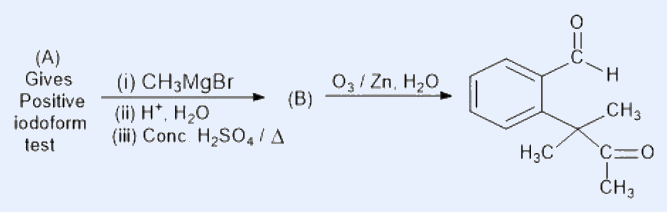
Identify (A) in the following reaction sequencer:
(1)
(2)
(3)
(4)
SolutionAnswer: Option 2
Approach:
Work backwards from the products: a positive iodoform test indicates a methyl ketone, and ozonolysis of the alkene from Grignard addition and dehydration gives the stated carbonyl fragments.
Step 1:A positive iodoform test on (A) requires (A) to be a methyl ketone (CH3-CO- group).
Step 2:Treatment with methylmagnesium bromide followed by acid and dehydration converts (A) into an alkene (B); ozonolysis of (B) with O3/Zn-H2O gives a ketoaldehyde fragment together with the indicated carbonyl product.
Step 3:Reconstructing the carbon skeleton consistent with all observations identifies (A) as the methyl ketone shown in option b.
Q46NumericalPhysical Chemistry
The molarity of HN in a sample which has density 1.4 g/mL and mass percentage of 63% is __________ (Molecular weight of HN = 63).
SolutionAnswer: 14
Approach:
Convert mass percentage and density to molarity using the standard relation.
Step 1:Given mass percentage 63%, density 1.4 g/mL and molar mass 63.
Step 2:Substitute into the molarity relation.
Step 3:Simplify to obtain the molarity.
Final answer: 14.00
Q47NumericalPhysical Chemistry
The hardness of a water sample containing M MgS expressed as CaC equivalents (in ppm)is __________ (molar mass of MgS is 120.37 g/mol)
SolutionAnswer: 100
Approach:
Convert the moles of MgSO4 in one litre to an equivalent mass of CaCO3 and express it in parts per million.
Step 1:One litre (1000 mL) of the sample contains mol of MgSO4, equivalent to mol of CaCO3.
Step 2:Mass of CaCO3 in 1000 mL equals moles times molar mass of CaCO3 (100 g/mol).
Step 3:Express as parts per million, i.e. grams per grams of water.
Final answer: 100.00
Q48NumericalPhysical Chemistry
How much amount of NaCl should be added to 600 g of water ( g/mL) to decrease the freezing point of water to C? (The freezing point depression constant for water = )
SolutionAnswer: 1.76
Approach:
Apply the depression-of-freezing-point relation with the van't Hoff factor for NaCl.
Step 1:NaCl dissociates into two ions, so the van't Hoff factor i = 2, and the required depression is 0.2 deg.
Step 2:Express molality in terms of the mass w of NaCl (molar mass 58.5) in 600 g of water.
Step 3:Substitute into the depression relation and solve for w.
Final answer: 1.76
Q49NumericalPhysical Chemistry
108 g silver (molar mass 108 g mo) is deposited at cathode from AgN(aq) solution by a certain quantity of electricity. The volume (in L) of oxygen gas produced at 273 K and 1 bar pressure from water by the same quantity of electricity is __________
SolutionAnswer: 5.68
Approach:
Find the moles of electrons from silver deposition, convert to moles of oxygen at the anode, then apply the ideal gas law.
Step 1:Depositing 108 g of silver (1 mol) requires 1 mol of electrons (1 F).
Step 2:Oxygen evolution requires 4 mol of electrons per mole of O2, so 1 F liberates 1/4 mol of O2.
Step 3:Apply the ideal gas law at T = 273 K, P = 1 bar, R = 0.0823 L bar .
Final answer: 5.68
Q50NumericalOrganic Chemistry
The mass percentage of nitrogen in histamine is __________
SolutionAnswer: 37.84
Approach:
Compute the mass percentage of nitrogen from the molar mass of histamine and the number of nitrogen atoms it contains.
Step 1:The molar mass of histamine is 111 g/mol.
Step 2:Histamine contains 3 nitrogen atoms contributing a mass of 42 g.
Step 3:Apply the mass percentage relation.
Final answer: 37.84
Mathematics25 questions
Q51Single correctCoordinate Geometry
If C be the centroid of the triangle having vertices , and . Let P be the point of intersection of the lines and , then the line passing through the points C and P also passes through the point:
(1)
(2)
(3)
(4)
SolutionAnswer: Option 2
Approach:
Find the centroid C of the triangle and the intersection point P of the two lines, then determine the line through C and P and test which option lies on it.
Step 1:Compute the centroid C.
Step 2:Solve the two lines for P.
Step 3:Equation of line CP.
Step 4:Test .
Final answer:
Q52Single correctSequences and Series
The product to is equal to:
(1)
(2)
(3)
(4)
SolutionAnswer: Option 3
Approach:
Express each factor as a power of 2 and sum the exponents, which form an arithmetico-geometric series.
Step 1:Write each factor as a power of 2.
Step 2:Sum the series with .
Step 3:Combine.
Final answer:
Q53Single correctApplication of Derivatives
A spherical iron ball of 10 cm radius is coated with a layer of ice of uniform thickness that melts at the rate of 50 c/min. When the thickness of ice is 5 cm, then the rate (in cm/min.) at which the thickness of ice decreases, is:
(1)
(2)
(3)
(4)
SolutionAnswer: Option 4
Approach:
Model the ice as a spherical shell of outer radius and differentiate its volume with respect to time.
Step 1:Net volume of ice with thickness x.
Step 2:Differentiate with respect to time.
Step 3:Substitute and .
Step 4:Magnitude of decrease.
Final answer:
Q54Single correctApplication of Derivatives
If f be any function continuous on [a,b] and twice differentiable on (a,b). If for all , and , then for any , is greater than:
(1)
(2)
(3)
(4)
SolutionAnswer: Option 3
Approach:
Apply the Lagrange Mean Value Theorem on and and use that is strictly decreasing.
Step 1:MVT on [a,c] gives .
Step 2:MVT on [c,b] gives .
Step 3:Since , is decreasing, so .
Final answer:
Q55Single correctTrigonometry
The value of is :
(1)
(2)
(3)
(4)
SolutionAnswer: Option 2
Approach:
Use to convert and reduce, then evaluate.
Step 1:Replace angles.
Step 2:Factor.
Step 3:Evaluate.
Final answer:
Q56Single correctQuadratic Equations
The number of real roots of the equation, is:
(1)
(2)
(3)
(4)
SolutionAnswer: Option 3
Approach:
Divide by and substitute to reduce to a quadratic in t.
Step 1:Divide by .
Step 2:Let , so .
Step 3:Reject since ; solve .
Final answer:
Q57Single correctIntegral Calculus
The value of is equal to:
(1)
(2)
(3)
(4)
SolutionAnswer: Option 4
Approach:
Apply the king property twice and use periodicity to reduce the weight to .
Step 1:Apply and add to the original.
Step 2:By symmetry over the period, the integrand averages with its counterpart.
Step 3:Combine.
Final answer:
Q58Single correctThree Dimensional Geometry
If for some and in R, the intersection of the following three planes
is a line in , then is equal to:
is a line in , then is equal to:
(1)
(2)
(3)
(4)
SolutionAnswer: Option 2
Approach:
For the three planes to meet in a line the coefficient determinant must vanish, and the augmented system must stay consistent.
Step 1:Set the coefficient determinant to zero.
Step 2:Impose consistency on the augmented matrix.
Step 3:Add.
Final answer:
Q59Single correctCoordinate Geometry
If and are the eccentricities of the ellipse, and the hyperbola, respectively and is a point on the ellipse, , then k is equal to:
(1)
(2)
(3)
(4)
SolutionAnswer: Option 4
Approach:
Compute the two eccentricities, then substitute into the given ellipse to find k.
Step 1:Eccentricity of the ellipse.
Step 2:Eccentricity of the hyperbola.
Step 3:Substitute into .
Final answer:
Q60Single correctLimits and Continuity
If is continuous at then is equal to:
(1)
(2)
(3)
(4)
SolutionAnswer: Option 3
Approach:
Equate the left limit, the value , and the right limit at to enforce continuity, then solve for and .
Step 1:Right-hand limit.
Step 2:Left-hand limit.
Step 3:Continuity forces all three equal.
Step 4:Compute .
Final answer:
Q61Single correctMatrices and Determinants
If the matrices , and , then is equal to:
(1)
(2)
(3)
(4)
SolutionAnswer: Option 3
Approach:
Use for a matrix and .
Step 1:Determinant of A.
Step 2:Since , .
Step 3:Determinant of C.
Step 4:Form the ratio.
Final answer:
Q62Single correctCoordinate Geometry
A circle touches the -axis at the point and passes through the point . Which of the following lines is not a tangent to this circle?
(1)
(2)
(3)
(4)
SolutionAnswer: Option 3
Approach:
Find the circle's centre and radius from the tangency at and the point , then test each line by comparing its distance from the centre with the radius.
Step 1:Tangency at on the y-axis means the centre is with radius .
Step 2:Test option (c).
Step 3:The other lines give distance , so option (c) is not a tangent.
Final answer:
Q63Single correctComplex Numbers
Let z be a complex number such that and . Then the value of is:
(1)
(2)
(3)
(4)
SolutionAnswer: Option 2
Approach:
Write ; the ratio condition gives a horizontal locus for y, and fixes , then compute .
Step 1:Equate moduli.
Step 2:Use .
Step 3:Compute .
Final answer:
Q64Single correctIntegral Calculus
If , , and , then is equal to:
(1)
(2)
(3)
(4)
SolutionAnswer: Option 1
Approach:
Simplify the inverse-tangent argument to a half-angle form, integrate the resulting linear expression, and apply the initial condition.
Step 1:Rewrite the argument.
Step 2:Express as a half-angle tangent.
Step 3:Integrate.
Step 4:Evaluate at .
Final answer:
Q65Single correctMathematical Reasoning
Negation of the statement: ' is an integer or 5 is irrational' is:
(1)
(2)
(3)
(4)
SolutionAnswer: Option 4 is not an integer and 5 is not irrational.
Approach:
Apply De Morgan's law to the negation of a disjunction.
Step 1:Define propositions.
Step 2:Apply De Morgan's law.
Step 3:Translate to words.
Final answer: is not an integer and 5 is not irrational.
Q66Single correctIntegral Calculus
If for all real triplets (a, b, c), , then is equal to:
(1)
(2)
(3)
(4)
SolutionAnswer: Option 4
Approach:
Integrate the quadratic directly and compare with the values of at the endpoints and midpoint (Simpson's rule for a quadratic).
Step 1:Integrate directly.
Step 2:Evaluate sample values.
Step 3:Form the combination.
Step 4:Compare.
Final answer:
Q67Single correctPermutations and Combinations
If the number of five digit numbers with distinct digits and 2 at the 10th place is 336, then is equal to:
(1)
(2)
(3)
(4)
SolutionAnswer: Option 18
Approach:
Fix the tens digit as 2 and count distinct-digit arrangements for the remaining places, respecting the leading-digit restriction.
Step 1:Tens place fixed as 2; ten-thousands place cannot be 0 or 2.
Step 2:Count the remaining three places from the remaining 8 digits.
Step 3:Total count.
Step 4:Identify .
Final answer: 8
Q68Single correctStatistics
Let the observations satisfy the equations, and . If and are the mean and the variance of observations, , then the ordered pair is equal to:
(1)
(2)
(3)
(4)
SolutionAnswer: Option 3
Approach:
Use the given sums to find the mean of , shift to the new observations, and use variance-invariance under a constant shift.
Step 1:Find the sum of .
Step 2:Mean of new observations.
Step 3:Variance is unchanged by a constant shift.
Step 4:Compute variance.
Final answer:
Q69Single correctIntegral Calculus
The integral is equal to: (where C is a constant of integration)
(1)
(2)
(3)
(4)
SolutionAnswer: Option 3
Approach:
Factor the integrand into a perfect derivative form by introducing the ratio .
Step 1:Rewrite the integrand.
Step 2:Substitute .
Step 3:Integrate in and absorb constant factors.
Step 4:Return to ; the keyed antiderivative differs only by a multiplicative constant of integration form.
Final answer:
Q70Single correctProbability
In a box, there are 20 cards out of which 10 are labelled as and remaining 10 are labelled as . Cards are drawn at random, one after the other and with replacement, till a second -card is obtained. The probability that the second -card appears before the third -card is:
(1)
(2)
(3)
(4)
SolutionAnswer: Option 4
Approach:
Each draw is independent with . Enumerate the sequences in which the second A appears before the third B.
Step 1:Probability of each card type.
Step 2:Favorable sequences (second before third ).
AA,\ BAA,\ ABA,\ AABB,\ ABAB,\ BABA,\ BAAB,\ ABBA
Step 3:Sum the probabilities.
Final answer:
Q71NumericalVector Algebra
If the vectors , and () are coplanar and , then the value of is ____.
SolutionAnswer: 1
Approach:
Impose coplanarity via the scalar triple product to find a, then evaluate the dot and cross products at that value to solve for .
Step 1:Set the scalar triple product determinant to zero.
Step 2:Solve for .
Step 3:Evaluate vectors at .
Step 4:Compute and , then solve.
Final answer: 1
Q72NumericalThree Dimensional Geometry
The projection of the line segment joining the points and on the line joining the points and is ____.
SolutionAnswer: 8
Approach:
Form both direction vectors and project the first onto the second using the scalar projection formula.
Step 1:Direction of segment .
Step 2:Direction of line .
Step 3:Dot product.
Step 4:Magnitude of and projection.
Final answer: 8
Q73NumericalTrigonometry
The number of distinct solutions of the equation, in the interval , is ____.
SolutionAnswer: 8
Approach:
Combine the logarithms, reduce to a double-angle equation, and count solutions on excluding the axes where the logarithms are undefined.
Step 1:Combine logs.
Step 2:Use the double-angle identity.
Step 3:Count solutions of on .
gives 8 solutions
Step 4:Confirm none fall on the axes (where or vanish).
Final answer: 8
Q74NumericalDifferential Equations
If for , is the solution of the differential equation , , then is equal to ____.
SolutionAnswer: 3
Approach:
Rearrange into a linear first-order ODE, find the integrating factor, integrate, apply the initial condition, then evaluate at .
Step 1:Write in linear form.
Step 2:Integrating factor.
Step 3:Integrate the exact derivative.
Step 4:Apply , then evaluate at .
Final answer: 3
Q75NumericalBinomial Theorem
The coefficient of in the expansion of is ____.
SolutionAnswer: 615
Approach:
Use the multinomial theorem: the general term has exponent ; sum the coefficients for which .
Step 1:Set the exponent equal to 4.
Step 2:Case .
Step 3:Case .
Step 4:Case and sum.
Final answer: 615
More JEE Main 2020 papers
Frequently Asked Questions
How many questions are in the JEE Main 2020 January 09, Shift 1 paper?
The JEE Main 2020 January 09, Shift 1 paper has 75 questions — Physics (25), Chemistry (25) and Mathematics (25). Every question is on this page with its correct answer and a step-by-step solution.
What is the marking scheme for JEE Main?
JEE Main awards +4 marks for each correct answer and −1 for a wrong answer, with 0 for questions left unattempted. The paper covers Physics, Chemistry and Mathematics.
Are the answer key and step-by-step solutions provided for the 2020 January 09, Shift 1 paper?
Yes — every question shows the correct answer (answer key) and a detailed step-by-step solution, free to read online.
Can I take the JEE Main 2020 January 09, Shift 1 paper as a timed mock test?
Yes. With a free JEEnify account you can attempt this exact paper as a timed test in the real exam interface, then see your score and weak-area analysis.
Solved this paper? Calculate your JEE Main scoremost important chaptersformula sheetsall free tools.