
Back to JEE Main PYQs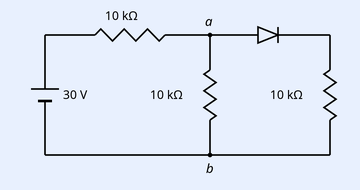

JEE Main 2020 January 07, Shift 2 Question Paper with Solutions
All 74 questions from the JEE Main 2020 (January 07, Shift 2) shift — Physics (24), Chemistry (25) and Mathematics (25) — each with the correct answer (answer key) and a step-by-step solution. Read it free online, or attempt the full paper as a timed mock test.
Physics24 questions
Q1Single correctGravitation
A box weighs on a spring balance at the North Pole. Its weight recorded on the same balance if it is shifted to the equator is close to (Take at the North Pole and radius of the Earth )
(1)
(2)
(3)
(4)
SolutionAnswer: Option 3
Approach:
At the equator the spring balance reads the apparent weight, reduced from the true weight by the centrifugal effect of Earth's rotation.
Step 1:Determine the mass from the polar weight.
Step 2:Compute Earth's angular speed for one rotation per day.
Step 3:Subtract the centrifugal term using .
Final answer:
Q2Single correctCurrent Electricity
In a building, there are 15 bulbs of , 15 bulbs of , 15 small fans of and 2 heaters of . The voltage of electric main is . The minimum fuse capacity (rated value) of the building will be approximately
(1)
(2)
(3)
(4)
SolutionAnswer: Option 2
Approach:
Add the power consumed by every appliance, then divide the total power by the supply voltage to obtain the line current.
Step 1:Sum the appliance powers.
Step 2:Divide by the mains voltage.
Step 3:Select the next standard fuse rating above the line current.
Final answer:
Q4Single correctLaws of Motion
A mass of is suspended by a rope of length , from the ceiling. A force F is applied horizontally at the mid-point of the rope such that the top half of the rope makes an angle of with the vertical. Then F equals (Take and the rope to be massless)
(1)
(2)
(3)
(4)
SolutionAnswer: Option 1
Approach:
Apply equilibrium to the mid-point, where the upper tension, the horizontal force, and the lower tension (equal to the weight) meet.
Step 1:The lower half supports the weight, so the downward pull at the mid-point is .
Step 2:Resolve the upper tension at : vertical balance gives .
Step 3:Horizontal balance gives .
Final answer:
Q5Single correctRotational Motion
Mass per unit area of a circular disc of radius a depends on the distance r from its centre as . The moment of inertia of the disc about the axis, perpendicular to the plane and passing through its centre is
(1)
(2)
(3)
(4)
SolutionAnswer: Option 1
Approach:
Integrate over annular rings, with .
Step 1:Write the elemental moment of inertia.
Step 2:Integrate from to .
Step 3:Factor out .
Final answer:
Q6Single correctThermodynamics
Two ideal Carnot engines operate in cascade (all heat given up by one engine is used by the other engine to produce work) between temperatures and . The temperature of the hot reservoir of the first engine is and the temperature of the cold reservoir of the second engine is . T is the temperature of the sink of first engine which is also the source for the second engine. How is T related to and if both the engines perform equal amount of work?
(1)
(2)
(3)
(4)
SolutionAnswer: Option 2
Approach:
Set the work of the first engine equal to that of the second using the cascade heat relation, then solve for the intermediate temperature.
Step 1:Equal work requires , hence .
Step 2:Use the Carnot proportionality and .
Step 3:Solve for .
Final answer:
Q7Single correctAtoms and Nuclei
The activity of a radioactive substance falls from to in 30 minutes. Its half-life is close to
(1)
(2)
(3)
(4)
SolutionAnswer: Option 2
Approach:
Find the decay constant from the activity ratio over 30 minutes, then convert to half-life.
Step 1:Take the logarithm of the activity ratio.
Step 2:Evaluate the decay constant.
Step 3:Compute the half-life.
Final answer:
Q8Single correctWave Optics
In a Young's double slit experiment, the separation between the slits is . In the experiment, a source of light of wavelength is used and the interference pattern is observed on a screen kept away. The separation between the successive bright fringes on the screen is
(1)
(2)
(3)
(4)
SolutionAnswer: Option 1
Approach:
Apply the fringe-width formula .
Step 1:Substitute , , .
Step 2:Convert to millimetres.
Final answer:
Q9Single correctMechanical Properties of Fluids
An ideal fluid flows (laminar flow) through a pipe of non-uniform diameter. The maximum and minimum diameters of the pipes are and , respectively. The ratio of minimum and maximum velocities of fluid in this pipe is
(1)
(2)
(3)
(4)
SolutionAnswer: Option 2
Approach:
Use the continuity equation: velocity is inversely proportional to cross-sectional area, which scales as diameter squared.
Step 1:Minimum velocity occurs where the diameter is maximum; maximum velocity where diameter is minimum.
Step 2:Substitute the diameters.
Final answer:
Q10Single correctSemiconductor Electronics
In the figure, potential difference between and is
(1)
(2)
(3)
(4)
SolutionAnswer: Option 3
Approach:
The diode is forward biased and behaves as an ideal conductor, short-circuiting its branch; the potential across is then a resistive divider of the source.
Step 1:The forward-biased diode acts as a plain wire, leaving the and resistors in series across the source.
Step 2:Apply the divider to find the drop across the relevant resistor.
Final answer:
Q11Single correctMoving Charges and Magnetism
A particle of mass m and charge q has an initial velocity . If an electric field and magnetic field act on the particle, its speed will double after a time
(1)
(2)
(3)
(4)
SolutionAnswer: Option 1
Approach:
The magnetic force does no work, and along does not affect motion along ; only the electric field accelerates the particle along x, building up speed.
Step 1:The component perpendicular to retains magnitude (magnetic force does no work); the x-component grows as .
Step 2:Require the speed to double: .
Step 3:Solve for the time.
Final answer:
Q12Single correctWaves
A stationary observer receives sound from two identical tuning forks, one of which approaches and the other one recedes with the same speed (much less than the speed of sound). The observer hears 2 beats/sec. The oscillation frequency of each tuning fork is and the velocity of sound in air is . The speed of each tuning fork is close to
(1)
(2)
(3)
(4)
SolutionAnswer: Option 1
Approach:
Apply the Doppler shift for the approaching and receding forks, take the difference as the beat frequency, and solve for the fork speed.
Step 1:Write the two received frequencies and their difference.
Step 2:Since , approximate .
Step 3:Substitute and .
Final answer:
Q13Single correctDual Nature of Radiation and Matter
An electron (of mass ) and a photon have the same energy in the range of few . The ratio of the de Broglie wavelength associated with the electron and the wavelength of the photon is. ( speed of light in vacuum)
(1)
(2)
(3)
(4)
SolutionAnswer: Option 4
Approach:
Express the de Broglie wavelength of the electron from its kinetic energy and the photon wavelength from its energy, then take the ratio.
Step 1:Form the ratio of the two wavelengths.
Step 2:Simplify by writing .
Final answer:
Q14Single correctElectromagnetic Induction and Alternating Currents
A planar loop of wire rotates in a uniform magnetic field. Initially at , the plane of the loop is perpendicular to the magnetic field. If it rotates with a period of about an axis in its plane, then the magnitude of induced emf will be maximum and minimum, respectively, at:
(1)
(2)
(3)
(4)
SolutionAnswer: Option 1 and
Approach:
The flux is ; the induced emf is its negative time derivative, maximum when the plane is parallel to the field and zero (minimum) when the plane is perpendicular.
Step 1:Compute the angular frequency for the given period.
Step 2:The emf magnitude is maximum where , i.e. .
Step 3:The emf magnitude is minimum (zero) where , i.e. .
Final answer: and
Q15Single correctElectromagnetic Waves
The electric field of a plane electromagnetic wave is given by . At , a positively charged particle is at the point . If its instantaneous velocity at is , the force acting on it due to the wave is:
(1)
(2)
(3)
(4)
SolutionAnswer: Option 2antiparallel to
Approach:
Evaluate the electric field at the given position and time to get the electric force, and check whether the magnetic force adds along the same line; the net force direction follows.
Step 1:Evaluate the field at and .
Step 2:The electric force on the positive charge is along .
Step 3:The magnetic force is parallel to here, so the net force stays along the same line.
Final answer: antiparallel to
Q16Single correctOptics
A thin lens made of glass (refractive index ) of focal length is immersed in a liquid of refractive index . If its focal length in liquid is , then the ratio is closest to the integer:
(1)
(2)
(3)
(4)
SolutionAnswer: Option 19
Approach:
Use the lensmaker's equation in air and in the liquid; the ratio of focal lengths reduces to the ratio of the two relative refractive index factors.
Step 1:Form the ratio of the in-liquid to in-air focal lengths.
Step 2:Substitute , , .
Step 3:Round to the closest integer.
Final answer: 9
Q17Single correctWork, Energy and Power
An elevator in a building can carry a maximum of 10 persons, with the average mass of each person being . The mass of the elevator itself is and it moves with a constant speed of . The frictional force opposing the motion is . If the elevator is moving up with its full capacity, the power delivered by the motor to the elevator (in ) must be at least:
(1)
(2)
(3)
(4)
SolutionAnswer: Option 166000 W
Approach:
At constant speed the motor force balances total weight plus friction; power is that force times the speed.
Step 1:Total mass is the elevator plus ten persons.
Step 2:Motor force balances weight and friction.
Step 3:Power is force times speed.
Final answer: 66000 W
Q18Single correctMagnetism and Matter
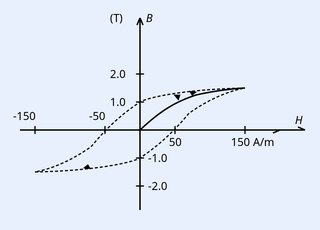
The figure gives experimentally measured B vs H variation in a ferromagnetic material. The retentivity, coercivity and saturation, respectively, of the material are:
(1)
(2)
(3)
(4)
SolutionAnswer: Option 21 T, 50 A/m, 1.5 T
Approach:
Read the hysteresis loop: retentivity is the B-intercept at H=0, coercivity is the H-intercept at B=0, and saturation is the maximum B value.
Step 1:Retentivity is the B value where the curve crosses the B-axis ().
Step 2:Coercivity is the magnitude of H where the curve crosses the H-axis ().
Step 3:Saturation is the maximum B attained.
Final answer: 1 T, 50 A/m, 1.5 T
Q19Single correctElectromagnetic Induction and Alternating Currents
An emf of is applied at time to a circuit containing in series inductor and resistor. The ratio of the currents at time and at is close to (take ):
(1)
(2)
(3)
(4)
SolutionAnswer: Option 11.06
Approach:
The growing current in an LR circuit is ; form the ratio of the steady-state current to the current at .
Step 1:Steady-state current.
Step 2:Current at with .
Step 3:Form the ratio, which is just slightly greater than one.
Final answer: 1.06
Q20Single correctPhysics and Measurement
The dimension of , where B is magnetic field and is the magnetic permeability of vacuum, is:
(1)
(2)
(3)
(4)
SolutionAnswer: Option 1
Approach:
is the magnetic energy density, i.e. energy per unit volume; its dimension follows from force times displacement divided by volume.
Step 1:Energy density equals energy per unit volume.
Step 2:Simplify the powers of length.
Final answer:
Q21NumericalElectrostatics
A capacitor is fully charged by a supply. It is then disconnected from the supply and is connected to another uncharged capacitor in parallel. The electrostatic energy that is lost in this process by the time the charge is redistributed between them is (in nJ) ______.
SolutionAnswer: 6
Approach:
Compute the initial energy stored on the charged capacitor and the final energy after charge redistributes over two equal capacitors at half the voltage; the difference is the energy lost.
Step 1:Initial energy on the capacitor at .
Step 2:After parallel connection the voltage halves to across each capacitor; total final energy.
Step 3:Energy lost is the difference; substitute , .
Final answer: 6
Q22NumericalThermodynamics
M grams of steam at C is mixed with of ice at its melting point in a thermally insulated container. If it produces liquid water at C [heat of vaporization of water is and heat of fusion of ice is ], the value of M is ______.
SolutionAnswer: 40
Approach:
Equate the heat released by steam (condensing then cooling to C) to the heat absorbed by ice (melting then warming to C).
Step 1:Heat absorbed by ice: fusion plus warming to C.
Step 2:Heat released by steam: condensation plus cooling to C.
Step 3:Set absorbed equal to released and solve for .
Final answer: 40
Q23NumericalLaws of Motion
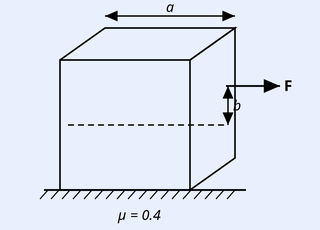
Consider a uniform cubical box of side a on a rough floor that is to be moved by applying minimum possible force F at a point b above its centre of mass (see figure). If the coefficient of friction is , the maximum value of for the box not to topple before moving is ______.
SolutionAnswer: 50
Approach:
The applied force must overcome kinetic friction to move the box; the no-toppling condition is found by taking torque about the bottom edge that the box would rotate over. The friction limit on is compared with the geometric limit.
Step 1:The minimum moving force balances kinetic friction.
Step 2:No toppling about the bottom right edge requires the net torque to be non-positive.
Step 3:Substitute and solve for b.
Step 4:Geometrically can be at most half the side, so the binding limit is .
Final answer: 50
Q24NumericalPhysics and Measurement
The sum of two forces and is such that . The angle (in degrees) that the resultant of and will make with is ______.
SolutionAnswer: 90
Approach:
Use the condition on to relate Q and the angle between and , then resolve along and perpendicular to to find the angle.
Step 1:Apply where is the angle between and .
Step 2:Resolve perpendicular and parallel to ; the component of along is .
Step 3:With zero component along , the resultant of and is perpendicular to .
Final answer: 90
Q25NumericalCurrent Electricity
The balancing length for a cell is in a potentiometer experiment. When an external resistance of is connected in parallel to the cell, the balancing length changes by . If the internal resistance of the cell is , the value of N is ______.
SolutionAnswer: 12
Approach:
Balancing length is proportional to the potential measured; without the resistor it reads the emf, with the parallel resistor it reads the terminal voltage. The shift gives the internal resistance.
Step 1:Without the resistor the balancing length corresponds to the emf.
Step 2:With the resistor in parallel the length drops by to , giving the terminal voltage.
Step 3:Solve for the internal resistance .
Step 4:Express and read off .
Final answer: 12
Chemistry25 questions
Q26Single correctOrganic Chemistry — Some Basic Principles and Techniques
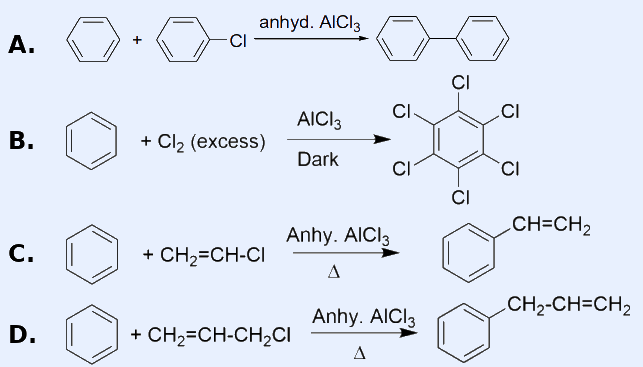
Consider the following reactions:
Which of these reactions are possible?
Which of these reactions are possible?
(1)
(2)
(3)
(4)
SolutionAnswer: Option 2B and D
Approach:
Assess each reaction for the feasibility of a Friedel-Crafts type substitution under anhydrous Lewis-acid conditions, considering the stability of the intermediate carbocation.
Step 1:Aryl halides such as chlorobenzene do not form the aryl cation, because the C-Cl bond has partial double-bond character; reaction A fails.
Step 2:Chlorination of benzene with excess chlorine over a Lewis acid in the dark proceeds; reaction B is possible.
Step 3:Vinyl halides do not undergo Friedel-Crafts because the vinyl cation intermediate is unstable; reaction C fails.
Step 4:Allyl halide generates a resonance-stabilized allyl cation, so the Friedel-Crafts alkylation proceeds; reaction D is possible.
Final answer: B and D
Q27Single correctOrganic Chemistry — Some Basic Principles and Techniques
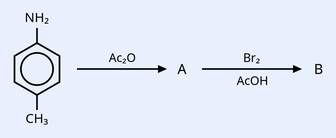
In the following reaction sequence,
The major product B is:
The major product B is:
(1)
(2)
(3)
(4)
SolutionAnswer: Option 1
Approach:
Identify the more strongly activating, ortho/para-directing group on the trisubstituted benzene and place the incoming bromine accordingly.
Step 1:Acetylation of the amine gives the acetanilide derivative A, bearing an group.
Step 2:The acetanilido group is more electron-donating (+M) than the methyl group, so it directs the electrophile.
Step 3:Bromination occurs ortho to the acetanilido group, giving product B.
Final answer: Option a (Br ortho to NHCOCH3, methyl para)
Q28Single correctOrganic Chemistry — Some Basic Principles and Techniques
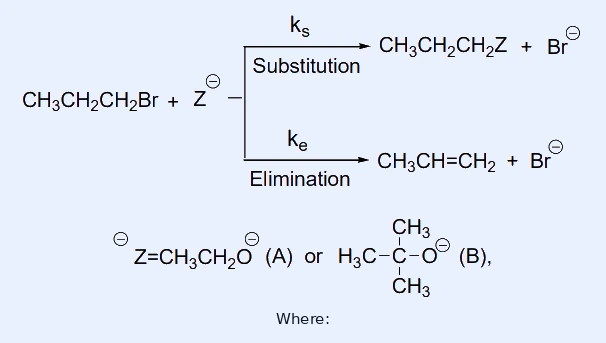
For the following reactions, shown below with the definitions of Z, and are, respectively, the rate constants for substitution and elimination, and , the correct option is ______.
(1)
(2)
(3)
(4)
SolutionAnswer: Option 3 and
Approach:
Compare the steric bulk of ethoxide (A) and tert-butoxide (B) to decide which favours elimination over substitution.
Step 1:Ethoxide is small and favours substitution, giving a large ratio of substitution to elimination.
Step 2:tert-Butoxide is bulky and favours elimination, lowering its substitution-to-elimination ratio.
Step 3:The bulky base B promotes elimination, so its elimination rate constant exceeds that of A.
Final answer: and
Q29Single correctBiomolecules
Which of the following statements is correct?
(1)
(2)
(3)
(4)
SolutionAnswer: Option 4Gluconic acid is a partial oxidation product of glucose
Approach:
Recall the oxidation chemistry of glucose and the structure of gluconic acid to evaluate each statement.
Step 1:Mild oxidation of the aldehyde group of glucose with bromine water gives gluconic acid, a monocarboxylic acid.
Step 2:Strong oxidation with gives the dicarboxylic glucaric (saccharic) acid, not gluconic acid.
Step 3:Gluconic acid lacks the free aldehyde, so it does not form a cyclic hemiacetal; it is a partial oxidation product of glucose.
Final answer: Gluconic acid is a partial oxidation product of glucose
Q30Single correctOrganic Chemistry — Some Basic Principles and Techniques
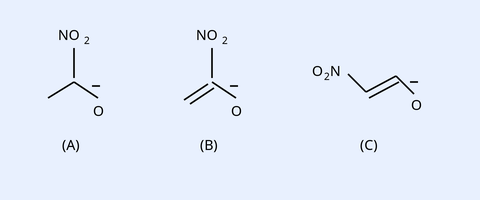
The correct order of stability for the following alkoxides is:
(1)
(2)
(3)
(4)
SolutionAnswer: Option 2(C) > (B) > (A)
Approach:
Rank the alkoxides by the extent of delocalization of the negative charge by the nitro group and conjugation.
Step 1:In (A) the negative charge is stabilized only by the -I effect of the group.
Step 2:In (B) the charge is stabilized by delocalization over the double bond together with the -I effect of .
Step 3:In (C) the charge is stabilized by the most extended conjugation, making it the most stable.
Final answer: (C) > (B) > (A)
Q31Single correctOrganic Chemistry — Some Basic Principles and Techniques
In the following reaction sequence, structures of A and B, respectively will be:
(1)
(2)
(3)
(4)
SolutionAnswer: Option 1
Approach:
Apply acidic ether cleavage by HBr followed by an intramolecular Wurtz coupling with sodium in ether.
Step 1:HBr cleaves the cyclic ether through an pathway to give the bromo-phenol A bearing a side chain.
Step 2:Sodium in ether effects an intramolecular Wurtz coupling between the two C-Br centres, forming a carbocyclic ring fused to the phenol B.
Final answer: Option a
Q32Single correctOrganic Chemistry — Some Basic Principles and Techniques
A chromatography column, packed with silica gel as stationary phase, was used to separate a mixture of compounds consisting of (A) benzanilide, (B) aniline and (C) acetophenone. When the column is eluted with a mixture of solvents, hexane : ethyl acetate (20:80), the sequence of obtained compounds is:
(1)
(2)
(3)
(4)
SolutionAnswer: Option 2(C), (A) and (B)
Approach:
On a polar silica stationary phase, the least polar compound elutes first; rank the three compounds by polarity.
Step 1:Acetophenone (dipole ) is the least polar and elutes first.
Step 2:Benzanilide (dipole ) elutes next.
Step 3:Aniline (dipole ) is held most strongly and elutes last; however polarity order gives C, A, B as the elution sequence.
Final answer: (C), (A) and (B)
Q33Single correctCoordination Compounds
The number of possible optical isomers for the complexes with and hybridized metal atom, respectively, is:
Note: A and B are unidentate neutral and unidentate monoanionic ligands, respectively.
Note: A and B are unidentate neutral and unidentate monoanionic ligands, respectively.
(1)
(2)
(3)
(4)
SolutionAnswer: Option 20 and 0
Approach:
Determine the geometry from the hybridization and check for a plane of symmetry that would make each complex optically inactive.
Step 1:For hybridization the geometry is tetrahedral; possesses a plane of symmetry and shows no optical activity.
Step 2:For hybridization the geometry is square planar; has a plane of symmetry and is optically inactive.
Final answer: 0 and 0
Q34Single correctChemical Bonding and Molecular Structure
The bond order and magnetic characteristics of are:
(1)
(2)
(3)
(4)
SolutionAnswer: Option 33, diamagnetic
Approach:
Build the molecular orbital configuration of the 14-electron species and compute the bond order and magnetic nature.
Step 1: has 14 electrons with configuration filling through the bonding sigma 2p orbital.
Step 2:Substituting the bonding and antibonding electron counts gives the bond order.
Step 3:All electrons are paired, so is diamagnetic.
Final answer: 3, diamagnetic
Q35Single correctElectrochemistry
The equation which is incorrect is:
(1)
(2)
(3)
(4)
SolutionAnswer: Option 1
Approach:
Apply Kohlrausch's law of independent migration of ions to each combination and test the equality of ionic differences.
Step 1:Expanding option (a) gives a difference of bromide and iodide on the left but bromide-bound terms that do not cancel symmetrically on the right.
Step 2:Options (b), (c) and (d) reduce to identities under Kohlrausch's law, leaving (a) as the incorrect relation.
Final answer:
Q36Single correctp-Block Elements
In the following reactions, product (A) and (B), respectively, are:
(A) + side products (hot & conc.)
(B) + side products (dry)
(A) + side products (hot & conc.)
(B) + side products (dry)
(1)
(2)
(3)
(4)
SolutionAnswer: Option 4 and
Approach:
Apply the disproportionation of chlorine with hot concentrated alkali and with dry slaked lime.
Step 1:Hot, concentrated sodium hydroxide with chlorine gives sodium chlorate as product A.
Step 2:Dry slaked lime with chlorine gives bleaching powder, calcium hypochlorite, as product B.
Final answer: and
Q37Single correctSolutions
Two open beakers one containing a solvent and the other containing a mixture of that solvent with a non-volatile solute are together sealed in a container. Over time:
(1)
(2)
(3)
(4)
SolutionAnswer: Option 2the volume of the solution increases and the volume of the solvent decreases
Approach:
Compare the vapour pressures of the pure solvent and the solution to determine the net direction of solvent transfer through the vapour phase.
Step 1:The pure solvent has a higher vapour pressure than the solution containing a non-volatile solute.
Step 2:Solvent evaporates from the pure-solvent beaker and condenses into the solution to equalize vapour pressures.
Step 3:Therefore the solution volume increases while the solvent volume decreases.
Final answer: the volume of the solution increases and the volume of the solvent decreases
Q38Single correctGeneral Principles and Processes of Isolation of Elements
The refining method used when the metal and the impurities have low and high melting temperatures, respectively, is:
(1)
(2)
(3)
(4)
SolutionAnswer: Option 3liquation
Approach:
Match the description of a low-melting metal with high-melting impurities to the appropriate refining technique.
Step 1:When the metal melts at a lower temperature than its impurities, the metal can be melted and run off, leaving the impurities behind.
Step 2:This separation by selective melting is the process of liquation.
Final answer: liquation
Q39Single correctHydrogen
Among statements I-IV, the correct ones are:
I. Decomposition of hydrogen peroxide gives dioxygen
II. Like hydrogen peroxide, compounds, such as , and when heated liberate dioxygen.
III. 2-Ethylanthraquinone is useful for the industrial preparation of hydrogen peroxide.
IV. Hydrogen peroxide is used for the manufacture of sodium perborate.
I. Decomposition of hydrogen peroxide gives dioxygen
II. Like hydrogen peroxide, compounds, such as , and when heated liberate dioxygen.
III. 2-Ethylanthraquinone is useful for the industrial preparation of hydrogen peroxide.
IV. Hydrogen peroxide is used for the manufacture of sodium perborate.
(1)
(2)
(3)
(4)
SolutionAnswer: Option 1I,II, III and IV
Approach:
Assess the validity of each statement about hydrogen peroxide and related dioxygen-liberating reactions.
Step 1:Hydrogen peroxide decomposes to liberate dioxygen.
Step 2:Thermal decomposition of the named salts liberates dioxygen.
Step 3:The anthraquinone auto-oxidation route uses 2-ethylanthraquinone industrially.
Step 4:Hydrogen peroxide is used in synthesis of sodium perborate.
Final answer: I,II, III and IV
Q40Single correctRedox Reactions
The redox reaction among the following is:
(1)
(2)
(3)
(4)
SolutionAnswer: Option 3combination of dinitrogen with dioxygen at 2000 K
Approach:
A redox reaction requires a change in oxidation states. Examine each option for oxidation-state changes.
Step 1:Ozone formation is allotrope interconversion of oxygen with no oxidation-state change of bonded O in the simplistic sense; the other options must be tested.
Step 2:Acid-base neutralisation involves no oxidation-state change.
Step 3:In the combination of dinitrogen with dioxygen, nitrogen goes from 0 to +2 and oxygen from 0 to -2.
Step 4:The reaction with silver nitrate is a double-displacement precipitation, not redox.
Final answer: combination of dinitrogen with dioxygen at 2000 K
Q41Single correctStates of Matter
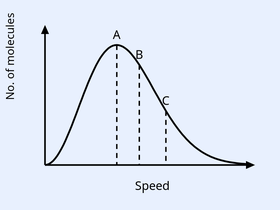
Identify the correct labels of A, B and C in the following graph from the options given below:
Root mean square speed ; most probable speed ; average speed
Root mean square speed ; most probable speed ; average speed
(1)
(2)
(3)
(4)
SolutionAnswer: Option 1
Approach:
Order the three characteristic speeds and assign them to the curve labels from left to right.
Step 1:Compare the numeric coefficients under the root.
Step 2:Therefore the speeds increase in the order most probable, average, root mean square.
Step 3:Reading the curve left to right, A is the smallest and C the largest.
Final answer:
Q42Single correctChemical Kinetics
For the reaction,
The observed rate expression is, rate . The rate expression for the reverse reaction is:
The observed rate expression is, rate . The rate expression for the reverse reaction is:
(1)
(2)
(3)
(4)
SolutionAnswer: Option 3
Approach:
Use the equilibrium condition that forward rate equals backward rate, with the equilibrium constant equal to the ratio of rate constants.
Step 1:At equilibrium the forward rate equals the backward rate.
Step 2:Express the backward rate using the equilibrium constant.
Final answer:
Q43Single correctClassification of Elements and Periodicity
Within each pair of elements F & Cl, S & Se and Li & Na, respectively, the elements that release more energy upon an electron gain are:
(1)
(2)
(3)
(4)
SolutionAnswer: Option 2Cl, S and Li
Approach:
Compare first electron gain enthalpies within each pair; the element with the more negative value releases more energy.
Step 1:For F and Cl, despite F being more electronegative, the small size of F gives stronger electron-electron repulsion, so Cl has the more negative electron gain enthalpy.
Step 2:For S and Se, going down the group the magnitude of electron gain enthalpy decreases, so S releases more energy.
Step 3:For Li and Na, Li has the more negative first electron gain enthalpy.
Final answer: Cl, S and Li
Q44Single correctCoordination Compounds
Among the following statements A-D, the incorrect ones are:
A. Octahedral Co(III) complexes with strong field ligands have high magnetic moments
B. When , the d- electron configuration of Co(III) in an octahedral complex is .
C. Wavelength of light absorbed by is lower than that of .
D. If the for an octahedral complex of Co(III) is 18000 c, the for its tetrahedral complex with the same ligand will be16000 c.
A. Octahedral Co(III) complexes with strong field ligands have high magnetic moments
B. When , the d- electron configuration of Co(III) in an octahedral complex is .
C. Wavelength of light absorbed by is lower than that of .
D. If the for an octahedral complex of Co(III) is 18000 c, the for its tetrahedral complex with the same ligand will be16000 c.
(1)
(2)
(3)
(4)
SolutionAnswer: Option 3A and D only
Approach:
Evaluate each statement A-D about Co(III) octahedral complexes and crystal field splitting to find the incorrect ones.
Step 1:Statement A: strong field ligands give low-spin Co(III), which has low magnetic moment, so A is incorrect.
Step 2:Statement D: the tetrahedral splitting is four-ninths of the octahedral value.
Step 3:The other statements are consistent, so the incorrect ones are A and D.
Final answer: A and D only
Q45Single correctSome Basic Concepts of Chemistry
The ammonia released on quantitative reaction of 0.6 g urea with sodium hydroxide (NaOH) can be neutralized by:
(1)
(2)
(3)
(4)
SolutionAnswer: Option 4100 mL of 0.2 N HCl
Approach:
Find moles of ammonia from the stoichiometry of urea with NaOH, then equate to moles of HCl required.
Step 1:Compute moles of urea using its molar mass of 60.
Step 2:Each mole of urea gives two moles of ammonia.
Step 3:Equate to moles of HCl: 100 mL of 0.2 N HCl supplies 0.02 mol.
Final answer: 100 mL of 0.2 N HCl
Q46NumericalBiomolecules
Number of hybrid carbon atoms present in aspartame is ___.
SolutionAnswer: 9
Approach:
Count carbons in aspartame that are sp2 hybridised: the aromatic ring carbons and the carbonyl carbons.
Step 1:The benzene ring contributes six sp2 carbons.
Step 2:The three carbonyl carbons (one ester, one amide, one carboxylic acid) are sp2.
Step 3:Add the sp2 carbons.
Final answer: 9
Q47NumericalIonic Equilibrium
3 grams of acetic acid is added to250 mL of 0.1 M HCl and the solution is made up to 500 mL. To 20 mL of this solution mL of 5 M NaOH is added. The pH of this solution is___.
(Given: log 3 = 0.4771, of acetic acid = 4.74, molar mass of acetic acid = 60 g/mole).
(Given: log 3 = 0.4771, of acetic acid = 4.74, molar mass of acetic acid = 60 g/mole).
SolutionAnswer: 5.22
Approach:
Determine the millimoles of acetic acid, HCl and NaOH in 20 mL, neutralise the strong acid first, then form the acetate buffer and apply the Henderson-Hasselbalch equation.
Step 1:In 20 mL: acetic acid is 2 mmol, HCl is 1 mmol, NaOH is 2.5 mmol.
Step 2:NaOH first neutralises HCl (1 mmol), leaving 1.5 mmol NaOH to react with acetic acid.
Step 3:1.5 mmol NaOH converts acetic acid to acetate, leaving 0.5 mmol acid and 1.5 mmol salt.
Step 4:Apply Henderson-Hasselbalch.
Final answer: 5.22
Q48NumericalSurface Chemistry
The flocculation value of HCl for arsenic sulphide sol is 30 mmol. If is used for the flocculation of arsenic sulphide, the amount, in grams, of in 250 mL required for the above purpose is ___.
SolutionAnswer: 0.3675
Approach:
Match the equivalent flocculating power: the same number of millimoles of effective ions as the HCl flocculation value, then convert to mass of sulphuric acid in 250 mL.
Step 1:For 1 L of sol, 30 mmol of HCl are required, corresponding to 15 mmol of H2SO4.
Step 2:For 250 mL the requirement is one quarter.
Step 3:Evaluate the mass.
Final answer: 0.3675
Q49NumericalThe d- and f-Block Elements
Consider the following reactions :
(A) + side products
(A) + NaOH (B) + side products
(B) + (dil.) + (C) + side products
The sum of the total number of atoms in one molecule of (A), (B) & (C) is ___.
(A) + side products
(A) + NaOH (B) + side products
(B) + (dil.) + (C) + side products
The sum of the total number of atoms in one molecule of (A), (B) & (C) is ___.
SolutionAnswer: 18
Approach:
Identify the chromium products A, B and C from the chromyl chloride test sequence and add up the atoms in each molecule.
Step 1:NaCl with dichromate and sulphuric acid gives chromyl chloride (A).
Step 2:Chromyl chloride with NaOH gives sodium chromate (B).
Step 3:Sodium chromate with dilute sulphuric acid and hydrogen peroxide gives chromium peroxide (C).
Step 4:Add the atom counts.
Final answer: 18
Q50NumericalThermodynamics
The standard heat of formation of ethane (in kJ/mol), if the heat of combustion of ethane, hydrogen and graphite are -1560, -393.5 and -286 kJ/mol, respectively, is___.
SolutionAnswer: -192.5
Approach:
Apply Hess's law by combining the combustion reactions to construct the formation reaction of ethane.
Step 1:Combustion of graphite, hydrogen and ethane are given with their enthalpies.
Step 2:Invert ethane combustion and add two graphite and three hydrogen combustions.
Step 3:Evaluate the sum.
Final answer: -192.5
Mathematics25 questions
Q51Single correctCo-ordinate Geometry
If is a tangent to the ellipse , for some then the distance between the foci of the ellipse is :
(1)
(2)
(3)
(4)
SolutionAnswer: Option 2
Approach:
Use the tangent condition for an ellipse: a line is tangent to when .
Step 1:Rewrite the line in slope-intercept form.
Step 2:Apply the tangent condition with .
Step 3:Solving for .
Step 4:Compute eccentricity and the distance between foci .
Final answer:
Q52Single correctMathematical Reasoning
Let A, B, C and D be four non-empty sets. The Contrapositive statement of "If and , then " is :
(1)
(2)
(3)
(4)
SolutionAnswer: Option 4If , then or
Approach:
The contrapositive of is . Here and .
Step 1:Negate the conclusion.
Step 2:Negate the hypothesis using De Morgan.
Step 3:Form the contrapositive .
Final answer: If , then or
Q53Single correctBinomial Theorem
The coefficient of in the expression is :
(1)
(2)
(3)
(4)
SolutionAnswer: Option 2
Approach:
The given expression is a geometric series with ratio ; sum it and extract the coefficient of .
Step 1:Sum the GP of 11 terms with first term and ratio .
Step 2:Extract the coefficient of .
Final answer:
Q54Single correctStatistics and Probability
In a workshop, there are five machines and the probability of any one of them to be out of service on a day is . If the probability that at most two machines will be out of service on the same day is , then k is equal to :
(1)
(2)
(3)
(4)
SolutionAnswer: Option 4
Approach:
Model the number of faulty machines as a binomial variable with , , and compute .
Step 1:Set , and sum .
Step 2:Simplify the bracket.
Final answer:
Q55Single correctCo-ordinate Geometry
The locus of mid points of the perpendiculars drawn from points on the line to the line is :
(1)
(2)
(3)
(4)
SolutionAnswer: Option 3
Approach:
Take a point on , drop a perpendicular to meeting it at , and find the locus of the midpoint of .
Step 1:The perpendicular from to has slope ; write it as .
Step 2:Intersection with gives ; intersection with gives .
Step 3:Midpoint of .
Step 4:Eliminate from the coordinates of .
Final answer:
Q56Single correctIntegral Calculus
The value of for which , is :
(1)
(2)
(3)
(4)
SolutionAnswer: Option 1
Approach:
Split the integral of at to handle the modulus, then solve the resulting equation for .
Step 1:Split using .
Step 2:Evaluate both integrals.
Step 3:Let to obtain a quadratic.
Step 4:Solve for .
Final answer:
Q57Single correctSequence and Series
If the sum of the first 40 terms of the series, is , then m is equal to :
(1)
(2)
(3)
(4)
SolutionAnswer: Option 4
Approach:
Group the terms in pairs; each pair sum forms an arithmetic progression, then sum 20 such pairs.
Step 1:Pair consecutive terms: gives (20 pairs).
Step 2:Sum the 20-term AP.
Step 3:Compare with .
Final answer:
Q58Single correctComplex Numbers
If , , is a real number, then the argument of is :
(1)
(2)
(3)
(4)
SolutionAnswer: Option 1
Approach:
Rationalize the fraction; set its imaginary part to zero to relate and , then find the argument of .
Step 1:Multiply numerator and denominator by and set the imaginary part to zero.
Step 2:With in the second quadrant, , , so lies in the second quadrant.
Step 3:Substitute .
Final answer:
Q59Single correctMatrices and Determinants
Let and be two real matrices such that , where . If the determinant of B is 81, then the determinant of A is :
(1)
(2)
(3)
(4)
SolutionAnswer: Option 1
Approach:
Express B as a diagonal-scaled transpose of A and use the product rule for determinants.
Step 1:Since j = 3^(i-1)·3^(j-1)·i, B = D D with D = diag(1,3,9).
Step 2:The determinant of D is 1·3·9 = 27.
Step 3:Therefore det(B) = · det(A) = 729·det(A).
Step 4:Setting det(B)=81 gives det(A).
Final answer:
Q60Single correctDifferential Calculus
Let f(x) be a polynomial of degree 5 such that are its critical points. If , then which one of the following is not true?
(1)
(2)
(3)
(4)
SolutionAnswer: Option 4 is a point of minima and is a point of maxima of .
Approach:
Use the limit to fix the low-order coefficients, the critical-point condition for the rest, then test each statement.
Step 1:For the limit to be finite as , f has no constant, linear, or quadratic terms; the limit gives the coefficient as 2.
Step 2:Apply and to find .
Step 3:Second-derivative test: , , so is a maximum and is a minimum; statement (d) is the false one.
Step 4:Also holds.
Final answer: is a point of minima and is a point of maxima of .
Q61Single correctPermutations and Combinations
The number of ordered pairs (r, k) for which , where k is an integer, is :
(1)
(2)
(3)
(4)
SolutionAnswer: Option 1
Approach:
Use to reduce the equation to a relation in r and k, then count integer solutions.
Step 1:Substitute the identity to cancel .
Step 2:Thus , with , so must be a multiple of 6.
Step 3:Each valid gives two integer values.
Final answer:
Q62Single correctSequence and Series
Let be a G.P. such that , and . If , then is equal to :
(1)
(2)
(3)
(4)
SolutionAnswer: Option 3
Approach:
Use the two given sums to find the common ratio r and first term (with ), then sum nine terms.
Step 1:Divide the relations: , so .
Step 2:From with : gives (rejected), so , .
Step 3:Sum nine terms.
Step 4:Compare with .
Final answer:
Q63Single correctVector Algebra
Let and be three unit vectors such that . If and , then the ordered pair is equal to :
(1)
(2)
(3)
(4)
SolutionAnswer: Option 3
Approach:
Square the vanishing sum to obtain , and use the cyclic cross-product structure of to express it in terms of .
Step 1:Square with unit magnitudes.
Step 2:Substitute into and simplify using cross-product antisymmetry.
Step 3:Form the ordered pair.
Final answer:
Q64Single correctDifferential Equations
Let be the solution curve of the differential equation, , satisfying . This curve intersects the axis at a point whose abscissa is :
(1)
(2)
(3)
(4)
SolutionAnswer: Option 3
Approach:
Treat as a function of to obtain a first-order linear differential equation, solve with the integrating factor, apply the initial condition, then set to find the -intercept.
Step 1:Rewrite the equation with as the dependent variable.
Step 2:Multiply by the integrating factor and integrate.
Step 3:Apply , i.e. at .
Step 4:Substituting and setting for the -axis.
Final answer:
Q65Single correctIntegral Calculus
If and be respectively the smallest and the largest values of in which satisfy the equation, , then is equal to :
(1)
(2)
(3)
(4)
SolutionAnswer: Option 2
Approach:
Convert the trigonometric equation to a quadratic in , find the admissible solutions in , then evaluate the definite integral of .
Step 1:Use to form a quadratic.
Step 2:Solve the quadratic; reject (gives valid) and (impossible).
Step 3:Identify smallest and largest values.
Step 4:Integrate using the power-reduction identity.
Final answer:
Q66Single correctSequences and Series
Let and are the roots of the equation . If then which one of the following statements is not true?
(1)
(2)
(3)
(4)
SolutionAnswer: Option 3
Approach:
Use Newton's recurrence from the characteristic equation, compute through , then test each statement.
Step 1:From , the power sums satisfy .
Step 2:Generate the sequence.
Step 3:Test statements b, a, d.
Step 4:Test statement c.
Final answer:
Q67Single correctIntegral Calculus
The area (in sq. units) of the region is :
(1)
(2)
(3)
(4)
SolutionAnswer: Option 2
Approach:
Find the intersection of the parabola and the line , then integrate the difference between the line and the parabola over the interval.
Step 1:Set the curves equal to find limits.
Step 2:Write the area integral.
Step 3:Integrate.
Step 4:Evaluate the bounds.
Final answer:
Q68Single correctDifferential Calculus
The value of c in Lagrange's mean value theorem for the function , where is :
(1)
(2)
(3)
(4)
SolutionAnswer: Option 1
Approach:
Apply Lagrange's mean value theorem: set equal to the average rate of change over , solve the resulting quadratic, and select the root inside .
Step 1:Compute the endpoint values and slope.
Step 2:Differentiate and equate.
Step 3:Solve the quadratic.
Step 4:Select the root in .
Final answer:
Q69Single correctDifferential Calculus
Let be a function of x satisfying where k is a constant and . Then at , is equal to :
(1)
(2)
(3)
(4)
SolutionAnswer: Option 1
Approach:
Differentiate the implicit relation with respect to x, then substitute and to evaluate .
Step 1:Differentiate both sides with respect to .
Step 2:Substitute , .
Step 3:Collect the terms.
Step 4:Solve for .
Final answer:
Q70Single correctCoordinate Geometry
Let the tangents drawn from the origin to the circle, touch it at the points A and B. The is equal to :
(1)
(2)
(3)
(4)
SolutionAnswer: Option 2
Approach:
Find the centre and radius, compute the length of the tangent from the origin, then use the chord-of-contact length formula .
Step 1:Identify the centre and radius.
Step 2:Length of tangent from origin.
Step 3:Apply the chord-of-contact formula.
Step 4:Square the length.
Final answer:
Q71NumericalMatrices and Determinants
If system of linear equations
has more than two solutions, then is equal to ______.
has more than two solutions, then is equal to ______.
SolutionAnswer: 13
Approach:
For infinitely many solutions the coefficient determinant must vanish (giving ) and the augmented system must be consistent (giving ).
Step 1:Set the coefficient determinant to zero.
Step 2:Set a replaced-column determinant to zero with .
Step 3:Compute the required expression.
Final answer: 13
Q72NumericalCoordinate Geometry
If the foot of perpendicular drawn from the point on a line passing through is , then is equal to ________.
SolutionAnswer: 4
Approach:
The vector from the external point to the foot is perpendicular to the line's direction (foot minus the given point on the line); set their dot product to zero and solve for .
Step 1:Vector from to foot .
Step 2:Direction of the line: foot minus point .
Step 3:Set the dot product to zero.
Step 4:Solve for .
Final answer: 4
Q73NumericalDifferential Calculus
If the function f defined on by
is continuous, the k is equal to ______.
is continuous, the k is equal to ______.
SolutionAnswer: 5
Approach:
For continuity at , k must equal ; split the logarithm and use .
Step 1:Continuity requires the limit to equal .
Step 2:Split the logarithm.
Step 3:Apply the standard limit to each term.
Final answer: 5
Q74NumericalStatistics
If the mean and variance of eight numbers and y be 10 and 25 respectively then xy is equal to ______.
SolutionAnswer: 54
Approach:
Use the mean to get , then the variance formula to get , and combine to find xy.
Step 1:Apply the mean condition.
Step 2:Apply the variance condition.
Step 3:Use the identity .
Step 4:Solve for .
Final answer: 54
Q75NumericalSets, Relations and Functions
Let . If and , then the number of elements in the smallest subset of X containing both A and B is ______.
SolutionAnswer: 29
Approach:
The smallest subset containing both A and B is ; apply the inclusion-exclusion principle.
Step 1:Count multiples of 2 up to 50.
Step 2:Count multiples of 7 up to 50.
Step 3:Count multiples of 14 (common to both).
Step 4:Apply inclusion-exclusion.
Final answer: 29
More JEE Main 2020 papers
Frequently Asked Questions
How many questions are in the JEE Main 2020 January 07, Shift 2 paper?
The JEE Main 2020 January 07, Shift 2 paper has 74 questions — Physics (24), Chemistry (25) and Mathematics (25). Every question is on this page with its correct answer and a step-by-step solution.
What is the marking scheme for JEE Main?
JEE Main awards +4 marks for each correct answer and −1 for a wrong answer, with 0 for questions left unattempted. The paper covers Physics, Chemistry and Mathematics.
Are the answer key and step-by-step solutions provided for the 2020 January 07, Shift 2 paper?
Yes — every question shows the correct answer (answer key) and a detailed step-by-step solution, free to read online.
Can I take the JEE Main 2020 January 07, Shift 2 paper as a timed mock test?
Yes. With a free JEEnify account you can attempt this exact paper as a timed test in the real exam interface, then see your score and weak-area analysis.
Solved this paper? Calculate your JEE Main scoremost important chaptersformula sheetsall free tools.