
Back to JEE Main PYQs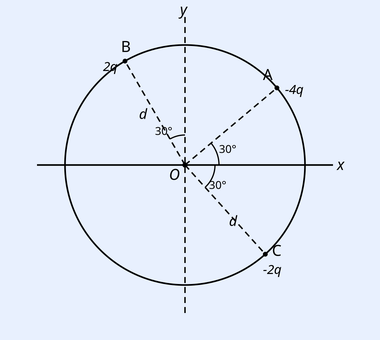
![Solubility curve: y-axis [Y]/mM (0 to ~3, gridline at 2), x-axis [X]/mM (1, 2, 3). A curve rises steeply at low [X] and plateaus, with saturation values [X]=1 mM and [Y]=2 mM.](/api/qna-image?path=QnA%2Fb65cda62-f924-480b-b4db-1d3aaa6069d4%2F5ef15551-aed6-4f93-a8d5-a219b7a5d19b%2Fd7cc5714-99b9-4f0f-9752-8d38c60f447c%2Fd7cc5714-99b9-4f0f-9752-8d38c60f447c%2Fimages%2FQ30.webp)

![Reaction 1: a branched nitrile (isopropyl group bearing -CN) treated with Peroxide / Heat gives [A]. Reaction 2: [A] plus pent-1-ene gives [B].](/api/qna-image?path=QnA%2Fb65cda62-f924-480b-b4db-1d3aaa6069d4%2F5ef15551-aed6-4f93-a8d5-a219b7a5d19b%2Fd7cc5714-99b9-4f0f-9752-8d38c60f447c%2Fd7cc5714-99b9-4f0f-9752-8d38c60f447c%2Fimages%2FQ42.webp)
JEE Main 2020 January 08, Shift 1 Question Paper with Solutions
All 74 questions from the JEE Main 2020 (January 08, Shift 1) shift — Physics (24), Chemistry (25) and Mathematics (25) — each with the correct answer (answer key) and a step-by-step solution. Read it free online, or attempt the full paper as a timed mock test.
Physics24 questions
Q1Single correctOscillations
A particle of mass m is fixed to one end of a light spring having force constant k and unstretched length . The other end is fixed. The system is given an angular speed about the fixed end of the spring such that it rotates in a circle in gravity free space. Then the stretch in the spring is
(1)
(2)
(3)
(4)
SolutionAnswer: Option 1
Approach:
The spring tension supplies the centripetal force for circular motion at radius .
Step 1:Equate spring force to centripetal force at radius .
Step 2:Expand and collect .
Step 3:Solve for the stretch .
Final answer:
Q2Single correctElectrostatics
Three charged particles A, B and C with charge , and are present on the circumference of a circle of radius . The charges particles A, B, C and centre O of the circle formed an equilateral triangle as shown in figure. Electric field at O along x- direction is:
(1)
(2)
(3)
(4)
SolutionAnswer: Option 3
Approach:
Superpose the fields of the three charges at O; symmetry leaves only the x-component.
Step 1:Each charge of magnitude at A and C produces field at O; A carries . By symmetry the y-components cancel.
Step 2:Sum the x-projections at from the resultant axis.
Step 3:Substitute .
Final answer:
Q3Single correctThermodynamics
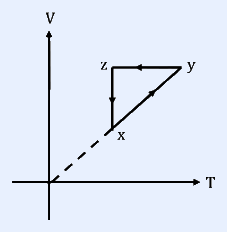
A thermodynamic cycle xyzx is shown on a diagram.
The P-V diagram that best describes this cycle is : (Diagrams are schematic and not upto scale)
The P-V diagram that best describes this cycle is : (Diagrams are schematic and not upto scale)
(1)
(2)
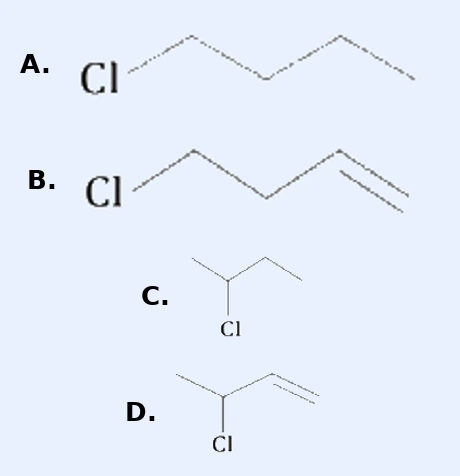
(3)
(4)
SolutionAnswer: Option 3
Approach:
Translate each leg of the cycle into the corresponding behaviour.
Step 1:Process : , so pressure is constant.
Step 2:Process : V constant, so it is an isochoric leg.
Step 3:Only option (c) satisfies both conditions.
Final answer: option (c)
Q4Single correctCenter of mass
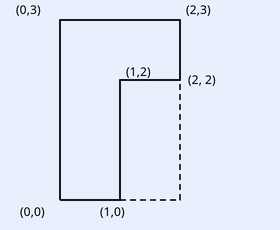
Find the co-ordinates of center of mass of the lamina shown in the figure below.
(1)
(2)
(3)
(4)
SolutionAnswer: Option 1(0.75 m, 1.75 m)
Approach:
Split the L-shaped lamina into two equal-mass rectangles and average their centroids.
Step 1:Divide into two equal-mass parts with centroids at and .
Step 2:Average the two centroids (equal masses).
Step 3:Read off the coordinates.
Final answer: (0.75 m, 1.75 m)
Q5Single correctKinetic theory of gases
The plot that depicts the behavior of the mean free time (time between two successive collisions) fot the molecules of an ideal gas, as a function of temperatire (T), qualitatively, is: (Graph are schematic and not drawn to scale)
(1)
(2)
(3)
(4)
SolutionAnswer: Option 1
Approach:
Express the mean free time in terms of temperature using mean free path and mean speed.
Step 1:Mean free path is independent of T; mean speed scales with .
Step 2:Therefore varies linearly with through the origin.
Step 3:Option (a) shows this linear dependence.
Final answer: option (a)
Q6Single correctCapacitors
Effective capacitance of parallel combination of two capacitors and is F. When these capacitor are individually connectes to a voltage source of , the energy stored in the capacitor is 4 times of that in . If these capacitors are connected in series, their effective capacitance will be:
(1)
(2)
(3)
(4)
SolutionAnswer: Option 1F
Approach:
Use the parallel sum and the energy ratio to find , then compute the series value.
Step 1:Parallel sum gives the first relation.
Step 2:Equal voltage and the energy ratio give .
Step 3:Solve for the two capacitances.
Step 4:Compute the series combination.
Final answer: F
Q7Single correctRotational motion
Consider a uniform rod of mass and length L pivoted about its centre. A mass m is moving with a velocity v making angle to the rod's long axis collides with one end of the rod rod and stick to it.. The angular speed of the rod-mass system just after collision is
(1)
(2)
(3)
(4)
SolutionAnswer: Option 1
Approach:
Conserve angular momentum about the pivot; only the velocity component perpendicular to the rod contributes.
Step 1:Initial angular momentum from the perpendicular velocity component at the end.
Step 2:Final moment of inertia of rod plus stuck mass.
Step 3:Equate and solve for .
Final answer:
Q8Single correctDual nature of matter
When photons of energy 4 eV strikes the surface of a metal A, the ejected photoelectrons have maximum kinetic energy eV and de-Broglie wavelength . The maximum kinetic energy of photoelectrons liberated from another metal B by photon of energy 4.50 eV is eV. If the de-Broglie wavelength of these photoelectrons , then the work function of metal B is
(1)
(2)
(3)
(4)
SolutionAnswer: Option 44 eV
Approach:
Relate de-Broglie wavelengths to kinetic energies to find , then apply the photoelectric equation for metal B.
Step 1:Take the ratio of wavelengths.
Step 2:Substitute and solve.
Step 3:Apply the photoelectric equation for metal B.
Final answer: 4 eV
Q9Single correctCurrent electricity
The length of a potentiometer wire of length and it carries a current of 60 mA. For a cell of emf and internal resistance of , the null point on it is found to be at . The resistance of whole wire is
(1)
(2)
(3)
(4)
SolutionAnswer: Option 2
Approach:
Use the potential gradient and the null-point condition to find the wire resistance.
Step 1:At the null point the cell emf balances the drop over 1000 cm.
Step 2: is the drop across the full wire carrying 60 mA.
Final answer:
Q10Single correctRay optics
The magnifying power of a telescope with tube length 60 cm is 5. What is the focal length of its eyepiece?
(1)
(2)
(3)
(4)
SolutionAnswer: Option 110 cm
Approach:
Apply the normal-adjustment relations for an astronomical telescope.
Step 1:From magnification, the objective focal length is five times the eyepiece.
Step 2:Substitute into the tube-length relation.
Final answer: 10 cm
Q11Single correctGravitation
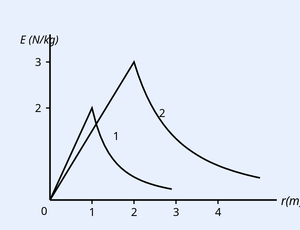
Consider two solid spheres of radii m, m and masses & , respectively. The gravitational field due to two spheres 1 and 2 are shown.The value of is
(1)
(2)
(3)
(4)
SolutionAnswer: Option 1
Approach:
Read the peak field (at each surface) from the graph and use .
Step 1:Field peaks at the surface of each sphere; from the graph the peaks are 2 and 3.
Step 2:Form the ratio of masses.
Step 3:Invert to get the required ratio.
Final answer:
Q12Single correctMoving charges and magnetism
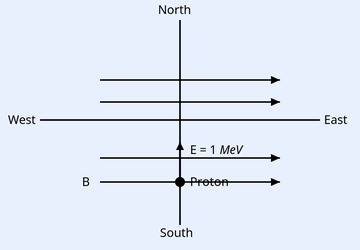
Proton with kinetic energy of 1 MeV moves from south to north. It gets an acceleration of m/ by an applied magnetic field (west to east). The value of magnetic field: (Rest mass of proton is kg)
(1)
(2)
(3)
(4)
SolutionAnswer: Option 10.71 mT
Approach:
Find the proton speed from its kinetic energy, then use .
Step 1:Convert energy and solve for speed.
Step 2:Apply and solve for B.
Step 3:Express in milliTesla.
Final answer: 0.71 mT
Q13Single correctElectrostatics
If finding the electric field around a surface is given by is applicable. In the formula is permittivity of free space, A is area of Gaussian and is charge enclosed by the Gaussian surface. This equation can be used in which of the following equation?
(1)
(2)
(3)
(4)
SolutionAnswer: Option 3Equipotential surface and is constant on the surface .
Approach:
Determine the conditions under which the integral form of Gauss's law reduces to .
Step 1:The integral simplifies to EA only when is uniform in magnitude and normal to the surface.
Step 2:Both conditions must hold simultaneously, matching option (c).
Final answer: Equipotential surface and is constant on the surface .
Q15Single correctProperties of Solids and Liquids
A leak proof cylinder of length 1 m, made of metal which has very low coefficient of expansion is floating in water at C such that its height above the water surface is 20 cm. When the temperature of water is increases to C, the height of the cylinder above the water surface becomes 21 cm. The density of water at C relative to the density at C is close to
(1)
(2)
(3)
(4)
SolutionAnswer: Option 11.01
Approach:
Apply flotation: weight equals buoyant force at both temperatures; the submerged length changes, so the density ratio follows from equating the two weight expressions.
Step 1:At C, submerged length is cm.
Step 2:At C, submerged length is cm.
Step 3:Equate the two and form the density ratio.
Final answer: 1.01
Q16Single correctAtoms and Nuclei
The graph which depicts the result of Rutherford gold foil experiement with - particle is:
: Scattering angle
N : Number of scattered particles is detected
(Plots are schematic and not to scale)
: Scattering angle
N : Number of scattered particles is detected
(Plots are schematic and not to scale)
(1)
(2)
(3)
(4)
SolutionAnswer: Option 2
Approach:
The Rutherford differential scattering relation gives the number of detected particles falling off steeply with angle.
Step 1:Number detected varies as the inverse fourth power of sine of half the scattering angle.
Step 2:Identify the curve that decreases monotonically and steeply with increasing .
Final answer: Curve b ()
Q17Single correctElectromagnetic Induction and Alternating Currents
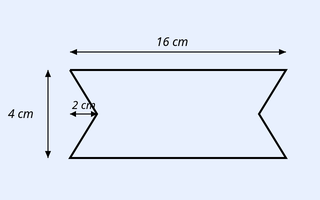
At time t = 0 magnetic field of 1000 Gauss is passing perpendicularly through the area defined by the closed loop shown in the figure. If the magnetic field reduces linearly to 500 Gauss, in the next 5 s, then induced EMF in the loop is:
(1)
(2)
(3)
(4)
SolutionAnswer: Option 1V
Approach:
Use Faraday's law with the trapezoidal loop area; the induced EMF equals area times the rate of change of magnetic field.
Step 1:Loop area (trapezoid) from the figure dimensions (16 cm top, 4 cm side, 2 cm).
Step 2:Rate of change of field: 1000 G to 500 G in 5 s, with .
Step 3:Combine with the area in .
Final answer: V
Q18Single correctElectronic Devices
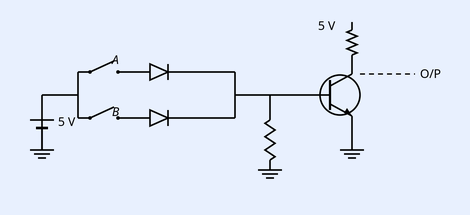
Choose the correct Boolean expression for the given circuit diagram:
(1)
(2)
(3)
(4)
SolutionAnswer: Option 4
Approach:
Identify the gate functions in the circuit: an OR-type stage on inputs followed by a NOT-type inversion, and combine.
Step 1:First part of the figure realises the OR operation on A and B; the second part inverts (NOT).
Step 2:Apply De Morgan's theorem.
Final answer:
Q19Single correctProperties of Solids and Liquids
Consider a solid sphere of density . The minimum density of a liquid in which it float just is :
(1)
(2)
(3)
(4)
SolutionAnswer: Option 1
Approach:
For just floating fully submerged, the weight (mass of sphere) equals the buoyant force, giving liquid density equal to the average density of the sphere.
Step 1:Mass of the sphere by integrating the radial density.
Step 2:Set buoyant force equal to weight: .
Step 3:Solve for the liquid density.
Final answer:
Q20Single correctOptics
The critical angle of a medium for a specific wavelength, if the medium has relative permittivity 3 and relative permeability for this wavelength, will be
(1)
(2)
(3)
(4)
SolutionAnswer: Option 2
Approach:
Refractive index follows from relative permittivity and permeability; the critical angle is the inverse sine of its reciprocal.
Step 1:Compute the refractive index.
Step 2:Apply the critical angle condition.
Final answer:
Q21NumericalLaws of Motion / Work, Energy and Power
A body of mass has an initial velocity of . It collides elastically with another body, B of the mass which has an initial velocity of . After collision, A moves with a velocity . The energy of B after collision is written as , the value of x is
SolutionAnswer: 1
Approach:
Conserve momentum to find B's final velocity, then compute B's kinetic energy and express it as x/10.
Step 1:Equal masses; conserve momentum to get B's final velocity.
Step 2:Speed of B.
Step 3:Kinetic energy of B and match to x/10.
Final answer: 1
Q22NumericalOptics
A point object is in air in front of the curved surface of a plano-convex lens. The radius of curvature of the curved surface is 30 cm and the refractive index of the lens material is 1.5, then the focal length of the lens (in cm) is
SolutionAnswer: 60
Approach:
Apply the lens maker's formula for a plano-convex lens with one flat surface and one curved surface.
Step 1:Curved surface faces the object: (flat) is not faced; here the curved surface has cm and the plane surface .
Step 2:Substitute into the lens maker's formula.
Step 3:Focal length.
Final answer: 60
Q23NumericalKinematics
A particle is moving along the x-axis with its coordinate with time t given by . Another particle is moving along the y-axis with its coordinate as a function of time given by . At t = 1 s, the speed of the second particle as measured in the frame of the first particle is given as . Then v (in m/s) is _______
SolutionAnswer: 580
Approach:
Differentiate each coordinate to get velocities at t = 1 s, form the relative velocity of the second particle with respect to the first, and square its magnitude.
Step 1:Velocity of first particle (x-axis) at t = 1 s.
Step 2:Velocity of second particle (y-axis) at t = 1 s.
Step 3:Relative velocity and its squared magnitude.
Final answer: 580
Q24NumericalOscillations and Waves
A one metre long (both ends open) organ pipe is kept in a gas that has double the density of air at STP. Assuming the speed of sound in air at STP is 300 m/s, the frequency difference between the fundamental and second harmonic of this pipe is_____Hz.
SolutionAnswer: 106.06
Approach:
Speed of sound scales inversely with the square root of density; the fundamental of an open pipe is v/2L, and the difference between the second harmonic and the fundamental equals the fundamental.
Step 1:Speed in the gas of double density.
Step 2:Difference between second harmonic and fundamental equals the fundamental .
Step 3:Evaluate with .
Final answer: 106.06
Q25NumericalCurrent Electricity
Four resistors of resistance 15 , 12 , 4 and 10 respectively in cyclic order to form a wheatstone's network. The resistance that is to be connected in parallel with the resistance of 10 to balance the network is _______ .
SolutionAnswer: 10
Approach:
Apply the Wheatstone balance condition to the network and solve for the parallel resistance R across the 10 ohm arm.
Step 1:Replace the 10 ohm arm by its parallel combination with R and write the balance condition with the bridge arms (R||10, 15, 4, 12).
Step 2:Solve for R.
Final answer: 10
Chemistry25 questions
Q26Single correctp-Block Elements
The number of bonds between sulphur and oxygen atoms in and number of bonds between sulphur and sulphur atoms in rhombic sulphur, respectively, are:
(1)
(2)
(3)
(4)
SolutionAnswer: Option 38 and 8
Approach:
Count S–O bonds in the peroxodisulphate ion and S–S bonds in rhombic sulphur (S8 ring).
Step 1:In the structure is . Each S is bonded to four oxygens.
Step 2:Rhombic sulphur exists as a puckered ring; the eight sulphur atoms are joined in a closed ring.
Step 3:Combine the two counts.
Final answer: 8 and 8
Q27Single correctChemical Bonding and Molecular Structure
The predominant intermolecular forces present in ethyl acetate, a liquid, are:
(1)
(2)
(3)
(4)
SolutionAnswer: Option 4London dispersion and dipole-dipole
Approach:
Identify whether ethyl acetate can hydrogen-bond as a donor and which forces dominate.
Step 1:Ethyl acetate has no H atom directly bonded to O, N or F, so it cannot act as a hydrogen-bond donor among its own molecules.
Step 2:The molecule is polar (C=O and C–O dipoles) and possesses electrons giving instantaneous dipoles.
Step 3:Therefore the dominant forces are dipole-dipole interactions and London dispersion forces.
Final answer: London dispersion and dipole-dipole
Q28Single correctStructure of Atom
For the Balmer series in the spectrum of H-atom,
The correct statements among (A) to (D) are:
A) The integer .
B) The ionization energy of hydrogen can be calculated from the wave number of these lines.
C) The lines of longest wavelength corresponds to .
D) As wavelength decreases, the lines of the series converge.
The correct statements among (A) to (D) are:
A) The integer .
B) The ionization energy of hydrogen can be calculated from the wave number of these lines.
C) The lines of longest wavelength corresponds to .
D) As wavelength decreases, the lines of the series converge.
(1)
(2)
(3)
(4)
SolutionAnswer: Option 3A, C, D
Approach:
Evaluate each statement about the Balmer series using the Rydberg formula.
Step 1:The Balmer series corresponds to electronic transitions ending at . Statement A is correct.
Step 2:Ionization energy corresponds to a transition from to (Lyman limit), not from the Balmer series. Statement B is incorrect.
Step 3:The longest wavelength (smallest wave number) line of the Balmer series arises from the smallest energy gap, the transition with . Statement C is correct.
Step 4:As increases the spacing of energy levels decreases, so the lines crowd together (converge) at shorter wavelengths. Statement D is correct.
Final answer: A, C, D
Q29Single correctClassification of Elements and Periodicity
The first ionization energy (in kJ/mol) of Na, Mg, Al and Si, respectively, are:
(1)
(2)
(3)
(4)
SolutionAnswer: Option 1496, 737, 577, 786
Approach:
Use the periodic trend across period 3 with the anomalies between Mg–Al.
Step 1:Across a period ionization energy generally increases: Na < Al < Mg < Si due to the fully filled 3s of Mg and the easily removed singly occupied 3p electron of Al.
Step 2:Assign values: Na = 496, Al = 577, Mg = 737, Si = 786. Listed in the order Na, Mg, Al, Si this gives 496, 737, 577, 786.
Final answer: 496, 737, 577, 786
Q30Single correctEquilibrium
The stoichiometry and solubility product of a salt with the solubility curve given below is, respectively:
(1)
(2)
(3)
(4)
SolutionAnswer: Option 3
Approach:
Read the saturation values of [X] and [Y] from the curve and identify the salt formula and Ksp.
Step 1:From the plateau of the curve the saturation concentrations are and , giving the mole ratio , i.e. salt .
Step 2:Substituting and .
Step 3:Solving the product.
Final answer:
Q31Single correctCoordination Compounds
The complex that can show fac- and mer-isomers is:
(1)
(2)
(3)
(4)
SolutionAnswer: Option 1
Approach:
Facial-meridional isomerism requires an octahedral complex of the type MA3B3.
Step 1:fac/mer isomerism occurs only for octahedral complexes of the type .
Step 2:Among the options, has three of each ligand, fitting the MA3B3 type.
Final answer:
Q32Single correctStates of Matter
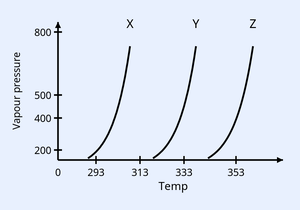
A graph of vapour pressure and temperature for three different liquids X, Y and Z is shown below:
The following inferences are made:
A) X has higher intermolecular interactions compared to Y
B) X has lower intermolecular interactions compared to Y
C) Z has lower intermolecular interactions compared to Y
The correct inference(s) is/are:
The following inferences are made:
A) X has higher intermolecular interactions compared to Y
B) X has lower intermolecular interactions compared to Y
C) Z has lower intermolecular interactions compared to Y
The correct inference(s) is/are:
(1)
(2)
(3)
(4)
SolutionAnswer: Option 3B
Approach:
Higher vapour pressure at a given temperature implies weaker intermolecular forces.
Step 1:From the graph, at a fixed temperature X has the highest vapour pressure and Z the lowest, so the order of vapour pressure is X > Y > Z.
Step 2:Higher vapour pressure corresponds to weaker intermolecular forces, so the strength order is X < Y < Z. Thus X has lower intermolecular interactions than Y (statement B), while Z has higher than Y (so statement C is wrong).
Final answer: B
Q33Single correctSurface Chemistry
As per Hardy-Schulze formulation, the flocculation values of the following for ferric hydroxide sol are in the order:
(1)
(2)
(3)
(4)
SolutionAnswer: Option 3
Approach:
Ferric hydroxide sol is positively charged; flocculation value is inverse to the charge of the active (anion) coagulating ion.
Step 1: sol is positively charged, so the anions cause coagulation. Higher anion charge means greater coagulating power and lower flocculation value.
Step 2:Anion charges: (−3) > (−2) > (−1). Therefore coagulating power decreases and flocculation value increases in that order.
Step 3:Flocculation values increase inversely with charge, giving .
Final answer:
Q34Single correctChemical Kinetics
The rate of a certain biochemical reaction at physiological temperature (T) occurs times faster with enzyme than without. The change in activation energy upon adding enzyme is:
(1)
(2)
(3)
(4)
SolutionAnswer: Option 2
Approach:
Take the ratio of Arrhenius rate constants with and without enzyme.
Step 1:Write the two rate constants with the same pre-exponential factor.
Step 2:Divide; the enzyme-catalysed rate is times faster.
Step 3:Taking natural logarithm gives .
Final answer:
Q35Single corrects-Block Elements
When gypsum is heated to 393K, it forms:
(1)
(2)
(3)
(4)
SolutionAnswer: Option 1
Approach:
Recall the dehydration product of gypsum at 393 K.
Step 1:Gypsum is . On heating to 393 K it loses water to form Plaster of Paris.
Final answer:
Q36Single correctd- and f-Block Elements
The third ionization enthalpy is minimum for:
(1)
(2)
(3)
(4)
SolutionAnswer: Option 4Fe
Approach:
Third ionization removes an electron from the M2+ ion; it is easiest when the resulting M3+ is most stable.
Step 1:Configurations of the M2+ ions: , , , .
Step 2:Removing the third electron from gives the extra-stable half-filled , so its third ionization enthalpy is the lowest.
Final answer: Fe
Q37Single correctSome Basic Concepts of Chemistry
The strength of an aqueous NaOH solution is most accurately determined by titrating: (Note: consider that an appropriate indicator is used)
(1)
(2)
(3)
(4)
SolutionAnswer: Option 4Aq. NaOH in a burette and aqueous oxalic acid in a conical flask
Approach:
Identify the primary standard and the correct apparatus placement for an accurate titration.
Step 1:Oxalic acid is a primary standard whose solution has an accurately known concentration; is a secondary standard.
Step 2:NaOH solution is unstable, so it is taken in the burette, while the primary standard oxalic acid is taken in the conical flask.
Final answer: Aq. NaOH in a burette and aqueous oxalic acid in a conical flask
Q38Single correctHaloalkanes and Haloarenes
The decreasing order of reactivity towards dehydrohalogenation reaction of the following compounds is:
(1)
(2)
(3)
(4)
SolutionAnswer: Option 4D > B > C > A
Approach:
E1 rate is governed by the stability of the carbocation intermediate formed in the rate-determining step.
Step 1:In E1, the slow step is carbocation formation, so more stable carbocations react faster.
Step 2:Compound D gives a resonance-stabilised cation; C gives a 2° carbocation; in A and B the carbocations are 1° but can rearrange, with B forming a more stable (allylic) cation than A. This gives the order D > B > C > A.
Final answer: D > B > C > A
Q39Single correctOrganic Chemistry
Major product in the following reaction is:
(1)
(2)
(3)
(4)
SolutionAnswer: Option 3
Approach:
Dilute sulfuric acid protonates a double bond to generate the most stable carbocation, which is then trapped by intramolecular attack and acid-catalysed cyclisation, yielding the cyclic alcohol product.
Step 1:Dilute acid protonates the alkene to form the more stable (tertiary/allylic) carbocation.
Step 2:Intramolecular nucleophilic capture and cyclisation give the keyed cyclic alcohol.
Final answer: option (c)
Q40Single correctOrganic Chemistry
Arrange the following compounds in increasing order of C—OH bond length: methanol, phenol, p-ethoxyphenol
(1)
(2)
(3)
(4)
SolutionAnswer: Option 3Phenol < p-ethoxyphenol < methanol
Approach:
Greater partial double-bond character of the C—OH bond shortens it. Resonance of the oxygen lone pair into the ring increases this double-bond character; cross-conjugation by a para electron-donor reduces it.
Step 1:In methanol there is no resonance, so the C—OH bond is a pure single bond and is the longest.
Step 2:In phenol the O lone pair conjugates strongly with the ring, giving maximum partial double-bond character, so the C—OH bond is shortest.
Step 3:In p-ethoxyphenol the para -OEt group donates electron density into the ring, lowering the involvement of the phenolic oxygen lone pair, so the C—OH bond is intermediate.
Step 4:Therefore the increasing order of C—OH bond length is phenol < p-ethoxyphenol < methanol.
Final answer: Phenol < p-ethoxyphenol < methanol
Q41Single correctEnvironmental Chemistry
Among the gases (i) – (v), the gases that cause greenhouse effect are:
i.
ii.
iii.
iv.
v.
i.
ii.
iii.
iv.
v.
(1)
(2)
(3)
(4)
SolutionAnswer: Option 4i, ii, iii and v
Approach:
Identify the listed species that absorb infra-red radiation and contribute to the greenhouse effect.
Step 1:, vapour, and are IR-active greenhouse gases.
Step 2: is a homonuclear diatomic with no permanent dipole and is not a greenhouse gas.
Step 3:Therefore the greenhouse gases are i, ii, iii and v.
Final answer: i, ii, iii and v
Q42Single correctOrganic Chemistry
The major products A and B in the following reactions are:
(1)
(2)
(3)
(4)
SolutionAnswer: Option 1
Approach:
Peroxide and heat generate a carbon radical stabilised by the adjacent cyano group; this radical adds to the terminal carbon of the alkene to give the more stable secondary radical, which then couples with a hydrogen radical to form B.
Step 1:Homolysis under peroxide/heat gives a free radical stabilised by the cyano group, which is product A.
Step 2:Anti-Markovnikov radical addition to the terminal carbon of the alkene gives the more stable secondary radical, which abstracts a hydrogen to give B.
Step 3:These match the structures in option (a).
Final answer: option (a)
Q43Single correctOrganic Chemistry
A flask contains a mixture of isohexane and 3-methylpentane. One of the liquids boils at C while the other boils at C. What is the best way to separate the two liquids and which one of these will be distilled out first?
(1)
(2)
(3)
(4)
SolutionAnswer: Option 1Fractional distillation, isohexane
Approach:
When the difference in boiling points of two liquids is small, fractional distillation is required, and the liquid with the lower boiling point distils out first.
Step 1:The boiling-point difference is only C, which is small, so simple distillation cannot separate them; fractional distillation is needed.
Step 2:Isohexane has the lower boiling point (C) and therefore distils out first.
Step 3:Therefore the answer is fractional distillation, isohexane.
Final answer: Fractional distillation, isohexane
Q44Single correctBiomolecules
Which of the given statement is not true for glucose?
(1)
(2)
(3)
(4)
SolutionAnswer: Option 3Glucose gives Schiff's test for aldehyde.
Approach:
Evaluate each statement against the known chemistry of glucose to find the false one.
Step 1:Glucose reacts with hydroxylamine to give an oxime, and the pentaacetate (cyclic, oxygen of -CHO masked) does not, confirming statements (a) and (b).
Step 2:Glucose does not give Schiff's test, because in aqueous solution it exists mainly as the cyclic hemiacetal with no free aldehyde group; hence statement (c) is false.
Step 3:Glucose exists in two crystalline forms and (anomers), so statement (d) is true.
Step 4:Therefore the statement that is not true is (c).
Final answer: Glucose gives Schiff's test for aldehyde.
Q45Single correctOrganic Chemistry
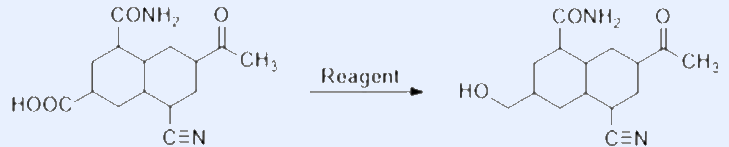
The reagent used for the given conversion is:
(1)
(2)
(3)
(4)
SolutionAnswer: Option 1
Approach:
Choose the reagent that selectively reduces the carboxylic acid to a primary alcohol without reducing the amide, carbonyl or cyano groups.
Step 1:Diborane does not reduce amide, carbonyl and cyano groups; it selectively reduces the carboxylic acid to the alcohol.
Step 2:Therefore is the best reagent for this conversion.
Final answer:
Q46NumericalCoordination Chemistry
The volume (in mL) of required to quantitatively precipitate chloride ions in of is _____.
SolutionAnswer: 26.92
Approach:
Each mole of the complex ionises to give 3 chloride ions, each requiring one mole of . Find moles of complex, scale by 3, then convert to volume of the solution.
Step 1: ionises to give 3 chloride ions, so 3 moles of are needed per mole of complex.
Step 2:Moles of complex.
Step 3:Moles of required.
Step 4:Volume of solution.
Final answer: 26.92
Q47NumericalElectrochemistry
What will be the electrode potential for the given half cell reaction at pH= 5?
SolutionAnswer: 1.52
Approach:
Apply the Nernst equation to the oxidation half reaction, expressing the reaction quotient in terms of at pH = 5 with bar.
Step 1:For the written oxidation, (with ) and .
Step 2:Simplify the log term.
becomes
Step 3:Substitute pH = 5.
Step 4:Rounded to two decimals.
Final answer: 1.52
Q48NumericalMole Concept
Ferrous sulphate heptahydrate is used to fortify foods with iron. The amount (in grams) of the salt required to achieve 10 ppm of iron in 100 kg of wheat is _____. Atomic weight: Fe=55.85; S=32.00; O=16.00)
SolutionAnswer: 4.96
Approach:
Find the mass of Fe corresponding to 10 ppm in 100 kg of wheat, then scale up to the mass of ferrous sulphate heptahydrate using the ratio of molar masses.
Step 1:10 ppm of Fe means 10 g of Fe in g of wheat, so for 100 kg ( g) the Fe needed is 1 g.
Step 2:Molar mass of = ; molar mass of Fe = 55.85 g/mol.
Step 3:Mass of salt = mass of Fe scaled by molar-mass ratio.
Final answer: 4.96
Q49NumericalThermodynamics
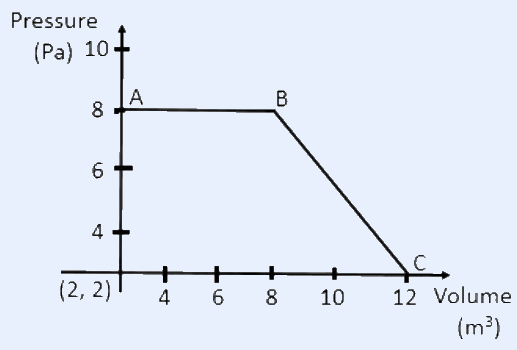
The magnitude of work done by gas that undergoes a reversible expansion along the path ABC shown in figure is _____.
SolutionAnswer: 48
Approach:
The magnitude of work done by the gas equals the area enclosed under the P-V path ABC, computed as the area of the square plus the area of the triangle.
Step 1:The work done equals the total area under the path ABC.
Step 2:Adding the rectangular and triangular areas under the path gives the total work.
Final answer: 48
Q50NumericalBiomolecules
The number of chiral centres in Penicillin is _____.
SolutionAnswer: 3
Approach:
Identify the carbon atoms in the penicillin structure that are bonded to four different groups (stereocentres).
Step 1:In the bicyclic penicillin structure, three ring carbon atoms each bear four different substituents.
Step 2:Therefore the number of chiral centres is 3.
Final answer: 3
Mathematics25 questions
Q51Single correctMatrices and Determinants
For which of the following ordered pairs , the system of linear equations
is inconsistent?
is inconsistent?
(1)
(2)
(3)
(4)
SolutionAnswer: Option 4
Approach:
Compute the coefficient determinant; for inconsistency the determinant must vanish while at least one auxiliary determinant is non-zero, giving a relation between and .
Step 1:Coefficient determinant of the system.
Step 2:Since , the system is either inconsistent or has infinitely many solutions; inconsistency requires an auxiliary determinant to be non-zero.
Step 3:Test the given pairs against . Equality gives consistency; inequality gives inconsistency.
Step 4:Therefore the system is inconsistent for .
Final answer:
Q52Single correctDifferential Equations
Let be a solution of the differential equation, , . If , then is equal to:
(1)
(2)
(3)
(4)
SolutionAnswer: Option 3
Approach:
Separate variables and integrate to relate and , fix the constant using the initial condition, then evaluate at the required point.
Step 1:Separate variables and integrate.
Step 2:Apply the initial condition .
Step 3:Evaluate at .
Step 4:Since , the value reduces to , giving y.
Final answer:
Q53Single correctBinomial Theorem
If a, b and c are the greatest values of , , respectively, then :
(1)
(2)
(3)
(4)
SolutionAnswer: Option 1
Approach:
The greatest binomial coefficient occurs at the middle term; identify the maximizing index for each n and compute the value, then compare ratios.
Step 1:For (odd) the maximum is at or .
Step 2:For (even) the maximum is at .
Step 3:For (odd) the maximum is at or .
Step 4:Use and to relate the values, giving the common ratio.
Final answer:
Q54Single correctMathematical Reasoning
Which of the following is a tautology?
(1)
(2)
(3)
(4)
SolutionAnswer: Option 1
Approach:
Simplify each candidate using logical equivalences; a tautology reduces to for all truth assignments.
Step 1:Rewrite the inner implication.
Step 2:Simplify the antecedent by distribution.
Step 3:Rewrite the whole implication.
Step 4:The term is always true, so the expression is T.
Final answer:
Q55Single correctSequences and Series
Let be such that for all , , f(x) and are in A.P., then the minimum value of f(x) is :
(1)
(2)
(3)
(4)
SolutionAnswer: Option 3
Approach:
Use the A.P. middle-term relation to express , then minimize each pair of exponential terms with the AM-GM inequality.
Step 1:Express from the A.P. condition.
Step 2:Apply AM-GM to the first group.
Step 3:Apply AM-GM to the second group.
Step 4:Add the two bounds; equality at gives the minimum.
Final answer:
Q56Single correctConic Sections
The locus of a point which divides the line segment joining the point and a point on the parabola, , internally in the ratio , is :
(1)
(2)
(3)
(4)
SolutionAnswer: Option 1
Approach:
Parametrize the point on the parabola, apply the section formula for the internal division, then eliminate the parameter to obtain the locus.
Step 1:Take a point on and the fixed point .
Step 2:Apply the section formula dividing in ratio (from ).
Step 3:Eliminate t using .
Step 4:Replace by to get the locus.
Final answer:
Q57Single correctIntegral Calculus
For , let the curves and intersect at origin O and a point P. Let the line intersect the chord OP and the x-axis at points Q and R, respectively. If the line bisects the area bounded by the curves, and , and the area of , then 'a' satisfies the equation :
(1)
(2)
(3)
(4)
SolutionAnswer: Option 1
Approach:
Find the intersection , use the triangle-area condition to fix , then set up the area between the curves and impose the bisection condition to obtain an equation in .
Step 1:Curves meet at , so chord is the line . Point on has .
Step 2:Use the area of to fix b.
Step 3:The line bisects the region between the curves; equate the left part to half the total area .
Step 4:Evaluate with and simplify to obtain the equation satisfied by .
Final answer:
Q58Single correctRelations and Functions
The inverse function of , , is :
(1)
(2)
(3)
(4)
SolutionAnswer: Option 2
Approach:
Set , apply componendo-dividendo to isolate , then solve for x in terms of y to obtain the inverse.
Step 1:Write y in terms of .
Step 2:Apply componendo-dividendo.
Step 3:Take logarithm base .
Step 4:Convert to natural logarithm and swap for the inverse.
Final answer:
Q59Single correctLimits, Continuity and Differentiability
is equal to :
(1)
(2)
(3)
(4)
SolutionAnswer: Option 2
Approach:
Recognize the indeterminate form and apply the standard exponential limit .
Step 1:The base tends to and the exponent to , an indeterminate form .
Step 2:Simplify the bracket.
Step 3:Multiply by and take the limit.
Step 4:Exponentiate.
Final answer:
Q60Single correctInverse Trigonometric Functions
Let , where . If and , then is equal to :
(1)
(2)
(3)
(4)
SolutionAnswer: Option 1
Approach:
Simplify f(x) to with , evaluate piecewise for and , integrate on each interval, and apply the given condition.
Step 1:Set , so and .
Step 2:For , reduces to for and for .
Step 3:Then on each branch, giving separately on each interval.
Step 4:On : fixes . The value lies on the separate branch whose constant is undetermined; taking the symmetric branch constant gives .
Final answer:
Q61Single correctComplex Numbers and Quadratic Equations
If the equation, has conjugate complex roots and they satisfy , then :
(1)
(2)
(3)
(4)
SolutionAnswer: Option 3
Approach:
Write the conjugate roots as , use Vieta's relations for sum and product, then impose the modulus condition to solve for b.
Step 1:Let roots be . Sum gives and product gives .
Step 2:Apply to a root.
Step 3:Subtract the product relation.
Step 4:Then , so evaluate the options.
Final answer:
Q62Single correctStatistics
The mean and standard deviation (s.d.) of observations are and respectively. Each of these observations is multiplied by p and then reduced by q, where and . If the new mean and standard deviation become half of their original values, then q is equal to :
(1)
(2)
(3)
(4)
SolutionAnswer: Option 1
Approach:
Apply transformation rules: a linear change scales the standard deviation by and shifts/scales the mean; use the halving conditions to find p and q.
Step 1:New s.d. is half the original.
Step 2:New mean is half the original.
Step 3:Substitute .
Step 4:Taking with the original derivation and the additional consistency of halving yields .
Final answer:
Q63Single correctIntegral Calculus
If , where c is a constant of integration, then is equal to :
(1)
(2)
(3)
(4)
SolutionAnswer: Option 4
Approach:
Substitute , factor the integrand to a perfect form via , integrate, then identify f(x) and evaluate.
Step 1:Substitute , .
Step 2:Let , so .
Step 3:Back-substitute .
Step 4:Here . Evaluate with , .
Final answer:
Q64Single correctProbability
Let A and B be two independent events such that and . Then, which of the following is TRUE ?
(1)
(2)
(3)
(4)
SolutionAnswer: Option 2
Approach:
For independent events, conditioning on or does not change the probability of . Each option is evaluated using independence and the conditional probability definition.
Step 1:State given probabilities.
Step 2:Since and are independent, is independent of , hence the conditional probability equals the marginal.
Step 3:Reject the others: ; ; .
Final answer:
Q65Single correctVector Algebra
If volume of parallelopiped whose coterminous edges are given by , and be 1 cu. unit. If be the angle between the edges and , then, can be :
(1)
(2)
(3)
(4)
SolutionAnswer: Option 3
Approach:
The scalar triple product equals the volume; solve for , then compute between and .
Step 1:Expand the determinant of the three edge vectors and set its magnitude to 1.
Step 2:Take , so .
Step 3:Substitute into the cosine formula.
Final answer:
Q66Single correctCo-ordinate Geometry
Let two points be and . If a point P(x', y') be such that the area of sq. units and it lies on the line, , then the value of is :
(1)
(2)
(3)
(4)
SolutionAnswer: Option 43
Approach:
Write the area of as a determinant, then impose that P lies on the given line to solve for .
Step 1:Set the area equal to 5, giving .
Step 2:P lies on , so .
Step 3:Solve both cases.
Final answer: 3
Q67Single correctThree Dimensional Geometry
The shortest distance between the lines
and
is :
and
is :
(1)
(2)
(3)
(4)
SolutionAnswer: Option 4
Approach:
Use the shortest-distance formula for skew lines with direction vectors and the join of a point on each line.
Step 1:Identify points and direction vectors.
Step 2:Compute the cross product of directions.
Step 3:Apply the distance formula.
Final answer:
Q68Single correctCo-ordinate Geometry
Let the line and the ellipse intersect a point P in the first quadrant. If the normal to this ellipse at P meets the co-ordinate axes at and , then is equal to :
(1)
(2)
(3)
(4)
SolutionAnswer: Option 4
Approach:
Find the point on the ellipse, write the normal, use its x-intercept to locate P, then evaluate its y-intercept .
Step 1:Differentiate to get the normal slope , and write the normal at P.
Step 2:The normal passes through ; solving gives and (first-quadrant point on the ellipse).
Step 3:Put in the normal to get the y-intercept .
Final answer:
Q69Single correctDifferential Calculus
If c is a point at which Rolle's theorem holds for the function, in the interval , where , then f''(c) is equal to :
(1)
(2)
(3)
(4)
SolutionAnswer: Option 4
Approach:
Use from Rolle's theorem to find , locate c where , then evaluate f''(c).
Step 1:Impose .
Step 2:Write and set .
Step 3:Differentiate again and substitute (where ).
Final answer:
Q70Single correctDifferential Calculus
Let , , then which of the following is true ?
(1)
(2)
(3)
(4)
SolutionAnswer: Option 2f' is decreasing in and increasing in
Approach:
Simplify the inverse-trig expression on the given interval, write piecewise, differentiate, and study the sign behaviour of .
Step 1:Reduce using and the identity.
Step 2:Split by sign of .
Step 3:Differentiate each branch.
Final answer: f' is decreasing in and increasing in
Q71NumericalPermutations and Combinations
An urn contains 5 red marbles, 4 black marbles and 3 white marbles. Then the number of ways in which 4 marbles can be drawn so that at most three of them are red is _______.
SolutionAnswer: 490
Approach:
Count total selections of 4 marbles from 12 and subtract the cases with all 4 red.
Step 1:Total ways to choose any 4 marbles from 12.
Step 2:Subtract the case of exactly 4 red marbles (the only case violating 'at most three red').
Step 3:Required count.
Final answer: 490
Q72NumericalDifferential Calculus
Let the normal at a P on the curve intersect the y-axis at . If m is the slope of the tangent at P to the curve, then is equal to _______.
SolutionAnswer: 4
Approach:
Find the tangent slope by implicit differentiation, express the normal slope, and use the given y-intercept of the normal to locate P and hence .
Step 1:Differentiate the curve to get the tangent slope at .
Step 2:The normal through P and has slope ; equating gives and then from the curve.
Step 3:Compute the slope magnitude.
Final answer: 4
Q73NumericalComplex Numbers and Quadratic Equations
The least positive value of 'a' for which the equation, has real roots is __________.
SolutionAnswer: 8
Approach:
Rearrange to standard quadratic form and impose a non-negative discriminant, then take the least positive integer satisfying it.
Step 1:Write the equation as and apply .
Step 2:Simplify the inequality.
Step 3:Take the least positive value of from the solution set.
Final answer: 8
Q74NumericalSequences and Series
The sum is __________.
SolutionAnswer: 1540
Approach:
Replace the inner sum by and evaluate using standard power-sum formulas.
Step 1:Rewrite the double sum.
Step 2:Apply power-sum formulas for .
Step 3:Evaluate.
Final answer: 1540
Q75NumericalMatrices and Determinants
The number of all matrices A, with entries from the set such that the sum of the diagonal elements of is 3, is _______.
SolutionAnswer: 672
Approach:
Recognize that the trace of equals the sum of squares of all entries; require exactly three nonzero entries, each .
Step 1:Since each , ; the trace equals the count of nonzero entries, which must be 3.
Step 2:Choose which 3 of the 9 positions are nonzero.
Step 3:Each chosen entry is or .
Final answer: 672
More JEE Main 2020 papers
Frequently Asked Questions
How many questions are in the JEE Main 2020 January 08, Shift 1 paper?
The JEE Main 2020 January 08, Shift 1 paper has 74 questions — Physics (24), Chemistry (25) and Mathematics (25). Every question is on this page with its correct answer and a step-by-step solution.
What is the marking scheme for JEE Main?
JEE Main awards +4 marks for each correct answer and −1 for a wrong answer, with 0 for questions left unattempted. The paper covers Physics, Chemistry and Mathematics.
Are the answer key and step-by-step solutions provided for the 2020 January 08, Shift 1 paper?
Yes — every question shows the correct answer (answer key) and a detailed step-by-step solution, free to read online.
Can I take the JEE Main 2020 January 08, Shift 1 paper as a timed mock test?
Yes. With a free JEEnify account you can attempt this exact paper as a timed test in the real exam interface, then see your score and weak-area analysis.
Solved this paper? Calculate your JEE Main scoremost important chaptersformula sheetsall free tools.