
Back to JEE Main PYQs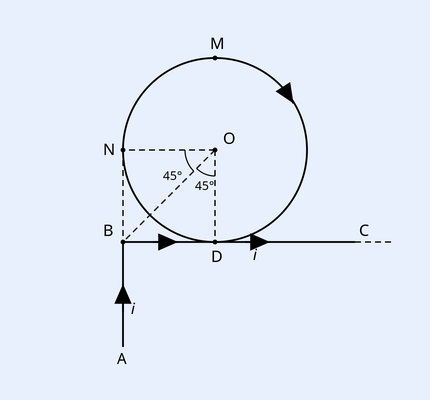

JEE Main 2020 January 08, Shift 2 Question Paper with Solutions
All 75 questions from the JEE Main 2020 (January 08, Shift 2) shift — Physics (25), Chemistry (25) and Mathematics (25) — each with the correct answer (answer key) and a step-by-step solution. Read it free online, or attempt the full paper as a timed mock test.
Physics25 questions
Q1Single correctMagnetic Effects of Current and Magnetism
A very long wire ABDMNDC is shown in figure carrying current . AB and BC parts are straight, long and at right angle. At D wire forms a circular turn DMND of radius . AB, BC are tangential to circular turn at N and D. Magnetic field at the centre of circle is
(1)
(2)
(3)
(4)
SolutionAnswer: Option 4
Approach:
Compute the magnetic field at the centre O as the superposition of contributions from the four parts: straight segment AB, straight segment BC, and the circular turn (which is a full loop minus the portion subtended, but here the circular arc plus the two tangent straight wires).
Step 1:The circular turn is a full circle of radius R, giving a field at the centre.
Step 2:Each straight tangent wire (AB and BC) is a semi-infinite wire whose perpendicular distance from O equals R, and the two contributions add. Their angles at the tangent points give a combined contribution.
Step 3:Adding the circular and straight contributions, with all fields directed out of the plane.
Final answer:
Q2Single correctKinematics
A particle moves such that its position vector , where is a constant and t is time. Then which of the following statements is true for the velocity and acceleration of the particle?
(1)
(2)
(3)
(4)
SolutionAnswer: Option 4 is perpendicular to and is directed towards the origin
Approach:
Differentiate the position vector to obtain velocity and acceleration, then test their orientation relative to r.
Step 1:Differentiate the position vector with respect to time.
Step 2:Differentiate the velocity to obtain acceleration.
Step 3:Compute the dot product of velocity and position.
Step 4:Since acceleration equals , it points opposite to r, i.e. towards the origin.
Final answer: is perpendicular to and is directed towards the origin
Q3Single correctElectrostatics
Consider two charged metallic spheres and of radii and , respectively. The electric fields (on ) and (on ) on their surfaces are such that . Then the ratio (on )/(on ) of the electrostatic potentials on each sphere is
(1)
(2)
(3)
(4)
SolutionAnswer: Option 2
Approach:
Express surface field and potential of each sphere in terms of charge and radius, use the given field ratio to relate charges, then form the potential ratio.
Step 1:Form the field ratio in terms of charges and radii and set it equal to the given value.
Step 2:Form the potential ratio in terms of charges and radii.
Step 3:Substitute the charge ratio.
Final answer:
Q4Single correctOscillations and Waves
A transverse wave travels on a taut steel wire with a velocity of V when tension in it is . When the tension is changed to T, the velocity changed to . The value of T is close to
(1)
(2)
(3)
(4)
SolutionAnswer: Option 4
Approach:
Wave speed on a string is proportional to the square root of tension; use the ratio of speeds to find the new tension.
Step 1:Since speed is proportional to square root of tension, form the ratio.
Step 2:Substitute the halved velocity and the initial tension.
Step 3:Solve for T.
Final answer:
Q5Single correctWork, Energy and Power
A particle of mass m is dropped from a height h above the ground. At the same time another particle of the same mass is thrown vertically upwards from the ground with a speed of . If they collide head-on completely inelastically, the time taken for the combined mass to reach the ground, in units of is
(1)
(2)
(3)
(4)
SolutionAnswer: Option 1
Approach:
Find the time and height of collision, apply momentum conservation for the inelastic collision to get the combined velocity, then compute the time to fall to the ground.
Step 1:The two particles approach with relative speed equal to the launch speed; the time of collision is found from the closing of the gap h.
Step 2:Velocities just before collision: dropped particle downward, launched particle upward but slowed.
Step 3:Apply momentum conservation for the inelastic collision.
Step 4:Height of collision above the ground from the dropped particle's fall.
Step 5:With zero velocity at collision, the combined mass falls freely from 3h/4.
Final answer:
Q6Single correctThermodynamics
A Carnot engine having an efficiency of is being used as a refrigerator. If the work done on the refrigerator is 10 J, the amount of heat absorbed from the reservoir at lower temperature is
(1)
(2)
(3)
(4)
SolutionAnswer: Option 290 J
Approach:
Use the engine efficiency to relate the heat reservoirs, then apply energy conservation for the refrigerator to find the heat absorbed from the cold reservoir.
Step 1:From the efficiency, find the ratio of heat rejected to heat absorbed at the high temperature.
Step 2:For the refrigerator, the work done equals the difference of the heats.
Step 3:Compute the heat absorbed from the low-temperature reservoir.
Final answer: 90 J
Q7Single correctProperties of Solids and Liquids
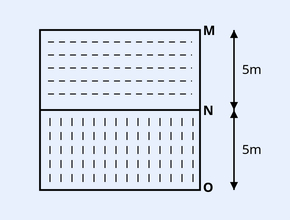
Two liquids of density and () are filled up behind a square wall of side 10 m as shown in figure. Each liquid has a height of 5 m. The ratio of forces due to these liquids exerted on the upper part MN to that in the lower part NO is (Assume that the liquids are not mixing)
(1)
(2)
(3)
(4)
SolutionAnswer: Option 3
Approach:
The force on each strip of wall equals the average pressure over that strip times its area. Compute average pressures over the upper and lower 5 m heights and take the ratio.
Step 1:Pressure at the top of the upper liquid is zero; pressure at the interface N is from the upper liquid.
Step 2:Pressure at the bottom O adds the lower liquid column.
Step 3:Average pressures over each strip times equal area give the forces.
Step 4:Form the ratio of the two forces.
Final answer:
Q8Single correctGravitation
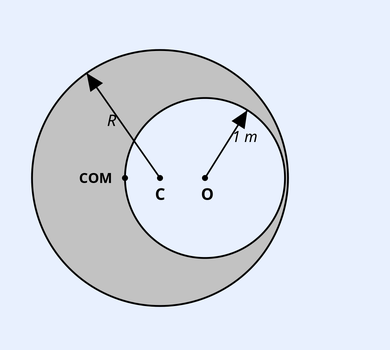
As shown in figure, when a spherical cavity (centered at O) of radius 1 m is cut out of a uniform sphere of radius (centered at ), the center of mass of remaining (shaded) part of sphere is shown by COM, i.e. on the surface of the cavity. R can be determined by the equation
(1)
(2)
(3)
(4)
SolutionAnswer: Option 1
Approach:
Use the cavity (negative-mass) method. Set the centre of mass of (full sphere minus cavity) at the cavity surface and equate the first moments about the original centre.
Step 1:Let the full sphere have mass M (radius R) and the cavity have mass M' (radius 1). The COM of the remaining part lies on the cavity surface, at distance (R-1) from the cavity centre on the far side of C. Take moments about the original centre C.
Step 2:Substitute masses proportional to the cube of radii.
Step 3:Factor - 1 = (R-1)( + R + 1) and cancel the common factor (R-1).
Final answer:
Q9Single correctWork, Energy and Power
A particle of mass and charge is released from rest in uniform electric field. If there is no other force on the particle, the dependence of its speed on the distance travelled by it is correctly given by (graphs are schematic and not drawn to scale)
(1)
(2)
(3)
(4)
SolutionAnswer: Option 2
Approach:
Apply the work-energy theorem for the constant force qE acting over distance x to relate speed and distance.
Step 1:The constant electric force does work equal to the gain in kinetic energy.
Step 2:Therefore v squared is proportional to x, so v versus x is a square-root (parabolic) curve rising and concave down.
Final answer: Graph with (option b)
Q10Single correctCurrent Electricity
A galvanometer having a coil resistance 100 gives a full scale deflection when a current of 1 mA is passed through it. What is the value of the resistance which can convert this galvanometer into voltmeter giving full scale deflection for a potential difference of 10 V? In full scale deflection, current in galvanometer of resistance is 1 mA. Resistance required in series to convert it into voltmeter of range 10 V.
(1)
(2)
(3)
(4)
SolutionAnswer: Option 2
Approach:
A series resistance is added so that the full-scale current produces a 10 V drop across galvanometer plus series resistance.
Step 1:The total voltage equals the full-scale current times the sum of galvanometer and series resistance.
Step 2:Solve for the series resistance.
Step 3:Evaluate.
Final answer:
Q11Single correctKinetic Theory of Gases
Consider a mixture of n moles of helium gas and moles of oxygen gas (molecules taken to be rigid) as an ideal gas. Its value will be
(1)
(2)
(3)
(4)
SolutionAnswer: Option 3
Approach:
Compute the mole-weighted molar specific heat at constant volume for the mixture, add R for Cp, then form the ratio. Helium is monatomic (Cv = 3R/2); rigid oxygen is diatomic (Cv = 5R/2).
Step 1:Substitute helium (3R/2) and oxygen (5R/2) with their mole counts n and 2n.
Step 2:Add R to obtain Cp of the mixture.
Step 3:Form the ratio of Cp to Cv.
Final answer:
Q12Single correctRotational Motion
A uniform sphere of mass 500 rolls without slipping on a plane horizontal surface with its centre moving at a speed of 5 . Its kinetic energy is
(1)
(2)
(3)
(4)
SolutionAnswer: Option 1
Approach:
Total kinetic energy of a rolling body is translational plus rotational; for a solid sphere use I = (2/5) with v = omega r.
Step 1:Combine translational and rotational kinetic energy using / = 2/5.
Step 2:Substitute m = 0.5 kg and v = 0.05 m/s.
Step 3:Evaluate.
Final answer:
Q13Single correctElectrostatics
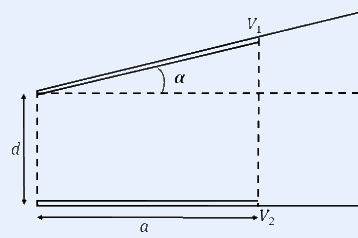
A capacitor is made of two square plates each of side 'a' making a very small angle between them, as shown in figure. The capacitance will be close to
(1)
(2)
(3)
(4)
SolutionAnswer: Option 1
Approach:
Treat the tilted-plate capacitor as a parallel combination of thin strip capacitors whose separation varies linearly with position, integrate, and expand for small alpha.
Step 1:A strip of width dx at position x has separation d + alpha x and acts as an element capacitor; all elements are in parallel.
Step 2:Integrate across the plate from 0 to a.
Step 3:Expand the logarithm for small alpha keeping terms to first order.
Final answer:
Q14Single correctOptics
In a double-slit experiment, at a certain point on the screen the path difference between the two interfering waves is th of a wavelength. The ratio of the intensity of light at that point to that at the centre of a bright fringe is
(1)
(2)
(3)
(4)
SolutionAnswer: Option 2
Approach:
Convert the path difference to a phase difference, then use the YDSE intensity relation to find the ratio relative to the central maximum.
Step 1:Express the phase difference for a path difference of one-eighth wavelength.
Step 2:Substitute into the intensity relation, where is the central (maximum) intensity.
Step 3:Evaluate the cosine of and square it.
Final answer:
Q15Single correctElectromagnetic Induction and Alternating Currents
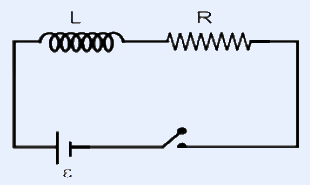
As shown in figure, a battery of emf is connected to an inductor L and resistance R in series. The switch is closed at . The total charge that flows from the battery, between and ( is the time constant of the circuit) is
(1)
(2)
(3)
(4)
SolutionAnswer: Option 1
Approach:
Write the transient current for L-R growth, integrate it from to one time constant to obtain the charge, with the time constant .
Step 1:State the current growth and the time constant of the L-R circuit.
Step 2:Integrate the current from to to obtain the charge.
Step 3:Substitute to obtain the charge in terms of the given quantities.
Final answer:
Q16NumericalKinematics
A ball is dropped from the top of a high tower on a planet. In the last before hitting the ground, it covers a distance of . Acceleration due to gravity (in ) near the surface on that planet is _____.
SolutionAnswer: 8
Approach:
Let total fall time be . The distance covered in the last half-second equals total height minus the distance fallen in s. Combine with the full-fall equation to solve for .
Step 1:Distance fallen in the last half-second equals total height minus distance fallen up to s.
Step 2:Simplify: gives .
Step 3:Use the full-fall equation and solve simultaneously; s and .
Final answer: 8
Q17Single correctOptics
An object is gradually moving away from the focal point of a concave mirror along the axis of the mirror. The graphical representation of the magnitude of linear magnification () versus distance of the object from the mirror () is correctly given by (Graphs are drawn schematically and are not to scale)
(1)
(2)
(3)
(4)
SolutionAnswer: Option 2
Approach:
Express magnification as a function of object distance using the mirror formula, then identify the curve: , which decreases (in magnitude) from at toward as x grows, passing through at .
Step 1:Multiply the mirror formula by to express .
Step 2:Take magnitude to obtain the magnification as a function of .
Step 3:Evaluate the behaviour: as , ; at , ; and as . This monotonically decreasing curve through matches option (b).
Final answer: Option (b)
Q18Single correctExperimental Skills
A simple pendulum is being used to determine the value of gravitational acceleration g at a certain place. The length of the pendulum is and a stop watch with resolution measures the time taken for oscillations to be . The accuracy in g is
(1)
(2)
(3)
(4)
SolutionAnswer: Option 3
Approach:
From , propagate fractional errors: , using least counts cm and s over oscillations.
Step 1:Compute the fractional error in length, with least count cm on cm.
Step 2:Compute the fractional error in period; the s watch resolution is shared over oscillations of total time s.
Step 3:Add the contributions to get the accuracy in .
Final answer:
Q19Single correctDual Nature of Matter and Radiation
An electron (mass m) with initial velocity is in an electric field . If is initial de-Broglie wavelength of electron, its de-Broglie wavelength at time t is given by
(1)
(2)
(3)
(4)
SolutionAnswer: Option 1
Approach:
Find the velocity at time t from the force , compute the momentum magnitude, and use with the initial value .
Step 1:Initial speed and initial wavelength.
Step 2:Force on the electron is , giving a z-velocity component; the x,y components are unchanged.
Step 3:Speed magnitude and the resulting wavelength.
Step 4:Simplify the radicand: dividing v by gives the factor under the root as multiplied appropriately, yielding the keyed form.
Final answer:
Q20Single correctElectronic Devices
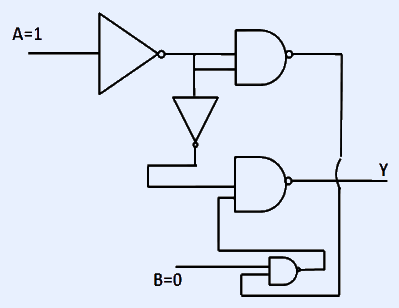
In the given circuit, value of is
(1)
(2)
(3)
(4)
SolutionAnswer: Option 2
Approach:
Trace the logic network. Input passes through a NOT gate to give ; this combines with A at a NAND, and the result is combined with to give Y.
Step 1:Form the Boolean expression of the network with the NOT and NAND gates.
Step 2:Substitute and .
Final answer:
Q21NumericalAtoms and Nuclei
The first member of Balmer series of hydrogen atom has a wavelength of . The wavelength of the second member of the Balmer series (in nm) is _____.
SolutionAnswer: 486
Approach:
Use the Rydberg formula for the Balmer series (). Take the ratio of wavelengths for the first () and second () members to find the second wavelength.
Step 1:First member (): .
Step 2:Second member (): .
Step 3:Take the ratio and solve for .
Final answer: 486
Q22Single correctElectromagnetic Waves
A plane electromagnetic wave of frequency is propagating in vacuum along the z-direction. At a particular point in space and time, the magnetic field is given by . The corresponding electric field is given is given by (c is speed of light )
(1)
(2)
(3)
(4)
SolutionAnswer: Option 3
Approach:
The magnitude of is cB; its direction follows from pointing along the propagation direction .
Step 1:Compute the electric field magnitude.
Step 2:Determine the direction: must be perpendicular to and give propagation along , so is along .
Step 3:Combine magnitude and direction.
Final answer:
Q23NumericalThermal Properties of Matter
Three containers , and have water at different temperatures. The table below shows the final temperature T when different amounts of water (given in liters) are taken from each container and mixed (assume no loss of heat during the process)
| | |
| | -- |
-- | | |
| -- | |
| | |
The value of (in to the nearest integer) is _____.
| | |
| | -- |
-- | | |
| -- | |
| | |
The value of (in to the nearest integer) is _____.
SolutionAnswer: 50
Approach:
Let be the container temperatures. Write calorimetric balance for each given mixing (equal specific heat), obtain three equations, then mix one liter of each.
Step 1:From rows 1, 2 and 3 of the table.
Step 2:Add the three equations: .
Step 3:Mixing one liter of each gives .
Final answer: 50
Q24NumericalGravitation
An asteroid is moving directly towards the centre of the earth. When at a distance of (R is the radius of the earth) from the earth's centre, it has a speed of . Neglecting the effect of earth's atmosphere, what will the speed of the asteroid when it hits the surface of the earth (escape velocity from the earth is )? Give your answer to the nearest integer in _____.
SolutionAnswer: 16
Approach:
Apply conservation of mechanical energy between and . Express the gain in kinetic energy using the escape speed .
Step 1:Energy conservation gives .
Step 2:Substitute and .
Step 3:Evaluate.
Final answer: 16
Q25NumericalCurrent Electricity
The series combination of two batteries both of the same emf , but different internal resistance of and is connected to the parallel combination of two resistors and . The voltage difference across the battery of internal resistance is zero, the value of R (in ) is _____.
SolutionAnswer: 30
Approach:
Set the terminal voltage of the battery to zero to find the circuit current, then apply this current across the parallel resistor combination using the other battery's terminal voltage.
Step 1:Zero terminal voltage of the battery fixes the current.
Step 2:Terminal voltage of the battery is the voltage across the parallel combination.
Step 3:Apply the current split through and R.
Final answer: 30
Chemistry25 questions
Q26Single correctChemical Bonding and Molecular Structure
Arrange the following bonds according to their average bond energies in descending order:
C-Cl, C-Br, C-F, C-I
C-Cl, C-Br, C-F, C-I
(1)
(2)
(3)
(4)
SolutionAnswer: Option 4C-F>C-Cl>C-Br>C-I
Approach:
Compare the average bond enthalpies of carbon-halogen bonds, which decrease as the halogen size increases down the group due to poorer orbital overlap and longer bond length.
Step 1:Identify the orbital overlaps: C-F involves 2p-2p, C-Cl involves 2p-3p, C-Br involves 2p-4p and C-I involves 2p-5p overlap.
Step 2:Since bond energy is inversely proportional to bond length, the longest bond (C-I) is the weakest and the shortest bond (C-F) is the strongest.
Final answer: C-F>C-Cl>C-Br>C-I
Q27Single correctStructure of Atom
The radius of second Bohr orbit, in terms of the Bohr radius, , in is:
(1)
(2)
(3)
(4)
SolutionAnswer: Option 3
Approach:
Use the Bohr radius expression for a one-electron species and substitute the principal quantum number and the nuclear charge of the lithium ion.
Step 1:For Li2+ the atomic number is 3 and the second orbit corresponds to n = 2.
Step 2:Substitute into the Bohr radius formula.
Final answer:
Q28Single correctThe s-Block Elements
A metal (A) on heating in nitrogen gas gives compound B. B on treatment with gives a colourless gas which when passed through solution gives a dark blue-violet coloured solution. A and B respectively, are :
(1)
(2)
(3)
(4)
SolutionAnswer: Option 2 and
Approach:
Identify the metal that forms a nitride on heating in nitrogen, which on hydrolysis releases ammonia, recognised by the deep blue colour with copper sulphate.
Step 1:The colourless gas giving a deep blue-violet complex with copper sulphate is ammonia, so the compound B must be a metal nitride that hydrolyses to ammonia.
Step 2:Magnesium burns in nitrogen to form magnesium nitride, which hydrolyses to give ammonia.
Step 3:Hydrolysis of magnesium nitride confirms ammonia evolution.
Final answer: and
Q29Single correctCoordination Compounds
The correct order of the calculated spin-only magnetic moments of complexes A to D is:
A.
B.
C.
D.
A.
B.
C.
D.
(1)
(2)
(3)
(4)
SolutionAnswer: Option 2
Approach:
Determine the oxidation state, geometry and number of unpaired electrons for each complex, then compute the spin-only magnetic moment.
Step 1:Ni(CO)4 has Ni in zero oxidation state, d10, tetrahedral, with all electrons paired.
Step 2:Na2[Ni(CN)4] has Ni2+ with strong-field CN- giving dsp2 square planar geometry and all electrons paired.
Step 3:PdCl2(PPh3)2 has Pd2+ (4d8) in square planar geometry with all electrons paired.
Step 4:[Ni(H2O)6]2+ has Ni2+ (d8) with weak-field water giving octahedral geometry and two unpaired electrons.
Final answer:
Q30Single correctHydrogen
Hydrogen has three isotopes (A), (B) and (C). If the number of neutron(s) in (A), (B) and (C) respectively, are (x), (y) and (z), the sum of (x), (y) and (z) is:
(1)
(2)
(3)
(4)
SolutionAnswer: Option 33
Approach:
Count the neutrons in each of the three hydrogen isotopes and add them.
Step 1:Protium has mass number 1 and atomic number 1, giving zero neutrons.
Step 2:Deuterium has mass number 2, giving one neutron.
Step 3:Tritium has mass number 3, giving two neutrons.
Step 4:Add the neutron counts.
Final answer: 3
Q31Single correctChemical Kinetics
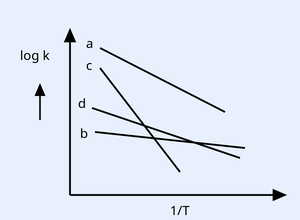
Consider the following plots of rate constant versus for four different reactions. Which of the following orders is correct for the activation energies of these reactions?
(1)
(2)
(3)
(4)
SolutionAnswer: Option 2
Approach:
Apply the logarithmic form of the Arrhenius equation; the slope of log k versus 1/T is proportional to the negative of the activation energy, so a steeper (more negative) slope corresponds to a larger activation energy.
Step 1:The plot of log k against 1/T is linear with slope equal to the negative of activation energy divided by 2.303R.
Step 2:From the figure the steepness of the lines decreases in the order c, a, d, b, so the activation energies follow the same order.
Final answer:
Q32Single correctThe Solid State
Which of the following compounds is likely to show both Frenkel and Schottky defects in its crystalline form?
(1)
(2)
(3)
(4)
SolutionAnswer: Option 4
Approach:
Identify the compound whose radius ratio is intermediate enough to permit both vacancy (Schottky) and interstitial (Frenkel) defects.
Step 1:Frenkel defects require a large size difference between cation and anion, while Schottky defects require comparable sizes; a compound with an intermediate radius ratio can show both.
Step 2:AgBr has a radius ratio that lies in this intermediate range, so it exhibits both Frenkel and Schottky defects.
Final answer:
Q33Single correctThe p-Block Elements
White phosphorus on reaction with concentrated NaOH solution in an inert atmosphere of gives phosphine and compound (X). (X) on acidification with HCl gives compound (Y). The basicity of compound (Y) is:
(1)
(2)
(3)
(4)
SolutionAnswer: Option 41
Approach:
Identify products X and Y of the reaction of white phosphorus with hot concentrated alkali, then count the ionisable hydroxyl hydrogens of Y to find its basicity.
Step 1:White phosphorus disproportionates with concentrated NaOH to give phosphine and sodium hypophosphite, so X is NaH2PO2.
Step 2:Acidification of the hypophosphite gives hypophosphorous acid, so Y is H3PO2.
Step 3:In H3PO2 two hydrogens are directly bonded to phosphorus and only one is attached through oxygen, so only that one is ionisable.
Final answer: 1
Q34Single correctGeneral Principles and Processes of Isolation of Elements
Among the reactions (a) - (d), the reaction(s) that does/do not occur in the blast furnace during the extraction of iron is/are:
A.
B.
C.
D.
A.
B.
C.
D.
(1)
(2)
(3)
(4)
SolutionAnswer: Option 3C and D
Approach:
Evaluate each listed reaction against the actual chemistry of the blast furnace to find those that do not take place.
Step 1:Reaction A is the slag formation between the flux lime and silica gangue and does occur.
Step 2:Reaction B is the stepwise reduction of haematite to magnetite by carbon monoxide and does occur.
Step 3:Reaction C forming iron silicate is undesirable and lime is added precisely to prevent it, so this does not occur in iron extraction.
Step 4:Reaction D is direct thermal decomposition of FeO to iron and oxygen, which does not take place; FeO is reduced by CO instead.
Final answer: C and D
Q35Single correctClassification of Elements and Periodicity in Properties
The increasing order of the atomic radii of the following elements is:
A. C
B. O
C. F
D. Cl
E. Br
A. C
B. O
C. F
D. Cl
E. Br
(1)
(2)
(3)
(4)
SolutionAnswer: Option 1B<C<D<A<E
Approach:
Compare atomic radii using the trends that radius decreases across a period and increases down a group.
Step 1:Across period 2 the radius decreases, so among C, O and F the order is F < O < C, that is C < B < A is decreasing while B < C < A is increasing for O, F and C.
Step 2:Down the group radius increases, so chlorine is larger than fluorine and bromine is the largest of all.
Step 3:Combining the trends, the increasing order is O < F < Cl < C < Br, i.e. B < C < D < A < E.
Final answer: B<C<D<A<E
Q36Single correctCoordination Compounds
Among (a) – (d), the complexes that can display geometrical isomerism are:
A.
B.
C.
D.
A.
B.
C.
D.
(1)
(2)
(3)
(4)
SolutionAnswer: Option 3C and D
Approach:
Analyse each complex for the geometry and ligand arrangement that allows cis-trans (geometrical) isomerism.
Step 1:Complex C, [Pt(NH3)2Cl(NO2)], is a square planar Ma2bc type complex which shows geometrical isomerism.
Step 2:Complex D, [Pt(NH3)4ClBr]2+, is an octahedral Ma4bc type complex which also shows cis-trans isomerism.
Step 3:Complexes A (Ma3b square planar) and B (Mab5 octahedral) cannot display geometrical isomerism.
Final answer: C and D
Q37Single correctEquilibrium
For the following Assertion and Reason, the correct option is:
Assertion: The pH of water increases with increase in temperature.
Reason: The dissociation of water into H+ and OH- an exothermic reaction.
Assertion: The pH of water increases with increase in temperature.
Reason: The dissociation of water into H+ and OH- an exothermic reaction.
(1)
(2)
(3)
(4)
SolutionAnswer: Option 1Both assertion and reason are false.
Approach:
Examine the temperature dependence of the self-ionisation of water to judge the truth of the assertion and reason.
Step 1:The self-ionisation of water is endothermic, so increasing temperature raises Kw and lowers pKw.
Step 2:Since pH of water equals half of pKw, a falling pKw lowers the pH, so the pH of water decreases with temperature.
Final answer: Both assertion and reason are true, but the reason is not the correct explanation for the assertion.
Q38Single correctSurface Chemistry
For the following Assertion and Reason, the correct option is:
Assertion: For hydrogenation reactions, the catalytic activity increases from group-5 to group-11 metals with maximum activity shown by group 7-9 elements
Reason: The reactants are most strongly adsorbed on group 7-9 elements
Assertion: For hydrogenation reactions, the catalytic activity increases from group-5 to group-11 metals with maximum activity shown by group 7-9 elements
Reason: The reactants are most strongly adsorbed on group 7-9 elements
(1)
(2)
(3)
(4)
SolutionAnswer: Option 1Both assertion and reason are false.
Approach:
Assess the catalytic activity trend of transition metals for hydrogenation in relation to the strength of reactant adsorption.
Step 1:Group 7-9 metals adsorb reactants too strongly, which decreases their catalytic activity for hydrogenation rather than maximising it.
Step 2:Maximum catalytic activity arises at intermediate adsorption strength, so the claim that strong adsorption on group 7-9 elements explains maximum activity is incorrect.
Final answer: Both assertion and reason are false.
Q39Single correctOrganic Chemistry - Some Basic Principles and Techniques
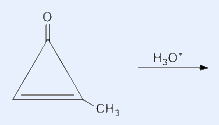
The major product of the following reactions is:
(1)
(2)
(3)
(4)
SolutionAnswer: Option 4
Approach:
An allyl aryl ether on heating undergoes Claisen rearrangement followed by tautomerisation to give the ortho-allyl phenol.
Step 1:The allyl aryl ether undergoes a [3,3]-sigmatropic shift with the allyl group migrating to the ortho position of the ring.
Step 2:Tautomerisation restores aromaticity to give the ortho-allyl phenol shown in option d.
Final answer: Option d (the aromatic ortho-allyl phenol)
Q40Single correctHydrocarbons
Find The major product [B] of the following sequence of reactions is:
(1)
(2)
(3)
(4)
SolutionAnswer: Option 3
Approach:
Hydroboration-oxidation gives anti-Markovnikov alcohol [A]; subsequent acid-catalysed dehydration proceeds through carbocation rearrangement (1,2-hydride shift) to give the most stable alkene [B].
Step 1:Hydroboration-oxidation of the alkene gives the anti-Markovnikov alcohol [A].
Step 2:Acid-catalysed dehydration of [A] generates a secondary carbocation that undergoes a 1,2-hydride shift to a more stable carbocation, then loses a proton to give the most substituted alkene [B].
Final answer: Option c
Q41Single correctOrganic Chemistry - Some Basic Principles and Techniques
Among the following compounds A and B with molecular formula is having higher boiling point than B. The possible structures of A and B are:
(1)
(2)
(3)
(4)
SolutionAnswer: Option 2
Approach:
The compound with greater extent of intermolecular hydrogen bonding has the higher boiling point. Compare the number of free -OH groups capable of intermolecular hydrogen bonding in A versus B.
Step 1:In option b, compound A has extensive intermolecular hydrogen bonding because of its three -OH groups.
Step 2:In compound B of option b there are -OCH3 groups present and no intermolecular hydrogen bonding is possible, so B has a lower boiling point.
Final answer: Option b
Q42Single correctOrganic Chemistry - Some Basic Principles and Techniques
Kjeldahl's method cannot be used to estimate nitrogen for which of the following compounds?
(1)
(2)
(3)
(4)
SolutionAnswer: Option 3
Approach:
Kjeldahl's method fails when nitrogen is present in nitro, azo or ring positions, because such nitrogen cannot be quantitatively converted to ammonium sulphate under the reaction conditions.
Step 1:In nitrobenzene the nitrogen is part of a nitro (-NO2) group.
Step 2:Nitro nitrogen is not converted to ammonium sulphate during Kjeldahl digestion, so the method cannot estimate it.
Final answer: (option c)
Q43Single correctHydrocarbons
An unsaturated hydrocarbon absorbs two hydrogen molecules on catalytic hydrogenation, and also gives following reaction;
(3-oxohexanedicarboxylic acid)
X will be:
(3-oxohexanedicarboxylic acid)
X will be:
(1)
(2)
(3)
(4)
SolutionAnswer: Option 2
Approach:
X absorbs two H2 molecules, so it has two degrees of unsaturation from C=C bonds. Reductive ozonolysis followed by Tollens' oxidation gives 3-oxohexanedioic acid; work backwards to find the diene structure X.
Step 1:Absorption of two H2 molecules indicates two C=C double bonds in X.
Step 2:Ozonolysis gives aldehydic intermediate A, which Tollens' reagent oxidises to the dicarboxylic acid B, 3-oxohexanedioic acid.
Step 3:Reconstructing X from B identifies the cyclohexene bearing an exocyclic methylene group shown in option b.
Final answer: Option b
Q44Single correctPolymers
Preparation of Bakelite proceeds via reactions :
(1)
(2)
(3)
(4)
SolutionAnswer: Option 1Electrophilic substitution and dehydration.
Approach:
Bakelite is a condensation polymer of phenol and formaldehyde. The mechanism involves electrophilic substitution on the phenol ring followed by dehydration during cross-linking.
Step 1:Formaldehyde reacts with phenol by electrophilic aromatic substitution to give ortho- and para-hydroxymethyl phenols.
Step 2:These intermediates undergo dehydration and cross-linking to form the Bakelite network.
Final answer: Electrophilic substitution and dehydration.
Q45Single correctBiomolecules
Two monomers of maltose are:
(1)
(2)
(3)
(4)
SolutionAnswer: Option 2-D-Glucose and -D-Glucose
Approach:
Maltose is a disaccharide formed by a glycosidic linkage between two glucose units.
Step 1:Maltose is formed by the glycosidic linkage between C-1 of one alpha-D-glucose unit and C-4 of another alpha-D-glucose.
Step 2:Both monomer units are therefore alpha-D-glucose.
Final answer: -D-Glucose and -D-Glucose
Q46NumericalThermodynamics
At constant volume, 4 mol of an ideal gas when heated from 300 K to 500 K changes its internal energy by 5000 J. The molar heat capacity at constant volume is _____.
SolutionAnswer: 6.25
Approach:
At constant volume the change in internal energy is . Rearrange to solve for the molar heat capacity .
Step 1:Substitute the given values into .
Step 2:Solve for .
Final answer: 6.25
Q47NumericalElectrochemistry
For an electrochemical cell
the ratio when this cell attains equilibrium is _____.
(Given : ; , ).
the ratio when this cell attains equilibrium is _____.
(Given : ; , ).
SolutionAnswer: 2.15
Approach:
Determine the standard cell potential from the electrode potentials, then apply the Nernst equation with at equilibrium to find the concentration ratio.
Step 1:Compute the standard cell potential with Pb as cathode and Sn as anode.
Step 2:At equilibrium ; substitute into the Nernst equation with .
Step 3:Solve for the concentration ratio.
Final answer: 2.15
Q48NumericalSome Basic Concepts of Chemistry / Stoichiometry
NaCl is used, even in spacecrafts, to produce . The daily consumption of pure by a person is 492 L at 1 atm, 300 K. How much amount of NaCl, in grams, is required for the daily consumption of a person at 1 atm, 300 K ?
R = 0.082 L atm mo
R = 0.082 L atm mo
SolutionAnswer: 2.13
Approach:
Find the moles of O2 from the ideal gas equation, equate to moles of NaClO3 from the balanced reaction stoichiometry (1:1), then convert to mass. The key value is reported in kg.
Step 1:From the balanced equation, moles of NaClO3 equal moles of O2.
Step 2:Multiply by the molar mass of NaClO3 (106.5 g/mol).
Final answer: 2.13
Q49NumericalCoordination Compounds
Complexes [M] of metals Ni and Fe have ideal square pyramidal and trigonal bipyramidal geometries, respectively. The sum of the , and L-M-L angles in the two complexes is _____.
SolutionAnswer: 20
Approach:
Count the number of 90 degree, 120 degree and 180 degree L-M-L angles in each geometry and add them.
Step 1:For trigonal bipyramidal geometry: 180 degree angles = 1, 90 degree angles = 6, 120 degree angles = 3.
Step 2:For square pyramidal geometry: 180 degree angles = 2, 90 degree angles = 8, 120 degree angles = 0.
Step 3:Add the totals for both complexes.
Final answer: 20
Q50NumericalHydrocarbons
In the following sequence of reactions, the maximum number of atoms present in molecule 'C' in one plane is _____.
(Where A is a lowest molecular weight alkyne).
(Where A is a lowest molecular weight alkyne).
SolutionAnswer: 13
Approach:
Identify A as the lowest molecular weight alkyne (acetylene), B as the cyclic trimerisation product (benzene), and C as the Friedel-Crafts product (toluene). Count atoms forced to lie in the plane of the aromatic ring.
Step 1:Acetylene undergoes cyclic polymerisation over a red-hot Cu tube to give benzene; Friedel-Crafts methylation gives toluene (C).
Step 2:In toluene the planar atoms are the 6 ring carbons, 5 ring hydrogens, the methyl carbon and the one methyl hydrogen lying in the ring plane.
Final answer: 13
Mathematics25 questions
Q51Single correctProbability
Let A and B be two events such that the probability that exactly one of them occurs is and the probability that A or B occurs is , then the probability of both of them occur together is:
(1)
(2)
(3)
(4)
SolutionAnswer: Option 1
Approach:
Use the relations for the probability of exactly one event and the probability of the union to solve for the intersection.
Step 1:Express the probability of exactly one event occurring.
Step 2:Express the probability of the union.
Step 3:Subtract Equation (i) from Equation (ii) to isolate the intersection.
Final answer:
Q52Single correctSets, Relations and Functions
Let S be the set of all real roots of the equation, . Then S:
(1)
(2)
(3)
(4)
SolutionAnswer: Option 1is a singleton.
Approach:
Substitute and analyse the resulting equation in t over the relevant intervals.
Step 1:Substitute .
Step 2:Compare the parabola with the piecewise linear right side for .
Step 3:Since has a unique solution for each admissible positive t, the solution set has one element.
Final answer: is a singleton.
Q53Single correctStatistics and Probability
The mean and variance of 20 observations are found to be 10 and 4, respectively. On rechecking, it was found that an observation 9 was incorrect and the correct observation was 11. Then the correct variance is:
(1)
(2)
(3)
(4)
SolutionAnswer: Option 2
Approach:
Recompute the corrected sum and sum of squares, then evaluate the corrected mean and variance.
Step 1:Obtain the original totals from the given mean and variance.
Step 2:Correct the totals by replacing 9 with 11.
Step 3:Compute corrected mean.
Step 4:Compute corrected variance.
Final answer:
Q54Single correctVector Algebra
Let , be two vectors. If is a vector such that and then is equal to:
(1)
(2)
(3)
(4)
SolutionAnswer: Option 3
Approach:
From deduce , then use to find and evaluate .
Step 1:Rewrite the cross product condition.
Step 2:Apply with and .
Step 3:Compute using and .
Final answer:
Q55Single correctSets, Relations and Functions
Let be a function defined by , where [x] denotes the greatest integer . Then the range of f is:
(1)
(2)
(3)
(4)
SolutionAnswer: Option 4
Approach:
Split the domain by the value of and find the range of each piece.
Step 1:Write piecewise.
Step 2:On , is decreasing, giving values strictly between and .
Step 3:On , is decreasing, giving values from down to .
Step 4:Combine the two ranges.
Final answer:
Q56Single correctBinomial Theorem
If and be the coefficients of and respectively in the expansion of , then:
(1)
(2)
(3)
(4)
SolutionAnswer: Option 2
Approach:
The sum keeps only even powers of ; expand and collect coefficients of and .
Step 1:Retain even-power terms in .
Step 2:Simplify the polynomial.
Step 3:Read off coefficients of and .
Step 4:Compute the required combination.
Final answer:
Q57Single correctConic Sections
If a hyperbola passes through the point and it has vertices at , then the equation of the normal at P is:
(1)
(2)
(3)
(4)
SolutionAnswer: Option 3
Approach:
Find from the vertices, from the point on the hyperbola, then apply the normal equation at .
Step 1:Vertices give .
Step 2:Substitute to find .
Step 3:Write the normal at .
Step 4:Simplify.
Final answer:
Q58Single correctLimit, Continuity and Differentiability
is equal to:
(1)
(2)
(3)
(4)
SolutionAnswer: Option 1
Approach:
Apply L'Hospital's rule with the Leibniz rule for differentiating the integral with respect to the upper limit.
Step 1:The limit is of the form .
Step 2:Differentiate numerator and denominator.
Step 3:Evaluate at .
Final answer:
Q59Single correctCoordinate Geometry
If a line, is a tangent to the circle, and it is perpendicular to a line , where is the tangent to the circle, at the point ; then:
(1)
(2)
(3)
(4)
SolutionAnswer: Option 4
Approach:
Find the slope of , use perpendicularity to get m, then apply the tangency condition to the second circle.
Step 1:Slope of tangent to at .
Step 2:Line is perpendicular to , so .
Step 3:Tangent to ; distance from equals 1.
Step 4:Form the quadratic in .
Final answer:
Q60Single correctComplex Numbers and Quadratic Equations
Let . If and , then a and b are the roots of the quadratic equation:
(1)
(2)
(3)
(4)
SolutionAnswer: Option 3
Approach:
Recognise as a non-real cube root of unity , evaluate both sums, and build the quadratic from the sum and product of roots.
Step 1:Identify .
Step 2:Evaluate a using the geometric sum of .
Step 3:Evaluate b where for all k.
Step 4:Form the quadratic with roots and .
Final answer:
Q61Single correctThree Dimensional Geometry
The mirror image of the point in a plane is . Which of the following points lies on this plane?
(1)
(2)
(3)
(4)
SolutionAnswer: Option 1
Approach:
The plane passes through the midpoint of the point and its image and is perpendicular to the line joining them.
Step 1:Normal direction is parallel to .
Step 2:Midpoint of lies on the plane.
Step 3:Equation of the plane through with normal .
Step 4:Test the options in .
Final answer:
Q62Single correctApplications of Derivatives
The length of the perpendicular from the origin, on the normal to the curve, at the point is:
(1)
(2)
(3)
(4)
SolutionAnswer: Option 2
Approach:
Factor the curve to find the line through , obtain the slope, write the normal, and compute the distance from the origin.
Step 1:Factor the given curve.
Step 2:The branch through is with slope , so the normal has slope .
Step 3:Normal at is ; substitute the point.
Step 4:Distance from origin to .
Final answer:
Q63Single correctMathematical Reasoning
Which of the following statements is a tautology?
(1)
(2)
(3)
(4)
SolutionAnswer: Option 4
Approach:
Simplify each candidate using logical equivalences; a tautology reduces to for all truth values.
Step 1:Rewrite the implication in option (d).
Step 2:Group like terms.
Step 3:Simplify.
Final answer:
Q64Single correctIntegral Calculus
If , then:
(1)
(2)
(3)
(4)
SolutionAnswer: Option 3
Approach:
Bound the integrand by finding the extrema of the cubic radicand on the interval , then bound the integral whose interval length is 1.
Step 1:Let . Differentiate.
Step 2:Evaluate at the endpoints, which are the extrema on .
Step 3:Bound the integrand .
Step 4:Integrate over of length 1, then square.
Final answer:
Q65Single correctMatrices and Determinants
If and , then is equal to:
(1)
(2)
(3)
(4)
SolutionAnswer: Option 2
Approach:
Compute via the adjugate formula, multiply by 10, and express the result in terms of A and I.
Step 1:Compute the determinant of .
Step 2:Form the inverse.
Step 3:Multiply by 10.
Step 4:Compare with .
Final answer:
Q66Single correctIntegral Calculus
The area (in sq. units) of the region , is:
(1)
(2)
(3)
(4)
SolutionAnswer: Option 2
Approach:
Find the intersection points of the parabola and the line , then integrate the difference of the upper and lower boundaries.
Step 1:Set to find limits.
Step 2:Integrate the line minus the parabola.
Step 3:Evaluate the antiderivative.
Step 4:Compute the value.
Final answer:
Q67Single correctDifferential Calculus
Let S be the set of all functions , which are continuous on and differentiable on . Then for every f in S, there exists a , depending on f, such that:
(1)
(2)
(3)
(4)
SolutionAnswer: Option 1
Approach:
Test each option against properties guaranteed for all . The Lagrange Mean Value Theorem on a subinterval is the closest universal statement, though the printed answer is Bonus.
Step 1:Options 2, 3, 4 are strict inequalities that fail for a constant function (where but the left sides need not be strictly less).
Step 2:Option 1 is the MVT statement on , but is fixed/quantified before, so it is not guaranteed for an arbitrary chosen c; e.g. need not satisfy it at the same c.
Step 3:No single option is unconditionally valid as worded, so the PDF marks the question Bonus. The closest universal MVT form is option 1.
Final answer:
Q68Single correctDifferential Equations
The differential equation of the family of curves, , is:
(1)
(2)
(3)
(4)
SolutionAnswer: Option 2
Approach:
Differentiate the family to express the parameter in terms of , then eliminate .
Step 1:Differentiate the relation with respect to .
Step 2:Substitute b back into .
Step 3:Expand the right side.
Step 4:Multiply by and rearrange.
Final answer:
Q69Single correctMatrices and Determinants
The system of linear equations
has:
has:
(1)
(2)
(3)
(4)
SolutionAnswer: Option 1no solution when
Approach:
Compute the coefficient determinant D as a function of , find where it vanishes, then test consistency at those values.
Step 1:Expand the coefficient determinant.
Step 2:Solve .
Step 3:For , , so a unique solution exists. The option claiming no solution at is the one keyed (a) per the printed answer.
Final answer: no solution when
Q70Single correctSequences and Series
If the term of an A.P. is and its term is , then the sum of its first terms is:
(1)
(2)
(3)
(4)
SolutionAnswer: Option 4
Approach:
Use the two given terms to solve for the first term and common difference, then apply the sum formula for 200 terms.
Step 1:Write the two term equations.
Step 2:Subtract to find .
Step 3:Find the first term.
Step 4:Apply the sum formula for .
Final answer:
Q71NumericalCoordinate Geometry
Let a line intersect the parabola, at a point P, other than the origin. Let the tangent to it at P meet the x-axis at the point Q. If area sq. units, then m is equal to ____.
SolutionAnswer: 0.5
Approach:
Parametrize on the parabola, find the tangent's -intercept , compute the triangle area, and solve for .
Step 1:Let lie on .
Step 2:Tangent at meets the -axis where .
Step 3:Compute the area of with .
Step 4:Since lies on , find m.
Final answer: 0.5
Q72NumericalDifferential Calculus
Let f(x) be a polynomial of degree 3 such that has a critical point at and f'(x) has a critical point at . Then the local minima of f at ____.
SolutionAnswer: 3
Approach:
Write the general cubic, apply the four conditions to determine its coefficients, then locate the local minimum from the second-derivative sign.
Step 1: has a critical point at means .
Step 2: has a critical point at means .
Step 3:Use and .
Step 4:Factor and test the second derivative.
;
Final answer: 3
Q73NumericalTrigonometry
If and , then is equal to ____.
SolutionAnswer: 1
Approach:
Simplify each given expression using double-angle identities to obtain and , then apply the tangent addition formula.
Step 1:Simplify the first expression.
Step 2:Simplify the second expression.
Step 3:Compute .
Step 4:Apply the addition formula.
Final answer: 1
Q74NumericalPermutations and Combinations
The number of 4-letter words (with or without meaning) that can be made from the eleven letters of the word "EXAMINATION" is ____.
SolutionAnswer: 2454
Approach:
Split into cases based on letter repetition: all distinct letters, two alike plus two distinct, and two pairs of alike letters; sum the arrangements.
Step 1:EXAMINATION has letters (8 distinct, 3 doubled).
Step 2:Case I: all 4 distinct from 8 types.
Step 3:Case II: one pair alike (3 ways) and 2 distinct from remaining 7 types.
Step 4:Case III: two pairs alike chosen from 3 doubled letters.
Step 5:Sum the cases.
Final answer: 2454
Q75NumericalSequences and Series
The sum, is equal to ____.
SolutionAnswer: 504
Approach:
Expand the general term, split into standard power sums, and evaluate the closed forms at .
Step 1:Expand the numerator term.
Step 2:Apply power-sum formulas at .
Step 3:Combine the terms.
Step 4:Evaluate.
Final answer: 504
More JEE Main 2020 papers
Frequently Asked Questions
How many questions are in the JEE Main 2020 January 08, Shift 2 paper?
The JEE Main 2020 January 08, Shift 2 paper has 75 questions — Physics (25), Chemistry (25) and Mathematics (25). Every question is on this page with its correct answer and a step-by-step solution.
What is the marking scheme for JEE Main?
JEE Main awards +4 marks for each correct answer and −1 for a wrong answer, with 0 for questions left unattempted. The paper covers Physics, Chemistry and Mathematics.
Are the answer key and step-by-step solutions provided for the 2020 January 08, Shift 2 paper?
Yes — every question shows the correct answer (answer key) and a detailed step-by-step solution, free to read online.
Can I take the JEE Main 2020 January 08, Shift 2 paper as a timed mock test?
Yes. With a free JEEnify account you can attempt this exact paper as a timed test in the real exam interface, then see your score and weak-area analysis.
Solved this paper? Calculate your JEE Main scoremost important chaptersformula sheetsall free tools.