
Back to JEE Main PYQs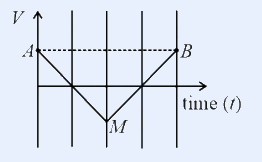
![Aniline + Conc. HNO3 / Conc. H2SO4, 288 K gives [A] para-nitroaniline 51% + [B] meta-nitroaniline 47% + [C] ortho-nitroaniline 2%.](/api/qna-image?path=QnA%2Fb65cda62-f924-480b-b4db-1d3aaa6069d4%2F5ef15551-aed6-4f93-a8d5-a219b7a5d19b%2F9c445320-49ac-47f4-a9ed-07b7f6644a40%2F9c445320-49ac-47f4-a9ed-07b7f6644a40%2Fimages%2FQ37_stem.webp)
JEE Main 2021 February 24, Shift 1 Question Paper with Solutions
All 90 questions from the JEE Main 2021 (February 24, Shift 1) shift — Physics (30), Chemistry (30) and Mathematics (30) — each with the correct answer (answer key) and a step-by-step solution. Read it free online, or attempt the full paper as a timed mock test.
Physics30 questions
Q1Single correctUnits and Measurements
The work done by a gas molecule in an isolated system is given by, , where x is the displacement, k is the Boltzmann constant and T is the temperature. and are constants. Then the dimensions of will be:
(1)
(2)
(3)
(4)
SolutionAnswer: Option 3
Approach:
The exponent must be dimensionless to find the dimensions of , then use to find .
Step 1:
Step 2:
Step 3:
Step 4:
Step 5:
Final answer:
Q2Single correctKinematics
If the velocity-time graph has the shape AMB, what would be the shape of the corresponding acceleration-time graph?
(1)
(2)
(3)
(4)
SolutionAnswer: Option 1Drawn graph: acceleration constant and negative, then constant and positive (a step from a negative level up to a positive level)
Approach:
Acceleration is the slope of the velocity-time graph; read the slope of each straight segment of the AMB graph.
Step 1:
From to the velocity falls linearly, so the slope is constant and negative.
Step 2:
From to the velocity rises linearly, so the slope is constant and positive.
Step 3:
The acceleration-time graph is therefore a negative constant level followed by a positive constant level.
Final answer: Option 1: constant negative acceleration followed by constant positive acceleration
Q3Single correctRotational Motion
Moment of inertia (M.I.) of four bodies, having same mass and radius, are reported as;
M.I. of thin circular ring about its diameter,
M.I. of circular disc about an axis perpendicular to disc and going through the centre,
M.I. of solid cylinder about its axis and
M.I. of solid sphere about its diameter.
Then:
M.I. of thin circular ring about its diameter,
M.I. of circular disc about an axis perpendicular to disc and going through the centre,
M.I. of solid cylinder about its axis and
M.I. of solid sphere about its diameter.
Then:
(1)
(2)
(3)
(4)
SolutionAnswer: Option 3
Approach:
Write each moment of inertia with same and and compare the numerical coefficients.
Step 1:
Ring about a diameter:
Step 2:
Disc about central perpendicular axis:
Step 3:
Solid cylinder about its axis:
Step 4:
Solid sphere about a diameter:
Step 5:
Final answer:
Q4Single correctGravitation
Consider two satellites and with periods of revolution 1hr and 8hr respectively revolving around a planet in circular orbits. The ratio of angular velocity of satellite to the angular velocity of satellite is:
(1)
(2)
(3)
(4)
SolutionAnswer: Option 1
Approach:
Angular velocity is inversely proportional to the period; take the ratio.
Step 1:
Step 2:
Final answer:
Q5Single correctGravitation
Four identical particles of equal masses 1 kg made to move along the circumference of a circle of radius 1 m under the action of their own mutual gravitational attraction. The speed of each particle will be:
(1)
(2)
(3)
(4)
SolutionAnswer: Option 4
Approach:
Four masses at corners of a square inscribed in the circle; the net gravitational force on one mass provides the centripetal force for circular motion.
Step 1:
Side of inscribed square ; diagonal .
Step 2:
Step 3:
Step 4:
Step 5:
Step 6:
Among the given options the matching expression is form (option 4).
Final answer:
Q6Single correctGravitation
Two stars of masses and at a distance rotate about their common centre of mass in free space. The period of revolution is:
(1)
(2)
(3)
(4)
SolutionAnswer: Option 1
Approach:
Gravitational attraction provides the centripetal force; the angular velocity gives the period. Note the option set lists the same two expressions twice; the printed key is 1.
Step 1:
Centre of mass divides d so that mass m orbits at .
Step 2:
Step 3:
Step 4:
Final answer:
Q7Single correctProperties of Solids and Liquids
If Y, K and are the values of Young's modulus, bulk modulus and modulus of rigidity of any material respectively. The correct relation for these parameters is:
(1)
(2)
(3)
(4)
SolutionAnswer: Option 3
Approach:
Start from the standard elastic-moduli relation and rearrange to test each option.
Step 1:
Step 2:
Step 3:
Step 4:
Final answer:
Q8Single correctProperties of Solids and Liquids
Each side of a box made of metal sheet in cubic shape is a at room temperature T, the coefficient of linear expansion of the metal sheet is . The metal sheet is heated uniformly, by a small temperature , so that its new temperature is . Calculate the increase in the volume of the metal box.
(1)
(2)
(3)
(4)
SolutionAnswer: Option 2
Approach:
Volume expansion uses the coefficient of volume expansion for the cube of volume .
Step 1:
Step 2:
Final answer:
Q9Single correctThermodynamics
Match List I with List II.
| List I | List II |
|---|---|
| (a). Isothermal | (i). Pressure constant |
| (b). Isochoric | (ii). Temperature constant |
| (c). Adiabatic | (iii). Volume constant |
| (d). Isobaric | (iv). Heat content is constant |
(1)
(2)
(3)
(4)
SolutionAnswer: Option 1
Approach:
Match each thermodynamic process name to the quantity it holds constant.
Step 1:
Isothermal temperature constant (ii)
Step 2:
Isochoric volume constant (iii)
Step 3:
Adiabatic heat content constant (iv)
Step 4:
Isobaric pressure constant (i)
Final answer:
Q10Single correctThermodynamics
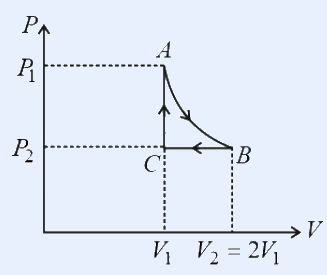
n mole of a perfect gas undergoes a cyclic process ABCA (see figure) consisting of the following processes.
: Isothermal expansion at temperature T so that the volume is doubled from to and pressure changes from to .
: Isobaric compression at pressure to initial volume .
: Isochoric change leading to change of pressure from to .
Total work done in the complete cycle ABCA is:
: Isothermal expansion at temperature T so that the volume is doubled from to and pressure changes from to .
: Isobaric compression at pressure to initial volume .
: Isochoric change leading to change of pressure from to .
Total work done in the complete cycle ABCA is:
(1)
(2)
(3)
(4)
SolutionAnswer: Option 1
Approach:
Sum the work done in the three processes: isothermal A-B, isobaric B-C, and isochoric C-A (zero).
Step 1:
Step 2:
(since , )
Step 3:
(isochoric)
Step 4:
Final answer:
Q11Single correctOscillations and Waves
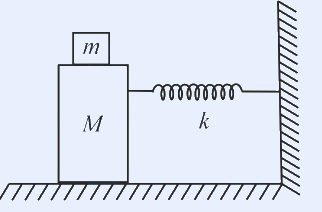
In the given figure, a mass is attached to a horizontal spring which is fixed on one side to a rigid support. The spring constant of the spring is . The mass oscillates on a frictionless surface with time period and amplitude . When the mass is in equilibrium position, as shown in the figure, another mass is gently fixed upon it. The new amplitude of oscillation will be:
(1)
(2)
(3)
(4)
SolutionAnswer: Option 4
Approach:
Mass is added at the equilibrium (mean) position where speed is maximum; momentum is conserved during the gentle placing, then equate maximum kinetic energy to spring potential energy at the new amplitude.
Step 1:
At mean position .
Step 2:
Momentum conserved: .
Step 3:
New angular frequency , and .
Step 4:
Final answer:
Q12Single correctElectrostatics
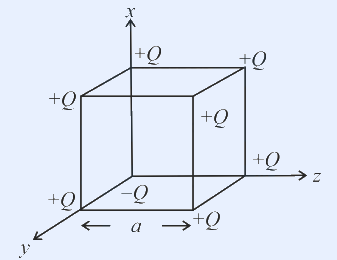
A cube of side has point charges located at each of its vertices except at the origin where the charge is . The electric field at the centre of cube is:
(1)
(2)
(3)
(4)
SolutionAnswer: Option 3
Approach:
Seven charges at the cube corners produce zero net field at the centre by symmetry; the field is due to the difference, treated as the at the origin replacing a , i.e. an effective relative to a full set, giving a field directed from the origin to the centre.
Step 1:
If all eight corners had , the field at the centre would be zero by symmetry.
Step 2:
Replacing the corner at the origin by is equivalent to superposing an extra at that corner.
Step 3:
Distance from corner to centre , so .
Step 4:
, with the unit vector along the body diagonal .
Step 5:
Final answer:
Q13Single correctElectrostatics
Two equal capacitors are first connected in series and then in parallel. The ratio of the equivalent capacities in the two cases will be:
(1)
(2)
(3)
(4)
SolutionAnswer: Option 2
Approach:
Compute series and parallel equivalents of two equal capacitors and take the ratio.
Step 1:
Step 2:
Step 3:
Final answer:
Q14Single correctCurrent Electricity
A current through a wire depends on time as , where A and A . Find the charge crossed through a section of the wire in 15 s.
(1)
(2)
(3)
(4)
SolutionAnswer: Option 2 C
Approach:
Charge is the time integral of current from 0 to 15 s.
Step 1:
Step 2:
Final answer: C
Q15Single correctCurrent Electricity
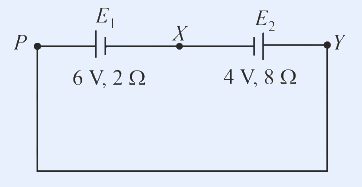
A cell of emf 6 V and internal resistance is connected with another cell of emf 4 V and internal resistance 8 (as shown in the figure). The potential difference across points X and Y is:
(1)
(2)
(3)
(4)
SolutionAnswer: Option 2 V
Approach:
The two cells with the same polarity are in a loop; find the loop current, then the terminal potential difference across X-Y.
Step 1:
Net emf drives current A.
Step 2:
V.
Step 3:
Check via other cell: V.
Final answer: V
Q16Single correctOptics
The focal length is related to the radius of curvature of the spherical convex mirror by:
(1)
(2)
(3)
(4)
SolutionAnswer: Option 2
Approach:
Relate the focal length of a spherical mirror to its radius of curvature using the sign convention for a convex mirror.
Step 1:
Step 2:
Final answer:
Q17Single correctOptics
In a Young's double slit experiment, the width of the one of the slit is three times the other slit. The amplitude of the light coming from a slit is proportional to the slit-width. Find the ratio of the maximum to the minimum intensity in the interference pattern.
(1)
(2)
(3)
(4)
SolutionAnswer: Option 4
Approach:
Express the amplitude ratio from the slit-width ratio, then use the maximum and minimum intensity formula for interference.
Step 1:
Step 2:
Final answer:
Q18Single correctDual Nature of Matter and Radiation
Given below are two statements:
Statement I: Two photons having equal linear momenta have equal wavelengths.
Statement II: If the wavelength of the photon is decreased, then the momentum and energy of a photon will also decrease.
In the light of the above statements, choose the correct answer from the options given below.
Statement I: Two photons having equal linear momenta have equal wavelengths.
Statement II: If the wavelength of the photon is decreased, then the momentum and energy of a photon will also decrease.
In the light of the above statements, choose the correct answer from the options given below.
(1)
(2)
(3)
(4)
SolutionAnswer: Option 3Statement I is true but Statement II is false
Approach:
Use the de Broglie relation between momentum and wavelength and the energy-wavelength relation for a photon to test each statement.
Step 1:
Step 2:
Final answer: Statement I is true but Statement II is false
Q19Single correctAtoms and Nuclei
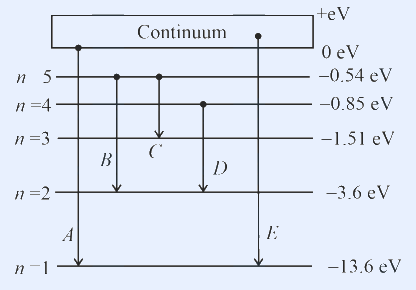
In the given figure, the energy levels of hydrogen atom have been shown along with some transitions marked and .
The transitions and respectively represent
The transitions and respectively represent
(1)
(2)
(3)
(4)
SolutionAnswer: Option 3The series limit of Lyman series, third member of Balmer series and second member of Paschen series.
Approach:
Identify the lower and upper levels of each marked transition and classify it by series and member number.
Step 1:
Step 2:
Step 3:
Final answer: The series limit of Lyman series, third member of Balmer series and second member of Paschen series.
Q20Single correctElectronic Devices
If an emitter current is changed by mA, the collector current changes by mA. The value of will be:
(1)
(2)
(3)
(4)
SolutionAnswer: Option 4
Approach:
Find the change in base current from emitter and collector currents, then compute the current gain beta as the ratio of collector to base current change.
Step 1:
Step 2:
Final answer:
Q21NumericalLaws of Motion
The coefficient of static friction between a wooden block of mass kg and a vertical rough wall is . The magnitude of the horizontal force that should be applied on the block to keep it adhere to the wall will be________N. m
SolutionAnswer: 25
Approach:
Balance the weight of the block by limiting static friction, where the normal reaction equals the applied horizontal force.
Step 1:
Step 2:
Final answer:
Q22NumericalLaws of Motion
An inclined plane is bent in such a way that the vertical cross-section is given by where y is in vertical and x in horizontal direction. If the upper surface of this curved plane is rough with coefficient of friction , the maximum height in cm at which a stationary block will not slip downward is________cm.
SolutionAnswer: 25
Approach:
Find the slope of the curve, apply the no-slip condition that the tangent of the incline angle equals the coefficient of friction, then evaluate the height there.
Step 1:
Step 2:
Step 3:
Final answer:
Q23NumericalWork, Energy and Power
A ball with a speed of m collides with another identical ball at rest. After the collision, the direction of each ball makes an angle of with the original direction. If the ratio of velocities of the balls after the collision is x:y, then what is the value of x?
SolutionAnswer: 1
Approach:
Apply conservation of momentum perpendicular to the original direction for two identical balls deflected by equal angles.
Step 1:
Step 2:
Final answer:
Q24NumericalProperties of Solids and Liquids
A hydraulic press can lift kg when a mass m is placed on the smaller piston. It can lift ____ kg when the diameter of the larger piston is increased by times and that of the smaller piston is decreased by times keeping the same mass m on the smaller piston.
SolutionAnswer: 25600
Approach:
Use Pascal's law equating pressure on both pistons, then scale the areas with the changed diameters to find the new liftable mass.
Step 1:
Step 2:
Step 3:
Final answer:
Q25NumericalElectromagnetic Induction and Alternating Currents
A common transistor radio set requires V D.C. for its operation. The D.C. source is constructed by using a transformer and a rectifier circuit, which are operated at V A.C. on standard domestic A.C. supply. The number of turns of secondary coil are , then the number of turns of primary are________.
SolutionAnswer: 440
Approach:
Apply the transformer turns ratio between primary and secondary voltages and the given secondary turns.
Step 1:
Step 2:
Final answer:
Q26NumericalElectromagnetic Induction and Alternating Currents
A resonance circuit having inductance and resistance H and respectively oscillates at MHz frequency. The value of quality factor of this resonator is________.
SolutionAnswer: 2000
Approach:
Compute the quality factor from the inductive reactance at resonance divided by the resistance.
Step 1:
Step 2:
Final answer:
Q27NumericalElectromagnetic Waves
An electromagnetic wave of frequency 5GHz, is travelling in a medium whose relative electric permittivity and relative magnetic permeability both are . Its velocity in this medium is ____ m .
SolutionAnswer: 15
Approach:
Find the wave speed in the medium by dividing the speed of light by the square root of the product of relative permittivity and relative permeability.
Step 1:
Step 2:
Final answer:
Q28NumericalOptics
An unpolarized light beam is incident on the polarizer of a polarization experiment and the intensity of light beam emerging from the analyzer is measured as 100 Lumens. Now, if the analyzer is rotated around the horizontal axis (direction of light) by in clockwise direction, the intensity of emerging light will be________Lumens.
SolutionAnswer: 75
Approach:
Apply Malus's law to the analyzer intensity for a rotation of the analyzer by the given angle.
Step 1:
Step 2:
Final answer:
Q29NumericalCurrent Electricity
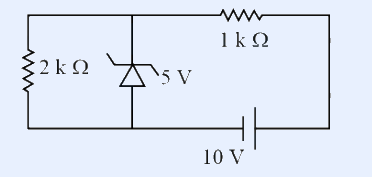
In connection with the circuit drawn below, the value of current flowing through k resistor is________ A.
SolutionAnswer: 25
Approach:
The Zener diode in breakdown clamps the voltage across the parallel branch, fixing the voltage across the 2 k-ohm resistor, then apply Ohm's law.
Step 1:
Step 2:
Final answer:
Q30NumericalElectromagnetic Waves
An audio signal amplitude modulates a carrier . The value of percent modulation is
SolutionAnswer: 25
Approach:
Compute the modulation index as the ratio of the modulating signal amplitude to the carrier amplitude, then express it as a percentage.
Step 1:
Step 2:
Final answer:
Chemistry30 questions
Q31Single correctClassification of Elements and Periodicity in Properties
Consider the elements Mg, Al, S, P and Si, the correct increasing order of their first ionisation enthalpy is:
(1)
(2)
(3)
(4)
SolutionAnswer: Option 1
Approach:
Order the first ionisation enthalpies of the third-period elements, accounting for the dips caused by stable filled and half-filled subshells.
Step 1:
Across period 3 the general trend rises: , modified by exceptions.
Step 2:
Removing the singly-occupied electron of Al is easier than removing a paired electron of Mg, so .
Step 3:
The half-filled of P is extra stable, so despite S having higher nuclear charge.
Final answer:
Q32Single correctChemical Bonding and Molecular Structure
Which of the following are isostructural pairs?
A. and
B. and
C. and
D. and
A. and
B. and
C. and
D. and
(1)
(2)
(3)
(4)
SolutionAnswer: Option 3
Approach:
Determine the geometry of each species in every pair and pick the pairs with identical shapes.
Step 1:
and are both tetrahedral (steric number 4, no lone pair) — isostructural.
Step 2:
and are both tetrahedral — isostructural.
Step 3:
is pyramidal (one lone pair) while is trigonal planar — not isostructural.
Step 4:
is trigonal planar while is T-shaped (two lone pairs) — not isostructural.
Final answer:
Q33Single correctRedox Reactions and Electrochemistry
(A)
(B)
Choose the correct option.
(B)
Choose the correct option.
(1)
(2)
(3)
(4)
SolutionAnswer: Option 4 acts as reducing agent in equations ( A ) and ( B ).
Approach:
Track the oxidation state of oxygen in H2O2 in each reaction; oxidation of peroxide oxygen to O2 means H2O2 acts as a reducing agent.
Step 1:
In (A) the peroxide oxygen is oxidised to while is reduced to .
Step 2:
In (B) the peroxide oxygen is again oxidised to while is reduced to .
Final answer: acts as reducing agent in equations ( A ) and ( B ).
Q34Single correctp-Block Elements
was leached with alkali to get X. The solution of X on passing of gas Y, forms Z. X, Y and Z respectively are
(1)
(2)
(3)
(4)
SolutionAnswer: Option 4, , ,
Approach:
Apply the Bayer process steps for purification of bauxite: alkali leaching, carbon dioxide neutralisation, and calcination.
Step 1:
Leaching with hot NaOH gives soluble sodium aluminate (written ), so X is sodium aluminate.
Step 2:
Passing (Y) through the aluminate solution precipitates hydrated alumina/aluminium hydroxide.
Step 3:
Calcination of the precipitate yields hydrated alumina (Z).
Final answer: , , ,
Q35Single correctOrganic Compounds Containing Oxygen
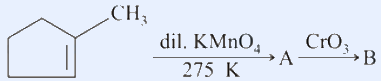
Identify products A and B.
(1)
(2)
(3)
(4)
SolutionAnswer: Option 3
Approach:
Cold dilute KMnO4 performs syn-dihydroxylation of the alkene; CrO3 then oxidises only the secondary hydroxyl to a ketone, leaving the tertiary hydroxyl intact.
Step 1:
1-methylcyclopentene undergoes syn-hydroxylation across the C=C with cold dilute at 275 K, giving A = 1-methylcyclopentane-1,2-diol (one tertiary and one secondary OH).
Step 2:
oxidises the secondary OH to a carbonyl but cannot oxidise the tertiary OH, giving B = 2-hydroxy-2-methylcyclopentan-1-one.
Final answer:
Q36Single correctOrganic Compounds Containing Oxygen
Which of the following compound gives pink colour on reaction with phthalic anhydride in conc. followed by treatment with NaOH?
(1)
(2)
(3)
(4)
SolutionAnswer: Option 1
Approach:
The phthalein test (phthalic anhydride + conc. H2SO4, then NaOH) gives a pink phenolphthalein-type dye only with a phenol bearing free ortho/para positions; identify the mono-hydroxy phenol option.
Step 1:
The phthalein (phenolphthalein-forming) reaction requires a phenol with a reactive para position to condense with phthalic anhydride.
Step 2:
The structure that is a mono-substituted phenol with a free para position (the ortho-propyl phenol of option 1) forms the phthalein and turns pink with NaOH.
Final answer:
Q37Single correctHydrocarbons
In the following reaction, the reason why meta-nitro product also formed is:
(1)
(2)
(3)
(4)
SolutionAnswer: Option 1
Approach:
Explain why nitration of aniline in strongly acidic medium yields a significant meta product by considering protonation of the amino group.
Step 1:
In the strongly acidic nitrating mixture, the basic group is protonated to the anilinium ion .
Step 2:
The positively charged is a deactivating, meta-directing group, so a substantial meta-nitro product (about 47%) is obtained alongside the ortho and para products from the unprotonated aniline.
Final answer:
Q38Single correctp-Block Elements
The gas released during anaerobic degradation of vegetation may lead to:
(1)
(2)
(3)
(4)
SolutionAnswer: Option 3
Approach:
Identify the gas released by anaerobic decay of vegetation and its environmental consequences.
Step 1:
Anaerobic degradation of vegetation (marsh/biogas conditions) releases methane .
Step 2:
Methane is a potent greenhouse gas, contributing to global warming, and the listed effect set 'Global warming and cancer' is the intended consequence.
Final answer:
Q39Single correctSome Basic Concepts in Chemistry
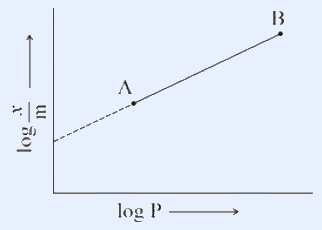
In Freundlich adsorption isotherm, slope of AB line is:
(1)
(2)
(3)
(4)
SolutionAnswer: Option 1 with to
Approach:
Linearise the Freundlich isotherm by taking logarithms and read off the slope and its allowed range.
Step 1:
Taking logarithm: , a straight line of versus .
Step 2:
The slope of this line AB equals , and for physical adsorption lies between 0 and 1.
Final answer: with to
Q40Single correctd- and f-Block Elements
Which of the following ore is concentrated using group 1 cyanide salt?
(1)
(2)
(3)
(4)
SolutionAnswer: Option 4
Approach:
Identify which sulphide ore is selectively concentrated in froth flotation using NaCN (a group 1 cyanide) as a depressant.
Step 1:
In froth flotation of a mixed galena-sphalerite ore, NaCN (sodium cyanide, group 1 cyanide) is added as a depressant to selectively suppress the zinc sulphide.
Step 2:
Sphalerite is , the sulphide ore whose concentration involves the group 1 cyanide salt.
Final answer:
Q41Single correctd- and f-Block Elements
The major components in "Gun Metal" are:
(1)
(2)
(3)
(4)
SolutionAnswer: Option 1
Approach:
Recall the standard composition of the alloy gun metal.
Step 1:
Gun metal is a type of bronze, an alloy of copper with tin and zinc.
Final answer:
Q42Single correctd- and f-Block Elements
The electrode potential of of 3 d-series elements shows positive value for?
(1)
(2)
(3)
(4)
SolutionAnswer: Option 4
Approach:
Compare standard reduction potentials of M2+/M for the 3d-series; the only positive value belongs to copper.
Step 1:
For most 3d metals is negative because the metals are more reactive than hydrogen.
Step 2:
Copper has , the only positive standard electrode potential in the series, due to its high sublimation and ionisation energies outweighing the hydration energy.
Final answer:
Q43Single correctOrganic Compounds Containing Halogens
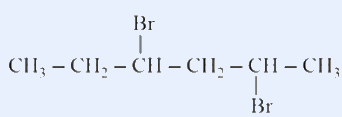
The product formed in the first step of the reaction of the following compound with excess Mg / (Et ) is:
(1)
(2)
(3)
(4)
SolutionAnswer: Option 1
Approach:
Excess Mg in dry ether inserts into each carbon-bromine bond; the first-step product is the corresponding di-Grignard reagent.
Step 1:
Each bond of the dibromide reacts with Mg in ether to form a carbon-magnesium bond.
Step 2:
With excess Mg both bromine sites convert, giving the di-Grignard .
Final answer:
Q44Single correctHydrocarbons
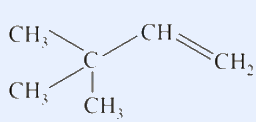
What is the major product formed by HI on reaction with the following compound?
(1)
(2)
(3)
(4)
SolutionAnswer: Option 22-iodo-2,3-dimethylbutane
Approach:
Apply Markovnikov addition of HI to the alkene, forming a secondary carbocation that rearranges by a 1,2-methyl shift to a more stable tertiary carbocation before iodide capture.
Step 1:
adds to the terminal of , giving the secondary cation .
Step 2:
A 1,2-methyl shift from the adjacent quaternary carbon converts it to the tertiary cation .
Step 3:
adds to the tertiary carbon, giving = 2-iodo-2,3-dimethylbutane.
Final answer: (2-iodo-2,3-dimethylbutane)
Q45Single correctOrganic Compounds Containing Oxygen
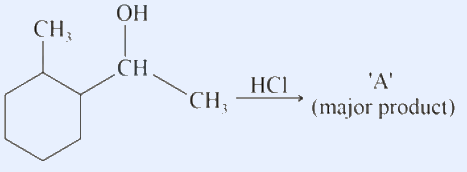
What is the final product (major) 'A' in the given reaction?
Major product among the following is?
Major product among the following is?
(1)
(2)
(3)
(4)
SolutionAnswer: Option 1
Approach:
Protonation of the secondary alcohol and loss of water gives a secondary carbocation that rearranges by a 1,2-hydride shift to a tertiary ring carbocation; chloride capture gives the tertiary chloride.
Step 1:
HCl protonates the -OH of the exocyclic group; loss of water gives a secondary carbocation on the exocyclic carbon.
Step 2:
A 1,2-hydride shift moves the positive charge onto the ring carbon, which is bonded to two ring carbons and the resulting ethyl group, forming a tertiary carbocation.
Step 3:
adds to the tertiary ring carbon, giving 1-chloro-1-ethyl-2-methylcyclohexane.
Final answer:
Q46Single correctOrganic Compounds Containing Oxygen
Which of the following reagent is used for the following reaction?
(1)
(2)
(3)
(4)
SolutionAnswer: Option 3Molybdenum oxide
Approach:
Identify the catalyst for selective oxidation of a terminal carbon of propane to the corresponding aldehyde.
Step 1:
Step 2:
Molybdenum oxide acts as the catalyst for partial oxidation of an alkane to an aldehyde
Final answer: Molybdenum oxide
Q47Single correctOrganic Compounds Containing Nitrogen
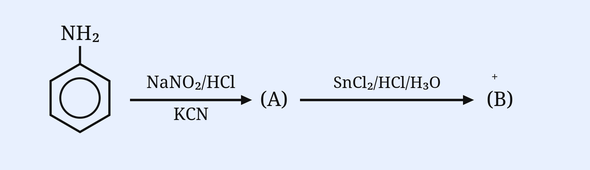
A and B in the following reactions are:
(1)
(2)
(3)
(4)
SolutionAnswer: Option 4 benzonitrile; benzaldehyde
Approach:
Carry the aniline through diazotisation, Sandmeyer-type cyanation, then Stephen reduction to identify A and B.
Step 1:
Aniline with forms benzenediazonium chloride, which with KCN gives benzonitrile (A)
Step 2:
Benzonitrile with followed by (Stephen reduction) gives benzaldehyde (B)
Final answer: benzonitrile; benzaldehyde
Q48Single correctSome Basic Principles of Organic Chemistry
Match List I with List II.
| List I (Monomer Unit) | List II (Polymer) |
|---|---|
| (a). Caprolactum | (i). Natural rubber |
| (b). - Chloro- - butadiene | (ii). Buna-N |
| (c). Isoprene | (iii). Nylon 6 |
| (d). Acrylonitrile | (iv). Neoprene |
(1)
(2)
(3)
(4)
SolutionAnswer: Option 1a iii, b iv, c i, d ii
Approach:
Match each monomer to the polymer it forms.
Step 1:
Caprolactum gives Nylon 6 (a iii)
Step 2:
2-Chloro-1,3-butadiene (chloroprene) gives Neoprene (b iv)
Step 3:
Isoprene is the monomer of Natural rubber (c i)
Step 4:
Acrylonitrile (with butadiene) gives Buna-N (d ii)
Final answer: a iii, b iv, c i, d ii
Q49Single correctd- and f-Block Elements
Given below are two statements:
Statement I: Colourless cupric metaborate is reduced to cuprous metaborate in a luminous flame.
Statement II: Cuprous metaborate is obtained by heating boric anhydride and copper sulphate in a non-luminous flame.
In the light of the above statements, choose the most appropriate answer from the options given below.
Statement I: Colourless cupric metaborate is reduced to cuprous metaborate in a luminous flame.
Statement II: Cuprous metaborate is obtained by heating boric anhydride and copper sulphate in a non-luminous flame.
In the light of the above statements, choose the most appropriate answer from the options given below.
(1)
(2)
(3)
(4)
SolutionAnswer: Option 2Both Statement I and Statement II are false
Approach:
Evaluate the borax bead test conditions for cupric and cuprous metaborate.
Step 1:
Blue cupric metaborate is reduced to colourless (or red) cuprous metaborate in a reducing (luminous) flame; the statement reverses the colour, so Statement I is false
Step 2:
Cuprous metaborate forms in the reducing luminous flame, not in the non-luminous (oxidising) flame, so Statement II is false
Final answer: Both Statement I and Statement II are false
Q50Single correctBiomolecules
Out of the following, which type of interaction is responsible for the stabilisation of - helix structure of proteins?
(1)
(2)
(3)
(4)
SolutionAnswer: Option 3Hydrogen bonding
Approach:
Recall the bonding that holds the secondary structure of proteins.
Step 1:
The -helix is held by intramolecular hydrogen bonds between the C=O of one residue and the N-H of another
Final answer: Hydrogen bonding
Q51NumericalSome Basic Concepts in Chemistry
g of compound AM .W . was used to make mL of its aqueous solution. The molarity of the solution in M is . The value of x is_____ (Rounded off to the nearest integer)
SolutionAnswer: 2
Approach:
Find moles of solute, then divide by the volume in litres to obtain molarity.
Step 1:
Step 2:
Final answer: 2
Q52NumericalAtomic Structure
A proton and a nucleus are accelerated by the same potential. If and denote the de Broglie wavelengths of and proton respectively, then the value of is . The value of x is _____ (Rounded off to the nearest integer) [Mass of mass of proton]
SolutionAnswer: 2
Approach:
Use the de Broglie wavelength for a charged particle accelerated through a potential and take the ratio.
Step 1:
for the same V
Step 2:
Step 3:
Final answer: 2
Q53NumericalEquilibrium
For the reaction , the value of the equilibrium constant at K and atm is equal to . The value of for the reaction at K and atm in is , where x is (Rounded off to the nearest integer) and
SolutionAnswer: 1380
Approach:
Apply the Gibbs free energy relation with the equilibrium constant and express the result as a multiple of R.
Step 1:
Step 2:
Final answer: 1380
Q54NumericalCoordination Compounds
The stepwise formation of is given below:
The value of stability constants and are and respectively. The overall equilibrium constants for dissociation of is . The value of x is _____ (Rounded off to the nearest integer)
The value of stability constants and are and respectively. The overall equilibrium constants for dissociation of is . The value of x is _____ (Rounded off to the nearest integer)
SolutionAnswer: 1
Approach:
Multiply the stepwise stability constants for the overall formation, then invert for the dissociation constant.
Step 1:
Step 2:
Step 3:
Final answer: 1
Q55NumericalEquilibrium
At K and atm pressure, there are equal number of molecules and Cl atoms in the reaction mixture. The value of for the reaction under the above conditions is . The value of x is _____ (Rounded off to the nearest integer)
SolutionAnswer: 5
Approach:
With equal numbers of Cl2 and Cl, assign equal partial pressures and compute Kp.
Step 1:
Equal numbers give equal mole fractions, so at atm total
Step 2:
Final answer: 5
Q56NumericalRedox Reactions and Electrochemistry
The reaction of sulphur in alkaline medium is given below:
The values of 'a' is _____ (Integer answer)
The values of 'a' is _____ (Integer answer)
SolutionAnswer: 12
Approach:
Balance the disproportionation of sulphur in alkaline medium for atoms and charge.
Step 1:
Step 2:
S: ; O: ; H: ; charge:
Final answer: 12
Q57Numericalp-Block Elements
Number of amphoteric compounds among the following is
(A) BeO
(B) BaO
(C) BeO
(D) Sr O
(A) BeO
(B) BaO
(C) BeO
(D) Sr O
SolutionAnswer: 2
Approach:
Classify each compound as amphoteric or basic based on beryllium versus heavier alkaline earth metals.
Step 1:
BeO is amphoteric; is amphoteric
Step 2:
BaO and are basic
Final answer: 2
Q58NumericalSome Basic Concepts in Chemistry
The coordination number of an atom in a body-centered cubic structure is_____ [Assume that the lattice is made up of atoms.]
SolutionAnswer: 8
Approach:
Recall the number of nearest neighbours for the central atom in a body-centred cubic cell.
Step 1:
The central atom in a BCC unit cell touches the eight corner atoms
Final answer: 8
Q59NumericalSolutions
When g of is added to mL of water, its freezing point drops by C. The dissociation constant of is . The value of x is off to the nearest integer)
SolutionAnswer: 36
Approach:
Use the freezing point depression to find the van't Hoff factor and degree of dissociation, then compute the dissociation constant.
Step 1:
Step 2:
Step 3:
Step 4:
Final answer: 36
Q60NumericalChemical Kinetics
Gaseous cyclobutene isomerizes to butadiene in a first order process which has a 'K' value of at C. The time in minutes it takes for the isomerization to proceed to completion at this temperature is_____. (Rounded off to the nearest integer)
SolutionAnswer: 26
Approach:
Apply the first order integrated rate law for 40% completion and convert seconds to minutes.
Step 1:
Step 2:
Step 3:
Final answer: 26
Mathematics30 questions
Q61Single correctComplex Numbers and Quadratic Equations
Let p and q be two positive numbers such that and . Then p and q are roots of the equation:
(1)
(2)
(3)
(4)
SolutionAnswer: Option 4
Approach:
Form the quadratic with sum of roots and product , then find from the given symmetric relation.
Step 1:
Step 2:
Step 3:
Step 4:
Final answer:
Q62Single correctPermutations and Combinations
A scientific committee is to be formed from 6 Indians and 8 foreigners, which includes at least 2 Indians and double the number of foreigners as Indians. Then the number of ways, the committee can be formed, is:
(1)
(2)
(3)
(4)
SolutionAnswer: Option 2
Approach:
With I Indians the foreigners must be , with ; enumerate feasible cases and sum the products of combinations.
Step 1:
Step 2:
Step 3:
Step 4:
Final answer:
Q63Single correctSequence and Series
If satisfies the equation , then the value of , where , is equal to
(1)
(2)
(3)
(4)
SolutionAnswer: Option 2
Approach:
Sum the infinite geometric series of cosines to get , reduce the exponential to , solve the quadratic for t and evaluate the trigonometric expression.
Step 1:
Step 2:
Step 3:
Step 4:
Step 5:
Final answer:
Q64Single correctCo-ordinate Geometry
A man is walking on a straight line. The arithmetic mean of the reciprocals of the intercepts of this line on the coordinate axes is . Three stones A,B and C are placed at the points and respectively. Then which of these stones is / are on the path of the man?
(1)
(2)
(3)
(4)
SolutionAnswer: Option 3 only
Approach:
Use the intercept form of the line with the given mean condition to find the fixed point through which every such line passes, then test the three points.
Step 1:
Step 2:
Step 3:
Point lies on every such line; and do not
Final answer: only
Q65Single correctBinomial Theorem and its Simple Applications
The value of is equal to
(1)
(2)
(3)
(4)
SolutionAnswer: Option 4
Approach:
Evaluate the first alternating weighted sum via the identity , then evaluate the partial sum of odd binomial coefficients of .
Step 1:
Step 2:
Step 3:
Step 4:
Final answer:
Q66Single correctCo-ordinate Geometry
The locus of the mid-point of the line segment joining the focus of the parabola to a moving point of the parabola, is another parabola whose directrix is:
(1)
(2)
(3)
(4)
SolutionAnswer: Option 2
Approach:
Parametrize the moving point, take the midpoint with the focus , eliminate the parameter to get the locus parabola and read off its directrix.
Step 1:
Step 2:
Step 3:
Final answer:
Q67Single correctSets, Relations and Functions
The statement among the following that is a tautology is:
(1)
(2)
(3)
(4)
SolutionAnswer: Option 4
Approach:
Simplify each compound statement and identify which is true for all truth values of and .
Step 1:
Step 2:
Step 3:
Step 4:
Final answer:
Q68Single correctTrigonometry
Two vertical poles are m apart and the height of one is three times that of the other. If from the middle point of the line joining their feet, an observer finds the angles of elevation of their tops to be complementary, then the height of the shorter pole (in meters) is:
(1)
(2)
(3)
(4)
SolutionAnswer: Option 4
Approach:
Take the shorter height and taller ; with the observer m from each foot, set the two elevation angles complementary so their tangents are reciprocals.
Step 1:
Step 2:
Step 3:
Final answer:
Q69Single correctMatrices and Determinants
The system of linear equations
is inconsistent if :
is inconsistent if :
(1)
(2)
(3)
(4)
SolutionAnswer: Option 1
Approach:
Set the coefficient determinant to zero to find , then determine for which the reduced equations conflict.
Step 1:
Step 2:
Reduce: and
Step 3:
From eq.1 and :
Step 4:
gives consistency; inconsistent when
Final answer:
Q70Single correctSets, Relations and Functions
Let be defined as and be defined as . Then the composition function f(g(x)) is:
(1)
(2)
(3)
(4)
SolutionAnswer: Option 2one-one but not onto
Approach:
Compute the composition explicitly and analyze injectivity and surjectivity of the resulting rational function on its domain.
Step 1:
Step 2:
is strictly monotonic on
Step 3:
value is never attained
Final answer: one-one but not onto
Q71Single correctLimit, Continuity and Differentiability
If is a function defined by , where denotes the greatest integer function, then f is:
(1)
(2)
(3)
(4)
SolutionAnswer: Option 4continuous for every real
Approach:
Simplify the cosine factor, then examine the product of the greatest-integer factor and the trigonometric factor at integers and elsewhere.
Step 1:
Step 2:
At any integer n: and is bounded near n
Step 3:
At non-integers is locally constant and is continuous
Final answer: continuous for every real
Q72Single correctLimit, Continuity and Differentiability
The function :
(1)
(2)
(3)
(4)
SolutionAnswer: Option 1increases in
Approach:
Differentiate, factor the derivative, and determine the sign on each interval.
Step 1:
Step 2:
Step 3:
For : and , so
Final answer: increases in
Q73Single correctCo-ordinate Geometry
If the tangent to the curve at the point meets the curve again at Q, then the ordinate of the point which divides PQ internally in the ratio is:
(1)
(2)
(3)
(4)
SolutionAnswer: Option 2
Approach:
Find where the tangent at re-intersects the cubic to locate , then apply the section formula for ratio .
Step 1:
Step 2:
ordinate
Final answer:
Q74Single correctIntegral Calculus
If , where c is a constant of integration, then the ordered pair a,b is equal to:
(1)
(2)
(3)
(4)
SolutionAnswer: Option 4
Approach:
Substitute so that the numerator becomes du and the radicand becomes .
Step 1:
Step 2:
Step 3:
Final answer:
Q75Single correctIntegral Calculus
is equal to:
(1)
(2)
(3)
(4)
SolutionAnswer: Option 2
Approach:
Approximate near (or apply Leibniz differentiation) to evaluate the indeterminate form.
Step 1:
Step 2:
Final answer:
Q76Single correctIntegral Calculus
The area (in sq. units) of the part of the circle , which is outside the parabola , is equal to
(1)
(2)
(3)
(4)
SolutionAnswer: Option 3
Approach:
Find the intersection of the circle and parabola, then subtract the area enclosed by the parabola inside the circle from the circle's total area.
Step 1:
Step 2:
Step 3:
Final answer:
Q77Single correctDifferential Equations
The population at time t of a certain species follows the differential equation . If , then the time at which population becomes zero is:
(1)
(2)
(3)
(4)
SolutionAnswer: Option 2
Approach:
Separate variables in the linear differential equation, apply the initial condition, then set the population to zero.
Step 1:
Step 2:
Step 3:
Final answer:
Q78Single correctThree Dimensional Geometry
The distance of the point from the point of intersection of the line and the plane is:
(1)
(2)
(3)
(4)
SolutionAnswer: Option 3
Approach:
Parametrize the line, substitute into the plane equation to locate the intersection point, then apply the distance formula.
Step 1:
Step 2:
Final answer:
Q79Single correctThree Dimensional Geometry
The equation of the plane passing through the point and perpendicular to the planes and , is
(1)
(2)
(3)
(4)
SolutionAnswer: Option 1
Approach:
The required normal is the cross product of the normals of the two given planes; use it with the given point.
Step 1:
Step 2:
Step 3:
Final answer:
Q80Single correctStatistics and Probability
An ordinary dice is rolled for a certain number of times. If the probability of getting an odd number 2 times is equal to the probability of getting an even number 3 times, then the probability of getting an odd number for odd number of times is:
(1)
(2)
(3)
(4)
SolutionAnswer: Option 4
Approach:
Use the binomial model with success probability one-half to find the number of rolls, then sum the odd-count probabilities.
Step 1:
Step 2:
Final answer:
Q81NumericalComplex Numbers and Quadratic Equations
If the least and the largest real values of , for which the equation and has a solution, are p and q respectively; then is equal to______.
SolutionAnswer: 10
Approach:
Write , separate real and imaginary parts to fix y, then determine the range of for which a real x exists.
Step 1:
Imaginary part:
Step 2:
, requiring real x for the extreme values p and q
Step 3:
Final answer:
Q82NumericalCo-ordinate Geometry
If one of the diameters of the circle is a chord of another circle C, whose center is at , then its radius is______.
SolutionAnswer: 3
Approach:
The midpoint of the chord is the center of the smaller circle; combine the center distance with the half-chord using the perpendicular-from-center relation.
Step 1:
Step 2:
Final answer:
Q83NumericalSequence and Series
Let and for some . If the sum of all the elements of the set is , then l is equal to______.
SolutionAnswer: 5
Approach:
Sum the three-digit numbers in each residue class modulo 9 and match the total to the given value to find .
Step 1:
: residue 2, terms to , terms, sum
Step 2:
sum for
Step 3:
residue : terms to , sum
Final answer:
Q84NumericalMatrices and Determinants
Let , where . Suppose is a matrix satisfying for some non-zero . If and , then is equal to______.
SolutionAnswer: 17
Approach:
Use to express via a cofactor, solve for , then apply the determinant condition to find k.
Step 1:
Step 2:
Step 3:
Final answer:
Q85NumericalMatrices and Determinants
Let M be any matrix with entries from the set . The maximum number of such matrices, for which the sum of diagonal elements of is seven, is______.
SolutionAnswer: 540
Approach:
The trace of is the sum of squares of all nine entries; count placements with squares (from ) summing to seven.
Step 1:
with a ones and b twos
Step 2:
and
Step 3:
Final answer:
Q86NumericalTrigonometry
is equal to______.
SolutionAnswer: 1
Approach:
Express each arctangent term as a telescoping difference, evaluate the limit of the sum, then take the tangent.
Step 1:
Step 2:
Step 3:
Final answer:
Q87NumericalTrigonometry
The minimum value of for which the equation has at least one solution in is______.
SolutionAnswer: 9
Approach:
Set and minimize the function on the left to obtain the least attainable .
Step 1:
Step 2:
Final answer:
Q88NumericalIntegral Calculus
If , and x denotes the greatest integer , then is equal to______.
SolutionAnswer: 3
Approach:
Use the property for non-integers to evaluate the greatest-integer integral over a symmetric interval, find a, then evaluate the second integral.
Step 1:
Step 2:
matching the condition
Step 3:
Final answer:
Q89NumericalVector Algebra
Let three vectors and be such that is coplanar with and , and is perpendicular to , where and , then the value of is ______.
SolutionAnswer: 75
Approach:
Express as a linear combination of and , impose the dot-product conditions to find the coefficients, then evaluate the required magnitude.
Step 1:
and
Step 2:
Step 3:
Final answer:
Q90NumericalStatistics and Probability
Let be three independent events in a sample space. The probability that only occur is , only occurs is and only occurs is . Let p be the probability that none of the events occurs and these 4 probabilities satisfy the equations and (All the probabilities are assumed to lie in the interval ) Then is equal to______.
SolutionAnswer: 6
Approach:
Express the four probabilities through , use the identities etc., divide the given equations by p, and solve for the ratio .
Step 1:
dividing by p and using
Step 2:
dividing by p and using
Step 3:
Final answer:
More JEE Main 2021 papers
Frequently Asked Questions
How many questions are in the JEE Main 2021 February 24, Shift 1 paper?
The JEE Main 2021 February 24, Shift 1 paper has 90 questions — Physics (30), Chemistry (30) and Mathematics (30). Every question is on this page with its correct answer and a step-by-step solution.
What is the marking scheme for JEE Main?
JEE Main awards +4 marks for each correct answer and −1 for a wrong answer, with 0 for questions left unattempted. The paper covers Physics, Chemistry and Mathematics.
Are the answer key and step-by-step solutions provided for the 2021 February 24, Shift 1 paper?
Yes — every question shows the correct answer (answer key) and a detailed step-by-step solution, free to read online.
Can I take the JEE Main 2021 February 24, Shift 1 paper as a timed mock test?
Yes. With a free JEEnify account you can attempt this exact paper as a timed test in the real exam interface, then see your score and weak-area analysis.
Solved this paper? Calculate your JEE Main scoremost important chaptersformula sheetsall free tools.