
Back to JEE Main PYQs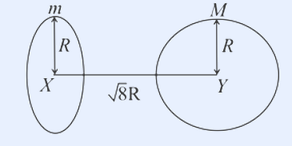


B reacts with Hydroxyl amine but does not give Tollen's test. Identify A and B.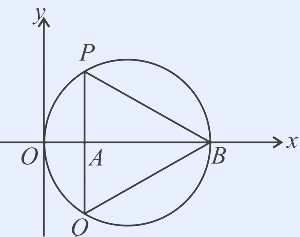
JEE Main 2021 February 26, Shift 1 Question Paper with Solutions
All 90 questions from the JEE Main 2021 (February 26, Shift 1) shift — Physics (30), Chemistry (30) and Mathematics (30) — each with the correct answer (answer key) and a step-by-step solution. Read it free online, or attempt the full paper as a timed mock test.
Physics30 questions
Q1Single correctUnits and Measurements
In a typical combustion engine the workdone by a gas molecule is given by , where x is the displacement, k is the Boltzmann constant and T is the temperature. If and are constants, dimensions of will be:
(1)
(2)
(3)
(4)
SolutionAnswer: Option 4
Approach:
Force the exponent to be dimensionless to fix the dimensions of beta, then use the dimensions of work to extract alpha.
Step 1:
is dimensionless, with and
Step 2:
Step 3:
gives
Step 4:
Final answer:
Q2Single correctOscillations and Waves
If two similar springs each of spring constant are joined in series, the new spring constant and time period would be changed by a factor:
(1)
(2)
(3)
(4)
SolutionAnswer: Option 4
Approach:
Combine two equal springs in series, then relate the change in spring constant to the change in time period.
Step 1:
Step 2:
so
Final answer:
Q3Single correctLaws of Motion
A particle is moving with uniform speed along the circumference of a circle of radius R under the action of a central fictitious force F which is inversely proportional to . Its time period of revolution will be given by :
(1)
(2)
(3)
(4)
SolutionAnswer: Option 4
Approach:
Equate the given central force to the centripetal force requirement and find how speed and then period scale with radius.
Step 1:
gives
Step 2:
Final answer:
Q4Single correctWork, Energy and Power
Given below are two statements: one is labelled as Assertion A and the other is labelled as Reason R.
Assertion A : Body P having mass M moving with speed u has head-on collision elastically with another body Q having mass m initially at rest. If , body Q will have a maximum speed equal to after collision.
Reason R : During elastic collision, the momentum and kinetic energy are both conserved.
In the light of the above statements, choose the most appropriate answer from the options given below:
Assertion A : Body P having mass M moving with speed u has head-on collision elastically with another body Q having mass m initially at rest. If , body Q will have a maximum speed equal to after collision.
Reason R : During elastic collision, the momentum and kinetic energy are both conserved.
In the light of the above statements, choose the most appropriate answer from the options given below:
(1)
(2)
(3)
(4)
SolutionAnswer: Option 3Both A and R are correct and R is the correct explanation of A
Approach:
Use the elastic-collision velocity formula for the struck mass and take the heavy-projectile limit, then judge whether the reason supplies that result.
Step 1:
Step 2:
Step 3:
Elastic collision conserves momentum and kinetic energy, which yields this formula
Final answer: Both A and R are correct and R is the correct explanation of A
Q5Single correctRotational Motion
Four identical solid spheres each of mass and radius are placed with their centres on the four corners of a square of side . The moment of inertia of the system about one side of square where the axis of rotation is parallel to the plane of the square is :
(1)
(2)
(3)
(4)
SolutionAnswer: Option 3
Approach:
Add the moments of inertia of all four spheres about the chosen side, applying the parallel-axis theorem to the two spheres a distance b away.
Step 1:
Two spheres lie on the axis:
Step 2:
Two spheres at distance b:
Step 3:
Final answer:
Q6Single correctGravitation
A planet revolving in elliptical orbit has :
A. a constant velocity of revolution.
B. has the least velocity when it is nearest to the sun.
C. its areal velocity is directly proportional to its velocity.
D. areal velocity is inversely proportional to its velocity.
E. to follow a trajectory such that the areal velocity is constant.
Choose the correct answer from the options given below:
A. a constant velocity of revolution.
B. has the least velocity when it is nearest to the sun.
C. its areal velocity is directly proportional to its velocity.
D. areal velocity is inversely proportional to its velocity.
E. to follow a trajectory such that the areal velocity is constant.
Choose the correct answer from the options given below:
(1)
(2)
(3)
(4)
SolutionAnswer: Option 3E only
Approach:
Apply Kepler's second law and the variation of orbital speed to test each statement.
Step 1:
Orbital speed varies along an ellipse, so A is false
Step 2:
Speed is maximum at perihelion, not minimum, so B is false
Step 3:
Areal velocity is constant, independent of speed, so C and D are false
Step 4:
is constant, so E is true
Final answer: E only
Q7Single correctGravitation
Find the gravitational force of attraction between the ring and sphere as shown in the diagram, where the plane of the ring is perpendicular to the line joining the centres. If is the distance between the centres of a ring (of mass m) and a sphere (mass M) where both have equal radius R.
(1)
(2)
(3)
(4)
SolutionAnswer: Option 4
Approach:
Compute the gravitational field of the ring on its axis at the sphere's centre, then multiply by the sphere's mass.
Step 1:
, so
Step 2:
Step 3:
Final answer:
Q8Single correctProperties of Solids and Liquids
The normal density of a material is and its bulk modulus of elasticity is K. The magnitude of increase in density of material, when a pressure P is applied uniformly on all sides, will be :
(1)
(2)
(3)
(4)
SolutionAnswer: Option 2
Approach:
Relate the fractional change in density to the fractional volume change through the bulk modulus.
Step 1:
Step 2:
Final answer:
Q9Single correctProperties of Solids and Liquids
A large number of water drops, each of radius , combine to have a drop of radius . If the surface tension is and mechanical equivalent of heat is , the rise in heat energy per unit volume will be:
(1)
(2)
(3)
(4)
SolutionAnswer: Option 4
Approach:
Find the surface energy released using volume conservation, convert to heat with J, and divide by the final drop volume.
Step 1:
Step 2:
Step 3:
Heat per unit volume
Final answer:
Q10Single correctProperties of Solids and Liquids
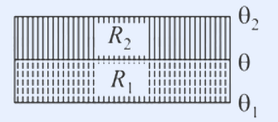
The temperature at the junction of two insulating sheets, having thermal resistances and as well as top and bottom temperatures and (as shown in figure) is given by :
(1)
(2)
(3)
(4)
SolutionAnswer: Option 3
Approach:
Set the steady-state heat current through the top sheet equal to that through the bottom sheet and solve for the junction temperature.
Step 1:
Step 2:
Step 3:
Final answer:
Q11Single correctGravitation
Assume that a tunnel is dug along a chord of the earth, at a perpendicular distance from the earth's centre, where R is the radius of the earth. The wall of the tunnel is frictionless. If a particle is released in this tunnel, it will execute a simple harmonic motion with a time period:
(1)
(2)
(3)
(4)
SolutionAnswer: Option 2
Approach:
Use that for any straight chord tunnel through a uniform earth the restoring acceleration along the tunnel gives the same period as a diametric tunnel.
Step 1:
The component of gravity along the tunnel is , independent of the chord's perpendicular distance
Step 2:
Final answer:
Q12Single correctElectrostatics
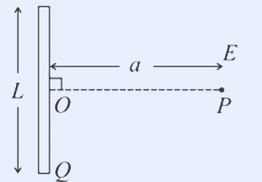
Find the electric field at point P (as shown in figure) on the perpendicular bisector of a uniformly charged thin wire of length L carrying a charge Q. The distance of the point P from the centre of the rod is .
(1)
(2)
(3)
(4)
SolutionAnswer: Option 2
Approach:
Apply the standard finite-line field on the perpendicular bisector with linear charge density Q/L and substitute the given distance.
Step 1:
Step 2:
Step 3:
Final answer:
Q13Single correctElectrostatics
Consider the combination of two capacitors and , with , when connected in parallel, the equivalent capacitance is 10 times the equivalent capacitance of the same connected in series. Calculate the ratio of capacitors, .
(1)
(2)
(3)
(4)
SolutionAnswer: Option 1
Approach:
Set the parallel capacitance equal to ten times the series capacitance, substitute the ratio variable, and solve the resulting quadratic with C2 greater than C1.
Step 1:
Step 2:
Let :
Step 3:
, and requires , so
Final answer:
Q14Single correctCurrent Electricity
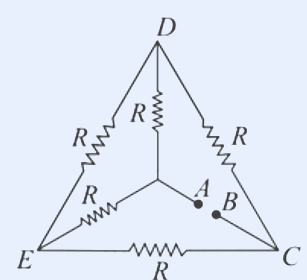
Five equal resistances are connected in a network as shown in figure. The net resistance between the points and is :
(1)
(2)
(3)
(4)
SolutionAnswer: Option 1
Approach:
Reduce the symmetric resistor network around the closely spaced terminals A and B to find the equivalent between them.
Step 1:
The network combines the five equal resistors so that the path between the central terminals reduces to a single equivalent
Step 2:
Combining the symmetric branches yields a net value equal to
Final answer:
Q15Single correctElectromagnetic Induction and Alternating Currents
An alternating current is given by the equation . The rms current will be:
(1)
(2)
(3)
(4)
SolutionAnswer: Option 4
Approach:
Square the current, take the time average using the standard averages of sine-squared, cosine-squared and their product, then take the square root.
Step 1:
Step 2:
Step 3:
Final answer:
Q16Single correctDual Nature of Matter and Radiation
Given below are two statements : one is labelled as Assertion A and the other is labelled as Reason R.
Assertion A : An electron microscope can achieve better resolving power than an optical microscope.
Reason R : The de Broglie's wavelength of the electrons emitted from an electron gun is much less than wavelength of visible light.
In the light of the above statements, choose the correct answer from the options given below:
Assertion A : An electron microscope can achieve better resolving power than an optical microscope.
Reason R : The de Broglie's wavelength of the electrons emitted from an electron gun is much less than wavelength of visible light.
In the light of the above statements, choose the correct answer from the options given below:
(1)
(2)
(3)
(4)
SolutionAnswer: Option 2
Approach:
Compare the resolving capability of an electron microscope to an optical one through the de Broglie wavelength of accelerated electrons.
Step 1:
Step 2:
Step 3:
Final answer:
Q17Single correctOptics
A short straight object of height 100 cm lies before the central axis of a spherical mirror whose focal length has absolute value cm. The image of object produced by the mirror is of height 25 cm and has the same orientation of the object. One may conclude from the information:
(1)
(2)
(3)
(4)
SolutionAnswer: Option 4
Approach:
Use the magnification (erect, diminished) to identify the mirror type, then apply the mirror equation to place the image.
Step 1:
Step 2:
Step 3:
Step 4:
Final answer:
Q18Single correctOptics
In a Young's double slit experiment two slits are separated by 2 mm and the screen is placed one meter away. When a light of wavelength 500 nm is used, the fringe separation will be :
(1)
(2)
(3)
(4)
SolutionAnswer: Option 4
Approach:
Apply the fringe width formula for a double slit experiment.
Step 1:
Step 2:
Final answer:
Q19Single correctAtoms and Nuclei
If and are the wavelengths of the third member of Lyman and first member of the Paschen series respectively, then the value of is :
(1)
(2)
(3)
(4)
SolutionAnswer: Option 1
Approach:
Use the Rydberg formula for the third Lyman line () and the first Paschen line ().
Step 1:
Step 2:
Step 3:
Final answer:
Q20Single correctElectronic Devices
LED is constructed from semiconducting material. The energy gap of this LED is 1.9 eV. Calculate the wavelength of light emitted and its colour. and
(1)
(2)
(3)
(4)
SolutionAnswer: Option 1 and red colour
Approach:
Convert the band gap energy to an emitted wavelength and identify the visible colour.
Step 1:
Step 2:
Step 3:
Final answer: and red colour
Q21NumericalLaws of Motion
A boy pushes a box of mass 2 kg with a force on a frictionless surface. If the box was initially at rest, then ______ m is displacement along the x-axis after 10 s
SolutionAnswer: 500
Approach:
Find the x-component of acceleration from Newton's second law and apply kinematics from rest.
Step 1:
Step 2:
Final answer: 500
Q22NumericalLaws of Motion
A person standing on a spring balance inside a stationary lift measures 60 kg. The weight of that person if the lift descends with uniform downward acceleration of 1.8 m will be ______ N.
SolutionAnswer: 492
Approach:
Compute the apparent weight (normal reaction) for a lift accelerating downward.
Step 1:
Step 2:
Final answer: 492
Q23NumericalLaws of Motion
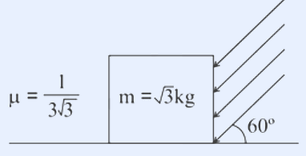
As shown in the figure, a block of mass kg is kept on a horizontal rough surface of coefficient of friction . The critical force to be applied on the vertical surface as shown at angle 60 with horizontal such that it does not move, will be 3x. The value of x will
SolutionAnswer: 3.33
Approach:
Resolve the inclined applied force; at the critical (maximum) value the horizontal component equals limiting friction, with the vertical component adding to the normal force.
Step 1:
Step 2:
Step 3:
Step 4:
Step 5:
Final answer: 3.33
Q24NumericalKinetic Theory of Gases
A container is divided into two chambers by a partition. The volume of first chamber is 4.5 litre and second chamber is 5.5 litre. The first chamber contain 3.0 moles of gas at pressure 2.0 atm and second chamber contain 4.0 moles of gas at pressure 3.0 atm. After the partition is removed and the mixture attains equilibrium, then, the common equilibrium pressure existing in the mixture is atm. Value of x (nearest integer) is ______
SolutionAnswer: 26
Approach:
With internal energy conserved on mixing identical ideal gases, the total PV is conserved, giving the common pressure over the combined volume.
Step 1:
Step 2:
Step 3:
Step 4:
Final answer: 26
Q25NumericalOscillations and Waves
The mass per unit length of a uniform wire is 0.135 g c. A transverse wave of the form is produced in it, where x is in meter and t is in second. Then, the expected value of tension in the wire is N. Value of x is ______ (Round-off to the nearest integer)
SolutionAnswer: 1215
Approach:
Read wave speed from the wave equation, convert linear mass density to SI, and use the speed of a transverse wave on a string.
Step 1:
Step 2:
Step 3:
Step 4:
Final answer: 1215
Q26NumericalCurrent Electricity
In an electrical circuit, a battery is connected to pass 20 C of charge through it in a certain given time. The potential difference between two plates of the battery is maintained at 15 V. The workdone by the battery is ______ J
SolutionAnswer: 300
Approach:
Work done by a battery equals the charge transferred times the potential difference.
Step 1:
Step 2:
Final answer: 300
Q27NumericalElectromagnetic Induction and Alternating Currents
In a series LCR resonant circuit, the quality factor is measured as 100. If the inductance is increased by two fold and resistance is decreased by two fold, then the quality factor after this change will be ______
SolutionAnswer: 282.84
Approach:
Express the quality factor of a series resonant circuit and scale it for the changed inductance and resistance.
Step 1:
Step 2:
Step 3:
Final answer: 282.84
Q28NumericalElectromagnetic Waves
A radiation is emitted by 1000 W bulb and it generates an electric field and magnetic field at P, placed at a distance of 2 m. The efficiency of the bulb is 1.25%. The value of peak electric field at P is V . Value of x is ______ (Rounded-off to the nearest integer) [Take ]
SolutionAnswer: 137
Approach:
Find the radiated optical power, convert to intensity over a sphere, then relate intensity to the peak electric field.
Step 1:
Step 2:
Step 3:
Step 4:
Final answer: 137
Q29NumericalElectronic Devices
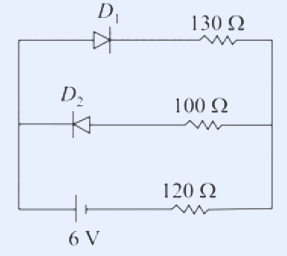
The circuit contains two diodes each with a forward resistance of 50 and with infinite reverse resistance. If the battery voltage is 6 V, the current through the 120 resistance is ______ mA
SolutionAnswer: 20
Approach:
Determine which diode is forward biased, then add the forward diode resistance in series with its branch resistor and the 120 ohm resistor.
Step 1:
Step 2:
Step 3:
Final answer: 20
Q30NumericalElectromagnetic Waves
The maximum and minimum amplitude of an amplitude modulated wave is 16 V and 8 V respectively. The modulation index for this amplitude modulated wave is . The value of x is ______. (Round off your answer to the nearest integer)
SolutionAnswer: 33
Approach:
Compute the modulation index from the maximum and minimum amplitudes of the AM wave.
Step 1:
Step 2:
Step 3:
Final answer: 33
Chemistry30 questions
Q31Single correctAtomic Structure
The orbital having two radial as well as two angular nodes is:
(1)
(2)
(3)
(4)
SolutionAnswer: Option 1
Approach:
Relate the count of angular nodes to the azimuthal quantum number and radial nodes to the principal quantum number.
Step 1:
Step 2:
Step 3:
Final answer:
Q32Single correctClassification of Elements and Periodicity in Properties
Match List-I with List-II. List-I: Electronic configuration of elements. List-II: in kJ mo. Choose the most appropriate answer from the options given below:
| List-I | List-II |
|---|---|
| a. | p. |
| b. | q. |
| c. | r. |
| d. | s. |
(1)
(2)
(3)
(4)
SolutionAnswer: Option 1
Approach:
Identify each element from its configuration, then assign first ionization enthalpies using periodic trends.
Step 1:
Step 2:
Step 3:
Step 4:
Final answer:
Q33Single correctChemical Bonding and Molecular Structure
Given below are two statements:
Statement I : o-Nitrophenol is steam volatile due to intramolecular hydrogen bonding.
Statement II : o-Nitrophenol has high melting due to hydrogen bonding.
In the light of the above statements, choose the most appropriate answer from the options given below:
Statement I : o-Nitrophenol is steam volatile due to intramolecular hydrogen bonding.
Statement II : o-Nitrophenol has high melting due to hydrogen bonding.
In the light of the above statements, choose the most appropriate answer from the options given below:
(1)
(2)
(3)
(4)
SolutionAnswer: Option 2Statement I is true but Statement II is false
Approach:
Assess each statement against the consequences of intramolecular hydrogen bonding in o-nitrophenol.
Step 1:
Step 2:
Step 3:
Final answer: Statement I is true but Statement II is false
Q34Single correctChemical Bonding and Molecular Structure
Given below are two statements: one is labelled as Assertion A and the other is labelled as Reason R.
Assertion A : Dipole-dipole interactions are the only non-covalent interactions, resulting in hydrogen bond formation.
Reason R : Fluorine is the most electronegative element and hydrogen bonds in HF are symmetrical.
In the light of the above statements, choose the most appropriate answer from the options given below:
Assertion A : Dipole-dipole interactions are the only non-covalent interactions, resulting in hydrogen bond formation.
Reason R : Fluorine is the most electronegative element and hydrogen bonds in HF are symmetrical.
In the light of the above statements, choose the most appropriate answer from the options given below:
(1)
(2)
(3)
(4)
SolutionAnswer: Option 1A is false but R is true
Approach:
Judge the assertion about the nature of hydrogen-bonding forces and the reason about fluorine and HF.
Step 1:
Step 2:
Final answer: A is false but R is true
Q35Single correctp-Block Elements
Statements about heavy water are given below.
A. Heavy water is used in exchange reactions for the study of reaction mechanisms.
B. Heavy water is prepared by exhaustive electrolysis of water.
C. Heavy water has higher boiling point than ordinary water.
D. Viscosity of is greater than .
Choose the most appropriate answer from the options given below:
A. Heavy water is used in exchange reactions for the study of reaction mechanisms.
B. Heavy water is prepared by exhaustive electrolysis of water.
C. Heavy water has higher boiling point than ordinary water.
D. Viscosity of is greater than .
Choose the most appropriate answer from the options given below:
(1)
(2)
(3)
(4)
SolutionAnswer: Option 2A, B and C only
Approach:
Evaluate each statement about the properties and preparation of heavy water.
Step 1:
Step 2:
Step 3:
Step 4:
Final answer: A, B and C only
Q36Single correctp-Block Elements
Find A, B and C in the following reactions:
(1)
(2)
(3)
(4)
SolutionAnswer: Option 1
Approach:
Balance each step of the Solvay (ammonia-soda) process to identify the missing species.
Step 1:
Step 2:
Step 3:
Final answer:
Q37Single correctp-Block Elements
Compound A used as a strong oxidizing agent is amphoteric in nature. It is the part of lead storage batteries. Compound A is:
(1)
(2)
(3)
(4)
SolutionAnswer: Option 3
Approach:
Match the described properties (strong oxidant, amphoteric, lead-acid cell component) to the correct lead oxide.
Step 1:
Step 2:
Step 3:
Final answer:
Q38Single correctPurification and Characterisation of Organic Compounds
Given below are two statements:
Statement I: A mixture of chloroform and aniline can be separated by simple distillation.
Statement II: When separating aniline from a mixture of aniline and water by steam distillation aniline boils below its boiling point.
In the light of the above statements, choose the most appropriate answer from the options given below:
Statement I: A mixture of chloroform and aniline can be separated by simple distillation.
Statement II: When separating aniline from a mixture of aniline and water by steam distillation aniline boils below its boiling point.
In the light of the above statements, choose the most appropriate answer from the options given below:
(1)
(2)
(3)
(4)
SolutionAnswer: Option 1Both Statement I and Statement II are true
Approach:
Check the validity of simple distillation for the chloroform-aniline mix and the principle of steam distillation.
Step 1:
Step 2:
Final answer: Both Statement I and Statement II are true
Q39Single correctp-Block Elements
Which of the following is a FALSE statement?
(1)
(2)
(3)
(4)
SolutionAnswer: Option 3Carius method is used for the estimation of nitrogen in an organic compound.
Approach:
Match each estimation technique to the element it determines and locate the false claim.
Step 1:
Step 2:
Step 3:
Step 4:
Final answer: Carius method is used for the estimation of nitrogen in an organic compound.
Q40Single correctp-Block Elements
The presence of ozone in troposphere:
(1)
(2)
(3)
(4)
SolutionAnswer: Option 4generates photochemical smog
Approach:
Distinguish the harmful tropospheric ozone from the protective stratospheric ozone.
Step 1:
Step 2:
Final answer: generates photochemical smog
Q41Single correctp-Block Elements
Match List-I with List-II. List-I (Ore). List-II (Element Present). Choose the most appropriate answer from the options given below:
| List-I | List-II |
|---|---|
| a. Kernite | p. Tin |
| b. Cassiterite | q. Boron |
| c. Calamine | r. Fluorine |
| d. Cryolite | s. Zinc |
(1)
(2)
(3)
(4)
SolutionAnswer: Option 4
Approach:
Identify the chemical formula of each ore and read off the principal element present.
Step 1:
Step 2:
Step 3:
Step 4:
Final answer:
Q42Single correctp-Block Elements
On treating a compound with warm dil. , gas X is evolved which turns paper acidified with dil. to a green compound Y. X and Y respectively are :
(1)
(2)
(3)
(4)
SolutionAnswer: Option 3
Approach:
Identify the gas evolved from a sulphite and the green chromium product of its reaction with acidified dichromate.
Step 1:
Step 2:
Final answer:
Q43Single correctd- and f-Block Elements
Which one of the following lanthanoids does not form ? [M is lanthanoid metal]
(1)
(2)
(3)
(4)
SolutionAnswer: Option 1
Approach:
Relate dioxide formation to the availability of the +4 oxidation state among the listed lanthanoids.
Step 1:
Step 2:
Final answer:
Q44Single correctHydrocarbons
For the given reaction:
What is A?
What is A?
(1)
(2)
(3)
(4)
SolutionAnswer: Option 21,3,5-trimethylbenzene (mesitylene)
Approach:
Dehydrohalogenate the bromoalkene to an alkyne, then cyclically trimerize it over a red-hot iron tube.
Step 1:
Step 2:
Final answer: 1,3,5-trimethylbenzene (mesitylene)
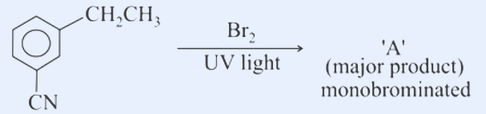
Q45Single correctHydrocarbons
For the given reaction:
What is A?
What is A?
(1)
(2)
(3)
(4)
SolutionAnswer: Option 2benzylic bromide: ring with a side chain
Approach:
Apply free-radical bromination conditions, which favour substitution at the benzylic C-H rather than on the ring.
Step 1:
Step 2:
Final answer: benzylic bromide: ring with a side chain
Q46Single correctOrganic Compounds Containing Oxygen
Identify the major products A and B respectively in the following reactions of phenol:
(1)
(2)
(3)
(4)
SolutionAnswer: Option 4 = -bromophenol; = salicylaldehyde and -hydroxybenzaldehyde
Approach:
Bromination of phenol with Br2 in the non-polar solvent CS2 at low temperature gives the para product; the Reimer-Tiemann reaction (CHCl3/NaOH then acid) introduces a CHO group ortho to OH (with some para).
Step 1:
Step 2:
Final answer: = -bromophenol; = salicylaldehyde and -hydroxybenzaldehyde
Q47Single correctOrganic Compounds Containing Oxygen
B reacts with Hydroxyl amine but does not give Tollen's test. Identify A and B.
(1)
(2)
(3)
(4)
SolutionAnswer: Option 22, 2-Dichlorobutane and Butan-2-one
Approach:
A gem-dihalide on hydrolysis gives a carbonyl compound; reaction with hydroxylamine but no positive Tollen's test identifies the product as a ketone, fixing the position of the two chlorines.
Step 1:
is a gem-dihalide; hydrolysis gives
Step 2:
Reacts with (carbonyl) but negative Tollen's test
Step 3:
butan-2-one 2,2-dichlorobutane
Final answer: 2, 2-Dichlorobutane and Butan-2-one
Q48Single correctOrganic Compounds Containing Nitrogen
An amine on reaction with benzenesulphonyl chloride produces a compound insoluble in alkaline solution. This amine can be prepared by ammonolysis of ethyl chloride. The correct structure of amine is:
(1)
(2)
(3)
(4)
SolutionAnswer: Option 3
Approach:
In the Hinsberg test a secondary amine forms an N,N-disubstituted benzenesulphonamide that is insoluble in alkali; the option that is a secondary amine consistent with the description is selected.
Step 1:
Secondary amine N,N-disubstituted sulphonamide
Step 2:
The structure must be a secondary amine
Final answer:
Q49Single correctBiomolecules
The structure of Neoprene is :
(1)
(2)
(3)
(4)
SolutionAnswer: Option 3
Approach:
Neoprene is the addition polymer of chloroprene (2-chloro-1,3-butadiene); its repeating unit carries a chlorine on the carbon bearing the internal double bond.
Step 1:
Monomer: 2-chloro-1,3-butadiene
Step 2:
-addition polymerisation gives
Final answer:
Q50Single correctBiomolecules
Which of the following vitamin is helpful in the blood clotting?
(1)
(2)
(3)
(4)
SolutionAnswer: Option 3Vitamin K
Approach:
The vitamin essential for the synthesis of clotting factors and hence for blood coagulation is recalled.
Step 1:
Vitamin K is required for coagulation of blood
Final answer: Vitamin K
Q51NumericalSome Basic Concepts in Chemistry
The number of significant figures in is ________
SolutionAnswer: 8
Approach:
Significant figures are counted in the mantissa; the power of ten does not change the count.
Step 1:
has digits
Final answer: 8
Q52NumericalSome Basic Concepts in Chemistry
A certain gas obeys . The value of is . The value of x is ________(Integer answer)
(Z : compressibility factor)
(Z : compressibility factor)
SolutionAnswer: 1
Approach:
Express the compressibility factor Z in terms of P from the given equation of state and differentiate with respect to P at constant T.
Step 1:
Step 2:
Step 3:
Final answer: 1
Q53NumericalChemical Thermodynamics
For a chemical reaction the entropy change depends on the temperature T (in K) as . Minimum temperature at which it will become spontaneous is ________ K. (Integer)
SolutionAnswer: 200
Approach:
A reaction is spontaneous when the Gibbs free energy change is negative; substitute the temperature-dependent entropy and solve the inequality.
Step 1:
Step 2:
Step 3:
Final answer: 200
Q54NumericalEquilibrium
A homogeneous ideal gaseous reaction is carried out in a 25 litre flask at . The initial amount of was 1 mole and the equilibrium pressure was 1.9 atm. The value of is . The value of x is ________ (Integer answer)
SolutionAnswer: 73
Approach:
Find the initial pressure of AB2 from the ideal gas law, relate the total equilibrium pressure to the degree of dissociation, then evaluate Kp from the partial pressures.
Step 1:
Step 2:
Step 3:
Step 4:
Final answer: 73
Q55NumericalRedox Reactions and Electrochemistry
Dichromate ion is treated with base, the oxidation number of Cr in the product formed is ________
SolutionAnswer: 6
Approach:
On treatment with base, dichromate converts to chromate; the oxidation state of chromium is found from charge balance.
Step 1:
Step 2:
Final answer: 6
Q56NumericalSolutions
224 mL of at 298 K and 1 atm is passed through 100 mL of 0.1 M NaOH solution. The non-volatile solute produced is dissolved in 36 g of water. The lowering of vapour pressure of solution (assuming the solution is dilute) is mm of Hg. The value of x is ________ (Integer answer)
SolutionAnswer: 18
Approach:
Determine moles of SO2 and NaOH, identify the non-volatile salt formed, count the dissociated particles, and apply Raoult's law for the lowering of vapour pressure in a dilute solution.
Step 1:
Step 2:
Step 3:
(i=3);
Step 4:
Final answer: 18
Q57NumericalRedox Reactions and Electrochemistry
Consider the following reaction
, .
The quantity of electricity required in Faraday to reduce five moles of is ________
, .
The quantity of electricity required in Faraday to reduce five moles of is ________
SolutionAnswer: 25
Approach:
Each mole of permanganate requires 5 moles of electrons (5 Faraday) for reduction; multiply by the number of moles.
Step 1:
needs
Step 2:
Final answer: 25
Q58NumericalChemical Kinetics
An exothermic reaction has an activation energy . If energy change during the reaction is , then the activation energy for the reverse reaction in kJ is ________ (Integer answer)
SolutionAnswer: 50
Approach:
The energy change of the reaction equals the forward activation energy minus the reverse activation energy; rearrange to find the reverse activation energy.
Step 1:
Final answer: 50
Q59NumericalSome Basic Concepts in Chemistry
g of oxygen is adsorbed on g of platinum metal. The volume of oxygen adsorbed per gram of the adsorbent at 1 atm and 300 K in L is ________
SolutionAnswer: 2
Approach:
Find the moles of oxygen, compute its volume from the ideal gas law, then divide by the mass of the adsorbent.
Step 1:
Step 2:
Step 3:
Final answer: 2
Q60NumericalCoordination Compounds
Number of bridging CO ligands in is ________
SolutionAnswer: 0
Approach:
Recall the structure of dimanganese decacarbonyl, which contains a metal-metal bond and only terminal carbonyl groups.
Step 1:
has five terminal CO on each Mn and a direct Mn-Mn bond
Final answer: 0
Mathematics30 questions
Q61Single correctPermutations and Combinations
The number of seven digit integers with sum of the digits equal to 10 and formed by using the digits 1, 2 and 3 only is:
(1)
(2)
(3)
(4)
SolutionAnswer: Option 1
Approach:
Count compositions of seven positions with digit values from {1,2,3} whose values sum to 10, then permute each composition.
Step 1:
Step 2:
Step 3:
Step 4:
Final answer:
Q62Single correctSequence and Series
The sum of the infinite series is equal to:
(1)
(2)
(3)
(4)
SolutionAnswer: Option 4
Approach:
Express the numerators after the first term as an arithmetic sequence and sum the resulting arithmetico-geometric series.
Step 1:
Step 2:
Step 3:
Final answer:
Q63Single correctSequence and Series
In an increasing geometric series, the sum of the second and the sixth term is and the product of the third and fifth term is 25. Then, the sum of and terms is equal to:
(1)
(2)
(3)
(4)
SolutionAnswer: Option 1
Approach:
Use the product condition to find the fourth term, then solve for the common ratio from the sum condition.
Step 1:
Step 2:
Step 3:
Step 4:
Final answer:
Q64Single correctBinomial Theorem and its Simple Applications
The maximum value of the term independent of t in the expansion of where is:
(1)
(2)
(3)
(4)
SolutionAnswer: Option 3
Approach:
Find the term with zero power of t in the binomial expansion, then maximize the resulting function of x on (0,1).
Step 1:
Step 2:
Step 3:
Step 4:
Step 5:
Final answer:
Q65Single correctCo-ordinate Geometry
The intersection of three lines and is a/an
(1)
(2)
(3)
(4)
SolutionAnswer: Option 1Isosceles triangle
Approach:
Find the three pairwise intersection points and compare the side lengths and angles of the triangle formed.
Step 1:
Step 2:
Step 3:
Step 4:
Step 5:
Final answer: Isosceles triangle
Q66Single correctCo-ordinate Geometry
In the circle given below, let unit, unit and . Then, the area of the triangle PQB (in square units) is:
(1)
(2)
(3)
(4)
SolutionAnswer: Option 1
Approach:
Treat OB as a diameter; PA is the altitude from the right angle at P onto the diameter, giving the half-chord PA from the geometric mean relation, then compute the triangle area.
Step 1:
Step 2:
Step 3:
Step 4:
Final answer:
Q67Single correctLimit, Continuity and Differentiability
The value of is :
(1)
(2)
(3)
(4)
SolutionAnswer: Option 3
Approach:
Simplify the numerator using a compound-angle identity, then evaluate the standard sine limit.
Step 1:
Step 2:
Step 3:
Final answer:
Q68Single correctSets, Relations and Functions
Let be a relation, then the equivalence class of is the set
(1)
(2)
(3)
(4)
SolutionAnswer: Option 2
Approach:
The equivalence class of a point under this relation is all points at the same distance from the origin.
Step 1:
Step 2:
Final answer:
Q69Single correctMatrices and Determinants
Let A be a symmetric matrix of order 2 with integer entries. If the sum of the diagonal elements of is 1, then the possible number of such matrices is:
(1)
(2)
(3)
(4)
SolutionAnswer: Option 2
Approach:
Write the general symmetric 2x2 matrix, compute the trace of its square, and count integer solutions.
Step 1:
Step 2:
Step 3:
Final answer:
Q70Single correctMatrices and Determinants
The value of is
(1)
(2)
(3)
(4)
SolutionAnswer: Option 3
Approach:
Reduce the first column using row/column operations to obtain a Vandermonde-type determinant, then evaluate.
Step 1:
Step 2:
Step 3:
Step 4:
Final answer:
Q71Single correctTrigonometry
If ; , then the value of is:
(1)
(2)
(3)
(4)
SolutionAnswer: Option 1
Approach:
Set the common ratio equal to k, use the inverse sine plus inverse cosine identity to find k, then evaluate the cosine of a double inverse-tangent.
Step 1:
Step 2:
Step 3:
Final answer:
Q72Single correctLimit, Continuity and Differentiability
Let f be any function defined on R and let it satisfy the condition: . If , then :
(1)
(2)
(3)
(4)
SolutionAnswer: Option 4
Approach:
Divide the inequality by the modulus of (x-y) to bound the difference quotient, conclude the derivative is zero, and use the initial value.
Step 1:
Step 2:
Step 3:
Final answer:
Q73Single correctLimit, Continuity and Differentiability
The maximum slope of the curve occurs at the point
(1)
(2)
(3)
(4)
SolutionAnswer: Option 2
Approach:
The slope is the first derivative; maximize it by setting its derivative to zero and using the second derivative test, then evaluate the curve at that abscissa.
Step 1:
Step 2:
Step 3:
Final answer:
Q74Single correctIntegral Calculus
The value of , where [x] is the greatest integer , is:
(1)
(2)
(3)
(4)
SolutionAnswer: Option 1
Approach:
On each interval the fractional part replaces the integrand, making every integral identical, then multiply by the number of terms.
Step 1:
Step 2:
Step 3:
Final answer:
Q75Single correctIntegral Calculus
The value of is:
(1)
(2)
(3)
(4)
SolutionAnswer: Option 2
Approach:
Apply the property for symmetric limits with the 1+ denominator to reduce the integrand to the even numerator over half the interval.
Step 1:
Step 2:
Final answer:
Q76Single correctDifferential Equations
The rate of growth of bacteria in a culture is proportional to the number of bacteria present and the bacteria count is 1000 at initial time . The number of bacteria is increased by 20% in 2 hours. If the population of bacteria is 2000 after hours, then is equal to:
(1)
(2)
(3)
(4)
SolutionAnswer: Option 2
Approach:
Model exponential growth, find the growth constant from the 20% increase, then evaluate the required expression.
Step 1:
Step 2:
Step 3:
Comparing with gives
Step 4:
Final answer:
Q77Single correctVector Algebra
If and are perpendicular, then is equal to:
(1)
(2)
(3)
(4)
SolutionAnswer: Option 1
Approach:
Apply the vector triple product expansion repeatedly using the orthogonality of the vectors.
Step 1:
Step 2:
Step 3:
Final answer:
Q78Single correctThree Dimensional Geometry
If and are coplanar, then the sum of all possible values of is:
(1)
(2)
(3)
(4)
SolutionAnswer: Option 1
Approach:
Set the scalar triple product of the three edge vectors from one point to zero and sum the roots.
Step 1:
Step 2:
Determinant condition gives
Step 3:
Roots and , sum
Final answer:
Q79Single correctThree Dimensional Geometry
Consider the three planes
, and
Then, which one of the following is true?
, and
Then, which one of the following is true?
(1)
(2)
(3)
(4)
SolutionAnswer: Option 4 and are parallel.
Approach:
Compare the normal vectors of the planes; parallel planes have proportional normals.
Step 1:
Step 2:
is not proportional to
Final answer: and are parallel.
Q80Single correctStatistics and Probability
A fair coin is tossed a fixed number of times. If the probability of getting 7 heads is equal to probability of getting 9 heads, then the probability of getting 2 heads is
(1)
(2)
(3)
(4)
SolutionAnswer: Option 1
Approach:
Use the binomial symmetry to find the number of tosses, then compute the probability of exactly two heads.
Step 1:
Step 2:
Final answer:
Q81NumericalLimit, Continuity and Differentiability
The number of solutions of the equation is ________.
SolutionAnswer: 1
Approach:
Convert both logarithms to base 2, solve the resulting algebraic equation, and discard solutions outside the domain.
Step 1:
Step 2:
or ; domain requires
Final answer: 1
Q82NumericalComplex Numbers and Quadratic Equations
The sum of power of the roots of the equation is ________.
SolutionAnswer: 3
Approach:
Factor the cubic, identify the roots as roots of unity, and raise each to the 162nd power.
Step 1:
Roots: and
Step 2:
and
Step 3:
Sum
Final answer: 3
Q83NumericalBinomial Theorem and its Simple Applications
Let and . If , then is equal to ________. (Here )
SolutionAnswer: 45
Approach:
Recognize the sum as a known binomial identity and express the result in the form n times a power of two.
Step 1:
Step 2:
, so
Final answer: 45
Q84NumericalTrigonometry
The number of integral values of k for which the equation has a solution, is ________.
SolutionAnswer: 11
Approach:
Use the range of the sinusoidal expression to bound the constant, then count the integers.
Step 1:
Step 2:
Integers from to inclusive
Final answer: 11
Q85NumericalTrigonometry
If , then number of solutions of the given equation when is ________.
SolutionAnswer: 1
Approach:
Treat the equation as a quadratic in cosine, factor it, and retain roots lying in the given interval.
Step 1:
Factoring gives
Step 2:
On , ; has no solution
Final answer: 1
Q86NumericalIntegral Calculus
The value of the integral is ________.
SolutionAnswer: 2
Approach:
Use the periodicity and symmetry of the absolute sine to reduce the integral over a single hump.
Step 1:
has four equal humps on , each contributing
Step 2:
Final answer: 2
Q87NumericalIntegral Calculus
The area bounded by the lines and is ________.
SolutionAnswer: 8
Approach:
Locate the intersection points of the W-shaped graph with the horizontal line and integrate the difference.
Step 1:
at ; curve lies below on
Step 2:
Final answer: 8
Q88NumericalDifferential Equations
The difference between degree and order of a differential equation that represents the family of curves given by is ________.
SolutionAnswer: 2
Approach:
Eliminate the single parameter by differentiation, rationalize the fractional power, and read off order and degree.
Step 1:
Differentiating gives ; one arbitrary constant means order
Step 2:
Substituting leaves ; squaring yields a term in
Step 3:
Difference
Final answer: 2
Q89NumericalDifferential Equations
If is the solution of the equation ; then is equal to ________.
SolutionAnswer: 1
Approach:
Substitute to linearize the equation, solve with the initial condition, and evaluate the required combination.
Step 1:
The equation becomes with integrating factor
Step 2:
Step 3:
Final answer: 1
Q90NumericalThree Dimensional Geometry
Let be a point on the plane which passes through the point . If the plane is perpendicular to the line joining the points and , then is equal to ________.
SolutionAnswer: 8
Approach:
Take the line's direction as the plane normal, write the plane equation, substitute the given point to find lambda, then evaluate the expression.
Step 1:
Direction is the normal
Step 2:
Plane through : ; substitute :
Step 3:
Final answer: 8
More JEE Main 2021 papers
Frequently Asked Questions
How many questions are in the JEE Main 2021 February 26, Shift 1 paper?
The JEE Main 2021 February 26, Shift 1 paper has 90 questions — Physics (30), Chemistry (30) and Mathematics (30). Every question is on this page with its correct answer and a step-by-step solution.
What is the marking scheme for JEE Main?
JEE Main awards +4 marks for each correct answer and −1 for a wrong answer, with 0 for questions left unattempted. The paper covers Physics, Chemistry and Mathematics.
Are the answer key and step-by-step solutions provided for the 2021 February 26, Shift 1 paper?
Yes — every question shows the correct answer (answer key) and a detailed step-by-step solution, free to read online.
Can I take the JEE Main 2021 February 26, Shift 1 paper as a timed mock test?
Yes. With a free JEEnify account you can attempt this exact paper as a timed test in the real exam interface, then see your score and weak-area analysis.
Solved this paper? Calculate your JEE Main scoremost important chaptersformula sheetsall free tools.