
Back to JEE Main PYQs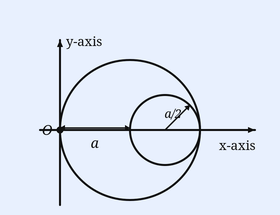
JEE Main 2021 February 24, Shift 2 Question Paper with Solutions
All 90 questions from the JEE Main 2021 (February 24, Shift 2) shift — Physics (30), Chemistry (30) and Mathematics (30) — each with the correct answer (answer key) and a step-by-step solution. Read it free online, or attempt the full paper as a timed mock test.
Physics30 questions
Q1Single correctUnits and Measurements
The period of oscillation of a simple pendulum is . Measured value of L is from meter scale having a minimum division of and time of one complete oscillation is measured from stopwatch of resolution. The percentage error in the determination of g will be:
(1)
(2)
(3)
(4)
SolutionAnswer: Option 4
Approach:
Propagate the errors in L and T through g obtained from the pendulum period formula.
Step 1:
Step 2:
Step 3:
Step 4:
Final answer:
Q2Single correctWork, Energy and Power
A particle is projected with velocity along x-axis. A damping force is acting on the particle which is proportional to the square of the distance from the origin i.e. . The distance at which the particle stops:
(1)
(2)
(3)
(4)
SolutionAnswer: Option 2
Approach:
Use a=v dv/dx and integrate from the launch speed to rest.
Step 1:
Step 2:
Step 3:
Step 4:
Final answer:
Q3Single correctRotational Motion
A circular hole of radius is cut out of a circular disc of radius a as shown in figure. The centroid of the remaining circular portion with respect to point O will be:
(1)
(2)
(3)
(4)
SolutionAnswer: Option 2
Approach:
Treat the hole as negative mass and take moments of area about O.
Step 1:
Step 2:
Step 3:
Step 4:
Final answer:
Q4Single correctGravitation
A body weighs on a spring balance at the north pole. What will be its weight recorded on the same weighing machine, if it is shifted to the equator?
[Use and radius of earth, .]
[Use and radius of earth, .]
(1)
(2)
(3)
(4)
SolutionAnswer: Option 2
Approach:
Find the mass from the polar reading, then apply the rotational reduction of effective gravity at the equator.
Step 1:
Step 2:
Step 3:
Step 4:
Final answer:
Q5Single correctThermodynamics
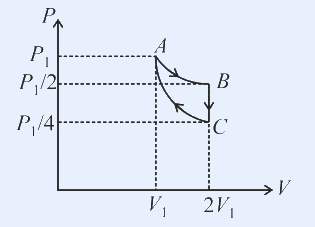
If one mole of an ideal gas at is allowed to expand reversibly and isothermally (A to B) its pressure is reduced to one-half of the original pressure (see figure). This is followed by a constant volume cooling till its pressure is reduced to one-fourth of the initial value (). Then it is restored to its initial state by a reversible adiabatic compression (C to A). The net workdone by the gas is equal to:
(1)
(2)
(3)
(4)
SolutionAnswer: Option 4
Approach:
Sum the work done in the three legs: isothermal expansion, isochoric cooling, and adiabatic compression.
Step 1:
isothermal, so
Step 2:
at constant volume,
Step 3:
Step 4:
Final answer:
Q6Single correctKinetic Theory of Gases
On the basis of kinetic theory of gases, the gas exerts pressure because its molecules:
(1)
(2)
(3)
(4)
SolutionAnswer: Option 2suffer change in momentum when impinge on the walls of container.
Approach:
Identify the microscopic origin of gas pressure in kinetic theory.
Step 1:
Molecules collide elastically with the walls and reverse their momentum component normal to the wall.
Step 2:
The rate of momentum transfer to the wall gives a force, and force per unit area gives pressure.
Final answer: suffer change in momentum when impinge on the walls of container.
Q7Single correctOscillations and Waves
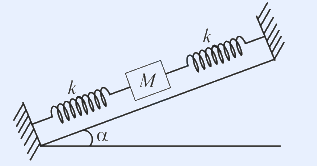
In the given figure, a body of mass is held between two massless springs, on a smooth inclined plane. The free ends of the springs are attached to firm supports. If each spring has spring constant , the frequency of oscillation of given body is:
(1)
(2)
(3)
(4)
SolutionAnswer: Option 4
Approach:
Combine the two springs acting on the block to get the effective constant, then apply the SHM frequency formula.
Step 1:
On displacement along the incline one spring stretches and the other compresses, both giving restoring force.
Step 2:
Step 3:
Final answer:
Q8Single correctOscillations and Waves
When a particle executes SHM, the nature of graphical representation of velocity as a function of displacement is:
(1)
(2)
(3)
(4)
SolutionAnswer: Option 2elliptical
Approach:
Express SHM velocity in terms of displacement and identify the curve.
Step 1:
Step 2:
Final answer: elliptical
Q9Single correctOscillations and Waves
Which of the following equations represents a travelling wave?
(1)
(2)
(3)
(4)
SolutionAnswer: Option 1
Approach:
A travelling wave has the form y=f(x ± vt), a single function of the combination x ± vt.
Step 1:
depends only on the combination
Step 2:
The other forms factor space and time separately or grow unboundedly, so they are not travelling waves.
Final answer:
Q10Single correctElectrostatics
Two electrons each are fixed at a distance . A third charge proton placed at the midpoint is displaced slightly by a distance perpendicular to the line joining the two fixed charges. Proton will execute simple harmonic motion having angular frequency:
( mass of charged particle)
( mass of charged particle)
(1)
(2)
(3)
(4)
SolutionAnswer: Option 3
Approach:
Find the net restoring force on the displaced proton for small x and extract the angular frequency.
Step 1:
Distance from each fixed charge to the displaced proton:
Step 2:
Net restoring component:
Step 3:
Step 4:
Final answer:
Q11Single correctMagnetic Effects of Current and Magnetism
A soft ferromagnetic material is placed in an external magnetic field. The magnetic domains:
(1)
(2)
(3)
(4)
SolutionAnswer: Option 4may increase or decrease in size and change its orientation.
Approach:
Recall how domains respond to an applied field in a soft ferromagnet.
Step 1:
Domains favourably aligned with the field grow while unfavourable ones shrink.
Step 2:
Domain magnetization also rotates toward the field direction.
Final answer: may increase or decrease in size and change its orientation.
Q12Single correctElectromagnetic Induction and Alternating Currents
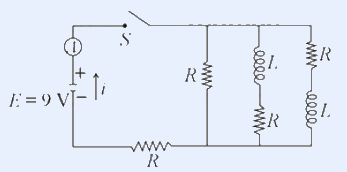
The figure shows a circuit that contains four identical resistors with resistance , two identical inductors with inductance and an ideal battery with E.M.F. . The current i just after the switch S is closed will be:
(1)
(2)
(3)
(4)
SolutionAnswer: Option 3
Approach:
Just after closing, inductors carry zero current and behave as open branches; reduce the circuit to resistors only.
Step 1:
At the two inductor branches act as open circuits and carry no current.
Step 2:
Current flows through the series resistor and the single middle resistor:
Step 3:
Final answer:
Q13Single correctDual Nature of Matter and Radiation
An X-ray tube is operated at million volt. The shortest wavelength of the produced photon will be:
(1)
(2)
(3)
(4)
SolutionAnswer: Option 1
Approach:
The shortest wavelength corresponds to the entire electron energy eV converted to one photon.
Step 1:
Step 2:
Final answer:
Q14Single correctElectromagnetic Waves
Match List - I with List - II.
| List-I | List-II |
|---|---|
| (a). Source of microwave frequency | (i). Radioactive decay of nucleus |
| (b). Source of infrared frequency | (ii). Magnetron |
| (c). Source of Gamma Rays | (iii). Inner shell electrons |
| (d). Source of X-rays | (iv). Vibration of atoms and molecules |
| (v). LASER | |
| (vi). RC circuit |
(1)
(2)
(3)
(4)
SolutionAnswer: Option 4(a)-(ii), (b)-(iv), (c)-(i), (d)-(iii)
Approach:
Match each electromagnetic source to its physical origin.
Step 1:
Microwaves are generated by a magnetron: (a)-(ii)
Step 2:
Infrared arises from vibration of atoms and molecules: (b)-(iv)
Step 3:
Gamma rays come from radioactive decay of nucleus: (c)-(i)
Step 4:
X-rays come from transitions of inner shell electrons: (d)-(iii)
Final answer: (a)-(ii), (b)-(iv), (c)-(i), (d)-(iii)
Q15Single correctOptics
If the source of light used in a Young's double slit experiment is changed from red to violet:
(1)
(2)
(3)
(4)
SolutionAnswer: Option 1consecutive fringe lines will come closer.
Approach:
Relate fringe width to wavelength and compare red versus violet.
Step 1:
Violet light has a shorter wavelength than red light.
Step 2:
decreases as decreases
Final answer: consecutive fringe lines will come closer.
Q16Single correctDual Nature of Matter and Radiation
The de Broglie wavelength of a proton and -particle are equal. The ratio of their velocities is
(1)
(2)
(3)
(4)
SolutionAnswer: Option 1
Approach:
Equate the de Broglie wavelengths of the two particles and relate their velocities through their masses.
Step 1:
Step 2:
Step 3:
Final answer:
Q17Single correctAtoms and Nuclei
According to Bohr atom model, in which of the following transitions will the frequency be maximum?
(1)
(2)
(3)
(4)
SolutionAnswer: Option 4 to
Approach:
Compute the emitted frequency for each transition, which is proportional to the difference of the inverse squares of the principal quantum numbers.
Step 1:
Step 2:
Step 3:
Step 4:
Final answer: to
Q18Single correctElectronic Devices
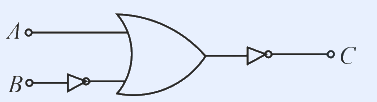
The logic circuit shown above is equivalent to :
(1)
(2)
(3)
(4)
SolutionAnswer: Option 3 (input A inverted then AND with B)
Approach:
Reduce the given gate network to a Boolean expression and match it to the option whose gate combination yields the same expression.
Step 1:
Step 2:
Step 3:
Final answer: (Option 3)
Q19Single correctElectronic Devices
Zener breakdown occurs in a junction having and both:
(1)
(2)
(3)
(4)
SolutionAnswer: Option 4heavily doped and have narrow depletion layer.
Approach:
Relate Zener breakdown conditions to doping level and depletion-layer width.
Step 1:
Step 2:
Step 3:
Final answer: heavily doped and have narrow depletion layer.
Q20Single correctElectronic Devices
Given below are two statements:
Statement I : junction diodes can be used to function as a transistor, simply by connecting two diodes, back to back, which acts as the base terminal
Statement II: In the study of transistors, the amplification factor indicates ratio of the collector current to the base current.
In the light of the above statements, choose the correct answer from the options given below.
Statement I : junction diodes can be used to function as a transistor, simply by connecting two diodes, back to back, which acts as the base terminal
Statement II: In the study of transistors, the amplification factor indicates ratio of the collector current to the base current.
In the light of the above statements, choose the correct answer from the options given below.
(1)
(2)
(3)
(4)
SolutionAnswer: Option 3Statement I is false but Statement II is true
Approach:
Evaluate each statement against the physics of transistors.
Step 1:
Step 2:
Final answer: Statement I is false but Statement II is true
Q21NumericalWork, Energy and Power
Two solids A and B of mass kg and kg respectively are moving with equal linear momentum. The ratio of their kinetic energies will be , so the value of A will be __________.
SolutionAnswer: 2
Approach:
Express kinetic energy in terms of momentum and mass for equal momenta and form the ratio.
Step 1:
Step 2:
Final answer: 2
Q22NumericalRotational Motion
A uniform thin bar of mass kg and length meter is bent to make an equilateral hexagon. The moment of inertia about an axis passing through the centre of mass and perpendicular to the plane of hexagon is __________ .
SolutionAnswer: 8
Approach:
Treat each of the six sides as a rod and apply the parallel-axis theorem about the hexagon centre, then sum.
Step 1:
Step 2:
Step 3:
Step 4:
Final answer: 8
Q23NumericalProperties of Solids and Liquids
A uniform metallic wire is elongated by m when subjected to a linear force F. The elongation, if its length and diameter is doubled and subjected to the same force will be __________ cm.
SolutionAnswer: 2
Approach:
Use the elongation formula and scale length and area for doubled length and doubled diameter.
Step 1:
Step 2:
Step 3:
Final answer: 2
Q24NumericalKinetic Theory of Gases
The root-mean-square speed of molecules of a given mass of a gas at and atmosphere pressure is . The root-mean-square speed of molecules of the gas at and atmosphere pressure is . The value of x will be __________.
SolutionAnswer: 400
Approach:
Use that rms speed depends only on temperature, scaling with the square root of absolute temperature.
Step 1:
Step 2:
Step 3:
Final answer: 400
Q25NumericalOscillations and Waves
Two cars are approaching each other at an equal speed of . When they see each other, both blow horns having a frequency of Hz. The beat frequency heard by each driver will be __________ Hz. [Velocity of sound in air is ].
SolutionAnswer: 8
Approach:
Convert the car speed, apply the Doppler formula for source and observer moving toward each other, then take the beat with the own horn frequency.
Step 1:
Step 2:
Step 3:
Final answer: 8
Q26NumericalElectrostatics
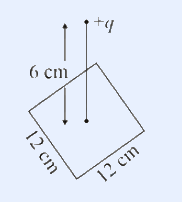
A point charge of is at a distance cm vertically above the centre of a square of side cm as shown in figure. The magnitude of the electric flux through the square will be __________ .
SolutionAnswer: 226
Approach:
Place the charge at the centre of an imaginary cube of side equal to the square, so the square is one face, and apply Gauss law with the flux split equally among six faces.
Step 1:
Step 2:
Step 3:
Final answer: 226
Q27NumericalCurrent Electricity
A cylindrical wire of radius mm and conductivity is subjected to an electric field of mV . The expected value of current in the wire will be mA. The value of x is __________.
SolutionAnswer: 5
Approach:
Use the microscopic form of Ohm law to get current density, multiply by cross-sectional area, and match to the given form.
Step 1:
Step 2:
Step 3:
Step 4:
Final answer: 5
Q28NumericalElectromagnetic Induction and Alternating Currents
A series LCR circuit is designed to resonate at an angular frequency . The circuit draws W power from V source at resonance. The value of resistance R in the circuit is __________ .
SolutionAnswer: 900
Approach:
At resonance the impedance is purely resistive, so the average power equals the square of the source voltage divided by the resistance.
Step 1:
Step 2:
Final answer: 900
Q29NumericalElectromagnetic Waves
An electromagnetic wave of frequency GHz enters a dielectric medium of relative electric permittivity from vacuum. The wavelength of this wave in that medium will be __________ cm.
SolutionAnswer: 667
Approach:
Find the vacuum wavelength from the frequency, then divide by the refractive index, which is the square root of the relative permittivity.
Step 1:
Step 2:
Step 3:
Final answer: 667
Q30NumericalElectromagnetic Waves
A signal of kW is transmitted in a cable. The attenuation of cable is dB per km and cable length is km. The power received at the receiver is W. The value of x is __________. [Gain in dB ]
SolutionAnswer: 8
Approach:
Compute the total attenuation over the cable length, apply the dB gain definition, and solve for the received power.
Step 1:
Step 2:
Step 3:
Final answer: 8
Chemistry30 questions
Q31Single correctAtomic Structure
According to Bohr's atomic theory:
(A) Kinetic energy of electron is .
(B) The product of velocity (v) of electron and principal quantum number (n), .
(C) Frequency of revolution of electron in an orbit is .
(D) Coulombic force of attraction on the electron is .
Choose the most appropriate answer from the options given below:
(A) Kinetic energy of electron is .
(B) The product of velocity (v) of electron and principal quantum number (n), .
(C) Frequency of revolution of electron in an orbit is .
(D) Coulombic force of attraction on the electron is .
Choose the most appropriate answer from the options given below:
(1)
(2)
(3)
(4)
SolutionAnswer: Option 2
Approach:
Apply Bohr model relations for radius, velocity, energy, frequency and force and test each statement.
Step 1:
Step 2:
Step 3:
Step 4:
Final answer:
Q32Single correctChemical Bonding and Molecular Structure
The correct set from the following in which both pairs are in correct order of melting point is:
(1)
(2)
(3)
(4)
SolutionAnswer: Option 4
Approach:
Compare lattice energies; higher charge and smaller anion give higher melting point.
Step 1:
Step 2:
Final answer:
Q33Single correctChemical Bonding and Molecular Structure
The correct shape and bond angles respectively in ion are:
(1)
(2)
(3)
(4)
SolutionAnswer: Option 4
Approach:
Determine hybridisation and geometry of the central iodine in triiodide using VSEPR.
Step 1:
Step 2:
Step 3:
Final answer:
Q34Single correctClassification of Elements and Periodicity in Properties
Given below are two statements: one is labelled as Assertion A and the other is labelled as Reason R.
Assertion A: Hydrogen is the most abundant element in the Universe, but it is not the most abundant gas in the troposphere.
Reason R: Hydrogen is the lightest element.
In the light of the above statements, choose the correct answer from the options given below:
Assertion A: Hydrogen is the most abundant element in the Universe, but it is not the most abundant gas in the troposphere.
Reason R: Hydrogen is the lightest element.
In the light of the above statements, choose the correct answer from the options given below:
(1)
(2)
(3)
(4)
SolutionAnswer: Option 2
Approach:
Evaluate the truth of the assertion and reason and whether the reason explains the assertion.
Step 1:
Step 2:
Final answer:
Q35Single correctPrinciples Related to Practical Chemistry
Match List - I with List - II.
| List-I (Salt) | List-II (Flame colour wavelength) |
|---|---|
| (a). | (i). |
| (b). | (ii). |
| (c). | (iii). |
| (d). | (iv). |
(1)
(2)
(3)
(4)
SolutionAnswer: Option 4
Approach:
Match each alkali metal chloride to its characteristic flame emission wavelength.
Step 1:
Step 2:
Step 3:
Step 4:
Final answer:
Q36Single correctHydrocarbons
Which one of the following compounds is non-aromatic?
(1)
(2)
(3)
(4)
SolutionAnswer: Option 3
Approach:
Apply Huckel's rule and check planarity to decide aromatic, antiaromatic or non-aromatic character.
Step 1:
Step 2:
Step 3:
Step 4:
Final answer:
Q37Single correctOrganic Compounds Containing Nitrogen
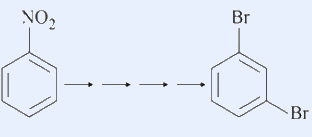
What is the correct sequence of reagents used for converting nitrobenzene into m-dibromobenzene?
(1)
(2)
(3)
(4)
SolutionAnswer: Option 2
Approach:
Use the nitro group as a meta-director, then convert via diazonium to introduce a second bromine at the position vacated by the amino group.
Step 1:
Step 2:
Step 3:
Step 4:
Final answer:
Q38Single correctOrganic Compounds Containing Halogens
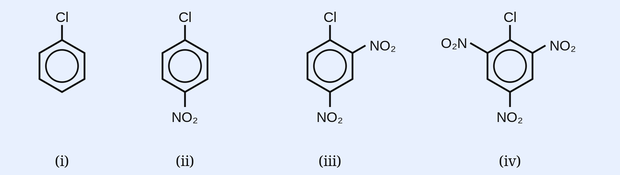
The correct order of the following compounds showing increasing tendency towards nucleophilic substitution reaction is:
(1)
(2)
(3)
(4)
SolutionAnswer: Option 2
Approach:
More electron-withdrawing nitro groups (especially ortho/para to Cl) increase reactivity in aromatic nucleophilic substitution.
Step 1:
Step 2:
Step 3:
Step 4:
Final answer:
Q39Single correctPrinciples Related to Practical Chemistry
Given below are two statements:
Statement I: The value of the parameter "Biochemical Oxygen Demand (BOD)" is important for survival of aquatic life.
Statement II: The optimum value of BOD is .
In the light of the above statements, choose the most appropriate answer from the options given below:
Statement I: The value of the parameter "Biochemical Oxygen Demand (BOD)" is important for survival of aquatic life.
Statement II: The optimum value of BOD is .
In the light of the above statements, choose the most appropriate answer from the options given below:
(1)
(2)
(3)
(4)
SolutionAnswer: Option 1
Approach:
Judge each statement against standard water-quality criteria for BOD.
Step 1:
Step 2:
Final answer:
Q40Single correctSome Basic Principles of Organic Chemistry
Most suitable salt which can be used for efficient clotting of blood will be?
(1)
(2)
(3)
(4)
SolutionAnswer: Option 1
Approach:
Identify the salt providing high-charge cations that coagulate the negatively charged blood colloid most effectively.
Step 1:
Step 2:
Final answer:
Q41Single correctd- and f-Block Elements
Match List - I with List - II.
| List-I (Metal) | List-II (Ores) |
|---|---|
| (a). | (i). |
| (b). | (ii). |
| (c). | (iii). |
| (d). | (iv). |
(1)
(2)
(3)
(4)
SolutionAnswer: Option 4
Approach:
Match each metal to its characteristic ore by composition.
Step 1:
Step 2:
Step 3:
Step 4:
Final answer:
Q42Single correctd- and f-Block Elements
The incorrect statement among the following is:
(1)
(2)
(3)
(4)
SolutionAnswer: Option 4
Approach:
Assess each statement and identify the false one.
Step 1:
Step 2:
Step 3:
Step 4:
Final answer:
Q43Single correctd- and f-Block Elements
What is the correct order of the following elements with respect to their density?
(1)
(2)
(3)
(4)
SolutionAnswer: Option 3
Approach:
Order the elements by their known densities.
Step 1:
Step 2:
Final answer:
Q44Single correctCoordination Compounds
The calculated magnetic moments (spin only value) for species , and respectively are:
(1)
(2)
(3)
(4)
SolutionAnswer: Option 1
Approach:
Determine the number of unpaired electrons for each species and apply the spin-only formula.
Step 1:
Step 2:
Step 3:
Final answer:
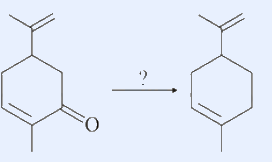
Q45Single correctOrganic Compounds Containing Oxygen
Which of the following reagent is suitable for the preparation of the product in the above reaction?
(1)
(2)
(3)
(4)
SolutionAnswer: Option 3
Approach:
The carbonyl group is reduced to a methylene while the carbon-carbon double bonds are retained, indicating Wolff-Kishner reduction.
Step 1:
Step 2:
Final answer:
Q46Single correctHydrocarbons
Which one of the following carbonyl compounds cannot be prepared by addition of water on an alkyne in the presence of and ?
(1)
(2)
(3)
(4)
SolutionAnswer: Option 1
Approach:
Acid-catalysed hydration of an alkyne (oxymercuration) follows Markovnikov addition, so terminal alkynes other than ethyne give methyl ketones and only ethyne gives an aldehyde; identify the carbonyl that cannot arise this way.
Step 1:
Step 2:
Step 3:
Final answer:
Q47Single correctOrganic Compounds Containing Nitrogen
The diazonium salt of which of the following compounds will form a coloured dye on reaction with -Naphthol in NaOH?
(1)
(2)
(3)
(4)
SolutionAnswer: Option 2
Approach:
Azo dye formation by coupling with beta-naphthol requires a benzene diazonium salt, which forms only from a primary aromatic amine bearing the amino group directly on the ring.
Step 1:
Step 2:
azo dye
Step 3:
N,N-dimethylaniline, benzylamine, N-methylaniline
Final answer:
Q48Single correctOrganic Compounds Containing Oxygen
Match List - I with List - II.
| List-I (Salt) | List-II (Flame colour wavelength) |
|---|---|
| a. | i. |
| b. | ii. |
| c. | iii. |
| d. | iv. |
(1)
(2)
(3)
(4)
SolutionAnswer: Option 1(a)-(ii), (b)-(iv), (c)-(i), (d)-(iii)
Approach:
Match each named organic transformation in List-I with the reagent in List-II that effects it.
Step 1:
Step 2:
Step 3:
Step 4:
Final answer: (a)-(ii), (b)-(iv), (c)-(i), (d)-(iii)
Q49Single correctSome Basic Principles of Organic Chemistry
In polymer Buna-S 'S' stands for:
(1)
(2)
(3)
(4)
SolutionAnswer: Option 4Styrene
Approach:
Recall the composition of Buna-S, a synthetic copolymer rubber.
Step 1:
Buna-S = 1,3-butadiene + styrene copolymer
Final answer: Styrene
Q50Single correctBiomolecules
Match List - I with List - II.
| List-I | List-II |
|---|---|
| a. Valium | i. Antifertility drug |
| b. Morphine | ii. Pernicious anaemia |
| c. Norethindrone | iii. Analgesic |
| d. Vitamin | iv. Tranquilizer |
(1)
(2)
(3)
(4)
SolutionAnswer: Option 4(a)-(iv), (b)-(iii), (c)-(i), (d)-(ii)
Approach:
Match each medicinal compound in List-I with its pharmacological role in List-II.
Step 1:
Valium
Step 2:
Morphine
Step 3:
Norethindrone
Step 4:
Vitamin B12
Final answer: (a)-(iv), (b)-(iii), (c)-(i), (d)-(ii)
Q51NumericalSome Basic Concepts in Chemistry
The formula of a gaseous hydrocarbon which requires 6 times of its own volume of for complete oxidation and produces 4 times its own volume of is . The value of y is __________.
SolutionAnswer: 8
Approach:
Use Gay-Lussac's law of combining volumes for the combustion stoichiometry of the hydrocarbon to find the number of hydrogen atoms.
Step 1:
Step 2:
Step 3:
Final answer: 8
Q52NumericalPrinciples Related to Practical Chemistry
1.86 g of aniline completely reacts to form acetanilide. 10% of the product is lost during purification. Amount of acetanilide obtained after purification (in g) is __________ .
SolutionAnswer: 243
Approach:
Convert the mass of aniline to moles, find the theoretical mass of acetanilide formed in a 1:1 conversion, then apply the 10% loss.
Step 1:
Step 2:
Step 3:
Final answer: 243
Q53NumericalSome Basic Concepts in Chemistry
The volume occupied by 4.75 g of acetylene gas at and 740 mm Hg pressure is __________ L.
(Rounded off to the nearest integer)
[Given ]
(Rounded off to the nearest integer)
[Given ]
SolutionAnswer: 5
Approach:
Find moles of acetylene from its mass, then apply the ideal gas law with temperature in kelvin and pressure in atm.
Step 1:
Step 2:
Step 3:
Final answer: 5
Q54NumericalChemical Thermodynamics
Assuming ideal behaviour, the magnitude of log K for the following reaction at is . The value of x is __________. (Integer answer)
[Given:
]
[Given:
]
SolutionAnswer: 855
Approach:
Compute the standard Gibbs energy of the trimerisation of ethyne to benzene from formation energies, then convert to log K using the standard relation.
Step 1:
Step 2:
Step 3:
Final answer: 855
Q55NumericalEquilibrium
The solubility product of is . The solubility of lead iodide in 0.1 molar solution of lead nitrate is mol /L. The value of x is __________ (Rounded off to the nearest integer)
[Given ]
[Given ]
SolutionAnswer: 141
Approach:
Account for the common ion effect of lead nitrate, treating the lead-ion concentration as 0.1 M, then solve the solubility-product expression for the solubility of lead iodide.
Step 1:
Step 2:
Step 3:
Final answer: 141
Q56NumericalSolutions
freezes at . The temperature at which a solution of 10 g of in 200 g of freeze is __________ . (nearest integer value), (The molal freezing point depression constant of is .)
SolutionAnswer: 1
Approach:
Compute the molality of the butane solution, apply the freezing point depression equation, and subtract the depression from the freezing point of pure benzene.
Step 1:
Step 2:
Step 3:
Final answer: 1
Q57NumericalRedox Reactions and Electrochemistry
The magnitude of the change in oxidising power of the couple is V if the concentration is decreased from 1 M to M at . (Assume concentration of and to be same on change in concentration). The value of x is __________.
(Rounded off to the nearest integer)
[Given: ]
(Rounded off to the nearest integer)
[Given: ]
SolutionAnswer: 3776
Approach:
Write the Nernst equation for the permanganate-manganese couple including the eight hydrogen ions, and evaluate the change in electrode potential caused only by the drop in hydrogen-ion concentration.
Step 1:
Step 2:
Step 3:
Final answer: 3776
Q58NumericalChemical Kinetics
Sucrose hydrolyses in acid solution into glucose and fructose following first order rate law with a half-life of 3.33 h at . After 9 h, the fraction of sucrose remaining is f. The value of is __________ .
(Rounded off to the nearest integer)
[Assume: ln10 = 2.303, ln 2 = 0.693]
(Rounded off to the nearest integer)
[Assume: ln10 = 2.303, ln 2 = 0.693]
SolutionAnswer: 81
Approach:
Obtain the first-order rate constant from the half-life, then use the integrated first-order rate law to find the logarithm of the reciprocal of the remaining fraction at the given time.
Step 1:
Step 2:
Step 3:
Final answer: 81
Q59Numericalp-Block Elements
Among the following allotropic forms of sulphur, the number of allotropic forms, which will show paramagnetism is __________.
(A) -sulphur
(B) -sulphur
(C) -form
(A) -sulphur
(B) -sulphur
(C) -form
SolutionAnswer: 1
Approach:
Determine the magnetic behaviour of each allotrope from its molecular structure and electron configuration.
Step 1:
alpha-sulphur and beta-sulphur are S8 rings
Step 2:
form has two unpaired electrons in antibonding pi orbitals
Step 3:
count of paramagnetic forms = 1
Final answer: 1
Q60NumericalOrganic Compounds Containing Nitrogen
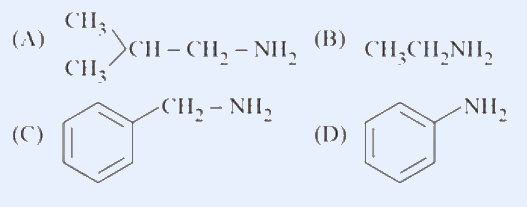
The total number of amines among the following which can be synthesized by Gabriel synthesis is __________.
SolutionAnswer: 3
Approach:
Gabriel phthalimide synthesis gives only primary amines from alkyl halides and fails for aromatic amines because aryl halides do not undergo the required nucleophilic substitution; count the structures that qualify.
Step 1:
(CH3)2CH-CH2-NH2 (isobutylamine)
Step 2:
CH3CH2NH2 (ethylamine)
Step 3:
C6H5-CH2-NH2 (benzylamine)
Step 4:
C6H5-NH2 (aniline)
Final answer: 3
Mathematics30 questions
Q61Single correctComplex Numbers and Quadratic Equations
Let a, b, c be in arithmetic progression. Let the centroid of the triangle with vertices (a, c), and (a, b) be . If are the roots of the equation , then the value of is:
(1)
(2)
(3)
(4)
SolutionAnswer: Option 1
Approach:
Use the AP condition and the centroid coordinates to find , then form the quadratic and evaluate the symmetric expression.
Step 1:
Step 2:
with
Step 3:
Step 4:
Step 5:
Final answer:
Q62Single correctPermutations and Combinations
If is a positive integer, then the sum of the series is
(1)
(2)
(3)
(4)
SolutionAnswer: Option 2
Approach:
Apply the hockey-stick identity to the bracketed sum, then combine with the leading term.
Step 1:
Step 2:
Step 3:
Final answer:
Q63Single correctLimit, Continuity and Differentiability
If P is a point on the parabola which is closest to the straight line , then the co-ordinates of P are:
(1)
(2)
(3)
(4)
SolutionAnswer: Option 3
Approach:
The closest point on the parabola has a tangent parallel to the given line, so equate the parabola's slope to the line's slope.
Step 1:
Step 2:
Final answer:
Q64Single correctSets, Relations and Functions
The negation of the statement is:
(1)
(2)
(3)
(4)
SolutionAnswer: Option 3
Approach:
Apply De Morgan's laws to negate the conjunction and simplify.
Step 1:
Step 2:
Final answer:
Q65Single correctSets, Relations and Functions
For the statements p and q, consider the following compound statements:
Then which of the following statements is correct?
Then which of the following statements is correct?
(1)
(2)
(3)
(4)
SolutionAnswer: Option 2 and both are tautologies.
Approach:
Evaluate each compound statement over all truth assignments of and .
Step 1:
(a): is true only when q false and p false, where is true, so (a) holds for all assignments
Step 2:
(b): is true only when p false and q true, where q is true, so (b) holds for all assignments
Final answer: and both are tautologies.
Q66Single correctTrigonometry
The angle of elevation of a jet plane from a point A on the ground is . After a flight of seconds at the speed of km / hour, the angle of elevation changes to . If the jet plane is flying at a constant height, then its height is:
(1)
(2)
(3)
(4)
SolutionAnswer: Option 1
Approach:
Convert speed to find horizontal distance covered, then use the two elevation angles to set up the height relation.
Step 1:
Step 2:
Step 3:
Final answer:
Q67Single correctMatrices and Determinants
For the system of linear equations:
Consider the following statements:
(A) The system has unique solution if .
(B) The system has unique solution if .
(C) The system has unique solution if .
(D) The system has no-solution if .
(E) The system has infinite number of solutions if .
Which of the following statements are correct?
Consider the following statements:
(A) The system has unique solution if .
(B) The system has unique solution if .
(C) The system has unique solution if .
(D) The system has no-solution if .
(E) The system has infinite number of solutions if .
Which of the following statements are correct?
(1)
(2)
(3)
(4)
SolutionAnswer: Option 3 and only
Approach:
Compute the coefficient determinant to locate non-unique cases, then test consistency at the critical values of .
Step 1:
Step 2:
unique solution, so (A) holds
Step 3:
: the equations become inconsistent no solution, so (D) holds
Step 4:
: the system reduces to infinitely many solutions, so (E) is false
Final answer: and only
Q68Single correctMatrices and Determinants
Let A and B be real matrices such that A is a symmetric matrix and B is a skew-symmetric matrix. Then the system of linear equations , where X is a column matrix of unknown variables and O is a null matrix, has
(1)
(2)
(3)
(4)
SolutionAnswer: Option 2infinitely many solutions
Approach:
Determine the symmetry type of the coefficient matrix to find its determinant, then classify the homogeneous system.
Step 1:
since
Step 2:
Step 3:
M is a skew-symmetric matrix
Step 4:
with infinitely many solutions
Final answer: infinitely many solutions
Q69Single correctTrigonometry
A possible value of is:
(1)
(2)
(3)
(4)
SolutionAnswer: Option 4
Approach:
Let the inner inverse-sine be , express via the double-angle identities, and solve for .
Step 1:
Step 2:
Step 3:
satisfies the relation
Final answer:
Q70Single correctCo-ordinate Geometry
For which of the following curves, the line is the tangent at the point ?
(1)
(2)
(3)
(4)
SolutionAnswer: Option 3
Approach:
Require the given point to lie on the curve and the implicit slope there to equal the line's slope.
Step 1:
, so the point lies on
Step 2:
Final answer:
Q71Single correctLimit, Continuity and Differentiability
Let be defined as
Let . Then A is equal to:
Let . Then A is equal to:
(1)
(2)
(3)
(4)
SolutionAnswer: Option 2
Approach:
Differentiate each piece and determine the sub-intervals where the derivative is positive within the respective domains.
Step 1:
: , decreasing
Step 2:
: for , so increasing on
Step 3:
: for all , so increasing on
Final answer:
Q72Single correctLimit, Continuity and Differentiability
If the curve , passes through the point and the tangent line to this curve at origin is , then the possible values of a,\ b,\ c are:
(1)
(2)
(3)
(4)
SolutionAnswer: Option 3
Approach:
Use passage through the given point, passage through the origin, and the tangent slope at the origin to solve for the coefficients.
Step 1:
Tangent at origin and
Step 2:
Final answer:
Q73Single correctIntegral Calculus
The value of the integral, , where [x] denotes the greatest integer less than or equal to x, is
(1)
(2)
(3)
(4)
SolutionAnswer: Option 4
Approach:
Write the integrand as , find the sub-intervals where the floor is constant, and sum the contributions.
Step 1:
On : floor ; on : floor
Step 2:
On : floor ; on : floor
Step 3:
Final answer:
Q74Single correctIntegral Calculus
The area of the region: is
(1)
(2)
(3)
(4)
SolutionAnswer: Option 2 square units
Approach:
Find the intersection abscissae of the two parabolas, then integrate the vertical gap between them.
Step 1:
Step 2:
Final answer: square units
Q75Single correctLimit, Continuity and Differentiability
Let f be a twice differentiable function defined on R such that and for all . If , for all , then the value of lies in the interval
(1)
(2)
(3)
(4)
SolutionAnswer: Option 4
Approach:
Expand the determinant into a differential relation, integrate to obtain explicitly, then evaluate .
Step 1:
Step 2:
using
Step 3:
Final answer:
Q76Single correctDifferential Equations
If a curve passes through the point and satisfies , then for what value of b, ?
(1)
(2)
(3)
(4)
SolutionAnswer: Option 2
Approach:
Recognize the left side as the derivative of a product and integrate to find f(x), then impose the definite integral condition to solve for b.
Step 1:
Step 2:
Step 3:
Step 4:
Step 5:
Step 6:
Step 7:
Final answer:
Q77Single correctIntegral Calculus
Let f(x) be a differentiable function defined on such that for all , and . Then the value of is
(1)
(2)
(3)
(4)
SolutionAnswer: Option 2
Approach:
Use the symmetry condition to show f(x)+f(2-x) is constant, then apply the integral property.
Step 1:
Step 2:
Step 3:
Step 4:
Final answer:
Q78Single correctThree Dimensional Geometry
The vector equation of the plane passing through the intersection of the planes and , and the point is:
(1)
(2)
(3)
(4)
SolutionAnswer: Option 1
Approach:
Form the family of planes through the line of intersection and fix the parameter using the given point.
Step 1:
Step 2:
Step 3:
Step 4:
Step 5:
Final answer:
Q79Single correctThree Dimensional Geometry
Let . If the mirror image of the point with respect to the line is , then is equal to:
(1)
(2)
(3)
(4)
SolutionAnswer: Option 4
Approach:
Impose that the midpoint of P and its image lies on the line and that PQ is perpendicular to the line direction.
Step 1:
Step 2:
Step 3:
Step 4:
Final answer:
Q80Single correctStatistics and Probability
The probability that two randomly selected subsets of the set have exactly two elements in their intersection, is:
(1)
(2)
(3)
(4)
SolutionAnswer: Option 4
Approach:
Count ordered pairs of subsets and the favourable assignments where exactly two elements lie in both.
Step 1:
Step 2:
Step 3:
Final answer:
Q81NumericalComplex Numbers and Quadratic Equations
The number of the real roots of the equation is ________.
SolutionAnswer: 2
Approach:
Split the modulus into two cases and count valid real roots in each region.
Step 1:
Step 2:
Step 3:
Final answer: 2
Q82NumericalComplex Numbers and Quadratic Equations
Let . If , and be the greatest integral part of . Then is equal to ________.
SolutionAnswer: 310
Approach:
Evaluate the complex expression to find k, take the integral part, then compute the difference of the two sums.
Step 1:
Step 2:
Step 3:
Step 4:
Final answer: 310
Q83NumericalPermutations and Combinations
The students are to be divided into 3 groups A,\ B and C such that each group has at least one student and the group C has at most 3 students. Then the total number of possibilities of forming such groups is ________.
SolutionAnswer: 31650
Approach:
Sum over the possible sizes of group C, choosing its members and distributing the rest into A and B with each non-empty.
Step 1:
Step 2:
Step 3:
Step 4:
Final answer: 31650
Q84NumericalSequence and Series
The sum of first four terms of a geometric progression (G. P. ) is and the sum of their respective reciprocals is . If the product of first three terms of the G. P. is 1, and the third term is , then is ________.
SolutionAnswer: 3
Approach:
Use the ratio of the sum to the sum of reciprocals together with the product condition to find the third term.
Step 1:
Step 2:
Step 3:
Step 4:
Step 5:
Final answer: 3
Q85NumericalBinomial Theorem and its Simple Applications
For integers n and r, let . The maximum value of k for which the sum is maximum, is equal to ________.
SolutionAnswer: 12
Approach:
Apply Vandermonde's identity to each sum and combine using Pascal's rule, then locate the maximizing index.
Step 1:
Step 2:
Step 3:
Step 4:
Final answer: 12
Q86NumericalCo-ordinate Geometry
Let a point P be such that its distance from the point is thrice the distance of P from the point . If the locus of the point P is a circle of radius r, then (in the nearest integer) is equal to ________.
SolutionAnswer: 56
Approach:
Set up the distance condition, square it to obtain the circle equation, and extract the radius.
Step 1:
Step 2:
Step 3:
Step 4:
Final answer: 56
Q87NumericalStatistics and Probability
If the variance of 10 natural numbers is less than 10, then the maximum possible value of k is ________.
SolutionAnswer: 11
Approach:
Express the variance of nine ones and k, impose the inequality, and find the largest natural number k.
Step 1:
Step 2:
Step 3:
Step 4:
Final answer: 11
Q88NumericalSets, Relations and Functions
If and , then the value of the expression is ________.
SolutionAnswer: 2
Approach:
Replace x by 1/x to obtain a second relation, solve the linear system for f(x) and f(1/x), then form the required ratio.
Step 1:
Step 2:
Step 3:
Step 4:
Final answer: 2
Q89NumericalCo-ordinate Geometry
If the area of the triangle formed by the x-axis, the normal and the tangent to the circle at the point is A, then is equal to ________.
SolutionAnswer: 1225
Approach:
Find the tangent and normal lines at the given point, locate their x-axis intercepts, and compute the triangle area.
Step 1:
Step 2:
Step 3:
Step 4:
Step 5:
Final answer: 1225
Q90NumericalThree Dimensional Geometry
Let be an integer. If the shortest distance between the lines and is , then the value of is ________.
SolutionAnswer: 1
Approach:
Write each line in point-direction form, apply the shortest-distance formula, set it equal to the given value, and select the integer solution.
Step 1:
Step 2:
Step 3:
Step 4:
Step 5:
Final answer: 1
More JEE Main 2021 papers
Frequently Asked Questions
How many questions are in the JEE Main 2021 February 24, Shift 2 paper?
The JEE Main 2021 February 24, Shift 2 paper has 90 questions — Physics (30), Chemistry (30) and Mathematics (30). Every question is on this page with its correct answer and a step-by-step solution.
What is the marking scheme for JEE Main?
JEE Main awards +4 marks for each correct answer and −1 for a wrong answer, with 0 for questions left unattempted. The paper covers Physics, Chemistry and Mathematics.
Are the answer key and step-by-step solutions provided for the 2021 February 24, Shift 2 paper?
Yes — every question shows the correct answer (answer key) and a detailed step-by-step solution, free to read online.
Can I take the JEE Main 2021 February 24, Shift 2 paper as a timed mock test?
Yes. With a free JEEnify account you can attempt this exact paper as a timed test in the real exam interface, then see your score and weak-area analysis.
Solved this paper? Calculate your JEE Main scoremost important chaptersformula sheetsall free tools.