
Back to JEE Main PYQs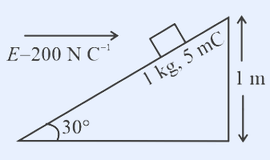


JEE Main 2021 February 26, Shift 2 Question Paper with Solutions
All 90 questions from the JEE Main 2021 (February 26, Shift 2) shift — Physics (30), Chemistry (30) and Mathematics (30) — each with the correct answer (answer key) and a step-by-step solution. Read it free online, or attempt the full paper as a timed mock test.
Physics30 questions
Q1Single correctCurrent Electricity
A wire of has a length of m. It is stretched till its length increases by . The percentage change in resistance to the nearest integer is :
(1)
(2)
(3)
(4)
SolutionAnswer: Option 4
Approach:
At constant volume the resistance varies as the square of length, so a length increase fixes the new resistance and hence the percentage change.
Step 1:
Step 2:
Step 3:
Final answer:
Q2Single correctUnits and Measurements
If C and V represent capacity and voltage respectively then what are the dimensions of where ?
(1)
(2)
(3)
(4)
SolutionAnswer: Option 1
Approach:
Divide the dimensional formula of capacitance by that of potential difference.
Step 1:
Step 2:
Final answer:
Q3Single correctKinematics
A scooter accelerates from rest for time at constant rate and then retards at constant rate for time and comes to rest. The correct value of will be :
(1)
(2)
(3)
(4)
SolutionAnswer: Option 1
Approach:
Equate the peak velocity reached during acceleration to the velocity lost during retardation.
Step 1:
Step 2:
Step 3:
Final answer:
Q4Single correctKinematics
The trajectory of a projectile in a vertical plane is , where and are constants and x & y are respectively the horizontal and vertical distances of the projectile from the point of projection. The angle of projection and the maximum height attained H are respectively given by
(1)
(2)
(3)
(4)
SolutionAnswer: Option 4
Approach:
The launch angle is the slope at the origin; the maximum height is the y value where the slope vanishes.
Step 1:
Step 2:
Step 3:
Step 4:
Final answer:
Q5Single correctLaws of Motion
An inclined plane making an angle of with the horizontal is placed in a uniform horizontal electric field as shown in the figure. A body of mass kg and charge mC is allowed to slide down from rest at a height of m. If the coefficient of friction is , find the time taken by the body to reach the bottom.
(1)
(2)
(3)
(4)
SolutionAnswer: Option 2 s
Approach:
Resolve gravity and the horizontal electric force along and perpendicular to the incline, find the net acceleration down the slope, then apply kinematics over the slope length.
Step 1:
Step 2:
Step 3:
Step 4:
Step 5:
Final answer: s
Q6Single correctLaws of Motion
Two masses and , each of mass are fixed together by a massless spring, A force acts on the mass as shown in figure. If the mass starts moving away from mass with acceleration , then the acceleration of mass will be :
(1)
(2)
(3)
(4)
SolutionAnswer: Option 4
Approach:
The spring force on A is the only force on A, fixing its value; apply Newton's second law to B with the external force and the spring reaction.
Step 1:
Step 2:
Step 3:
Final answer:
Q7Single correctRotational Motion
A cord is wound round the circumference of wheel of radius , The axis of the wheel is horizontal and the moment of inertia about it is . A weight is attached to the cord at the end. The weight falls from rest. After falling through a distance h, the square of angular velocity of wheel will be
(1)
(2)
(3)
(4)
SolutionAnswer: Option 1
Approach:
Apply energy conservation: the loss in gravitational potential energy equals the combined translational kinetic energy of the weight and rotational kinetic energy of the wheel, with the constraint v equals omega r.
Step 1:
Step 2:
Step 3:
Final answer:
Q8Single correctProperties of Solids and Liquids
The length of metallic wire is when tension in it is . It is when the tension is . The original length of the wire will be :
(1)
(2)
(3)
(4)
SolutionAnswer: Option 3
Approach:
Express each stretched length using Hooke's law about the natural length, then eliminate the elastic constant between the two equations.
Step 1:
Step 2:
Step 3:
Final answer:
Q9Single correctKinetic Theory of Gases
The internal energy (U), pressure (P) and volume (V) of an ideal gas are related as . The gas is
(1)
(2)
(3)
(4)
SolutionAnswer: Option 2polyatomic only
Approach:
Compare the given relation with the kinetic-theory expression for internal energy to read off the degrees of freedom.
Step 1:
Step 2:
Step 3:
Final answer: polyatomic only
Q10Single correctOscillations and Waves
Given below are two statements:
Statement I: A second's pendulum has a time period of 1 second.
Statement II: It takes precisely one second to move between the two extreme positions. In the light of the above statements,
choose the correct answer from the options given below
Statement I: A second's pendulum has a time period of 1 second.
Statement II: It takes precisely one second to move between the two extreme positions. In the light of the above statements,
choose the correct answer from the options given below
(1)
(2)
(3)
(4)
SolutionAnswer: Option 1Statement I is false but Statement II is true
Approach:
Recall the definition of a second's pendulum and the meaning of motion between extreme positions.
Step 1:
Step 2:
Final answer: Statement I is false but Statement II is true
Q11Single correctOscillations and Waves
A particle executes S.H.M., the graph of velocity as a function of displacement is :
(1)
(2)
(3)
(4)
SolutionAnswer: Option 4an ellipse
Approach:
Write the velocity-displacement relation for simple harmonic motion and recognise its conic form.
Step 1:
Step 2:
Final answer: an ellipse
Q12Single correctOscillations and Waves
A tuning fork A of unknown frequency produces beats with a fork of known frequency Hz. When fork A is filed, the beat frequency decreases to beats . What is the frequency of fork A ?
(1)
(2)
(3)
(4)
SolutionAnswer: Option 1 Hz
Approach:
Use the two possible frequencies from the initial beat count and decide using the effect of filing, which raises a fork's frequency.
Step 1:
Step 2:
Step 3:
Final answer: Hz
Q13Single correctElectrostatics
Given below are two statements
Statement I : An electric dipole is placed at the centre of a hollow sphere. The flux of electric field through the sphere is zero, but the electric field is not zero anywhere in the sphere.
Statement II : If is the radius of a solid metallic sphere and be the total charge on it. The electric field at any point on the spherical surface of radius is zero but the electric flux passing through this closed spherical surface of radius is not
In the light of the above statements, choose the correct answer from the options given below:
Statement I : An electric dipole is placed at the centre of a hollow sphere. The flux of electric field through the sphere is zero, but the electric field is not zero anywhere in the sphere.
Statement II : If is the radius of a solid metallic sphere and be the total charge on it. The electric field at any point on the spherical surface of radius is zero but the electric flux passing through this closed spherical surface of radius is not
In the light of the above statements, choose the correct answer from the options given below:
(1)
(2)
(3)
(4)
SolutionAnswer: Option 3Statement I is true but Statement II is false
Approach:
Apply Gauss's law to each described situation and compare the enclosed charge with the claims about field and flux.
Step 1:
Step 2:
Step 3:
Final answer: Statement I is true but Statement II is false
Q14Single correctElectromagnetic Induction and Alternating Currents
An aeroplane, with its wings spread m, is flying at a speed of km in a horizontal direction. The total intensity of earth's field at that part is Wb and the angle of dip is . The emf induced between the tips of the plane wings will be
(1)
(2)
(3)
(4)
SolutionAnswer: Option 1 mV
Approach:
Only the vertical component of the earth's field contributes to the motional emf across the horizontal wings; compute it from the dip angle.
Step 1:
Step 2:
Step 3:
Step 4:
Final answer: mV
Q15Single correctElectromagnetic Induction and Alternating Currents
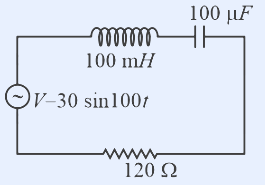
Find the peak current and resonant frequency of the following circuit (as shown in figure).
(1)
(2)
(3)
(4)
SolutionAnswer: Option 4 A and Hz
Approach:
Compute the inductive and capacitive reactances at the driving angular frequency, find the impedance and hence the peak current, then evaluate the resonant frequency from L and C.
Step 1:
Step 2:
Step 3:
Step 4:
Final answer: A and Hz
Q16Single correctOptics
Given below are two statements : one is labeled as Assertion and the other is labeled as Reason .
Assertion : For a simple microscope, the angular size of the object equals the angular size of the image.
Reason : Magnification is achieved as the small object can be kept much closer to the eye than 25 cm and hence it subtends a large angle. In the light of the above statements, choose the most appropriate answer from the options given below:
Assertion : For a simple microscope, the angular size of the object equals the angular size of the image.
Reason : Magnification is achieved as the small object can be kept much closer to the eye than 25 cm and hence it subtends a large angle. In the light of the above statements, choose the most appropriate answer from the options given below:
(1)
(2)
(3)
(4)
SolutionAnswer: Option 4Both and are true and is the correct explanation of
Approach:
Evaluate the assertion and reason about angular magnification of a simple microscope.
Step 1:
A simple microscope produces a virtual, erect, magnified image; the eye sees the image and the object subtends the same angle at the eye as the image.
Step 2:
The object is placed within the focal length, closer than the least distance of distinct vision , so it subtends a larger angle, giving angular magnification.
Final answer: Both and are true and is the correct explanation of
Q17Single correctOptics
The incident ray, reflected ray and the outward drawn normal are denoted by the unitvectors and respectively. Then choose the correct relation for these vectors.
(1)
(2)
(3)
(4)
SolutionAnswer: Option 3
Approach:
Apply the vector law of reflection about the surface normal.
Step 1:
Reflection reverses the normal component of the incident unit vector while keeping the tangential component unchanged.
Step 2:
with the outward normal.
Final answer:
Q18Single correctAtoms and Nuclei
The recoil speed of a hydrogen atom after it emits a photon in going from state to state will be
(1)
(2)
(3)
(4)
SolutionAnswer: Option 1
Approach:
Use conservation of momentum: the photon momentum equals the recoil momentum of the atom for the transition (stem prints , a paper typo).
Step 1:
Step 2:
Final answer:
Q19Single correctAtoms and Nuclei
A radioactive sample is undergoing decay, At any time , its activity is A and another time , the activity is . What is the average life time for the sample ?
(1)
(2)
(3)
(4)
SolutionAnswer: Option 3
Approach:
Relate activities at two times by exponential decay and express mean life as the reciprocal of the decay constant.
Step 1:
Step 2:
Final answer:
Q20Single correctElectronic Devices
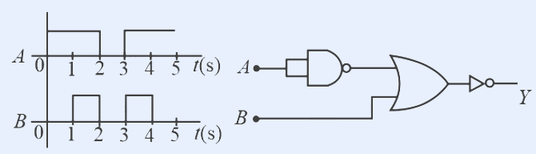
Draw the output signal in the given combination of gates.
(1)
(2)
(3)
(4)
SolutionAnswer: Option 1
Approach:
Read input waveforms A and B, pass A through the NAND gate, OR with B, then invert to get Y.
Step 1:
A is high during to and to ; B is high during to and to .
Step 2:
The two-input NAND with both inputs A acts as NOT A; OR with B then inverted by the final NOT gives .
Step 3:
A=1,B=0 during to and to .
Final answer: Output waveform of option (1)
Q21NumericalGravitation
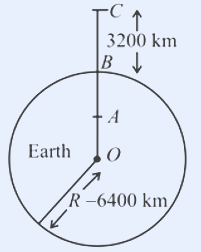
In the reported figure of earth, the value of acceleration due to gravity is same at point A and C but it is smaller than that of its value at point B (surface of the earth). The value of OA : AB will be . The value of x is ______
SolutionAnswer: 4
Approach:
Set the gravitational acceleration inside the earth at A equal to that above the surface at C, with B on the surface, using km and at km above the surface.
Step 1:
with km, km, km.
Step 2:
Step 3:
;
Final answer: 4
Q22NumericalKinetic Theory of Gases
1 mole of rigid diatomic gas performs a work of when heat Q is supplied to it. The molar heat capacity of the gas during this transformation is . The value of x is
[R universal gas constant ]
[R universal gas constant ]
SolutionAnswer: 25
Approach:
Apply the first law with for one mole of a rigid diatomic gas and express the molar heat capacity.
Step 1:
Step 2:
Step 3:
Final answer: 25
Q23NumericalThermodynamics
The volume V of a given mass of monoatomic gas changes with temperature T according to the relation . The workdone when temperature changes by 90 K will be xR. The value of x is
[R universal gas constant ]
[R universal gas constant ]
SolutionAnswer: 60
Approach:
Express pressure from the ideal gas law using and integrate P\,dV over the temperature change.
Step 1:
;
Step 2:
Step 3:
Final answer: 60
Q24NumericalOscillations and Waves
A particle executes S.H.M. with amplitude A and time period T. The displacement of the particle when its speed is half of maximum speed is . The value of x is
SolutionAnswer: 3
Approach:
Use the SHM velocity relation with speed equal to half the maximum speed to find the displacement.
Step 1:
Step 2:
Step 3:
Final answer: 3
Q25NumericalOscillations and Waves
Time period of a simple pendulum is T. The time taken to complete oscillations starting from mean position is . The value of is ______
SolutionAnswer: 7
Approach:
Track the pendulum bob from the mean position through successive extreme and mean crossings to cover five-eighths of an oscillation.
Step 1:
From the mean position, a half oscillation (mean to mean) takes , reaching mean again after passing one extreme.
Step 2:
The remaining one-eighth of an oscillation from the mean covers a quarter swing toward the next extreme; the bob travels to amplitude and the total covers of the motion in time .
Step 3:
Final answer: 7
Q26NumericalElectrostatics
27 similar drops of mercury are maintained at 10 V each. All these spherical drops combine into a single big drop. The potential energy of the bigger drop is ______ times that of a smaller drop.
SolutionAnswer: 243
Approach:
Relate the big drop radius and charge to a small drop, then compare electrostatic self-energies.
Step 1:
; total charge .
Step 2:
Final answer: 243
Q27NumericalOptics
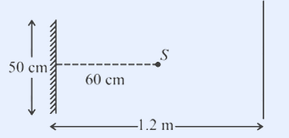
A point source of light S, placed at a distance 60 cm infront of the centre of a plane mirror of width 50 cm, hangs vertically on a wall. A man walks infront of the mirror along a line parallel to the mirror at a distance 1.2 m from it (see in the figure). The distance between the extreme points where he can see the image of the light source in the mirror is ______ cm
SolutionAnswer: 150
Approach:
Locate the image behind the mirror and use similar triangles through the mirror edges projected onto the man's line of motion.
Step 1:
Image S' lies behind the mirror; the man is in front, so S' to man's line .
Step 2:
Each mirror edge is from the axis at from S'; spread on the man's line each side.
Step 3:
Total span
Final answer: 150
Q28NumericalDual Nature of Matter and Radiation
Two stream of photons, possessing energies equal to twice and ten times the work function of metal are incident on the metal surface successively. The value of ratio of maximum velocities of the photoelectrons emitted in the two respective cases is . The value of is
SolutionAnswer: 1
Approach:
Apply the photoelectric equation to each photon energy and take the ratio of resulting maximum velocities.
Step 1:
;
Step 2:
Step 3:
Final answer: 1
Q29NumericalElectronic Devices
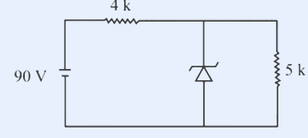
The zener diode has a V. The current passing through the diode for the following circuit is ______ mA.
SolutionAnswer: 9
Approach:
Hold the load voltage at the zener voltage, find the series and load currents, and take their difference for the diode current.
Step 1:
Load (5 k) voltage , so
Step 2:
Step 3:
Final answer: 9
Q30NumericalElectromagnetic Waves
If the highest frequency modulating a carrier is 5 kHz, then the number of broadcast stations accommodated in a 90 kHz bandwidth are
SolutionAnswer: 9
Approach:
Find the bandwidth needed per AM station (twice the highest modulating frequency) and divide the total bandwidth by it.
Step 1:
Step 2:
Final answer: 9
Chemistry30 questions
Q31Single correctClassification of Elements and Periodicity in Properties
The correct order of electron gain enthalpy is:
(1)
(2)
(3)
(4)
SolutionAnswer: Option 3
Approach:
Rank the group-16 elements by the magnitude (most negative) of their electron gain enthalpy, accounting for the anomalously low value of oxygen.
Step 1:
Step 2:
Step 3:
Final answer:
Q32Single correctp-Block Elements
Which pair of oxides is acidic in nature?
(1)
(2)
(3)
(4)
SolutionAnswer: Option 4
Approach:
Classify each listed oxide as acidic, basic or amphoteric and find the pair where both members are acidic.
Step 1:
Step 2:
Step 3:
Final answer:
Q33Single correctp-Block Elements
Given below are two statements: one is labelled as Assertion A and the other is labelled as Reason R.
Assertion A : In Tl, isomorphous to Cs, the metal is present in +1 oxidation state.
Reason R : Tl metal has fourteen f electrons in its electronic configuration.
In the light of the above statements, choose the most appropriate answer from the options given below:
Assertion A : In Tl, isomorphous to Cs, the metal is present in +1 oxidation state.
Reason R : Tl metal has fourteen f electrons in its electronic configuration.
In the light of the above statements, choose the most appropriate answer from the options given below:
(1)
(2)
(3)
(4)
SolutionAnswer: Option 4Both A and R are correct but R is NOT the correct explanation of A
Approach:
Evaluate the truth of the assertion and the reason independently, then test whether the reason explains the assertion.
Step 1:
Step 2:
Step 3:
Final answer: Both A and R are correct but R is NOT the correct explanation of A
Q34Single correctChemical Bonding and Molecular Structure
Match List-I with List-II.
| List-I | List-II |
|---|---|
| (a). | (i). |
| (b). | (ii). |
| (c). | (iii). |
| (d). | (iv). |
(1)
(2)
(3)
(4)
SolutionAnswer: Option 2(a) (iii), (b) (iv), (c) (i), (d) (ii)
Approach:
Use molecular orbital theory to assign the bond order of each diatomic molecule.
Step 1:
Step 2:
Step 3:
Step 4:
Final answer: (a) (iii), (b) (iv), (c) (i), (d) (ii)
Q35Single correctp-Block Elements
Calgon is used for water treatment. Which of the following statement is NOT true about Calgon?
(1)
(2)
(3)
(4)
SolutionAnswer: Option 2Calgon contains the 2 most abundant element by weight in the Earth's crust.
Approach:
Recall the composition and water-softening action of Calgon and test each statement for correctness.
Step 1:
Step 2:
Step 3:
Final answer: Calgon contains the 2 most abundant element by weight in the Earth's crust.
Q36Single correctAtomic Structure
Which of the following forms of hydrogen emits low energy particles?
(1)
(2)
(3)
(4)
SolutionAnswer: Option 3
Approach:
Identify the radioactive isotope of hydrogen and its decay mode.
Step 1:
Step 2:
Final answer:
Q37Single correctSome Basic Principles of Organic Chemistry
In molecule, the hybridization of carbon 1, 2, 3 and 4 respectively, are :
(1)
(2)
(3)
(4)
SolutionAnswer: Option 2
Approach:
Assign hybridization to each carbon from the number of sigma bonds plus lone pairs (steric number).
Step 1:
Step 2:
Step 3:
Step 4:
Final answer:
Q38Single correctSome Basic Concepts in Chemistry
The nature of charge on resulting colloidal particles when FeC is added to excess of hot water is:
(1)
(2)
(3)
(4)
SolutionAnswer: Option 1positive
Approach:
Identify the colloid formed and the ions it preferentially adsorbs to determine its charge.
Step 1:
Step 2:
Final answer: positive
Q39Single correctd- and f-Block Elements
Match List-I with List-II.
| List-I | List-II |
|---|---|
| (a). Sodium Carbonate | (i). Deacon |
| (b). Titanium | (ii). Castner-Kellner |
| (c). Chlorine | (iii). van-Arkel |
| (d). Sodium hydroxide | (iv). Solvay |
(1)
(2)
(3)
(4)
SolutionAnswer: Option 4(a) (iv), (b) (iii), (c) (i), (d) (ii)
Approach:
Associate each substance with the industrial process used in its manufacture or purification.
Step 1:
Step 2:
Step 3:
Step 4:
Final answer: (a) (iv), (b) (iii), (c) (i), (d) (ii)
Q40Single correctd- and f-Block Elements
Match List-I with List-II.
| List-I | List-II |
|---|---|
| (a). Siderite | (i). Cu |
| (b). Calamine | (ii). Ca |
| (c). Malachite | (iii). Fe |
| (d). Cryolite | (iv). Al |
| (v). Zn |
(1)
(2)
(3)
(4)
SolutionAnswer: Option 3(a) (iii), (b) (v), (c) (i), (d) (iv)
Approach:
Identify the metal contained in each named ore/mineral.
Step 1:
Step 2:
Step 3:
Step 4:
Final answer: (a) (iii), (b) (v), (c) (i), (d) (iv)
Q41Single correctOrganic Compounds Containing Halogens
Match List-I with List-II.
| List-I | List-II |
|---|---|
| (a). | (i). Wurtz reaction |
| (b). | (ii). Sandmeyer reaction |
| (c). | (iii). Fittig reaction |
| (d). | (iv). Gatterman reaction |
(1)
(2)
(3)
(4)
SolutionAnswer: Option 4(a) (ii), (b) (iv), (c) (i), (d) (iii)
Approach:
Name each reaction in List-I and pair it with the correct named reaction in List-II.
Step 1:
Step 2:
Step 3:
Step 4:
Final answer: (a) (ii), (b) (iv), (c) (i), (d) (iii)
Q42Single correctOrganic Compounds Containing Halogens
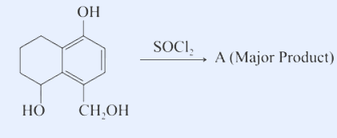
Identify A in the given reaction.
(1)
(2)
(3)
(4)
SolutionAnswer: Option 2DRAWN: tetralin bearing OH on the aromatic ring (top), Cl on the saturated-ring carbon (bottom-left) and CCl on the aromatic ring (bottom)
Approach:
Apply the selective action of SOCl2: it converts alcoholic (aliphatic and benzylic) hydroxyl groups to chlorides but leaves phenolic hydroxyl groups unchanged.
Step 1:
Step 2:
Step 3:
Final answer: DRAWN: tetralin bearing OH on the aromatic ring (top), Cl on the saturated-ring carbon (bottom-left) and CCl on the aromatic ring (bottom)
Q43Single correctHydrocarbons
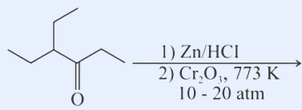
Considering the above reaction, the major product among the following is:
(1)
(2)
(3)
(4)
SolutionAnswer: Option 4DRAWN: benzene ring bearing a group (ethylbenzene)
Approach:
Step 1 (Zn/HCl, Clemmensen) reduces the ketone carbonyl to a methylene; step 2 (Cr2O3, 773 K, 10-20 atm) is catalytic reductive aromatization (dehydrocyclization) of the resulting alkane.
Step 1:
Step 2:
Step 3:
Final answer: DRAWN: benzene ring bearing a group (ethylbenzene)
Q44Single correctOrganic Compounds Containing Oxygen
2, 4 DNP test can be used to identify :
(1)
(2)
(3)
(4)
SolutionAnswer: Option 1aldehyde
Approach:
Recall the functional group detected by 2,4-dinitrophenylhydrazine (Brady's reagent).
Step 1:
Step 2:
Final answer: aldehyde
Q45Single correctOrganic Compounds Containing Oxygen
Identify A in the given chemical reaction.
(1)
(2)
(3)
(4)
SolutionAnswer: Option 2DRAWN: benzene fused to a seven-membered carbocyclic ring carrying a on a ring double bond (a benzo-fused cycloheptene carbaldehyde)
Approach:
The substrate has two ortho -CH2CH2CHO chains; dilute NaOH promotes an intramolecular aldol condensation between the two aldehyde chains.
Step 1:
Step 2:
Step 3:
Final answer: DRAWN: benzene fused to a seven-membered carbocyclic ring carrying a on a ring double bond (a benzo-fused cycloheptene carbaldehyde)
Q46Single correctOrganic Compounds Containing Oxygen
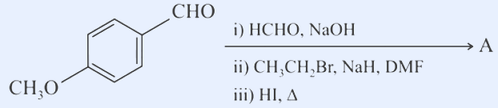
Identify in the following chemical reaction.
(1)
(2)
(3)
(4)
SolutionAnswer: Option 14-hydroxybenzyl iodide (--, para)
Approach:
Track each functional group transformation: crossed Cannizzaro on the aldehyde, Williamson etherification of the benzylic alcohol, then HI cleavage of both ethers.
Step 1:
Step 2:
Step 3:
Step 4:
Final answer: 4-hydroxybenzyl iodide (--, para)
Q47Single correctOrganic Compounds Containing Nitrogen
Ceric ammonium nitrate and / alc. KOH are used for the identification of functional groups present in ___ and ___ respectively.
(1)
(2)
(3)
(4)
SolutionAnswer: Option 2alcohol, amine
Approach:
Match each reagent to the functional group it identifies.
Step 1:
Ceric ammonium nitrate gives a red colouration with alcohols.
Step 2:
/ alc. KOH is the carbylamine test, positive for primary amines.
Final answer: alcohol, amine
Q48Single correctOrganic Compounds Containing Nitrogen
A. Phenyl methanamine
B. N, N-Dimethylaniline
C. N-Methyl aniline
D. Benzenamine
Choose the correct order of basic nature of the above amines.
B. N, N-Dimethylaniline
C. N-Methyl aniline
D. Benzenamine
Choose the correct order of basic nature of the above amines.
(1)
(2)
(3)
(4)
SolutionAnswer: Option 1
Approach:
Rank basicity using the absence of direct ring conjugation and the number of electron-donating alkyl groups on nitrogen.
Step 1:
A is benzylamine (); the lone pair is not conjugated with the ring, making it the strongest base.
Step 2:
Among the aryl amines, two N-methyl groups (B) donate more electron density than one (C), which donates more than none (D).
Step 3:
Combining: .
Final answer:
Q49Single correctBiomolecules
Match List-I with List-II.
| List-I | List-II |
|---|---|
| (a). Sucrose | (i). |
| (b). Lactose | (ii). |
| (c). Maltose | (iii). |
(1)
(2)
(3)
(4)
SolutionAnswer: Option 3
Approach:
Identify the monosaccharide units released on hydrolysis of each disaccharide.
Step 1:
Sucrose hydrolyses to and .
Step 2:
Lactose hydrolyses to and .
Step 3:
Maltose hydrolyses to two units.
Final answer:
Q50Single correctBiomolecules
Seliwanoff test and Xanthoproteic test are used for the identification of ___ and ___ respectively.
(1)
(2)
(3)
(4)
SolutionAnswer: Option 2ketoses, proteins
Approach:
Match each named test to the species it detects.
Step 1:
Seliwanoff test gives a rapid red colour with ketoses, distinguishing them from aldoses.
Step 2:
Xanthoproteic test gives a yellow colour with proteins bearing aromatic residues.
Final answer: ketoses, proteins
Q51NumericalSome Basic Concepts in Chemistry
The weighed out to make 50 mL of an aqueous solution containing 70.0 mg per mL . (Rounded off to the nearest integer) [Given : Atomic weight in Na : 23; N : 14; O : 16]
SolutionAnswer: 13
Approach:
Find total sodium ions, convert to moles, then to mass of sodium nitrate.
Step 1:
Step 2:
Step 3:
Step 4:
Final answer: 13
Q52NumericalAtomic Structure
A ball weighing 10 g is moving with a velocity of 90 . If the uncertainty in its velocity is 5%, then the uncertainty in its position is _ m. (Rounded off to the nearest integer) [Given: Js]
SolutionAnswer: 1
Approach:
Apply the Heisenberg uncertainty principle with the velocity uncertainty taken as 5% of the speed.
Step 1:
Step 2:
Step 3:
Final answer: 1
Q53NumericalChemical Thermodynamics
The average bond energy in kJ of is _. (Rounded off to the nearest integer) [Given : The values of standard enthalpy of formation of , and are , 275 and 80 kJ respectively.]
SolutionAnswer: 309
Approach:
Form SF6 from gaseous atoms; the enthalpy of that step equals minus six S-F bond energies.
Step 1:
Step 2:
Step 3:
Final answer: 309
Q54NumericalEquilibrium
The pH of ammonium phosphate solution, if of phosphoric acid and of ammonium hydroxide are 5.23 and 4.75 respectively, is
SolutionAnswer: 7
Approach:
Ammonium phosphate is a salt of a weak acid and a weak base; apply the salt-of-weak-acid-weak-base pH relation.
Step 1:
Step 2:
Final answer: 7
Q55NumericalRedox Reactions and Electrochemistry
In mildly alkaline medium, thiosulphate ion is oxidized by to "". The oxidation state of sulphur in "" is_
SolutionAnswer: 6
Approach:
Identify the oxidation product of thiosulphate by permanganate in mildly alkaline medium and assign the oxidation state of sulphur in it.
Step 1:
Step 2:
In :
Final answer: 6
Q56NumericalSome Basic Concepts in Chemistry
The number of octahedral voids per lattice site in a lattice is_. (Rounded off to the nearest integer)
SolutionAnswer: 1
Approach:
Recall the standard count of octahedral voids relative to lattice points in close packing.
Step 1:
In a close-packed lattice the number of octahedral voids equals the number of lattice points.
Final answer: 1
Q57NumericalSolutions
When 12.2 g of benzoic acid is dissolved in 100 g of water, the freezing point of solution was found to be ( K kg ). The number (n) of benzoic acid molecules associated (assuming 100% association) is _.
SolutionAnswer: 2
Approach:
Find the van't Hoff factor from the freezing point depression, then deduce the association number for complete association.
Step 1:
Step 2:
Step 3:
Final answer: 2
Q58NumericalRedox Reactions and Electrochemistry
Emf of the following cell at 298 K in V is
The value of x is _ (Rounded off to the nearest integer)
[Given : V; V; ]
The value of x is _ (Rounded off to the nearest integer)
[Given : V; V; ]
SolutionAnswer: 147
Approach:
Compute the standard cell potential, then apply the Nernst equation with n = 2 for the Zn-Ag cell.
Step 1:
Step 2:
Step 3:
Step 4:
Final answer: 147
Q59NumericalChemical Kinetics
If the activation energy of a reaction is 80.9 kJ , the fraction of molecules at 700 K, having enough energy to react to form products is . The value of x is (Rounded off to the nearest integer) [Use J ]
SolutionAnswer: 14
Approach:
The fraction of molecules with energy above the activation energy is the Boltzmann factor; identify x as the exponent.
Step 1:
Step 2:
Final answer: 14
Q60NumericalCoordination Compounds
The number of stereo isomers possible for is _. [ox = oxalate]
SolutionAnswer: 3
Approach:
Treat the complex as an octahedral M(AA)2bc type with two bidentate oxalates and two different monodentate ligands, and count geometrical and optical isomers.
Step 1:
The complex is of type with AA = oxalate, b = Br, c = NH3.
Step 2:
The trans arrangement of b and c is achiral, giving one isomer; the cis arrangement is chiral, giving a pair of enantiomers.
Step 3:
Total stereoisomers .
Final answer: 3
Mathematics30 questions
Q61Single correctPermutations and Combinations
A natural number has prime factorization given by , where y and z are such that and . Then the number of odd divisors of n, including 1, is:
(1)
(2)
(3)
(4)
SolutionAnswer: Option 1
Approach:
Determine and from the two given relations, then count odd divisors from the odd part of the factorization.
Step 1:
Step 2:
Step 3:
Step 4:
Final answer:
Q62Single correctSequence and Series
The sum of the series is equal to
(1)
(2)
(3)
(4)
SolutionAnswer: Option 4
Approach:
Express the numerator in terms of and so each term reduces to standard series for e and .
Step 1:
Step 2:
Step 3:
Step 4:
Final answer:
Q63Single correctTrigonometry
If , and , then the value of is :
(1)
(2)
(3)
(4)
SolutionAnswer: Option 4
Approach:
Recognize each bracketed expansion as the logarithm series and use the inverse-tangent sum condition.
Step 1:
Step 2:
Step 3:
Step 4:
Final answer:
Q64Single correctCo-ordinate Geometry
If the locus of the mid-point of the line segment from the point to a point on the circle, is a circle of radius r, then r is equal to
(1)
(2)
(3)
(4)
SolutionAnswer: Option 4
Approach:
Parametrize the midpoint and substitute the circle constraint to obtain the locus.
Step 1:
Step 2:
Step 3:
Final answer:
Q65Single correctCo-ordinate Geometry
Let and be two points. Let P be a point on the circle , such that have maximum value, then the points, P,\ A and B lie on
(1)
(2)
(3)
(4)
SolutionAnswer: Option 2a straight line
Approach:
Write the sum of squared distances using the midpoint of and maximize over the circle to locate .
Step 1:
Step 2:
Step 3:
; maximum of the expression occurs at , giving
Step 4:
all satisfy
Final answer: a straight line
Q66Single correctLimit, Continuity and Differentiability
Let f(x) be a differentiable function at with and . Then equals:
(1)
(2)
(3)
(4)
SolutionAnswer: Option 3
Approach:
The limit is a form; rewrite to expose the derivative definition or apply L'Hopital.
Step 1:
Step 2:
Step 3:
Final answer:
Q67Single correctSets, Relations and Functions
Let and be two logical expressions. Then :
(1)
(2)
(3)
(4)
SolutionAnswer: Option 2 is not a tautology but is a tautology
Approach:
Simplify each expression using De Morgan and the implication identity, then test for tautology.
Step 1:
Step 2:
Step 3:
Final answer: is not a tautology but is a tautology
Q68Single correctMatrices and Determinants
Consider the following system of equations:
where and are real constants. Then the system of equations :
where and are real constants. Then the system of equations :
(1)
(2)
(3)
(4)
SolutionAnswer: Option 3has infinite number of solutions when
Approach:
Evaluate the coefficient determinant; since it vanishes, find the consistency condition on the constants.
Step 1:
Step 2:
Step 3:
Final answer: has infinite number of solutions when
Q69Single correctPermutations and Combinations
Let and be defined as Then the number of possible functions such that is:
(1)
(2)
(3)
(4)
SolutionAnswer: Option 4
Approach:
Determine the image of , force to fix those elements, and count free choices for the rest.
Step 1:
Step 2:
Step 3:
Final answer:
Q70Single correctSets, Relations and Functions
Let and . If , then the domain of the function fog is
(1)
(2)
(3)
(4)
SolutionAnswer: Option 3
Approach:
Require for , using the redefined value at .
Step 1:
Step 2:
Step 3:
Final answer:
Q71Single correctLimit, Continuity and Differentiability
Let be defined as If f(x) is continuous on R, then equals :
(1)
(2)
(3)
(4)
SolutionAnswer: Option 4
Approach:
Match left and right limits to the middle branch at the junction points and .
Step 1:
Step 2:
Step 3:
Final answer:
Q72Single correctLimit, Continuity and Differentiability
The triangle of maximum area that can be inscribed in a given circle of radius is :
(1)
(2)
(3)
(4)
SolutionAnswer: Option 1An equilateral triangle having each of its side of length .
Approach:
The maximum-area inscribed triangle is equilateral; relate its side to the circumradius.
Step 1:
Step 2:
Final answer: An equilateral triangle having each of its side of length .
Q73Single correctIntegral Calculus
For , if , then is equal to
(1)
(2)
(3)
(4)
SolutionAnswer: Option 2
Approach:
Substitute in and combine with f(e) to obtain a clean integral.
Step 1:
Step 2:
Step 3:
Final answer:
Q74Single correctDifferential Equations
Let be a differentiable function for all . Then f(x) equals :
(1)
(2)
(3)
(4)
SolutionAnswer: Option 4
Approach:
Differentiate the integral equation to get a first-order linear ODE, use the initial value at .
Step 1:
Step 2:
Step 3:
Step 4:
Final answer:
Q75Single correctIntegral Calculus
Let be the area of the region bounded by the curves and y-axis in the first quadrant. Also, let be the area of the region bounded by the curves -axis and in the first quadrant. Then,
(1)
(2)
(3)
(4)
SolutionAnswer: Option 2 and
Approach:
Use the intersection at to integrate the bounded regions for and .
Step 1:
Step 2:
Step 3:
Step 4:
Final answer: and
Q76Single correctDifferential Equations
Let slope of the tangent line to a curve at any point P(x,y) be given by . If the curve intersects the line at , then the value of y, for which the point lies on the curve, is :
(1)
(2)
(3)
(4)
SolutionAnswer: Option 3
Approach:
Solve the Bernoulli differential equation from the given slope, apply the intersection condition to find the constant, then evaluate at the required abscissa.
Step 1:
Step 2:
Step 3:
Step 4:
Step 5:
Final answer:
Q77Single correctVector Algebra
If vectors and are collinear, then a possible unit vector parallel to the vector is:
(1)
(2)
(3)
(4)
SolutionAnswer: Option 4
Approach:
Use the collinearity condition to express the components, identify the resultant vector, and normalise it.
Step 1:
Step 2:
Step 3:
Step 4:
Final answer:
Q78Single correctThree Dimensional Geometry
Let L be a line obtained from the intersection of two planes and . If point is the foot of perpendicular from on L, then the value of equals:
(1)
(2)
(3)
(4)
SolutionAnswer: Option 1
Approach:
Parametrise the line of intersection, impose perpendicularity from the external point, solve for the parameter, and evaluate the foot.
Step 1:
Step 2:
Step 3:
Step 4:
Step 5:
Final answer:
Q79Single correctThree Dimensional Geometry
If the mirror image of the point with respect to the plane is , then equals :
(1)
(2)
(3)
(4)
SolutionAnswer: Option 2
Approach:
Apply the reflection formula across the plane using the normal vector and the signed value of the point.
Step 1:
Step 2:
Step 3:
Step 4:
Final answer:
Q80Single correctStatistics and Probability
A seven digit number is formed using digits . The probability, that number so formed is divisible by , is
(1)
(2)
(3)
(4)
SolutionAnswer: Option 2
Approach:
Count total distinct arrangements of the multiset and favourable arrangements ending in an even digit.
Step 1:
Step 2:
Step 3:
Final answer:
Q81NumericalSequence and Series
Let and be two real numbers such that and . Let , and for some integer . Then, the value of is ______.
SolutionAnswer: 324
Approach:
Use the linear recurrence satisfied by power sums of the roots of .
Step 1:
are roots of
Step 2:
Step 3:
Final answer: 324
Q82NumericalComplex Numbers and Quadratic Equations
Let z be those complex numbers which satisfy and , . If the maximum value of is , then the value of is
SolutionAnswer: 48
Approach:
Translate the constraints into a disk and a half-plane in the Cartesian plane, then maximise the squared distance from .
Step 1:
Step 2:
maximise
Step 3:
circle line :
Step 4:
Step 5:
Final answer: 48
Q83NumericalPermutations and Combinations
The total number of -digit numbers whose greatest common divisor with is is ______.
SolutionAnswer: 1000
Approach:
Numbers with with are odd multiples of that are not divisible by ; count such -digit numbers.
Step 1:
count with odd,
Step 2:
direct enumeration yields
Final answer: 1000
Q84NumericalSequence and Series
If the arithmetic mean and the geometric mean of the and terms of the sequence satisfy the equation , then is equal to ______.
SolutionAnswer: 10
Approach:
Identify the GP, take the roots of the quadratic as the AM and GM values, and find the term indices that produce them.
Step 1:
roots
Step 2:
Step 3:
Final answer: 10
Q85NumericalCo-ordinate Geometry
Let L be a common tangent line to the curves and . Then the square of the slope of the line L is ______.
SolutionAnswer: 3
Approach:
Write the tangent-line condition for the ellipse and for the circle, then equate the two expressions for the intercept squared.
Step 1:
Step 2:
Step 3:
Final answer: 3
Q86NumericalStatistics and Probability
Let be eighteen observations such that and , where and are distinct real numbers. If the standard deviation of these observations is , then the value of is ______.
SolutionAnswer: 4
Approach:
Express the mean via the first sum, expand the second sum about the mean, and use the variance to solve for the offset.
Step 1:
Step 2:
Step 3:
Step 4:
Final answer: 4
Q87NumericalMatrices and Determinants
If the matrix satisfies the equation for some real numbers and , then is equal to ______.
SolutionAnswer: 4
Approach:
Compute the relevant powers of the matrix entrywise and match against the right-hand side to solve for the scalars.
Step 1:
Step 2:
solving the entry equations gives
Step 3:
Final answer: 4
Q88NumericalDifferential Equations
Let the normals at all the points on a given curve pass through a fixed point (a,b). If the curve passes through and , given that , then is equal to ______.
SolutionAnswer: 9
Approach:
A curve all of whose normals pass through one point is a circle centred at that point; impose equal distances to the two given points and the linear condition.
Step 1:
equidistance from center
Step 2:
solving with gives
Step 3:
Final answer: 9
Q89NumericalLimit, Continuity and Differentiability
Let a be an integer such that all the real roots of the polynomial lie in the interval . Then, is equal to ______.
SolutionAnswer: 2
Approach:
Locate the real root by sign analysis of the polynomial and identify the unit interval containing it.
Step 1:
the polynomial has a single real root
Step 2:
root
Step 3:
Final answer: 2
Q90NumericalIntegral Calculus
If , for , and , , then equals ______.
SolutionAnswer: 1
Approach:
Recognise as the Beta function and apply the standard identity reducing the given integral to it.
Step 1:
the substitution maps the integral to B(m,n)
Step 2:
integral
Final answer: 1
More JEE Main 2021 papers
Frequently Asked Questions
How many questions are in the JEE Main 2021 February 26, Shift 2 paper?
The JEE Main 2021 February 26, Shift 2 paper has 90 questions — Physics (30), Chemistry (30) and Mathematics (30). Every question is on this page with its correct answer and a step-by-step solution.
What is the marking scheme for JEE Main?
JEE Main awards +4 marks for each correct answer and −1 for a wrong answer, with 0 for questions left unattempted. The paper covers Physics, Chemistry and Mathematics.
Are the answer key and step-by-step solutions provided for the 2021 February 26, Shift 2 paper?
Yes — every question shows the correct answer (answer key) and a detailed step-by-step solution, free to read online.
Can I take the JEE Main 2021 February 26, Shift 2 paper as a timed mock test?
Yes. With a free JEEnify account you can attempt this exact paper as a timed test in the real exam interface, then see your score and weak-area analysis.
Solved this paper? Calculate your JEE Main scoremost important chaptersformula sheetsall free tools.