
Back to JEE Main PYQs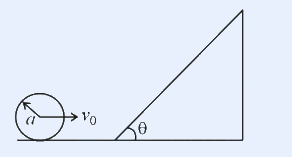

JEE Main 2021 February 25, Shift 2 Question Paper with Solutions
All 90 questions from the JEE Main 2021 (February 25, Shift 2) shift — Physics (30), Chemistry (30) and Mathematics (30) — each with the correct answer (answer key) and a step-by-step solution. Read it free online, or attempt the full paper as a timed mock test.
Physics30 questions
Q1Single correctUnits and Measurements
If e is the electronic charge, c is the speed of light in free space and h is Planck's constant, the quantity has dimensions of :
(1)
(2)
(3)
(4)
SolutionAnswer: Option 2
Approach:
Identify the given combination as the fine-structure constant and determine its dimensions.
Step 1:
has dimensions of energy times length,
Step 2:
hc has dimensions of energy times length,
Step 3:
Final answer:
Q2Single correctKinematics
A stone is dropped from the top of a building. When it crosses a point m below the top, another stone starts to fall from a point m below the top. Both stones reach the bottom of building simultaneously. The height of the building is :
(1)
(2)
(3)
(4)
SolutionAnswer: Option 2 m
Approach:
Use free fall kinematics to find when the first stone reaches the 5 m mark, then equate total fall times of both stones.
Step 1:
at m, reached after s
Step 2:
for the first stone over total time T
Step 3:
for the second stone
Step 4:
s
Step 5:
m
Final answer: m
Q3Single correctRotational Motion
A sphere of radius a and mass m rolls along a horizontal plane with constant speed . It encounters an inclined plane at angle and climbs upward. Assuming that it rolls without slipping, how far up the sphere will travel?
(1)
(2)
(3)
(4)
SolutionAnswer: Option 2
Approach:
Equate total kinetic energy of the rolling sphere to the gravitational potential energy gained along the incline.
Step 1:
Step 2:
Step 3:
Final answer:
Q4Single correctKinetic Theory of Gases
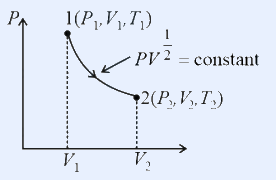
Thermodynamic process is shown below on a diagram for one mole of an ideal gas. If , then the ratio of temperature is :
(1)
(2)
(3)
(4)
SolutionAnswer: Option 1
Approach:
Use the process relation constant together with the ideal gas law to express temperature as a function of volume.
Step 1:
Step 2:
Step 3:
Final answer:
Q5Single correctKinetic Theory of Gases
Given below are two statements:
Statement I: In a diatomic molecule, the rotational energy at a given temperature obeys Maxwell's distribution.
Statement II : In a diatomic molecule, the rotational energy at a given temperature equals the translational kinetic energy for each molecule.
In the light of the above statements, choose the correct answer from the options given below:
Statement I: In a diatomic molecule, the rotational energy at a given temperature obeys Maxwell's distribution.
Statement II : In a diatomic molecule, the rotational energy at a given temperature equals the translational kinetic energy for each molecule.
In the light of the above statements, choose the correct answer from the options given below:
(1)
(2)
(3)
(4)
SolutionAnswer: Option 2Statement I is true but Statement II is false.
Approach:
Assess each statement against the kinetic theory of gases and the equipartition theorem for a diatomic molecule.
Step 1:
Molecular energies, including rotational, are distributed according to the Maxwell-Boltzmann statistics at a given temperature
Step 2:
(two rotational degrees of freedom) while (three translational degrees of freedom)
Step 3:
Final answer: Statement I is true but Statement II is false.
Q6Single correctOscillations and Waves
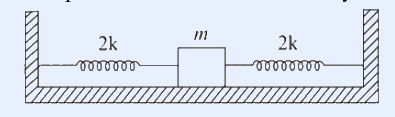
Two identical springs of spring constant are attached to a block of mass and to fixed support (see figure). When the mass is displaced from equilibrium position on either side, it executes simple harmonic motion. The time period of oscillations of this system is :
(1)
(2)
(3)
(4)
SolutionAnswer: Option 1
Approach:
Combine the two springs (both restoring on displacement) as parallel springs to find the effective constant, then apply the SHM period formula.
Step 1:
Step 2:
Final answer:
Q7Single correctOscillations and Waves
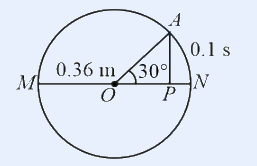
The point moves with a uniform speed along the circumference of a circle of radius m and covers in s. The perpendicular projection from on the diameter represents the simple harmonic motion of . The restoration force per unit mass when touches will be :
(1)
(2)
(3)
(4)
SolutionAnswer: Option 2 N
Approach:
Find the angular frequency from the arc-time data, then evaluate the SHM acceleration per unit mass at the extreme position (amplitude equal to the radius).
Step 1:
Step 2:
Step 3:
Final answer: N
Q8Single correctOscillations and Waves
is the time-displacement equation of a SHM. At the displacement of the particle is and it is moving along negative x-direction. Then the initial phase angle will be:
(1)
(2)
(3)
(4)
SolutionAnswer: Option 3
Approach:
Apply the displacement condition to fix the sine of the phase, then use the direction of motion to fix its quadrant through the sign of velocity.
Step 1:
Step 2:
Moving along negative direction requires , so
Step 3:
while
Final answer:
Q9Single correctElectrostatics
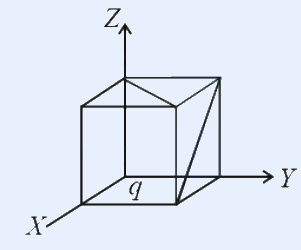
A charge q is placed at one corner of a cube as shown in figure. The flux of electrostatic field through the shaded area is:
(1)
(2)
(3)
(4)
SolutionAnswer: Option 2
Approach:
Use Gauss's law with the symmetry of a charge at a cube corner: enclose the charge with eight such cubes, then distribute the cube's flux among its non-adjacent faces.
Step 1:
A charge at a corner is shared by cubes, so flux through one cube
Step 2:
The three faces meeting at the corner carry zero flux (field is along them); the flux passes through the remaining faces
Step 3:
Final answer:
Q10Single correctMagnetic Effects of Current and Magnetism
In a ferromagnetic material, below the curie temperature, a domain is defined as:
(1)
(2)
(3)
(4)
SolutionAnswer: Option 1A macroscopic region with saturation magnetization.
Approach:
Recall the definition of a magnetic domain in a ferromagnet below the Curie temperature.
Step 1:
Within a domain, all atomic magnetic dipoles align in the same direction
Step 2:
Such complete alignment corresponds to saturation magnetization for that macroscopic region
Final answer: A macroscopic region with saturation magnetization.
Q11Single correctElectrostatics
An electron with kinetic energy enters between parallel plates of a capacitor at an angle with the plates. It leaves the plates at angle with kinetic energy . Then the ratio of kinetic energies will be :
(1)
(2)
(3)
(4)
SolutionAnswer: Option 4
Approach:
The electric field between the plates is perpendicular to them, so the velocity component parallel to the plates is unchanged; equate this component at entry and exit.
Step 1:
(parallel component conserved)
Step 2:
Step 3:
Final answer:
Q12Single correctElectronic Devices
Match List I with List II.
| List I | List II |
|---|---|
| (a). Rectifier | (i). Used either for stepping up or stepping down the A.C. voltage |
| (b). Stabilizer | (ii). Used to convert A.C. voltage into D.C. voltage |
| (c). Transformer | (iii). Used to remove any ripple in the rectified output voltage |
| (d). Filter | (iv). Used for constant output voltage even when the input voltage or load current change |
(1)
(2)
(3)
(4)
SolutionAnswer: Option 1(a) (ii), (b) (iv), (c) (i), (d) (iii)
Approach:
Match each device with its function based on the operation of a power supply chain.
Step 1:
Rectifier converts A.C. into D.C. (a)-(ii)
Step 2:
Stabilizer gives constant output despite input or load change (b)-(iv)
Step 3:
Transformer steps voltage up or down (c)-(i)
Step 4:
Filter removes ripple in the rectified output (d)-(iii)
Final answer: (a) (ii), (b) (iv), (c) (i), (d) (iii)
Q13Single correctElectromagnetic Induction and Alternating Currents
An L.C.R. circuit contains resistance of and a supply of V at angular frequency. If only capacitance is removed from the circuit, current lags behind the voltage by . If on the other hand, the only the inductor is removed the current leads by with the applied voltage. The R.M.S. current flowing in the circuit will be:
(1)
(2)
(3)
(4)
SolutionAnswer: Option 2 A
Approach:
Use the two phase conditions to relate the reactances to the resistance, conclude resonance for the full circuit, then apply Ohm's law for the rms current.
Step 1:
With C removed (R-L), lag
Step 2:
With L removed (R-C), lead
Step 3:
resonance, so
Step 4:
Final answer: A
Q14Single correctOptics
Consider the diffraction pattern obtained from the sunlight incident on a pinhole of diameter . If the diameter of the pinhole is slightly increased, it will affect the diffraction pattern such that
(1)
(2)
(3)
(4)
SolutionAnswer: Option 3its size decreases, but intensity increases
Approach:
Use the inverse relation between the angular width of a diffraction pattern and the aperture size, and the direct relation between transmitted light and aperture area.
Step 1:
Angular width , so increasing d decreases the size of the pattern
Step 2:
A larger aperture admits more light, so intensity increases
Final answer: its size decreases, but intensity increases
Q15Single correctDual Nature of Matter and Radiation
An electron of mass and a proton of mass are moving with the same speed. The ratio of their de Broglie wavelength will be :
(1)
(2)
(3)
(4)
SolutionAnswer: Option 1
Approach:
Apply the de Broglie relation at equal speeds, so the wavelength becomes inversely proportional to mass.
Step 1:
Step 2:
Final answer:
Q16Single correctDual Nature of Matter and Radiation
The stopping potential for electrons emitted from a photosensitive surface illuminated by light of wavelength nm is V. When the incident wavelength is changed to a new value, the stopping potential is V. The new wavelength is :
(1)
(2)
(3)
(4)
SolutionAnswer: Option 1 nm
Approach:
Apply the photoelectric equation at both wavelengths and eliminate the work function.
Step 1:
Step 2:
Step 3:
Final answer: nm
Q17Single correctAtoms and Nuclei
The wavelength of the photon emitted by a hydrogen atom when an electron makes a transition from to state is:
(1)
(2)
(3)
(4)
SolutionAnswer: Option 1 nm
Approach:
Apply the Rydberg formula for the Lyman transition .
Step 1:
Step 2:
Final answer: nm
Q18Single correctElectronic Devices
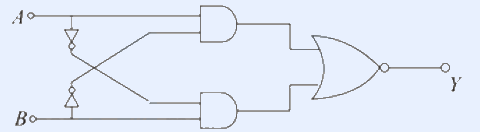
The truth table for the following logic circuit is :
(1)
(2)
(3)
(4)
SolutionAnswer: Option 1
Approach:
Trace the circuit: each input is inverted and cross-fed into two AND gates, whose outputs feed a NOR gate.
Step 1:
Top AND output ; bottom AND output
Step 2:
Step 3:
when and when
Final answer:
Q19Single correctElectronic Devices
For extrinsic semiconductors; when doping level is increased;
(1)
(2)
(3)
(4)
SolutionAnswer: Option 4Fermi-level of - type semiconductors will go downward and Fermi-level of - type semiconductor will go upward.
Approach:
Relate the position of the Fermi level to the dopant concentration in p-type and n-type material.
Step 1:
Increasing acceptor doping shifts of p-type closer to the valence band (downward).
Step 2:
Increasing donor doping shifts of n-type closer to the conduction band (upward).
Final answer: Fermi-level of - type semiconductors will go downward and Fermi-level of - type semiconductor will go upward.
Q20Single correctElectromagnetic Waves
If a message signal of frequency is amplitude modulated with a carrier signal of frequency and radiated through an antenna, the wavelength of the corresponding signal in air is
(1)
(2)
(3)
(4)
SolutionAnswer: Option 3
Approach:
The radiated electromagnetic wave is carried at the carrier frequency, so its wavelength uses .
Step 1:
Radiated signal frequency
Step 2:
Final answer:
Q21NumericalVector Algebra
If , the angle between and is . The value of will be ___.
SolutionAnswer: 180
Approach:
Use the anticommutative property of the cross product to constrain the angle.
Step 1:
Step 2:
Final answer: 180
Q22NumericalWork, Energy and Power
Two particles having masses g and g respectively are moving with equal kinetic energies. The ratio of the magnitudes of their linear momentum is . The value of n will be ___.
SolutionAnswer: 1
Approach:
Express momentum in terms of kinetic energy and mass, then take the ratio.
Step 1:
Step 2:
Final answer: 1
Q23NumericalGravitation
The initial velocity required to project a body vertically upward from the surface of the earth to reach a height of , where R is the radius of the earth, may be described in terms of escape velocity such that . The value of x will be
SolutionAnswer: 10
Approach:
Apply energy conservation for projection to height and compare with the escape velocity expression.
Step 1:
Step 2:
Step 3:
Final answer: 10
Q24NumericalThermodynamics
A reversible heat engine converts one-fourth of the heat input into work. When the temperature of the sink is reduced by K, its efficiency is doubled. The temperature in Kelvin of the source will be ___ .
SolutionAnswer: 208
Approach:
Use the Carnot efficiency for both cases and subtract to isolate the source temperature.
Step 1:
Step 2:
Step 3:
Final answer: 208
Q25NumericalOscillations and Waves
The percentage increase in the speed of transverse waves produced in a stretched string if the tension is increased by , will be ___ .
SolutionAnswer: 2
Approach:
The wave speed varies as the square root of tension; use the small-change approximation.
Step 1:
Step 2:
Final answer: 2
Q26NumericalElectromagnetic Waves
The peak electric field produced by the radiation coming from the W bulb at a distance of m is . The efficiency of the bulb is and it is a point source. The value of x is,
SolutionAnswer: 2
Approach:
Find the radiated power, the intensity at the given distance, then the peak field from the intensity relation, and match the coefficient.
Step 1:
Step 2:
Step 3:
Step 4:
Final answer:
Q27NumericalElectrostatics
Two small spheres each of mass mg are suspended from a point by threads m long. They are equally charged and repel each other to a distance of m. The charge on each of the sphere is C. The value of a will be ___.[Given ]
SolutionAnswer: 20
Approach:
Balance the Coulomb repulsion against gravity for a suspended charged sphere and solve for the charge.
Step 1:
Step 2:
Step 3:
Final answer: 20
Q28NumericalElectrostatics
Two identical conducting spheres with negligible volume have nC and nC charges, respectively. They are brought into contact and then separated by a distance of m. The electrostatic force acting between the spheres is ___ N.
[Given : SI unit]
[Given : SI unit]
SolutionAnswer: 36
Approach:
Identical spheres in contact share equal charge; apply Coulomb's law to the new charges.
Step 1:
Step 2:
Final answer: 36
Q29NumericalCurrent Electricity
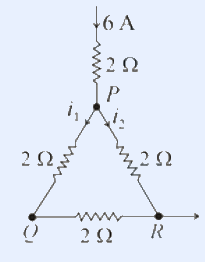
A current of A enters one corner P of an equilateral triangle PQR having wires of resistance each and leaves by the corner R. The currents in ampere is
SolutionAnswer: 2
Approach:
The current entering at P splits between the direct branch PR and the indirect branch PQR, divided inversely with resistance.
Step 1:
Step 2:
Step 3:
Final answer: 2
Q30NumericalDual Nature of Matter and Radiation
The wavelength of an X-ray beam is Å. The mass of a fictitious particle having the same energy as that of the X-ray photons is kg. The value of x is ___ . ( Planck's constant)
SolutionAnswer: 10
Approach:
Equate the photon energy to the rest energy of the fictitious particle and solve for its mass.
Step 1:
Step 2:
Final answer: 10
Chemistry30 questions
Q31Single correctChemical Bonding and Molecular Structure
Which among the following species has unequal bond lengths?
(1)
(2)
(3)
(4)
SolutionAnswer: Option 2
Approach:
Determine the geometry of each species using VSEPR and identify which has two non-equivalent bond environments.
Step 1:
: tetrahedral, all bonds equivalent.
Step 2:
: square planar, all bonds equivalent.
Step 3:
: tetrahedral, all bonds equivalent.
Step 4:
: see-saw (one lone pair), two axial bonds (longer) and two equatorial bonds (shorter).
Final answer:
Q32Single correctEquilibrium
The solubility of in water is :
[Given : The solubility product of in water ]
[Given : The solubility product of in water ]
(1)
(2)
(3)
(4)
SolutionAnswer: Option 3
Approach:
For the dissolution , relate the solubility product to the molar solubility and solve.
Step 1:
Step 2:
Step 3:
Final answer:
Q33Single correctp-Block Elements
Water does not produce CO on reacting with :
(1)
(2)
(3)
(4)
SolutionAnswer: Option 1
Approach:
Examine which species, on reaction with water (steam), fails to give carbon monoxide.
Step 1:
(water gas), produces CO.
Step 2:
(steam reforming), produces CO.
Step 3:
(steam reforming), produces CO.
Step 4:
does not react with water to give CO; it forms carbonic acid.
Final answer:
Q34Single correctPurification and Characterisation of Organic Compounds
Which of the following compound is added to the sodium extract before addition of silver nitrate for testing of halogens?
(1)
(2)
(3)
(4)
SolutionAnswer: Option 1Nitric acid
Approach:
Recall the Lassaigne (silver nitrate) test for halogens and the role of the acid added beforehand.
Step 1:
The sodium extract is first acidified with dilute nitric acid to decompose and , which would otherwise interfere.
Step 2:
Silver nitrate is then added to precipitate the silver halide.
Final answer: Nitric acid
Q35Single correctOrganic Compounds Containing Oxygen
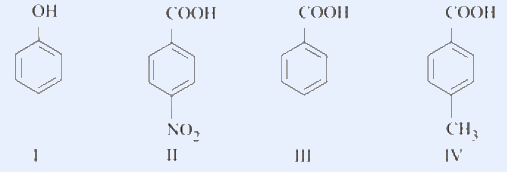
The correct order of acid character of the following compounds is :
(1)
(2)
(3)
(4)
SolutionAnswer: Option 2
Approach:
Compare the acid strengths of the four substituted aromatics by considering the functional group and the electronic effect of the para substituent.
Step 1:
I is phenol, II is 4-nitrobenzoic acid, III is benzoic acid, IV is 4-methylbenzoic acid.
Step 2:
Carboxylic acids (II, III, IV) are far stronger than phenol (I).
Step 3:
Electron-withdrawing (II) increases acidity above benzoic acid (III); electron-donating (IV) decreases it below benzoic acid.
Step 4:
Final answer:
Q36Single correctOrganic Compounds Containing Nitrogen
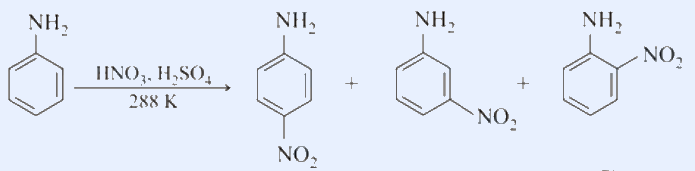
Correct statement about the given chemical reaction is
(1)
(2)
(3)
(4)
SolutionAnswer: Option 1Reaction is possible and compound (A) will be the major product.
Approach:
Analyse nitration of aniline at 288 K and decide which of the products (A, B, C) predominates.
Step 1:
In strongly acidic medium aniline is protonated to anilinium ion; the group is meta directing, but a fraction of free aniline still reacts.
Step 2:
The products are para- (A), meta- (B) and ortho-nitroaniline (C); the para isomer (A) is obtained as the major product.
Final answer: Reaction is possible and compound (A) will be the major product.
Q37Single correctHydrocarbons
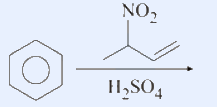
The major product of the following reaction is :
(1)
(2)
(3)
(4)
SolutionAnswer: Option 3Structure shown in option (3): benzene ring attached to (a bonded to the ring bearing a methyl, joined to a bearing a methyl and an ).
Approach:
Treat the conjugated nitroalkene with benzene under acidic conditions as a Friedel-Crafts-type alkylation proceeding through the more stable carbocation.
Step 1:
Protonation of the alkene of 3-nitrobut-1-ene generates the more stable secondary (benzylic-forming) carbocation by Markovnikov addition.
Step 2:
Benzene attacks this carbocation, forming a new C-C bond to give the ring-substituted nitroalkane.
Step 3:
The product is the benzene ring bonded to a carbon chain , matching structure (3).
Final answer: Option (3) structure:
Q38Single correctHydrocarbons
The correct sequence of reagents used in the preparation of 4 -bromo-2-nitroethylbenzene from benzene is :
(1)
(2)
(3)
(4)
SolutionAnswer: Option 2
Approach:
Build 4-bromo-2-nitroethylbenzene from benzene by introducing the ethyl group first (via acylation then reduction to avoid rearrangement), then bromine, then nitro, respecting directing effects.
Step 1:
Friedel-Crafts acylation with gives acetophenone (avoids carbocation rearrangement of direct ethylation).
Step 2:
Clemmensen reduction converts to (ethylbenzene).
Step 3:
Bromination : ethyl is o,p-directing, gives 4-bromoethylbenzene (para major).
Step 4:
Nitration then installs ortho to ethyl (position 2), giving 4-bromo-2-nitroethylbenzene.
Final answer:
Q39Single correctp-Block Elements
Given below are two statements :
Statement I: The pH of rain water is normally 5.6.
Statement II : If the pH of rain water drops below 5.6 , it is called acid rain.
In the light of the above statements, choose the correct answer from the options given below:
Statement I: The pH of rain water is normally 5.6.
Statement II : If the pH of rain water drops below 5.6 , it is called acid rain.
In the light of the above statements, choose the correct answer from the options given below:
(1)
(2)
(3)
(4)
SolutionAnswer: Option 1Both Statement I and Statement II are true.
Approach:
Recall the standard pH of natural rain water and the definition of acid rain.
Step 1:
Dissolved atmospheric forms carbonic acid, giving rain water a pH of about 5.6, so Statement I is true.
Step 2:
Rain with pH below 5.6, due to dissolved and acids, is termed acid rain, so Statement II is true.
Final answer: Both Statement I and Statement II are true.
Q40Single correctSome Basic Principles of Organic Chemistry
Which one of the following statements is FALSE for hydrophilic sols?
(1)
(2)
(3)
(4)
SolutionAnswer: Option 2The viscosity is of the order of that of .
Approach:
Compare each property statement with the known characteristics of hydrophilic (lyophilic) sols.
Step 1:
Hydrophilic sols are reversible, stable without added electrolytes, and not easily coagulated; these statements are true.
Step 2:
The viscosity of hydrophilic sols is much higher than that of water (the dispersion medium), so the statement equating it to water is false.
Final answer: The viscosity is of the order of that of .
Q41Single correctd- and f-Block Elements
The method used for the purification of Indium is :
(1)
(2)
(3)
(4)
SolutionAnswer: Option 3zone refining
Approach:
Match indium to the standard purification technique used for semiconductor-grade metals.
Step 1:
Zone refining exploits differing solubility of impurities in molten and solid metal and is used for high-purity semiconductor elements such as germanium, silicon, gallium and indium.
Final answer: zone refining
Q42Single correctp-Block Elements
The correct order of bond dissociation enthalpy of halogens is :
(1)
(2)
(3)
(4)
SolutionAnswer: Option 4
Approach:
Order the X-X bond dissociation enthalpies, accounting for the anomalously low value of fluorine.
Step 1:
Bond enthalpy generally decreases down the group as bond length increases, giving .
Step 2:
Fluorine has an anomalously low bond enthalpy due to strong interelectronic repulsion between lone pairs in the small molecule, placing below .
Step 3:
Final answer:
Q43Single correctp-Block Elements
Given below are two statements :
Statement I : and forms of sulphur can change reversibly between themselves with slow heating or slow cooling.
Statement II : At room temperature the stable crystalline form of sulphur is monoclinic sulphur.
In the light of the above statements, choose the correct answer from the options given below:
Statement I : and forms of sulphur can change reversibly between themselves with slow heating or slow cooling.
Statement II : At room temperature the stable crystalline form of sulphur is monoclinic sulphur.
In the light of the above statements, choose the correct answer from the options given below:
(1)
(2)
(3)
(4)
SolutionAnswer: Option 2Statement I is true but Statement II is false.
Approach:
Assess the reversible interconversion of rhombic (alpha) and monoclinic (beta) sulphur and the stable form at room temperature.
Step 1:
Rhombic () and monoclinic () sulphur interconvert reversibly around 369 K with slow heating or cooling, so Statement I is true.
Step 2:
At room temperature the stable crystalline form is rhombic () sulphur, not monoclinic, so Statement II is false.
Final answer: Statement I is true but Statement II is false.
Q44Single correctd- and f-Block Elements
The major components of German Silver are :
(1)
(2)
(3)
(4)
SolutionAnswer: Option 2
Approach:
Recall the composition of the alloy known as German silver.
Step 1:
German silver (nickel silver) is an alloy of copper, zinc and nickel, and contains no silver despite its name.
Final answer:
Q45Single correctCoordination Compounds
In which of the following order the given complex ions are arranged correctly with respect to their decreasing spin only magnetic moment?
(i)
(ii)
(iii)
(iv)
(i)
(ii)
(iii)
(iv)
(1)
(2)
(3)
(4)
SolutionAnswer: Option 3
Approach:
Find the number of unpaired electrons for each complex and order by spin-only magnetic moment .
Step 1:
: is , weak field , high spin, .
Step 2:
: is , tetrahedral, .
Step 3:
: is , .
Step 4:
: is , strong field , low spin, .
Step 5:
Order of unpaired electrons: , i.e. (i) > (iii) > (iv) > (ii).
Final answer:
Q46Single correctCoordination Compounds
Given below are two statements:
Statement I : The identification of is carried out by dimethyl glyoxime in the presence of .
Statement II :The dimethyl glyoxime is a bidentate neutral ligand.
In the light of the above statements, choose the correct answer from the options given below:
Statement I : The identification of is carried out by dimethyl glyoxime in the presence of .
Statement II :The dimethyl glyoxime is a bidentate neutral ligand.
In the light of the above statements, choose the correct answer from the options given below:
(1)
(2)
(3)
(4)
SolutionAnswer: Option 2
Approach:
Assess each statement on the use and nature of dimethylglyoxime as a ligand.
Step 1:
Step 2:
Final answer:
Q47Single correctHydrocarbons
The major product of the following reaction is :
(1)
(2)
(3)
(4)
SolutionAnswer: Option 2
Approach:
Apply hydroformylation (oxo process) of a terminal alkene with H2/CO over a Rh catalyst.
Step 1:
Step 2:
Final answer:
Q48Single correctOrganic Compounds Containing Oxygen
What is /X/ in the given reaction?
(1)
(2)
(3)
(4)
SolutionAnswer: Option 2
Approach:
Heating ethylene glycol with oxalic acid at high temperature drives dehydration/decomposition to the alkene.
Step 1:
Step 2:
Final answer:
Q49Single correctOrganic Compounds Containing Nitrogen
Carbylamine test is used to detect the presence of primary amino group in an organic compound. Which of the following compound is formed when this test is performed with aniline?
(1)
(2)
(3)
(4)
SolutionAnswer: Option 4
Approach:
Apply the carbylamine (isocyanide) test for primary amines.
Step 1:
Step 2:
Final answer:
Q50Single correctBiomolecules
Which of the following is correct structure of -anomer of maltose?
(1)
(2)
(3)
(4)
SolutionAnswer: Option 1
Approach:
Identify the maltose structure: two alpha-D-glucose units joined by an alpha-1,4-glycosidic bond, with the anomeric (reducing) -OH of the second ring in the alpha (down) orientation.
Step 1:
Step 2:
Final answer:
Q51NumericalAtomic Structure
Electromagnetic radiation of wavelength nm is just sufficient to ionise the atom of metal A. The ionization energy of metal A in is ___. (Rounded-off to the nearest integer)
SolutionAnswer: 181
Approach:
Compute the energy per photon, multiply by Avogadro's number, and convert to kJ per mole.
Step 1:
Step 2:
Final answer: 181
Q52NumericalChemical Thermodynamics
Five moles of an ideal gas at K is expanded isothermally from an initial pressure of MPa to MPa against at constant external pressure MPa. The heat transferred in this process is ___ .
(Rounded-off to the nearest integer)
(Rounded-off to the nearest integer)
SolutionAnswer: 3
Approach:
For an isothermal ideal-gas process the internal energy change is zero, so heat equals work; compute irreversible work against constant external pressure.
Step 1:
Step 2:
Step 3:
Step 4:
Final answer: 3
Q53NumericalPrinciples Related to Practical Chemistry
Consider titration of NaOH solution versus M oxalic acid solution. At the end point following burette readings were obtained.
(i) mL
(ii) mL
(iii) mL
(iv) mL
(v) mL
If the volume of oxalic acid taken was mL then the molarity of the NaOH solution is ___M. (Rounded-off to the nearest integer)
(i) mL
(ii) mL
(iii) mL
(iv) mL
(v) mL
If the volume of oxalic acid taken was mL then the molarity of the NaOH solution is ___M. (Rounded-off to the nearest integer)
SolutionAnswer: 1
Approach:
Use the concordant burette readings and equivalence of acid and base, with oxalic acid as a diprotic acid (n-factor 2).
Step 1:
Step 2:
Step 3:
Final answer: 1
Q54NumericalClassification of Elements and Periodicity in Properties
Among the following, number of metal/s which can be used as electrodes in the photoelectric cell is ___ . (Integer answer)
(A) Li
(B) Na
(C) Rb
(D) Cs
(A) Li
(B) Na
(C) Rb
(D) Cs
SolutionAnswer: 1
Approach:
Identify the alkali metals with sufficiently low work function and photo-sensitivity to serve as photoelectric cell electrodes.
Step 1:
Step 2:
Final answer: 1
Q55NumericalSome Basic Concepts in Chemistry
The unit cell of copper corresponds to a face centered cube of edge length Å with one copper atom at each lattice point. The calculated density of copper in is ___ . [Molar mass of Cu : g; Avogadro Number J]
SolutionAnswer: 9076
Approach:
Use the FCC density formula with Z = 4 atoms per unit cell, then convert to kg per cubic metre.
Step 1:
Step 2:
Step 3:
Final answer: 9076
Q56NumericalSolutions
If a compound AB dissociates to the extent of in an aqueous solution, the molality of the solution which shows a K rise in the boiling point of the solution is ___ molal. (Rounded-off to the nearest integer)
SolutionAnswer: 3
Approach:
Apply boiling-point elevation with the van't Hoff factor for 75% dissociation of AB into A and B.
Step 1:
Step 2:
Step 3:
Final answer:
Q57NumericalRedox Reactions and Electrochemistry
Copper reduces into NO and depending upon the concentration of in solution. (Assuming fixed and ), the concentration at which the thermodynamic tendency for reduction of into NO and by copper is same is M. The value of is ___. (Rounded-off to the nearest integer)
SolutionAnswer: 4
Approach:
Set the cell potentials for the two reduction half-reactions equal using the Nernst equation, then solve for the HNO3 concentration exponent.
Step 1:
Step 2:
Step 3:
Step 4:
Final answer: 4
Q58NumericalChemical Kinetics
The rate constant of a reaction increases by five times on increase in temperature from C to C. The value of activation energy in is ___ (Rounded-off to the nearest integer)
SolutionAnswer: 52
Approach:
Apply the two-temperature form of the Arrhenius equation with the ratio of rate constants equal to five.
Step 1:
Step 2:
Step 3:
Step 4:
Final answer: 52
Q59Numericald- and f-Block Elements
The spin only magnetic moment of a divalent ion in aqueous solution (atomic number 29) is ___ BM.
SolutionAnswer: 2
Approach:
Identify the divalent ion of element 29 (Cu2+), count unpaired electrons, and apply the spin-only formula.
Step 1:
Step 2:
Final answer: 2
Q60NumericalSome Basic Principles of Organic Chemistry
Number of compound/s given below which contain/s group is ___ . (Integer answer)
(A) Sulphanilic acid
(B) Picric acid
(C) Aspirin
(D) Ascorbic acid
(A) Sulphanilic acid
(B) Picric acid
(C) Aspirin
(D) Ascorbic acid
SolutionAnswer: 1
Approach:
Examine the functional groups of each listed compound and count those bearing a carboxylic acid (-COOH) group.
Step 1:
Step 2:
Step 3:
Step 4:
Final answer: 1
Mathematics30 questions
Q61Single correctSequence and Series
Let and be the roots of . If for , then the value of is:
(1)
(2)
(3)
(4)
SolutionAnswer: Option 3
Approach:
Use the recurrence satisfied by powers of the roots to simplify the numerator.
Step 1:
Step 2:
Step 3:
Step 4:
Final answer:
Q62Single correctComplex Numbers and Quadratic Equations
If are such that (here ) is a root of , then is equal to:
(1)
(2)
(3)
(4)
SolutionAnswer: Option 1
Approach:
Real coefficients force the complex conjugate to be the other root; apply sum and product of roots.
Step 1:
Step 2:
Step 3:
Step 4:
Final answer:
Q63Single correctLimit, Continuity and Differentiability
The minimum value of , where and , is equal to:
(1)
(2)
(3)
(4)
SolutionAnswer: Option 4
Approach:
Substitute the positive quantity and apply the AM-GM inequality.
Step 1:
Step 2:
Step 3:
Final answer:
Q64Single correctTrigonometry
If and , then is equal to:
(1)
(2)
(3)
(4)
SolutionAnswer: Option 4
Approach:
The maximum of the given expression equals 3/2 and forces a unique pair of angles.
Step 1:
with equality at
Step 2:
Step 3:
Final answer:
Q65Single correctCo-ordinate Geometry
If the curve intersects the line at two points P and Q, then the angle subtended by the line segment PQ at the origin is
(1)
(2)
(3)
(4)
SolutionAnswer: Option 3
Approach:
Find the intersection points, then the angle between their position vectors from the origin.
Step 1:
Step 2:
Step 3:
Step 4:
Final answer:
Q66Single correctCo-ordinate Geometry
A hyperbola passes through the foci of the ellipse and its transverse and conjugate axes coincide with major and minor axes of the ellipse, respectively. If the product of their eccentricities is one, then the equation of the hyperbola is:
(1)
(2)
(3)
(4)
SolutionAnswer: Option 1
Approach:
Find the ellipse foci and eccentricity, get the hyperbola eccentricity from the product condition, then its parameters.
Step 1:
Step 2:
Step 3:
Step 4:
Final answer:
Q67Single correctSets, Relations and Functions
The contrapositive of the statement "If you will work, you will earn money" is:
(1)
(2)
(3)
(4)
SolutionAnswer: Option 1If you will not earn money, you will not work
Approach:
The contrapositive of is .
Step 1:
Step 2:
Step 3:
If you will not earn money, you will not work
Final answer: If you will not earn money, you will not work
Q68Single correctMatrices and Determinants
If for the matrix, , , then the value of is :
(1)
(2)
(3)
(4)
SolutionAnswer: Option 2
Approach:
The condition makes the rows orthonormal, fixing the parameters.
Step 1:
Step 2:
Step 3:
Final answer:
Q69Single correctMatrices and Determinants
Let A be a matrix with . Let denote the row of A. If a matrix B is obtained by performing the operation on , then is equal to :
(1)
(2)
(3)
(4)
SolutionAnswer: Option 1
Approach:
Scale the determinant for the factor 2 on each row, then apply the row operation rule.
Step 1:
Step 2:
Step 3:
Final answer:
Q70Single correctMatrices and Determinants
The following system of linear equations
(1)
(2)
(3)
(4)
SolutionAnswer: Option 2has a unique solution
Approach:
Evaluate the coefficient determinant; a non-zero value gives a unique solution.
Step 1:
Step 2:
Step 3:
Final answer: has a unique solution
Q71Single correctTrigonometry
is equal to:
(1)
(2)
(3)
(4)
SolutionAnswer: Option 1
Approach:
Convert the inverse functions to a single angle and take the cosecant.
Step 1:
Step 2:
Step 3:
Step 4:
Final answer:
Q72Single correctSets, Relations and Functions
A function f(x) is given by , then the sum of the series
is equal to:
is equal to:
(1)
(2)
(3)
(4)
SolutionAnswer: Option 3
Approach:
Use the symmetry to pair terms.
Step 1:
Step 2:
Step 3:
Step 4:
Final answer:
Q73Single correctPermutations and Combinations
Let x denote the total number of one-one functions from a set A with elements to a set B with elements and y denote the total number of one-one functions from the set A to the set . Then :
(1)
(2)
(3)
(4)
SolutionAnswer: Option 3
Approach:
Count one-one functions as permutations of the codomain size taken three at a time.
Step 1:
Step 2:
Step 3:
Final answer:
Q74Single correctLimit, Continuity and Differentiability
The shortest distance between the line and the curve is:
(1)
(2)
(3)
(4)
SolutionAnswer: Option 3
Approach:
The nearest point on the parabola has a tangent parallel to the line; compute its distance to the line.
Step 1:
Step 2:
Step 3:
Final answer:
Q75Single correctIntegral Calculus
The integral , , is equal to
(where c is a constant of integration)
(where c is a constant of integration)
(1)
(2)
(3)
(4)
SolutionAnswer: Option 2
Approach:
Simplify each exponential of a logarithm to a power, then recognise the numerator as the derivative of the denominator factor.
Step 1:
Step 2:
Step 3:
Step 4:
Final answer:
Q76Single correctIntegral Calculus
If , then
(1)
(2)
(3)
(4)
SolutionAnswer: Option 3 are in A.P.
Approach:
Apply the reduction relation for the integral of powers of cotangent and form the required sums.
Step 1:
Step 2:
Step 3:
Final answer: are in A.P.
Q77Single correctIntegral Calculus
is equal to
(1)
(2)
(3)
(4)
SolutionAnswer: Option 1
Approach:
Express the sum as a Riemann sum and evaluate the corresponding definite integral.
Step 1:
Step 2:
Final answer:
Q78Single correctThree Dimensional Geometry
A plane passes through the points and . If O is the origin and P is , then the projection of on this plane is of length:
(1)
(2)
(3)
(4)
SolutionAnswer: Option 4
Approach:
Find the plane's normal, then subtract the component of OP along the normal to get the in-plane projection length.
Step 1:
Step 2:
Step 3:
Step 4:
Final answer:
Q79Single correctStatistics and Probability
In a group of 400 people, 160 are smokers and non-vegetarian; 100 are smokers and vegetarian and the remaining 140 are non-smokers and vegetarian. Their chances of getting a particular chest disorder are 35%, 20% and 10% respectively. A person is chosen from the group at random and is found to be suffering from the chest disorder. The probability that the selected person is a smoker and non-vegetarian is :
(1)
(2)
(3)
(4)
SolutionAnswer: Option 4
Approach:
Apply Bayes' theorem with the three disjoint groups as priors and the disorder rates as likelihoods.
Step 1:
Step 2:
(scaled by 400)
Step 3:
Step 4:
Final answer:
Q80Single correctStatistics and Probability
Let be a set of all -digit natural numbers whose exactly one digit is . Then the probability that a randomly chosen element of leaves remainder when divided by is:
(1)
(2)
(3)
(4)
SolutionAnswer: Option 3
Approach:
Count 4-digit numbers containing exactly one digit 7, then count those ending in a digit giving remainder 2 mod 5.
Step 1:
Total with exactly one 7
Step 2:
Remainder 2 on division by 5 requires last digit or
Step 3:
Last digit (not the unique 7):
Step 4:
Last digit (this is the unique 7): leading gives ... recount gives favourable
Step 5:
Final answer:
Q81NumericalPermutations and Combinations
The total number of two digit numbers mn, such that is a multiple of , is ___ .
SolutionAnswer: 45
Approach:
Determine the unit digit cycle of and and find when their sum ends in 0.
Step 1:
when n is odd
Step 2:
Two digit numbers to that are odd:
Step 3:
Count
Final answer: 45
Q82NumericalBinomial Theorem and its Simple Applications
If the remainder when x is divided by is , then the remainder when is divided by is ___ .
SolutionAnswer: 1
Approach:
Show the base is odd, then use that any odd square is congruent to 1 modulo 8.
Step 1:
so x is odd, and is even, hence is odd
Step 2:
Final answer: 1
Q83NumericalCo-ordinate Geometry
A line is a common tangent to the circle and the parabola . If the two points of contact (a,b) and (c,d) are distinct and lie in the first quadrant, then is equal to ___ .
SolutionAnswer: 9
Approach:
Use the tangent to the parabola in slope form, impose tangency to the circle, then find both contact points.
Step 1:
(first-quadrant branch)
Step 2:
Parabola contact: so
Step 3:
Foot of perpendicular from gives circle contact so
Step 4:
Final answer: 9
Q84NumericalLimit, Continuity and Differentiability
If exists and is equal to b, then the value of is ___ .
SolutionAnswer: 5
Approach:
Expand the exponential as a series; existence of the limit fixes a, then evaluate b.
Step 1:
Numerator
Step 2:
Denominator
Step 3:
For a finite limit the term must vanish:
Step 4:
Step 5:
Final answer: 5
Q85NumericalLimit, Continuity and Differentiability
A function f is defined on as
where [x] denotes the greatest integer . The number of points, where f is not differentiable in is ___ .
where [x] denotes the greatest integer . The number of points, where f is not differentiable in is ___ .
SolutionAnswer: 5
Approach:
Identify the corner points of the min expression and the discontinuities introduced by the greatest-integer branch.
Step 1:
, switch points
Step 2:
has a corner at
Step 3:
At the value jumps from to the integer branch, giving discontinuity
Step 4:
Non-differentiable points in :
Final answer: 5
Q86NumericalLimit, Continuity and Differentiability
If the curves and cut at right angles, then is equal to ___ .
SolutionAnswer: 4
Approach:
Impose orthogonality of the slopes at the intersection and use the intersection relation to evaluate .
Step 1:
Step 2:
Step 3:
Step 4:
At intersection , so
Final answer: 4
Q87NumericalIntegral Calculus
The value of is ___ .
SolutionAnswer: 19
Approach:
Factor the quadratic to find its sign on the interval, then integrate piecewise.
Step 1:
Roots at and ; on the quadratic is negative
Step 2:
Step 3:
Final answer: 19
Q88NumericalDifferential Equations
If the curve, represented by the solution of the differential equation , passes through the intersection of the lines, and , then is equal to ___ .
SolutionAnswer: 1
Approach:
Recognise the equation as a Bernoulli type, solve for the family, fix the constant by the given point, then evaluate at x=1.
Step 1:
Solution family:
Step 2:
Intersection of is
Step 3:
Step 4:
Final answer: 1
Q89NumericalVector Algebra
Let and . If the area of the parallelogram whose adjacent sides are represented by the vectors and is square units, then is equal to ___ .
SolutionAnswer: 2
Approach:
Use the area as the magnitude of the cross product to solve for alpha, then compute the dot product.
Step 1:
Step 2:
Step 3:
Final answer: 2
Q90NumericalThree Dimensional Geometry
A line l passing through origin is perpendicular to the lines
If the co-ordinates of the point in the first octant on at a distance of from the point of intersection of l and are (a,\ b,\ c), then is equal to ___ .
If the co-ordinates of the point in the first octant on at a distance of from the point of intersection of l and are (a,\ b,\ c), then is equal to ___ .
SolutionAnswer: 44
Approach:
Find the direction of l as the cross product of the two line directions, locate its intersection with l1, then find the point on l2 at distance sqrt(17) lying in the first octant.
Step 1:
Step 2:
meets at , giving point
Step 3:
Point on : at distance from gives for the first octant
Step 4:
Point , so
Final answer: 44
More JEE Main 2021 papers
Frequently Asked Questions
How many questions are in the JEE Main 2021 February 25, Shift 2 paper?
The JEE Main 2021 February 25, Shift 2 paper has 90 questions — Physics (30), Chemistry (30) and Mathematics (30). Every question is on this page with its correct answer and a step-by-step solution.
What is the marking scheme for JEE Main?
JEE Main awards +4 marks for each correct answer and −1 for a wrong answer, with 0 for questions left unattempted. The paper covers Physics, Chemistry and Mathematics.
Are the answer key and step-by-step solutions provided for the 2021 February 25, Shift 2 paper?
Yes — every question shows the correct answer (answer key) and a detailed step-by-step solution, free to read online.
Can I take the JEE Main 2021 February 25, Shift 2 paper as a timed mock test?
Yes. With a free JEEnify account you can attempt this exact paper as a timed test in the real exam interface, then see your score and weak-area analysis.
Solved this paper? Calculate your JEE Main scoremost important chaptersformula sheetsall free tools.