
JEEnify Logo
JEEnify
All formula sheets

Biomolecules Formula Sheet — JEE Main Chemistry

Every key Biomolecules formula, definition and theorem for JEE Main Chemistry in one place — with common examiner traps and worked examples. Free to read; blurt from memory, then check your gaps.

Syllabus — topics coveredNTA · 11 sub-topics

  • General introduction and importance of biomolecules
  • Carbohydrates - Classification, aldoses and ketoses
  • Monosaccharides (glucose and fructose)
  • Constituent monosaccharides of oligosaccharides (sucrose, lactose, maltose)
  • Proteins - Elementary idea of alpha-amino acids, peptide bond, polypeptides
  • Proteins: primary, secondary, tertiary and quaternary structure
  • Denaturation of proteins, enzymes
  • Vitamins - Classification and functions
  • Nucleic Acids - Chemical constitution of DNA and RNA
  • Biological functions of nucleic acids
  • Hormones (General introduction)

Carbohydrates I — Classification, Glucose & Fructose

Carbohydrates: Optically active , or compounds that give them on hydrolysis (many fit ). Classified by hydrolysis into mono-, oligo- and poly-saccharides, and by behaviour into vs non-reducing sugars.
Classifying carbohydrates
  • : can't hydrolyse further — glucose, fructose, ribose.
  • : 2–10 units — sucrose, maltose, lactose.
  • : many units — starch, cellulose, glycogen.
  • (reduce Tollens'/Fehling's) = all monosaccharides maltose, lactose; sucrose is non-reducing.
🎯 Exam · The six proofs of glucose's open chain
n-hexane (6 C, straight). / add a . water gluconic acid it is an . penta-acetate . saccharic acid a primary .
★ Remember · Glucose vs fructose
= aldohexose, - (dextrose); = ketohexose with the at , - (laevorotatory). Both are and both are reducing sugars.
⚠️ Watch out · D/L is configuration, not rotation
The /L label fixes the spatial configuration (relative to glyceraldehyde, via the lowest asymmetric C); the / sign is the measured optical rotation. They are independent — -glucose is but -fructose is .
🚫 Examiner Trap · Examiner traps
(1) ALL monosaccharides are reducing; among disaccharides maltose/lactose reduce but (both anomeric C locked in the glycosidic bond). (2) Glucose's free CHO is shown by B-water (gluconic acid) — but it does NOT give the Schiff/2,4-DNP tests fully (exists mostly cyclic). (3) gives the di-acid (saccharic acid), confirming a terminal OH. (4) Fructose is a keto-hexose yet still reduces Tollens (isomerises in base).

Carbohydrates II — Cyclic Sugars, Disaccharides & Polysaccharides
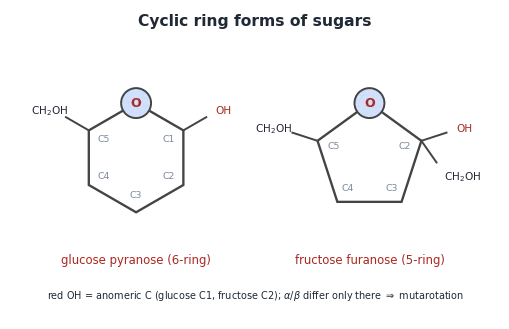
Cyclic ring forms: glucose as a 6-membered pyranose and fructose as a 5-membered furanose.
★ Remember · Why a ring, and what anomers are
The adds to the to give a cyclic : glucose 6-membered , fructose 5-membered . The / forms differ only at the new ( carbon) — they are .
🎯 Exam · Mutarotation explains the missing –CHO tests
In solution open chain (), so very little free exists at any moment. That is why glucose fails the 2,4-DNP / Schiff / tests despite being an aldose.
SugarMade ofReducing?
Sucroseα-glucose C1–C2 β-fructoseNo (both anomeric C tied)
Maltosetwo α-glucose, C1–C4Yes
Lactoseβ-galactose C1–C4 β-glucoseYes (milk sugar)
★ Remember · Starch vs cellulose vs glycogen
= amylose (-1,4 linear) amylopectin (-1,4 -1,6 branched) — plant storage. = -1,4 glucose, straight — plant structure. = 'animal starch', more branched than amylopectin — liver/muscle.
🎯 Exam · Invert sugar
Sucrose is , but hydrolysis gives glucose fructose — net . The sign flips, so the product is called . The single / glycosidic bond ties up both reducing groups, making sucrose non-reducing.
🚫 Examiner Trap · Examiner traps
(1) Mutarotation: and anomers differ ONLY at the anomeric C1 and interconvert in solution. (2) Glucose pyranose 6-membered; fructose furanose 5-membered — don't swap them. (3) Starch amylose (-1,4 linear) amylopectin (branched); cellulose -1,4 (humans can't digest it). (4) Sucrose hydrolysis 'invert sugar' (rotation flips because fructose is strongly laevorotatory).

Amino Acids — Structure, Zwitterion & Classification
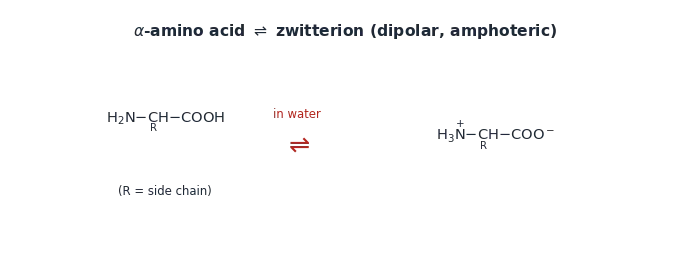
α-Amino acid: A molecule with both an amino () and a carboxyl () group on the (-) carbon, plus a side chain R. Proteins are polymers of -amino acids — 20 of them build all natural proteins.
An alpha-amino acid in equilibrium with its dipolar zwitterion in water.
An -amino acid in equilibrium with its dipolar zwitterion in water.
★ Remember · The zwitterion makes them salt-like
In water both groups ionise to a dipolar (), which is (reacts with acids and bases). That is why amino acids are high-melting, water-soluble crystalline solids — unlike simple amines or acids.
🎯 Exam · Isoelectric point
The is the pH at which the amino acid carries zero net charge (exists mainly as the zwitterion). Below it the picks up (net ); above it the loses (net ).
Two classifications
  • (more ): glutamic, aspartic acid.
  • (more ): lysine, arginine.
  • (equal groups): glycine, alanine.
  • (Val, Leu, Ile, Lys, Phe, Trp, Thr, Met, His, Arg) — diet-only; the rest are made in the body.
⚠️ Watch out · All are chiral except glycine
Every -amino acid has a chiral -carbon (four different groups) and is optically active — (R = H, so two H on the -C). Most naturally occurring amino acids are the -form.
🚫 Examiner Trap · Examiner traps
(1) Amino acids exist as (internal salt) high m.p., water-soluble, amphoteric — NOT as the neutral /COOH form. (2) At the net charge and the molecule is least soluble / doesn't migrate in an electric field. (3) All standard amino acids are chiral (L-form) EXCEPT (RH). (4) 'Essential' means must come from DIET (body can't synthesise) — not 'most important'.

Proteins — Peptide Bond, Structure Levels & Denaturation
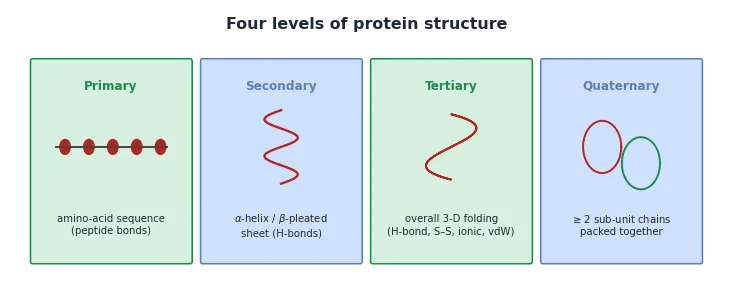
The four levels of protein structure: primary, secondary, tertiary and quaternary.
★ Remember · Peptide bond
An amide formed between the of one amino acid and the of the next, with loss of . Chains grow dipeptide polypeptide; a has 100 residues (MW 10000 u; insulin = 51).
Four levels of structure
  • : the exact sequence of amino acids.
  • : -helix (intramolecular H-bonds) & -pleated sheet.
  • : overall 3-D folding (H-bonds, , van der Waals, ionic).
  • : arrangement of two or more sub-unit chains.
🎯 Exam · Fibrous vs globular
: parallel chains held by H-bonds/disulphide, — keratin (hair, wool), myosin (muscle). : chains coil into a sphere, usually — insulin, albumins. The shape comes from the tertiary structure.
⚠️ Watch out · Denaturation keeps the primary structure
Heat or a pH change breaks the H-bonds, the helix uncoils, and the protein loses its biological activity — but only the and structures are destroyed; the sequence stays intact. Examples: egg-white coagulation, milk curdling.
🚫 Examiner Trap · Examiner traps
(1) The peptide (amide) bond forms by losing O between COOH of one and of the next. (2) destroys structure (H-bonds/SS break) but the PRIMARY sequence (peptide bonds) stays intact — a common trap. (3) -helix and -pleated sheet are held by H-bonds (secondary). (4) Fibrous structural/insoluble (keratin); globular functional/soluble (enzymes, insulin).

Enzymes & Vitamins

VitaminSourceDeficiency disease
A (retinol)fish-liver oil, carrotsxerophthalmia, night blindness
(thiamine)yeast, cerealsberi-beri
(riboflavin)milk, eggcheilosis
(pyridoxine)yeast, gramsconvulsions
meat, fish, curdpernicious anaemia
C (ascorbic acid)citrus fruits, amlascurvy (bleeding gums)
Dsunlight, fish, eggrickets / osteomalacia
Evegetable oilsRBC fragility, weakness
Kgreen leafy vegraised clotting time
Enzymes
  • Almost all are ; highly specific to one substrate and reaction.
  • Named after the substrate '' (maltase, oxidoreductase).
  • They — sucrose hydrolysis drops from 6.22 to 2.15 kJ mo with sucrase.
  • Needed only in tiny amounts; they let life's reactions run under mild conditions.
★ Remember · Fat-soluble vs water-soluble vitamins
(A, D, E, K) are stored in liver/adipose tissue. (B-group and C) are excreted in urine, so they must be supplied regularly in the diet — the exception is , which can be stored.
🎯 Exam · Deficiency diseases worth memorising
A night blindness/xerophthalmia; beri-beri; cheilosis; pernicious anaemia; C scurvy; D rickets/osteomalacia; K slow blood clotting.
🚫 Examiner Trap · Examiner traps
(1) Enzymes LOWER the activation energy — they do NOT change or the equilibrium position. (2) Enzymes are highly specific (lock-and-key) and almost all are globular proteins. (3) overdose possible; water-soluble (B, C) are excreted need daily supply. (4) Match deficiency: Anight-blindness, Bberi-beri, Cscurvy, Drickets, Kpoor clotting.

Nucleic Acids — DNA, RNA & the Double Helix
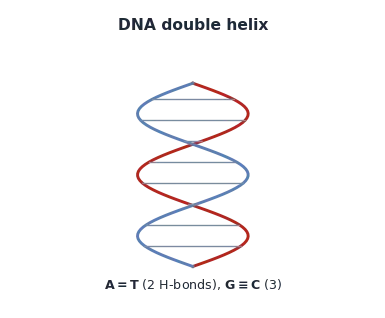
Nucleic acids: Polynucleotides (DNA and RNA) that store and express heredity. Complete hydrolysis gives a , and . DNA uses 2-deoxyribose and bases A, G, C, T; RNA uses ribose and A, G, C, U.
The DNA double helix held by complementary base pairing (A=T, GequivC).
The DNA double helix held by complementary base pairing (, ).
FeatureDNARNA
Sugar-D-2-deoxyribose-D-ribose
BasesA, G, C, A, G, C,
Strandsdouble helix (Watson–Crick)single (m-, r-, t-RNA)
Functionheredity, self-duplicationprotein synthesis
Building blocks
  • = base sugar (base at ).
  • = nucleoside phosphate (at ).
  • Nucleotides link by bonds ().
  • A, G (double ring); C, T, U (single ring).
★ Remember · The Watson–Crick double helix
Two complementary, antiparallel strands twist into a helix held by base pairing: (two H-bonds) and (three H-bonds). The sugar–phosphate backbone forms the rails; the base pairs are the rungs.
🎯 Exam · DNA vs RNA
: deoxyribose, base , double helix — stores heredity and self-duplicates. : ribose, base , single-stranded (m-, r-, t-RNA) — carries out protein synthesis. Base pairing is what lets DNA be copied faithfully.
🚫 Examiner Trap · Examiner traps
(1) base sugar (NO phosphate); nucleoside phosphate — keep them distinct. (2) DNA sugar is 2-deoxyribose, RNA is ribose; DNA has Thymine, RNA has Uracil. (3) Base pairing AT (2 H-bonds), GC (3 H-bonds) — purine always pairs with pyrimidine. (4) Backbone links are (3); DNA is double-helix, RNA usually single-stranded.

Hormones & the Biomolecule Big Picture

Hormones: Chemical messengers secreted by endocrine glands that travel in the blood and regulate metabolism, growth and reproduction. They act at very low concentrations, and an imbalance causes disease (e.g. low insulin diabetes).
Three chemical classes of hormones
  • (from cholesterol): testosterone, estrogen, cortisol.
  • : adrenaline (fight-or-flight), thyroxine (metabolic rate).
  • : insulin & glucagon (blood-glucose control).
  • Imbalance disease: low thyroxine hypothyroidism.
★ Remember · The four families at a glance
= energy/storage/structure; = structure, enzymes, transport, hormones; = store & express genes ( protein); = membranes, energy store, micro-cofactors.
🎯 Exam · How they connect
DNA's sequence (genes) is read by RNA to build , many of which are that process and lipids for energy — and act as the small cofactors those enzymes need.
🚫 Examiner Trap · Examiner traps
(1) Hormones are released DIRECTLY into blood by ductless (endocrine) glands; they regulate, they are not catalysts (enzymes are). (2) Insulin/glucagon are PEPTIDE hormones; testosterone/estrogen/cortisol are STEROID (from cholesterol); adrenaline/thyroxine are amino-acid-derived. (3) Low insulin diabetes; low thyroxine hypothyroidism. (4) Don't confuse hormones (chemical messengers) with vitamins (micro-cofactors from diet).

More JEE Main Chemistry formula sheets

Frequently Asked Questions

What are the most important Biomolecules formulas for JEE Main?

This Biomolecules formula sheet covers all the high-yield Chemistry formulas, definitions and theorems you need for JEE Main, across General introduction and importance of biomolecules, Carbohydrates - Classification, aldoses and ketoses, Monosaccharides (glucose and fructose), Constituent monosaccharides of oligosaccharides (sucrose, lactose, maltose), Proteins - Elementary idea of alpha-amino acids, peptide bond, polypeptides — each shown with the key result and, where useful, a worked example.

Is this Biomolecules formula sheet free?

Yes — the full chapter formula sheet is free to read online, no login or payment required.

How should I revise Biomolecules formulas?

Blurt the Biomolecules formulas from memory, then check against this sheet to find your gaps — and practise a few previous-year questions on the chapter to make sure you can apply them under time pressure.

Also useful: all formula sheets · JEE Main previous-year papers · most important chapters.