JEEnify Logo
JEEnify
All formula sheets

Haloalkanes & Haloarenes Formula Sheet — JEE Main Chemistry

Every key Haloalkanes & Haloarenes formula, definition and theorem for JEE Main Chemistry in one place — with common examiner traps and worked examples. Free to read; blurt from memory, then check your gaps.

Syllabus — topics coveredNTA · 4 sub-topics

  • General methods of preparation, properties and reactions
  • Nature of C-X bond
  • Mechanisms of substitution reactions
  • Uses and environmental effects of chloroform, iodoform, freons and DDT

Classification, Nomenclature & the C–X Bond

Haloalkanes & haloarenes: Compounds where halogen () replaces H of a hydrocarbon. They differ by the carbon bearing X: (alkyl, allylic, benzylic) vs (vinylic, aryl) — a distinction that controls almost all their chemistry.
BondLength / pmEnthalpy / kJ mo
C–F139452
C–Cl178351
C–Br193293
C–I214234
Classifying the carbon
  • (): , or by the carbon holding X.
  • : X on an C next to a / ring.
  • (): X on a carbon / aromatic ring.
  • (both X on one C) vs (on adjacent C).
★ Remember · The C–X bond is polar
X is more electronegative, so . The carbon invites (substitution), and the halogen leaves as .
🎯 Exam · Reactivity order R–I > R–Br > R–Cl ≫ R–F
Down the group the bond gets (C–F 452 → C–I 234 kJ mo), so the bond breaks more easily — is the most reactive, the least.
⚠️ Watch out · Naming gem vs vic dihalides
= 1,1-dichloroethane (gem, 'ethylidene chloride'); = 1,2-dichloroethane (vic, 'ethylene dichloride'). Use only in common names of arenes — IUPAC uses 1,2/1,3/1,4.
🚫 Examiner Trap · Examiner traps
(1) CX bond strength falls down the group (CF CCl CBr CI), so reactivity is the REVERSE: RI RBr RCl RF. (2) CF is the shortest/strongest yet most polar — don't equate 'most polar' with 'most reactive'. (3) CX (vinyl/aryl) is shorter and stronger than (alkyl). (4) gem two X on the SAME carbon; vic on ADJACENT carbons.

Preparation of Haloalkanes & Haloarenes

★ Remember · From alcohols
(), or /, or . : — the gaseous by-products escape, leaving pure .
From hydrocarbons & alkenes
  • Free-radical halogenation of alkanes (gives a mixture).
  • Aryl halides: arene /anhyd. (electrophilic substitution).
  • From alkenes: (Markovnikov / peroxide); vicinal dihalide.
🎯 Exam · Halogen exchange
: (NaCl/NaBr precipitate drives it forward). : .
★ Remember · Aryl halides from diazonium salts
: (X = Cl, Br). For iodide, just warm the diazonium salt with KI. Fluoroarenes are made by the Balz–Schiemann route, not direct halogenation.
🚫 Examiner Trap · Examiner traps
(1) Alcohol SOC is the route (by-products S HCl escape). (2) Lucas reagent reactivity (carbocation order). (3) makes RI (NaI/dry acetone — NaCl/NaBr precipitate drives it); makes RF (AgF/Sb). (4) Markovnikov vs peroxide (anti-Mark.) decides which carbon gets X from an alkene.

Nucleophilic Substitution — S_N1 vs S_N2

Nucleophilic substitution: A nucleophile () attacks the carbon and the halogen leaves: . It runs by two limiting mechanisms — and .
★ Remember · 2 — bimolecular
concerted step, rate (2nd order). The nucleophile attacks from the , so the centre . Crowding slows it: .
🎯 Exam · 1 — unimolecular
steps via a carbocation; rate (1st order, depends only on RX). Favoured by and polar protic solvents; allylic/benzylic halides react fast (resonance-stabilised cation).
Which mechanism wins?
  • : (open to backside attack).
  • : (stable carbocation, too crowded for ).
  • : either, depending on nucleophile and solvent.
  • Polar protic solvent, weak nucleophile, good ionising power → .
★ Remember · Leaving group still matters
For a given R, both mechanisms follow — a better (weaker-bonded, more polarisable) leaving group reacts faster.
🚫 Examiner Trap · Examiner traps
(1) S1 rate depends on substrate ONLY (); S2 on BOTH (). (2) Order is OPPOSITE: S1 favours (stable cation), S2 favours /C (least steric). (3) S2 inversion (one product); S1 racemisation (planar cation). (4) Polar PROTIC solvent + good leaving group push S1; polar APROTIC favours S2.

Stereochemistry & Optical Activity

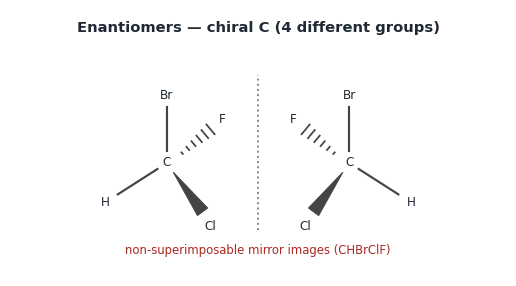
Chirality & optical activity: A carbon bearing is an asymmetric (stereo)centre, making the molecule — non-superimposable on its mirror image. Chiral molecules are : they rotate plane-polarised light (d/+ clockwise, l/− anticlockwise).
A pair of enantiomers — non-superimposable mirror images about a chiral carbon (4 different groups).
Key terms
  • : a mirror-image pair — identical physical properties, optical rotation.
  • ( or dl): an equimolar mix of enantiomers — (rotations cancel).
  • : a chiral compound converting into the racemic mixture.
🎯 Exam · 2 → inversion
Backside attack flips the stereocentre like an (Walden inversion). An optically active substrate gives a product — e.g. -2-bromooctane → -octan-2-ol.
★ Remember · 1 → racemisation
The intermediate carbocation is (), so the nucleophile attacks from ~equally → a ~50:50 mixture of the two enantiomers, i.e. a (optically inactive) product.
⚠️ Watch out · Retention
If , configuration is . The sign of rotation (/) is a reliable guide to absolute configuration — they are independent.
🚫 Examiner Trap · Examiner traps
(1) Chirality needs a carbon with groups (no plane of symmetry). (2) A () mix is 50:50 enantiomers and optically INACTIVE (external compensation). (3) Enantiomers share all physical properties EXCEPT direction of rotation (and behaviour in chiral environments). (4) S2 gives inversion (Walden); S1 gives partial racemisation — link mechanism to optical outcome.

Elimination & Reaction with Metals

★ Remember · β-Elimination (dehydrohalogenation)
Alcoholic KOH removes an H from the -carbon and X from the -carbon to form an alkene. : the alkene predominates — 2-bromopentane → pent-2-ene (81%) over pent-1-ene (19%).
🎯 Exam · Elimination vs substitution
Both compete for an alkyl halide with β-H's. A and heat favour ; a good nucleophile in a suitable solvent favours . Roughly: , /elimination.
Grignard reagent
C–Mg is polar (); very reactive — water/alcohols/amines destroy it to give RH, so it must be kept anhydrous.
Coupling with sodium
  • : (symmetrical alkane).
  • : an alkylarene.
  • : a biaryl (e.g. biphenyl).
🚫 Examiner Trap · Examiner traps
(1) Elimination follows — the MORE substituted alkene dominates. (2) Same RX can give substitution OR elimination: alc. KOH elimination, aq. KOH substitution; bulky base / high T / favour elimination. (3) Grignard is destroyed by ANY acidic H (water, alcohol, NH, COOH) alkane. (4) Wurtz fails for unsymmetrical alkanes (mixture).

Haloarenes — Structure & Reactivity

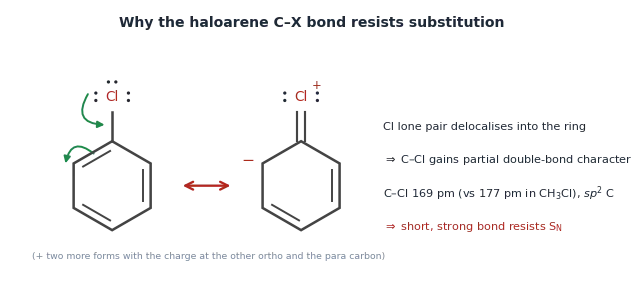
Haloarenes: Aryl halides have X on an aromatic carbon. They are to nucleophilic substitution than haloalkanes — the bond is reinforced by the ring.
Resonance gives the haloarene C–X bond partial double-bond character, so it resists substitution.
🎯 Exam · Why so unreactive to nucleophiles?
(1) gives partial double-bond character; (2) the carbon makes (169 vs 177 pm); (3) the is unstable, ruling out ; (4) the electron-rich ring nucleophiles.
★ Remember · Nucleophilic substitution needs force or activation
Chlorobenzene → phenol only at NaOH (Dow). An group () at o/p activates it (p-nitro at 443 K, 2,4-dinitro at 368 K) by stabilising the carbanion intermediate — m- does not help.
🎯 Exam · Electrophilic substitution
Haloarenes still undergo halogenation, nitration, sulphonation and Friedel–Crafts, but (ring deactivated by ). The halogen is (resonance raises o/p density) yet overall — e.g. chlorobenzene → 1,4-dichlorobenzene (major).
⚠️ Watch out · Reactivity vs orientation
For halogens the () effect controls (net deactivation) while the effect controls (o/p). The two effects point in opposite directions — don't conflate them.
🚫 Examiner Trap · Examiner traps
(1) Haloarenes RESIST nucleophilic substitution — CX has partial double-bond (resonance), shorter/stronger CX, unstable phenyl cation, and the ring repels nucleophiles. (2) NS needs harsh conditions UNLESS groups activate it (m-N does NOT). (3) In EAS the halogen is -directing but (I withdraws, lone pair directs). (4) Don't confuse haloarene (unreactive) with allyl/benzyl halide (very reactive).

Polyhalogen Compounds — Uses & Hazards

Polyhalogen compounds: Carbon compounds with . Many are industrially useful solvents, propellants and refrigerants — but several are toxic or environmentally damaging.
CompoundNameUses & hazards
Dichloromethanesolvent, paint remover; harms CNS, skin/eye burns
Chloroformsolvent, old anaesthetic; air+light phosgene (store dark)
Iodoformold antiseptic; replaced (bad smell)
Carbon tetrachloridefire extinguisher, solvent; liver damage, ozone depletion
CFCs (Freon)Chlorofluorocarbonsrefrigerants/propellants; deplete the ozone layer
DDTdichlorodiphenyltrichloroethanefirst chlorinated insecticide; persistent, bioaccumulates — banned widely
★ Remember · Chloroform → phosgene
(an old anaesthetic) is slowly oxidised by air and light to poisonous : . It is therefore stored in to exclude air.
Uses at a glance
  • — solvent / paint remover; — fire extinguisher, solvent.
  • (iodoform) — former antiseptic (free iodine).
  • Freons (CFCs) — refrigerants and aerosol propellants.
🎯 Exam · Environmental impact
are inert enough to reach the stratosphere, where they . — the first chlorinated insecticide — is (non-biodegradable), bioaccumulates in fat, and is now banned/restricted in many countries.
⚠️ Watch out · Health hazards
These are not benign solvents: and damage the (and is carcinogenic), and harms the central nervous system and burns skin/eyes.
🚫 Examiner Trap · Examiner traps
(1) CHC oxidises in airlight to poisonous (COC) — store in dark, full bottles with a little ethanol. (2) CC and CFCs (Cl radicals). (3) Iodoform's antiseptic action is due to liberated FREE iodine, not the compound itself. (4) DDT is persistent and bio-accumulates banned in many countries.

More JEE Main Chemistry formula sheets

Frequently Asked Questions

What are the most important Haloalkanes & Haloarenes formulas for JEE Main?

This Haloalkanes & Haloarenes formula sheet covers all the high-yield Chemistry formulas, definitions and theorems you need for JEE Main, across General methods of preparation, properties and reactions, Nature of C-X bond, Mechanisms of substitution reactions, Uses and environmental effects of chloroform, iodoform, freons and DDT — each shown with the key result and, where useful, a worked example.

Is this Haloalkanes & Haloarenes formula sheet free?

Yes — the full chapter formula sheet is free to read online, no login or payment required.

How should I revise Haloalkanes & Haloarenes formulas?

Blurt the Haloalkanes & Haloarenes formulas from memory, then check against this sheet to find your gaps — and practise a few previous-year questions on the chapter to make sure you can apply them under time pressure.

Also useful: all formula sheets · JEE Main previous-year papers · most important chapters.