
Equilibrium Formula Sheet — JEE Main Chemistry
Syllabus — topics coveredNTA · 24 sub-topics
- Meaning and concept of dynamic equilibrium
- Physical equilibria: solid-liquid, liquid-gas, gas-gas, solid-gas
- Henry's law
- General characteristics of equilibria in physical processes
- Chemical equilibria
- Law of chemical equilibrium
- Equilibrium constants Kp and Kc and significance
- Significance of ΔG and ΔG° in equilibrium
- Factors affecting equilibrium
- Le Chatelier's principle
- Ionic equilibrium
- Weak and strong electrolytes
- Ionization of electrolytes
- Concepts of acids and bases: Arrhenius, Bronsted-Lowry and Lewis
- Ionization of acids and bases
- Acid-base equilibria including multistage ionization
- Ionization constants
- Ionization of water
- pH scale
- Common ion effect
- Hydrolysis of salts and pH
- Solubility of sparingly soluble salts
- Solubility products
- Buffer solutions
Equilibrium & the Equilibrium Constant
- ▸Reached in a system when forward and reverse rates become equal — concentrations stay constant (but equal).
- ▸It is : both reactions continue (confirmed by isotope/radioactive tracer studies).
- ▸Can be approached from either side (reactants or products).
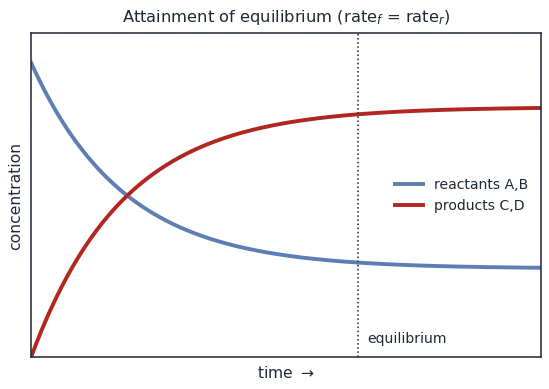
- ▸Depends only on — independent of initial concentrations or catalyst.
- ▸Has one value for a given balanced equation; always quote the equation with .
- ▸Says nothing about the at which equilibrium is reached.
- ▸ ⇌ : coexist only at the melting point for a given pressure (ice–water at 273 K, 1 atm); rates of melting and freezing are equal.
- ▸ ⇌ : in a closed vessel the vapour pressure becomes constant at a given T; boiling point = T where it equals the external pressure.
- ▸ ⇌ : sublimation (iodine, camphor, naphthalene). in liquid: Henry's law — solubility rises with pressure, falls with temperature.
- ▸Common features: closed system at fixed T; a measurable property becomes constant; the constant (e.g. ) characterises the equilibrium.
Kp, Reaction Quotient & ΔG°
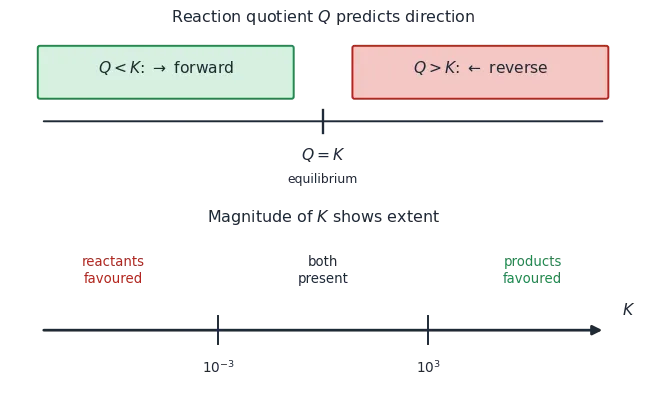
- .
- .
Le Chatelier's Principle
- ▸: adding a reactant (or removing a product) shifts forward; the reverse shifts back.
- ▸ ( by compression): shifts toward the side with . No effect if .
- ▸ at constant V: no change in partial pressures no shift.
- Left side: mol gas; right side: mol gas.
- Compression (↑ pressure) favours fewer gas moles.
Acids & Bases — Concepts
- ▸: acid gives , base gives in water (limited to aqueous).
- ▸: acid = proton () donor, base = proton acceptor.
- ▸: acid = electron-pair acceptor (e.g. , ), base = electron-pair donor (e.g. , ).

- ▸: pairs are and .
- ▸ species act as both acid and base, e.g. , , .
- ▸Conjugate base of is ; conjugate acid of is .
Ionization, Ka/Kb & pH
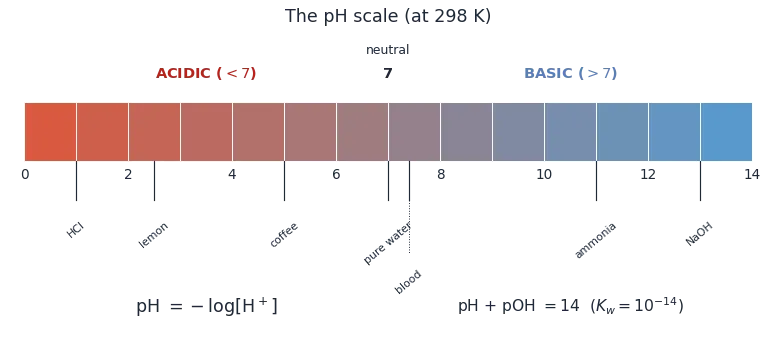
- ▸ electrolytes ionise fully; ones partly (equilibrium, degree ).
- ▸Weak acid, concentration c: , , so (valid when ).
- ▸Very dilute strong acid (e.g. M HCl): add water's contribution — solve , so and pH (NOT 8).
- ▸Multistage (polyprotic) acids: (harder to remove H from an anion); pH comes almost entirely from the first step, and for A alone.
- .
- .
Buffers & Salt Hydrolysis
| Salt of | Nature | pH |
|---|---|---|
| strong acid + strong base | neutral | |
| weak acid + strong base | basic | |
| strong acid + weak base | acidic | |
| weak acid + weak base | -decided |
Solubility Equilibrium (Ksp)
- ▸An indicator HIn changes colour over .
- ▸Phenolphthalein 8.2–10 (colourless pink): strong acid–strong base, weak acid–strong base. Methyl orange 3.1–4.4 (red yellow): strong acid–strong base, strong acid–weak base.
- ▸Weak acid vs weak base has no sharp end point — no suitable indicator.
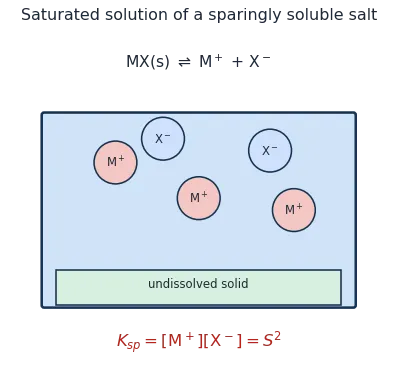
- , so .
- .
More JEE Main Chemistry formula sheets
Frequently Asked Questions
What are the most important Equilibrium formulas for JEE Main?
This Equilibrium formula sheet covers all the high-yield Chemistry formulas, definitions and theorems you need for JEE Main, across Meaning and concept of dynamic equilibrium, Physical equilibria: solid-liquid, liquid-gas, gas-gas, solid-gas, Henry's law, General characteristics of equilibria in physical processes, Chemical equilibria — each shown with the key result and, where useful, a worked example.
Is this Equilibrium formula sheet free?
Yes — the full chapter formula sheet is free to read online, no login or payment required.
How should I revise Equilibrium formulas?
Blurt the Equilibrium formulas from memory, then check against this sheet to find your gaps — and practise a few previous-year questions on the chapter to make sure you can apply them under time pressure.
Also useful: all formula sheetsJEE Main previous-year papersmost important chapters.