JEEnify Logo
JEEnify
All formula sheets

Chemical Kinetics Formula Sheet — JEE Main Chemistry

Every key Chemical Kinetics formula, definition and theorem for JEE Main Chemistry in one place — with common examiner traps and worked examples. Free to read; blurt from memory, then check your gaps.

Syllabus — topics coveredNTA · 11 sub-topics

  • Rate of a chemical reaction
  • Factors affecting rate: concentration, temperature, pressure, catalyst
  • Elementary and complex reactions
  • Order and molecularity of reactions
  • Rate law and rate constant with units
  • Differential and integral forms of zero and first-order reactions
  • Characteristics and half-lives
  • Effect of temperature on rate
  • Arrhenius theory
  • Activation energy and calculation
  • Collision theory of bi-molecular gaseous reactions

Rate of Reaction & Rate Expression
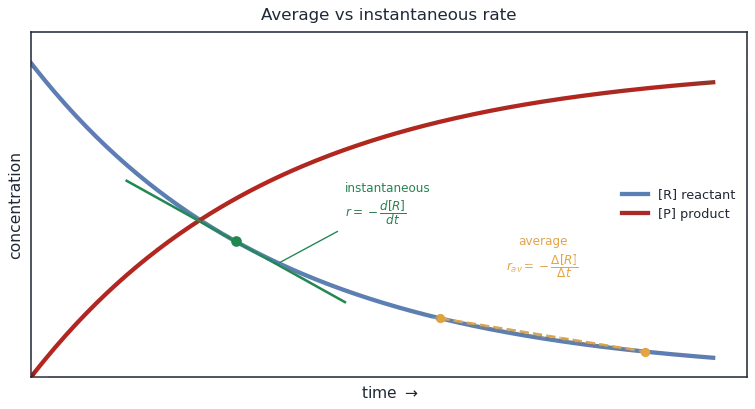
Rate of a reaction: The change in concentration of a reactant or product per unit time. over an interval; is its limit as — the tangent slope of the concentration–time curve.
Concentration versus time curves: reactant falling and product rising, with a tangent line giving the instantaneous rate and a chord giving the average rate
Reactant falls, product rises; tangent = instantaneous, chord = average rate.
Rate from stoichiometry
For . Divide each term by its coefficient so the unique rate is obtained. E.g. : rate .
Essentials
  • Units of rate: (or for gases via partial pressure).
  • is negative, so a makes the rate positive.
  • Rate is constant — it falls as reactants are used up.
🎯 Exam · Factors that change the rate
(pressure for gases), , and a are the main factors; also surface area of solids and, for some reactions, light. Higher concentration/temperature faster reaction.
✎ Example · Average rate
For , falls mol in 184 min. Find the average rate.
  1. Rate .
  2. mol mi.
🚫 Examiner Trap · Examiner traps
(1) Divide each species' rate by its for the unique reaction rate (HI: rate ). (2) Reactant terms carry a sign so the rate stays positive. (3) Rate is NOT constant — it falls as reactants deplete. (4) Average rate uses a chord (), instantaneous uses a tangent (d).

Rate Law, Order & Molecularity

Rate law (rate expression): The experimentally found dependence of rate on concentration: . The powers x,y be read off the balanced equation — they must be determined by experiment.
Differential rate equation
= rate constant (specific reaction rate); it is independent of concentration but depends on temperature and catalyst.
OrderUnits of
0
1
2
Elementary vs complex
  • reaction: one step; molecularity is defined.
  • reaction: a sequence of elementary steps (a mechanism).
  • The slowest step is the ; it fixes the overall rate and order.
  • Molecularity has no meaning for an overall complex reaction.
💡 Tip · Order from a rate law
Rate order . The also fixes the order: first order, second order.
🚫 Examiner Trap · Examiner traps
(1) Orders x,y are found by , NOT from the balanced equation. (2) Order can be 0, fractional or negative; is an integer for steps only. (3) The unit of k reveals the order ( first). (4) The slowest (rate-determining) step fixes the overall order.

Zero-Order Reactions

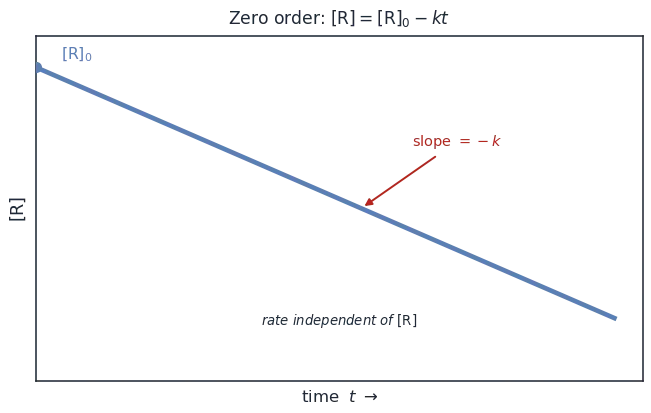
Zero-order reaction: Rate is independent of reactant concentration: . The rate stays constant until the reactant runs out.
Integrated rate law
Form : a plot of vs t is a straight line of slope and intercept . Units of k: .
Straight-line plot of concentration of R versus time, starting at R-zero and decreasing linearly with slope minus k, showing rate independent of concentration
vs t is linear with slope .
Half-life (zero order)
Directly proportional to the initial concentration and inversely proportional to k.
Where zero order occurs
  • catalytic reactions — the surface holds a fixed amount of reactant.
  • (hot platinum surface).
  • Thermal decomposition of HI on a gold surface.
  • Many enzyme reactions at saturating substrate.
★ Remember · Tell-tale sign
If a graph of against t is a , the reaction is zero order — the concentration drops by equal amounts in equal times.
🚫 Examiner Trap · Examiner traps
(1) Zero order: rate is INDEPENDENT of ( rate). (2) vs t is a (slope ); units of k are . (3) is to initial concentration. (4) Occurs on saturated surfaces/enzymes — not common otherwise.

First-Order Reactions

Integrated rate law (first order)
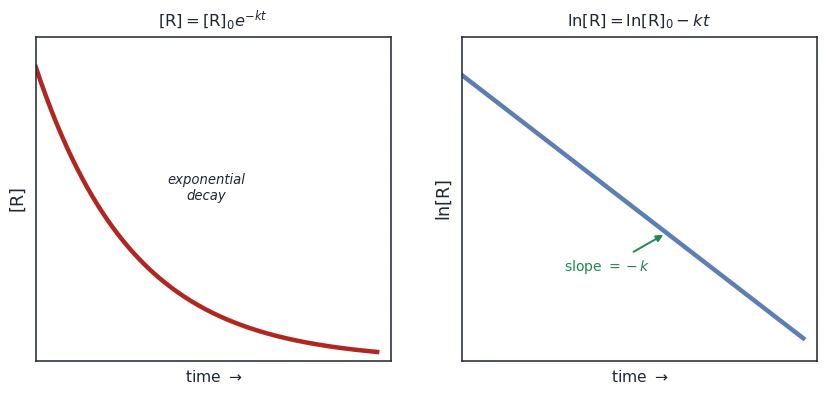
Equivalently . Units of k: (concentration-independent).
Left: concentration decaying exponentially with time; right: natural log of concentration falling as a straight line of slope minus k
decays exponentially; vs t is linear, slope .
✎ Example · First-order rate constant
decomposition (1st order): falls mol in 60 min.
  1. .
Half-life (first order)
of initial concentration — a hallmark of first-order kinetics (e.g. all radioactive decay).
First-order examples
  • All natural & artificial ().
  • Hydrogenation of ethene; decomposition of , .
  • Gas-phase: track total pressure, .
🎯 Exam · Pseudo-first-order reactions
A higher-order reaction looks first order when one reactant is in large excess. Hydrolysis of an ester: Rate , but is ~constant, so Rate with . Inversion of cane sugar is another example.
🚫 Examiner Trap · Examiner traps
(1) First order: ; vs t is linear (slope ). (2) is of initial concentration (all radioactive decay). (3) Units of k are . (4) : a higher-order reaction looks first order when one reactant is in large excess (ester hydrolysis).

Half-Life & Integrated-Law Summary

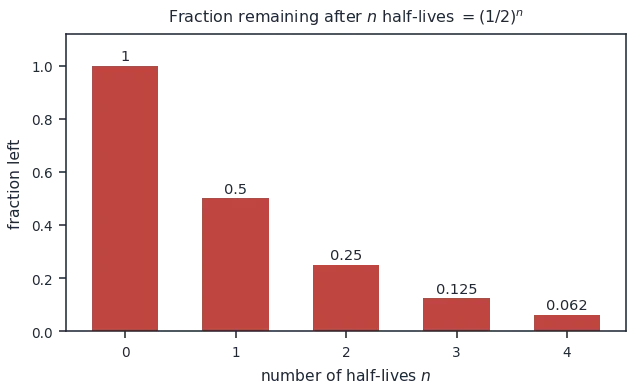
Left: zero-order half-life equals R-zero over 2k proportional to initial concentration, first-order half-life equals 0.693 over k independent of initial concentration; right: bar chart of fraction remaining halving each half-life
depends on for zero order but is constant for first order.
Half-life (): The time for the reactant concentration to fall to half its initial value. After n half-lives the fraction left is , so a first-order reactant is never fully consumed.
OrderIntegrated lawLinear plot
0 vs t
1 vs t
Reading the order off a graph
  • vs t linear order (slope ).
  • (or ) vs t linear order.
  • Constant regardless of first order.
  • Units of k also reveal order: (0), (1).
✎ Example · 99.9% completion (first order)
Show the time for 99.9% completion is .
  1. .
  2. .
🚫 Examiner Trap · Examiner traps
(1) for zero order but is for first order — the quickest way to tell them apart. (2) Linear vs zero; linear vs first. (3) After n half-lives, fraction left — never fully consumed. (4) 99.9% completion takes (first order).

Temperature Dependence: Arrhenius & Activation Energy
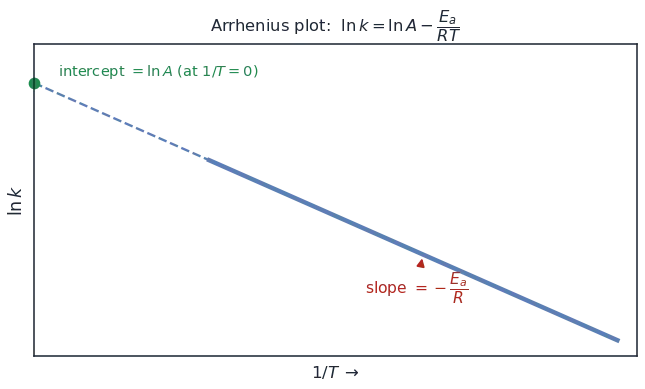
Arrhenius equation
A = frequency (pre-exponential) factor, = activation energy, . The factor is the fraction of molecules with energy .
Straight-line plot of natural log of k versus one over T with slope minus Ea over R and intercept ln A, beside the Arrhenius equation and its two-temperature form
vs is linear: slope , intercept .
Two-temperature form
Obtained by writing at two temperatures and subtracting; used to find from two rate constants (or k at a new T).
What it tells you
  • A rise of C roughly the rate.
  • Higher T or lower larger k faster reaction.
  • = energy gap between the activated complex and the reactants.
  • On a Maxwell–Boltzmann curve, raising T broadens it so more molecules clear .
✎ Example · at a new temperature
: at 600 K, kJ mo. Find at 700 K.
  1. .
  2. .
★ Remember · Catalyst
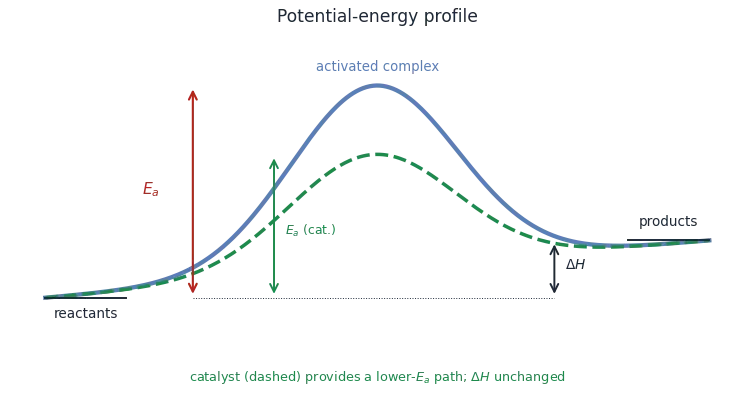
A catalyst provides an alternate path with , so it speeds the reaction. It does change or — it speeds forward and backward equally, reaching equilibrium faster.
🚫 Examiner Trap · Examiner traps
(1) vs slope (NOT ). (2) A C rise roughly DOUBLES the rate. (3) A lowers (alternate path) but does NOT change or K — it speeds forward & back equally. (4) Use J/mol K with in J (convert from kJ).

Collision Theory & Energy Profile

Collision theory: Reactant molecules (treated as hard spheres) react when they collide. The Z is the number of collisions per second per unit volume; only a fraction of collisions actually lead to product.
Rate from collision theory
= collision frequency, = fraction of collisions with enough energy, P = steric (probability) factor for correct orientation.
Potential energy versus reaction coordinate: reactants rise over an activation-energy barrier through the activated complex to products, with a lower dashed catalysed path and the reaction enthalpy delta H
Reactants climb to the activated complex, then fall to products; = net energy change.
Effective collisions
  • activation energy energy already possessed by the molecules.
  • A collision is only if it has (i) energy threshold (ii) the correct orientation.
  • The at the barrier top is an unstable arrangement that decays to products.
⚠️ Watch out · Limits of the model
Treating molecules as structureless hard spheres ignores their internal structure, so simple collision theory over-predicts rates for complex molecules — hence the steric factor is needed to account for orientation.
🚫 Examiner Trap · Examiner traps
(1) An effective collision needs BOTH enough energy ( threshold) AND correct (steric factor P). (2) Threshold energy energy already in the molecules. (3) The sits at the barrier TOP (max PE), not at the products. (4) A catalyst lowers but leaves unchanged.

More JEE Main Chemistry formula sheets

Frequently Asked Questions

What are the most important Chemical Kinetics formulas for JEE Main?

This Chemical Kinetics formula sheet covers all the high-yield Chemistry formulas, definitions and theorems you need for JEE Main, across Rate of a chemical reaction, Factors affecting rate: concentration, temperature, pressure, catalyst, Elementary and complex reactions, Order and molecularity of reactions, Rate law and rate constant with units — each shown with the key result and, where useful, a worked example.

Is this Chemical Kinetics formula sheet free?

Yes — the full chapter formula sheet is free to read online, no login or payment required.

How should I revise Chemical Kinetics formulas?

Blurt the Chemical Kinetics formulas from memory, then check against this sheet to find your gaps — and practise a few previous-year questions on the chapter to make sure you can apply them under time pressure.

Also useful: all formula sheets · JEE Main previous-year papers · most important chapters.