JEEnify Logo
JEEnify
All formula sheets

Classification of Elements & Periodicity Formula Sheet — JEE Main Chemistry

Every key Classification of Elements & Periodicity formula, definition and theorem for JEE Main Chemistry in one place — with common examiner traps and worked examples. Free to read; blurt from memory, then check your gaps.

Syllabus — topics coveredNTA · 9 sub-topics

  • Modern periodic law
  • Present form of periodic table
  • s, p, d and f block elements
  • Periodic trends in properties
  • Atomic and ionic radii
  • Ionization enthalpy
  • Electron gain enthalpy
  • Valence and oxidation states
  • Chemical reactivity

Modern Periodic Law & the Long-Form Table

From Mendeleev to the modern law
  • arranged elements by increasing and predicted undiscovered elements (eka-aluminium etc.).
  • showed properties depend on Z, not mass — resolving anomalies (e.g. Ar before K).
  • Atomic number = number of protons = the true basis of classification.
Modern periodic law: The physical and chemical properties of the elements are a . Elements with similar valence-shell configurations recur at regular intervals.
★ Remember · Anatomy of the table
(horizontal rows, set by the value of n of the valence shell) and (vertical columns / families with the same valence configuration).
PeriodElementsSub-shells filled
112
228
338
4418
5518
6632
7732
Why those lengths?
  • Number of elements in a period the number of orbitals filled in that energy level.
  • fills in period 6 and in period 7, giving the 32-element rows.
  • Filling follows the order ( before , etc.).
🚫 Examiner Trap · Examiner traps
(1) The modern law uses Z (Moseley), not atomic mass (Mendeleev) — this fixed anomalies like Ar-before-K. (2) Period value of n of the valence shell; period lengths . (3) Number of elements in a period orbitals filled. (4) Group number gives the valence-shell configuration.

Electronic Configuration & the s, p, d, f Blocks
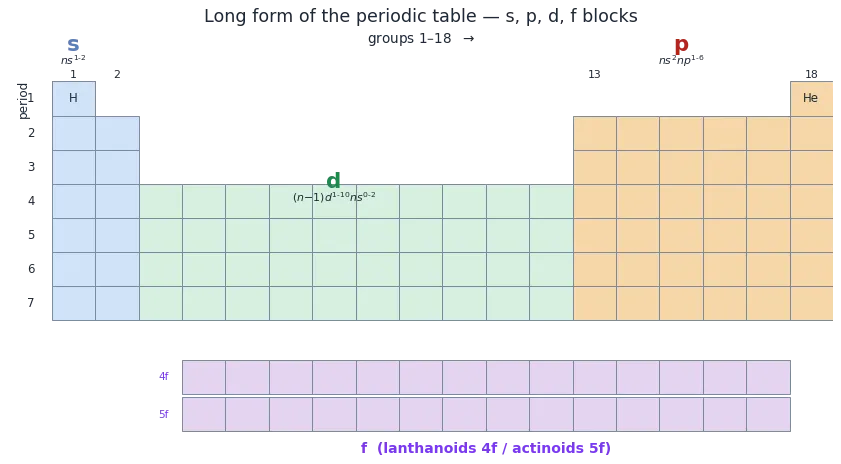
Blocks of the periodic table: Elements are grouped into — s, p, d, f — according to the type of atomic orbital that receives the last (differentiating) electron.
Long-form periodic table coloured by block: s-block in groups 1-2, p-block in groups 13-18, d-block in groups 3-12, and the f-block lanthanoids and actinoids shown detached below, with the valence configuration of each block
The four blocks and their valence configurations; the -block sits detached below.
-block (Gr 1–2)
-block (Gr 13–18)
-block (Gr 3–12)
-block
Locating an element from its configuration
  • highest principal quantum number n in the configuration.
  • sub-shell receiving the last electron.
  • : s-block valence ; p-block (valence ); d-block electrons.
  • () is unique — placed with Group 1, but resembles Group 17 too; () sits in Group 18.
🚫 Examiner Trap · Examiner traps
(1) Block sub-shell that gets the LAST electron; Period highest n. (2) d-block is , f-block is — mind the /. (3) p-block group valence electrons. (4) H () is anomalous (Group 1 but resembles 17); He is in Group 18 despite .

Types of Elements & Nomenclature

Metals, non-metals & metalloids
  • (>78%): left & centre; lustrous, malleable, ductile, good conductors (exceptions: Hg liquid; Ga, Cs low m.p.).
  • : top-right; brittle, poor conductors (C, B exceptions).
  • (Si, Ge, As, Sb, Te): along the zig-zag border, intermediate properties.
  • Metallic character down a group, across a period.
Four types of elements: (main-group: s- and p-blocks), (d-block, bridge metals), (f-block lanthanoids & actinoids), and (Group 18, filled ).
DigitRootDigitRoot
0nil (n)5pent (p)
1un (u)6hex (h)
2bi (b)7sept (s)
3tri (t)8oct (o)
4quad (q)9enn (e)
🎯 Exam · IUPAC naming for
Spell the digits of Z using the roots, add , and combine the symbols. E.g. : un-bi-nil-ium ; ununseptium (Uus).
🚫 Examiner Trap · Examiner traps
(1) Metalloids (Si, Ge, As, Sb, Te) lie on the zig-zag border. (2) Metallic character down a group, across a period. (3) IUPAC : spell digits (un-bi-nil...) ium ( unbinilium Ubn). (4) Noble gases () are a separate type, not 'non-metals' for trends.

Atomic & Ionic Radii

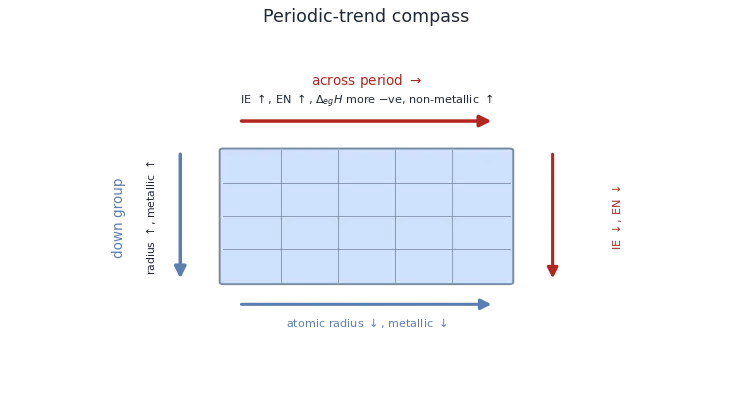
Compass showing that across a period ionization energy, electronegativity, electron gain enthalpy magnitude and non-metallic character rise while atomic radius and metallic character fall; down a group radius and metallic character rise while ionization energy and electronegativity fall
Master compass of the periodic trends.
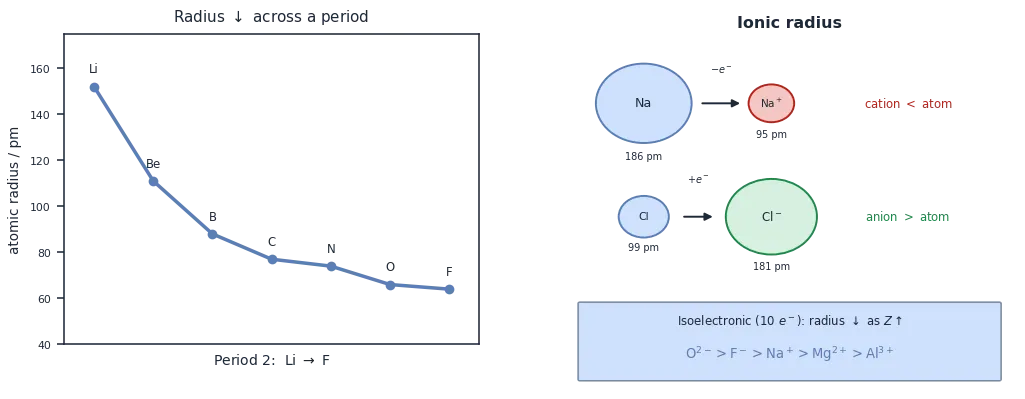
Atomic radius: Half the internuclear distance between bonded atoms: for non-metals (Cl–Cl pm 99 pm), for metals (Cu–Cu pm 128 pm). Noble gases use the larger radius.
Left: atomic radius decreasing across Period 2 from lithium to fluorine. Right: sodium shrinking to its cation and chlorine growing to its anion, with the isoelectronic radius order
Radius falls across a period; cation atom anion.
Size trends
  • : radius (effective nuclear charge rises, same shell).
  • : radius (new shells; inner electrons shield).
  • parent atom (fewer , same charge); parent atom (added , more repulsion).
  • species: radius as nuclear charge ().
🚫 Examiner Trap · Examiner traps
(1) Radius across a period (), down a group (new shell). (2) Cation parent atom; anion parent atom. (3) species: radius as nuclear charge (). (4) Noble gases use the larger van der Waals radius — don't compare directly.

Ionization Enthalpy

Ionization enthalpy (): The energy needed to remove the most loosely bound electron from an isolated gaseous atom in its ground state: . Always positive; (harder to pull an from a cation).
First ionization enthalpy rising across Period 2 from lithium to neon, with dips where beryllium exceeds boron and nitrogen exceeds oxygen
rises across a period, with two notable dips.
Trends & their causes
  • : (nuclear charge rises, shielding nearly constant).
  • : (electron farther out, more shielding).
  • Depends on , shielding/screening and penetration ().
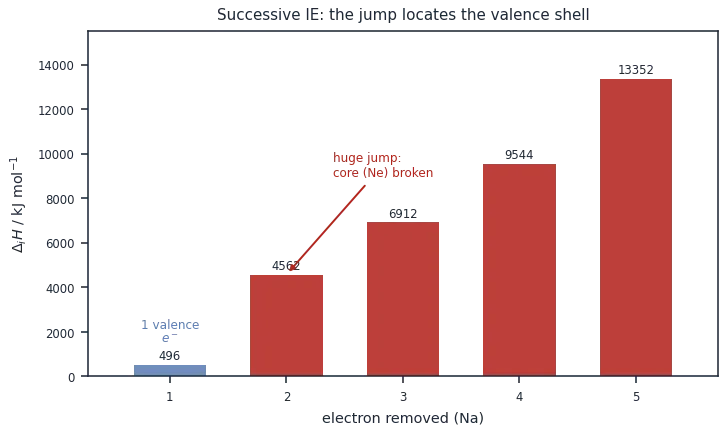
Successive ionization energies of sodium, with a small first value and a huge jump at the second electron where the neon core is broken
A sudden jump marks the start of a new (core) shell — here Na has 1 valence .
⚠️ Watch out · Two classic anomalies
: removing B's electron (shielded by ) is easier than Be's penetrating 2s. : N has a stable half-filled ; O's fourth electron is paired and feels extra repulsion.
🚫 Examiner Trap · Examiner traps
(1) is ALWAYS positive; . (2) IE across, down. (3) Anomalies: (B's is shielded) and (N has stable half-filled ). (4) A sudden jump in successive IE marks the start of a noble-gas core — it locates the valence electrons.

Electron Gain Enthalpy & Electronegativity

Electron gain enthalpy (): The enthalpy change when an electron is added to a neutral gaseous atom: . Usually negative (energy released); the more negative, the greater the tendency to form an anion.
Left: bar chart of halogen electron gain enthalpies, most negative, with chlorine more negative than fluorine. Right: electronegativity rising across Period 2 to fluorine at 4.0 on the Pauling scale
Halogens have the most negative ; electronegativity peaks at F.
Electronegativity: The tendency of an atom to attract the electron pair in a bond. It is a relative (not measurable) quantity; the sets F , the highest.
Element (kJ/mol)EN (Pauling)
F
Cl
O
S
Trends & anomalies
  • becomes across a period, down a group.
  • : and (added crowds the compact shell).
  • Noble gases have (electron must enter a new shell).
  • Electronegativity across, down — it tracks non-metallic character.
🚫 Examiner Trap · Examiner traps
(1) is usually negative (energy released); more negative stronger anion-former. (2) Anomaly: and in magnitude (small shell crowds the added electron). (3) Noble gases have . (4) Electronegativity is RELATIVE (not measurable); F is the highest; EN across, down.

Periodicity of Valence & Chemical Properties

Valence & oxidation states
  • of a representative element number of valence electrons, or that number.
  • Group 1→18 valence: .
  • d- and f-block elements show oxidation states.
  • Reactivity is highest at the two (alkali metals lose , halogens gain ) and lowest in the centre.
GroupValenceOxideNature
11basic
22basic
133amphoteric
155acidic
177acidic
🎯 Exam · Second-period anomalies & diagonal relationship
The first element of each group (Li, Be, B…) differs from its heavier congeners — small size, high charge/radius ratio, and only valence orbitals (no d). It resembles the second-period element of the group: (the diagonal relationship).
🚫 Examiner Trap · Examiner traps
(1) Valence of a main-group element valence electrons OR that. (2) Oxides go across a period (NO A C). (3) Reactivity is highest at the EXTREMES (alkali metals, halogens), lowest in the centre. (4) Diagonal relationship: Li–Mg, Be–Al, B–Si (2nd-period anomaly).

More JEE Main Chemistry formula sheets

Frequently Asked Questions

What are the most important Classification of Elements & Periodicity formulas for JEE Main?

This Classification of Elements & Periodicity formula sheet covers all the high-yield Chemistry formulas, definitions and theorems you need for JEE Main, across Modern periodic law, Present form of periodic table, s, p, d and f block elements, Periodic trends in properties, Atomic and ionic radii — each shown with the key result and, where useful, a worked example.

Is this Classification of Elements & Periodicity formula sheet free?

Yes — the full chapter formula sheet is free to read online, no login or payment required.

How should I revise Classification of Elements & Periodicity formulas?

Blurt the Classification of Elements & Periodicity formulas from memory, then check against this sheet to find your gaps — and practise a few previous-year questions on the chapter to make sure you can apply them under time pressure.

Also useful: all formula sheets · JEE Main previous-year papers · most important chapters.