
JEEnify Logo
JEEnify
All formula sheets

Hydrocarbons Formula Sheet — JEE Main Chemistry

Every key Hydrocarbons formula, definition and theorem for JEE Main Chemistry in one place — with common examiner traps and worked examples. Free to read; blurt from memory, then check your gaps.

Syllabus — topics coveredNTA · 12 sub-topics

  • Classification, isomerism, IUPAC nomenclature
  • General methods of preparation, properties and reactions
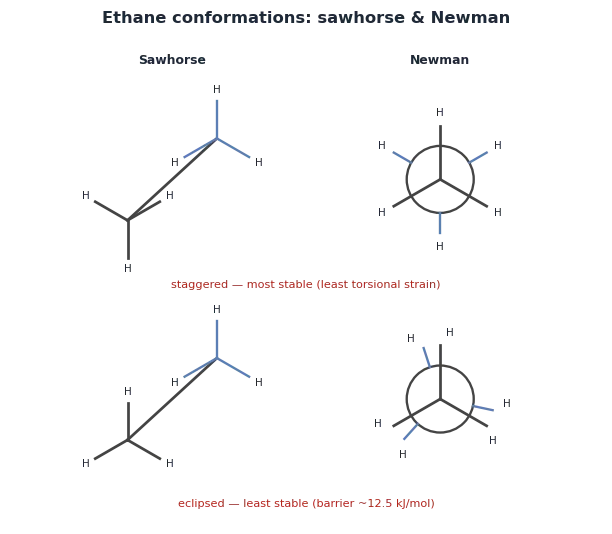
  • Alkanes - Conformations: Sawhorse and Newman projections
  • Mechanism of halogenation of alkanes
  • Alkenes - Geometrical isomerism, mechanism of electrophilic addition
  • Addition of hydrogen, halogens, water, hydrogen halides
  • Markownikoff's and peroxide effect, Ozonolysis and polymerization
  • Alkynes - Acidic character, addition of hydrogen, halogens, water and hydrogen halides
  • Aromatic hydrocarbons - Nomenclature, benzene structure and aromaticity
  • Mechanism of electrophilic substitution - halogenation, nitration
  • Friedel-Craft's alkylation and acylation
  • Directive influence of functional group in mono-substituted benzene

Alkanes — Preparation, Conformations & Halogenation
Alkanes: Saturated open-chain hydrocarbons, general formula , with only C–C and C–H bonds (tetrahedral, ). Once called — chemically inert, so their main reactions are radical substitution and combustion.
Newman projections of ethane: staggered (stable) versus eclipsed.
Preparation
  • : or alkane.
  • : — gives -carbon alkanes.
  • : (one C less).
★ Remember · Free-radical halogenation
A chain mechanism: (), (; ), (two radicals combine). Reactivity ; H abstraction .
🎯 Exam · Conformations of ethane
Rotation about the C–C bond gives infinite conformers. (H's far apart) has the least torsional strain — most stable; has the most. The barrier is only ~, so rotation is nearly free.
⚠️ Watch out · Branching lowers boiling point
b.p. rises with molecular mass (more van der Waals contact), but among isomers a alkane is more spherical, has less surface contact, and boils than its straight-chain isomer.
🚫 Examiner Trap · Examiner traps
(1) gives only EVEN-carbon, symmetrical alkanes (RR). (2) Halogenation reactivity F and H-abstraction . (3) ethane is most stable (least torsional strain). (4) Among isomers, BRANCHING LOWERS the boiling point (less surface contact).

Alkenes I — Structure, Isomerism & Preparation

Alkenes (olefins): Unsaturated hydrocarbons with at least one , general formula . The double bond is 1 + 1 ; the loosely-held cloud makes alkenes electron-rich and attacked by .
The C=C bond as one sigma plus one pi, cis and trans geometrical isomers of but-2-ene, and the preparation routes by dehydrohalogenation, dehalogenation, dehydration and partial reduction of alkynes
structure, cis/trans isomers and preparation routes.
★ Remember · Geometrical (cis / trans) isomerism
Rotation about is , so when each doubly-bonded carbon carries two groups, (like groups same side) and (opposite) differ. cis is more polar (); trans usually has the higher melting point.
Preparation (β-eliminations & reductions)
  • : alkyl halide alkene (Saytzeff — the more substituted alkene predominates).
  • : vicinal dihalide alkene .
  • of alcohol: conc. , (also β-elimination).
  • of an alkyne: Lindlar's catalyst cis; trans.
🎯 Exam · Structural isomerism too
alkenes show both and isomerism (but-1-ene, but-2-ene, 2-methylprop-1-ene) — count these before adding geometrical isomers.
🚫 Examiner Trap · Examiner traps
(1) cis/trans needs restricted CC rotation AND each alkene carbon carrying two DIFFERENT groups. (2) cis is more polar (); trans usually has the higher m.p. (3) Dehydrohalogenation follows (more-substituted alkene). (4) Lindlar cis-alkene; Na/liq.N trans-alkene.

Alkenes II — Electrophilic Addition

★ Remember · Markovnikov's rule
In adding to an unsymmetrical alkene, the and X to the other. The real reason: addition goes through the (via a cation).
🎯 Exam · Peroxide (Kharasch) effect
With a peroxide, adds (propene 1-bromopropane) by a chain through the more stable radical. It works for — not HCl or HI.
Ni/Pt/Pd alkane
vicinal dihalide ( decolourises test)
HI HBr HCl, Markovnikov
dil. alcohol (Markovnikov)
⚠️ Watch out · Why the carbocation matters
Markovnikov 'memorising H-to-more-H' can mislead — always check which intermediate carbocation is more stable (). With rearrangement-prone substrates, the stable cation, not the rule of thumb, decides the product.
🚫 Examiner Trap · Examiner traps
(1) Markovnikov: H to the carbon with MORE H — really because it goes through the MORE STABLE carbocation. (2) (anti-Markovnikov) works for , not HCl/HI (free-radical chain). (3) B/CC decolourisation unsaturation test. (4) Watch for carbocation REARRANGEMENT — the stable cation decides the product, not the rule of thumb.

Alkenes III — Oxidation, Ozonolysis & Polymerisation

★ Remember · Ozonolysis — locate the double bond
adds to the alkene to give an , which cleaves into compounds. The carbonyls reveal exactly where the was — e.g. .
🎯 Exam · Baeyer's test (unsaturation)
(Baeyer's reagent) gives a (glycol) and its purple-pink colour — a standard test for . Hot/acidic instead the double bond to acids/ketones.
Polymerisation
Many monomers join into a polymer — ethene → polythene, propene → polypropene.
Two oxidation outcomes
  • (cold dil. ): kept, adds two → glycol.
  • (hot acidic / ): broken → ketones / carboxylic acids.
  • Ozonolysis is the structure-determination tool; combustion gives .
🚫 Examiner Trap · Examiner traps
(1) ( then Zn/O) cleaves CC into TWO carbonyls — it locates the double bond. (2) (cold dilute KMn) gives a diol and the purple colour FADES; HOT/acidic KMn instead CLEAVES to acids/ketones. (3) Don't confuse the two KMn outcomes. (4) Addition polymerisation needs high T/P/catalyst.

Alkynes — Acidity, Preparation & Addition

Alkynes: Unsaturated hydrocarbons with a , general formula . The triple bond is 1 + 2 (sp, linear, , pm). Ethyne (acetylene) is the first member.
★ Remember · Acidic terminal hydrogen
The carbon is sp ( s-character), so it holds the bonding pair tightly and the H is : . Acidity order — used to distinguish terminal alkynes.
Preparation
  • (industrial).
  • Vicinal dihalide alkenyl halide alkyne.
  • Cyclic polymerisation: benzene (aliphatic → aromatic).
Pt/Pd/Ni alkene alkane
/
tetrahalide / gem-dihalide (Markovnikov)
, 333 K → carbonyl (Kucherov)
🎯 Exam · Kucherov hydration
Water adds across () to give an unstable that tautomerises to a carbonyl: ethyne ethanal (); propyne propanone.
🚫 Examiner Trap · Examiner traps
(1) The terminal (H) hydrogen is ACIDIC (sp, s); acidity HCCH CH C — used to distinguish terminal alkynes (acetylide test). (2) Only TERMINAL alkynes form acetylides. (3) (O, H/H): enol tautomerises to a carbonyl (ethyne ethanal). (4) HX adds Markovnikov to give a gem-dihalide.

Aromatic Hydrocarbons — Benzene, Aromaticity & Resonance

Benzene & arenes: Benzene () is the parent hydrocarbon (arene): a flat ring of six carbons, six C–C and six C–H bonds, with each carbon's p orbital overlapping into a system.
Benzene as a resonance hybrid of two Kekulé forms (six delocalised pi electrons).
Benzene as a resonance hybrid of two Kekulé forms (six delocalised electrons).
★ Remember · Resonance & stability
Benzene is a of the two Kekulé structures (drawn as a circle for the 6 delocalised electrons). X-ray shows all six C–C bonds equal at (between single and double ). This delocalisation gives extra stability, so benzene prefers .
🎯 Exam · Aromaticity — the Hückel rule
A ring is aromatic if it is (i) , (ii) fully , and (iii) has electrons (). Benzene: , . Naphthalene: , . Anthracene: , .
Preparation of benzene
  • of ethyne (red-hot iron, 873 K).
  • of sodium benzoate with soda lime.
  • vapour over heated Zn dust.
⚠️ Watch out · Aromatic ≠ 'three double bonds'
Benzene's three 'double bonds' are not localised — that hypothetical cyclohexatriene would readily add. It is the system, not the formal double bonds, that confers aromatic stability.
🚫 Examiner Trap · Examiner traps
(1) Benzene is ONE resonance hybrid (all C–C pm), NOT alternating single/double bonds. (2) Aromatic planar fully conjugated electrons (benzene , naphthalene ). (3) The delocalisation makes benzene prefer . (4) Count electrons in the RING only for the Hückel rule.

Aromatic — Electrophilic Substitution & Directive Influence

Electrophilic aromatic substitution: E^+ adds to give the arenium (sigma-complex), which loses H^+ to re-aromatise.
Electrophilic aromatic substitution: adds to give the arenium (-complex), which loses to re-aromatise.
★ Remember · EAS mechanism (3 steps)
(a) (a Lewis acid like / makes , , acylium; makes ). (b) adds to the ring → resonance-stabilised (-complex, one C). (c) to restore aromaticity.
Nitration
conc. /, 323–333 K ()
Halogenation
/anhyd.
Sulphonation
fuming (oleum)
F–C alkylation / acylation
/ with anhyd.
🎯 Exam · Ortho/para directors (mostly activating)
Electron- groups raise the electron density and speed up substitution: , , , , , . : halogens (, ) are -directing but (strong ).
★ Remember · Meta directors (deactivating)
Electron- groups lower the ring density and slow substitution; the m-position is least deactivated, so the electrophile attacks there: , , , , , , .
🚫 Examiner Trap · Examiner traps
(1) EAS goes via a resonance-stabilised (-complex, one C); the slow step is its formation, then H is lost. (2) -directors are EDG (activating) — but (strong ). (3) m-directors are EWG (deactivating: N, CN, CHO, COOH). (4) Friedel–Crafts fails on strongly deactivated (e.g. nitrobenzene) rings.

More JEE Main Chemistry formula sheets

Frequently Asked Questions

What are the most important Hydrocarbons formulas for JEE Main?

This Hydrocarbons formula sheet covers all the high-yield Chemistry formulas, definitions and theorems you need for JEE Main, across Classification, isomerism, IUPAC nomenclature, General methods of preparation, properties and reactions, Alkanes - Conformations: Sawhorse and Newman projections, Mechanism of halogenation of alkanes, Alkenes - Geometrical isomerism, mechanism of electrophilic addition — each shown with the key result and, where useful, a worked example.

Is this Hydrocarbons formula sheet free?

Yes — the full chapter formula sheet is free to read online, no login or payment required.

How should I revise Hydrocarbons formulas?

Blurt the Hydrocarbons formulas from memory, then check against this sheet to find your gaps — and practise a few previous-year questions on the chapter to make sure you can apply them under time pressure.

Also useful: all formula sheets · JEE Main previous-year papers · most important chapters.