
JEEnify Logo
JEEnify
All formula sheets

Organic Compounds Containing Oxygen Formula Sheet — JEE Main Chemistry

Every key Organic Compounds Containing Oxygen formula, definition and theorem for JEE Main Chemistry in one place — with common examiner traps and worked examples. Free to read; blurt from memory, then check your gaps.

Syllabus — topics coveredNTA · 16 sub-topics

  • General methods of preparation, properties, reactions and uses
  • Alcohols: Identification of primary, secondary and tertiary alcohols
  • Mechanism of dehydration of alcohols
  • Phenols: Acidic nature, electrophilic substitution reactions
  • Halogenation, nitration and sulphonation of phenols
  • Reimer-Tiemann reaction
  • Ethers: Structure
  • Aldehydes and Ketones: Nature of carbonyl group
  • Nucleophilic addition to >C=O group
  • Relative reactivities of aldehydes and ketones
  • Nucleophilic addition reactions (HCN, NH3 and derivatives), Grignard reagent
  • Oxidation, reduction (Wolff-Kishner and Clemmensen)
  • Acidity of alpha-hydrogen, Aldol condensation
  • Cannizzaro reaction, Haloform reaction
  • Chemical tests to distinguish aldehydes and ketones
  • Carboxylic Acids: Acidic strength and factors affecting it

Alcohols & Phenols — Classification, Structure & Acidity
Alcohols, phenols & ethers: Compounds with a . have on an carbon; have on an (aromatic) carbon; have an oxygen bridging two carbons ().
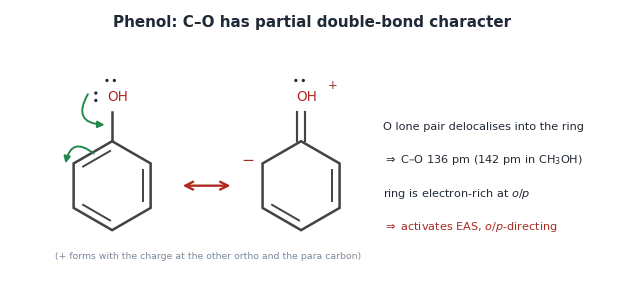
In phenol, the O lone pair conjugates into the ring, giving the C–O partial double-bond character.
Classifying alcohols
  • By number of : .
  • By the carbon: , , (, alkyl).
  • : on C next to / ring.
  • (): on / aromatic ring (= phenol).
★ Remember · Phenol — the C–O is partly double
The oxygen lone pair conjugates into the ring, so phenol's shortens to ( C) and gains partial double-bond character. This makes the ring electron-rich (activates EAS, -directing) and the more easily ionised.
🎯 Exam · Acidity ladder: acid > phenol > water > alcohol
Order follows conjugate-base stability: carboxylate (two equivalent resonance forms) phenoxide (charge spread onto ring) alkoxide (charge localised). So phenol water alcohol.
Compound
-Nitrophenol7.1
Phenol10.0
-Cresol10.2
Ethanol15.9
⚠️ Watch out · Substituents flip acidity the opposite way for the two
On : EWG (, esp. ) stronger acid; EDG (, cresols) weaker. Among , acidity is because the effect of alkyl groups destabilises the alkoxide.
🚫 Examiner Trap · Examiner traps
(1) Acidity order: carboxylic acid phenol water alcohol — phenol IS acidic (turns blue litmus red), but a WEAKER acid than carbonic so it does NOT liberate C from NaHC (key phenol-vs-acid test). (2) EWG () on phenol raises acidity (); EDG (cresols) lowers it. (3) Alcohol acidity (I of alkyl). (4) Phenol's CO is partly double (resonance) shorter, and the ring is activated/o,p-directing.

Reactions of Alcohols, Phenols & Ethers

🎯 Exam · Oxidation tells the three alcohols apart
aldehyde carboxylic acid; ketone; resists (no -H on the C–OH carbon). Hot Cu (573 K) dehydrogenates to carbonyls but to an alkene.
★ Remember · Lucas test & dehydration both follow 3° > 2° > 1°
(conc. HCl/): turbid at once, in ~5 min, no turbidity cold. ease (carbocation route, Saytzeff major). Both reflect carbocation stability.
Phenol-only reactions
  • : phenoxide salicylic acid (o-hydroxybenzoic acid).
  • : /NaOH salicylaldehyde (o-CHO).
  • : water 2,4,6-tribromophenol (white ppt), no catalyst needed.
  • Dilute -nitrophenol; conc. picric acid; Zn dust benzene.
★ Remember · Ethers: Williamson synthesis & HX cleavage
: — use a halide ( only eliminates). by hot HX (HI > HBr > HCl): dialkyl ether R–I + R–OH; aryl alkyl ether (the strong aryl–O bond survives).
⚠️ Watch out · Esterification needs the acid, not the alcohol, activated
is reversible — drive it by removing water. Acetylation of salicylic acid with gives .
🚫 Examiner Trap · Examiner traps
(1) Lucas test (anhydrous ZnC/HCl): turbid at once, in 5 min, no reaction cold — distinguishes the three alcohols. (2) Dehydration ease (carbocation), product follows Saytzeff. (3) Williamson works best with RX (a bulky halide ELIMINATES instead). (4) In ether cleavage by HI, the smaller/less-hindered alkyl leaves as RI; phenyl ether gives phenol RI (arylO survives).

Aldehydes & Ketones — The Carbonyl & Its Preparation

The carbonyl group >C=O: A trigonal-planar carbon () doubly bonded to oxygen. Because O is more electronegative, the bond is polarised — the carbon is electrophilic (open to nucleophiles), the oxygen nucleophilic.
The carbonyl group: a planar sp^2 carbon polarised d+C=d-O.
The carbonyl group: a planar carbon polarised .
Aldehydes — named routes
  • : (poisoned catalyst stops at aldehyde).
  • : ; or DIBAL-H on a nitrile/ester.
  • : toluene benzaldehyde.
  • : (AlC/CuCl) benzaldehyde.
Ketones & shared routes
  • Acyl chloride ketone.
  • Nitrile ketone.
  • acylation: arene aryl ketone.
  • : oxidation/dehydrogenation of alcohols; ozonolysis; alkyne hydration (: ethyne ethanal, others ketone).
★ Remember · Aldehyde vs ketone — the key difference
An aldehyde has at least one on the carbonyl carbon (); a ketone has two carbon groups (). That single H is why aldehydes are oxidised far more easily than ketones.
🎯 Exam · Reactivity to nucleophiles: aldehyde > ketone
Two alkyl groups in a ketone (i) crowd the approach of a nucleophile () and (ii) push electron density onto the carbonyl C by , lowering its (). Aromatic carbonyls are even less reactive (ring resonance donates).
🚫 Examiner Trap · Examiner traps
(1) (/Pd-BaS, poisoned) stops at the aldehyde — without the poison it over-reduces. (2) Aldehyde always has H on the carbonyl C; ketone has two C-substituents different oxidation behaviour. (3) Etard (Cr) and GattermanKoch (CO/HCl) make aromatic ALDEHYDES specifically. (4) Reactivity to nucleophiles: aldehyde ketone (less steric crowding, less I donation).

Nucleophilic Addition to the Carbonyl

Nucleophilic addition to >C=O: Nu^- attacks the planar carbonyl to give an sp^3 alkoxide, then H^+ adds.
Nucleophilic addition to O: Nu attacks the planar carbonyl to give an alkoxide, then H adds.
Common additions
  • (base-catalysed) ( and on one C).
  • crystalline — used to separate/purify aldehydes & methyl ketones (regenerate with dilute acid/alkali).
  • /dry HCl (via hemiacetal); ketone glycol cyclic ketal — a protecting group.
  • alcohol.
Reagent H₂N–ZProduct
AmmoniaImine
amineSchiff base (subst. imine)
HydroxylamineOxime
HydrazineHydrazone
PhenylhydrazinePhenylhydrazone
2,4-DNP (Brady's)2,4-DNP-hydrazone
SemicarbazideSemicarbazone
🎯 Exam · 2,4-DNP is the carbonyl fingerprint
Aldehydes and ketones give orange-red solids with Brady's reagent — a classic test for the group (but it does distinguish an aldehyde from a ketone).
⚠️ Watch out · These reactions are acid-catalysed but not too acidic
additions need mild acid: too much acid protonates the nucleophile (killing it), too little slows the dehydration to . The equilibrium is pulled forward by losing water.
🚫 Examiner Trap · Examiner traps
(1) Nucleophile attacks to the planar carbonyl; C rehybridises — net addition of Nu and H across CO. (2) NaHS adduct works for aldehydes and METHYL ketones only (steric) — used to purify them. (3) 2,4-DNP (Brady's) gives orange-red solids test for O (NOT acids/esters). (4) Reactivity aldehyde ketone here too.

α-Hydrogen Reactions, Reduction & Distinguishing Tests

★ Remember · Aldol needs an α-H; Cannizzaro needs none
(dil. NaOH, -H required): 3-hydroxybutanal but-2-enal. (no -H, conc. alkali): (one reduced, one oxidised).
Reduction of the carbonyl
  • / (or /cat.) / alcohol.
  • (Zn-Hg / conc. HCl): — acidic conditions.
  • (, then KOH/): — basic conditions.
  • Pick by what the rest of the molecule tolerates (acid vs base).
Distinguishing aldehydes from ketones
  • : bright (aldehydes only).
  • : red-brown (aliphatic aldehydes; aromatic aldehydes do respond).
  • Ketones resist both mild oxidants; strong oxidation cleaves C–C smaller acids.
  • (/NaOH): or yellow .
🎯 Exam · α-H acidity is the engine of condensations
The -H is acidic because the carbonyl withdraws electrons () and the resulting carbanion is resonance-stabilised as an . No -H no aldol, but Cannizzaro becomes possible.
⚠️ Watch out · Cross-aldol gives a messy mixture
Two different carbonyls that have -H give up to products (two self + two cross). It is only synthetically useful when one partner has -H (e.g. benzaldehyde) so it can only be the electrophile.
🚫 Examiner Trap · Examiner traps
(1) Aldol needs an -H; Cannizzaro happens only with NO -H (HCHO, benzaldehyde) — disproportionation. (2) (ketones resist); aromatic aldehydes FAIL Fehling. (3) Iodoform (/NaOH) is positive for C or CCH(OH) groups (and ethanal/ethanol) — flags a methyl-carbonyl, NOT all carbonyls. (4) Use Clemmensen (acidic) vs WolffKishner (basic) by the substrate's acid/base sensitivity.

Carboxylic Acids — Preparation & Acidity

Carboxylic acid –COOH: A carbonyl fused to a hydroxyl (onyl + hydr). The lone pair donates into the by resonance, so the carboxyl carbon is electrophilic than a plain carbonyl — it does acyl , not simple addition.
Preparation of –COOH
  • Oxidation of alcohols / aldehydes (, ).
  • Alkylbenzenes ArCOOH (whole side chain COOH).
  • Hydrolysis of nitriles / amides ( or ).
  • (dry ice) RCOOH (adds one carbon).
  • Hydrolysis of acyl halides, anhydrides or esters.
★ Remember · Why –COOH beats phenol
Both lose , but the has resonance forms with the charge on two electronegative O atoms, whereas phenoxide spreads charge onto less-electronegative ring carbons. So phenol water alcohol.
🎯 Exam · Substituents: EWG strengthen, EDG weaken
. EWG () stabilise the carboxylate; more/closer halogens stronger acid. (Acetic 4.76, benzoic 4.19.)
⚠️ Watch out · Aromatic ring effect can look backwards
Direct attachment of phenyl/vinyl acidity (the carbon is more electronegative). On a benzoic acid, raise acidity (4-nitrobenzoic 3.41) while lower it (4-methoxy 4.46 vs benzoic 4.19).
🚫 Examiner Trap · Examiner traps
(1) Acidity: acid phenol water alcohol — carboxylate has TWO equivalent resonance forms (charge on 2 O). (2) EWG (I: F, Cl, N) RAISE acid strength, and nearer the COOH stronger (CCCOOH CCOOH). (3) Acids exist as H-bonded b.p. higher than alcohols of similar mass. (4) HCOOH is the strongest simple acid (no I alkyl) and also reduces (has a CHO part).

Carboxylic Acids — Reactions & The Carbonyl Toolkit

🎯 Exam · NaHCO₃ test separates acid from phenol
. The confirms ; phenol is too weak to react with bicarbonate, so this cleanly distinguishes the two.
C–OH cleavage (acyl substitution)
  • : ester .
  • acyl chloride ( best — gaseous by-products).
  • : .
  • amide (via ammonium salt, ).
–COOH group & the α-carbon
  • : or alcohol — does touch .
  • : (soda-lime).
  • : -halo acid (needs an -H).
  • Kolbe electrolysis of the salt alkane (doubles the carbon count).
★ Remember · Diborane reduces –COOH but not esters
(diborane) reduces readily to alcohol but leaves esters, nitro and halo groups alone — a useful selectivity. is stronger and less selective.
⚠️ Watch out · No simple addition at –COOH
Unlike aldehydes/ketones, the carboxyl carbon's is muted by the lone pair (resonance). So nucleophiles trigger (replace ), never a stable tetrahedral addition product.
🚫 Examiner Trap · Examiner traps
(1) COOH does NOT give simple nucleophilic ADDITION (the OH lone pair feeds the carbonyl by resonance) — it does acyl SUBSTITUTION. (2) LiAl/ reduce COOH to alcohol, but \textbf{NaBH}$_4$ does NOT. (3) HVZ ($X_2$/red P) needs an $\alpha$-H $\Rightarrow$ $\alpha$-halo acid. (4) NaHC$O_3$ effervescence (C$O_2-$COOH from phenol — fast, diagnostic.

More JEE Main Chemistry formula sheets

Frequently Asked Questions

What are the most important Organic Compounds Containing Oxygen formulas for JEE Main?

This Organic Compounds Containing Oxygen formula sheet covers all the high-yield Chemistry formulas, definitions and theorems you need for JEE Main, across General methods of preparation, properties, reactions and uses, Alcohols: Identification of primary, secondary and tertiary alcohols, Mechanism of dehydration of alcohols, Phenols: Acidic nature, electrophilic substitution reactions, Halogenation, nitration and sulphonation of phenols — each shown with the key result and, where useful, a worked example.

Is this Organic Compounds Containing Oxygen formula sheet free?

Yes — the full chapter formula sheet is free to read online, no login or payment required.

How should I revise Organic Compounds Containing Oxygen formulas?

Blurt the Organic Compounds Containing Oxygen formulas from memory, then check against this sheet to find your gaps — and practise a few previous-year questions on the chapter to make sure you can apply them under time pressure.

Also useful: all formula sheets · JEE Main previous-year papers · most important chapters.