
Purification & Characterisation of Organic Compounds Formula Sheet — JEE Main Chemistry
Syllabus — topics coveredNTA · 6 sub-topics
- Purification: Crystallization, sublimation, distillation
- Differential extraction and chromatography - principles and applications
- Qualitative analysis - Detection of nitrogen, sulphur, phosphorus and halogens
- Quantitative analysis - Estimation of carbon, hydrogen, nitrogen, halogens, sulphur and phosphorus
- Calculations of empirical formulae and molecular formulae
- Numerical problems in organic quantitative analysis
Purification I — Sublimation, Crystallisation, Distillation
| Situation | Method | Example / note |
|---|---|---|
| Solid sublimes on heating | Sublimation | camphor, |
| Solid, solubility differs with | Crystallisation | cool hot satd. soln.; charcoal |
| Liquid + non-volatile impurity | Simple distillation | or two liquids, b.p. large |
| Two liquids, close b.p. | Fractional distillation | column; crude-oil refining |
| Liquid, high b.p. / decomposes | Reduced-pressure distillation | boils below b.p.; glycerol |
| Steam-volatile + water-immiscible | Steam distillation | ; aniline |
| Compound dissolved in water | Differential extraction | separating funnel; solvent |
- ▸Separates a volatile liquid from a impurity, or two liquids with a .
- ▸The lower-boiling component vaporises first, condenses, and is collected in the receiver.
- ▸Example: chloroform (b.p. 334 K) from aniline (b.p. 457 K).
Distillation Variants & Differential Extraction
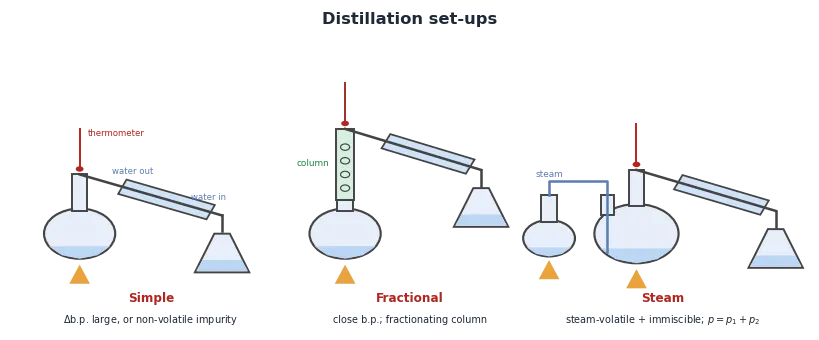
- ▸For substances that are and with water.
- ▸Steam is passed through the heated liquid; the mixture distils and is separated in a separating funnel.
- ▸Classic example: purifying from an aniline–water mixture.
Chromatography
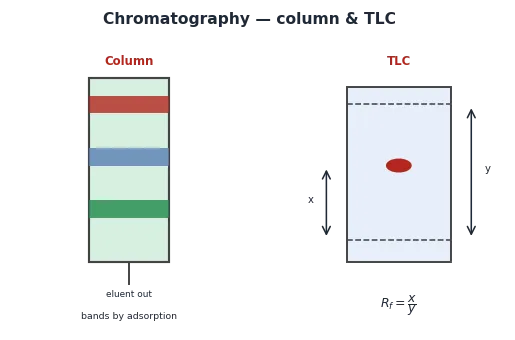
- ▸ — fluorescent spots glow.
- ▸ — many compounds give brown spots.
- ▸ spray — detects amino acids.
Qualitative Analysis I — C, H & the Lassaigne Test
Qualitative Analysis II — Sulphur, Halogens & Phosphorus
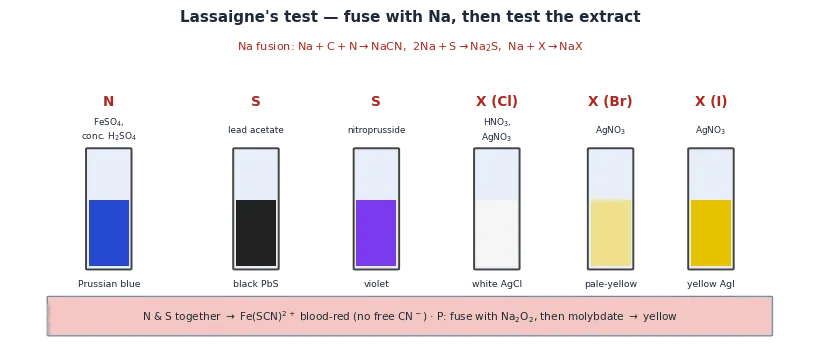
- ▸Heat with an oxidising agent (sodium peroxide) — P is oxidised to .
- ▸Boil with ammonium molybdate ammonium phosphomolybdate .
Quantitative — Carbon, Hydrogen & Nitrogen
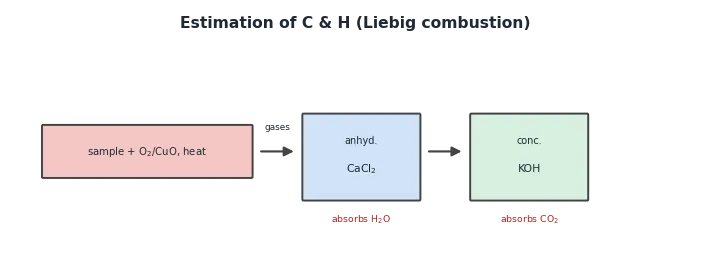
- mL of M (dibasic) mL of M .
- mL of M has g N, so mL has g N.
- .
Quantitative — Halogens, S, P, O & Formula
| Element | Method | % formula |
|---|---|---|
| Halogen (Carius) | fuming AgX | (A = at. mass, M = mol. mass) |
| Sulphur (Carius) | oxidise | |
| Phosphorus | (mass 222) | |
| Oxygen | by difference |
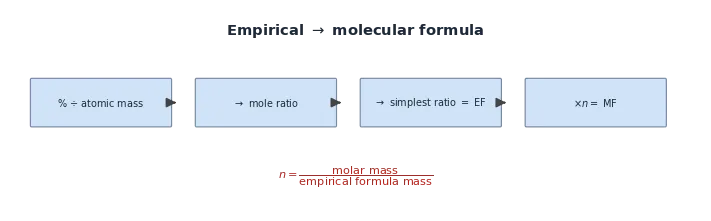
- ▸Divide each element's by its → relative moles.
- ▸Divide by the smallest → simplest whole-number ratio .
- ▸; then .
- ▸If the vapour density is given, molar mass
More JEE Main Chemistry formula sheets
Frequently Asked Questions
What are the most important Purification & Characterisation of Organic Compounds formulas for JEE Main?
This Purification & Characterisation of Organic Compounds formula sheet covers all the high-yield Chemistry formulas, definitions and theorems you need for JEE Main, across Purification: Crystallization, sublimation, distillation, Differential extraction and chromatography - principles and applications, Qualitative analysis - Detection of nitrogen, sulphur, phosphorus and halogens, Quantitative analysis - Estimation of carbon, hydrogen, nitrogen, halogens, sulphur and phosphorus, Calculations of empirical formulae and molecular formulae — each shown with the key result and, where useful, a worked example.
Is this Purification & Characterisation of Organic Compounds formula sheet free?
Yes — the full chapter formula sheet is free to read online, no login or payment required.
How should I revise Purification & Characterisation of Organic Compounds formulas?
Blurt the Purification & Characterisation of Organic Compounds formulas from memory, then check against this sheet to find your gaps — and practise a few previous-year questions on the chapter to make sure you can apply them under time pressure.
Also useful: all formula sheetsJEE Main previous-year papersmost important chapters.