JEEnify Logo
JEEnify
All formula sheets

Redox Reactions & Electrochemistry Formula Sheet — JEE Main Chemistry

Every key Redox Reactions & Electrochemistry formula, definition and theorem for JEE Main Chemistry in one place — with common examiner traps and worked examples. Free to read; blurt from memory, then check your gaps.

Syllabus — topics coveredNTA · 6 sub-topics

  • Concept of oxidation and reduction
  • Redox reactions
  • Oxidation number
  • Balancing redox reactions
  • In terms of loss and gain of electron and change in oxidation number
  • Applications of redox reactions

Redox Reactions & Oxidation Number

Oxidation & reduction (always together)
  • = loss of electrons / increase in oxidation number (O.N.).
  • = gain of electrons / decrease in O.N.
  • A reaction couples the two — electrons lost = electrons gained.
  • (oxidant) is itself reduced; (reductant) is itself oxidised.
Type of redox reactionExample
Combination
Decomposition
Displacement
Disproportionation (same element oxidised & reduced)
Redox couple & agents: In : is oxidised (reducing agent), is reduced (oxidising agent). The pair is a .
Oxidation-number rules (in order)
  • Free element (e.g. , ) ; monatomic ion its charge.
  • Group 1 , Group 2 ; F always.
  • H (but in metal hydrides like ).
  • O (but in peroxides, in ).
  • O.N. in a neutral molecule, charge in an ion.
💡 Tip · Reading O.N. fast
S in : . Mn in ; Cr in . These high-O.N. species are strong oxidants.
🎯 Exam · Balancing redox equations
: split into oxidation & reduction halves; balance atoms, then O with , H with (add in base), balance charge with ; multiply so cancel and add. = total change in O.N.; equivalent mass .
🚫 Examiner Trap · Examiner traps
(1) Oxidation LOSS of e (O.N. ); the oxidising agent is itself REDUCED. (2) O is except peroxides () and O (); H is except metal hydrides (). (3) : same element both oxidised AND reduced (Cu, C in base). (4) n-factor total O.N. change; equiv. mass -factor.

Galvanic Cells & Electrode Potential

Galvanic (voltaic) cell: Converts the Gibbs energy of a redox reaction into electrical energy. Two half-cells (each a metal in its ion solution) are joined externally by a wire and internally by a salt bridge. (), ().
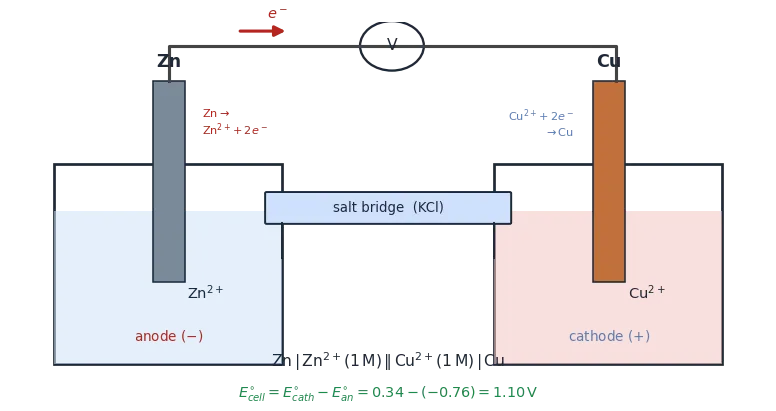
Daniell cell: zinc anode in zinc sulphate and copper cathode in copper sulphate joined by a salt bridge and an external voltmeter, with half-reactions and cell notation giving 1.10 V
Daniell cell — electrons flow Zn (anode) to Cu (cathode); V.
Conventions
  • Electrons flow anode cathode in the wire; conventional current is opposite.
  • (e.g. KCl in agar) completes the circuit and keeps each solution electrically neutral.
  • Cell notation: anode anode soln cathode soln cathode (left = oxidation).
Standard electrode potential (): The potential of an electrode (as a , IUPAC) measured against the standard hydrogen electrode when all species are at unit concentration/activity, gases at 1 bar, 298 K.
★ Remember · Standard Hydrogen Electrode (SHE)
is the reference, assigned V at all temperatures for .
Standard cell potential
Both are reduction potentials. means the cell reaction is spontaneous as written.
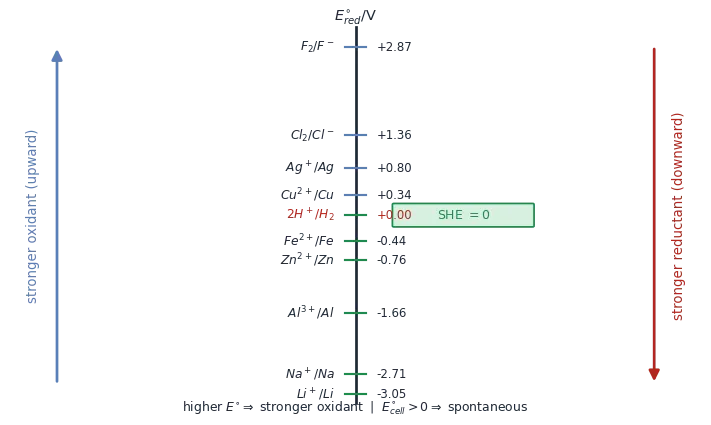
Vertical electrochemical series of standard reduction potentials from fluorine at plus 2.87 volts down to lithium at minus 3.05 volts, with SHE at zero, oxidising power increasing upward and reducing power increasing downward
Electrochemical series: higher = stronger oxidant; lower = stronger reductant.
🚫 Examiner Trap · Examiner traps
(1) In a cell anode is , cathode ; oxidation is ALWAYS at the anode (sign flips in electrolytic). (2) , both as potentials. (3) SHE V by definition. (4) Higher stronger oxidant; the salt bridge keeps solutions neutral, not the current path metal.

Nernst Equation, ΔG & Equilibrium

Nernst equation (298 K)
General form ; electrons transferred, reaction quotient. Increasing product-ion or decreasing reactant-ion concentration lowers .
✎ Example · Worked Nernst calculation
For with V, find .
  1. ; .
  2. .
Gibbs energy
Standard
Equilibrium
From
🎯 Exam · Spontaneity at a glance
(reaction favours products). C mo; use in joules ( with in volts).
Concentration cell
  • Same electrodes, different ion concentrations: .
  • — EMF arises purely from the concentration difference, and falls to zero as concentrations equalise.
🚫 Examiner Trap · Examiner traps
(1) Nernst: — get n and Q right (products/reactants, powers coefficients). (2) (use joules, E in volts). (3) . (4) A concentration cell has but until concentrations equalise.

Conductance & Molar Conductivity

Conductivity (): Reciprocal of resistivity: the conductance of a 1 m (or 1 cm) cube of solution. From , . SI unit ; the factor is the .
Molar conductivity (): Conductance of all the ions from of electrolyte between electrodes 1 unit apart: . Rises as concentration falls (ions occupy more volume).
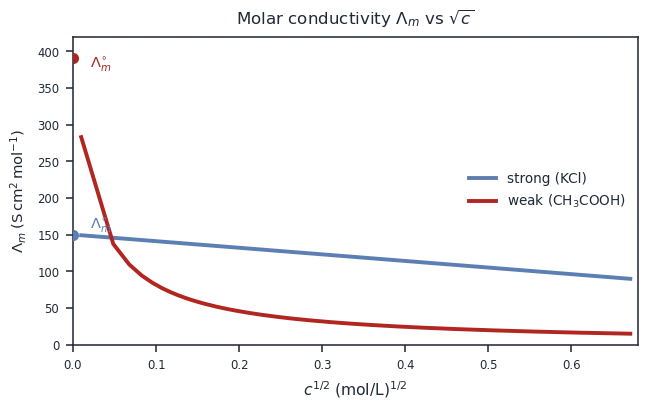
Plot of molar conductivity versus square root of concentration showing a nearly straight line for strong KCl extrapolating to its limiting value and a steeply rising curve for weak acetic acid that cannot be extrapolated, plus the key conductivity relations
vs : linear for strong, steeply rising for weak electrolytes.
Cell constant & conductivity
c in mol gives in S c mo. is found from a standard KCl solution of known .
QuantitySI unitCommon unit
Conductivity
Molar cond.
Conversion
Variation with concentration
  • on dilution (fewer ions per unit volume).
  • on dilution for both types.
  • electrolytes: (gentle, linear in ).
  • electrolytes: rises steeply near , so cannot be found by extrapolation.
🚫 Examiner Trap · Examiner traps
(1) On dilution DECREASES (fewer ions/volume) but INCREASES — opposite directions. (2) with c in mol/L gives S c/mol. (3) Strong electrolytes: (extrapolate to ); weak: rises steeply, CANNOT extrapolate. (4) Find the cell constant from a standard KCl solution.

Kohlrausch's Law & Its Applications

Kohlrausch's law of independent migration: At infinite dilution each ion migrates independently, so the limiting molar conductivity of an electrolyte is the sum of the limiting contributions of its ions.
Limiting molar conductivity
= number of cations/anions per formula unit; = limiting molar conductivity of each ion. E.g. .
CationAnion
349.6199.1
50.176.3
73.578.1
119.040.9
106.0160.0
★ Remember · Why & are huge
(349.6) and (199.1) conduct far better than other ions via the proton-hopping mechanism, not bodily migration. Units: S c mo.
Applications
  • of a electrolyte (unreachable by extrapolation) is built from strong-electrolyte data.
  • : .
  • : .
✎ Example · of a weak acid
Given : HCl , NaAc , NaCl S c mo. Find of acetic acid (HAc).
  1. .
  2. .
💡 Tip · Then get and
If at some c, then ; feed and c into .
🚫 Examiner Trap · Examiner traps
(1) — multiply by the number of each ion (CaC has Cl). (2) Get a WEAK electrolyte's from strong-electrolyte data (HAc HCl NaAc NaCl). (3) . (4) H/OH conduct anomalously high (Grotthuss hopping).

Electrolysis & Faraday's Laws

Electrolytic cell: An external DC source drives a redox reaction (). The is now (oxidation) and the is (reduction) — opposite signs to a galvanic cell, but oxidation is still at the anode.
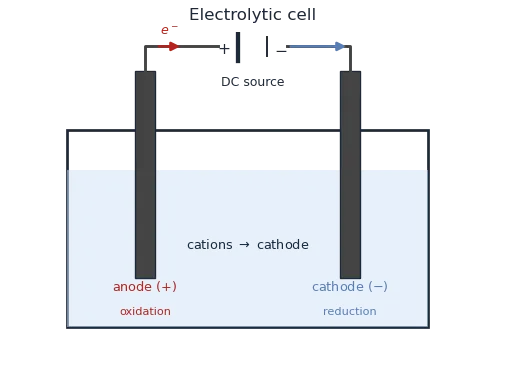
An electrolytic cell driven by a DC source with anode positive and cathode negative, cations moving to the cathode, beside Faraday's first law m equals M Q over n F and second law m1 over m2 equals E1 over E2
Electrolysis driven by a DC source, with Faraday's two laws.
Faraday's first law
Mass deposited charge passed. is the electrochemical equivalent; n = electrons per ion; C mo.
Faraday's second law
For the same Q, masses liberated are in the ratio of equivalent masses . One mole of electrons () deposits one .
Products of electrolysis
  • Depend on the species present and their (and on ).
  • NaCl Na (cathode) (anode).
  • NaCl (cathode) (anode, due to overpotential) NaOH.
  • Used industrially: refining of Cu, extraction of Na/Mg/Al.
✎ Example · Mass deposited
is electrolysed for 10 min at 1.5 A. Mass of Cu deposited? (, )
  1. C.
  2. (= C) deposit 63 g, so .
🚫 Examiner Trap · Examiner traps
(1) In an cell anode is , cathode (OPPOSITE to galvanic) — but oxidation is still at the anode. (2) ; , . (3) NaCl gives (not Na) at the cathode and C (overpotential) at the anode; NaCl gives Na. (4) deposits one gram-equivalent.

Batteries, Fuel Cells & Corrosion

Two kinds of batteries
  • : reaction occurs once, cannot be recharged (dry cell, mercury cell).
  • : reversible — recharged by passing current backwards (lead storage, Ni-Cd).
  • A battery is one or more galvanic cells in series, made light, compact and steady in voltage.
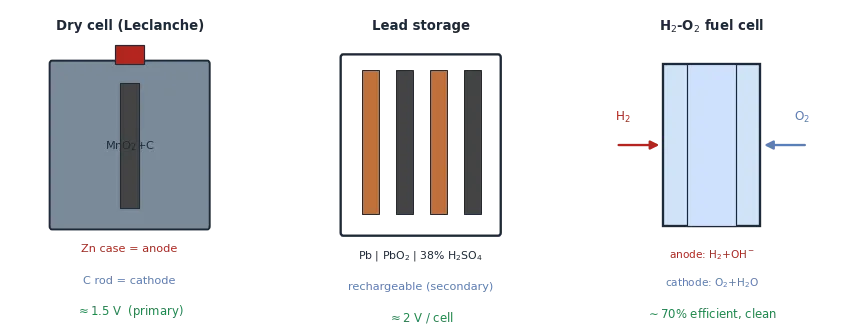
Three panels: a Leclanche dry cell with zinc case anode and carbon rod cathode at 1.5 volts, a lead storage battery with Pb and PbO2 plates in sulphuric acid at 2 volts per cell, and a hydrogen-oxygen fuel cell about 70 percent efficient
Dry cell (primary), lead storage (secondary) and - fuel cell.
Lead anode
Lead cathode
Fuel cell
CellTypeEMF
Dry (Leclanche)primary V
Mercury cellprimary V (steady)
Lead storagesecondary V/cell
- fuelcontinuous eff.
Corrosion (rusting of iron): An process: a moist iron surface acts as tiny galvanic cells. Anode: ; cathode: . is further oxidised to hydrated rust .
🎯 Exam · Preventing corrosion
(paint, oil, grease); (Zn coat); / cathodic protection — attach a more active metal (Mg, Zn) that corrodes preferentially and saves the object.
🚫 Examiner Trap · Examiner traps
(1) cells can't be recharged (dry, mercury); can (lead-acid, Ni-Cd). (2) Lead storage uses Pb/Pb in ( V/cell). (3) Corrosion is (mini galvanic cells) — needs both and water. (4) Sacrificial anode (Mg/Zn) protects by corroding FIRST (cathodic protection).

More JEE Main Chemistry formula sheets

Frequently Asked Questions

What are the most important Redox Reactions & Electrochemistry formulas for JEE Main?

This Redox Reactions & Electrochemistry formula sheet covers all the high-yield Chemistry formulas, definitions and theorems you need for JEE Main, across Concept of oxidation and reduction, Redox reactions, Oxidation number, Balancing redox reactions, In terms of loss and gain of electron and change in oxidation number — each shown with the key result and, where useful, a worked example.

Is this Redox Reactions & Electrochemistry formula sheet free?

Yes — the full chapter formula sheet is free to read online, no login or payment required.

How should I revise Redox Reactions & Electrochemistry formulas?

Blurt the Redox Reactions & Electrochemistry formulas from memory, then check against this sheet to find your gaps — and practise a few previous-year questions on the chapter to make sure you can apply them under time pressure.

Also useful: all formula sheets · JEE Main previous-year papers · most important chapters.