JEEnify Logo
JEEnify
All formula sheets

Some Basic Concepts of Chemistry Formula Sheet — JEE Main Chemistry

Every key Some Basic Concepts of Chemistry formula, definition and theorem for JEE Main Chemistry in one place — with common examiner traps and worked examples. Free to read; blurt from memory, then check your gaps.

Syllabus — topics coveredNTA · 10 sub-topics

  • General Introduction: Importance and scope of Chemistry
  • Nature of matter
  • Laws of chemical combination
  • Dalton's atomic theory: Concept of elements, atoms and molecules
  • Atomic and molecular masses
  • Mole concept and molar mass
  • Percentage composition
  • Empirical and molecular formula
  • Chemical reactions
  • Stoichiometry and calculations based on stoichiometry

Matter, Classification & Measurement

Matter: Anything with mass that occupies space. Three states — (definite shape & volume), (definite volume, takes shape), (neither) — interconverted by T/P.
Comparative: classification by composition
TypeCompositionSeparation
Elementone kind of atom
Compoundfixed mass ratiochemical
Homo. mixtureuniform, variablephysical
Hetero. mixturenon-uniformphysical
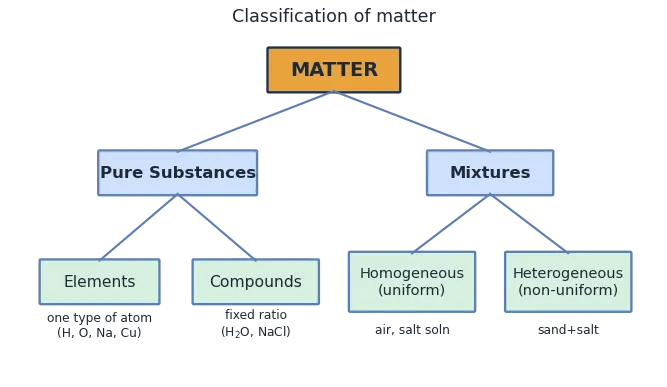
Tree classifying matter into pure substances (elements, compounds) and mixtures (homogeneous, heterogeneous)
Matter pure substances vs mixtures.
Useful relations
SI density kg ; chemists use g c
Temperature scales
Kelvin is SI; no negative values
Significant figures
  • Non-zero digits & zeros between them count; zeros don't ( s.f.); after a decimal do ().
  • : keep fewest s.f.; : keep fewest decimal places.
🚫 Examiner Trap · Matter & measurement
(1) A has a fixed ratio & new properties; a has variable composition & keeps component properties. (2) Use (NOT ) for precise work. (3) Changing units never changes the s.f. count. (4) The 7 SI base units: m, kg, s, A, K, mol, cd — everything else is derived.

Laws of Combination & Dalton's Theory

The five laws of chemical combination
LawStatement
Conservation of massreactant mass product mass (Lavoisier)
Definite proportionsa compound has a fixed mass ratio (Proust)
Multiple proportionsmasses of B per fixed A in small whole-number ratio (Dalton)
Gay-Lussac (gases)gas volumes react in whole-number ratios
Avogadroequal V (same T,P) equal molecules
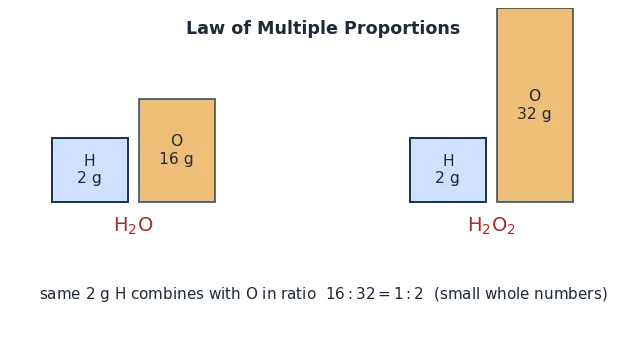
Bars showing 2 g H with 16 g O in water versus 2 g H with 32 g O in hydrogen peroxide, oxygen in ratio 1 to 2
Multiple proportions: O is for fixed H.
Dalton's atomic theory (1808)
  • Matter is made of indivisible .
  • Atoms of an element are identical; differ between elements.
  • Compounds atoms in fixed whole-number ratios.
  • A reaction only atoms (none created/destroyed).
🚫 Examiner Trap · Laws of combination
(1) proportions one compound's fixed ratio; proportions two compounds of the same elements (O vs ). (2) Avogadro's law resolved the atom/molecule confusion (diatomic gases). (3) Gay-Lussac is about , Avogadro about . (4) Dalton's 'identical atoms' fails for .

Atomic, Molecular & Average Masses

Atomic mass unit (u): mass of one C atom g. Atomic masses are relative to (H, O).
Average atomic mass
fractional abundance, isotope mass; periodic-table values are these averages
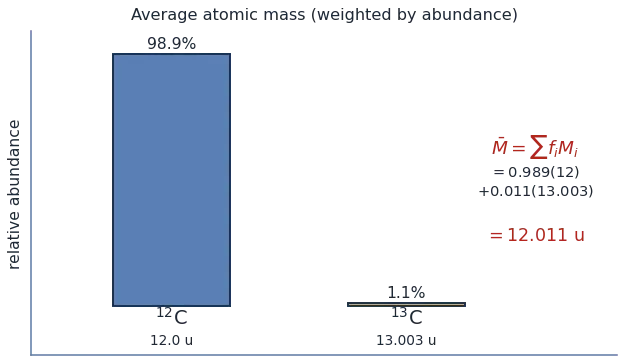
Bar chart of carbon isotopes: 12C at 98.9 percent and 13C at 1.1 percent, weighted average 12.011 u
C: u.
Molecular vs formula mass
molecular for covalent (); mass for ionic solids (NaCl, no discrete molecule)
✎ Example · Molecular mass of glucose
u (g/mol)
🚫 Examiner Trap · Atomic & molecular masses
(1) Average atomic mass is a mean by abundance — not a simple average of isotope masses. (2) 'Atomic mass' (u, relative) 'molar mass' (g/mol) but they're . (3) Ionic compounds have mass, not molecular mass (no molecule). (4) are fractions (sum ), not percentages — divide by 100.

The Mole Concept

Mole (mol): Amount of substance with exactly entities (atoms/molecules/ions) — the number of atoms in g of C. .
Core interconversions
molar mass (g/mol); mol ideal gas L at STP (0C, 1 atm)
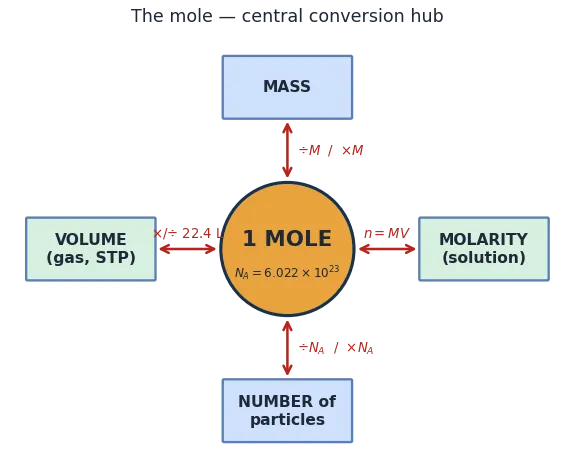
Hub-and-spoke diagram with 1 mole at the centre and conversions to mass, number of particles, gas volume and molarity
The mole links mass, number, volume & molarity.
✎ Example · Conversion
How many molecules in g of water?
  1. mol
molecules
🚫 Examiner Trap · The mole
(1) : 1 mol O mol H atoms mol O atoms. (2) L/mol holds only for an — not for solids/liquids or non-STP. (3) Molar mass (g/mol) molecular mass (u) numerically. (4) counts entities, so 1 mol of electrons electrons.

% Composition & Empirical/Molecular Formula
Mass % of an element
H in O
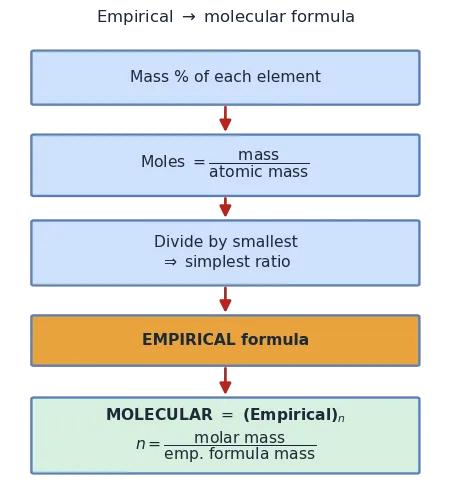
Empirical vs molecular formula: simplest whole-number atom ratio (CCl). actual atoms (). Molecular (empirical.
Flowchart: mass percent to moles to simplest ratio to empirical formula to molecular formula
Steps from mass % to molecular formula.
Finding
✎ Example · Empirical & molecular formula
H, C, Cl; molar mass .
  1. moles/100 g: H, C, Cl
  2. smallest CCl (mass )
🚫 Examiner Trap · Formulae
(1) Empirical formula gives only the , never the actual count — you need the molar mass for n. (2) Convert moles (divide by atomic mass), then divide by the smallest. (3) If a ratio comes to e.g. , by 2 to clear fractions. (4) Ionic compounds are always written as empirical (formula unit).

Stoichiometry & Limiting Reagent

Balanced equation = recipe
  • Same number of atoms of each element on both sides (conservation of mass).
  • Coefficients give the (and volume ratio for gases).
  • Balance by changing only — NEVER subscripts.
Mole bridge
given moles coefficient ratio moles of target mass/volume
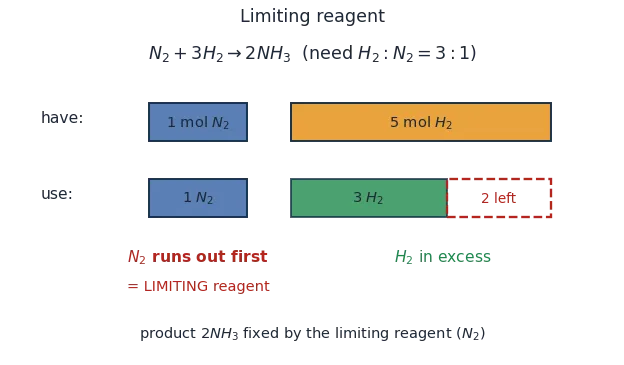
Limiting reagent: The reactant consumed first — it the product. Find it by dividing each reactant's moles by its coefficient; the value is limiting.
For N2 plus 3 H2 makes 2 NH3, with 1 mol N2 and 5 mol H2: N2 is limiting, 2 H2 left over
runs out first limiting; in excess.
Percentage yield
theoretical yield computed from the LIMITING reagent
🚫 Examiner Trap · Stoichiometry
(1) Find the — divide each reactant's moles by its coefficient, smallest wins. (2) Balance by coefficients, NEVER change a formula's subscript. (3) Theoretical yield is from the limiting reagent, not the excess one. (4) For gases at the same T,P, coefficient ratio volume ratio (Avogadro).

Concentration Terms

Comparative: concentration terms
TermDefinition-dependent?
Molarity mol solute / L solutionyes
Molality mol solute / kg solventno
Mole fraction no
Mass %mass solute / mass soln no
Molarity / Molality
uses solution volume; uses solvent mass
Mole fraction & dilution
dilution: moles of solute stay constant when solvent is added
🚫 Examiner Trap · Concentration
(1) is T-dependent (volume expands); /mole-fraction are not — use the latter for colligative properties. (2) Molality uses kg of , not solution. (3) only for dilution (same solute moles), not for reactions. (4) ppm for very dilute solutions.

More JEE Main Chemistry formula sheets

Frequently Asked Questions

What are the most important Some Basic Concepts of Chemistry formulas for JEE Main?

This Some Basic Concepts of Chemistry formula sheet covers all the high-yield Chemistry formulas, definitions and theorems you need for JEE Main, across General Introduction: Importance and scope of Chemistry, Nature of matter, Laws of chemical combination, Dalton's atomic theory: Concept of elements, atoms and molecules, Atomic and molecular masses — each shown with the key result and, where useful, a worked example.

Is this Some Basic Concepts of Chemistry formula sheet free?

Yes — the full chapter formula sheet is free to read online, no login or payment required.

How should I revise Some Basic Concepts of Chemistry formulas?

Blurt the Some Basic Concepts of Chemistry formulas from memory, then check against this sheet to find your gaps — and practise a few previous-year questions on the chapter to make sure you can apply them under time pressure.

Also useful: all formula sheets · JEE Main previous-year papers · most important chapters.