
Some Basic Principles of Organic Chemistry Formula Sheet — JEE Main Chemistry
Syllabus — topics coveredNTA · 18 sub-topics
- Tetravalency of carbon
- Shapes of simple molecules
- Hybridization (s and p)
- Classification of organic compounds based on functional groups
- Compounds containing halogens, oxygen, nitrogen and sulphur
- Homologous series
- Isomerism: structural and stereoisomerism
- Nomenclature: trivial and IUPAC
- Covalent bond fission: homolytic and heterolytic
- Free radicals, carbocations and carbanions
- Stability of carbocations and free radicals
- Electrophiles and nucleophiles
- Electronic displacement in covalent bond
- Inductive effect
- Electromeric effect
- Resonance and hyperconjugation
- Common types of organic reactions
- Substitution, addition, elimination and rearrangement
Tetravalence, Hybridisation & Shapes
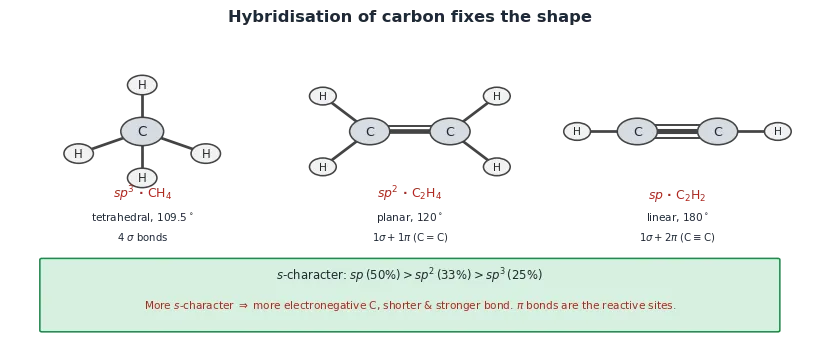
- ▸A single bond ; a double bond ; a triple bond .
- ▸Every bond (single, double or triple) contains exactly bond.
- ▸Restricted rotation is what makes geometrical (cis/trans) isomerism possible.
Structural Representation & Classification
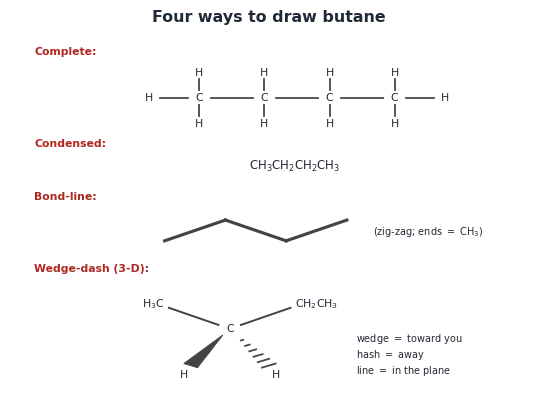
- ▸: every bond drawn (Lewis/dash formula).
- ▸: omit some/all bonds — .
- ▸: zig-zag lines; line ends & junctions are carbons, only heteroatoms are written, chain ends are .
- ▸ (3-D): solid wedge toward viewer, dashed away, plain line in plane.
IUPAC Nomenclature I — The System
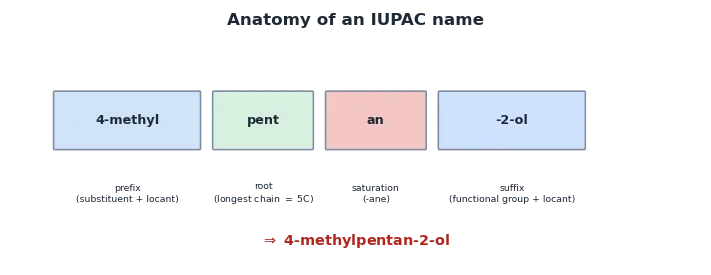
- ▸Drop ane, add yl: methyl, ethyl.
- ▸Branched: isopropyl, sec-butyl, isobutyl, tert-butyl, neopentyl.
- ▸- and - count in alphabetising; and do not.
IUPAC Nomenclature II — Functional Groups & Priority
| Class | Group | Suffix |
|---|---|---|
| Carboxylic acid | -oic acid | |
| Ester | -oate | |
| Amide | -amide | |
| Nitrile | -nitrile | |
| Aldehyde | -al | |
| Ketone | -one | |
| Alcohol | -ol | |
| Amine | -amine |
Isomerism
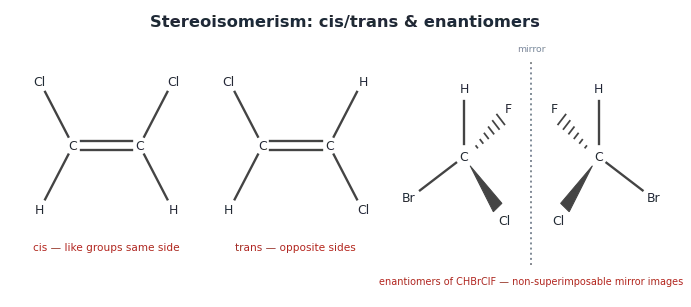
- ▸: different carbon skeleton — n-butane vs isobutane ().
- ▸: group on a different carbon — propan-1-ol vs propan-2-ol.
- ▸: different group — ethanol vs dimethyl ether ().
- ▸: different alkyl groups around a hetero atom (diethyl ether vs methyl propyl ether).
- ▸: rapid interconversion, e.g. keto enol.
- ▸Each ring or bond adds 1 to the DBE; O and S are ignored. : (1 ring 3 ).
- ▸ is the maximum. A molecule with a plane of symmetry has fewer: tartaric acid has 2 chiral C but only 3 stereoisomers (d, l and the optically inactive form).
Electronic Effects
- ▸: inductive, resonance, hyperconjugation (built into the molecule).
- ▸: electromeric (only during attack by a reagent).
- ▸When inductive and electromeric oppose, the .
- ▸ (lone pair next to the system): , , , , , .
- ▸ (a bond to an electronegative atom): , , , , , .
- ▸Halogens are and ; for them dominates.
- ▸Anything that stabilises the anion raises acidity: , and ( falls with distance and with lower electronegativity).
Reaction Mechanism & Intermediates
- ▸ — one group replaces another.
- ▸ — reagent adds across a multiple bond.
- ▸ — a small molecule is removed to form a multiple bond.
- ▸ — atoms reorganise within the molecule.
More JEE Main Chemistry formula sheets
Frequently Asked Questions
What are the most important Some Basic Principles of Organic Chemistry formulas for JEE Main?
This Some Basic Principles of Organic Chemistry formula sheet covers all the high-yield Chemistry formulas, definitions and theorems you need for JEE Main, across Tetravalency of carbon, Shapes of simple molecules, Hybridization (s and p), Classification of organic compounds based on functional groups, Compounds containing halogens, oxygen, nitrogen and sulphur — each shown with the key result and, where useful, a worked example.
Is this Some Basic Principles of Organic Chemistry formula sheet free?
Yes — the full chapter formula sheet is free to read online, no login or payment required.
How should I revise Some Basic Principles of Organic Chemistry formulas?
Blurt the Some Basic Principles of Organic Chemistry formulas from memory, then check against this sheet to find your gaps — and practise a few previous-year questions on the chapter to make sure you can apply them under time pressure.
Also useful: all formula sheetsJEE Main previous-year papersmost important chapters.