JEEnify Logo
JEEnify
All formula sheets

The d- and f-Block Elements Formula Sheet — JEE Main Chemistry

Every key The d- and f-Block Elements formula, definition and theorem for JEE Main Chemistry in one place — with common examiner traps and worked examples. Free to read; blurt from memory, then check your gaps.

Syllabus — topics coveredNTA · 18 sub-topics

  • Transition elements - general introduction
  • Electronic configuration
  • Occurrence and characteristics
  • General trends in first-row transition elements
  • Physical properties
  • Ionization enthalpy
  • Oxidation states
  • Atomic radii
  • Colour
  • Catalytic behaviour
  • Magnetic properties
  • Complex formation
  • Interstitial compounds
  • Alloy formation
  • Preparation, properties and uses of K₂Cr₂O₇ and KMnO₄
  • Inner transition elements
  • Lanthanoids: electronic configuration, oxidation states, lanthanoid contraction
  • Actinoids: electronic configuration and oxidation states

Position & Electronic Configuration

Transition element (IUPAC): An element whose atom a stable ion has a d subshell. They occupy between the s- and p-blocks, in three complete series: (Sc→Zn), (Y→Cd) and (La, Hf→Hg); the series is incomplete.
SeriesElementsSubshell filled
Sc–Zn
Y–Cd
La, Hf–Hg
Ac, Rf… (incomplete)
General valence configuration
Inner fills after the orbital; both take part in bonding.
🎯 Exam · Two configuration exceptions
and — a half-filled () or fully-filled () set is extra-stable, so one electron shifts into .
⚠️ Watch out · Zn, Cd, Hg are NOT transition metals
Their configuration is and they keep a shell in all their compounds (only state) — no partially filled d, so they fail the definition though they sit in the d-block.
Writing ion configurations
  • For cations remove , then : , .
  • and have no unpaired d electrons.
  • — exactly half-filled, hence extra stable.
Why a 'transition' series?
  • They form a bridge — a — between the highly electropositive s-block and the electronegative p-block.
  • and have similar energies, so the electrons are chemically active.
  • This shared involvement gives variable oxidation states, colour, magnetism, catalysis and complex formation (Pages 3–4).
🚫 Examiner Trap · Examiner traps
(1) A transition element has a partially filled d in the — so Zn/Cd/Hg ( always) are NOT true transition metals. (2) Exceptions: Cr , Cu (half/full-filled stability). (3) For cations remove , then (Fe). (4) Fill before , but ionise before .

Physical Properties & Atomic Trends

General physical character
  • Nearly all are hard, high-density metals with , high tensile strength, malleable, ductile and good conductors of heat & electricity.
  • These follow from involving the unpaired electrons in addition to ns.
  • Across a series the maxima occur near the middle, where the number of unpaired electrons (favouring interatomic bonding) is greatest.
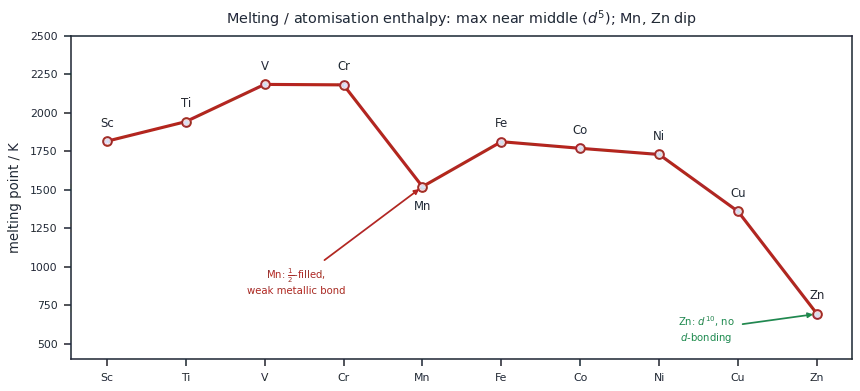
Melting point of the 3d series rising to a maximum around vanadium and chromium then falling, with a sharp dip at manganese and the lowest value at zinc
Melting / atomisation enthalpy peak near ; Mn & Zn dip.
🎯 Exam · Why Mn and Zn dip
has a stable half-filled set whose electrons resist delocalisation, so its metallic bond (and m.p.) is weaker than its neighbours. has d electrons at all — only bonds, giving the lowest m.p.
Atomic & ionic radii along a series
  • Radius first (rising nuclear charge), then stays almost constant in the middle (d-electron screening offsets it), and rises slightly at the end.
  • Ionic radius falls as oxidation state rises: .
  • Down a group radius increases, but — see below.
★ Remember · Lanthanoid contraction → equal 4d/5d radii
The electrons filled between La and Hf shield poorly, so the elements are pulled in: , , — making each pair very hard to separate.
Ionisation enthalpy & density
  • rises only across a series (added d electron partly screens the nucleus) — unlike the steep p-block rise.
  • Densities are high and increase across (smaller atoms, heavier nuclei); metals are densest (Os, Ir).
  • Enthalpy of atomisation is high — strong metal–metal bonds (catalysis-relevant).
🚫 Examiner Trap · Examiner traps
(1) High m.p./hardness come from strong metallic bonding by electrons — peaks near . (2) Mn (, stable half-filled) and Zn (, no unpaired) DIP in m.p. (3) Lanthanoid contraction makes (). (4) IE rises only gently/irregularly across a series (unlike the p-block).

Oxidation States & Standard Potentials
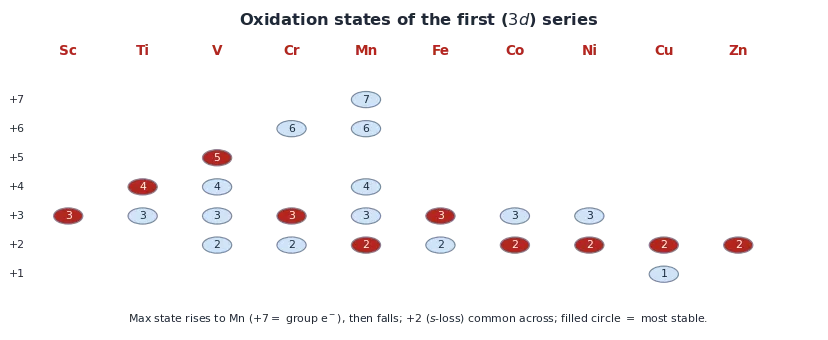
Variable oxidation states: Because and ns electrons have similar energies, a transition metal can lose a number of electrons, giving several oxidation states that differ by (e.g. ) — unlike p-block states that differ by two.
Chart of oxidation states of the 3d series from scandium plus 3 only, rising to manganese showing plus 2 to plus 7, then falling to zinc plus 2, with the most stable state of each element highlighted
Maximum state peaks at Mn ; runs across the series.
Reading the trend
  • shows only ; the range widens to , where total valence electrons, then narrows again to .
  • The state ( loss) appears for almost every element and becomes more stable across the series.
  • Highest states (, ) occur only with the most electronegative and (e.g. , , ).
🎯 Exam · Stability rule of thumb
Half-filled or filled d sub-shells are favoured: and are especially stable, which is why is harder to oxidise than and is a common state.
Standard electrode potential
is mostly negative ⇒ metals are electropositive and displace from acids.
★ Remember · Copper is the exception
V is — the high sublimation + ionisation enthalpy is not offset by hydration, so Cu does liberate from dilute acids (a 'noble' first-row metal).
Irregular E° values
  • is irregular because it depends on together, not one term.
  • V (M strongly oxidising, reverts to stable ).
  • V (C reducing, goes to stable C).
🚫 Examiner Trap · Examiner traps
(1) Oxidation states differ by (not two like p-block); max state peaks at Mn ( group e). (2) Highest states need O/F (MnO, Cr). (3) is mostly negative (electropositive); ( V) — won't displace . (4) (M, F) is extra stable.

Colour, Magnetism, Catalysis, Interstitials & Alloys
Colour from d–d transitions: In a partially filled d ion the d orbitals split in a ligand field; an electron absorbs visible light to jump between them () and the colour is transmitted. Ions with or show no such transition and are colourless.
Left graph of spin-only magnetic moment rising with the number of unpaired electrons; right panel listing characteristic colours of Ti3+, V3+, Cr3+, Mn2+, Fe2+ and Cu2+ ions with a note that d0 and d10 ions are colourless
and colours of common ions.
Ion (config)Colour
purple
green
violet
pale pink
green
blue
(S), (Z)colourless
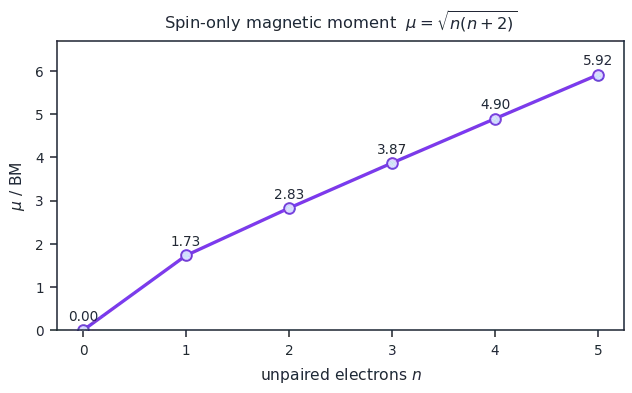
Spin-only magnetic moment
number of unpaired electrons; more unpaired ⇒ more paramagnetic.
🎯 Exam · Worked moment
has unpaired : BM. (, BM — the highest of the series.)
Catalytic activity
  • Arises from (easy electron transfer) and the ability to reactants on the metal surface, providing a low-energy path.
  • — Haber (); — Contact (); — hydrogenation; — many reactions.
  • catalyses the reaction via an cycle.
★ Remember · Interstitial compounds
Small atoms (H, C, N, B) lodge in the holes of the metal lattice giving non-stoichiometric solids such as , , . They are , have high melting points and — e.g. steel.
Complexes & alloys
  • : small highly-charged ions with vacant d orbitals accept lone pairs from ligands, e.g. , .
  • : similar atomic radii let transition metals substitute freely in one lattice, e.g. brass (Cu–Zn), bronze, steel.
  • Both rest on the same small-size + available--orbital theme.
🚫 Examiner Trap · Examiner traps
(1) Colour is from (S) and (Z) are COLOURLESS. (2) BM counts electrons (n), spin-only. (3) Catalysis comes from variable oxidation states surface adsorption. (4) Interstitial compounds (TiC) are hard, high-m.p., keep metallic conductivity.

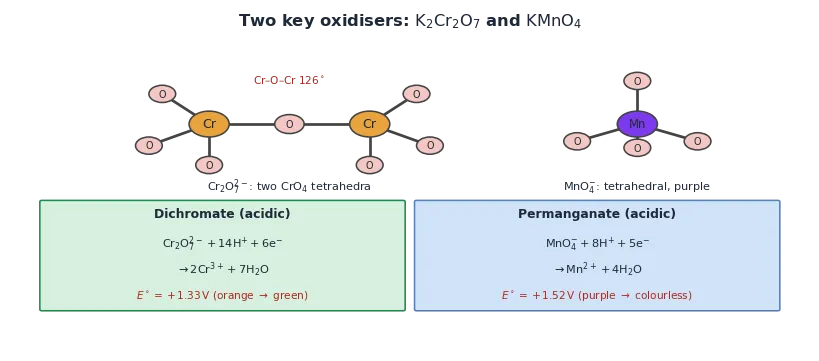
Potassium Dichromate & Permanganate

Structures of dichromate ion as two CrO4 tetrahedra sharing a bridging oxygen with a Cr-O-Cr angle of 126 degrees and the tetrahedral permanganate ion, alongside their acidic-medium reduction half reactions and standard potentials
= two corner-sharing tetrahedra; tetrahedral.
— preparation
  • Roast chromite with in air: .
  • Acidify the yellow chromate to orange dichromate, then add KCl to crystallise .
Chromate ⇌ dichromate (pH dependent)
Acid ⇒ orange ; alkali ⇒ yellow .
Dichromate as oxidiser (acidic)
V; orange → green. Used in volumetric estimation of and .
— preparation
  • Fuse pyrolusite with KOH and air/an oxidant: (green manganate).
  • Oxidise the manganate electrolytically (or by disproportionation): .
Permanganate as oxidiser (acidic)
V; purple → colourless. In neutral/alkaline media it goes only to brown ().
🎯 Exam · Structure & magnetism
Both (two tetrahedra, Cr–O–Cr ) and (regular tetrahedron) have the metal in its state — () and () — so both are ; their intense colour is a charge-transfer (O→M), not a d–d, transition.
⚠️ Watch out · Titration medium
Acidify titrations with , never HCl — is oxidised to and gives a false (high) reading.
🚫 Examiner Trap · Examiner traps
(1) Chromatedichromate is pH-controlled: acid orange C, alkali yellow CrO. (2) Acidify KMn titrations with , NEVER HCl (Cl oxidised C, false reading). (3) C two corner-sharing Cr tetrahedra (Cr–O–Cr ). (4) Both ions are DIAMAGNETIC; colour is charge-transfer, not d–d.

Lanthanoids & the Lanthanoid Contraction
Lanthanoids (4f-block): The fourteen elements (58) to (71) following lanthanum, in which the orbitals are progressively filled — general symbol . Configuration ; the stable ions are simply (–14).
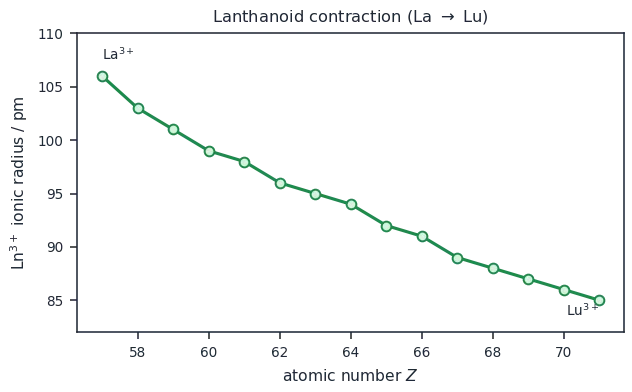
Graph of Ln3+ ionic radius decreasing steadily from lanthanum to lutetium, with a side panel listing the cause and consequences including Zr approximately equal to Hf
Steady size decrease La→Lu and its consequences.
★ Remember · Lanthanoid contraction
The steady decrease in atomic and ionic radii from La to Lu. Cause: a electron shields another electron , so the effective nuclear charge felt by the outer shell rises across the series.
Consequences
  • atoms shrink to match the : — second & third transition series resemble each other.
  • The Ln's are chemically alike and very .
  • Basic strength of hydroxides falls: (smaller ion, more covalent).
🎯 Exam · Oxidation states
state for all Ln. A few show or when that gives an empty, half-filled or full : , , , .
Ce4+ and Eu2+ — redox behaviour
  • is a strong (V), reverting to the stable ; a useful analytical reagent (cerimetry).
  • and are strong , changing to the common state.
General character & uses
  • Silvery-white soft metals that tarnish in air; most are coloured and paramagnetic (, colourless & diamagnetic).
  • React with water/acids giving , burn in to (basic).
  • (~95% Ln + ~5% Fe) → flints, tracer bullets; mixed Ln oxides catalyse petroleum cracking; used as TV/screen phosphors.
🚫 Examiner Trap · Examiner traps
(1) is the characteristic, most stable state for ALL lanthanoids. (2) Contraction is due to () ZrHf, Ln's hard to separate. (3) C () is a strong oxidant; E ()/Y () are reductants. (4) and ions are colourless & diamagnetic.

Actinoids & f-Block Comparison

Actinoids (5f-block): The fourteen elements (90) to (103) following actinium, in which the orbitals fill (configuration ). ; elements beyond uranium (transuranics) are synthetic.
🎯 Exam · Wider range of oxidation states
Actinoids show generally (like Ln), but the members reach much higher states because , and are close in energy: the maximum rises from (Th) to (Pa), (U) and (Np, Pu), then falls again.
★ Remember · Actinoid contraction
A gradual decrease in size across the series — from element to element than the lanthanoid contraction, because electrons shield the nuclear charge even more poorly than .
Why actinoid chemistry is more complex
  • orbitals are than , so they take part in bonding more (more covalent character, more varied compounds).
  • Radioactivity and short half-lives of later members make them hard to study; many exist only in trace synthetic amounts.
  • Magnetic and spectral behaviour is harder to interpret than for the lanthanoids.
Lanthanoid vs actinoid summary
  • : filling (Ln) vs filling (An).
  • : Ln mainly ; An show plus many higher states.
  • : only among Ln; actinoids.
  • : both reactive electropositive metals forming basic oxides/hydroxides.
⚠️ Watch out · Don't confuse the two contractions
Lanthanoid contraction makes and governs the heavier d-block; actinoid contraction is the analogous, shrink within the series itself.
🚫 Examiner Trap · Examiner traps
(1) actinoids are radioactive (only Pm among lanthanoids is). (2) Early actinoids reach much HIGHER states (U , Np/Pu ) because are close in energy. (3) Actinoid contraction is per element ( shields even worse than ). (4) is less buried than more covalent bonding.

More JEE Main Chemistry formula sheets

Frequently Asked Questions

What are the most important The d- and f-Block Elements formulas for JEE Main?

This The d- and f-Block Elements formula sheet covers all the high-yield Chemistry formulas, definitions and theorems you need for JEE Main, across Transition elements - general introduction, Electronic configuration, Occurrence and characteristics, General trends in first-row transition elements, Physical properties — each shown with the key result and, where useful, a worked example.

Is this The d- and f-Block Elements formula sheet free?

Yes — the full chapter formula sheet is free to read online, no login or payment required.

How should I revise The d- and f-Block Elements formulas?

Blurt the The d- and f-Block Elements formulas from memory, then check against this sheet to find your gaps — and practise a few previous-year questions on the chapter to make sure you can apply them under time pressure.

Also useful: all formula sheets · JEE Main previous-year papers · most important chapters.